Is American establishment internationalism in decline? Conventional wisdom is rapidly becoming that shifts in the international balance of power, along with generational and demographic changes within the United States, are inexorably eroding the broad, post-war liberal internationalist consensus that dominated American foreign policy since 1945. American internationalism, forged immediately after World War II and solidified by the Cold War, generally refers to an unprecedented array of international commitments made by the United States, oriented around binding, rule-based international institutions, democratic governments, and an open and nondiscriminatory economic system.Footnote 1 Many argue that this consensus is being eclipsed by a set of beliefs that are more conservative, unilateralist, and America-first in orientation. Charles Kupchan, for example, contends that:
At the same time that challengers to its dominance are on the rise, the United States is fast abandoning its embrace of a liberal brand of internationalism—one committed to multilateral action and international institutions. Instead, America is veering toward unilateralist and neoisolationist extremes, a change of course that will both alienate rising centers of power and encourage their autonomy.Footnote 2
In a recent study of change in foreign policy ideas, Jeffrey Legro suggests that “since 9/11 the United States has turned toward this foreign policy that is noticeably more muscular, more unilateral, and more expansive in its aims of reengineering the international system than arguably any since the end of World War II,” and asks “will this potential shift endure?”Footnote 3 A common argument is that the erosion of a centrist U.S. internationalism is due to “secular changes in American politics, not just the idiosyncrasies of George W. Bush and his neoconservative advisers.”Footnote 4 For others, isolationism and retrenchment is the natural predisposition in American politics, a default condition to which the United States reverts in the absence of specific and immediate security pressures. According to Arthur Schlesinger, for example, “the isolationist impulse has risen from the grave, and it has taken the new form of unilateralism.”Footnote 5
In this line of argument, American foreign policy internationalism did not just represent an intellectual consensus on a set of foreign policy ideas, but contained a reinforcing social and cultural component. Mid-century “establishment” figures such as Dean Acheson, Averell Harriman, John McCloy, and George Kennan—or the “Wise Men,” in Walter Isaacson and Evan Thomas' formulation—attended the same elite, Eastern private schools, met in Ivy League universities, and pursued interlocking careers in Wall Street business, banking, and law. According to Isaacson and Thomas they “[epitomized] a style and outlook that played a dominant role in modern American policymaking,” regarded public service as an honor and duty, and were “imbued with a sense of noblesse oblige.”Footnote 6 As a result, they were oriented towards the responsible use of America's newfound post-war position, initiated an array of international commitments, especially to Europe, and were willing to use American power to underwrite global security and economic institutions. Whereas the “Wise Men” sought pragmatic, international solutions and to bind U.S. power to international institutions, many argue that this perspective is being displaced by a new cohort—the “Vulcans,” in James Mann's narrative—that are focused on the unmediated exercise of U.S. military power and the freedom of action that follows from uncontested primacy.Footnote 7
However, a major gap in this argument is that, to date, very few studies have systematically analyzed the extent to which this “establishment” internationalism is in fact in decline. The current debate over the fate of U.S. internationalism suffers from two problems. First, the term liberal internationalism is often used in ways that are conceptually unclear and mischaracterizes the nature of the post-World War II consensus. Second, there have been virtually no attempts to develop and assess a set of consistent empirical indicators or measures of liberal internationalism. Consequently, there is little empirical or theoretical foundation to the emerging popular and scholarly agreement that U.S. internationalism is undergoing a secular and long-term decline.
By providing a diverse set of indicators to capture different aspects of the phenomenon, this paper seeks to address the underlying empirical question, “Is establishment internationalism in decline?” However, to do this requires several steps. In order to understand its decline, we first need to clarify what precisely is meant by “establishment internationalism.” We then need to clarify what evidence would constitute or provide support for a finding of “decline.” Would this be reflected in changes in elites or mass publics or both? Would this be evinced by changes in the public rhetoric and statements of U.S. foreign policy officials? Would decline be observable through changes in the composition of elites and their personal backgrounds, such as where they are from, their education, or their formative international experiences?
In the first section, we define “establishment internationalism” and identify its bases of support. At its high-water mark in the immediate aftermath of World War II and the early Cold War, we argue that establishment internationalism reflected a political coalition of individuals and groups committed to remaining engaged in international affairs and exercising U.S. power where necessary to defend global order, coupled with a commitment to use multilateral means to defend America's interests. In the traditional narrative, a unique and robust bipartisan consensus formed in support of this policy orientation and came to define the center of American politics throughout the Cold War. This establishment center, again in the traditional narrative, was also associated with a group of individuals who shared a set of formative experiences in the Depression, World War II, and the Cold War, and thus held a broadly similar worldview about foreign affairs. We describe the domestic constituencies that formed behind this consensus, and their particular regional, cultural, and socio-economic characteristics.
We next outline four empirical measures to capture whether this consensus is in long-term decline. First, we use foreign policy voting scores of members of Congress as assigned by the American Conservative Union (1970–2004) and Americans for Democratic Action (1948–2004) to track changes in patterns of bipartisanship in foreign policy and regional representation. Our second set of indicators track the state of birth, educational profile, and formative international experience of a cross-section of the U.S. foreign policy elite, including congressional chairmen and appointed positions in the Department of State, Department of Defense, and the National Security Council. Our third and fourth sets of indicators track the ideational patterns of elite thought as represented by presidential State of the Union addresses and party platform manifestos. We code the foreign policy content of post-1950 State of the Union addresses to determine if there has been an observable departure from internationalism. Finally, we use data from the Manifesto Research Group to determine whether the internationalist content of Republican and Democrat party platforms has declined since the end of the Cold War.
We then assess the evidence for whether these indicators of internationalism have experienced a measurable decline. We find that, based on this wide range of evidence, there is only mixed support for the claim that this basic internationalist consensus has collapsed in U.S. politics. While partisanship in congressional voting has indeed increased, the internationalist content of party platforms and presidential speeches has not declined markedly in recent years, and the composition of the elite, at least in terms of key aspects of their background, has not yet changed dramatically with the end of the Cold War.
What contribution do these empirical arguments make to the debate over U.S. internationalism? Possibly the central question in U.S. foreign policy today is whether the policies of Bush administration Vulcans are an anomalous break from recent U.S. diplomatic practice and will be reversed in future years, or whether these policies represent a fundamental and enduring shift in the political equilibrium in the United States. In an era of American primacy, the strategic ideas and assumptions guiding the use of U.S. power are of critical importance to the direction and stability of contemporary international politics. Scholars and opinion leaders note with alarm the growing divergence between the United States and the rest of the world on major international issues.Footnote 8 A conventional wisdom has gradually coalesced around the view that, as Kupchan and Trubowitz write:
the Bush presidency marks the end of the liberal internationalist era. Bush's brand of international engagement, far from being a passing aberration, represents a turning point in the historical trajectory of U.S. foreign policy. It is a product, not a cause, of the unraveling of the liberal internationalist compact that guided America from the presidency of Franklin Roosevelt through that of Bill Clinton… The era of liberal internationalism is over.Footnote 9
We think there are two problems with the emerging assessment of internationalism. First, liberal internationalism has been given a terminal diagnosis in the past, for example in a similar literature that emerged first in the wake of Vietnam and again at the end of the Cold War. Despite its weakened status, liberal internationalism has not been superceded.Footnote 10 Second, most of the academic and popular writings on this question are either anecdotal and empirically unsubstantiated, or rely on one empirical measure, such as public opinion, in isolation of others. Many fail to clearly identify what liberal internationalism was or specify the evidence that would be needed to persuasively demonstrate its decline. In short, there is much speculation on this topic and little research scholarship. This paper seeks to advance this debate by bringing together and evaluating a diverse set of empirical measures that bear on trends in internationalism. Our conclusion is that, to borrow a well-known phrase, rumors of establishment internationalism's demise have been greatly exaggerated. If the basic consensus that has guided U.S. foreign policy since World War II has in fact collapsed, the evidence has yet to show it.
Defining Establishment Internationalism
Establishment internationalism harkens back to a foreign policy consensus that emerged in the United States after World War II. At the broadest level, this view held that the United States, unlike after World War I, should remain engaged in international politics and use its unprecedented share of global power to shape the architecture of international order that was emerging in the wake of the war.Footnote 11 Previously, U.S. foreign policy was dominated by two doctrines: unilateralism (or avoiding binding political commitments or “entangling alliances” abroad) and achieving a preponderance of power in the western hemisphere (while avoiding engagement with the broader international security system, particularly in Europe).Footnote 12 Seeking to avoid a repeat of U.S. disengagement following World War I, the form of internationalism that emerged during and after World War II represented a sharp break from prior U.S. diplomatic tradition in two respects: not only would the United States use its growing power resources to remain active in international affairs, but it would also exercise its power through a wide array of international partnerships and multilateral institutions. According to Ikenberry, “the United States took the lead in fashioning a world of multilateral rules, institutions, open markets, democratic community, and regional partnerships—and it put itself at the center of it all.”Footnote 13 Rather than be exclusively realist or liberal, at its core the emerging internationalist doctrine blended the use of U.S. power with international, and at times institutionalized, cooperation. As Kupchan and Trubowitz write, “it was the dual commitment to power projection and international cooperation that distinguished liberal internationalism from the alternatives that came before … FDR's approach to statecraft drew on Teddy Roosevelt's realpolitik as much as on Wilson's idealism.”Footnote 14
This broad shift in strategic orientation was the result of both international and domestic changes. Internationally, the security pressures of World War II and the Cold War required that the United States for the first time play an active role in shaping the balance of power in Europe and Asia. The containment of a traditional great power threat in the form of the Soviet Union required denying the Soviet government control over major centers of industrial and military power, which in turn necessitated that the United States agree to credible, institutionalized international commitments such as the North Atlantic Treaty and the U.S.–Japan alliance, underwrite global institutions, and absorb the costs of collective action.Footnote 15 In the economic sphere, U.S. internationalists sought to avoid a repeat of the economic protectionism of the 1930s, which they regarded as a major source of the war and the global depression, and therefore created and committed the United States to an array of international rules, institutions, and procedures designed to maintain an open and nondiscriminatory international economic system.Footnote 16
The emergence of a new internationalist “consensus” was also the result of a series of domestic changes.Footnote 17 First, rising internationalism was underpinned by strong bipartisan agreement. Roosevelt and Truman actively sought to incorporate key Republican leaders such as Arthur Vandenberg and Wendell Willkie into a pro-internationalist coalition, neutralizing traditional isolationist opposition within the Republican Party. Second, the shift toward internationalism reflected the unique experiences of a generation of Americans who had lived through the Great Depression, World War II, and the beginning of the Cold War. These experiences produced a common belief in the importance of remaining engaged in international affairs, especially in Europe, and that U.S. security and economic well-being were irrevocably linked to events abroad. Third, internationalism was anchored by the growing weight of a group of cultural and economic elites centered in the Northern and Eastern coastal regions of the United States. This foreign policy “establishment” was made up of individuals that formed a “network connecting Wall Street, Washington, worthy foundations, and proper clubs,”Footnote 18 and often moved interchangeably between public and private service. Their pro-internationalism reflected not only a set of financial interests in markets abroad and a cultural affinity toward Europe and the Atlantic world but also a set of values that privileged pragmatic cooperation, moderation, and a moral duty to service and leadership. According to Isaacson and Thomas, “ideological fervor was frowned upon; pragmatism, realpolitik, moderation, and consensus were prized. Nonpartisanship was more than a principle, it was an art form… They were internationalists, and more specifically Atlanticists, an outlook that resulted in a certain willingness to make sweeping American commitments.”Footnote 19
What is thought of as “liberal” internationalism therefore came to reflect a coalition of different views. As Hughes argued, “a soft, inclusionist internationalism, stressing a universality that might bridge the main adversaries, coexisted with a harder, exclusionist internationalism, formalized in an alliance against the main adversary.”Footnote 20 One can better understand the different constituencies for “establishment internationalism” by looking at the typology of U.S. foreign policy thought developed by Wittkopf and later used by Holsti and Rosenau. Wittkopf suggested that Americans not only had opinions about whether to engage internationally but how to engage internationally. He identified two relevant dimensions, militant internationalism (MI) and cooperative internationalism (CI). MI was identified with a competitive strain of international engagement where the U.S. was prepared to use punitive measures such as force or sanctions to deal with international problems. The second focused on cooperative, consensual forms of international engagement such as treaties, trade agreements, and foreign assistance. We can think of these as sticks and carrots. While some people supported both carrots and sticks (internationalists) and some cared for neither (isolationists), others were selective internationalists and preferred some means but not others. Accommodationists supported carrots but not sticks, while hardliners favored sticks but not carrots.Footnote 21 In four surveys of American foreign policy elites between 1984 and 1996, Holsti and Rosenau found support for the two core strands of internationalism; nearly half were accommodationists, with about another third internationalist. Less than a quarter fell into hardliner or isolationist camps.Footnote 22 The coalition supporting establishment internationalism in the early Cold War era broadly was in agreement about multilateral means (carrots). Both realists and liberals, internationalists and accommodationists in the Wittkopf parlance, tended to support international institutional responses to deal with the post-World War II security environment, including the United Nations and NATO.
Indicators of Establishment Internationalism
Establishment internationalism at its high-water mark might be observed in four main ways. First, internationalism has historically been associated with a high degree of bipartisanship; in the immediate post-war period, both Democratic and Republican leaders largely rallied around a consensus view that the national interest required steady international engagement, and agreed that politics would “stop at the water's edge.” In the political science literature, high bipartisanship is frequently cited as a key element of post-war internationalism. If the internationalist consensus is still robust, we would expect to continue to see higher levels of bipartisanship on foreign policy in favor of internationalism as compared to domestic policy, as well as comparably high levels of foreign policy bipartisanship over time.
A related manifestation of high foreign policy bipartisanship should be visible in the regional basis of political party representation. The “bipartisan consensus” in foreign policy depended on enough Republicans and Democrats coming together across party lines to establish a sustained coalition in support of international engagement and containment. This coalition may have been sustained because the two main political parties were less regionally homogenous and more ideologically pluralistic than now. Parties that are becoming more regionally concentrated and more ideologically different might be an indicator of decline, since Republicans and Democrats would have more trouble forging across-the-aisle coalitions in favor of internationalism.
Second, if the “decline” hypothesis is correct, we would expect to see substantial shifts in the composition of the foreign policy elite. The presumption here is that establishment internationalism relied on a cohort of individuals who shared a set of formative experiences and a particular background (i.e., northeastern elites), and who as a result held a similar set of foreign policy beliefs. To capture potential changes in these qualities of “eliteness,” we created a dataset of foreign policy elites from 1941 to 2007, including top political appointees in the Executive Branch and the chairmen of the foreign policy committees in the U.S. House and Senate. If the domestic constituencies for internationalism were in fact eroding, we would expect these changes to be picked up in indicators such as where top decision-makers were born, where they went to school, and the key world events that shaped their early lives.
Finally, if establishment internationalism was the governing philosophy of the foreign policy elite, this should also be reflected in their beliefs about the world as expressed in public statements and rhetoric. We examine two potential indicators here: presidential State of the Union addresses and political party campaign platforms. While consistent opinion polls of elites are only available from the 1970s, presidential State of the Union addresses and written party platforms date back much further. These documents provide a regular platform for policymakers to connect with mass publics, and thus allow us to view changes in the attitudes of policymakers towards the question of internationalism over time. Public speeches and party platforms are of course an imperfect representation of decision-makers' foreign policy beliefs. However, political rhetoric such as the State of the Union addresses are, as Jeff Legro has argued, “highly symbolic” and “seen as an effort to capture the character, thought, and direction of the nation.” Because presidents use these speeches to “rally support and legitimacy,” they are much more than “simply the views of the individual leaders,” and reflect currents of underlying “social traditions and norms” as they change over time.Footnote 23 Party platforms during campaigns are public documents that represent a compromise between what the party believes and what agenda they think the public will support. If support for internationalism—as exemplified by positive statements about both international engagement and international institutions and multilateral means—were in decline, we would expect to see it in changes in these two kinds of public documents.
Evidence for and against Decline
What is the evidence for and against the argument of the decline in establishment internationalism? This section examines the four potential indicators outlined above: congressional voting patterns, elite biographies, the content of State of the Union addresses, and the content of major party campaign platforms.
Congressional Voting Patterns
As suggested above, declining internationalism may be observed in Congressional voting patterns on foreign policy. This might be manifested in a number of different ways. We might look for declining bipartisanship on foreign policy and rising foreign policy extremism within both parties. We might also seek to identify significant epochal moments when these changes are thought to have occurred. Potentially seminal moments include the Vietnam War era forward, after the Cold War, and after 9/11. We might also see increasing regional concentration by party, corresponding with shifts in voting patterns.
Two interest groups, the American Conservative Union (ACU) and the Americans for Democratic Action (ADA), have coded key roll call votes in Congress in the post-World War II era. Both measures tally the scores of individual members of Congress to identify how often politicians voted with their preferences, the ACU being “conservative” and the ADA being “liberal.” A politician that voted with the ACU 100 percent of the time, for example, would be given a 100 percent ACU rating. ADA scores are available from 1948–2004, while ACU scores are available from 1971–2004. We have taken the foreign policy votes of these organizations to track how often politicians voted with those interest groups and how often they voted with each other for key foreign policy roll call votes.Footnote 24 For the House, there were 274 House votes in the ADA dataset and 213 in the ACU dataset. For the Senate, there were 280 ADA votes and 187 votes in the ACU for the Senate.Footnote 25
“Conservative” under the ACU application has had a reasonably consistent meaning over time, identified with a strong support for military spending; opposition to foreign aid, international institutions, and treaties; anti-communism; and free trade. In Wittkopf's typology, the ACU falls most clearly into the hardliner school. Its support for free trade does not map quite as cleanly on to this framework. The ADA, for its part, has changed dramatically over time, mirroring the movement of liberals away from intervention and the Cold War consensus. In the immediate aftermath of World War II, the ADA was a stalwart supporter of internationalism, including military and aid commitments to defend and support Europe, foreign assistance for poor countries, and free trade. The ADA's foreign policy mission was based on liberal anti-communism and marginalizing isolationist elements. Domestically, the organization opposed McCarthy-esque tactics at home to root out domestic communist influence, and committed itself to what Arthur Schlesinger called the “vital center” in American politics.Footnote 26 Around 1967, the organization changed and became more anti-militarist, protectionist, and isolationist over time. It would become a staunch opponent of military spending thereafter.
Thus, the two interest groups represent highly opposed views of foreign policy. Particularly with the ADA's turn to pacifism since the Vietnam War, both represent what might be called extreme views on foreign policy. In the Wittkopf framework, both are selective internationalists, but exactly the opposite. The ACU is a hardliner, supporting sticks (“militant internationalism”) but opposing carrots (“cooperative internationalism”). The ADA began as an internationalist institution that supported both carrots and sticks. The ADA since Vietnam is the ACU's opposite, an accommodationist that rejects sticks but supports carrots.
Bipartisanship and Extremism in Foreign Policy
Do congressional voting patterns show a broad decline in support for internationalism? During the apex of Cold War internationalism, foreign policy was associated with a high and unprecedented degree of bipartisan support for an active and engaged U.S. international role on the world stage. Thus, rising partisanship over foreign policy is one potential indicator of declining support for internationalism.
Our findings are consistent with the stylized representation of politics stopping at the water's edge: bipartisanship has generally been higher on foreign policy than for domestic policy, with the highest bipartisanship in the early Cold War period.Footnote 27
Of course, bipartisanship on its own is not synonymous with internationalism; one could conceivably observe bipartisan support for an anti-internationalist agenda, or if all the internationalists flock to one party. However, given that the ADA during the early Cold War period supported free trade, international institutions, foreign aid, and military assistance to European allies, high levels of support for the ADA agenda in this era is indicative of high support for establishment internationalism. In the period 1948–1966, House Democrats supported the ADA agenda 59 percent or the time, while Republicans supported it 30.1 percent of the time (the Senate was similar). This finding suggests that a significant percentage of Republicans were willing to support an internationalist agenda in the initial post-war period, while simultaneously underscoring the point that this project was far more politicized than how it has come to be remembered.
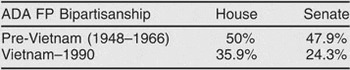
According to this data, bipartisanship, as a number of scholars have recognized, declined significantly in the wake of the Vietnam War.Footnote 28 From 1967 through the end of the Cold War, foreign policy bipartisanship declined but remained relatively high. Levels of bipartisanship in the House declined from 50 percent of ADA votes from 1948–1966 to 35.9 percent between 1967–1990. In the Senate, foreign policy bipartisanship declined more precipitously with the onset and aftermath of the Vietnam War, from 47.9 percent between 1948–1966 to 24.3 percent in the period 1967–1990.
Congressional voting patterns of foreign policy bipartisanship, Cold War era

Note: All t-tests significant at the 99% confidence level.
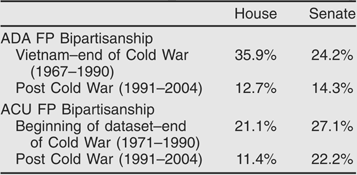
The second major watershed was the end of the Cold War. During the Cold War, bipartisanship on foreign policy was higher in both chambers of Congress. In the House, the parties voted together in high proportions 21.1 percent of the time during the Cold War compared to only 11.4 percent after the Cold War (according to the key votes of the ACU from 1971 to 1990). Looking at ADA data for the time period (1967–1990), this relationship holds up, with bipartisanship declining from 35.9 percent to 12.7 percent in the post Cold War era. Similarly, Senate bipartisanship on foreign policy was higher during than after the Cold War.
Congressional voting patterns of foreign policy bipartisanship, Vietnam and post-Cold War
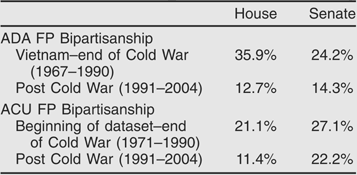
Note: All t-tests significant at the 99% confidence level.
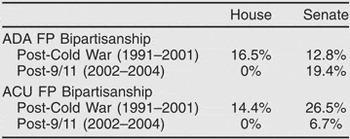
Finally, 9/11 represented another significant episode. While one might anticipate a rally-around-the-flag effect in the wake of an attack on the U.S. homeland, the ADA/ACU data supports Trubowitz and Mellow's finding that bipartisanship on foreign policy has suffered. Here, the data is preliminary since we only have records for the three years from 2002 to 2004 (the 2001 key votes from the ACU and ADA were largely pre-9/11 votes). We find that in the period 1991–2001, Democratic and Republican members of the House voted together in high proportions 14.4 percent of the time. After 9/11, this declined to 0 percent on the ACU votes. Similarly, bipartisanship declined from 16.5 percent of the votes to 0 percent in the ADA rankings during the same time period. In the Senate, the portrait was more mixed, most likely a result of the small number of votes.
Congressional voting patterns of foreign policy bipartisanship, post-Cold War and post-9/11

Note: All t-tests significant at the 99% confidence level.
These findings suggest that key events in American history have, in potentially different ways, created opportunities for partisan politicization of U.S. foreign policy. From the historically high levels of bipartisan cooperation that characterized the early Cold War era, the country has experienced a step-wise decline in bipartisanship. After Afghanistan, the highly contested invasion of Iraq appears to have accelerated this trend.
Since the ADA in the midst of the Vietnam War became pacifist and anti-interventionist, it is hard to use declining support for its agenda as a straightforward indicator of a decline in establishment internationalism. However, post-1967 ADA scores and ACU scores are still substantively informative. These two groups in this period represented opposed and extreme positions on foreign policy, one pacifist and supportive of international institutions (ADA) while the other was quite hawkish and hostile to international cooperation (ACU). To the extent each party has become more ideologically pure and has embraced one of these two outlier perspectives, this demonstrates a departure from the earlier establishment position. We would anticipate that Democrats have increasingly embraced the ADA's agenda on foreign policy while Republicans became more “conservative” in support of the ACU.
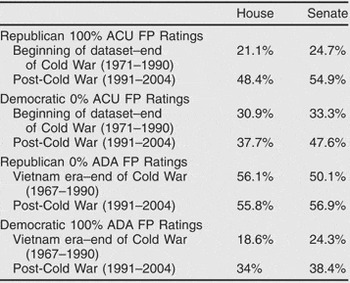
Indeed, we do observe rising ADA support by Democrats and rising ACU support by Republicans on foreign policy. We also observe that a larger proportion of Democrats and Republicans receive perfect foreign policy scores from the ADA and the ACU, respectively. Similar patterns are largely observed where rising numbers of Democrats received 0 scores from the ACU and rising numbers of Republicans received 0 scores from the ADA. All of this too suggests a change in the patterns of centrist accommodation and cooperation that was observed in the height of the Cold War. However, these voting patterns reinforce the point that this transition is part of a longer secular trend that began during the Vietnam era,Footnote 29 was later accelerated by the end of the Cold War and 9/11, and therefore predates the George W. Bush administration.Footnote 30
Partisan ACU and ADA foreign policy ratings

Note: All t-tests were significant at the 99% confidence level, except for Republican House ADA ratings.
Regional representation patterns
A related manifestation of declining internationalism in foreign policy might be observed in changing patterns of regional representation. In this view, there are deep and persistent cultural differences between the main regions of the United States, which produce varying attitudes towards foreign policy issues such as multilateral commitments and the use of force.Footnote 31 Southern and Western political culture is thought to be typically more populist and libertarian, distrustful of coastal and cosmopolitan elites, more comfortable with the use of force and military power, and characterized by an exceptionalism that can be both inward-looking and aggressively transformational.Footnote 32 This culture distrusts central state institutions that might impair individual freedoms or local rights and is thus correspondingly averse to international institutions or commitments that might reduce American sovereignty and freedom of action.Footnote 33 This region typically supports higher levels of defense spending and participates in the military at higher rates; according to Mead, this cultural bloc is the driving force behind an influential American militarist tradition. The Northeast, by contrast, tends to be more moralistic, occasionally pacifist, and more comfortable with multilateral institutions.Footnote 34
According to this line of argument, as the center of political gravity in the United States shifts from the northeast to the south and west, a more nationalist set of attitudes will be more more heavily represented in American foreign policy.Footnote 35 These regional differences in attitudes towards multilateral, institutionalized commitments and the use of military power might therefore account for a broad shift away from establishment internationalism towards a more nationalist foreign policy.Footnote 36
What evidence would support or undermine this argument for decline? The regional story of establishment internationalism's decline potentially takes on two forms. In the first, Northern dominance gives way to Southern and Western influence. In the second, the broad cross-regional support for establishment internationalism of the early Cold War era has been superseded by rising regional differences. If either of these interpretations is correct, we would expect public and elite opinion to systematically vary with region; we would expect these regional differences to be reflected in congressional voting records; and we would expect to see the balance of regional representation—both in terms of place of birth and education—to change within the foreign policy-making elite. Establishment internationalism would also be weaker if the major political parties were increasingly polarized by region.
First, did congressional representatives from different regions support the ADA in the early Cold War period? While the ADA's strongest support was among Northern Democrats, we find that in the early Cold War period (1948–1966) that the ADA enjoyed significant support among Southern Democrats as well as Northern Republicans.Footnote 37 Northern Democrats voted with the ADA foreign policy agenda 75.8 percent, while Northern Republicans voted with the ADA 33.1 percent. Southern Democrats supported the ADA 42.3 percent of the time. The handful of Southern Republicans voted with the ADA 17.6 percent of the time. In the West, Democrats voted with the ADA 69.6 percent while Republicans voted with the ADA 28.5 percent of the time (in the Senate, Northern Republicans and Southern Democrats supported the ADA in almost equal proportions—about 44 percent of the time). These results suggest that the North was historically the center of support for establishment internationalism and that the Democratic Party was highly heterogeneous across regions. At the same, like our findings on bipartisanship, there was some significant support for establishment internationalism in the early Cold War period across regional lines.
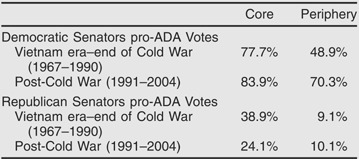
Second, has the basis of regional representation and partisan ideological cohesion changed? The ADA/ACU data supports the thesis that the two parties are indeed become more ideologically polarized by region. Dividing the country into two regions, we found that Democrats in the periphery and Democrats in the core were different from each other in the Cold War, signs of heterogeneity of preferences within the party.Footnote 38
Regional foreign policy voting patterns
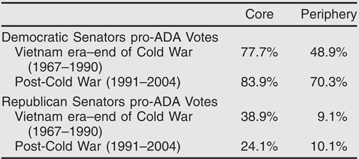
Note: All t-tests were significant at the 99% confidence level, except for Republican periphery voting patterns.
For example, core Democratic Senators voted with the ADA 77.7 percent during the period 1967–1990 while peripheral Democrats only voted with them 48.9 percent of the time. After the Cold War, these differences narrowed, suggesting a more homogenous party. Democratic Senators of the core voted with the ADA 83.9 percent of the time, peripheral Democrats 70.3 percent. Similarly, Republicans also become increasingly homogenous. Republican Senators from the core voted with the ADA 38.9 percent of the time in the same period while peripheral Republicans voted with the ADA 9.1 percent. After the Cold War, core Republicans voted with the ADA only 24.3 percent of the time while peripheral Republicans marginally increased their votes with the ADA to 10.1 percent.Footnote 39 At the same time as the parties were becoming homogenous, their regional basis of representation was becoming more concentrated regionally: the Democrats are becoming more concentrated in the North and East (the core), while the Republicans are becoming more concentrated in the South and West (the periphery) (see figure 1).Footnote 40
Senate representation in the core by party

These findings suggest that the two parties have grown apart on foreign policy as they have become more homogenous and regionally concentrated. Moreover, with the Democrats increasingly supportive of the ADA and the Republicans of the ACU, this finding suggests regionally homogenous parties that have increasingly embraced opposed and more extreme positions on foreign policy.
Why are the regions becoming more polarized? Trubowitz attributes regional differences in foreign policy preferences to changes wrought by the global economy.Footnote 41 He suggested that the erosion of bipartisan support for “cold war internationalism” in the 1980s was a consequence of regional splits in the basis of partisan representation. Declining fortunes under globalization for the North and rising fortunes for the West yielded different regional, and in turn, partisan preferences over foreign policy.Footnote 42 The Democrats were becoming increasingly a party of the North, the Republicans of the West. While one may fault the causal account in Trubowitz's work as overly deterministic in the foreign policy preferences that flow from economic change, there may well be, based on our findings, something to the broader argument about changes in regional representation. However, these just as easily could be interpreted as part of the process of the ideological polarization of America's political parties in response to the departure of conservative Southerners from the Democratic Party and the rising conservatism of the Republican Party. In effect, the increasing ideological purity in the Congress has concentrated internationalism in one party.Footnote 43
Foreign Policy Elite Biographies
A second potential indicator of the decline of establishment internationalism would be observed through changes in the composition of the foreign policy elite. As mentioned above, establishment internationalism may have relied on a cohort of individuals who shared a specific set of formative experiences and a particular social background, and who were thus as a group disposed towards internationalism. One line of argument is generational: the foreign policy beliefs of specific generations might be shaped by decisive historical events, which produce paradigms that guide their future orientation towards foreign policy problems.Footnote 44 In this case, the number of individuals with direct experience with Pearl Harbor, Munich, and the rebuilding of Europe are in decline relative to younger age cohorts, and the prevalence of internationalist or Atlanticist views within public and elite opinion may be declining as a result. Hughes, for example, charges that “whole leadership cadres in America are emerging whose internationalist chromosomes are missing.”Footnote 45 A second argument, also described above, suggests that U.S. foreign policy elites are changing in terms of key elements of their social and economic background, which may influence their foreign policy views. Anecdotal press reports suggest, for example, that a greater number of mid- to top-level decision-makers in the Bush administration were educated in smaller southern and evangelical colleges, rather than the eastern Ivy League backgrounds of many elites at the height of the internationalist era.Footnote 46
These arguments generate several testable empirical predictions about the decline of internationalism. Even if age groups did not hold tightly coherent views, we would expect individuals to have more in common with people in their age cohort than with people in others. We would expect to see a change in the formative generational experiences of the new foreign policy elite: those that came to power in the post-Cold War should be substantially different from those who served during the Cold War. Additionally, as discussed in the previous section on regional representation, if the political center of gravity in the U.S. shifted South and West and away from the Northeast, then we should also observe a larger proportion of foreign policy elites either growing up in or being educated in the South or West rather than the Northeast.
To assess these claims, we created a dataset of more than 225 foreign policy elites from 1941–2007 that includes the top political appointees in the Executive Branch and foreign policy committees in the U.S. Congress. In the Executive Branch, this includes the Secretaries of Defense and State, the National Security Advisor (and Deputy), the head of the CIA (and Deputy), the first level down of under/deputy secretaries of Defense and State, as well as the head of Policy Planning in the State Department and the representative to the United Nations. In the Congress, this includes the head of the Senate Foreign Relations Committee, the House International Relations Committee, and the Senate and House Armed Services committees. We identified the state where they were born, whether or not they participated in military service, and what would have been the relevant formative experience based on their age and early adult life. We also identified where they went to school, and specifically whether they attended an Ivy League institution.Footnote 47
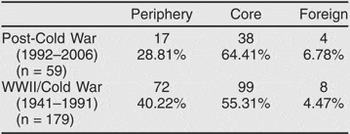
The two measures that get at regional effects, state of birth and education, do not support the conjectures that those who have come to power after the Cold War come increasingly from the South and West or from non-Ivy League schools compared to those who served in the World War II/Cold War era.Footnote 48 In terms of state of birth, we looked at this both in terms of a bi-regional and tri-regional division of the United States. For the bi-regional division, we find that more of the elite who have served in the post Cold War period were born in core states compared to those who served in the period 1941–1991. However, this difference is not statistically significant.
Regional state of birth of foreign policy elites

Note: Chi-square test not statistically significant.
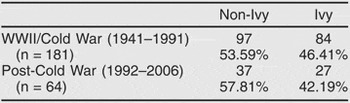
Similar results obtained from a tri-regional division, which shows that a smaller proportion of the elite who served in the post-Cold War period were born in the West and South and more were born in the Northeast compared to the 1941–1991 period.Footnote 49 When we look at education, while there is slight increase in the proportion of post-Cold War elites who went to non-Ivy league schools, that difference is not statistically different.Footnote 50
Education patterns of foreign policy elites

Note: Chi squared not statistically significant.
Moreover, there are several logical flaws in the education argument. Even if political leaders were educated at the same elite schools, people may come out with a different ideological outlook. George W. Bush, John Bolton, and John Kerry, for example, were all educated at Yale. When presidents come to power and select political appointees to play prominent roles in their administration, they are also likely to look for the best and brightest who share their ideological outlook. Since the Ivy's are likely to produce a large number of talented individuals with a range of ideological views, it is not surprising to find those schools over-represented across time.Footnote 51
It may also be that this shift is occurring at a lower level in the foreign policy bureaucracy, and thus not reflected in this data. However, it remains the case that among the top foreign policy decision-makers, there has not been a substantial shift in the balance of regional and educational backgrounds. If an ideological transformation is occurring among the elite, educational background and state of birth do not provide us much leverage on this question.
In terms of formative experiences, the length of the World War II-Cold War period will obviously include leaders with very different formative experiences from those who served in the post-Cold War period. However, we do find some interesting dynamics in the post-Cold War elite that suggests generational succession has yet to fully take place. We took the year of birth for each person and projected out twenty years and thirty-five years.Footnote 52 We identified seven different formative events in the late nineteenth and early twentieth century: the Spanish-American War (1898), World War I (1914–1918), the Great Depression (1929–1939), World War II (1941–1945), the early Cold War (1947–1964), Vietnam (1965–1975), and the post-Vietnam period (after 1975). We then determined what was the first formative experience that those individuals experienced between the ages of 20 and 35. Our results show that those who have come to power after 1991 still overwhelmingly were shaped by the events of the early Cold War; nearly 59 percent had their first formative international experience between 1947 and 1964. Vietnam counts as the second biggest influence. They are, in a sense, different from their Cold War contemporaries who were much more strongly shaped by the Depression and World War II. On the other hand, these results also suggest that events of the early Cold War, which provided impetus for the containment doctrine, continued to hold sway over the post-Cold War generation of foreign policy leaders.
First formative international event of foreign policy elites

The continuing legacy of the early Cold War can also be observed in the average starting age of foreign policy leaders. The average starting age for service of people in the post-Cold War period was 63.5 (compared to 58.2 in the period 1941–1991). Given that the early Cold War looms large as the first formative event for many of those who served after the Cold War, these results suggest that the Vietnam generation has yet to fully come to power. We find holdovers from the previous era returning to government service in the post-Cold War era. In the Executive Branch, this is exemplified on the Democratic side by figures such as Warren Christopher and Tony Lake, both of whom served in the Carter and Clinton Administrations. On the Republican side, both Donald Rumsfeld and Dick Cheney served Presidents Ford and George W. Bush. Similarly, in the Legislative Branch, chairs of the Congressional foreign policy committees from both parties in the post-Cold War era—such as Jesse Helms, Carl Levin, Richard Lugar, Strom Thurmond, Henry Hyde, and John Warner—were often of an earlier era. The baby boomer generation born after World War II and whose first formative experience was Vietnam, such as Condoleezza Rice, Dennis Ross, Richard Armitage, and Strobe Talbott among others, are not yet represented in large numbers. Given that this generation's first important historical event had such a contested legacy, it is hard to know how this will play out, especially since the Gulf War, the Balkans, Afghanistan, and Iraq have now provided a raft of new moments that are likely to have affected this and subsequent generations in different and possibly as conflicted ways.
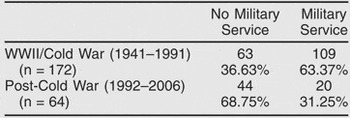
One likely significant difference between this post-Cold War elite and the earlier generation is military service. We find that the World War II/Cold War generation was far more likely to have served in the military. Of the 64 people for whom we have data in the post-Cold War period, only 31.25 percent have records of military service. Of the 172 people in the World War II/Cold War period for whom we had data, 63.37 percent had served in the military in some capacity. These differences are likely to be important in terms of views towards military force and civil-military relations.
From this empirical data, we can only conclude that the evidence does not suggest or is inconclusive that the elite that have come to power since the end of the Cold War are substantially different from their predecessors.
State of the Union Addresses and Party Platforms
The third and fourth set of indicators that might shed light on the decline of internationalism concern changes in the beliefs and ideas of foreign policy elites and/or the American people. In this view, the “internationalist” ideas of old have been de-legitimated by events and replaced by new bases of foreign policy thinking. If internationalism has declined, we would expect to find some secular trends away from the highly internationalist public statements and speeches of the post-World War II era. We use two measures, one that reflects broad trends at the presidential/executive branch level and another that looks at partisan political ideas in campaign platforms.
Records of military service

Note: Chi squared statistically significant at the 99% confidence level.
State of the Union Addresses
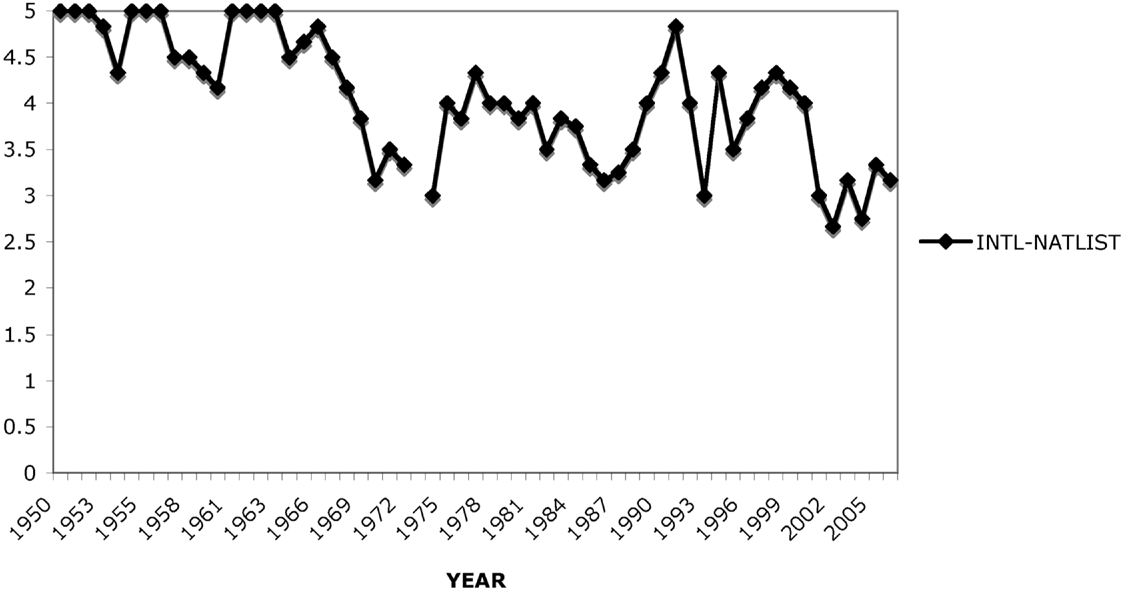
Using Legro's six-point scale to track the degree of internationalism (refer to Appendix A), we coded the internationalist content of the State of the Union addresses from 1950 to 2006 (refer to Appendix B for a discussion of inter-coder reliability).
Has there been a secular decline in the internationalist content in the State of the Union addresses? The internationalist content of State of the Union addresses has in fact declined slightly from its height after World War II, but nonetheless remains robust (refer to figure 2). In that era, a Republican President Dwight Eisenhower might address the nation and say:
In the world as a whole, the United Nations, admittedly still in a state of evolution, means much to the United States. It has given uniquely valuable services in many places where violence threatened. It is the only real world forum where we have the opportunity for international presentation and rebuttal…. The United Nations deserves our continued firm support.Footnote 53
While those days of relative optimism in the United Nations are gone, internationalism is sufficiently ingrained in the American habit of foreign policy that most contemporary presidents say nostrums against isolationism and pledge their support for free trade (sometimes with caveats about fairness and prizing open overseas markets). Thus, we see that despite occasional flirts with more unilateralist rhetoric under Reagan and George W. Bush, most postwar presidents have remained thoroughly above a mean internationalist score of 3.
Internationalist content analysis of presidential State of the Union addresses, 1950–2006
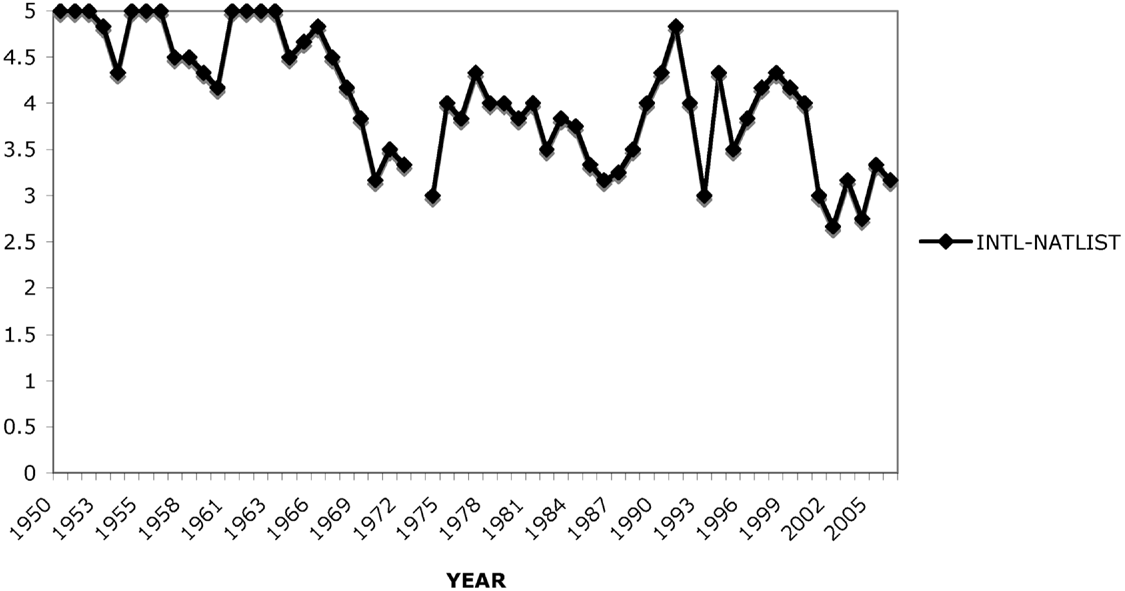
What led us to code some presidents with a slightly higher or lower internationalist score? Generally, support for free trade agreements placed postwar presidents minimally at the score of 3. Effusive praise for NATO and security commitments in Europe and Asia would raise their score to 4. Statements like Eisenhower's about the UN would raise their score still further to 5. When presidents made statements with unilateralist leanings, this in some cases led us to reduce a score of 3 to something somewhat lower. Thus, when President George W. Bush said in 2004 that “America will never seek a permission slip to defend the security of our people,” statements like these were coded as a 2.Footnote 54
The most internationalist American presidents were those who came to power after the Second World War (Truman, Kennedy, and Eisenhower). By the 1960s, the early optimism in the UN and broader multilateral institutions had dampened slightly but consistently remained high (between 4 and 5). The only consistently close nationalist in post–World War II American presidencies is George W. Bush (with an average internationalist score of 3.01). However, it is unclear, given his unfinished presidency and the second-term move to a more pragmatic support for alliances, whether this will be a long-lived trajectory of future presidents.
One objection to the use of State of the Union addresses as a measure of internationalism is that they may not represent what presidents actually think; rather, they may reflect what presidents and their advisors think will be palatable to the public. But this is, in a sense, our point. Presidents generally use State of the Union addresses to offer unifying, inclusive messages designed to seek broad popularity.Footnote 55 Kernell, for example has written how presidents use speeches to “go public,” to go around and over the heads of Congress, by directly appealing to the people.Footnote 56 Edwards argues that presidents have a limited ability to radically shape public opinion, which again suggests these addresses in fact function more as temperature gauges than as decisive opinion-shapers.Footnote 57 In either case, what presidents say in the State of the Union is an important confirmation of belief, either of the president's views or of what he believes the public will bear. Additionally, State of the Union speeches represent a public commitment leaders can be held to, and, as the audience-cost literature shows, pay a price for violating.
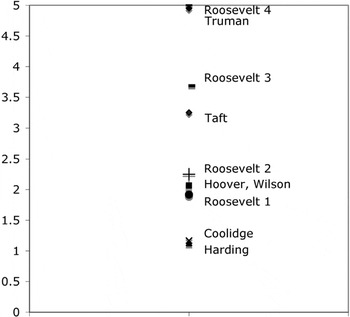
A related objection might be that these trends are not all that interesting since there is not much variation; most post-World War II presidents are rated as internationalists with scores above 3. However, using Legro's original data, we chart the variation in internationalism for presidential State of the Union addresses for the period 1912–1950 (refer to Appendix C). We find four presidents' average internationalism scores to be below 3 (Wilson, Taft, Coolidge, and Hoover). Moreover, the first two Roosevelt administration's addresses also fall below 3 (out of a total of seven State of the Union's from 1934–1940). Thus, nationalist presidencies dominated the pre-World War II era. This finding reinforces the extraordinary novelty and durability of the post-war internationalist consensus.
Party Platforms
Aside from the State of the Union, one could also look to other documents for collective ideational change. Political party platforms in particular provide an interesting portrait of continuities and discontinuities in foreign policy beliefs over time. While they may reflect the idiosyncratic interests of organized constituencies within political parties, they are also collective documents that bear the influence of many individuals. Even more than State of the Union addresses, they are intended to sell a set of ideas to the public. As such, they reflect both the views of political parties and what party elites think the voting public will find attractive at given moments in time.
We use the data provided by the Manifesto Research Group, which coded the content of party manifestos of mostly Western democracies from the end of World War II through the mid-1990s. They include ten variables for “external relations,” including the extent to which manifestos made “internationalist” or “anti-internationalist” statements, levels of pro- and anti-European Community statements as well as pro- and anti-military statements, among other elements.Footnote 58 This dataset records the amount of content in the manifesto said to reflect particular perspectives. The “Internationalism” variable is defined in broadly multilateralist terms, including the extent to which a platform supports the “need for international cooperation…. need for aid to developing countries; need for world planning of resources; need for international courts; support for any international goal or world state; support for UN.” By contrast, the “anti-internationalist” variable reflects a nationalist, pro-sovereignty perspective, emphasizing “favourable mentions of national independence and sovereignty as opposed to internationalism” and negative appraisals of the same objects in the internationalist variable.Footnote 59 If internationalism has experienced a secular decline, we would expect to find rising levels of nationalist content in the party manifestos.
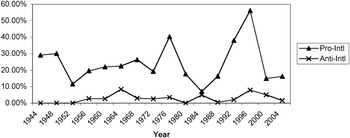
What do the manifestos show? Interestingly, there is only mixed evidence for the secular decline of internationalist content in the Republican Party platforms. We might expect rising nationalism to be present in the Republican Party, where nationalist, anti-UN elements have been especially active. With the Gingrich revolution and the Republican takeover of Congress in 1994, we might expect Republican Party platforms in the 1990s to reflect this nationalist turn. Given the unilateralism of the Bush Administration, we might think this nationalism should be evident in the Republican platforms of 2000 and possibly 2004. In fact, the manifesto data shows that throughout the entire post-World War II period, internationalist content dominates nationalism in the Republican Party platforms (refer to figure 3).Footnote 60 Only in 1984 is the amount of internationalist content nearly equal to the amount of nationalist content (7.08 percent to 4.87 percent). In the 1990s, the Republican Party platform became more rather than less internationalist. While the 2000 Republican Party manifesto shows a large decline in internationalist content, internationalism still dominated (14.94 percent to 5.05 percent). In 2004, nationalist content from the Republican Party platform was reduced significantly, perhaps a reflection of the chastened atmosphere in the White House in light of the difficulties in the occupation of Iraq.
Republican Party platform internationalist-nationalist content

The Democratic Party exhibits a similar pattern of internationalism dominating nationalism, with almost no nationalist statements in the party platform for more than fifty years (refer to figure 4). By this measure, the Democrats are generally much more internationalist (34 percent) than the Republicans (24.2 percent) throughout the entire period. While a t-test shows this difference over the entire period to be statistically significant at the 99 percent confidence level, neither party can be said to be pro-nationalist on the basis of these party manifesto measures.
Democratic Party platform internationalist-nationalist content

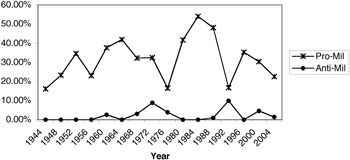
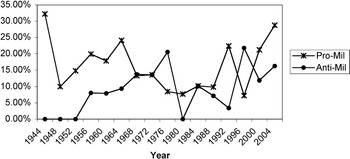
Changes are more apparent in party attitudes to the military. The pro-military variable is defined by positive statements about military expenditures, modernizing the military, rearmament, keeping military treaty obligations and securing sufficient manpower for the military. Anti-military statements favored disarmament, decreasing military expenditures, spoke of the “evils of war,” and included calls to reduce conscription, and other opposites of the pro-military variable.Footnote 61 A pro- and anti-military variable revealed the Republicans to be consistently pro-military in their party manifestos for the entire sixty-year period (refer to figure 5). Democrats, by contrast, rejected pro-military statements in the wake of Vietnam (refer to figure 6). These trends mirror rising Democratic support for the anti-interventionist turn in the ADA after Vietnam. That pattern remained, with some slight shift in the Clinton years, largely unaltered until after September 11.Footnote 62 In Wittkopf's two-dimensional framework, we can think of the internationalist-nationalist scale as the carrots of cooperative internationalism and the military/anti-military scale as the sticks of militant internationalism. The results here suggest that both parties were internationalists, supportive of sticks and carrots up to Vietnam. After Vietnam, the Republicans remained internationalists (occasionally flirting with a hardliner position) while the Democrats became accommodationists until after September 11. That post-Vietnam pattern of partisan difference may return in light of the difficulties of the occupation in Iraq, which may confirm Democratic doubts about the utility of force.
Republican platform pro/anti-military content

Democratic Party platform pro/anti military content

To the extent that the Democratic Party increasingly became accommodationist, it became a home for only one bloc of the coalition that supported establishment internationalism during the early Cold War. Similarly, as the Republican Party has drifted towards a hardliner position (favoring coercive instruments but hostile to multilateralism), those who supported both coercive means and international cooperation were not well represented by either party. Holsti and Rosenau found in their opinion polls that nearly half of U.S. foreign policy elites, at least through the mid-1990s, were accommodationist. If this is also true of wider public opinion, as scholars such as Steve Kull claim, this may explain why the rhetoric of the parties and presidential State of the Union addresses have not radically departed from support for internationalist themes. As our results demonstrate, internationalism remains an important part of the rhetorical repertoire of American presidents and political parties. While enthusiasm for the United Nations has dimmed, other aspects of internationalism—support for free trade, military commitments, and alliances—have not systematically been repudiated by either political party or by American presidents.
Conclusion
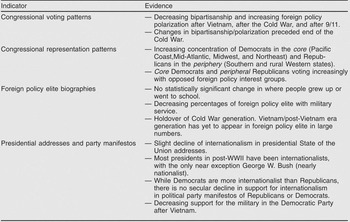
The evidence presented here shows mixed support for the notion that establishment internationalism is experiencing a secular decline (refer to table 10). We find that internationalism still has a powerful hold in terms of the attitudes of presidents and political parties, and in the rhetoric they use to communicate to the public. However, we also find that the parties, at least in terms of congressional voting, have become more ideologically homogenous, more regionally concentrated, and more extreme in their voting patterns on foreign policy. Vietnam sundered the bipartisan consensus and structural change after the Cold War has accentuated the division between the parties and further freed Democrats and Republicans from working together on a bipartisan basis. While September 11, 2001 brought temporary unity, cross-party internationalism will continue to be complicated by rising polarization and regional concentration among the main political parties. Finally, we do not yet observe the rise of a new foreign policy elite in terms of where they were born or went to school, suggesting more continuity than a sharp break with the past, but we also found that fewer number of elites have prior military service.
Summary table of evidence

The main purpose of this article has been to document whether or not establishment internationalism has declined. What explain the patterns we have observed? In our view, the data provide some preliminary support for the impact of the end of the Cold War but also demonstrates that the Vietnam War had a profound effect before the end of the Cold War and 9/11. While structural change may disrupt the status quo, domestic politics do not necessarily move in lock step with systemic incentives. Indeed, as Ikenberry has argued, even as America's unprecedented power position created new opportunities and pressures for unilateralism after the Cold War, there were offsetting structural incentives (such as interdependence) for continued multilateralism.Footnote 63 Thus, in our view, the 1990s provided confusing systemic signals to U.S. foreign policy elites about how best to defend the country's interests.
Additionally, if the fundamentals of establishment internationalism are still strong in the United States, how do we explain the seemingly abrupt shift of the George W. Bush administration towards a more unilateralist and nationalist foreign policy? There is reason to believe that the rising electoral success of the Republican Party in the 1990s brought to power people with different foreign policy ideas than their predecessors. With foreign policy issues of low salience in the 1990s, elites may have come to power in Congress largely as a result of successful mobilization on domestic policy. However, Congressional foreign policy leaders like Jesse Helms held more nationalist views on foreign policy and were able to use their new-found veto power to shift the tenor of American foreign policy by blocking international spending and treaty commitments. With the capture of the Presidency in 2000, both unilateralists and isolationists were empowered in the Executive Branch and Congress, and have been able to overpower internationalists.
This project to reshape American foreign policy has been highly contested, and it is unclear whether or not this effort is supported by domestic opinion or has been pursued despite lacking public support.Footnote 64 Of course, the events of 9/11 led to a tremendous shift in the priorities of both elites and the public, making foreign policy (and counterterrorism especially) politically salient again.Footnote 65 However, the subsequent wars in Afghanistan and, more importantly, Iraq may have created a new foreign policy event with as contested a legacy as Vietnam. Further research might provide a more complete picture, for example by analyzing elite and public opinion surveys from the Chicago Council on Foreign Relations to see if the cohort of nationalists has increased, and whether views on internationalism vary with region or age. A further extension might flesh out the causal mechanisms that best explain the patterns documented in this paper. In the meantime, our basic conclusion is that establishment internationalism has remained potent at the symbolic level while the legislative branch has become more insular and ideologically and regionally polarized.
Appendix A: Legro's Scale of Internationalism-No Entanglement Scale
Legro's stepwise measures of internationalism-no entanglement are:
0 The United States should avoid getting involved in international relations with major powers. To the extent possible the United States should live and let live. The country can best lead by example. (This end of the spectrum is stronger to the degree rhetoric also denigrates the opposite end).
1 The United States should necessarily engage the world, but it should do so without binding itself in institutional arrangements.
2 The United States should play a larger role in world affairs. This might involve some limited institutional commitments such as arms control and the mutual lowering of tariffs. But traditional political-military alliances or general commitments to collective security institutions should be proscribed, especially with Europe.
3 The United States should play a large role in the world, especially in economic affairs. There is a positive attitude toward the benefits of international institutions, but not toward those involving military precommitments.
4 The security of the United States would be best served by more substantial international commitments and agreements, even those that involve military precommitments.
5 The security of the United States depends on actively constructing international institutions and relationships that tie it to other major powers, and to which is gives political-military backing. (This end of the spectrum is stronger to the degree rhetoric also denigrates the opposite end).
By emphasizing institutions, Legro's scale is actually more like a continuum tracking multilateralist-unilateralist preferences than a simple internationalist-isolationist metric. When we coded the cases, we developed a shorthand for each step: national-based solutions to international problems were 0; informal, ad hoc bilateral cooperation and diplomacy was a 1; cooperation through long-lived bilateral agreements measured a 2; basic support for multilateral economic cooperation and free trade merited a 3; the possibilities for regional, multilateral responses (i.e., NATO) to international problems, including security, were a 4; and, praise for the United Nations, particularly its role in peace and security, would warrant a 5.
Appendix B: Inter-coder Reliability
Each author and a third coder, Dustin Tingley (DT), independently coded the entire set of documents 1950 to 2006 according to the Legro scale. We conferred at the beginning and did two State of the Union addresses together (1950, 2006) before separately analyzing the documents. DT was given the addresses, largely blind to the ultimate purpose of the project, with addresses in random order with information on the presidency and year largely stripped. Like Legro, we allow for half-point increments in our ratings. We average the scores. There are 59 entries for the 1950–2006 period because in some years where there was a transition to a new administration, two presidents gave State of the Union addresses: 1953 (Truman, Eisenhower) and 1961 (Eisenhower, Kennedy). Nixon's 1971 and 1973 addresses refer to another foreign policy speech he made later in the year which were then used to code that year.
For Busby (JB) and Monten's (JM) internationalism scores, 23 of 54 were the same (42 percent), 20 differed by a half-step (37 percent). For only two years (3.7 percent) did scores differ by 1.5 (under Ford and Reagan) and 9 of our scores (16 percent) differed by 1 (several of them under Reagan). For JB and DT's internationalism scores, there was zero difference on 23 of 55 scores (41.8 percent), a half-step difference 22 of 55 (40 percent), one-step difference on 14.5 percent, and 1.5 step difference on 3.6 percent. For JM-DT comparison, there was zero difference on 25 of 51 (49 percent), a half-step difference on 9 of 51 (17.6 percent), a one-step difference on 13 of 51 (25.5 percent), a 1.5 step difference on 4 of 51 (7.8 percent). Compare this to Legro and his coder : they had the same value in 39 percent of 41 observations; 37 percent differed by 1/2 point; 15 percent differed by 1 point; 10 percent differed by 1.5 points in 10 percent; and one observation differed by 2 points.
JM found five years where he thought there was insufficient data to make a ranking; DT found four years. They had 1973 in common so this observation was dropped from the internationalism index. All of these State of the Union Addresses and speeches were found on the web at http://www.presidency.ucsb.edu/sou.php.
Appendix C: Mapping of Legro's Data by Presidency
Internationalism scores for U.S. presidents prior to World War II displayed more diversity than they did in the post-war era in which most U.S. presidents were internationalists. Legro's codings demonstrate considerable variation between and within U.S. presidencies.Footnote 66 The Roosevelt presidency across administrations shows how internationalist rhetoric increasingly came to dominate after a long period of relative domination by more nationalist/no-engagement rhetoric.
Internationalist content of Presidential State of the Union addresses 1912–1950