Implications
Azaperone is a mild neuroleptic drug and sedative given to pigs to control stress caused by re-grouping and aggressiveness of older and bigger herd mates. Effects of azaperone treatment at weaning on reproductive capability of a commercial sow herd were assessed in this study. Azaperone increased litter size (LS) but it hindered the onset of estrus in winter-farrowing sows. Second parity sows had greater numbers of piglets born along with delayed onset of estrus. Azaperone significantly depressed the piglet productivity of summer-farrowing sows. The extra cost and labor due to delayed estrus may cancel out any reproductive benefits of azaperone injections.
Introduction
Stress is defined as an organism’s total response to external or internal factors that destabilize homeostasis (Selye, Reference Selye1978). Stressors may be physical, physiological or emotional. The impact of stress on reproductive performance of gilts and sows depends on the type of the stressor, critical timing and duration of stress, and individual susceptibility (genetic predisposition) of animals (Madej et al., Reference Madej, Lang, Brandt, Kindahl, Madsen and Einarsson2005; Tilbrook et al., Reference Tilbrook, Turner and Clarke2005; Einarsson et al., Reference Einarsson, Brandt, Lundheim and Madej2008). The primary response to stress involves the activation of the sympathetic nervous system and the hypothalamo–pituitary–adrenal axis, which enables the adaptation of the organism to stress and restoration of homeostatic regulation (Turner et al., Reference Turner, Hemsworth, Canny and Tilbrook1999 and Reference Turner, Hemsworth and Tilbrook2002; Tilbrook et al., Reference Tilbrook, Turner and Clarke2005). The main effect of stress-induced cortisol hypersecretion on the reproductive axis occurs at the level of the hypothalamus (alterations in gonadotropin-releasing hormone secretion) and the pituitary gland (gonadotropin secretion), with the direct effects on the gonads (downregulation of gonadotropin receptors and diminished pregnenolone biosynthesis) generally being of less importance (Harlow et al., Reference Harlow, Jenkins and Winston1997; Tilbrook et al., Reference Tilbrook, Turner and Clarke2005). Many short-term stresses do not exert any deleterious effects on reproduction and there are reports of stimulatory effects of some of such stressors (Turner et al., Reference Turner, Hemsworth, Canny and Tilbrook1999 and 2002; Tilbrook et al., Reference Tilbrook, Turner and Clarke2005). Prolonged stress associated with protracted increases in circulating concentrations of cortisol is undesirable and typically results in the impediment of normal reproductive function (Turner et al., Reference Turner, Hemsworth, Canny and Tilbrook1999 and 2002; Tilbrook et al., Reference Tilbrook, Turner and Clarke2005). Antral follicular growth and steroidogenesis, manifestation of sexual behavior, ovulation and implantation of the embryo are the most sensitive reproductive processes that can be altered by stress as they are largely governed by the neuroendocrine system (Einarsson et al., Reference Einarsson, Brandt, Lundheim and Madej2008). During the weaning-to-estrus interval (WEI), many events and disturbances, even seemingly trivial, may affect the reproductive function of the sow (Bjork, Reference Bjork1989; Pena et al., Reference Pena, Dominquez, Pelaez and Alegre2000; Willenburg et al., Reference Willenburg, Miller, Rogriduez-Zas and Knox2003; Kos and Bilkei, Reference Kos and Bilkei2004; Schwarz and Kopyra, Reference Schwarz and Kopyra2006). Weaning is a strong emotional stress for sows, but of a short duration. This stress culminates in the resumption of ovarian function after the period of ‘reproductive quiescence’ during lactational anestrus (Quesnel and Prunier, Reference Quesnel and Prunier1995; Tsuma et al., Reference Tsuma, Einarsson, Madej and Lundheim1995). A typical WEI ranges from 3 to 6 days (Quesnel and Prunier Reference Quesnel and Prunier1995; Poleze et al., Reference Poleze, Bernardi, Amaral Filha, Wentz and Bortolozzo2006; Einarsson et al., Reference Einarsson, Brandt, Lundheim and Madej2008). Both very short (0 to 2 days) and long (>6 days) WEIs are associated with impaired reproductive performance of sows (Peltoniemi et al., Reference Peltoniemi, Love, Heinonen, Tuovinen and Saloniemi1999; Pol et al., Reference Pol, Courboulay, Cotte, Nartrenchar, Hay and Mormede2002; Poleze et al., Reference Poleze, Bernardi, Amaral Filha, Wentz and Bortolozzo2006). Prolonged stress during the follicular phase of the estrus cycle bears an inevitable risk of negative outcomes (Madej et al., Reference Madej, Lang, Brandt, Kindahl, Madsen and Einarsson2005). Intense hierarchy fights could be such a stressor during the weaning-to-estrus/service period in the group housing system. Housing conditions in large production systems are often associated with aggressive behavior of dominant sows (Tsuma et al., Reference Tsuma, Einarsson, Madej, Forsberg, Lundheim and Rojkittikhun1996) and continued persecution of weaker animals, resulting in their malnutrition (physiological stress), constant fear (emotional stress) and injuries, sometimes serious (physical stress).
In the breeding practice, mild psychomotor sedatives (e.g. azaperone) are commonly used to reduce hierarchy fights of sows during the grouping or re-grouping of animals (Bjork, Reference Bjork1989; Luescher et al., Reference Luescher, Friendship and Mckeown1990). However, there is a paucity of studies on the pharmacological methods aimed to reduce the effects of stress associated with WEIs. Apart from their tranquilizing and mobility-reducing effects, very little is known about the influence of the pharmaceuticals on reproductive processes in sows.
Swine fertility is heavily dependent on a number of intrinsic factors, of which genotype, age and parity are the most influential in reproductively healthy sows (Safranski and Cox, Reference Safranski and Cox2007). A number of extrinsic factors including, but not limited to, herd management practices that are becoming commonplace in commercial swine operations and seasonal influences, may also exacerbate the effects of various stressors and lead to suboptimal reproductive efficiency (Peltoniemi et al., Reference Peltoniemi, Love, Heinonen, Tuovinen and Saloniemi1999 and 2000). Even though the specific mechanism of seasonal fluctuations in fertility of the domestic pig have yet to be determined, circannual changes in gonadotropin secretory patterns may affect conception rates (CRs) and piglet productivity in gilts and sows (Peltoniemi et al., Reference Peltoniemi, Tasta and Love2000). Hence, the main objective of the present study was to examine the effects of a butyrophenone neuroleptic-azaperone given at weaning on the reproductive performance of sows inseminated during the impending ovulatory period. Here we present the analyses of main reproductive parameters in a commercial herd of sows throughout the entire annual production cycle. We hypothesized that azaperone treatment would alter CRs and piglet productivity in sows.
Material and methods
The present study was in compliance with the EU Directive 2010/63/EU for animal experimentation and the Polish law for the care and use of experimental animals (August 2, 1997), and had been approved by the local Animal Care and Ethics in Research Committee at the Agricultural University of Kraków, Cracow, Poland.
Animals and experimental design
The present study was conducted in a large commercial facility housing ~900 cross-bred sows (Polish Large White×Polish Landrace). Before gestational day 90, all animals received a dry fodder mix containing 11.1 megajoules of metabolic energy (MJ of ME) and 90 g/kg of digestible protein (DP). With a daily food consumption of ~2.5 kg per sow, the mean amount of ME amounted to 27.75 MJ/sow per day. After day 90 of gestation as well as during lactation and weaning-to-service intervals, the sows were fed a dry fodder mix containing 13.1 MJ of ME and 134 g/kg of (DP); given an average daily dose of 2.8 kg of the fodder/pregnant sow per day, the estimated mean daily energy intake was 36.7 MJ of ME per sow. Lactating sows were fed ad libitum, and mean feed intake was ~7 kg per sow giving an approximate energy intake 91.7 MJ of ME per sow/day.
From January to December, a total of 1799 sows were weaned; a group of ~34 animals was weaned every week on Thursday. The median age of piglets at weaning was 4 weeks. Sows were moved into separate pens in groups of seven to nine animals; there was one pen for second parity sows and three pens for older sows. The size of a group pen in the mating sector was 3.4×8 m (27.2 m2). Each pen had a slatted/solid floor (30%/70% of area) and was equipped with a 7.5-m trough divided into nine sections (each ~0.8 m long). In addition, there were two hanging chains per pen and plastic bottles were made available during the 2 days after weaning as housing enrichment material. Immediately before the weaning, the sows from one randomly chosen pen were treated with azaperone (Stresnil®; 40 mg/ml solution for injection in pigs; Janssen Pharmaceutica, Beerse, Belgium) at a dose of 1 ml per 20 kg BW i.m. and a group of primiparous sows received azaperone injections every other week. Starting 2 days post-weaning, all animals were checked twice a day with a teaser boar for the signs of estrus. A teaser boar, normally housed in a separate building, was moved for 15 to 20 min to a neighboring pen and then for ~5 min into a pen with the tested sows. Immediately after the detection of estrus, sows were re-located into individual stalls (0.8×2.6 m=2.08 m2) and inseminated using semen obtained from PIC 337 or PIC 408 line boars (3×10⁹ spermatozoa per dose in 100 ml of Cronos® extender; Medichimica, Reggio Emilia, Italy). Semen was collected daily from own boars on farm; each boar was only ejaculated once a week. Re-inseminations were done 16 to 20 h after the first service in sows that ‘stood still’ during teasing. After 28 days in individual stalls and positive pregnancy testing, animals were moved back into the group pens housing six to eight females with no further re-grouping until final relocation to the stalls in a farrowing unit a week before the expected parturition.
Statistical analyses
The reproductive parameters of interest in the present study are listed in Tables 1 to 7. Statistical analyses utilized a mixed linear regression model with the SAS 9.2 software (SAS Institute Inc., Cary, NC, USA) to determine the main effects of azaperone treatment (treated v. control sows), parity (lifetime number of litters), season of farrowing (i.e. farrowing in calendar spring, summer, fall or winter), and the interactions of these terms on the variables analyzed. All data sets were initially subjected to heterogeneity and equal distribution tests (Shapiro test, variance test), and screened for potential outliers using the Grubb’s test (the maximum normed residual test; http://www.graphpad.com/www/grubb.htm). Subsequently, comparisons among different groups were done for all parameters excepting the variables with insignificant values for main effects (based on the statistical criterion of Wald, a.k.a. the Wald (F-distribution) test). The preliminary inspection of results revealed that a large proportion of animals were in standing heat and inseminated for the first time after day 6 post-weaning. Therefore, separate statistical comparisons were carried out for the sows that were inseminated for the first time within 6 days after weaning (further referred to as ‘on-time sows’) and for all animals under study. Percentages of animal going into estrus early (on-time sows) or late were compared by a χ 2-test using the Brandt–Snedecor formula (Cochran and Cox, Reference Cochran and Cox1957). All results are given as the mean±standard deviation (SD), unless otherwise indicated.
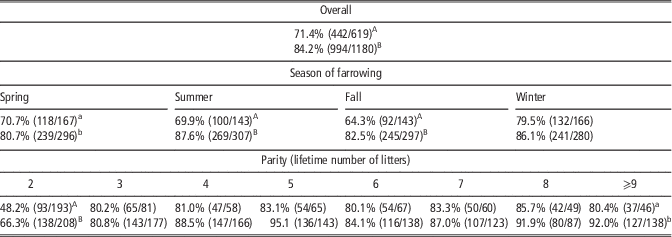
Differences between azaperone-treated (upper rows) and control groups (lower rows) in the proportion of sows that showed signs of estrus and were inseminated for the first time within 6 days post-weaning

Within cells, proportions denoted by different letter superscripts vary significantly (A,B P<0.001, a,b P<0.05).
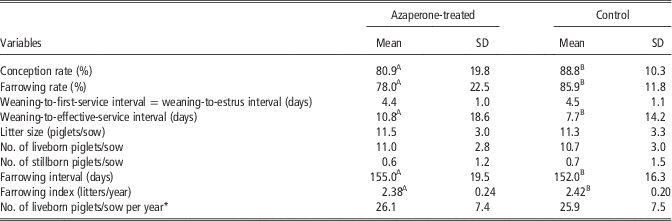
Overall differences in the reproductive parameters between Polish Large White×Polish Landrace sows that were treated with azaperone at weaning and untreated controls, for the sows that showed the signs of estrus and were inseminated for the first time within 6 days post-weaning

*No. of liveborn piglets×farrowing index.
A,B P<0.01 (within rows).
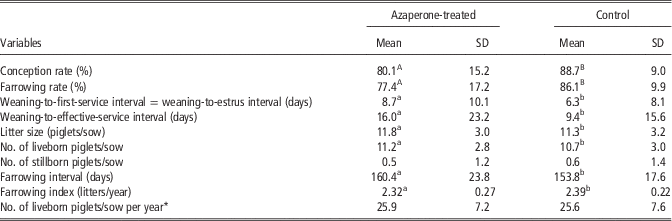
Overall differences in the reproductive parameters between all Polish Large White×Polish Landrace sows studied that were treated with azaperone at weaning and their respective controls

* No. of liveborn piglets×farrowing index.
A,B P<0.001, a,b P<0.05 (within rows).
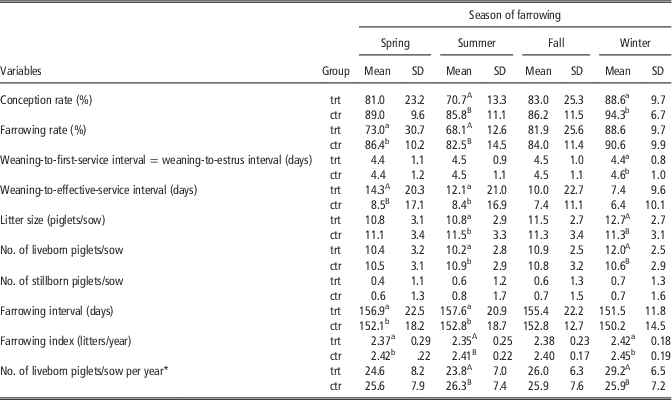
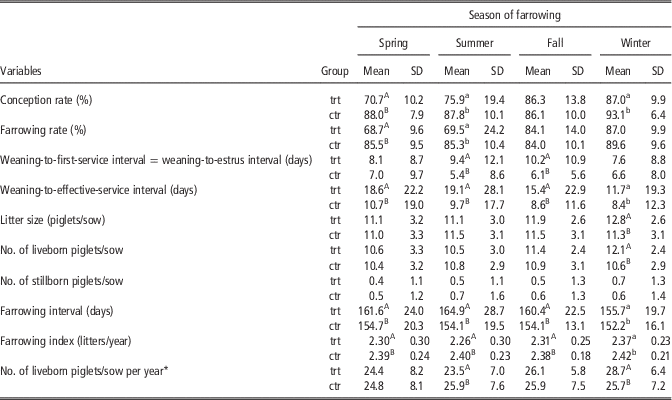
A summary of seasonal differences in the reproductive parameters between Polish Large White×Polish Landrace sows treated with azaperone at weaning (trt) and untreated controls (ctr) that showed the signs of estrus and were inseminated for the first time within 6 days post-weaning

*No. of liveborn piglets×farrowing index.
A,B P<0.001, a,b P<0.05 (between trt and ctr).
A summary of seasonal differences in the reproductive parameters between all Polish Large White×Polish Landrace sows studied that were treated with azaperone at weaning (trt) and untreated controls (ctr)

*No. of liveborn piglets×farrowing index.
A,B P<0.001, a,b P<0.05 (between trt and ctr).
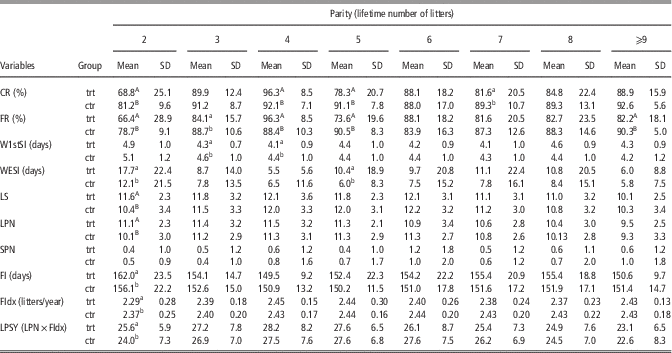
A summary of parity-allied differences in the reproductive parameters between Polish Large White×Polish Landrace sows that were treated with azaperone at weaning (trt) and untreated controls (ctr) for the sows that showed the signs of estrus and were inseminated for the first time within 6 days post-weaning and varying in parity

CR=conception rate; FR=farrowing rate; W1stSI=weaning-to-first-service interval; WEI=weaning-to-estrus interval; WESI=weaning-to-effective-service interval; LS=litter size; LPN=number of liveborn piglets per sow; SPN=number of stillborn piglets per sow; FI=farrowing interval; FIdx=farrowing index; LPSY=liveborn piglet number/sow per year.
A,B P<0.001, a,b P<0.05 (between trt and ctr).
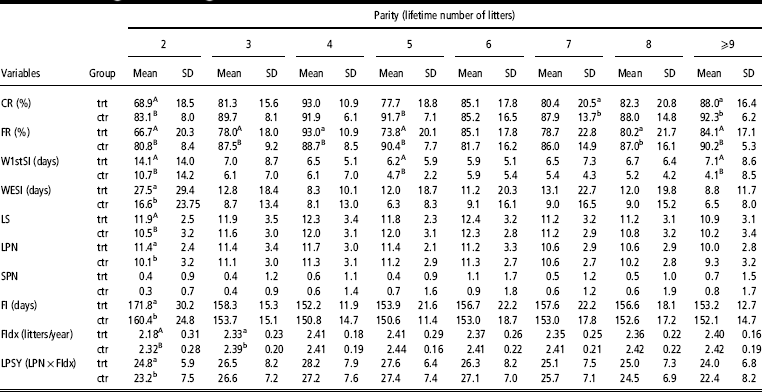
A summary of parity-allied differences in the reproductive parameters between all Polish Large White×Polish Landrace sows studied that were treated with azaperone at weaning (trt) and untreated controls (ctr)

CR=conception rate; FR=farrowing rate; W1stSI=weaning-to-first-service interval; WEI=weaning-to-estrus interval; WESI=weaning-to-effective-service interval; LS=litter size; LPN=number of liveborn piglets per sow; SPN=number of stillborn piglets per sow; FI=farrowing interval; FIdx=farrowing index; LPSY=liveborn piglet number/sow per year.
A,B P<0.001, a,b P<0.05 (between trt and ctr).
Results
The proportion of pigs that were in standing heat within 6 days post-weaning was significantly lower in azaperone-treated groups of animals than in controls regardless of the season (Table 1). However, when data were analyzed for the pigs varying in parity, this difference was only manifest in sows that in their lifetime produced either 2 or ⩾9 litters.
There was a significant main effect of treatment on all parameters analyzed except for the number of stillborn piglets per sow (Tables 2 to 7). Within a subset of pigs that were in heat within 6 days post-weaning, the azaperone-treated animals exceeded (P<0.05) control sows in the duration of the weaning-to-effective-service interval (WESI) and the farrowing interval (FI), whereas control animals had greater (P<0.05) CR and farrowing rates (FRs), and farrowing index (FIdx; Table 2). Adding the data for animals that were in estrus after day 6 showed that a delay in the onset of heat was generally greater (P<0.05) in azaperone-treated pigs, but the treatment groups had a larger (P<0.05) LS and numbers of live piglets born (LPN; Table 3).
Seasonal effects on the reproductive parameters in azaperone-treated and control sows that were in heat within 6 days post-weaning (the ‘on-time’ sows) are summarized in Table 4. Mean CR (P<0.05), LS and LPN (both P<0.001) were lower in azaperone-treated compared with their respective controls in the summer. Although mean CR was also lower (P<0.05) in azaperone-treated pigs in the winter, both the LS and LPN were greater (P<0.001) in control animals. Farrowing interval was significantly lower, whereas WESI was significantly longer in azaperone-treated compared with control animals in the spring and summer. Control pigs farrowing in the winter had a longer (P<0.05) weaning-to-first-service interval (W1stSI). Mean FI was longer (P<0.05) in azaperone-treated sows in the spring and summer, and FIdx was significantly greater in control animals in the spring, summer and winter. Within this subset of pigs, there were no differences (P>0.05) in any of the reproductive parameters analyzed between the treatment and control groups in the fall. The number of liveborn piglets/sow per year (LPSY) was lower in the summer but greater during the winter months in azaperone-treated compared with control animals (P<0.001). When similar comparisons were done for all animals studied, the difference (P<0.05) in WESI and FI between the treatment and control groups was sustained throughout the year (Table 5). The W1stSI was longer (P<0.001) in the treated animals in the summer and fall but it did not vary (P>0.05) between the two groups in the winter. Litter size and LPN did not differ between azaperone-treated sows and their respective controls during the summer farrowing. Conception rate was less (P<0.001) in the treatment group compared with controls also during the spring, and FIdx was less (P<0.001) in the treatment group in the fall. Consistent with the results for the on-time sows, the LPSY was lower in the azaperone-treated than in control animals in the summer but it was greater in the winter-farrowing controls (P<0.001).
Data analyses according to the animals’ parity revealed that in the subset of animals going into estrus within 6 days post-weaning: (i) mean FI, LS and LPN were all significantly greater in the azaperone-treated than control groups only in sows with two litters (Table 6); (ii) mean CR and FR were greater (P<0.001) in the treated pigs with four litters; and (iii) the values for WESI were greater (P<0.05) in the subsets of treated animals as compared with untreated controls for the sows with two or five litters. Alternatively, mean CR was significantly greater in control sows with two, five or seven litters, and FR was significantly greater in control animals with 2, 3, 5 and ⩾9 litters. Mean LPSY were greater (P<0.05) in second parity azaperone-treated sows compared with untreated controls.
When data for all animals studied were analyzed and compared between sows differing in parity, the results obtained with the similar analyses as for the on-time animals were as follows: (i) there was no difference (P>0.05) in mean CR between the treated and control animals with four litters, but mean CR and FR were greater (P<0.05) in control sows with eight litters (Table 7); (ii) there was no difference in mean W1stSI between the control and treatment groups of sows with three or four litters, but the interval was longer (P<0.001) in azaperone-treated sows with 2, 5 or ⩾9 litters; and (iii) mean WESI did not vary (P>0.05) between the treated and control animals with five litters.
Discussion
Reproductive efficiency of a sow herd is primarily determined by the number of non-productive days (i.e. intervals between successful breeding periods) and the number of liveborn piglets (LPN). Non-productive days due to the late onset of estrus increase the total costs of labor for animal relocation and second, or subsequent, estrus detections (if anestrus sows are not culled). Furthermore, prolonged (i.e. >6 days) WEIs are typically associated with the decreased duration of estrus and of the interval from the onset of estrus to ovulation (Kemp and Soede, Reference Kemp and Soede1996). In commercial operations, the shortened period of detectable standing heat and earlier ovulation make it difficult to accurately detect estrus and perform a timely insemination, respectively (Weitze et al., 1994; Kemp and Soede, Reference Kemp and Soede1996). Both of these factors can impinge negatively on resultant CR and FRs of sows (Kemp and Soede, Reference Kemp and Soede1996).
If estrus is not detected during the first 6 days after weaning, the sows may be in true anestrus (anovulatory state), ovulating but not displaying the signs of estrus (silent heat), or the heat was simply not detected (apparent anestrus; King et al., Reference King, Walton and Bellisimo1985). Group-housed sows with live boar exposure are the gold standard for estrus detection (Kemp et al., Reference Kemp, Soede and Langendijk2005), and since this was the method used in the present study, it is rather unlikely that the first estrus post-weaning could frequently be missed due to poor method of heat detection. However, the treatment with azaperone, a sedative neuroleptic of the butyrophenone series, may have altered secretory patterns of steroid hormones heralding the onset of behavioral estrus. It is important to note that sows ovulating but not showing physical signs of estrus could not be distinguished from anovular sows in this study.
In the subsets of sows that were in heat and inseminated for the first time within 6 days post-weaning, significant difference between azaperone-treated and control animals were recorded for all reproductive parameters analyzed except for WEIs, LS, the number of liveborn (LPN) or stillborn piglets per sow (SPN), and the total number of LPSY. However, the comparison of the same parameters in all animals under study revealed the existence of significant differences in LS and LPN between control and treated sows; both variables were greater for azaperone-treated sows. It is, therefore, evident that the greater LS and LPN were mainly associated with the delayed onset of estrus. Azaperone-treated animals consistently exhibited lower CR, FR and FIdx and had longer FI compared with untreated controls, and these differences did not seem to be related to the timing of the first estrus post-treatment. However, these differences resulted in a lack of significant overall differences in LPSY between the treated and control animals. Azaperone treatment did not affect the number of stillborn piglets suggesting that it had little effect on embryonic or fetal mortality rates.
The FIdx was significantly lower for all azaperone-treated sows regardless of the season. Winter enhanced the positive effects of azaperone on LS and LPN regardless of the timing of estrus. In addition, winter dampened the prolonging effect exerted by azaperone on the WEI; the treated sows did not have a significantly longer WEI than controls during the winter, and they had numerically lowest WEI of all treated sows over the year. Winter-farrowing sows had ~3 piglets/sow per year more in the treated compared with control sows; this increment is reflective of the increased LPN and probably a somewhat less steep decline in FIdx. Alternatively, azaperone injections given to sows farrowing in the summer resulted in the decreased LS and LPN in on-time sows and increased WEIs in all animals. Consequently, the mean LPSY of azaperone-treated sows was lower during that period compared with untreated controls. Hurtgen and Leman (Reference Hurtgen and Leman1978) demonstrated, in a slaughterhouse study, that during the Northern Hemisphere’s month of August, the ovaries in over 40% of sows were inactive. Such seasonal disturbances in ovarian activity have been noted more frequently in young sows (Prunier et al., Reference Prunier, Quesnel, de Braganca and Kermabon1996). Most pig farms in temperate climates experience some seasonal variations in reproductive efficiency; 68% of farms in North America showed a considerable depression in sows’ fertility during the summer (Knox et al., Reference Knox, Rodriguez Zas, Sloter, McNamara, Gall, Levist, Safranski and Singleton2012). From all these indications, the most optimal time of the year to use azaperone to reduce aggression after weaning is fall and winter (i.e. winter-farrowing period) when there may be a slight positive stimulation of reproductive efficiency.
The parity subsets of sows with the largest difference in annual numbers of piglets between the treatment and control groups are the most important source of an overall difference in sows’ productivity. Second parity azaperone-treated sows had ~1.5 more piglets/sow per year than controls. Interestingly, the on-time azaperone-treated second parity sows also had an increase of ~1.5 piglets/sow per year compared with their respective controls. Second parity sows have evidently been the main contributors to the increase in productivity across all parities of azaperone-treated sows. However, this age group of sows also had the lowest proportion of animals going into estrus within 6 days post-weaning. Second parity sows are still growing, and as such, may experience a similar stress response to primiparous sows when exposed to stressors such as suboptimal nutrition levels. Primiparous sows at parturition encounter a negative energy balance, which interferes with the normal functioning of their endocrine system (Zak et al., Reference Zak, Williams, Foxcroft, Pluske, Cegielski, Clowes and Aherne1998). Energy and protein requirements decrease throughout the reproductive cycle with age, so the requirement of second parity sows is greater than their older herd mates (NRC, 2012). Even a transient negative energy balance can decrease luteinizing hormone concentrations in blood and increases the WEI in sows (Zak et al., Reference Zak, Williams, Foxcroft, Pluske, Cegielski, Clowes and Aherne1998). Lastly, if the treatment with azaperone decreases the overall mobility of the penned sows, the frequency of feed intake may also decline.
The age and size of the sow may also impact the dominance hierarchy and henceforth the level of stress endured during the group housing. The individual rank of sows is directly proportional to their live weight and age (Steffen et al., Reference Steffen, Bauer, Borberg, Chonsch and Weirich2009). Higher parity and larger sows tend to have a higher rank compared with lower parity and lighter sows in the same pen (O’Connell et al., Reference O’Connell, Beattie and Moss2003; Arey, Reference Arey2009). Using azaperone to decrease mobility and aggression is usually beneficial for the smaller sows who are normally intimidated by their pen mates. On the other hand, administration of azaperone may decrease the activities and stressors associated with being the dominant sow. Therefore, the azaperone treatment at mixing or re-grouping sows may reduce the effects of dominance stress seen at the highest ranking and the lowest ranking sows (Hurtgen et al., Reference Hurtgen, Leman and Crabo1980; Zak et al., Reference Zak, Williams, Foxcroft, Pluske, Cegielski, Clowes and Aherne1998), which were the sows that responded best to azaperone in this study in terms of reproductive indices recorded. At any rate, further behavioral corroboration of the present findings would be of paramount interest.
Azaperone treatment does not prevent the forming of a dominance hierarchy in sows; it simply reduces aggression in the first 24 h post-injection and has a prolonged effect on animals’ mobility. These effects, spreading out along with the dampening of dominance behaviors, could be a source of the across the board increase in WEI (Csermeley and Wood-Gush, Reference Csermeley and Wood-Gush1990). If this is the case, using the timed insemination in combination with a gonadotropin-releasing hormone agonist should allow these sows to be bred at normal fertility rates (Stewart et al., Reference Stewart, Flowers, Rampacek, Greger, Swanson and Hafs2010). However, additional pharmacological treatments to ensure reproductive success would only increase the total cost of production.
In summary, the azaperone treatment at weaning delayed the onset of estrus beyond 6 days post-treatment in a further 10th of this sow population. Certain combinations of extrinsic and intrinsic factors (i.e. parity and season) have significantly impacted the numbers of live births in azaperone-treated sows. Specifically, the azaperone treatment was associated with increased piglet productivity in winter farrowing and in second parity sows but it reduced it during summer months. It is unlikely that generic azaperone treatment would be economically beneficial as it greatly increases the overall proportion of sows with delayed onset of estrus; this delay was observed throughout the year (excepting winter farrowing) and it was most prominent in the youngest and oldest subsets of animals (sows with 2 and ⩾9 litters). More research is needed, however, to precisely determine whether or not the benefits of azaperone treatment outweigh the labor-allied losses during most of the year in commercial swine operations.
Acknowledgments
The present study was funded by the Polish Ministry of Science and Higher Education (grant N N311 370837 to T.S.). These data were presented in the preliminary form at the International Conference on Biology and Pathology of Reproduction in Domestic Animals held in Gdańsk, Poland (September 28 to 30, 2015).