Introduction
Chronic rhinosinusitis with nasal polyps (CRSwNP) accounts for approximately 20 percent of all cases of chronic rhinosinusitis (CRS) and is associated with higher morbidity than the phenotype of CRS without nasal polyps.Reference Fokkens, Lund, Mullol, Bachert, Alobid and Baroody1 The primary aim of medical treatment of CRSwNP is to improve the patients quality of life and prolong the surgery-free period of the disease and/or to protect patients from revision surgery.Reference Ünal and Nasal polyp2 For the medical treatment of CRS, the drugs recommended in European Position Paper on Rhinosinusitis (EPOS) 2020 with an adequate level of evidence are intra-nasal corticosteroids (ICS), corticosteroid-releasing implants, nasal saline irrigation, treatment with oral aspirin after aspirin desentisation and anti-interleukin 4 (anti-IL4) receptor-a (dupilumab).Reference Fokkens, Lund, Hopkins, Hellings, Kern and Reitsma3 Whether antibiotics should be used as part of the treatment of CRS and/or CRSwNP, which are thought to have a multifactorial aetiology, is not clear due to conflicting evidence and concerns about side effects.Reference Fokkens, Lund, Hopkins, Hellings, Kern and Reitsma3 According to a survey conducted by Dubin et al., antibiotics are the mainstay of medical treatment of CRS for physicians.Reference Dubin, Liu, Lin and Senior4 Soler et al. investigated whether antibiotic treatments administered by different routes were effective in CRS patients and agreed that “based on the available published literature, oral antibacterials and long-term macrolide antibiotics are an option for CRS with or without polyps”.Reference Soler, Oyer, Kern, Senior, Kountakis and Marple5 The authors reported that the strongest evidence was for oral doxycycline and macrolides used in patients with CRSwNP. On the other hand, the study summarising the current guidelines for the treatment of CRS commented, “Because of the variable quality of most of the available evidence in adults with CRS, it remains unclear whether short- or long-term antibiotic use has an effect on outcomes”.Reference Smith, Kim and R6
This study is aimed to evaluate the clinical outcomes of long-term low-dose antibiotic treatment in patients with CRSwNP.
Methods
The study was conducted prospectively among patients who applied to Aydın Adnan Menderes University Faculty of Medicine, Department of Otorhinolaryngology Clinic between April 2018 and December 2020. Approval (decision no: 2018/1360) was obtained from Adnan Menderes University Non-Interventional Clinical Research Ethics Committee for the research. The inclusion criteria were to have a diagnosis of CRSwNP, to be between the ages of 18 and 65 years and to be able to comply with a follow-up period of at least six months. During the follow-up period, patients were followed up for at least six months with three-month intervals. The severity of symptoms was questioned using the Sinonasal Outcome Test-22 (SNOT-22) questionnaire at the first and last visits.Reference Cakir Cetin, Kumus, Keskinoglu, Sutay and Ecevit7
Nasal endoscopic examination was performed at all visits. Nasal polyps were endoscopically scored as follows: stage 0 (no polyp), stage 1 (extending above the lower border of the middle turbinate), stage 2 (extending between the lower border of the middle and inferior turbinates) and stage 3 (extending beyond the lower border of the inferior turbinate or medial to the middle turbinate).Reference Fokkens, Lund, Hopkins, Hellings, Kern and Reitsma3 During the visits, polyp stages were calculated for each patient as right-sided, left-sided and bilateral. The bilateral score was obtained by dividing the sum of the patient’s right and left polyp scores by two.
Para-nasal sinus computed tomography (PNSCT) was performed at the first and last visit. PNSCT was evaluated using the Lund–Mackey Score (LMS) and Kennedy Osteitis Score (KOS).Reference Lund and Kennedy8, Reference Snidvongs, Lam, Sacks, Earls, Kalish and Phillips9
Treatment groups were randomised. After the study began, patients were sequentially assigned to groups 1, 2 and 3 based on their order of presentation to the clinic. All patients used ICS and nasal saline irrigation. The groups were defined as follows: group 1 used only ICS and nasal irrigation, group 2 added macrolide antibiotics and group 3 added doxycycline antibiotics. Clarithromycin (500 mg) was administered once daily, while doxycycline was given as 100 mg twice on the first day, followed by 100 mg once daily. Antibiotic use was completed for eight weeks in groups 2 and 3.
Statistical analysis
Statistical analyses of the data were performed using IBM SPSS Statics Version 24 programme. Pearson chi-squared and Fisher’s exact tests were used for comparison of categorical data between groups. Mann–Whitney U statistical analyses were used for comparison between two groups. Kruskal Wallis H, Bonferroni-corrected Mann–Whitney U statistical analyses were used for comparison between more than two groups because continuous data were not normally distributed. Changes between measurement times were evaluated by Friedman’s variance and Wilcoxon signed ranks analyses, and the relationship between polyp stages and scores was evaluated by Spearman’s correlation analysis. A p less than 0.05 was considered statistically significant.
Results
Of the 72 patients in our study, 43 (59.7 per cent) were male and 29 (40.3 per cent) were female. The average age of the patients was found to be 48.69 ± 15.71 years. Skin prick tests were performed on 68 of the 72 patients, and allergy was detected in 32 (47.1 per cent) of them. Samter’s Triad was found in eight patients (11.1 per cent) across the entire patient group (Table 1). Group 1 included 23 patients (31.9 per cent), group 2 had 26 patients (36.1 per cent) and group 3 had 23 patients (31.9 per cent).
Demographic and clinical characteristics of patients

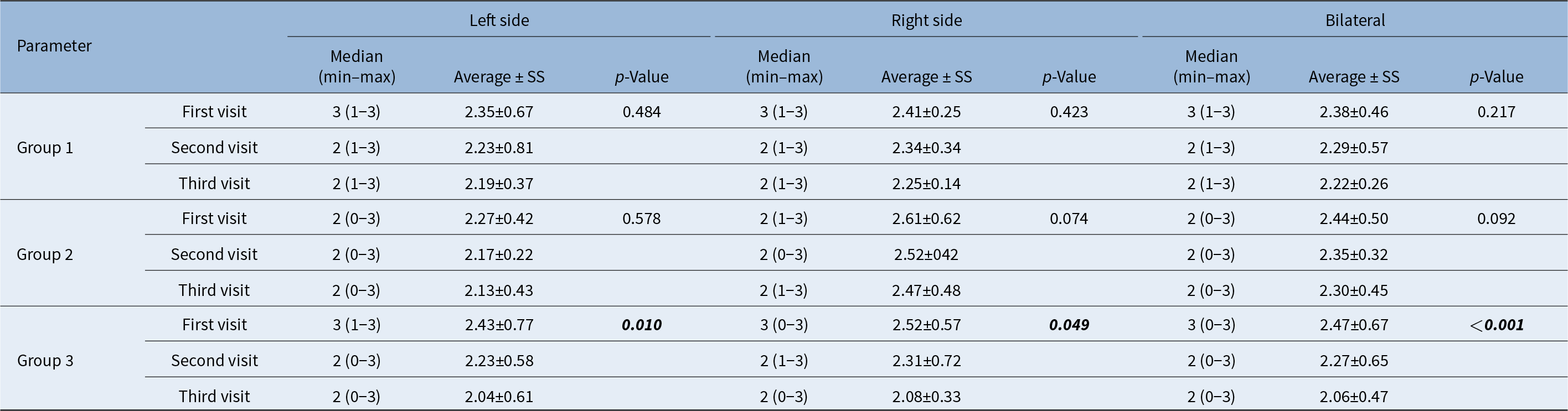
The average bilateral polyp stages were found to be 2.34 ± 0.79 at the first visit, 2.05 ± 0.81 at the second visit and 2.04 ± 0.78 at the third visit (Table 2). When the distribution of polyp stages during visits was examined, the reduction in polyp stages on the left side (p = 0.010), right side (p = 0.049) and bilateral polyp stages (p < 0.001) in group 3 was found to be statistically significant (Table 2). In pairwise comparisons conducted to determine between which visits the difference occurred, the changes in polyp stages on the left side and bilaterally were from the first to the second and third visits. The changes in polyp stages on the right side between the first and third visits were found to be statistically significant (p < 0.05).
Inter-visit changes in nasal polyps in the treatment groups

A significant increase in KOS was observed in patients from group 1 and group 2 (p = 0.016, p = 0.005, respectively) (Table 3). A significant reduction in LMS was found in patients from group 2 and group 3 (p = 0.045, p = 0.049, respectively). There was no significant change in SNOT-22 scores between visits in any of the groups (see Table 3).
SNOT-22, Lund–Mackay Score and Kennedy Osteitis Score scores in the treatment groups

SNOT-22 = Sinonasal Outcome Test-22.
Discussion
According to guidelines, the application of ICS and nasal saline still forms the basis of treatment for CRSwNP.Reference Fokkens, Lund, Hopkins, Hellings, Kern and Reitsma3 ICS have been used for many years in the medical treatment of CRSwNP.Reference Fokkens, Lund, Mullol, Bachert, Alobid and Baroody1 According to the EPOS guidelines, ICS improve nasal symptoms and quality of life scores in patients with chronic rhinosinusitis. In patients with CRSwNP, they prevent post-operative recurrence.Reference Fokkens, Lund, Hopkins, Hellings, Kern and Reitsma3 Johansen et al. reported that ICS reduced nasal discharge, nasal congestion and nasal itching by 50 per cent in CRSwNP patients and that changes in scores persisted for three months in 68 per cent of patients.Reference Vendelo Johansen, Illum, Kristensen, Winther, Vang Petersen and Synnerstad10 According to the authors, one of the main disadvantages of the treatment is that the effect does not continue after the treatment is discontinued. In our study, changes in polyp size were not statistically significant in the group using only ICS. No significant increase or decrease was observed in LMS in these patients. However, an increase in KOS was noted over time during follow-up in this group. Due to these findings, ICS alone may not be sufficient for the treatment of CRSwNP. This finding is indeed unexpected. The short-term benefits of intra-nasal steroids and saline irrigation have been well-documented across numerous publications. Further, more comprehensive studies may be necessary to evaluate long-term outcomes accurately.
It has been reported that the long-term use of low-dose macrolide and doxycycline antibiotics in patients with chronic rhinosinusitis has an immunomodulatory effect by reducing neutrophil infiltration, the production of proinflammatory cytokines and mucus secretion.Reference Lees, Orlandi, Oakley and Alt11 In patients with CRS, it is recommended to use half of the dose typically administered for acute infections for both macrolides and doxycycline.
It has been reported that macrolide antibiotics, due to their anti-inflammatory and immunomodulatory effects, may be beneficial in the treatment of persistent CRS that is resistant to both medical and surgical treatments.Reference Lees, Orlandi, Oakley and Alt11, Reference Suzuki, Shimomura, Ikeda, Oshima and Takasaka12, Reference Haruna, Shimada, Ozawa, Fukami and Moriyama13 Rhee et al. noted that various physical properties of the mucosa improved in patients treated with macrolides.Reference Rhee, Majima, Arima, Jung, Jinn and Min14 It has been reported that, when clarithromycin is used in combination with nasal steroids in patients with CRSwNP and CRS without nasal polyps, it reduces all symptom scores and the improvement continues for two months.Reference Deng, Chen, Lai, Luo, Xu and Ou15 After both treatments, quality of life was observed to improve in both treatment groups according to the SNOT-22 score. In our study, while changes in polyp size and SNOT-22 scores were not statistically significant in patients treated with macrolide antibiotics, a significant reduction in LMS was observed. In this group, a significant increase in KOS was noted.
Doxycycline, in addition to its antimicrobial properties, is a tetracycline group drug with immunomodulatory effects. It inhibits matrix metalloproteinase-9 activity, which has been shown to increase in CRSwNP.Reference Watelet, Bachert, Claeys and Van Cauwenberge16 Doxycycline also reduces eosinophil and neutrophil activity by lowering levels of eosinophilic cationic protein and myeloperoxidase in nasal secretions. Additionally, it reduces the harmful effects of free radicals, decreases nitric oxide synthase levels and suppresses proinflammatory cytokines such as tumor necrosis factor alpha (TNF-a), interleukin (IL) -1b and IL-6.Reference Van, Gevaert, Holtappels, Beule, Wormald and Mayr17, Reference Van, Gevaert, Watelet, Claeys, Holtappels and Claeys18
In our study, in addition to ICS, low-dose doxycycline treatment was administered for approximately two months. A significant reduction in polyp stages and LMS was observed in patients who used doxycycline. In contrast to the increase observed in the other two groups, no significant change was noted in SNOT-22 score. In a study conducted on patients with CRSwNP, a 12-week course of doxycycline was initiated for patients with persistent symptoms despite appropriate medical and surgical treatment, and significant improvement in symptoms and nasal endoscopic findings was observed after treatment.Reference Nishi, Mizuguchi, Tachibana, Ooka, Amemiya and Myou19 Van Zele et al. reported patients who used doxycycline for 20 days experienced a moderate reduction in polyp size, which was maintained for 12 weeks. However, no significant differences were found in nasal congestion scores, nasal inspiratory peak flow, rhinorrhoea symptoms or loss of smell.Reference Van, Gevaert, Holtappels, Beule, Wormald and Mayr17 Similarly, in our study, no significant improvement was observed in symptom scores assessed with the SNOT-22.
The main limitations of our study are the small number of patients and the short follow-up period. Additionally, no side effects were observed during the long-term use of low-dose antibiotics.
• The use of antibiotics in chronic sinusitis has been debated for many years. In the latest guidelines, the use of clarithromycin has started to be recommended
• This study thoroughly examines the long-term effects of different antibiotics in patients with chronic sinusitis
Conclusion
Our results suggest that significant clinical and radiological improvement can be achieved with the addition of doxycycline to ICS therapy. It should be considered that doxycycline group antibiotics could be a treatment option as part of the management of CRSwNP.
Acknowledgment
None declared.