‘Songs of our land, ye are with us forever’, sang Donegal’s ‘blind poetess’ Frances Brown in the 1840s, but she was wrong. Although feted and garlanded in her time, and awarded a pension by Prime Minister Robert Peel (not a noted lover of Ireland, as we shall see), she and her stirring anthems are virtually forgotten now. Histories, like songs and poems, belong to the time in which they are written, and inevitably reflect their writers’ interests, preoccupations and experiences. This concise history is written by an Irish female born in 1960 and reared in an urban, lower-middle-class Catholic extended family in which there was as strong a devotion to history in all its forms (political, social, archaeological, local, national, international and, of course, familial) as there was to religion. Nearly forty-five years of ‘doing history’ – learning, researching, writing, teaching, reading, lecturing and talking to people – has reinforced the early childhood conviction that study of the past is both a worthwhile pursuit and a pleasant use of one’s time. The late Raphael Samuel was right when he declared that history was a pastime as well as a passion, ‘a social form of knowledge; the work, in any given instance, of a thousand different hands’. The bibliography at the end of this book gives a list of the many secondary works consulted in the writing of this history, but the sense of the past which drives this narrative comes from numberless influences, sights, memories, sounds and stories absorbed over a lifetime, which would take another lifetime to list and to catalogue, assuming they could all be remembered.
This history follows the conventional timeline of nationalist Irish history, because events like the coming of Christianity, the Scandinavian and Norman invasions and the wars of the bloody sixteenth and seventeenth centuries really did change the lives of people in Ireland, and added new cultural and ethnic elements into the population. Headlining invasions, wars and changes in political leadership, however, can give the impression of a people lurching from crisis to crisis, always losing, always lamenting. ‘It would never be spring, always autumn | After a harvest always lost’, Patrick Kavanagh wrote in 1944, in ‘Memory of Brother Michael’, about the one of the seventeenth-century Four Masters who wrote a history of Ireland which (unsurprisingly for the time) emphasized defeats and losses. Kavanagh’s two lines have stayed in the back of my mind for almost half a century, as a warning against exaggeration of the victim narrative in writing about any oppressed or ‘marginal’ people. Ireland’s history, while it had its traumatic moments, was a lot less ‘distressful’ than that of many other small islands in the world, and there were, in Ireland as elsewhere, long periods of peace and normality throughout these sixteen centuries. The hidden history of Ireland, like that of any country, is the story of the vast majority of people of all classes and conditions who got on (when they were able to do so) with living, working and caring for each other as best they could, who, in George Eliot’s resonant words, ‘lived faithfully a hidden life, and rest in unvisited tombs’.
This concise history is aimed at anybody newly interested in Ireland, or in history, or anyone who wants a convenient ‘starter’ reference book. It is the history of Ireland from the coming of Christianity in or around ad 432 (and the beginning of written records), to the centenary of the 1916 Rising in Ireland and Brexit (the United Kingdom’s vote to leave the European Union) in Northern Ireland, in 2016. The emphasis is on telling a story, and every attempt has been made to present a fair and balanced picture of Ireland over 1,600 or so years. Discerning readers are invited to make up their own minds on controversial topics by reading further into the subject, in the books and articles listed at the end. More space is given in this history to Irish history after 1541 than to early and late medieval history. This would be true of any survey history of any country, firstly because there are far more sources for the later centuries, but secondly because comparatively recent events which shaped the modern political and social sphere seem to require more explanation. This might give the impression that the millennium from the fifth to the sixteenth century was somehow static or unchanging. It was not. Apart from the invasions from the eighth to the twelfth centuries, agriculture and trade developed, religion went through several cycles of corruption and reform (even before the Reformation), fortunes were made and lost, urban settlements grew and others declined, dwellings were built and eventually toppled or absorbed back into the landscape, and new methods of communications, commerce and defence developed to cope with changing circumstances. It is hoped that the two chapters which cover these 1,100 years will spur the interested reader to a closer examination of an Ireland whose traces – in the form of grassed-over ring forts, ruined monasteries, round towers and old castles – are everywhere.
Irish people have been described by outsiders for so much of their history (since at least the eleventh century) that it is impossible to disentangle their sense of who they were or are from their reactions to outsiders’ descriptions of them. Questions of ‘identity’ have been discussed at great length by historians, literary scholars, political scientists, sociologists, anthropologists, and many others. This history considers all people, regardless of origin, who made their permanent homes anywhere on the island from the fifth to the twenty-first centuries as ‘Irish’, whether they would have accepted or rejected such a designation. Of course, their origins (Anglo-Norman, New English, Scottish/English) often have to be specified, so as to explain their allegiances and loyalties. But it is not only confusing but downright inaccurate to refer to politically privileged landowning Protestants from the eighteenth century onwards as the ‘Anglo-Irish’. Ireland from the late seventeenth century had some powerful Protestant O’Briens, O’Haras, Conollys, O’Neills, and others whose origins went back before the Norman invasion. Also, many who were of settler stock came to describe themselves as Irish too, developing a distinctive identity within the greater British polity. Even the descendants of the northern Protestant settlers of the seventeenth century spoke with Irish accents, used Irish idioms and place names, understood some Irish and became attached to their native soil. ‘My country is Kiltartan Cross | My countrymen Kiltartan’s poor’, wrote W. B. Yeats during the Great War in the voice of Major Robert Gregory of Co. Galway, in ‘An Irish Airman Foresees His Death’. Gregory, whose mother was the famous Augusta (Lady) Gregory, belonged to the landlord class; should his love of place (even at one remove through the mouth of Yeats) be reckoned less sincere than that of a thousand poems and songs written in Irish eulogizing the country in part or in whole?
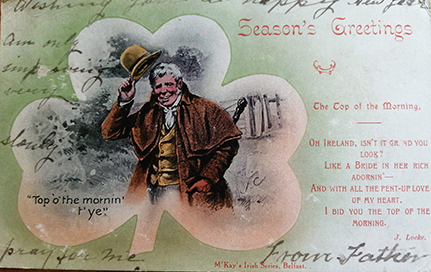
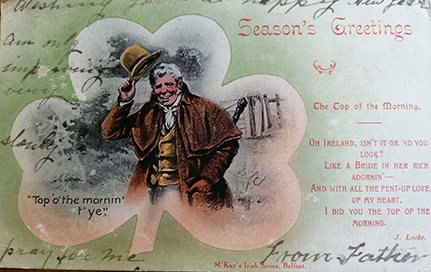
A very popular ‘recitation’, written by John Locke, which many Irish people born between the 1890s and the 1920s knew off by heart, begins with the words: ‘Glory be to God but there it is | The dawn on the hills of Ireland!’ (Figure 0.1) It goes on:
Postcard: ‘Top of the Morning’. From author’s personal collection. This postcard, incorporating Locke’s famous verse, was sent by a man from east Clare to his son in Boston, USA, around 1910 or 1912. (The stamp and postmark are missing.) A later generation of Irish people would reject such images as ‘stage-Irish’, but they were very popular in the early twentieth century.
Geological time being what it is, the dawn on the hills of Ireland is not that different today from what the young Patrick, chained in his slave ship, saw in the fifth century, although in his case, the love would come later. Our story begins with him and with the coming of Christianity, which brought modern writing and the beginning of written records, and forged new bonds with Britain and much of the European continent.