Palms are one of the groups of plants most dependent on scatter-hoarding rodents for seed dispersal in the Neotropics (Smythe Reference SMYTHE1989, Terborgh Reference TERBORGH and Soule1986). As a strategy to ensure food supply, rodents store excess seeds during times of high fruit abundance, carrying (i.e. dispersal effect) and burying seeds in caches (i.e. burial effect) usually away from parent trees (Vander Wall Reference VANDER WALL1990). As a consequence, seed caching favours seed survival since seeds in caches have lower chances of being detected and subsequently predated by invertebrates and other foraging vertebrates (Janzen Reference JANZEN1970, Kuprewicz Reference KUPREWICZ2015, Vander Wall Reference VANDER WALL1990). When fruit availability declines, rodents gradually recover seed caches; a portion of them, however, may not be recovered by rodents and can successfully establish as seedlings (Forget Reference FORGET1997, Jansen et al. Reference JANSEN, BONGERS and HEMERIK2004, Smythe Reference SMYTHE1989).
Direct evidence linking seed caching to palm seedling establishment is, however, still scarce and mainly based on artificial cache experiments (Kuprewicz Reference KUPREWICZ2015, Smythe Reference SMYTHE1989). Most studies suggesting ecological implications of scatter-hoarding for seedling recruitment have presented indirect field evidence (Xiao & Krebs Reference XIAO and KREBS2015), e.g. survival rates of cached seeds or decreased seedling recruitment in defaunated forests as a result of local extinction or lower population density of scatter-hoarders (Brewer & Webb Reference BREWER and WEBB2001, Donatti et al. Reference DONATTI, GUIMARÃES and GALETTI2009, Galetti et al. Reference GALETTI, DONATTI, PIRES, GUIMARÃES and JORDANO2006, Klinger & Rejmánek Reference KLINGER and REJMÁNEK2010, Wright & Duber Reference WRIGHT and DUBER2001). Besides, it remains questionable whether seed scatter-hoarding favours seedling establishment mainly through dispersal or burial effects (Xiao & Krebs Reference XIAO and KREBS2015). Attempts to disentangle those effects are needed to understand how palms may benefit from scatter-hoarding in a complex way.
In this study, we aimed to investigate how scatter-hoarders can contribute to early recruitment of two large-seeded palm species in the Atlantic Forest in Brazil. We propose a method using naturally established seedlings of the palms Astrocaryum aculeatissimum and Attalea humilis to evaluate to what extent seedling establishment is favoured by seed caching by rodents. Since dispersal and burial are expected to increase seed survival, we hypothesize that seedlings established primarily from dispersed and buried seeds (hereafter also referred to as endocarps).
We collected data in March–April 2014 at the Poço das Antas Biological Reserve (22°30′S, 42°14′W), a large remnant of Atlantic Forest in Rio de Janeiro state, Brazil, comprising 6300 ha of submontane rain forest. The palms A. aculeatissimum and A. humilis are endemic to the Atlantic Forest biome (Henderson et al. Reference HENDERSON, GALEANO and BERNAL1995). Both species produce large fruits (2.5–4 cm and 2.5–8 cm in diameter for A. aculeatissimum and A. humilis respectively; Dracxler et al. Reference DRACXLER, PIRES and FERNANDEZ2011, Henderson et al. Reference HENDERSON, GALEANO and BERNAL1995) containing stony endocarps which are dispersed and preyed upon by the same guild of scatter-hoarding rodents, including the agouti (Dasyprocta leporina), a squirrel (Guerlinguetus ingrami) and the spiny rat (Trinomys sp.) (Andreazzi et al. Reference ANDREAZZI, PIRES and FERNANDEZ2009); A. humilis is also consumed by the paca (Cuniculus paca) and other non-hoarding animals (Dasypus novemcinctus, Didelphis aurita) (Andreazzi et al. Reference ANDREAZZI, PIRES and FERNANDEZ2009). The two palm species are infested by the same scolytine beetle (Coccotrypes sp.) but by different bruchid species: Caryoborus serripes larvae infest A. aculeatissimum seeds enclosed in entire fruits, Speciomerus giganteus larvae can only infest A. humilis seeds after being defleshed by rodents, making the latter less susceptible (Dracxler Reference DRACXLER2012). Therefore, we hypothesize that A. aculeatissimum has a relatively higher dependence on the combined effects of seed dispersal and burial for seedling establishment than A. humilis.
To evaluate seedling recruitment, we first searched for adult palm individuals, identified by the presence of infructescences or vestiges of previous fruiting events. We set circular plots of 15-m radius around five adult individuals of each palm species, totalling a sampling area of 0.35 ha per species. Since seed density is expected to decrease as distance from the parent tree increases and seed dispersal area is expected to increase (Janzen Reference JANZEN1970), setting circular plots allowed us to eliminate bias based on distance-dependent seed density (Cramer et al. Reference CRAMER, MESQUITA and WILLIAMSON2007). To avoid possible effects of different adult palm densities, we placed plots around adult palms isolated at least 50 m from any conspecific adult. In addition, to maximize independence between plots, each focal adult individual was located at least 1 km away from another conspecific focal individual. Moreover, because fruits can slide away from parent palms located in slopes and to avoid overestimation of seed dispersal events, all focal individuals were located in flat areas. Within each plot we searched for conspecific seedlings (according to the focal palm species), considering only seedlings smaller than 50 cm in height; the ontogenetic criterion was defined in order to evaluate early seedling establishment and based on previous studies on the palm species (Portela & Santos Reference PORTELA and SANTOS2011, Souza et al. Reference SOUZA, MARTINS and SILVA-MATOS2000). Seedlings of both palms can be easily detected even in highly dense understorey. Besides, both palms have thick endocarps, which remain attached for at least 2 y to the growing seedling and can be detected both under and on the ground surface.
To test for the dispersal effect on seedling establishment, we mapped the location of conspecific seedlings in each plot, checking if they originated from a non-dispersed or from a dispersed seed. Seedlings found up to 2 m from the focal adult palm (i.e. under the palm crown) were considered as originating from non-dispersed seeds, while seedlings located from 2 m up to 15 m away from adults were considered as originating from dispersed seeds. For both palms, non-dispersed fruits are found on the soil surface beneath palm crowns (c. 2 m radius from the base of the palm stem) after falling down from the infructescence (Andreazzi et al. Reference ANDREAZZI, PIMENTA, PIRES, FERNANDEZ, OLIVEIRA-SANTOS and MENEZES2012, Dracxler et al. Reference DRACXLER, PIRES and FERNANDEZ2011). Additionally, for each seedling we recorded whether it established from seeds buried in the soil by rodents or from seeds left on the ground surface by carefully checking the location of the endocarp from which the seedling established. Firstly, we carefully searched for the endocarp on the soil surface around the seedling, and if it was not found, we searched for the endocarp by excavating the area around the seedling (up to 15 cm in the soil). If the endocarp attached to the seedling was found on the soil surface, we considered that the seedling established from an unburied seed; alternatively, if the endocarp was found inside the soil we considered it to be established from an endocarp buried by rodents. Since endocarps were found preserved and deeply buried in the soil, similar to descriptions of burial by rodents in seed-fate studies (Smythe Reference SMYTHE1989), we could accurately identify this as the result of seed caching. Moreover, although processes such as flooding and trampling by large mammals can eventually bury seeds in the soil (Beck Reference BECK, Forget, Lambert, Hulme and Vander Wall2005, Zwolak & Crone Reference ZWOLAK and CRONE2012), none of these processes could justify seed burial in the study area since sampling was conducted in non-flooded areas and large mammals such as the white-lipped peccary (Tayassu pecari) and the tapir (Tapirus terrestris) are absent in the area (Araújo et al. Reference ARAÚJO, DE SOUZA and RUIZ-MIRANDA2008). Even considering that seedlings can be used as a cue for scatter-hoarders to recover cached seeds, and that re-caching and pilferage events are expected to occur (Jansen et al. Reference JANSEN, HIRSCH, EMSENS, ZAMORA-GUTIERREZ, WIKELSKI and KAYS2012), by checking the location of seeds attached to established seedlings, this method can be used to evaluate the final contribution of scatter-hoarding to palm seedling establishment.
We performed ANOVA tests to investigate effects of seed dispersal and seed burial on palm seedling establishment. The response variable was the number of seedlings (and its attached endocarp) classified according to the explanatory variables dispersal effect (dispersed vs non-dispersed seed) and burial effect (buried vs unburied seed). We also included palm species as an explanatory variable to check for differences between them. Statistical analyses were performed in R version 2.15.
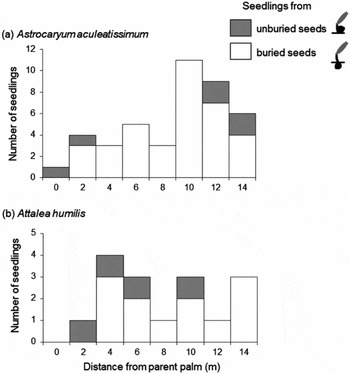
We found a total of 42 A. aculeatissimum seedlings and 16 A. humilis seedlings. Average seedling density in plots was 0.01 ± 0.006 m−2 for A. aculeatissimum and 0.004 ± 0.003 m−2 for A. humilis, similar to previous studies (Dracxler et al. Reference DRACXLER, PIRES and FERNANDEZ2011, C.M. Dracxler unpubl. data). Seed dispersal had a stronger positive effect on seedling establishment than burial of seeds for both palm species; virtually all seedlings (except for one A. aculeatissimum seedling) were established from seeds dispersed away from parents (df = 1, F = 18.0, P < 0.0001), and there was no significant difference between palm species (df = 1, F = 3.3, P > 0.05) (Figure 1). Seedlings of both species were mainly located between 10 to 15 m from parents (Figure 1). We found a significant effect of burial for both species, with the majority of seedlings of A. aculeatissimum (83%) and A. humilis (75%) established from buried seeds (df = 1, F = 7.5, P < 0.01), and there was no significant difference between palm species (df = 1, F = 2.3, P > 0.05) (Figure 1).
Number of seedlings of Astrocaryum aculeatissimum (a) and Attalea humilis (b) at different distances from the nearest conspecific adult palms at Poço das Antas Biological Reserve, Atlantic Forest, Brazil. Seedlings found 0–2 m from the focal adult palm individual were considered to be established from non-dispersed seeds, while seedlings found from 2 m up to 15 m were considered to be established from dispersed seeds. The white and grey portions of the bars represent numbers of seedlings established from buried and unburied seeds, respectively.

In this study, we provide direct evidence through a novel method that scatter-hoarding rodents equally contribute to seedling establishment of the two palm species by the combined effect of seed dispersal and seed burial. By checking natural seedling establishment, we found that nearly all seedlings established from seeds buried away (>2 m) from the base of parent palms.
In small defaunated Atlantic Forest remnants, where seeds of the two palm species were found to accumulate beneath parents due to the lack of seed dispersal, Dracxler (Reference DRACXLER2012) reported high levels of invertebrate seed infestation for both A. aculeatissimum and A. humilis, resulting in virtually no seedling recruitment around parents. Indeed, our results show that most seedlings were found 10 m or more from the nearest conspecific adults, suggesting dependence of the palms on seed dispersers as a strategy to escape seed predation, increasing chances of seeds to germinate and establish as seedlings.
Our findings also indicate a dependence on seed burial for the recruitment of new individuals of both palm species, overall suggesting positive effects on seed survival. Indeed, all seeds buried by scatter-hoarders and attached to the seedlings were intact, i.e. without vestiges of invertebrate infestation. Kuprewicz (Reference KUPREWICZ2015) reported that most buried seeds experimentally placed in a tropical forest escaped from vertebrate and invertebrate predation, positively affecting germination success. Scatter-hoarding rodents may take into account the seed value to make foraging decisions of seed consumption, burial and re-caching (Wang et al. Reference WANG, YE, CANNON and CHEN2013, Xiao & Krebs Reference XIAO and KREBS2015), usually caching larger and more nutritious seeds, while preferring to immediately consume smaller and low-value seeds during the hoarding process (Jansen et al. Reference JANSEN, BONGERS and HEMERIK2004). This seed trait selection may favour seedling establishment since increasing seed weight can confer an advantage to developing seedlings (Kuprewicz Reference KUPREWICZ2015).
The net outcome of seed caching for plants depends on several aspects of plant–rodent interactions, such as seed traits, rates of seed predation, seed caching and seed recovery. However, as pointed out by Zwolak & Crone (Reference ZWOLAK and CRONE2012), measuring all components determining the consequences of scatter-hoarding for plants can be particularly challenging, and logistical issues may limit our understanding about the mechanisms by which seed caching can favour seedling establishment. Here we conclude that accurate inferences can be achieved by a simple field method using the location of seedlings and the status of the seed from which it established, highlighting the importance of scatter-hoarding rodents to palm seedling recruitment.
ACKNOWLEDGEMENTS
We are very grateful to Rita Portela for her support to conduct fieldwork, Adilson Martins Pintor for field assistance and the staff of Poço das Antas Biological Reserve and the Brazilian environmental agency ICMBio/SISBIO for permission to conduct fieldwork (license # 43006-1). We also thank Erik Koenen for English language editing and two anonymous referees for reading a previous version of this manuscript and offering valuable comments. Financial support was provided by CAPES and UMR 7179 CNRS-MNHN.