Introduction
Traumatic optic neuropathy is very common in patients with closed head injuries.Reference Chou, Sadun and Chen1 It has been suggested that both direct and indirect mechanisms account for such optic nerve pathology. Direct optic injury usually results from optic nerve avulsion or laceration, or from direct fracture of the optic canal (with bony fragments injuring or transecting the optic nerve). Indirect optic injury is caused by increased intracanalicular pressure after an injury, which usually initiates a cascade of molecular and chemical mediators leading to secondary disorders such as intraneural oedema, haematoma, altered microvasculature or cerebrospinal fluid (CSF) circulation, and interruption of direct axoplasmic transport.Reference Sarkies2
The prognosis of direct optic injury is usually poor. Cases with complete disruption of the optic nerve will not recover, regardless of medical or surgical treatment. However, secondary injuries, such as oedema, haematoma or moderate bony optic nerve compression, may derive benefit from treatment.Reference Carta, Ferrigno, Salvo, Bianchi-Marzoli, Boschi and Carta3
Until recently, the best treatment for traumatic optic neuropathy remained unknown. Recommendations in the literature included medical therapy, surgical treatment, and medical therapy combined with surgical decompression. High-dose steroid therapy is the primary medical treatment for traumatic optic neuropathy. High-dose steroids have different pharmacological actions in suppressing the chemical cascade which leads to secondary optic nerve injury, compared with low-dose steroids.Reference Spoor, Hartel, Lensink and Wilkinson4 Surgical decompression is effective due to release of intracanalicular tension on the optic nerve, especially in patients with indirect lesions of the optic nerve.
Endoscopic optic nerve decompression is a less invasive procedure than other forms of extracranial optic nerve decompression.Reference Joseph, Lessell, Rizzo and Momose5, Reference Osguthorpe6 It has been widely applied in the treatment of traumatic optic neuropathy.Reference Kountakis, Maillard, Urso and Stiernberg7 Since 1997, we have performed optic nerve decompression using a nasal endoscope in patients with optic neuropathy.
In this study, we report outcomes for patients with traumatic optic neuropathy treated with both endoscopic optic nerve decompression and high-dose steroids. We also discuss our experience of this technique.
Materials and methods
Subjects
From February 1997 to March 2006, 237 patients with traumatic optic neuropathy were treated in our hospitals. Of these, 189 were male and 48 were female. The average age was 32.7 years (range 18–54 years). All patients were treated by one ophthalmologist and underwent a complete examination to evaluate visual impairment. A high resolution computed tomography (CT) scan was then performed to evaluate the orbit and optic canal.
Of these 237 cases of traumatic optic neuropathy, the main cause was motor vehicle accidents (198 cases), followed by falls (25 cases), accidental trauma (five cases), assault (two cases) and other reasons (seven cases). Of the 237 patients, 92 suffered immediate visual loss after the trauma, while 129 presented with secondary visual loss following the trauma, and 16 were unable to define the onset of visual loss due to a period of unconsciousness.
Once the diagnosis of traumatic optic neuropathy had been established, all patients were treated with high-dose dexamethasone (30 mg/day) intravenously for three days, followed by 20 mg/day for three days and 10 mg/day for three days. In order to assess visual outcome, all patients were categorised into the following two groups. Group A comprised 108 patients suffering immediate blindness after trauma (including the 16 patients unable to define their onset of blindness); 89 of these patients consented to endoscopic surgery. Group B comprised 129 patients with gradual visual loss after trauma; 87 of these consented to endoscopic surgery.
The study was approved by the local institutional review board, and informed consent was obtained from all patients.
Surgical procedure
Patients were prepared in the routine manner for endoscopic sinus surgery under general anaesthesia. Cotton pledgets soaked in adrenaline solution were placed in the nasal cavity to ensure vasoconstriction.
Routine endoscopic ethmoidectomy and sphenoidotomy were first performed. When the sphenoid sinus was opened and the ostium was enlarged, the optic nerve canal and carotid artery canal were identified. The orbital apex and optic ring were then dissected to expose the lateral wall of the sphenoid sinus. Under endoscopic observation, a long hand microdrill with a diamond burr was used to remove the medial wall of the bony optic canal. In order to avoid thermal injury to the optic nerve, frequent irrigation was needed. With this technique, the optical canal was drilled 180° medially from the optic tubercle to near the optic chiasm until the bony canal became very thin. A special elevator was then used to elevate the thin bony canal from over the optic nerve. Extreme care was taken not to exert pressure on the optic nerve with the elevator. Finally, the optic nerve sheath and the annulus of Zinn were incised with a delicate sickle knife, exposing the fasciculus opticus proper, as the optic nerve sheath and the annulus of Zinn may potentially contribute to pressure on the optic nerve. An absorbable gelatin sponge was placed in the cavity.
Evaluation and statistics
After hospital discharge, patients received regular follow up for at least three months, including visual acuity and field chart testing. A patient's vision was considered to have improved if they showed: an increase of two lines or more on the Snellen visual chart; or a 10 per cent improvement in their visual field; or an improvement from light perception to hand motion, or from hand motion to finger-counting.
The chi-square test was used to evaluate differences between the vision of patients treated with steroids alone versus those treated with steroids and surgery. Statistical significance was achieved at p < 0.05.
Results
Safety and efficacy of endoscopic optic nerve decompression
Of 237 patients with traumatic optic neuropathy, 176 patients consented to undergo endoscopic optic nerve decompression. All these procedures were successful. Major complications were as follows: severe bleeding for an injury of the ophthalmic artery in one case; CSF rhinorrhoea in three cases; and orbital infection in two cases. All of these complications were appropriately treated during or after the procedure. After three months' follow up, surgery did not appear to have worsened any patients' vision.
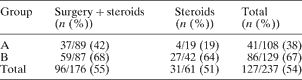
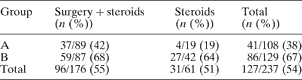
The total vision improvement rate in the 176 patients treated with steroids and surgery was 55 per cent (96/176). The total vision improvement rate in patients treated only with steroids was 51 per cent (31/61). The difference between these two outcomes was not statistically significant (p = 0.615). However, in group A (patients with immediate blindness), the total vision improvement rate was 38 per cent (41/108), while the total vision improvement rate in group B (patients with gradual visual loss) was 67 per cent (86/129). The difference between these two outcomes was statistically significant (p = 0.001), as presented in Table I.
Vision Improvement Rates in 237 Patients: Surgical Decompression Plus Steroids vs Steroids Alone
See text for definitions of groups A and B, and visual improvement.
In group A, the vision improvement rate was 19 per cent (4/19) in patients treated with steroids alone and 42 per cent (37/89) in those treated with steroids and surgery. This difference was not statistically significant (p = 0.158). In group B, the vision improvement rate was 64 per cent (27/42) in patients treated with steroids alone and 68 per cent (59/87) in those treated with steroids and surgery. Similarly, this difference was not statistically significant (p = 0.69).
Factors influencing outcomes of endoscopic optic nerve decompression
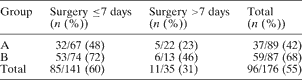
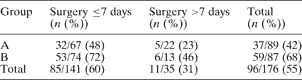
As presented in Table II, the total vision improvement rate was 42 per cent (37/89) in group A and 68 per cent (59/87) in group B; this difference was statistically significant (p = 0.001). Of the 176 patients treated with steroids and surgery, 141 underwent surgery within seven days and showed a vision improvement rate of 60 per cent (85/141), while 35 underwent surgery more than seven days after their trauma and showed a vision improvement rate of 31 per cent (11/35) (p = 0.002). Patients in group A undergoing surgery within seven days showed a vision improvement rate of 48 per cent, and those undergoing surgery after seven days showed a vision improvement rate of 23 per cent (p = 0.039). Patients in group B undergoing surgery within seven days showed a vision improvement rate of 72 per cent, and those undergoing surgery after seven days showed a vision improvement rate of 46 per cent (p = 0.07) (Figure 1).
Vision improvement rates in 176 surgically decompressed patients who underwent surgery within or beyond seven days after trauma.

Vision improvement rates in 176 surgically decompressed patients: surgery ≤7 days vs >7 days
See text for definitions of groups A and B, and visual improvement.
Discussion
It is well accepted that the endonasal approach has many advantages for treating traumatic optic neuropathy, including: less invasiveness, excellent visibility, rapid recovery time, preservation of olfaction and decreased morbidity.Reference Luxenberger, Stammberger, Jebeles and Christian8, Reference Jiang, Hsu and Shen9 Since 1997, we have performed endoscopic optic nerve decompression successfully in 176 patients with traumatic optic neuropathy. None of our patients experienced worsened vision as a result of such endoscopic treatment. Our results indicate that endoscopic optic nerve decompression is a very safe treatment for patients with traumatic optic neuropathy.
In this study, we found that the outcomes for patients who received surgery plus steroids were not significantly better than for those for patients receiving steroids alone. This was true regardless of whether patients had suffered immediate or gradual onset blindness. However, following surgical decompression, the vision improvement rate was 38 per cent in patients with immediate blindness and 67 per cent in those with gradual onset blindness, a significant difference. In summary, our results suggest that endoscopic decompression is helpful in patients with optic nerve injury causing gradual onset blindness, while it is less beneficial for those with optic nerve injury causing immediate blindness. Since this was not a randomised study, it is difficult to make definitive comparisons between the surgical and non-surgical groups, as they may have differed with respect to other factors.
The management of traumatic optic nerve injury is controversial. There is no optimal management protocol available. The use of high-dose steroids after optic nerve injury increased in the 1980s. The rationale was that steroids may reduce post-traumatic oedema, contusion necrosis and vasospasm and thus aid functional recovery.Reference Yip, Chng, Au Eong, Heng, Lim and Lim10 Following steroid therapy, improvements of between 44 and 82 per cent have been reported.Reference Lew, Lee, Jang, Kim, Kang and Kim11, Reference Yang, Chen, Tsay, de Villa, Tsai and Chen12 Thus far, the largest series of such steroid therapy has been reported by the International Optic Nerve Trauma Study group, which found a 54 per cent improvement in patients after three months' follow up. Interesting, 57 per cent of untreated patients in this series showed visual acuity improvement, indicating spontaneous remission. The study found no clear benefit for high-dose steroid therapy or canal decompression surgery, compared with observation alone.Reference Levin, Beck, Joseph, Seiff and Kraker13
The indications for endoscopic optic nerve decompression are also under debate.Reference Perry14 It is generally suggested that such surgery be performed only when high-dose steroid therapy has failed. In Thakar and colleagues' report,Reference Thakar, Mahapatra and Tandon15 delayed endoscopic optic nerve decompression was suggested to be a ‘salvage operation’, performed when the response to conventional-dose steroids had been inadequate and no further visual improvement was forthcoming. However, in Rajiniganth and colleagues' report,Reference Rajiniganth, Gupta, Gupta and Bapuraj16 endoscopic optic nerve decompression was performed in cases in which there was: (1) failure of vision improvement after 72 hours of methylprednisone therapy; or (2) progressive visual loss during steroid therapy. Furthermore, total blindness with CT evidence of optic nerve compression was also recommended as an indication for such surgery.
• The aim of this study was to assess the outcome of treating traumatic optic neuropathy with steroids and endoscopic surgical decompression
• A total of 237 patients with traumatic optic neuropathy were treated with steroids, 176 of whom also consented to undergo endoscopic optic nerve decompression
• Outcomes for patients receiving surgery plus steroids were not significantly better than those for patients receiving steroids alone; this was true regardless of whether patients had suffered immediate post-traumatic blindness or gradual visual loss
• Results suggest that endoscopic decompression is helpful in patients with optic nerve injury suffering gradual onset of vision loss, but is less beneficial in those suffering immediate blindness
Widespread use of the endoscopic technique would change the risk–benefit ratio of decompression surgery completely. The endonasal approach had many advantages, including: less invasiveness, excellent visibility, rapid recovery time, preservation of olfaction and decreased morbidity. These factors will hopefully encourage the patient to opt for surgical rescue. Based on the findings of the present study, we recommend endoscopic optic nerve decompression on two bases – severity of optic injury and risk–benefit ratio of surgery – even though we are as yet unable to ascertain all the prognostic factors of traumatic optic neuropathy.Reference Kountakis, Maillard, El-Harazi, Longhini and Urso17 Our findings demonstrate that, in cases of traumatic optic neuropathy, endoscopic optic nerve decompression results in significantly better vision improvement rates in patients with gradual vision loss, compared with those with immediate blindness (68 vs 42 per cent, respectively). Furthermore, we found that early endoscopic decompression surgery (i.e. within one week) is also an important prognosis factor, being associated with a vision improvement rate of 60 per cent, compared with 31 per cent for patients undergoing such surgery more than seven days after their trauma. For patients with a poor prognosis (i.e. immediate post-traumatic vision loss and no response to steroid therapy), we would recommend early endoscopic decompression surgery. In cases of severe vision loss with evidence of optic nerve compression, we do not believe it necessary to wait several days to assess the response to steroid therapy before considering endoscopic decompression surgery (provided that the risk–benefit ratio of surgery has been considered). For the patient who retains some functional vision, it is also prudent to undertake surgical decompression.
Conclusion
In this study, we found that endoscopic decompression surgery provided effective rescue for some patients with traumatic optic neuropathy. Analysis of the risk–benefit ratio suggests that combined therapy with steroids and endoscopic optic nerve decompression results in a better visual outcome, without any major risks.
Acknowledgement
Huabin Li and Bing Zhou contributed equally to this study. This study was supported by the National Science Fund of Guangdong Province (5001694).