To tackle the growing problem of antibiotic resistance, an increasingly recognized strategy is to create a formal antimicrobial stewardship program (ASP) that is charged with optimizing antibiotic usage in the hospital.Reference Barlam, Cosgrove and Abbo 1 Although many hospitals are in the process or have developed an ASP, it is unknown whether stewardship practices are encompassing only the general patient population or whether immunocompromised patients, such as cancer and solid organ transplant (SOT), are being included. Antimicrobial stewardship efforts in immunocompromised hosts can be challenging owing to the complexity of cases, difficulty with accurate and timely diagnoses, and the high mortality related to invasive bacterial, fungal, and viral infections.Reference Mihu, Paskovaty and Seo 2 – Reference Abbo and Ariza-Heredia 4 Established stewardship strategies, such as prospective audit and feedback (PAF) and antimicrobial de-escalation, can be effectively performed in cancer patients.Reference Cosgrove, Seo and Bolon 5 , Reference Paskovaty, Pastores, Gedrimaite, Kostelecky, Riedel and Seo 6 Although there are sparse data for hematopoietic cell transplant (HCT) and none for SOT, cost-savings and other benefits of ASPs in the care of transplant patients are thought possible because transplant recipients can be exposed to prolonged courses of broad-spectrum antimicrobial agents that in turn predispose them to colonization and infection by resistant organisms.Reference Aitken, Palmer, Topal, Gabardi and Tichy 7 For medical centers where there are established ASPs, it would be helpful to gauge the extent to which these programs are inclusive of transplant patients, how antimicrobial stewardship is being implemented, and what barriers need to be overcome. This is of particular importance as establishment of ASPs across all US acute care hospitals is one projected goal outlined in the National Action Plan for Combating Antibiotic-Resistant Bacteria released by the Obama administration in March 2015. 8 We conducted a cross-sectional survey assessing current antimicrobial stewardship practices, the availability and perceived usefulness of novel diagnostics and azole levels to guide therapy, and barriers to implementation of ASPs in hospitals treating SOT and HCT patients in the United States.
METHODS
Study Development
Institutional review boards at Memorial Sloan Kettering Cancer Center and the University of Miami approved the study. Investigators (L.M.A. and S.K.S.) jointly designed an 18-item electronic voluntary survey based on an accepted framework for stewardship practices in immunocompromised patients.Reference Mihu, Paskovaty and Seo 2 – Reference Abbo and Ariza-Heredia 4 Survey questions encompassed hospital name and location (state), respondent’s position within the hospital (physician, pharmacist, other), number of transplants (SOT, autologous and allogeneic HCT) performed annually, types of organ transplants performed, whether the facility had an ASP in place, years since ASP establishment, stewardship activities performed in hospital areas caring for transplant patients, measured outcomes, available microbiologic tests and their perceived usefulness, and barriers to antimicrobial stewardship for transplant patients. The questionnaire was pilot tested by the chair and co-chair of the American Society of Transplantation’s Infectious Disease Community of Practice for readability, length, and relevance of specific items.
Study Population
One hundred twenty-seven medical centers performing HCT were identified from the National Marrow Donor Program’s “Be the Match” directory. 9 Of these, 107 also performed SOT, as confirmed by each center’s website. The survey was sent to one of the infectious disease physicians or pharmacists, who could then forward it to the person most knowledgeable about antimicrobial stewardship at the center. In addition, an invitation was distributed via electronic mail to the American Society of Transplantation Infectious Disease Community of Practice members, which is comprised of infectious disease physicians and pharmacists involved in the care of SOT patients; only US respondents were included. The survey was open May 1–22, 2015. Two reminders were sent at 1-week intervals until the survey closed. Participation was voluntary, responses were anonymous, and no incentive was provided for completing the survey. Hospital name and location were collected for the purpose of removing duplicate responses. Only 1 respondent per site was included, and facilities were deidentified before analysis.
Data Analysis
Descriptive statistics including frequencies and proportions were computed to summarize the responses to all survey questions. All statistics were generated using SAS, version 9.3 (SAS Institute, Cary, NC).
RESULTS
Data from 87 unique respondents were collected. After duplicate hospital removal, responses from 71 (56%) of 127 unique medical centers from 32 states were analyzed. Twelve of 71 were freestanding children’s hospitals. Respondents included 55 physicians, 15 pharmacists, and 1 unknown. Sixty-one medical centers (86%) performed SOT, whereas fifty-nine (83%) did autologous and/or allogeneic HCT. Forty-four sites (62%) performed at least 100 SOT annually, and forty (56%) performed at least 100 HCT annually. Types of SOT performed at the 61 sites included the following: kidney (57 [93%]), kidney/pancreas (47 [77%]), pancreas (37 [61%]), liver (50 [82%]), lung (33 [54%]), heart (46 [75%]), heart/lung (22 [36%]), intestinal (13 [21%]), and multivisceral (14 [23%]).
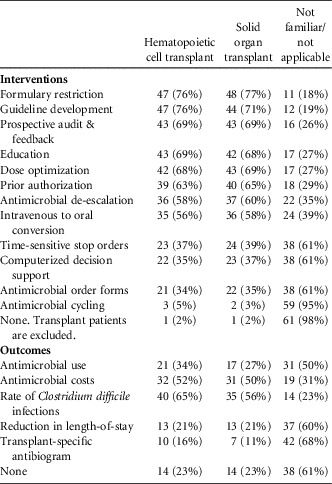
Of the 71 medical centers, 62 (87%) had an institutional ASP, defined as a comprehensive program that functions continuously to monitor antimicrobial use and includes full-time equivalents for a dedicated clinical pharmacist and/or adult or pediatric infectious disease specialist; 4 (6%) were in the process of implementing an ASP, and 3 (4%) did not have an ASP. At the 62 sites with an ASP, 27 (44%) started their ASP 5 years ago or less, whereas 32 (52%) had longstanding ASPs of more than 5 years’ duration; 3 sites (5%) were unsure. Of 62 ASPs, the proportion performing stewardship activities that included adult SOT, adult HCT, pediatric SOT, and pediatric HCT patients was 46 (74%), 44 (71%), 29 (47%), and 31 (50%), respectively. Antimicrobial stewardship interventions encompassing transplant patients are shown in Table 1. The top 5 activities were formulary restriction (SOT: 48 [77%]; HCT: 47 [76%]), guideline development (SOT: 44 [71%]; HCT: 47 [76%]), PAF (43 [69%]), education (SOT: 42 [68%]; HCT: 43 [69%]), and dose optimization (SOT: 43 [69%]; HCT: 42 [68%]). Antibiotic cycling (SOT: 2 [3%]; HCT: 3 [5%]) was rarely performed.
Antimicrobial Stewardship Interventions and Outcomes Encompassing Transplant Patients Among 62 Medical Centers With Antimicrobial Stewardship Programs

The following guidelines were commonly developed at 66 sites answering this question: empirical therapy for fever and neutropenia (57 [86%]), antifungal prophylaxis (57 [86%]), treatment for invasive fungal infections (IFI) (42 [64%]), cytomegalovirus prophylaxis (54 [82%]), and cytomegalovirus treatment (46 [70%]). Respondents also mentioned other locally developed transplant-specific guidelines, including infection control, management of “routine” infections (eg, Clostridium difficile, pneumonia), management of respiratory viruses (eg, influenza, respiratory syncytial virus), management and/or prevention of viral reactivations (eg, BK virus, Epstein-Barr virus, hepatitis B, herpes simplex virus), preoperative prophylaxis for SOT, sepsis, and therapeutic drug level monitoring (eg, vancomycin, azoles).
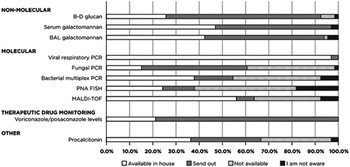
Table 1 also shows outcomes measured in transplant patients. Monitoring the rate of C. difficile infections was the most common outcome measure for both SOT and HCT, whereas devising transplant ward–specific antibiograms was least commonly done. However, 14 (23%) of 62 respondents did not measure outcomes for SOT or HCT at all. Figure 1 shows the percent availability of novel diagnostics and azole levels for transplant patients. Of the 66 respondents to this question, respiratory viral panels (66 [100%]), azole levels (64 [97%]), and serum or bronchoalveolar lavage galactomannan antigen (58 [88%]) were identified as being most useful to guide therapy. The other tests in order of decreasing utility were as follows: (1–3)-beta-D-glucan assay (44 [67%]), matrix assisted laser desorption/ionization-time of flight (MALDI-TOF) (42 [64%]), multiplex polymerase chain reaction (36 [55%]), fungal polymerase chain reaction (27 [41%]), peptide nucleic acid fluorescence in situ hybridization (23 [35%]), and procalcitonin levels (20 [30%]).
Availability of novel diagnostics and azole levels for transplant patients.BAL, bronchoalveolar lavage; B-D glucan, (1–3)-beta-D-glucan; MALDI-TOF, matrix assisted laser desorption/ionization-time of flight; PCR, polymerase chain reaction; PNA FISH, peptide nucleic acid fluorescence in situ hybridization.

Of 59 respondents to this question, perceived challenges for antimicrobial stewardship in transplant patients included undefined duration for certain infections (53 [90%]), diagnostic uncertainty (47 [80%]), the perception that therapeutic escalation was required for suspected antibiotic-resistant infections (42 [71%]), prescriber opposition (41 [69%]), high-cost drugs (37 [63%]), turnaround delay for microbiologic test results (28 [48%]), and lack of outcomes data for antimicrobial stewardship in immunocompromised hosts (26 [44%]). Lack of infectious disease physician (21 [36%]) or pharmacist (14 [24%]) staffing or lack of support by hospital administration (10 [17%]) rounded out the bottom of the list.
DISCUSSION
To the best of our knowledge, this is the first study to evaluate the extent to which institutional ASPs oversee antimicrobial utilization for both adult and pediatric SOT and HCT patients. Because of the high response rate, we had good geographic representation from transplant centers in the continental United States. Although most respondents had an institutional ASP, not all of these established programs were inclusive of adult and pediatric SOT and/or HCT patients. This finding shows that there is still for room for improvement in formalizing antimicrobial stewardship to encompass all patient populations, including transplant, across the continuum of care, as advocated by the Infectious Diseases Society of America (IDSA), the Society for Healthcare Epidemiology of America (SHEA), and the Pediatric Infectious Diseases Society. 10 Certainly, significant attention is being placed on antimicrobial stewardship at a national level. In March 2015, the Obama administration released the National Action Plan for Combating Antibiotic-Resistant Bacteria that called for the establishment of ASPs in all acute care hospitals by 2020. 8 In addition, both the Centers for Medicare & Medicaid Services and the Leapfrog Group have incorporated a set of questions regarding compliance with the Centers for Disease Control and Prevention standards for ASPs into their respective annual hospital surveys. 11 , 12 All of these changes will impact SOT and HCT programs within acute care facilities.
Transplant patients are important targets for antimicrobial stewardship. Patients undergoing SOT or HCT are frequently exposed to prolonged courses of prophylactic and therapeutic antibiotics, which may contribute to the occurrence of adverse drug events (eg, C. difficile infection) and colonization and infection by multidrug-resistant organisms.Reference Cervera, van Delden and Gavalda 13 – Reference Macesic, Morrissey, Cheng, Spencer and Peleg 15 There are also growing reports of antifungal and antiviral resistance occurring in transplant patients.Reference Steinmann, Hamprecht and Vehreschild 16 – Reference Frobert, Burrel and Ducastelle-Lepretre 18 Thus, efforts to optimize the selection, dosing, and duration of antimicrobial therapy both to improve patient outcomes and to minimize selective pressure are extremely relevant to this patient population. In order for stewardship efforts to be effective at a transplant center, ASP staff should be attuned to the complexities of caring for patients with varying degrees of immunosuppression, have expertise over a broad array of anti-infectives, and be informed of new diagnostic and therapeutic modalities that may affect transplant management.Reference Mihu, Paskovaty and Seo 2 , Reference Abbo and Ariza-Heredia 4
Our study revealed that established ASPs overseeing transplant patients are following the blueprint outlined in the 2016 IDSA/SHEA guideline.Reference Barlam, Cosgrove and Abbo 1 There was a slight edge in use of PAF over prior authorization in the transplant setting. Although we did not query survey participants on how effective they found either core strategy to be, there is a small but growing body of literature that has reported on the feasibility and benefits of PAF or prior authorization in hematology-oncology units caring for cancer and HCT patients.Reference Cosgrove, Seo and Bolon 5 , Reference Yeo, Chan and Earnest 19 , Reference Standiford, Chan, Tripoli, Weekes and Forrest 20 The answer is not yet known as to the effectiveness of PAF or prior authorization in the SOT setting, as there are no dedicated studies to date. We also realized that active ASPs utilized a variety of supplemental stewardship interventions, including formulary restriction, guideline development, education, antimicrobial de-escalation, and intravenous to oral conversion, in the SOT or HCT setting. Because poorer guideline concordance, increased duration of therapy, and higher readmission rates have been reported in immunocompromised patients labeled with a drug allergy, ASPs can also consider initiatives to improve drug allergy assessments.Reference Barlam, Cosgrove and Abbo 1 , Reference Trubiano, Leung, Chu, Worth, Slavin and Thursky 21 Antimicrobial cycling was rarely performed, a finding compatible with the lack of endorsement by the 2016 IDSA/SHEA guideline.Reference Barlam, Cosgrove and Abbo 1
Our survey found that commonly developed institutional guidelines included fever and neutropenia, prophylaxis and treatment of IFI, and cytomegalovirus management, all 3 being well-recognized infectious complications that can occur during the transplant course.Reference Tomblyn, Chiller and Einsele 22 – Reference Blumberg, Danziger-Isakov, Kumar, Michaels and Razonable 24 Due to the disproportionate use of expensive and potentially toxic antibiotic, antifungal, and antiviral drugs in immunocompromised patients, creation of guidelines for prescribing of these agents is fitting. We did not ask our respondents about the specifics of guideline implementation or the degree of guideline adherence by the transplant teams at their respective hospitals. However, it is worth mentioning that there is some evidence that facility-specific guidelines such as for fever and neutropenia or IFI can improve antimicrobial utilization and quality of care, even with partial guideline adherence.Reference Nucci, Landau, Silveira, Spector and Pulcheri 25 – Reference Mondain, Lieutier and Hasseine 29
Although the role of rapid molecular diagnostic testing for transplant patients has not been clearly established, the fast return of accurate results over standard culture methods is appealing, so as to institute timely and appropriate therapy for documented infections. One trend, however, is the outsourcing of infrequently ordered microbiologic tests to reference laboratories as part of cost-containment and quality-control efforts, and several of these may be disproportionately requested for immunocompromised patients, leading to a delay in results.Reference Procop and Winn 30 It was interesting to learn that only respiratory viral polymerase chain reaction was available in-house for 97% of responding sites, followed by MALDI-TOF (56%). Microbiologic tests for diagnosis and management of IFI were typically send-outs (azole levels, 79%; [1–3]-beta-D-glucan assay, 67%; serum or bronchoalveolar lavage galactomannan antigen, 50%–52%). That being said, respondents felt that tests for diagnosis of respiratory virus or IFI were the most useful in guiding therapy. Diagnostic uncertainty and the turnaround delay in results were 2 cited barriers for antimicrobial stewardship in immunocompromised hosts. These areas should be further examined in order to find solutions to help us better optimize therapy in transplant and other immunocompromised patients.
Other perceived challenges included undefined duration of therapy for certain infections, the view that antibiotic-resistant infections require further escalation of therapy, and opposition from oncology and surgical colleagues. Although we did not delve into this topic, the issue of prescriber opposition was explored in a recent study about stewardship barriers and goals in pediatric oncology and HCT.Reference Wolf, Sun and Tang 31 Our survey also showed that monitoring is not done robustly in transplant patients with the exception of C. difficile rates, followed by antimicrobial costs. According to the 2016 IDSA/SHEA guideline, every ASP should track antimicrobial utilization in order to examine overall consumption or compare usage by unit, provider, or service in the hospital.Reference Barlam, Cosgrove and Abbo 1 Additionally, measurement of expenditures based on prescriptions or administrations and use of both process (eg, guideline compliance) and outcome (eg, proportion of patients with C. difficile related to antibiotic treatment) metrics are important to gauge the effectiveness of stewardship interventions.Reference Barlam, Cosgrove and Abbo 1 Efforts dedicated to examining whether antimicrobial stewardship interventions are effective in transplant patients should be strongly encouraged.
One study limitation is that survey respondents were mostly from academic medical centers, so findings may not be generalizable to nonacademic centers with transplant capabilities. Another limitation is that the role or position of the respondent was not uniform across centers; it is possible that the respondent may not have been familiar with all aspects of antimicrobial stewardship for transplant patients. We also did not collect formal data by transplant center with regard to antimicrobial use or resistance patterns, and although we have an understanding of what stewardship interventions are being performed, the specifics of how these are executed and how these may impact the program were not evaluated. Due to constraints in survey length, factors facilitating antimicrobial stewardship in transplant centers, available resources, and stewardship practices utilized in ambulatory transplant clinics were not explored. Finally, for questions that allowed for more than one answer, we were unable to verify whether the answers of nonrespondents were true negatives versus skipping over the questions, so analyzing results by transplant volume to determine whether larger programs approached antimicrobial stewardship differently from smaller transplant programs was not performed owing to an unknown denominator. Strengths of our study were that the survey was anonymous and voluntary, which likely reduced the tendency of respondents to provide “socially desirable” answers. We also had a high response rate, and participants were from well-established, high-volume adult and pediatric SOT and HCT centers located in different geographic regions across the United States.
In conclusion, this study provides important information regarding the current state of ASPs in transplantation. ASP activities are performed at many adult and pediatric SOT and HCT centers in the United States. However, diagnostic and therapeutic uncertainty in transplant patients are challenging for ASPs. Collaborative research to examine the impact of antimicrobial stewardship practices in SOT and HCT should be explored.
ACKNOWLEDGMENTS
We thank Dr. Camille Kotton, chair, and Dr. Shirish Huprikar, co-chair, of the American Society of Transplantation Infectious Disease Community of Practice, for their helpful review and feedback of the electronic survey, as well as for distributing the survey to the American Society of Transplantation Infectious Disease Community of Practice membership.
Financial support. This research was funded in part through the NIH/NCI Cancer Center Support Grant P30 CA008748 (S.K.S).
Potential conflicts of interest. All authors report no conflicts of interest relevant to this article.