CHD are described as structural defects in the heart or the intrathoracic blood vessels arising throughout the period of fetal development. Reference Desai, Rabinowitz and Epstein1 The incidence of CHD between live-born children averages from 4 to 9 per thousand (0.4–0.9%). Around 1.5 million new cases are diagnosed each year. Reference Perloff and Warnes2 As for its effect on survival, there is an expanding interest in diverse clinical aspects of infants and children with CHD. Besides, the improved outcome for CHD has been associated with more interest in the associated morbidities. Reference Warnes, Liberthson and Danielson3
During growth, muscles and bones of children suffering from CHD are subjected to many harmful effects, Reference Witzel, Sreeram, Coburger, Schickendantz, Brockmeier and Schoenau4 while it is well recognized that adults with advanced cardiac pathology suffer from low bone mass, Reference Martínez-Quintana, Rodríguez-González and Nieto-Lago5 still, no satisfactory studies were conducted to investigate the effect of congenital cyanotic heart disease on the bone density in paediatric population. Reference Bachrach, Sills and Kaplowitz6
Few studies reviewed the bone changes in children suffering from congenital cyanotic heart disease, Reference Singh, Parkash, Saini and Wahi7-Reference Lohitkul, Thongchaiprasit, Jaovisidha and Siriwongpairat10 diverse studies investigated the effect of corrective surgeries, Reference Rego, Guerra and Guardiano11,Reference Sarafoglou, Petryk and Mishra12 and anticoagulant therapy. Reference Barnes, Newall and Ignjatovic13 We aimed to assess the bone mineral density in a cohort of children with congenital cyanotic heart disease of different anatomical diagnoses using dual-energy X-ray absorptiometry.
Patients and methods
Our study was a cross-sectional, observational study of children suffering from congenital cyanotic heart disease, conducted in Pediatric Cardiology Unit and Pediatric Endocrinology Unit at Mansoura University Children’s Hospital, Mansoura, Egypt, and written informed consent was taken from all parents of the patients enrolled in the study. The institutional Review Board of Mansoura University had approved the study.
Included patients
Patients who are below 18 years old and who were diagnosed within the first year of life with Cyanotic CHD attending the cardiology clinic Mansoura University Children’s Hospital are included. All the patients were ambulatory throughout the study.
Excluded patients
Patients who are suffering from other major congenital deformities, have done corrective surgery, receiving anticoagulant therapy, other comorbidities, or suffering from any acute illness are excluded.
All enrolled children were subjected to accurate history taking and clinical examination. Anthropometric measurements including length or height, body weight, and head circumference were evaluated using standard procedures by experienced single personnel. Data for weight, height and head circumference were checked using growth parameters standards in Egyptian infants and children. Reference El-Ziny, Al-Marsafawy and El-Haggar14 Body mass index was calculated (body mass index = weight/height2). Oxygen saturation of each patient was measured three times by pulse oximetry and average saturation was documented, hypoxemia was defined as arterial oxygen saturation less than or equal to 90%. Reference Bach15 Echocardiography was performed for all patients by single experienced paediatric cardiologist. This study took place on May 2019.
Lumbar bone mineral density was measured for all patients using the Lunar DPXIQ-USA software version 4.5. All examinations were performed by single technologist, and the same observer analyzed all scans. Patients who are less than three years were sedated. The results of the bone mineral density scans were compared to the data of 352 healthy age- and sex-matched Egyptian controls, Reference Al-Tonbary, El-Ziny, Elsharkawy, El-Hawary, El-Ashry and Fouda16 and Z-score was calculated:
 \[\begin{gathered}
{\text{Z}} - {\text{score}} = \\
\frac{{{\text{Patient}}\;{\text{bone}}\;{\text{mineral}}\;{\text{density}}\; - {\text{Control}}\;{\text{bone}}\;{\text{mineral}}\;{\text{density}}}}{{{\text{Standard}}\;{\text{Deviation}}\;{\text{of}}\;{\text{Control}}\;{\text{bone}}\;{\text{mineral}}\;{\text{density}}\;}} \\
\end{gathered} \]
Normal bone mineral density was considered as a lumbar spine Z-score >−1, a lumbar spine Z-score between −1 and −2 was identified as borderline, patients with low bone mineral density was considered as a lumbar spine Z-score equal or lower than −2.0. Reference Bishop, Arundel and Clark17
Statistical analysis
IBM SPSS software package version 22 was used for statistical analysis. Kolmogorov–Smirnov test was used to examine the distribution of data. Median and interquartile range (IQR) were used to describe the nonparametric quantitative data, while mean and standard deviation were used to describe the parametric quantitative data. p-Value less than 0.05 was regarded as significant. Non-parametric quantitative variables were tested using Mann–Whitney test. Predictors and risk factors were detected using Binary logistic regression by the Forward Wald technique for multivariable analysis. Variables enrolled into the multivariable analysis were those with p value of <0.1 by univariable analysis, or clinically relevant variables. Performance of the regression models was judged by the Hosmer–Lemeshow test.
Results
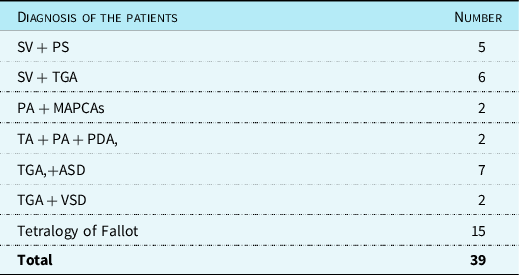
Thirty-nine (20 males) patients were enrolled in this study. The specific cardiac lesions are detailed in Table 1. Median age of patients was 2 years (IQR: 1–3), body weight 9 kg (IQR: 9–11.5), height 80 cm (IQR: 71–94), and body mass index 15.2 (IQR: 12.2–16.2).
Anatomical background of congenital cyanotic heart disease in the studied population

ASD, atrial septal defect; MAPCAs, major aortopulmonary collateral arteries; PA, pulmonary atresia; PDA, patent ductus arteriosus; PS, pulmonary stenosis; SV, single ventricle; TA, Tricuspid atresia; TGA, transposition of great arteries; VSD, ventricular septal defect.
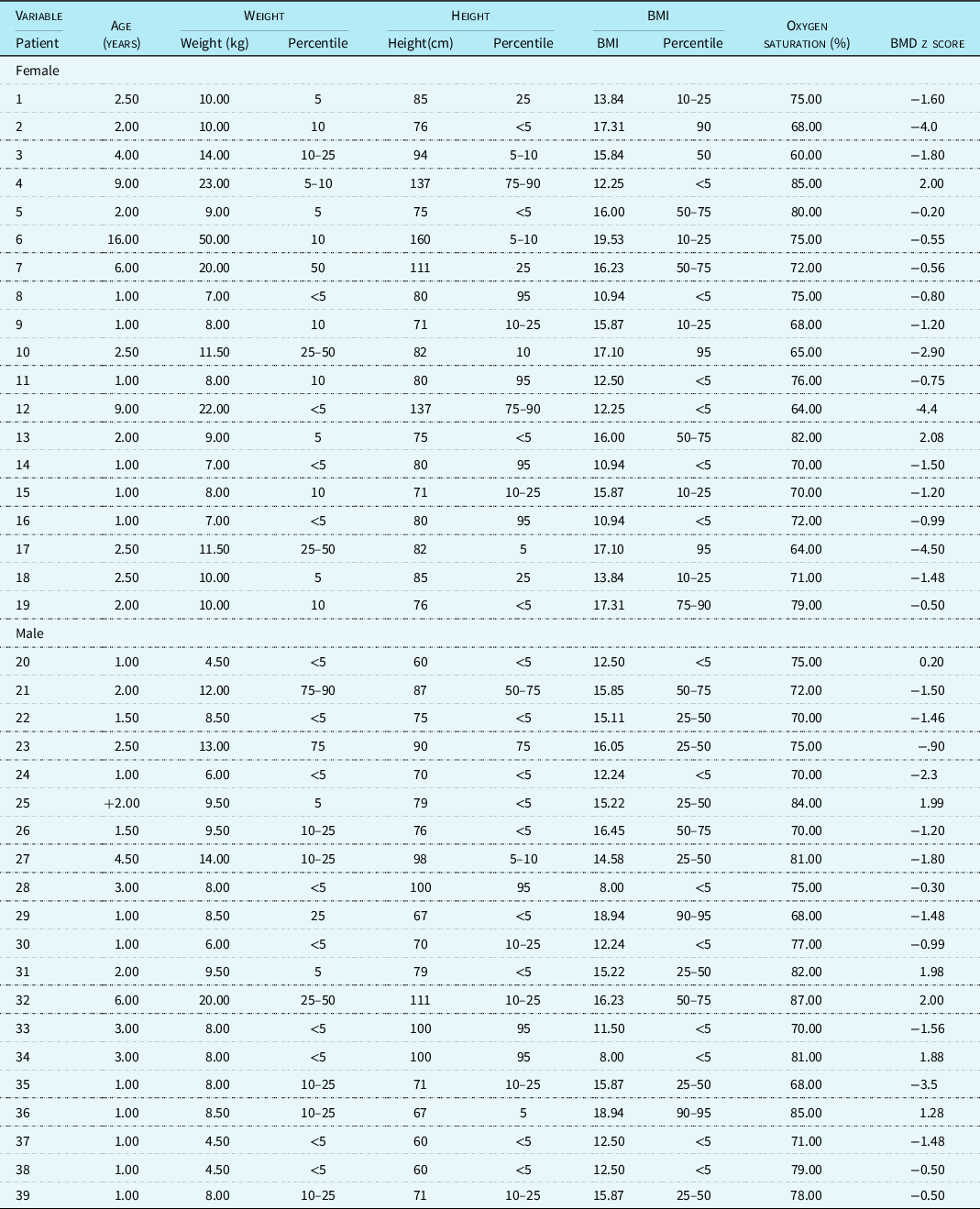
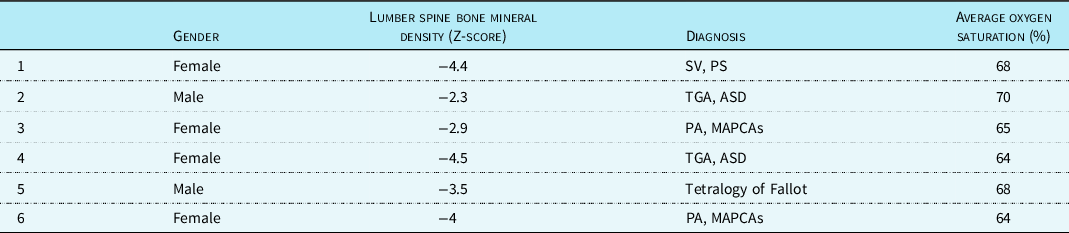
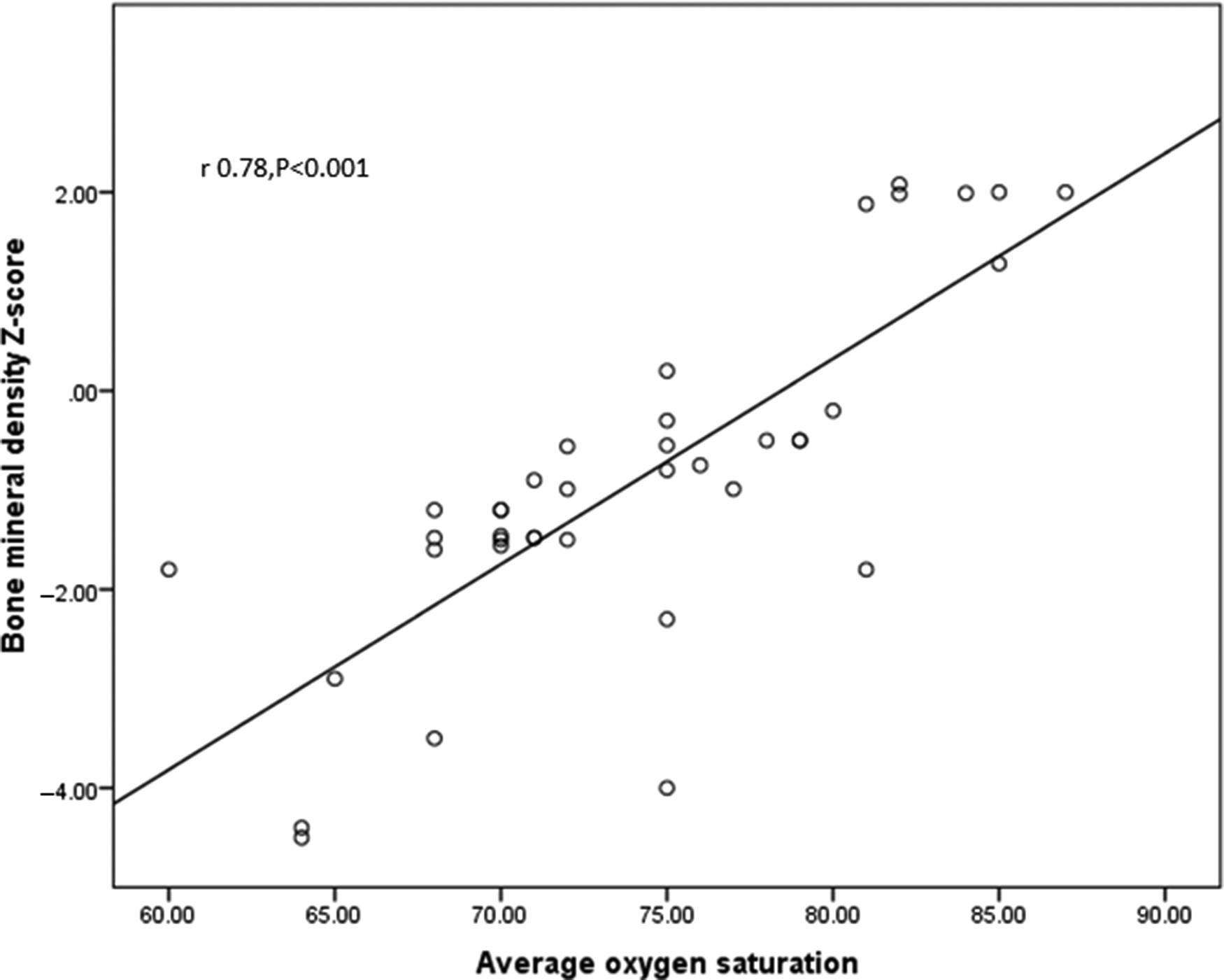
Mean oxygen saturation was 74 ± 6.4, and growth parameters of the enrolled patients are listed in Table 2. Among the studied patients, 20 patients (51.3%) showed normal bone mineral density (Z-score >−1), 13 patients (33.3%) showed borderline bone mineral density (Z-score between −1 and −2), and 6 patients (15.4%) showed bone mineral density reduction (Z-score <−2) (Table 3). All patients who suffered from low bone mineral density had different anatomical backgrounds of congenital cyanotic heart disease, with median age 3.5 years (IQR: 2.8–5.2), mean oxygen saturation 66.5 ± 2.5 (Table 4). The Z-scores of L2–L4 bone mineral density of the studied subjects showed a strong positive correlation with their average oxygen saturation (Fig 1). By univariable analysis lower oxygen saturation was identified as risk factor for reduction of bone mineral density, given that lower BMI was reported to be a risk factor for lower bone mineral density, Reference Bishop, Arundel and Clark17-Reference Hariri, Almatrafi and Zamka20 logistic regression model was implemented, the single independent risk factor for reduction of bone mineral density was lower oxygen saturation (Table 5).
Growth parameters and average oxygen saturation of the studied patients

BMD, bone mineral density; BMI, body mass index.
L2–L4 bone mineral density in examined children with cyanotic congenital heart disease

Results are expressed as, number (percentage of total), median and interquartile range. Statistical significance was defined as P ≤ 0.05, BMD: bone mineral density, No: number of the subjects, IQR: interquartile range.
Clinical characteristics and bone mineral density status of the 6 patients with bone mineral density reduction

ASD, Atrial septal defect; MAPCAs, major aortopulmonary collateral arteries; PA, pulmonary atresia, PS, pulmonary stenosis; SV, single ventricle; TGA, transposition of great arteries.
Correlation between average oxygen saturation and bone mineral density.

Risk factors for low bone mineral density by univariable and multivariable analysis

Statistical significance was defined as p ≤ 0.05. BMI, body mass index; CI, confidence interval; OR, odds ratio.
Discussion
Childhood is a crucial period for bone growth, satisfactory gain of bone mass is vital for avoiding bone fractures in paediatrics and osteoporosis in adulthood. Reference Komarov, Bkarev and Smolianitskiĭ21,Reference Ma and Jones22 Although knowing that children suffering from chronic diseases are at higher risk of bone mineral density reduction, there are no sufficient studies of bone mineral density status in children with cyanotic CHD. Reference Bendaly, DiMeglio, Fadel and Hurwitz23
This study investigated the bone mineral density in 39 children with different congenital cyanotic heart diseases using dual-energy X-ray absorptiometry, L2–L4 lumbar scans showed 13 patients had Z-scores of bone mineral density between –1 and –2, while 6 patients showed bone mineral density reduction (Z-score <−2), among the six patients with bone mineral density reduction, two patients only had height and weight below 5th centile for matched age and sex, thus even with the average growth parameters the bone mineral density was affected, this might support the hypothesis that congenital cyanotic heart disease can be linked to bone mineral density reduction. Patients who had reduced bone mineral density suffered from different anatomical CHD, and all of them suffered from hypoxemia.
A recent study in 2020 used dual energy X-ray absorptiometry to assess the bone mineral content in 73 adults suffering from complex CHD, the patients group showed significantly lower bone mineral density compared to controls (1.18 ± 0.12 g/cm2 vs. 1.26 ± 0.11 g/cm2, p < 0.001), this agrees with our findings. Reference Sandberg, Johansson, Christersson, Hlebowicz, Thilén and Johansson24 These results coincides with the results of Bendaly et al. Reference Bendaly, DiMeglio, Fadel and Hurwitz23 who studied bone mineral density in 26 children with single ventricle physiology using dual-energy X-ray absorptiometry, they realized that their bone mineral density was significantly reduced compared to the normal population (p < 0.0001), 25 (96%) of those patients had had Fontan procedure before the timing of the scan and 14 (53%) of them were on anticoagulant therapy. In accordance with the aforementioned results, Barens et al. investigated 17 patient with complex CHD following in Royal Children’s Hospital, Melbourne, Australia, they were maintained on warfarin, and compared them to 312 normal controls, there was a significant lumbar spine bone mineral density reduction in the patients group when compared to the control group. Reference Barnes, Newall and Ignjatovic13 Comparably, a recent study in Minnesota, United States of America, enrolled 10 patients with a history of Fontan procedure over 5 years before the timing of the scan and compared them to 11 healthy controls. Lumbar dual-energy X-ray absorptiometry scan revealed lower than average values amongst the patients group. Reference Sarafoglou, Petryk and Mishra12 These findings are supported by other studies that found decreased bone mineral density in patients with congenital cyanotic heart diseases who have undergone Fontan palliation. Reference Hariri, Almatrafi and Zamka20-Reference Ma and Jones22,Reference Avitabile, Goldberg and Zemel25 Furthermore, bone X-ray assessment in children with cyanotic CHD detected changes such as widening of diploe and “hair on end” striations in the skull, medullary cavity widening in long bones, and trabeculation in the lumbar spine. Reference Singh, Parkash, Saini and Wahi7
In opposition to the findings of this study, Witzel and colleagues analyzed bone and muscle parameters in patients with CHD (29 patients) aged 14–24 years using peripheral quantitative CT, and found normal muscle and bone development in most patients with CHD, this disagreement may be attributed to the difference in age group included in their study and to the fact that 31% (9 patients) of their patients had non-cyanotic CHD, 51.7% (15 patients) had reparative surgery for cyanotic CHD before the time of the study, while only 6.8% (2 patients) had cyanotic CHD with no surgery, or only palliative surgery. Reference Witzel, Sreeram, Coburger, Schickendantz, Brockmeier and Schoenau4
Another finding in this study was that lower oxygen saturation was identified as single independent risk factor for bone mineral density reduction, likewise we found that the average oxygen saturations in the studied subjects positively correlates with bone mineral density Z-scores, this result is concurring with the findings of the study by D’Ambrosio et al., where they found a positive correlation between resting oxygen saturation and hip t-score in 28 participants with Fontane circulation. Reference D’Ambrosio, Tran and Verrall26 In addition, a further study assessed bone health in individuals with prolonged residency in hypoxic environments at high altitude using multi-site quantitative bone speed of sound, they concluded that bone density was significantly lower in high altitude residents compared to sea level residents, Reference Basu, Malhotra and Pal27 furthermore bone mineral density in 30 males diagnosed with obstructive sleep apnea syndrome was assessed by Terzi et al., and compared to 20 healthy males, multivariable assessments performed for mean oxygen saturation levels were found to be significantly associated with neck bone mineral density, Reference Terzi and Yılmaz28 these conclusions are explained by the stimulatory effect of hypoxia on osteoclastic activity and bone resorption. Reference Arnett, Gibbons and Utting29-Reference Hulley, Bishop and Vernet31
To the best of our knowledge, this is the largest study to investigate the bone mineral density in a cohort of children with different cyanotic CHD using dual-energy X-ray absorptiometry.
The limitations of this study included lack of biochemical profile of calcium metabolism and vitamin D status. In addition, even though all the patients were active during the study, we lack accurate assessment of their activity level.
In conclusion, this cross-sectional, observational study showed that relevant abnormalities of bone mineral density exist in children suffering from congenital cyanotic heart diseases of different anatomical backgrounds. The aforementioned positive correlation between the level of oxygen saturation and bone mineral density, concurrently with the identification of lower oxygen saturation as a single independent risk factor for bone mineral density reduction, suggests that those with lower oxygen saturation are at higher risk to develop bone mineral density reduction. Based on these findings, it may be wise to consider bone mineral density assessment in children with cyanotic CHD, we believe that regular assessment of bone mineral density can improve bone health and decrease the risk for fragility fractures. Relevantly, further research is warranted to determine the need for early calcium or vitamin D supplementation for children with cyanotic CHD.
Acknowledgements
None.
Financial support
No funding.
Financial disclosure
The authors received no financial support relevant to this study.
Conflict of interest
No conflicts of interest.
Ethical standards
The institutional Review Board of Mansoura University had approved the study. Written informed consent was taken from all parents of the patients enrolled in the study.