The coronate scyphomedusa Periphylla periphylla (Péron & Lesueur, Reference Péron and Lesueur1810) is almost cosmopolitan in its distribution in the deep oceans (Haeckel, Reference Haeckel1880; Vanhöffen, Reference Vanhöffen1908; Kramp, Reference Kramp1948, Reference Kramp1957, Reference Kramp1968; Russell, Reference Russell1970; Larson, Reference Larson1986; Hay et al., Reference Hay, Hislop and Shanks1990; Larson et al., Reference Larson, Mills and Harbison1991; Dalpadado et al., Reference Dalpadado, Ellertsen, Melle and Skjoldal1998), but its oceanic abundance is sparse in comparison to some Norwegian Fjords (Larson, Reference Larson1986; Fosså, Reference Fosså1992, Sørnes et al., Reference Sørnes, Aksnes, Båmstedt and Youngbluth2007). Because of its mass occurrence in Norwegian Fjords it is one of the most studied deep-sea medusae (Sneli, Reference Sneli1984; Fosså, Reference Fosså1992; Jarms et al., Reference Jarms, Båmstedt, Tiemann, Martinussen and Fosså1999; Youngbluth & Båmstedt, Reference Youngbluth and Båmstedt2001). However, its unusual life cycle has only recently been revealed (Jarms et al., Reference Jarms, Båmstedt, Tiemann, Martinussen and Fosså1999) and to date, nothing is known about its reproductive strategy.
Approximately 80–90% of the adult population of P. periphylla in Lurefjorden show a diel vertical migratory pattern, avoiding daylight due to the phototoxic effect on its pigment porphyrine (Jarms et al., Reference Jarms, Tiemann and Båmstedt2002). Periphylla periphylla is found more frequently at the surface than other mesopelagic coronates, mostly in high latitudes of the deep oceans and especially at night (Fewkes, Reference Fewkes1882, Reference Fewkes1886; Vanhöffen, Reference Vanhöffen1908; Brown, Reference Brown1910; Kramp, Reference Kramp1913, Reference Kramp1957, Reference Kramp1968; Stiasny, Reference Stiasny1934; Thurston, Reference Thurston and Angel1977; Lid, Reference Lid1979; Larson, Reference Larson1986). This behaviour has also been observed in Norwegian coastal waters and Fjords (Havnø, Reference Havnø1918, Reference Havnø1922, Reference Havnø1926; Kramp, Reference Kramp1947, Reference Kramp1968; Lid, Reference Lid1979; Fosså, Reference Fosså1992; Flood et al., Reference Flood, Bassot, Herring, Hastings, Kricka and Stanley1997; Youngbluth & Båmstedt, Reference Youngbluth and Båmstedt2001), although the reason for this has been uncertain. Also unclear at present is how a deep-living medusa is able to find mating partners in the open oceans due to the wide separation of individuals. It is perhaps because of this fact that P. periphylla appears to have a high reproductive potential (Larson, Reference Larson1986) and why developmental stages of this species may be found throughout the year (Jarms et al., Reference Jarms, Båmstedt, Tiemann, Martinussen and Fosså1999).
The observations of P. periphylla reported here were made on board the RV ‘Håkon Mosby’ between 13 and 15 May 2005 in Lurefjorden (5°10′E 60°41′N; for station details see Sötje et al., Reference Sötje, Tiemann and Båmstedt2007), Norway. The observed patchy surface mass occurrences began at dusk (2300 Central European Time summertime), during cloudy and calm weather conditions. The abundance and distribution of animals in the fjord was examined with a remotely operated vehicle (ROV) using red light (Båmstedt & Youngbluth, Reference Båmstedt and Youngbluth2000) while recording their natural behaviour (Youngbluth & Båmstedt, Reference Youngbluth and Båmstedt2001). Behaviour at the surface was observed from the deck.
During daytime observations, P. periphylla remained ~ >30 m below the surface. During the first night, 47 specimens were counted at the surface within ten minutes within one patch, 43 of these were drifting with a straight upward tentacle extension (tentacle posture B). The foraging mode of this species (for medusae >5 cm in diameter) alternates between ambush (drifting) and ramming (slowly swimming). While foraging, medusae hold their tentacles straight, extending to the oral–aboral body axis (indicating a non-stressed behavioural state) using tentacle posture A or B. This is in contrast to other tentacle postures (C–H) used during non-foraging behaviours (for details see Sötje et al., Reference Sötje, Tiemann and Båmstedt2007).
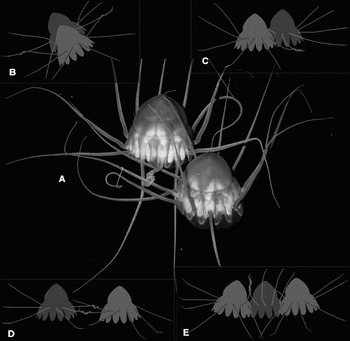
Individuals kept a distance of ~1 m from each other. During the second night, numerous animals were observed to be in contact (or aggregated) with at least one other individual. At times, one specimen was seen to actively move towards another specimen and engage into contact, primarily via entanglement of their tentacles. After this, individuals in contact proceeded towards a closer arrangement of their bells, utilizing their tentacles for leverage. Medusae in physical contact usually had their bells arranged in close proximity, often in the same direction, with one or more tentacles entwined around the tentacles of its neighbour (Figure 1A–E). Occasionally, single tentacles of a specimen were extended to the mouth of another.
Periphylla periphylla. Courtship-behaviour. (A) Photograph of a pair approaching close contact via tentacle entanglement (photograph P. Flood); (B, C, D, E) different aggregations of pairs, sketches based on live observations.

Aggregated medusae were hand-caught in groups, measured (CD, coronal furrow diameter), sexed, and the germ cells examined by light microscopy. Statistical comparisons of the size differences were made by Student's t-test (Lamprecht, Reference Lamprecht1999). On the first night, nine single specimens were caught, three males and six females (CD 5.4–9.4 cm, mean 7.7 ± 1.45 cm). On the second night, 13 pairs and three groups (3 specimens each) were collected at the surface. Nine of these pairs and all three groups were composed of both sexes (16 males and 18 females, CD 5.0–11.5 cm, mean 8.1 ± 1.63). These specimens were compared with 40 specimens caught by MIK net (Fraser, Reference Fraser, Tranter and Fraser1968) from the entire water column. The difference in mean CD between 8.1 ± 1.63 cm (surface) and 5.8 ± 1.96 cm (whole water column) is significant at the P = 0.001 level. Medusae of a medium size between 5 and 10 cm were found throughout the entire water column including the surface, whereas smaller medusae (<5 cm CD) were not observed at the surface and larger medusae (>10 cm CD) were observed exclusively at the surface.
All males were sexually mature and had gonads with mature sperm (fully developed tail, strongly mobile and non-aggregated). Most of the females had gonads with mature eggs (larger than 1.1 mm in diameter, yolk-filled and opaque; Jarms et al., Reference Jarms, Tiemann and Båmstedt2002). Free eggs were found in the gastrovascular cavity of two females only. In two other females, only unripe eggs were found. Cleavage stages were not present.
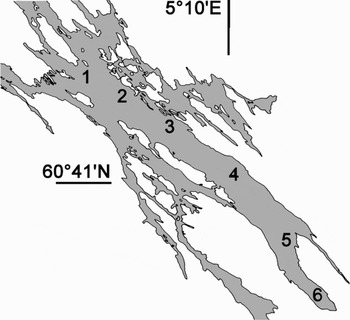
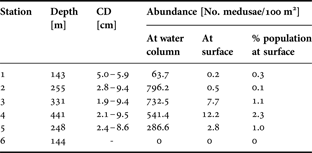
The abundance of P. periphylla medusae at the surface at night was counted in 5 minute transects under a 5 m wide spotlight, while the ship was moving at ≤4.9 kn from Station 6 (innermost) to Station 1 (outermost) in Lurefjorden. Medusae were most abundant at the deeper stations and less abundant at the shallower ones (1 and 6, Table 1). These stations were also used in previous studies (Figure 2; Sötje et al., Reference Sötje, Tiemann and Båmstedt2007).
Map of the sampling sites (Stations 1–6) in Lurefjorden.

Periphylla periphylla: size-range (coronal diameter) and abundance of medusae in the whole water column (MIK-net hauls) and surface abundance estimated from ship-based visual counts at night. Sampling was carried out at six sample stations in the Lurefjord between 13 and 15 May 2005.
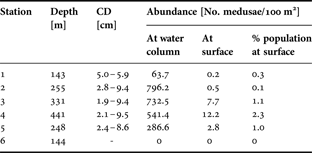
CD, coronal furrow diameter.
Approximately 1% of the entire population (Table 1) reached the surface. All of the animals at the surface were ripe, whereas smaller, unripe medusae (<5 cm CD) were never found there. These results agree with previous observations (Thurston, Reference Thurston and Angel1977; Larson, Reference Larson1986) which note that in the open ocean, the largest-sized specimens of P. periphylla (CD >6 cm) occur near the surface. With a year-round reproductive cycle (Jarms et al., Reference Jarms, Båmstedt, Tiemann, Martinussen and Fosså1999), the maturation stage among individual medusae will vary from premature to ripe and spent, thus imposing differential driving forces for surface aggregation on individuals, depending on their reproductive status.
An aggregation of the specimens at the two dimensional surface, in comparison to a three dimensional distribution throughout the water column, will greatly reduce the distance between single individuals, reducing the effort required for direct physical contact between mature individuals and therefore increasing the chances of successful fertilization. This would be especially true in the open ocean. This suggests that the observed surface aggregation may be a behaviour that is inherent in oceanic species. It should be noted that during certain surface events, the patches of medusae appeared to be denser in areas where accumulations of dust and foam were also present, suggesting that surface aggregation could be additionally enforced by the exploitation of physical water movements, as has been reported for several other species (Shanks & Graham, Reference Shanks and Graham1987; Kingsford et al., Reference Kingsford, Wolanski and Choat1991; Larson, 1991; Graham et al., Reference Graham, Pagès and Hamner2001). The differential behaviour of medusae observed on each night could not be correlated to any other measured ecological parameters.
Previous authors note that the cubomedusae Tripedalia cystophora and Carybdea sivickisi show a similar mating behaviour, in which the animals first make contact with their tentacles after which they swim in direct contact with each other, with the male continuously holding the female, until the spermatozoids are transferred (Werner, Reference Werner1973; Lewis & Long, Reference Lewis and Long2005). A high-density surface aggregation of Liriope tetraphylla (hydromedusae) was also assumed to be used for reproduction as most observed animals were ripe and tentacle entanglement also occurred (Ueno & Mitsutani, Reference Ueno and Mitsutani1994). Within the coronates, a comparable behaviour has been described in the small medusa Linuche unguiculata, which has mass occurrences of ripe specimens for a few days during spawning (Conklin, Reference Conklin1908). The dates of this surface occurrence showed no correlation to the lunar phase, as has been noted in other species (Chung et al., Reference Chung, Ratnapala, Cooke and Yanagihara2001). We attempted to correlate 23 different surface aggregations of P. periphylla observed between 1993 and 2005 with a possible lunar-phase connection, but no correlation was found.
In this study, it remains unclear how fertilization specifically takes place in P. periphylla, due to the absence of cleavage stages in the sampled females. However, in the absence of any other ecological correlates (i.e. temperature, salinity, season or lunar phase) to the observed surface aggregation of P. periphylla, it is difficult to imagine another reason for such large numbers of mature individuals to come into close contact which each other. Therefore, this study provides strong evidence of courtship-behaviour of P. periphylla. Further observations of this behaviour, including documented evidence of sperm and egg release and fertilization, will be needed to verify this hypothesis.
ACKNOWLEDGEMENTS
This work was funded by the European Union through the Training and Mobility of Researchers Programme (contract no. ERBFMGECT950013) and the EUROGEL-Project (contract no. EVK3-CT-2002-00074). We thank the crew on RV ‘Håkon Mosby’ for quality working facilities and the University of Bergen and the Institute of Marine Research for deployment of the ROV.