From the ‘new political history’ to a social history of postwar Singapore
More than four decades since Singapore obtained its independence, bringing to a close a period of dramatic political, demographic and social change following the end of World War II, the basic approach to understanding this era has remained largely unchanged. Since the late 1990s, there has been an important attempt to incorporate the Singapore Left into the history of the country's progress towards statehood. Although this emerging historiography, which may be called the ‘new political history’, has yielded fresh insights into the postwar political developments, the underlying focus has remained narrowly elitist. This article argues that approaching the postwar period at the interface between social and political history is important in setting the manifest politics in its full historical context. Salient themes in the study include the ideological continuity between the British and People's Action Party (PAP) governments, the importance of spatial and housing developments in the making of a nation-state, the resultant transformation of state-society relations, and the balance between structure and agency in history.
The ‘new political history’ of the late 1990s has substantially challenged the ‘Cold War’ paradigm within which earlier studies of the postwar period have been framed. Up till then, the master narratives of the historical works typically coincided with the interpretation of the postwar period by the victors of that past, the PAP.Footnote 1 This was the view of postwar Singapore as a place of great danger, allegedly confronted by communist and communal threats, and which was then positively remade by the progressive policies of the PAP. Only a handful of works in the earlier period have attempted a balanced analysis of the historical actors who functioned independently of the PAP platform.Footnote 2 The ‘new political history’, on the other hand, has questioned such narratives of danger overcome, while seeking to emphasise the vitality and complexity of postwar political and cultural life. This conceptualisation has contributed to a more nuanced and transnational understanding of the Singapore Left, which hitherto had been simply represented as a covert arm of the international communist movement. By contrast, the ‘new political history’ views the leftwing movement as symbolising the dynamism, cosmopolitanism, internationalism and idealism of the times. Lim Chin Siong, the top leftwing leader in Singapore, has been historiographically transformed from being the central communist conspirator to a product of a worldwide movement against colonial rule.Footnote 3 Similarly, Jamit Singh, a radical labour activist, has been hailed as embodying the cosmopolitan ideals of labour and political activism in 1950s Singapore.Footnote 4 Chinese-educated school students have also begun to emerge from an essentialist official representation as being ideologically pro-communist and culturally chauvinistic, with the new focus falling instead on the driving role of their youthful idealism in the anti-colonial struggle.Footnote 5 In a similar vein, I have argued, with Michael Fernandez, that the leftwing trade union movement should be viewed as both an integral part of the anti-colonial mass politics in the 1950s and a genuine attempt to assert the rights of Singapore's labouring class.Footnote 6 Reinforcing such interpretations of the Left is increasing evidence that the Malayan Communist Party's control of the movement was far more tenuous than previously supposed.Footnote 7 On the whole, the Left's efforts and contributions have recently been hailed as constituting the city-state's alternative ‘paths not taken’, which, it is argued, were closed off by the PAP government in the 1960s.Footnote 8
At the same time, new historical research from third-party or international history perspectives has also called into question the acceptance by the older ‘Cold War’ narratives of the notion, which originated with the PAP, of a clear and present communist-directed danger in Singapore. British empirical historians have highlighted the crucial role of anti-communist international actors, namely, the British, Malayan and Singapore governments, in suppressing the Left and planning the shape of the postcolonial region in the early 1960s.Footnote 9 Similarly, the same fear of communism which fuelled the efforts of the three governments in establishing ‘Greater Malaysia’ has also received the attention of a local historian.Footnote 10 Elsewhere, it has been shown that the American government intervened heavily in Singapore's trade union movement in the 1950s to forestall the rise of the Left.Footnote 11 In the field of racial and religious historiography, there is a recent study of the British response to the 1950 Maria Hertogh riots which aims to decentre the focus on the causes of the event and the theme of communalism to which the riots have long been linked.Footnote 12 I am not suggesting that the above-mentioned studies form a total unity of works on postwar Singapore history, but it is evident that historians with otherwise different aims and approaches are collectively seeking a deeper, more nuanced and transnational understanding of the basic character of the politics of the period.
This re-imagining of postwar Singapore history has relocated the politics of decolonisation within broader political-cultural and international history frameworks. The theme of a locally vibrant and internationally driven ‘Singapore Spring’ which is emerging from the recent scholarship is important for understanding change and continuity in postwar Singapore. Yet, its basic premise and approach remain decidedly political. Instead of the PAP dominating the historical stage, we have a group of dynamic actors – the local Left, the Malayan government, the British and the Americans – but nonetheless still the political elites. The ordinary people who experienced and in a real sense also ‘made’ the events of the past are missing in both the old and new histories, except as a nameless, faceless collective. Even worse, in the older histories the people were customarily cast as being passive, gullible or obstructionist towards the historic making of independent Singapore. Absent, too, are adequate conceptualisations of the less visible but no less important non-political factors which operated in the postwar society and shaped its politics, such as demographic change, intra-urban migration, housing development and other societal changes.
This article argues that a new approach to understanding the period may be found at the interface between social and political history, one which will link up the international, national and local dimensions of history. Social history as proposed here, then, is not ‘history with the politics left out’.Footnote 13 The term ‘social history’ is itself deeply contested and means different things to different schools of practitioners. Fernand Braudel, in his monumental study of the Mediterranean world in the sixteenth century, inspired the novel idea of ‘total history’, in which political events played a distinctly secondary role to the longue durée of environmental, social and economic forces.Footnote 14 However, following Braudel, other social historians have sought to strike a closer balance between the geographical, social, economic and political dimensions of history. This article follows, among others, E.P. Thompson, Eric Hobsbawm, George Rude, John Merriman and Arlette Farge in adopting a more integrated form of social and political history.Footnote 15 For Singapore, path-breaking social history has been written on marginal groups dwelling at the edge of society, the city's social and economic geography and the everyday experiences of major historical events, but this work has chiefly focused on the prewar and war periods.Footnote 16 The exception to their prewar focus is Stephen Dobbs' thought-provoking study of the shifting roles of the Singapore River in the wider development of the city-state and the processes of social and economic change demanded by the over-arching ethos of modernity in Singapore. Dobbs has aptly illustrated the interface between social and political history and the continuity in urban planning between the British and PAP governments, by tracing the origins and evolution of the PAP's decision for the Singapore economy to rely less on the river-borne trade in the 1970s and its adverse impact on the lives of the Chinese lightermen working along the riverfront.Footnote 17
This article presents a social history of low-income Chinese nuclear or semi-extended families living in unauthorised wooden housing in kampong [villages] located at the periphery of the city after World War II. It examines how the tension between Singapore's economic geography and the social dynamism of low-income Chinese created an expanding belt of urban kampong. These settlements were inhabited by a semi-autonomous population, partially integrated into the economic and political structures of colonial society but also, to a considerable extent, independent. This social change contextualises the political developments of postwar Singapore. The urban kampong, which lay largely beyond official regulation, constituted an important site in the history of Singapore's decolonisation in the 1950s and the establishment of a modern nation-state thereafter. A central focus in this article is the ambivalent relationship between urban kampong dwellers and the one major, seemingly non-political threat to their homes, namely fire, which periodically destroyed large settlements in the 1950s and 1960s. How the residents coped with the fire hazard and how the outbreak of kampong fires became a deeply contested issue in these decades are important questions which throw new light on the emerging dynamics of the postwar state and society.
In mapping a social history of urban kampong dwellers in postwar Singapore, I have focused on the Chinese population. There were also Malay kampong in the eastern and western parts of the city in the 1950s as well as Indian wooden house families, but both minority communities deserve a full and separate study.Footnote 18 To the British colonial regime, the challenge of rehousing wooden house dwellers was essentially a Chinese problem, with the Malays considered ‘more amenable … to resettlement and more willing to come to agreement with the landowners’.Footnote 19
A study of the urban kampong highlights important questions and themes in the postwar period. One is the question of change and continuity. There is a need to reconsider the commonly accepted historiographical divide between the British colonial regime and the PAP government. While the latter is correctly credited for the success of its public housing programme, this article maintains that in terms of the state's policy towards kampong clearance, there was as much continuity as change between the two administrations. Second, social history provides an understanding of the tension between structure and agency in history. It sets the agency of the political elites in context, while illuminating that of the urban kampong dwellers in moving, finding, building and rebuilding wooden houses, yet both were necessarily constrained by the economic geography of the postwar city of Singapore. James Warren has done important work in the late 1980s and early 1990s to decentre mainstream Singapore history by bringing into focus marginal occupational groups, namely rickshaw pullers and Chinese and Japanese prostitutes, who had been voiceless in history but played vital roles in the development of the colonial entrepôt.Footnote 20 Likewise, I have sought to give voice and agency to another peripheral social group: urban kampong dwellers in postwar Singapore. Unlike Warren, however, I have located their history in a time and place of societal transformation, where the very question of housing was deeply debated, contested by the residents themselves and then dramatically resolved from above.
A social history of the urban kampong also underscores the changing character of postwar Chinese society. Brenda Yeoh's fascinating study of the plebeian classes in colonial Singapore has revealed the city to be a ‘contested terrain’, in which their unhappiness with unpopular municipal regulations was usually expressed through silent strategies of passive resistance, evasion and avoidance.Footnote 21 This article demonstrates that there was both change and continuity in the tactics of resistance utilised by urban kampong dwellers against official programmes of clearance and resettlement. The repeated building and occupation of unauthorised wooden housing were clear signs of passive resistance by house owners and residents, but more overt and collective forms of opposition, either spontaneous or organised by secret societies and leftwing rural associations, also emerged in the mid-1950s. The new forms of resistance were underpinned by the revival of robust anti-colonial mass politics at that time, which emphasises the important point of convergence between the ‘new political history’ and the social history of the postwar period.
The contest for urban space use between the municipal planners and residents shows that besides time and chronology, spatial movement and change were salient themes in the postwar milieu. A central concept used in this study is the idea of a social and political ‘margin’, applied to the wooden house communities living after the war along the fringes of Singapore city, the area the colonial planners had marked out as the island's urban area. Here, as Mary Douglas observed in a broader context, official control was at its weakest and the colonial state feared that any social change could profoundly alter the basic character of the entire society.Footnote 22 The efforts by the British and PAP governments to build public housing estates along this urban periphery in the 1950s and 1960s was in fact an ambitious attempt to impose official control over the margin. This conceptualisation of space extends the site of historical conflict and change from the Parliament and inner city to the unauthorised wooden housing settlements on the urban fringe.
From another perspective, the instruments of societal change are revealed to encompass not only constitutional or mass politics but also the social technology of housing demolition and development. The latter, specifically, was encapsulated in the quintessential form of mid-twentieth-century architectural modernism: the public housing flat, both its standard and emergency versions. Public housing, to use James Scott's apt term, was characteristically ‘high modernist’, rooted in a robust ‘self-confidence about scientific and technical progress’ and based on ‘the rational design of social order commensurate with the scientific understanding of natural laws’.Footnote 23
Finally, a social history of housing unveils the basic political motivation behind the development of public housing in Singapore — to transform the semi-autonomous urban kampong population into a model and integrated citizenry. The politics of housing development, which has received considerable scholarly attention, have long been ignored by historians until recently.Footnote 24 This article seeks to place the Housing and Development Board (HDB) success story in context by charting the social and political contestations over kampong clearance and kampong fires that lit up the urban periphery in Singapore in the 1950s and 1960s. As social history throws light on the agents, spaces and continuities of political conflict and change in the postwar years, so politics is shown to be a major driving force in the history of public housing in Singapore.
A note on sources
This study draws its primary sources from official records and my interviews with over 70 people formerly living in the Kampong Bukit Ho Swee locality, just outside the western flank of the Central Area. It has rightly been observed that access to the political records of the postwar period is difficult.Footnote 25 However, the sources of social history, while not yet fully declassified, are becoming more accessible. The records of the Singapore Improvement Trust (SIT), the de facto colonial housing authority, have been declassified and are held at the National Archives of Singapore, although the files of the HDB, the fully empowered housing authority of the PAP government, remain under restricted access.Footnote 26 In addition, the period is within living memory and its visible actors, events and developments are well remembered by elderly Singaporeans. This is particularly the case for the fire hazard in the kampong and the inferno which destroyed Bukit Ho Swee in 1961, the greatest fire in Singapore's history. In the 1950s and early 1960s, my informants were teenagers or young adults; their reminiscences span the important social experiences of living in the urban kampong, coping with the everyday fire hazard, of fire cometh, and being resettled in modern public housing.
Demographically and economically, I have attempted to establish a representative sample of the urban kampong population in the 1950s. The interviewees comprised roughly equal numbers of men and women; many, though not all, of them were engaged in low-income occupations such as hawkers, shop assistants, shipyard cleaners, factory workers, transport workers, construction workers and general labourers. Their recollections are admittedly coloured by nostalgia for the past and the experience of rapid development since the early 1960s, but I have attempted to separate ‘sources’ from ‘reflections’ in the testimonies. The interviews have enabled me to retrieve significant aspects of the social life of a largely illiterate and marginalised community of urban kampong dwellers. These include their optimism and dynamism in moving to the urban periphery, their efforts at resisting eviction and their attempts to cope with the fire hazard — issues which are presented discursively in the official records.
It should be noted that the oral history is not the only problematic source. The SIT records must be used carefully because the agency was heavily involved in kampong clearance in the 1950s and so represented kampong life and its dwellers in a pejorative way. I have sought to use the two sets of sources, as well as other materials, in conjunction with one another, keeping in mind the basic aim to write a history of societal change and political conflict in postwar Singapore.
Moving into the margin
By 1961, there were 250,000 people living in the urban kampong, comprising a quarter of the city's population.Footnote 27 Consisting mainly of young, low-income Chinese nuclear or semi-extended families, these residents were concentrated in over 50 kampong. These settlements lined the main roads leading out of the Central Area, the inner city which historically served as the residential and employment centres for the Chinese population. As Map 1 shows, the urban kampong were located within four miles of the Central Area — west of the Singapore River from Covent Garden to Queenstown; north of the inner city at Toa Payoh, Bukit Timah and Paya Lebar; and east of the Central Area from the Kallang Basin to the Geylang lorong [lane]. The housing in the kampong was typically wooden, with attap [thatched] or zinc roofs, and had usually been built without official planning approval. The urban kampong constituted a new urban landscape in postwar Singapore. Their population had grown during the war and nearly doubled from 127,000 in 1947 to 246,000 by the mid-1950s.Footnote 28 By 1959, there were an estimated 10,000 wooden houses located at the fringes of the city.Footnote 29 The growth of the urban kampong population marked a significant change in the mindset of low-income Chinese towards family life and housing. The population had historically resided in shophouse cubicles in the Central Area, close to their workplaces. The 1930s Great Depression, however, began to change demographic and residential patterns in the city. Restrictions on male Chinese immigrants and the influx of female Chinese immigrants (unrestricted until 1938) nearly doubled the population in certain parts of the city.Footnote 30 The population also became younger; in 1941, there were ‘swarms of Chinese children in their teens, mostly local born, and still more who have not yet reached their teens’.Footnote 31 During the Japanese Occupation, numerous families occupied vacant land for cultivation, both with and without official approval, giving rise to what would later be known as the ‘squatter problem’.Footnote 32
Urban Kampong in Singapore c. 1955 Compiled from Map 2, Colony of Singapore, Master plan: Reports of study groups and working parties (1955) and SIT 808/50, ‘List of kampongs in city area in order of fire risk’, in Memorandum from Superintendent, Singapore Fire Brigade, to Manager, SIT, 27 Oct. 1954.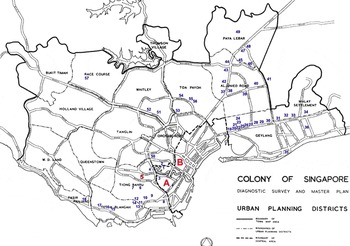

Sources: SIT 808/50, ‘List of kampongs in city area in order of fire risk’, in Memorandum from Superintendent, Singapore Fire Brigade, to Manager, SIT, 27 Oct. 1954; City Council, Minutes of Proceedings 1958, 19–20 May 1958, pp. 420–2.
At the end of the war, fresh political and economic crises in China and Malaya sustained a stream of Chinese immigrants to Singapore: the establishment of a communist regime in China in 1949, the outbreak of the Emergency in Malaya and the resettlement of rural Chinese into New Villages from 1948 and recession in Malaya's rubber and tin industries.Footnote 33 The resultant influx of Chinese women progressively improved the sex ratio from 1,656 men per 1,000 women in 1931 to 1,039 in 1957.Footnote 34 Established Chinese families in Singapore started bearing multiple children, while the migrants arrived to join their family members already on the island or in the hope of forming new families.Footnote 35 By 1957, two-thirds of all Chinese households were nuclear families whose average size was 5.1 members. Where the prewar population had been composed largely of working age adults, the average postwar person was significantly younger. The percentage of Chinese children rose from 37 per cent in 1947 to 44 per cent in 1957, while the mean age of the Chinese population fell from 26.9 in 1931 to 23 in 1957.Footnote 36 The expanding Chinese families placed tremendous strain on housing in the inner city. By the end of the war, the shophouses in the Central Area were extremely congested with married workers and their young families, with little possibility of adding or subdividing further cubicles.Footnote 37 The Chinese called the cubicles ‘pigeon cages’.Footnote 38
Official commentators criticised the low-income Chinese for being ‘choosy’ in looking for suitably located and affordable housing, for most of them rejected SIT housing.Footnote 39 The reality was quite different. There was a growing willingness among the larger families to leave the Central Area, for housing located on the urban fringe, albeit they did not have to move very far. Similarly, many Chinese migrants to the island were no longer arriving in the inner city, the traditional reception zone, but were settling directly in the urban kampong.Footnote 40 In this search for new homes, low-income Chinese were resolving the economic dilemma which had hitherto restricted their mobility — the need to keep the cost of living down and to live close to their workplace, families, relatives and friends.Footnote 41 This constraint was deeply rooted in the economic geography of Singapore. Stretching four miles long and 1 mile deep from the southern apex of the island, the Central Area had been the initial site of Singapore's development as a colonial entrepôt and was still the main source of employment in the postwar period. However, as it was a tiny area, further housing development there became impossible after the war.
In moving into the urban kampong, the Chinese families were highlighting how the classic tension between structure and agency was also being resolved — between the geography of housing in the city and the collective Chinese desire to obtain better homes and futures for themselves and their children. The families followed the radial roads out of the Central Area to the kampong, while private contractors supplied the housing, quickly erecting hundreds of cheap wooden dwellings, often overnight.Footnote 42 The result was that kampong which had once been in semi-rural areas experienced massive in-filling. The authorities likened the exodus into unauthorised wooden housing to an ‘overspill’, implying an involuntary relocation compelled by circumstances.Footnote 43 This was true, but there was also a genuine opportunism in how the moving families settled on hilly or swampy areas, unused burial grounds or areas adjacent to incinerators or sewage works at the urban periphery. In the meantime, the government spent months deliberating the acquisition of such lands for development.Footnote 44 West of the Central Area, a large urban kampong population resided on formerly unused hilly land, close to the main sources of employment in the Central Area and the city: the harbour docks, higher-income residential areas and the British military base at Pasir Panjang. To the east, likewise, kampong dwellers living in wooden houses built over swamps in the developed Kallang-Geylang area obtained work from the light industries and factories located in the Kallang Basin.Footnote 45
While there is a fine line between overspill and opportunism, oral history provides further insight into the postwar Chinese attitude towards moving. The testimonies frequently contained an optimistic outlook towards the future despite the challenging circumstances. In the words of Tan Tiam Ho, whose family lived in Kampong Bukit Ho Swee, this dynamism was expressed in the Hokkien term che lor (‘finding a road’).Footnote 46 Wong Pok Hee, another Bukit Ho Swee resident, migrated from Johor, Malaya with his widowed mother and four siblings after the war, because ‘we had nothing for making a livelihood in Johor’ after his father had passed away. Wong worked as a shop assistant in the kampong while his three sisters worked in a nearby laundry shop.Footnote 47 Another sign of their dynamism was the families' ability to find new homes in a kampong. While the authorities faced great difficulty in locating and controlling the proliferation of wooden dwellings, low-income Chinese could easily find one to rent; it required no government assistance, only informal social networks or information acquired by word of mouth. Tan Ah Kok lived in several wooden houses in the Bukit Ho Swee locality. On the ease of finding such housing, she explained, ‘People did not use to advertise in the newspapers. In the past, it was through recommendations.’Footnote 48
Economically, urban kampong dwellers also adapted to the physical environment. While some were full-time farmers or urban workers, others were ‘semi-urban’ dwellers who derived their income from both employment in the Central Area and home-based, semi-rural work.Footnote 49 Many families made full use of the limited space outside their wooden houses to reduce the cost of living by rearing poultry or pigs or growing vegetables, usually with the help of the women and children in the household. This blend of urban and rural economic life within a city was characteristic of the state of under-employment prevailing in 1950s Singapore. Other residents responded to the lack of full employment opportunities by taking up part-time or irregular work as unlicensed hawkers, trishaw riders and ‘pirate’ taxi drivers.Footnote 50
These part-involuntary, part-autonomous housing and demographic developments alone make for interesting social history, but they need to be seen in the context of a larger societal transformation imagined and directed from above. The growing belt of urban kampong drew the official gaze as a social and political margin. There was great official concern about the difficulty of controlling the proliferation of unauthorised housing, which was ‘erected with astonishing rapidity and … it was difficult to get [these structures] demolished … The situation changed almost from day to day and was very difficult to control.’Footnote 51 Anxious urban planners looking at the margins of the city after the war realised that, ‘[u]nlike the central areas, which are comparatively changeless … the attap areas change almost from day to day with the result that even a map prepared one year previously is certain to be out of date’.Footnote 52
The ability of wooden housing to elude official regulation underlines the deeply contested nature of housing development in postwar Singapore. Brenda Yeoh's study of the residents of the inner city in the prewar period has shown that this population was remarkably successful in countering colonial attempts to impose control over urban space through passive resistance and evasion.Footnote 53 Yet, partly because wooden housing could be easily and quickly constructed and partly because the urban periphery was a far less regulated place than the Central Area, the ‘Black Belt’ of urban kampong was much more difficult to control than the inner city. An added factor was the general wariness of low-income Chinese towards officialdom. The colonial state, according to Australian observers, understood that the ‘traditional notion of “law-abidingness” ’ among these Chinese did not amount to more than ‘keeping out of trouble and not interfering in matters not one's immediate concern’.Footnote 54 As former kampong resident Tan Tiam Ho expressed it, ‘we were more concerned with our families. Government, as long as we didn't break the law, we would not bother with them.’Footnote 55
There was another, more overtly political point of conflict between the colonial state and the urban kampong dwellers. As the SIT sought to clear unauthorised wooden housing on its lands to build public housing at the margins of the city from 1947, its efforts aroused tremendous opposition, both spontaneous and organised and passive and active, from the residents. The Trust often offered replacement flats for affected families but found that most were unwilling to accept because the flats were either too expensive to rent or too far away from their workplace.Footnote 56 The SIT's attempts to clear Kampong Henderson in the mid-1950s and Covent Garden at the end of the decade failed because in both cases former owners of vacated dwellings simply removed the official seals and enabled new unauthorised tenants to move in.Footnote 57
Such passive resistance was akin to James Scott's ‘weapons of the weak’, similar to the prewar forms of Chinese contestation against unpopular municipal regulations.Footnote 58 In a radical departure from the character of the prewar Chinese community, however, more assertive and aggressive forms of resistance to clearance also emerged in the 1950s. In July 1953, when Trust officials accompanied by two police constables tried to evict a Chinese family from a wooden house at Geylang Lorong 27, they aroused a hostile crowd of 40–50 people. Only with the dispatch of a riot squad to the scene was the operation eventually completed.Footnote 59 Often, the overt resistance was organised by social and political forces from the edge of mainstream colonial society. Secret societies, whose members were usually kampong residents and which viewed the settlement as a turf for their activities, challenged SIT demolition squads on the spot. By 1958, the demolition of wooden houses had become ‘a dangerous process’, with SIT officials frequently facing ‘written, verbal or, even physical’ intimidation on-site.Footnote 60 In that year, even with police escorts a demolition attempt at Henderson Road was thwarted by gangsters, while SIT officials were also assaulted in other kampong.Footnote 61
Besides the secret societies, the growing resistance of urban kampong dwellers to official regulation and resettlement intersected with the emergence of a mass-based anti-colonial movement in Singapore. Here the notion of a dynamic socialist political culture in postwar Singapore which is a central theme of the ‘new political history’ helps us to understand how the urban kampong population was being politicised. The Singapore Farmers' Association and Singapore Wooden House Dwellers' Association, both established in 1955, were pro-communist and affiliated to the PAP's left wing. They sought to unite kampong dwellers, both in the rural and urban areas, in the cause of the anti-colonial struggle.Footnote 62 On behalf of the residents, the Farmers' Association contested resettlement programmes by providing legal advice to the residents.Footnote 63
By 1956, ahead of the Labour Front government's crackdown on the Left in September and October, the British Special Branch had come to view kampong dwellers, together with workers and Chinese middle school students, as part of a powerful communist-controlled united front.Footnote 64 Following the outbreak of island-wide riots in October, both the Farmers' Association and the Wooden House Dwellers' Association were deregistered by the British regime. However, they were replaced within months by the Singapore Country People's Association and the Singapore Rural Residents' Association, which like their predecessors were strongly leftwing.Footnote 65 The two organisations mobilised substantial support among kampong dwellers in both rural and urban areas by organising young men into crime patrols and running kindergartens and literacy classes.Footnote 66 At the end of the 1950s, official planners concluded that wooden house dwellers were ‘even more intractable to resettlement than people in central areas’, because ‘the large numbers of … people living in attap dwellings make them a political force of some magnitude and the banding together of such persons into protective associations are discouragements to rapid clearance’.Footnote 67
Facing increasing opposition from the urban margins, the colonial state created a controlling discourse of emergency kampong clearance in response. Official statements and reports on housing ought not to be viewed as disinterested descriptions: they contained the ‘voice of committed colonialism’, which supported the SIT's clearance programme and constituted a body of ‘emergency reform literature’.Footnote 68 This literature collectively evoked a powerful sense of crisis in Singapore society, where robust government intervention in housing was not only important but indeed necessary.Footnote 69 In the official discourse, terms like ‘emergency’, ‘clearance’ and ‘rehousing’ were vested with a potent moral and political authority. The urban kampong were criminalised as places of social danger – in threatening public health, safety and order – not only to the residents themselves but to society as a whole. The 1947 Housing Committee warned that uncontrolled housing development was ‘detrimental to health and morals’.Footnote 70 Its Chairman viewed the kampong as ‘the nurseries of a C3 nation and schools for training youth for crime’. Someone could visit, he added, ‘if he likes to risk his personal safety, such unauthorised kampongs of attap huts’.Footnote 71 The solution, the Committee urged, was to embrace a strong policy of ‘demolition and re-housing’, and for the SIT to be given ‘proper zoning powers and powers to plan ahead of development’.Footnote 72 Collectively, the kampong were labelled as a ‘Black Belt’ that needed to be brought under official control and comprehensively redeveloped.Footnote 73
Yet another element in the official discourse was the classification of urban kampong dwellers as ‘squatters’, depicting them in effect as socially inert and incapable of establishing themselves in proper housing. The classification was inaccurate because the dwellers were in fact ‘migrants’ who had actively left or bypassed the Central Area to find suitable housing at the urban fringe. The residents, too, were frequently rent-paying ‘tenants’, living on land that the government and private landowners had leased out for temporary use.Footnote 74 Yet although the 1956 Land Clearance and Resettlement Working Party pointed out that the term ‘squatter’ was ‘most unsatisfactory’, and suggested the use of ‘attap dweller’ instead,Footnote 75 it continued to circulate widely in official circles well into the postcolonial period.
Juxtaposed against ‘dangerous’ spontaneous settlements and ‘inert squatters’ was the official version of architectural modernity — the emergency public housing. Such housing, while semi-permanent and prone to rapid physical deterioration, could be built cheaply and speedily.Footnote 76 The use of the word ‘emergency’ for such housing further indicates the discursiveness of the official kampong clearance programme. As an outwardly non-political term, ‘emergency housing’ provided a strong moral sanction for the state's rehousing programme. In reality, though, the emergency housing programme was an ambitious undertaking not only to house low-income families in better accommodation but also to erase the urban margin and forge urban kampong dwellers into model citizens of the imagined nation-state. The emergency housing was well suited for rehousing low-income families evicted from kampong, for the rentals were significantly lower than those of the standard SIT housing. It was also ideal for meeting the large-scale rehousing demand caused by the destruction of kampong by fire.
Living with fire
Fire was the second major factor which politicised kampong clearance in the 1950s. Singapore's fire-prone urban margin was a site of disaster, where fire outbreaks were ‘chronic events rooted in everyday hazard’.Footnote 77 While kampong blazes straddled the grey area between natural cause and human responsibility, they ought to be understood as merely a ‘trigger’ linked to deep-rooted demographic, social, economic and political pressures.Footnote 78 The responsibility for fire outbreaks in kampong was a keenly contested issue between the political elites and a source of much controversy and speculation among the residents. While a fire was ostensibly a non-political event, kampong dwellers understood that it could clear a kampong as effectively as an SIT demolition squad.Footnote 79 In fact, to many residents there was no practical difference between clearance by fire and by eviction. Consequently, the term ‘fire’ was as discursive as ‘emergency’, ‘squatter’, ‘clearance’ and ‘resettlement’ in the official literature.
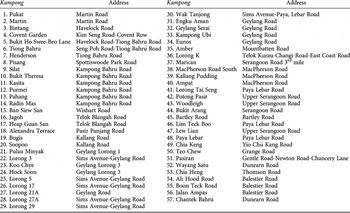
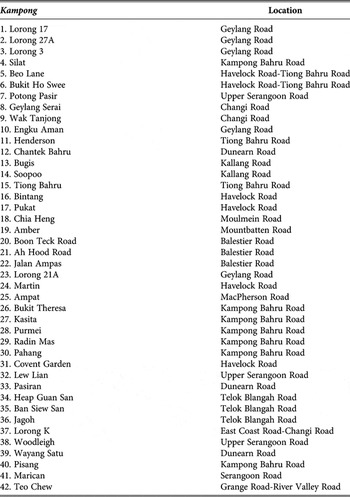
In 1954, as Table 1 shows, 42 urban kampong were identified as serious fire risks, mostly located at the eastern and western parts of the city.Footnote 80 The first major conflagration after the war occurred at Kampong Bugis in the urban east in 1951, rendering an estimated 3,000 persons homeless. The disaster was followed by severe fires two years later in the approximate area, at Geylang Lorong 3 (2,385 persons became homeless) and Lorong 25 (more than 1,000 fire victims). The western half of the city experienced its first major postwar fire at Kampong Tiong Bahru in 1955, in which 792 residents lost their homes. Even more devastating infernos swept through Kampong Koo Chye in the eastern half of the city in 1958, where 2,050 persons were made homeless and again Kampong Tiong Bahru a year later (5,220 fire victims). These blazes, however, were dwarfed by the 1961 Kampong Bukit Ho Swee fire which destroyed the homes of 15,694 people.
List of kampong in the city area in order of fire risk, 1954

Source: SIT 808/50, ‘List of kampongs in city area in order of fire risk’, in Memorandum from Superintendent, SFB, to Manager, SIT, 27 October 1954.
The devastating kampong fires highlighted the interface between structure and agency and the intersection of geographical, climatic, social and political factors. While satisfying the demand for suitable housing for low-income Chinese families, the urban kampong could not entirely escape the powerful grip of geography. The unplanned, unauthorised and closely built wooden housing had no fire breaks and often stood on hilly or otherwise inaccessible ground. In the Geylang Lorong 3 inferno, for instance, fire-fighters had to slowly negotiate ‘narrow, winding alleyways’ to reach the flames.Footnote 81 Similarly, in the 1955 Kampong Tiong Bahru fire, the Singapore Fire Brigade, the chief public body responsible for controlling the fire hazard, was not promptly notified, partly because the nearest telephone was half a mile away down a winding kampong path.Footnote 82 Swift response to a fire call was also hampered by the historical concentration of urban development at the southern apex of the island. As traffic congestion on the trunk roads in the inner city worsened after the war, the maximum time for a fire engine to travel between the fire stations at Hill Street and Sims Avenue increased from 12 minutes in 1950 to 20 minutes just three years later.Footnote 83 By contrast, in the received wisdom 5 minutes was the desirable maximum time in a city for a fire engine to reach an address in a high risk area.Footnote 84 The geographical factors complicated the fact that wooden houses were extremely combustible. This was particularly dangerous when the dwellings were scorched tinder dry by the tropical sun, or when a fire started at one dwelling, if driven by strong winds, could quickly engulf the entire settlement.Footnote 85
On the other hand, the fire hazard was embedded in the social fabric of kampong life. The main causes of fires in postwar Singapore matched the rhythm of everyday life in the urban kampong.Footnote 86 ‘Light thrown down’, ‘rubbish fires’ and the ‘sun's rays striking broken glass’ could be attributed to the discarding of or failure to remove used or unwanted items in the kampong; ‘joss burning’ to religious worship and celebrations within the home or nearby; ‘sparks from fires and stoves’ to household chores and the use of firewood for cooking; and ‘fireworks’ and ‘children playing with matches’ to celebrations and recreation in the kampong's open spaces. Two kampong infernos occurred during Chinese festive celebrations in which extensive burning of joss took place: the 1955 Kampong Tiong Bahru blaze which occurred during the Mooncake Festival, and the Kampong Koo Chye inferno during the Qing Ming Festival.Footnote 87 In addition, urban kampong dwellers appeared to be careless or negligent towards the fire threat. Some residents forgot to blow out a candle when leaving the house,Footnote 88 while the children in their unsupervised play commonly aimed fire crackers and sky rockets at attap roofs. Former kampong resident Wang Ah Tee recalled that ‘during the Chinese New Year, we could get a big packet of fire crackers for 10 cents. We would catch some rats, pour petrol on them and burn them, and then they ran onto the attap roof. Die! Because we didn't know [the risk] then.’Footnote 89 Eyewitnesses claimed that the 1959 Kampong Tiong Bahru blaze was started by children letting off fire rockets, one of which lodged in the bone-dry thatched roof of a shop.Footnote 90
Nevertheless, a deeper examination into the issue reveals that urban kampong dwellers' attitude towards the fire hazard was significantly more complex. They accepted fire as part of their everyday life in a way that appeared to outsiders as complacent but which in fact combined both an acute awareness and a passive acceptance of the risk. On this ambivalent attitude towards fire, Joyce Horsley, a social worker in Kampong Henderson in the 1950s, explained:
I suppose they took life as OK, they had no idea that they were likely to have fire. Or if they had, they thought they were prepared to cope with it. They all had to be on their guard. They lived from day to day. Of course they were quite careful in what they did, hoping that nothing would happen.Footnote 91
There was a certain degree of vigilance, both individual and social, towards the fire hazard. As one interviewee stated, ‘living in a kampong, the only thing we were afraid of was fire’.Footnote 92 ‘Fire is a very public thing’, a former resident explained; ‘one thing you were always vigilant about was fire. As soon as there was fire, everybody just screamed and yelled. Instantly. As soon as there was fire, the first thing most able-bodied young people would do was try to put out the fire.’Footnote 93 In the event of fire, the kampong dwellers' first instinct was to save what mattered most to them – their family and possessions – rather than to attempt to fight the flames. Yap Kuai Yong, who stayed near Kampong Bugis, recalled that ‘when someone in the kampong shouted “Fire!”, we were very frightened and would rush out of the house to see where it was, holding tightly to our children. When someone set off fire crackers, we were so afraid of fire, everyone, not just us.’Footnote 94Kampong dwellers did take some precautions to minimise the fire risk. According to one source, ‘if we were burning joss papers, we had to be careful, we had to take the responsibility to be around until the burning was over’.Footnote 95 Lily Wee, being the eldest child of a family residing in Kampong Henderson, had to plan to evacuate her seven younger siblings to safety in the event of a fire at night.Footnote 96
Just as crucial as factors linked to the dynamics of kampong life, however, were the shortcomings of the Singapore Fire Brigade. The Brigade was much more prepared to deal with fires in places such as public buildings and cinemas, which were directly connected by phone to the Fire Control Room, than in a kampong. Historically, the Brigade's Central Fire Station at Hill Street and Geylang station at Sims Avenue served the inner city and the eastern part of Singapore respectively. In 1954, after considerable delay, a third station was opened at Alexandra, west of the Central Area, although its main purpose was to service Queenstown New Town, which was being developed by the SIT.Footnote 97 In the 1950s the Brigade conducted an increasing number of safety inspections and ‘goodwill visits’ to urban and rural areas, but its focus was still on public and commercial buildings. In one important way, though, the force attempted to deal with the worsening kampong fire hazard. In 1950 it acquired a water tender, a specially designed fire engine equipped with a portable pump capable of drawing water from wells and ponds far off the main roads. More tenders were subsequently acquired, including the lightweight Austin ‘Champ’ tenders, which had rendered valuable service in villages in Southeast Asia and Hong Kong. These engines could negotiate narrow kampong lanes and reach fire outbreaks quickly before they grew beyond control.Footnote 98 The tenders could also function as ‘water carriers’ to fetch water from more distant areas and rapidly return to the fire site.Footnote 99 In the mid-1950s, the Brigade lauded the water tenders as being of ‘great value’ in fire-fighting operations in the congested kampong.Footnote 100
For all its efforts, however, the Fire Brigade was hampered by its strained relationship with the lower-income Chinese population. The force had long acquired a reputation among the Chinese for fire-site pilfering. Fire officer Arthur Lim Beng Lock revealed that, before the war, Chinese residents in the Central Area called a passing fire engine pah chiu chia (‘robbery vehicles’), as fire-fighters were encouraged by their Caucasian officers to pocket valuables found at a site. In the PAP era, when theft was expressly prohibited, fire engines were closely associated with slum clearance operations, where a passing pump was commonly viewed as being ‘on another URA [Urban Renewal Authority] job’, in reference to the statutory board established by the PAP government to clear the Central Area.Footnote 101 The Brigade's social distance from urban kampong dwellers severely hampered its work. In the event of a fire, kampong dwellers, as Arthur Lim recalled, ‘tended to want to pull our hoses and try to get water to protect their own properties’.Footnote 102 It is telling that the Fire Brigade received late calls for the conflagrations at Geylang Lorong 3 and Lorong 25 in 1953, and Kampong Tiong Bahru in 1955 and 1959, while the 1961 Kampong Bukit Ho Swee inferno was also ‘obviously a late call’.Footnote 103
Beyond the shortcomings of the fire-fighting services, however, was the city authorities' general failure to adequately address the geography of fire risk. While the number of fire hydrants in Singapore increased from 3,505 in 1949 to 5,370 in 1960, the water supply to the urban kampong was often inadequate due to the inaccessible or hilly ground or the failure to install water mains in the area.Footnote 104 In the 1951 Kampong Bugis disaster, the fire-fighters found the water supply in the mains inadequate and had to draw water from the Kallang River. As J.G. Shaw, Superintendent of the Brigade, conceded, ‘What we were up against was a poor water supply. Lines were laid on but it was found that there was no water.’Footnote 105 There was speculation in the Singapore Standard that the assigned water had been diverted from nearby Sin Koh Street to prevent wastage of use.Footnote 106 In kampong blazes in the eastern part of the city, the Fire Brigade was able to draw water from the Kallang River at reasonably good pressure, but this was still not enough to subdue the infernos. In the urban west, during the 1955 Kampong Tiong Bahru fire, the fire hydrant nearest to the flames was 250 yards away, while the fire hoses had to be joined together, reducing the power of the jets.Footnote 107 When the kampong was again ravaged by fire four years later, the situation had not improved. The fire engines attempting to reach the flames were ‘rendered decorative by lack of sufficient water supplies’, forcing the Fire Brigade to turn off several hydrants to raise the water pressure.Footnote 108 It turned out that no mains had yet been laid in the area, with the City Council still considering the question of whether Tiong Bahru Road was a main road.Footnote 109
The lack of water supply, then, was as much a failure of public administration as a factor of geography. Moreover, there was little official enthusiasm towards proposals for the government to provide non-combustible attap roofing to kampong dwellers at subsidised prices.Footnote 110 After the 1953 Geylang Lorong 25 blaze, T.P.F. McNeice, President of the City Council, reasoned that ‘any method we take should be a constructive one. It must not perpetuate the appalling conditions in which attap dwellers are living at present.’Footnote 111 ‘The money would be better spent’, McNeice concluded, ‘in building new houses complying with Municipal requirements’.Footnote 112 Clearly, the city authorities were keener on replacing the wooden houses than on making them safe from fire.
The government's failure to address the kampong fire hazard, coupled with the SIT's attempts to clear the settlements for development, strongly shaped the attitudes of urban kampong dwellers towards fire outbreaks. Already wary of the government in general, the semi-autonomous population readily attributed fires to acts of arson by the state. In the official statistics, arson was not a major cause of fire, usually constituting 1 or 2 per cent of the total number of fires in Singapore. Recorded cases of arson were officially viewed within the Cold War paradigm of counter-insurgency and associated with attacks by the Malayan Communist Party on industrial, commercial and public buildings.Footnote 113 Moreover, without comprehensive police investigation and the cooperation of witnesses in the kampong, it was difficult to distinguish between arson and other causes of fire. A ‘light thrown down’, for instance, could belie an act of arson. Arson directed against wooden dwellings was consequently both under-reported and under-investigated due to the social and political distance between urban kampong dwellers and officials of the state.
To many urban kampong dwellers, the logical leap from fire to arson was psychologically easy to make. ‘It was always like that’, they ventured years later, ‘There was eviction and people did not want to move. After a while, fire broke out.’Footnote 114 Such beliefs are not pure speculation as might be assumed but are based, ostensibly, on first-hand accounts, and possess a certain internal logic. One kampong dweller apparently had ‘seen a piece of cloth tied up with a metal wire and thrown onto the attap. We retrieved this thing. Someone had thrown it.’Footnote 115 Another resident ‘knew a friend who belonged to a type of gang, they would set fire to attap houses because when the landowner bought over the land, there were people who refused to be evicted, so they played dirty tricks’.Footnote 116
To kampong dwellers, fire was always accompanied by ‘suspicious’ circumstances: the impression was ‘that the fire engines arrived late or that there was no water, or that the fire engines were far away from the fire and were not really trying to fight the flames’.Footnote 117 The power of the belief in arson lay in the fact that it could not easily be proved or disproved. The large scale of destruction, in marked contrast to the minimum loss of lives in most kampong fires, appeared to establish the case for a well-crafted plan, namely that ‘whenever there was resettlement, there was arson and no one got hurt’.Footnote 118 What is historically significant about the rumours is not whether they were true but that they existed and circulated widely; while speculative, they ‘offer historians a way to see the world the way the storytellers did, as a world of vulnerability and unreasonable relationships’.Footnote 119 Allegations of arson indicated a genuine wariness of the government, born out of feelings of uncertainty among people dwelling in unauthorised wooden houses at the edge of society, in a decade marked by social transformation. The beliefs were further reinforced by the leftwing rural associations, which, conveniently, blamed the fires on the government.Footnote 120
Becoming citizens
Fire was not merely a politicised social phenomenon but also a contested political issue. Following the PAP's victory in the December 1957 City Council elections and the outbreak of the Kampong Koo Chye fire, the party sponsored a fresh initiative in the Council to deal with the fire hazard. In May the Fire Brigade, with the endorsement of the Council, formed volunteer fire-fighting squads in 36 urban kampong to ‘deal with outbreaks of fire and hold them in check pending the arrival of the Brigade’.Footnote 121 Each squad of at least 20 men was trained by the Brigade and provided with basic fire-fighting equipment.Footnote 122 This measure was part of the ‘new kampong policy’ of the PAP leader and first Mayor of the city, Ong Eng Guan. Ong had declared that ‘[t]he poorest sections of the people living in places like Chinatown, and those in the kampongs like Geylang or Kampong Silat … shall have first priority in our development programme’.Footnote 123 By 1960, there were 82 volunteer squads in 30 kampong, including persons with fire-fighting experience who had served in the regular or auxiliary fire brigades.Footnote 124 In Kampong Tiong Bahru in 1959 at the first major fire, following the formation of the squads, ‘a considerable amount of good work was done to help to contain the fire’ by the volunteers, including forming bucket chains, manning hoses and helping fire-fighters pull down houses to create fire breaks.Footnote 125 In 1961, the squads helped to extinguish more than 15 kampong fires.
The volunteer squads were a means by which politicians sought to mobilise the semi-autonomous and government-wary urban kampong population in the late 1950s. The PAP pragmatically sought to do so both within official circles and from the political margins of the anti-colonial movement. Besides its work in the City Council, the party also sponsored fire-fighting squads in the urban kampong through its leftwing associations. In Kampong Bukit Ho Swee, the volunteer squads were recruited from the local branch of the Singapore Rural Residents' Association and Old Boys' Associations of the primary schools in the kampong.Footnote 126 The primary aim of the squads organised by the Left, which distinguished them from the Fire Brigade-trained teams, was the prevention of arson. Chio Cheng Thun, a Singapore Rural Residents' Association organiser in Lorong Tai Seng, explained:
When kampong dwellers faced eviction, we organised fire-fighting squads for fear that the landlord would set fire to the houses. We organised them to patrol the village at night. We didn't see [the fires being set] or catch the arsonists but if you didn't want to move and if they burned your houses, you naturally had to move out, then they could develop the land. The squads were not organised in all places but in areas where some problem had occurred. If there was fire, they would sound the alarm. It was a self-help measure. The aim was not to fight fire but to prevent people from setting fire.Footnote 127
In Bukit Ho Swee, Loh Tian Ho did night shifts several times a week as a member of a fire-fighting squad; it had been organised because ‘the kampong was afraid that people from outside would come and start a fire or a fire would break out here’.Footnote 128 Before the 1961 fire, as another resident, Tay Yan Woon, explained, ‘people said that Bukit Ho Swee was being evicted, and everybody had to guard their houses. There were people keeping watch in shifts in the middle of the night because they were afraid that someone might come along and set a fire. If a stranger came in, they would be questioned, and if they did not answer satisfactorily, they would be beaten up.’Footnote 129 In 1960, the residents prevented two attempted cases of arson in Bukit Ho Swee, before the great fire the following May swept through and destroyed the kampong.Footnote 130
The work of the volunteer fire-fighting squads demands a revision of the official representation of kampong dwellers as inert. The Fire Brigade, for example, painted a wholly negative picture of the unorganised kampong dweller:
Prior to the formation of kampong fire parties there was practically no one in the least fire-minded and when a fire did occur the tendency was for kampong dwellers to snatch up their most valued possessions and run to safety. It never occurred to them to attempt to extinguish the fire which in many instances could have easily been done while in its incipient stage; neither was any thought given to calling the Brigade until the fire had gained a firm hold.Footnote 131
However, as scholars have pointed out, marginal communities are capable of developing effective strategies and social networks to cope with environmental hazards.Footnote 132 The establishment of the volunteer squads was necessarily based on the strong fabric and semi-autonomous character of kampong community life and its loose economic structure. Chua Beng Huat observed that a ‘[c]ollective vigilance was always maintained against the apprehension of the villagers, namely, fire. At the slightest indication of fire breaking out, the village men were there attempting to put it out rather than rushing home to help their own families prepare for evacuation’. According to Chua, it was the unemployed young men like the secret society gangsters who frequently provided the ‘free labour’ for these dangerous relief efforts.Footnote 133 These young men understood that fire was a serious threat to the kampong, much like hostile SIT demolition teams, requiring a collective social response.
From a larger historical perspective, the establishment of the volunteer squads – whether by the colonial state or the PAP – signalled the beginning of the political mobilisation of the semi-autonomous urban kampong population. While in the short term the kampong were made safe from fire, in the longer run they were doomed to eventual removal by being increasingly drawn into the political life of the developing state. Elsewhere, fire outbreaks were increasingly linked to issues of individual identity and obligations to the state. Following the 1959 Kampong Tiong Bahru disaster, Sin Chew Jit Poh newspaper reminded its readers that the disaster relief work on behalf of kampong dwellers constituted the ‘first step’ in the country's practice of self-government.Footnote 134 After the 1961 Bukit Ho Swee inferno, Nanyang Siang Pau newspaper emphasised the need to clearly define the responsibilities of a good citizen:
The observance of law and regulations is the first lesson for the citizens and an important condition for community life. It is hoped that all citizens will cultivate a good civic habit and refrain from building unauthorised houses for their own convenience, thus marring the look of the city and sowing the cause for future fires.Footnote 135
At the municipal and national levels of government in the late 1950s, rival political elites attempted to speak and act on behalf of kampong dwellers-turned-fire victims. The primary motivation was the changed political climate. Singapore had taken a step towards self-government in 1955, when the Labour Front had been elected as a minority government under the Rendel Constitution (albeit on limited suffrage), with partial control over the island's domestic affairs, including housing. The more radical PAP, though numerically a small opposition in the Legislative Assembly, held sway in the City Council following the 1957 elections. In May 1959, the political parties would contest the general elections in the hope of presiding over a self-governing state. It was in such a context of significantly raised political stakes that the relief and rehousing operations for major kampong fires were contested.
Following the Kampong Koo Chye fire, the Social Welfare Department instituted a ban on the presence of political parties at the relief centre. W.S. Woon, its Director, who had observed political party workers distributing gifts to fire victims, declared, ‘We do not want to allow a tragedy to be exploited for political propaganda purposes.’ He explained how the ‘PAP had sent hundreds of young supporters to markets and stalls to collect vegetables and meat. By noon, they had gathered lorry loads of vegetables and meat — enough to meet the victims’ requirements for weeks', although there was no refrigerator at the relief centre. The Workers' Party, he said, had also established collection centres at the fire site decorated with party symbols and banners, while the Labour Front had turned its headquarters at De Souza Street into a fire relief collection centre.Footnote 136
To an even greater degree, the Kampong Tiong Bahru disaster, which occurred closer to the 1959 general elections, produced a series of remarkable scenes of one-upmanship among the politicians. In the City Council, Mayor Ong Eng Guan, matching the Council's previous contribution for the Kampong Koo Chye fire, sought a $100,000 donation for the fire victims. Lee Bah Chee, Liberal Socialist Councillor for Tiong Bahru, countered with a $150,000 vote, reasoning that many more people were affected this time. Ong, however, rejected the higher amount, citing financial stringency and arguing that it was the government's duty, not the Council's, to provide relief. He told Lee that he would oppose any attempt to make political capital out of the fire by raising the amount of the donation. Lee replied, somewhat wildly, that since Ong had been Mayor there had been two serious fires and that if he had the people's interests at heart, he would return to his hometown in Batu Pahat!Footnote 137 Lee firmly blamed the fire on the PAP:
I knew this would happen. One of my first moves when I was elected to the City Council was to ask for fire hydrants to be installed INSIDE the kampong. The PAP said the Council had no money and could not accede to my request. If they had, the firemen would not have been hampered in their work and many hundreds of people would not have lost their homes. The PAP must accept the blame.Footnote 138
In March 1959, after Ong and other PAP Councillors resigned from the Council to contest the general elections, Tang Peng Yeu, the new Council Chairman and a member of the Singapore People's Alliance, pointed out: ‘The disastrous fire of Lorong 3 [Kampong Koo Chye] and Kampong Tiong Bahru should show to the people of Singapore whether the Mayor and his PAP Councillors have taken steps during the 15 months in the Council to minimise the fire risk in kampongs.’Footnote 139
The Kampong Tiong Bahru disaster also ignited a fire of sorts in the Singapore Legislative Assembly, a sign that kampong blazes had attained a new-found political importance at the highest level of politics. The relocation of the fire victims to the SIT's Kallang Estate became a point of conflict in the run-up to the elections on 30 May, as Polling Day, Saturday, was a public holiday. Previously, on 3 March, William Tan Ah Lek, Democratic Party Assemblyman for Tiong Bahru, had requested the government to either set up polling stations in Kallang or provide transport for the fire victims to vote in Tiong Bahru. Lee Kuan Yew, PAP Assemblyman for Tanjong Pagar, referring to the government's promise to build flats in Tiong Bahru within three months (by May), wondered if ‘pleasure-loving and indolent Ministers are rehousing the fire victims in record time for reasons not unconnected with the elections’.Footnote 140 Lee also called Chief Minister Lim Yew Hock an ‘amateur fire-fighter’ — Lim's photograph had appeared on the front page of the Straits Times the day after the fire, showing him at the fire site with his shirt sleeves and trousers rolled up and holding a bucket to douse attap roofs.Footnote 141 Lim countered that he had never harboured a desire for publicity, ‘unlike certain leaders of the PAP’, and that on the day of the fire, ‘there was a PAP propaganda machine out there saying that the Government was responsible for the fire!’Footnote 142
The following day, the politicians continued to engage in ‘fire politicking’ while claiming to deplore it. Retaliating against Lee Kuan Yew's insinuation that he was trying to win votes for the elections, William Tan initiated a motion against the electioneering propaganda that took place at the fire site and blamed the PAP City Councillors for not installing bigger water pipes in the area. He also accused PAP relief workers at the fire site of asking university medical students who had come to help to put on party armbands, and of making political speeches claiming the PAP to be the only political party in Singapore that assisted the unfortunate.Footnote 143 In response, Lee Kuan Yew wondered why, if the government was indeed against using acts of charity for publicity, a picture of Lim Yew Hock with his trousers rolled up and holding a bucket of water had appeared on the front page of the Singapore People's Alliance organ.Footnote 144 To Lee's accusation, Lee Choon Eng, Labour Front Assemblyman for Queenstown, who seconded Tan's motion, observed that Lee was not at the scene himself; while the Chief Minister held a hose to fight the flames, the PAP, including the Mayor of Singapore, had brought along only photographers.Footnote 145 Tan's motion was passed.
After the PAP won the 1959 general elections in a landslide, the new government was much more determined than the British and Labour Front administrations to integrate urban kampong dwellers into the social structures of a high modernist state. Under the State Development Plan for 1961–65, the PAP directed the HDB to redevelop 1,300 acres of land within five miles of the Central Area, in effect targeting the ‘Black Belt’ for clearance.Footnote 146 Unlike the SIT, the Board also accepted the need to build large numbers of emergency housing as an interim measure to rehouse evicted kampong dwellers. The HDB recognised that ‘political considerations were more pressing and that the Housing Board might have to sacrifice its ideas on what units should be constructed’.Footnote 147 The PAP's resolute policy on kampong clearance was highlighted in the Kampong Bukit Ho Swee inferno. Lee Kuan Yew, now Prime Minister, promised that ‘[i]n nine months’ time a sufficient number of units will be completed by the Housing and Development Board to house every fire victim family'.Footnote 148 At a low rate of one-third the unencumbered value of the land, the government acquired the fire site for rebuilding.Footnote 149 In September 1961, within four months of the calamity, 904 one-room emergency flats were completed at the nearby Tiong Bahru cemetery site, which had been acquired by the SIT following the 1959 Kampong Tiong Bahru fire. More than 700 of the flats were allocated to the Bukit Ho Swee fire victims. By the end of 1963, 2,166 out of the 2,600 families victimised by the fire had registered with the HDB and were successfully rehoused.Footnote 150
More crucially, Bukit Ho Swee's emergency flats also served as a vital springboard for the government's kampong clearance and urban renewal programmes in the vicinity. From September 1962, certain flats in the estate were reserved for kampong families affected by the clearance of Redhill, victims of the 1963 fire at Bukit Ban Kee, and also for general applicants on the housing register.Footnote 151 From October 1964, the Board opened more vacant flats in the estate to applicants evicted from South Precinct 1 due to the urban renewal programme.Footnote 152 By 1966, there were 12,562 flats in Bukit Ho Swee Estate, capable of housing an estimated 75,000 people, five times the number who had previously lived in the kampong.Footnote 153 Two-thirds of the people who eventually moved into the estate were, then, consequently not victims of the 1961 fire. As Teh Cheang Wan, the HDB's chief architect, later remarked, the Board's ‘building programme would have run into difficulties if not for the God-sent opportunity of the Bukit Ho Swee fire in 1961 where a site was made available for 10,000 units of flats’.Footnote 154
Politically, the PAP also removed the independent centres of power in the urban kampong in the early 1960s. In September 1961, following the split between the Lee Kuan Yew group and the PAP Left, the Singapore Country People's Association and Singapore Rural Residents' Association supported the Barisan Sosialis.Footnote 155 In 1961–62, the rural associations organised resistance against the PAP's merger campaign and the resettlement of kampong dwellers in Toa Payoh.Footnote 156 By April 1962, the first phase of the Toa Payoh clearance had been significantly slowed down by the opposition.Footnote 157
The PAP responded to this political challenge from the Left by repeatedly warning the Malayan and British colonial governments of a deepening communist threat to their respective security interests in the region. The establishment of this international entente of conservative forces has been mapped out in detail by a number of contributors to the ‘new political history’.Footnote 158 In February 1963, a massive purge orchestrated by the PAP, Malayan and British colonial governments, termed ‘Operation Coldstore’, detained over 100 leading Leftists on charges of a conspiracy to create a ‘Cuba in Singapore’ through violent revolution.Footnote 159 In November, following the PAP's victory in the September elections, the Singapore Country People's Association and Singapore Rural Residents' Association were deregistered for allegedly operating ‘recruiting and training centres for Communist cadres in the rural areas’.Footnote 160 These purges decimated the Singapore Left and effectively brought to an end the period of the ‘Singapore Spring’.
Without political organisation, kampong dwellers in Toa Payoh progressively accepted the HDB's compensation and rehousing terms.Footnote 161 By the mid-1960s, another institution in the urban kampong had also become redundant — the volunteer fire-fighting squads which had been politically expedient in mobilising the wooden house population earlier. The squads disappeared when their kampong were either destroyed by fire or cleared for development. By 1971, only 13 squads remained of the original 38 formed in 1958.
As a result of the Bukit Ho Swee fire and the political purges, high modernist HDB estates steadily replaced the kampong at the margins of Singapore city throughout the 1960s. A total of 12,829 families were evicted from their homes in the HDB's first five-year plan, of which three-quarters moved to planned resettlement areas or accepted HDB flats. By 1965, in the restored urban periphery stood 54,430 units of public housing flats, accommodating 23 per cent of the population, and rising. A year later, Lee Kuan Yew proudly stated that ‘Singapore is a proud city. It is acquiring the one hallmark of a great civilised community, magnificent buildings plus comparable workers housing.’Footnote 162 The semi-autonomous urban kampong population was progressively being socialised into becoming citizens of the new nation-state.
Conclusion
It is timely to consider ways both to extend the social history of Singapore into the postwar period and to expand the increasing interest in the politics of the period to the social arena. This article has demonstrated how the expansion of unauthorised wooden housing at the margins of the city after the war underlined the balance between structure and agency in history. The movement of low-income Chinese families with multiple children into inexpensive housing situated along the urban fringe was mandated by both the housing shortage in the inner city and the economic needs of the families. At the same time, though, the mobility was also buoyed by a remarkable opportunism in the Chinese population's search for housing and their optimism at the prospects of eking out a better future in the new postwar society. Similarly, they tackled the everyday threat of fire in the congested kampong through the formation of volunteer fire-fighting squads in the settlements in the late 1950s. These teams were at times politically assisted but always drew upon the strong fabric of community life in the kampong. At the same time, as the outbreak of devastating fires in the 1950s illustrates, the social efforts could not fully overcome the urban geography of risk and disaster in postwar Singapore. In addition, as kampong dwellers readily blamed the fires on the ruling government, a study of the rumours of arson underlines the social importance of housing and of kampong fires in the postwar history. Here the historian needs to examine singular events and environmental, social and economic forces as well as issues of public debate and the unsubstaintiated rumours, all of which mattered as much to the ordinary people as they did to the political elites and urban planners.
This study has also demonstrated the continuity in social policy between the British colonial state and the PAP government — in terms of both their disapproval of unauthorised housing and their determination to replace it with high modernist public housing. The PAP initially mobilised the urban margins from both the centre of authority and the political periphery — through the City Council and the rural associations respectively. Upon coming to power, however, the party adopted and massively expanded the colonial policy of kampong clearance and of integrating the population into the social fabric of the state. What was at stake in the 1950s and 1960s, then, was not merely the overtly political issues of colonial control or independence, but a deeper shared desire by the political elites to remake Singapore society and transform a semi-autonomous population into a disciplined citizenry. Like the colonial regime, the PAP government also employed a discursive approach to kampong clearance and resettlement. ‘Emergency’, ‘squatter’, ‘clearance’, ‘resettlement’ and ‘fire’ were not just disinterested terms of description but powerful agents of societal and political transformation, commonly used in the official housing and social literature in the postwar years. The social history of urban kampong clearance and of the great kampong fires suggests that the historiographical divide between the British and PAP governments in the postwar narratives be re-examined. This history was an integral part of decolonisation in Singapore.
It is also important to establish points of convergence between the ‘new political history’ and the social history in order to create a unified link between the international, national and local levels of the history of postwar Singapore. The urban kampong-dwellers of Singapore evidently straddled two different political and cultural worlds — one that was ideologically cosmopolitan, forward-looking and anti-colonial, and another which was semi-autonomous of the state and fearful of officialdom. The ordinary people, it appears, were not simply politically passive or assertively anti-colonial, but both. This view of the underside of postwar Chinese society suggests that we reconsider the complex nature of the mass-based politics of the 1950s and 1960s and the dramatic rise and collapse of the Singapore Left, particularly following the official purges in 1963.
In addition, the ‘new political history’ has retained the seemingly fixed categories used by the political actors to define themselves and others, specifically, ‘left’, ‘right’ and ‘centre’. A history of social change, however, would appear to render these ideological positions untenable. If, as this article has argued, kampong clearance and housing development in postwar Singapore constituted an attempt to socialise a semi-autonomous population into becoming model citizens of the state, it was an enterprise embraced by both the British colonial regime and the Fabian socialist faction of the PAP led by Lee Kuan Yew but also, to a considerable extent, by the radical left wing of the party. As James Scott has maintained, a history of the development of high modernisation cuts across the ideological divide between the Left and the Right.Footnote 163 It is to understanding the roles of both the ordinary people and the political elites in postwar Singapore that a social history approach brings both new questions and new insights amid the societal and political transformation of the city into a modern nation-state in the 1950s and 1960s.