Introduction
Acoustic neuroma or vestibular schwannoma is a benign neoplasm arising from the enveloping sheath of the vestibular (VIIIth cranial) nerve. Considerable resources in terms of clinical time and diagnostic investigations are consumed in the diagnosis of these neoplasms. There are two varieties: a sporadic form and a genetic form called neurofibromatosis type 2 (NF2). In this study, unless otherwise specified, vestibular schwannoma will refer to the sporadic form.
Magnetic resonance imaging (MRI) is considered to be the ‘gold standard’ in the diagnosis of vestibular schwannoma.Reference Hentschel, Scholte, Steen, Kunst and Rovers1 Among different neuro-otological symptoms and signs produced by vestibular schwannoma, asymmetrical sensorineural hearing loss (SNHL) is the most common, followed by tinnitus.Reference Caulley, Sawada, Hinther, Ko, Crowther and Kontorinis2 The MRI scans are very commonly requested for patients presenting to ENT clinics with these symptoms. These neoplasms exhibit a spectrum of clinical manifestations. A minority of tumours can undergo significant and rapid growth, passing out of the internal auditory meatus into the cerebellopontine angle, where they can cause brainstem compression and ultimately death. The majority of vestibular schwannomas, however, show indolent and slow growth, with symptoms of asymmetric deafness and tinnitus being the only presenting features.
The change in the demographic pattern of the world population has seen an increase in the proportion of people aged over 60 years (8 per cent in 1950 vs 11 per cent in 2010).3
This article aimed to examine the cost-effectiveness of MRI as a screening tool in the diagnosis of vestibular schwannoma in patients aged over 70 years and presenting with asymmetrical SNHL or unilateral tinnitus, by collecting and analysing data from published materials obtained through a literature search.
Materials and methods
A literature search covering the period from 2008 to 2018 was performed, by the first author, using the Medline, Embase, Cumulative Index to Nursing and Allied Health Literature (‘CIHNAL’), PubMed and Google Scholar databases. The key words ‘acoustic neuroma’ or ‘vestibular schwannoma’ were used in combination with: ‘epidemiology’ or ‘natural history’; ‘growth rate’, ‘rate of growth’ or ‘size’; ‘asymmetrical hearing loss’, ‘asymmetrical sensorineural hearing loss’ or ‘tinnitus’; and ‘pick up rate’, ‘screening’, ‘diagnosis’ or ‘test’. All searches were repeated to confirm the results.
Preferred Reporting Items for Systematic Reviews and Meta-Analyses (‘PRISMA’) flow charts were used in the selection of articles relevant for this study. These were articles involving sporadic vestibular schwannoma in adults, and epidemiological studies on its incidence rate, growth rate, change in its management with time, conservative management outcome, and reported incidence of vestibular schwannoma based on MRI in patients presenting with asymmetrical SNHL or unilateral tinnitus.
Articles not published in the English language or not available in English translation were excluded. Studies based solely on NF2 and patients aged below 16 years were also excluded. However, some articles included both sporadic and NF2 vestibular schwannoma groups; where the data from each group were given separately, only those from the former group were included in our study. Duplicate results were excluded.
The articles were excluded if the abstracts indicated that the main subject of the study focused on: vestibular schwannoma therapy; the epidemiology of the tumour in a societal group or discussion of the regional distribution of vestibular schwannoma; the tumour risk factors; the characteristics of incidental vestibular schwannoma only; a comparison of different protocols defining asymmetrical SNHL; or a comparison of MRI with other methods of diagnosing vestibular schwannoma.
Relevant meta-analyses and systematic reviews were used for reference and comparison with our results. For statistical analysis, those articles reporting observational studies on the epidemiology, size and growth rate of tumours, a change in management of vestibular schwannoma, and the pick-up rate of vestibular schwannoma from audiological tests were included.
In the next step, the articles selected were requested from the library of the first author's institution. Only when full articles were obtained were they included in this study, after screening and applying the same exclusion criteria. Abstracts from presentations were used for reference only and were not included in the statistical analysis.
Statistical analysis
Weighted averages, using the number of patients in each article as weight, were calculated in Microsoft Excel® spreadsheets for: tumour size at diagnosis (millimetres), percentage of tumours showing growth, growth rate (millimetre per year), and percentage of patients who completed conservative management and did not need any switch to active treatment during the follow-up period. These data were obtained from the papers included for statistical analysis for this article.
To calculate the pick-up rate of vestibular schwannoma from MRI scans performed for asymmetrical SNHL in pure tone audiograms, we used: scans per diagnosis (number of scans required to obtain one positive result) and yield (percentage value of positive results divided by the total number of scans performed). The reason for using this method is described later.
Results
Epidemiology
The search of the epidemiology literature was performed to investigate: the incidence of vestibular schwannoma in the general and elderly populations, the size of tumours at diagnosis and how this has changed with time, and the relationship between age and tumour size.
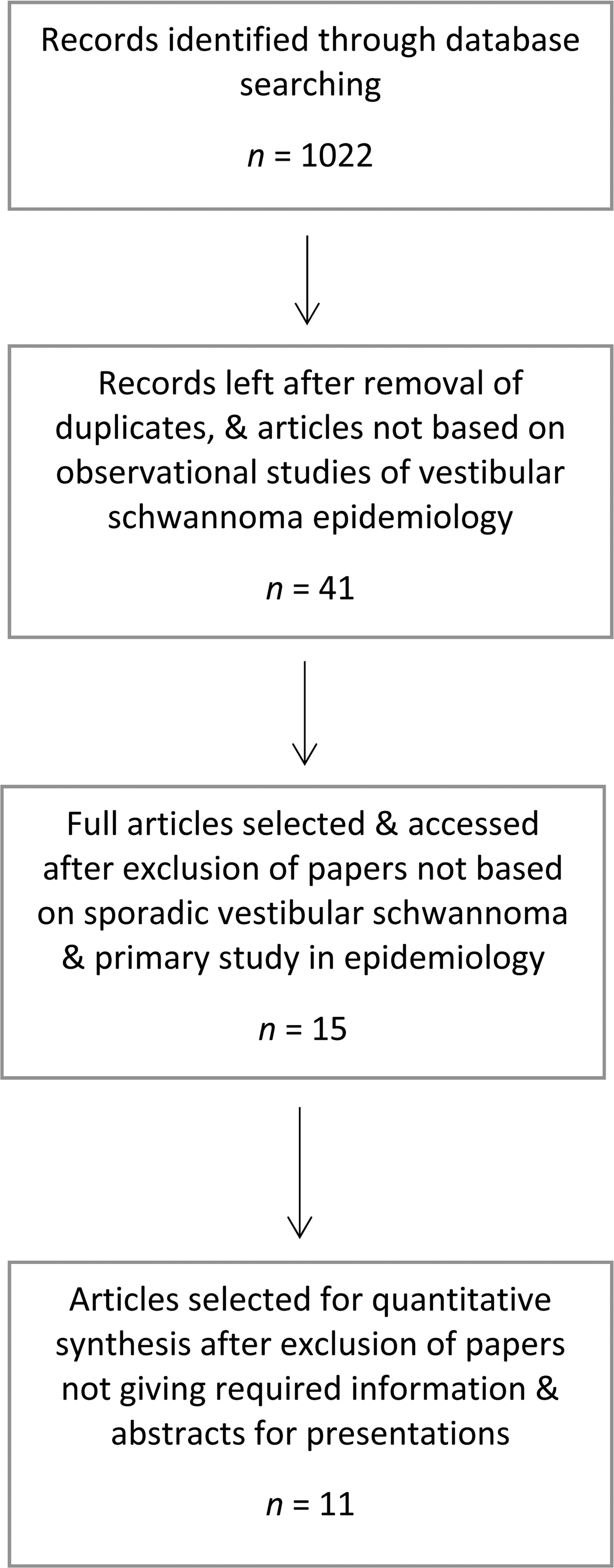
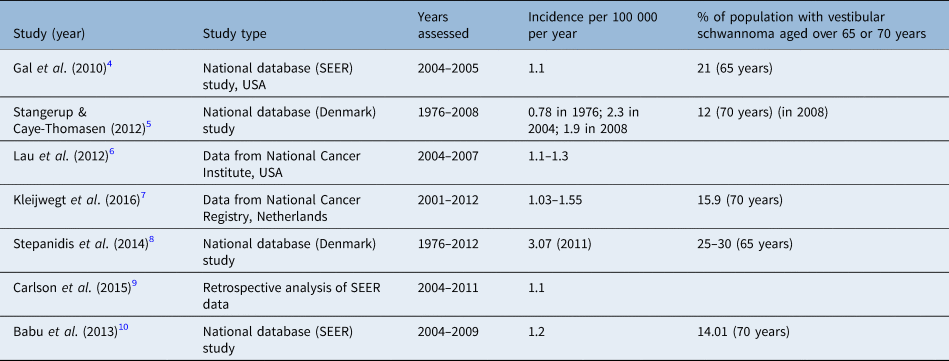
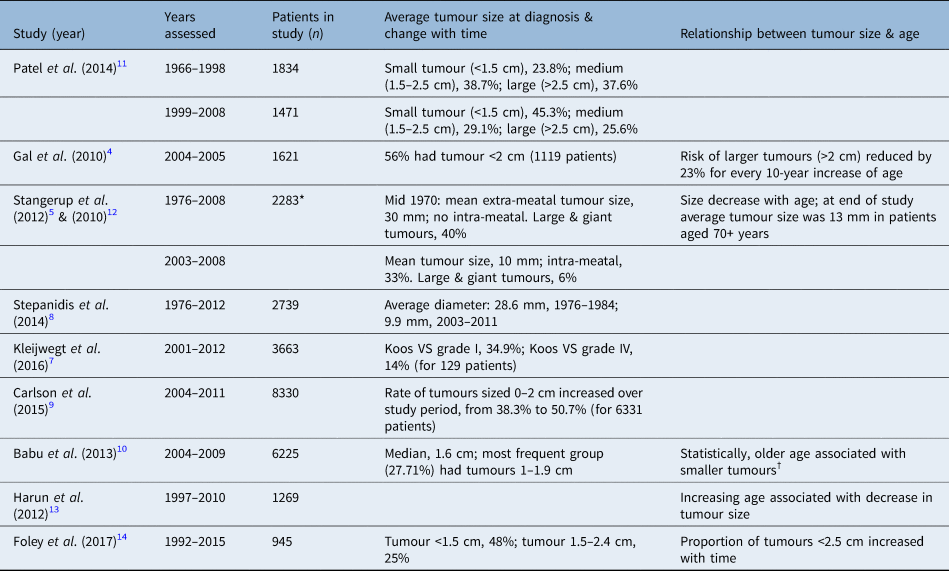
Our search revealed 1022 studies. By following the Preferred Reporting Items for Systematic Reviews and Meta-Analyses flow chart, 11 papers were included that met our criteria.Reference Gal, Shinn and Huang4–Reference Foley, Shirazi, Maweni, Walsh, McConn Walsh and Javadpour14 The results are shown in Figure 1, and Tables 1 and 2.
Preferred Reporting Items for Systematic Reviews and Meta-Analyses (‘PRISMA’) 2009 flow diagram for epidemiology of vestibular schwannoma.

Epidemiology of vestibular schwannoma – incidence rate and percentage of older patients

SEER = Surveillance, Epidemiology, and End Result Program
Epidemiology of vestibular schwannoma – tumour size and relationship with age

*Number obtained from 2010 study. †Study included 0.26 per cent neurofibromatosis type 2 patients. VS = vestibular schwannoma
The main reasons for excluding 1011 papers were as follows: the articles did not perform an epidemiological study themselves, but quoted figures from other sources; the main topics of discussion were vestibular schwannoma treatment, risk factors or change in management; the articles compared incidence of vestibular schwannoma between males and females, between people from different races or of different ethnicities, between different socio-economic classes; or the articles reported a regional comparison of vestibular schwannoma incidence within a country. It was not possible to determine the total number of cases across the entire population studied from the data in these papers.
The results for incidence rates of vestibular schwannoma in the general population came from studies conducted in the USA, Denmark and the Netherlands. We found seven papers in this section.Reference Gal, Shinn and Huang4–Reference Babu, Sharma, Bagley, Hatef, Friedman and Adamson10 The incidence rates varied from 1.1Reference Gal, Shinn and Huang4 to 3.07Reference Stepanidis, Kessel, Caye-Thomasen and Stangerup8 per 100 000 population per year. A long-term study carried out by Stangerup and Caye-ThomasenReference Stangerup and Caye-Thomasen5 showed that, after a steady increase, vestibular schwannoma incidence started to decline. The figure quoted by the British Acoustic Neuroma Association is 2 per 100 000 per year.15 An earlier study, by Tos et al.,Reference Tos, Stangerup, Cayé-Thomasen, Tos and Thomsen16 showed an increase in vestibular schwannoma incidence between 1976 and 2001.
Out of these seven papers, fiveReference Gal, Shinn and Huang4,Reference Stangerup and Caye-Thomasen5,Reference Kleijwegt, Ho, Visser, Godefroy and van der Mey7,Reference Stepanidis, Kessel, Caye-Thomasen and Stangerup8,Reference Babu, Sharma, Bagley, Hatef, Friedman and Adamson10 showed the percentage of patients aged over 65–70 years when they were first diagnosed with vestibular schwannoma. Two papersReference Gal, Shinn and Huang4,Reference Stepanidis, Kessel, Caye-Thomasen and Stangerup8 published the percentage of patients aged over 65 years, giving figures of 21 per cent and 25–30 per cent respectively. Three papersReference Lau, Olivera, Miller, Downes, Danner and van Loveren6,Reference Kleijwegt, Ho, Visser, Godefroy and van der Mey7,Reference Babu, Sharma, Bagley, Hatef, Friedman and Adamson10 showed the percentage of patients aged over 70 years; the respective results were 12 per cent, 15.9 per cent and 14.01 per cent. It appears that most of the patients were younger than 65 years when they were diagnosed with vestibular schwannoma.
A long-term epidemiological study conducted in DenmarkReference Stangerup and Caye-Thomasen5 showed that the mean age of vestibular schwannoma diagnosis increased from 49 in 1976 to 58 in 2008, but the number of patients aged under 40 years did not change significantly. This indicates that more vestibular schwannoma cases are diagnosed at an older age, but the percentage of those aged over 70 years is still low compared to the total diagnosed.
An assessment was made of the average vestibular schwannoma size at diagnosis, how this has changed with time, and the relationship between patient age and tumour size at diagnosis. Results were obtained from 10 studies and are shown in Table 2.Reference Gal, Shinn and Huang4,Reference Stangerup and Caye-Thomasen5,Reference Kleijwegt, Ho, Visser, Godefroy and van der Mey7–Reference Foley, Shirazi, Maweni, Walsh, McConn Walsh and Javadpour14 The focus was mainly directed on the change in tumour size with time and the age of patients.
It is clear that the tumour size at diagnosis decreased over time. This suggests that an increasing number of people were diagnosed with smaller tumours. This is mainly attributed to improved technology used in investigations for vestibular schwannoma. It was also found that, generally, older people were more likely to have smaller tumours.Reference Gal, Shinn and Huang4,Reference Stangerup and Caye-Thomasen5,Reference Babu, Sharma, Bagley, Hatef, Friedman and Adamson10,Reference Stangerup, Tos, Thomsen and Caye-Thomasen12,Reference Harun, Agrawal, Tan, Niparko and Francis13
A long-term study by Stangerup and Caye-ThomasenReference Stangerup and Caye-Thomasen5 found that, by 2008, the average size of tumours in people aged 70 years or more was 13 mm. A study from the same centre, published in 2010,Reference Stangerup, Tos, Thomsen and Caye-Thomasen12 found that the number of intra-meatal tumours and extra-meatal tumours sized 1–10 mm was highest in people aged over 70 years. A study by Harun et al.Reference Harun, Agrawal, Tan, Niparko and Francis13 showed that, for each additional year of age at diagnosis, the mean tumour size decreased by 0.244 mm. Papers from Kleijwegt et al.Reference Kleijwegt, Ho, Visser, Godefroy and van der Mey7 and Babu et al.Reference Babu, Sharma, Bagley, Hatef, Friedman and Adamson10 reported that, irrespective of age, the proportion of smaller tumours was higher than that of larger ones.
In summary, we can see from the published papers that the incidence of vestibular schwannoma has increased with time, and the size of the tumour at diagnosis has decreased with time. The percentage of people first diagnosed with vestibular schwannoma when aged over 70 years was reported as 12–15.9 per cent. In addition, elderly people had smaller sized tumours.
Change in vestibular schwannoma management
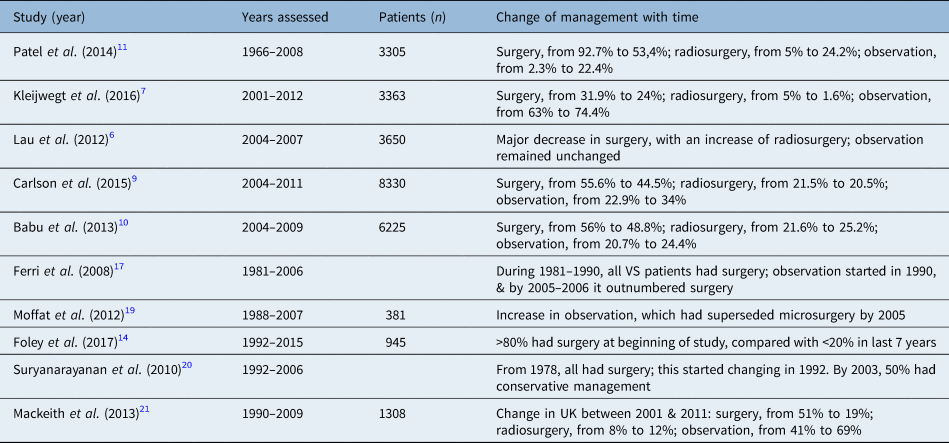
As the average patient age and vestibular schwannoma size at initial diagnosis changed, so did the management of this neoplasm. Factors considered when making decisions about treatment included tumour size, patient's age, health and hearing status, and the patient's preference.Reference Carlson, Habermann, Wagie, Driscoll, Van Gompel and Jacob9 However, the same authors also mentioned that sometimes the mode of treatment was influenced by the opinion and preference of the doctor(s) who saw these patients.
Generally, younger patients and larger tumours were treated with surgery, while older patients and those with smaller tumours received conservative management.Reference Babu, Sharma, Bagley, Hatef, Friedman and Adamson10 Conservative management involved a ‘wait and scan’ method, with serial MRI, to observe any tumour growth, and to check the symptoms and signs, in order to determine whether any change in treatment was required. There is also an argument in favour of active treatment for hearing preservation,Reference Ferri, Modugno, Pirodda, Fioravanti, Calbucci and Ceroni17 but this has been strongly challenged by Møller et al.Reference Møller, Hansen, Miyazaki, Stangerup and Caye-Thomasen18
Overall, our literature search revealed a decline in the rate of surgery and an increase in conservative management with time, which is shown in Table 3.Reference Lau, Olivera, Miller, Downes, Danner and van Loveren6,Reference Kleijwegt, Ho, Visser, Godefroy and van der Mey7,Reference Carlson, Habermann, Wagie, Driscoll, Van Gompel and Jacob9–Reference Patel, Vasan, van Loveren, Downes and Agazzi11,Reference Foley, Shirazi, Maweni, Walsh, McConn Walsh and Javadpour14,Reference Ferri, Modugno, Pirodda, Fioravanti, Calbucci and Ceroni17,Reference Moffat, Kasbekar, Axon and Lloyd19–Reference Mackeith, Kerr and Milford21 Carlson et al.Reference Carlson, Habermann, Wagie, Driscoll, Van Gompel and Jacob9 predicted that, by 2017, conservative management would become the most common method of treatment, and, by 2026, at least 50 per cent of tumours would be at least initially managed using the wait and scan method. The same paper proved (with a statistically significant correlation) that both surgery and radiotherapy were more commonly used for younger patients and larger tumours.
Change in management of vestibular schwannoma with time

VS = vestibular schwannoma
Tumour growth and conservative management outcome
With the changes in vestibular schwannoma epidemiology (an increase in the number of smaller tumours diagnosed; Table 2) and management (more cases of conservative management than active treatment; Table 3), the rate of vestibular schwannoma growth and the factors contributing to growth are two major topics of interest. These two topics can predict which of those tumours that are small at diagnosis will need active treatment during the observation period. This has led to many articles being published on the subject of tumour growth.
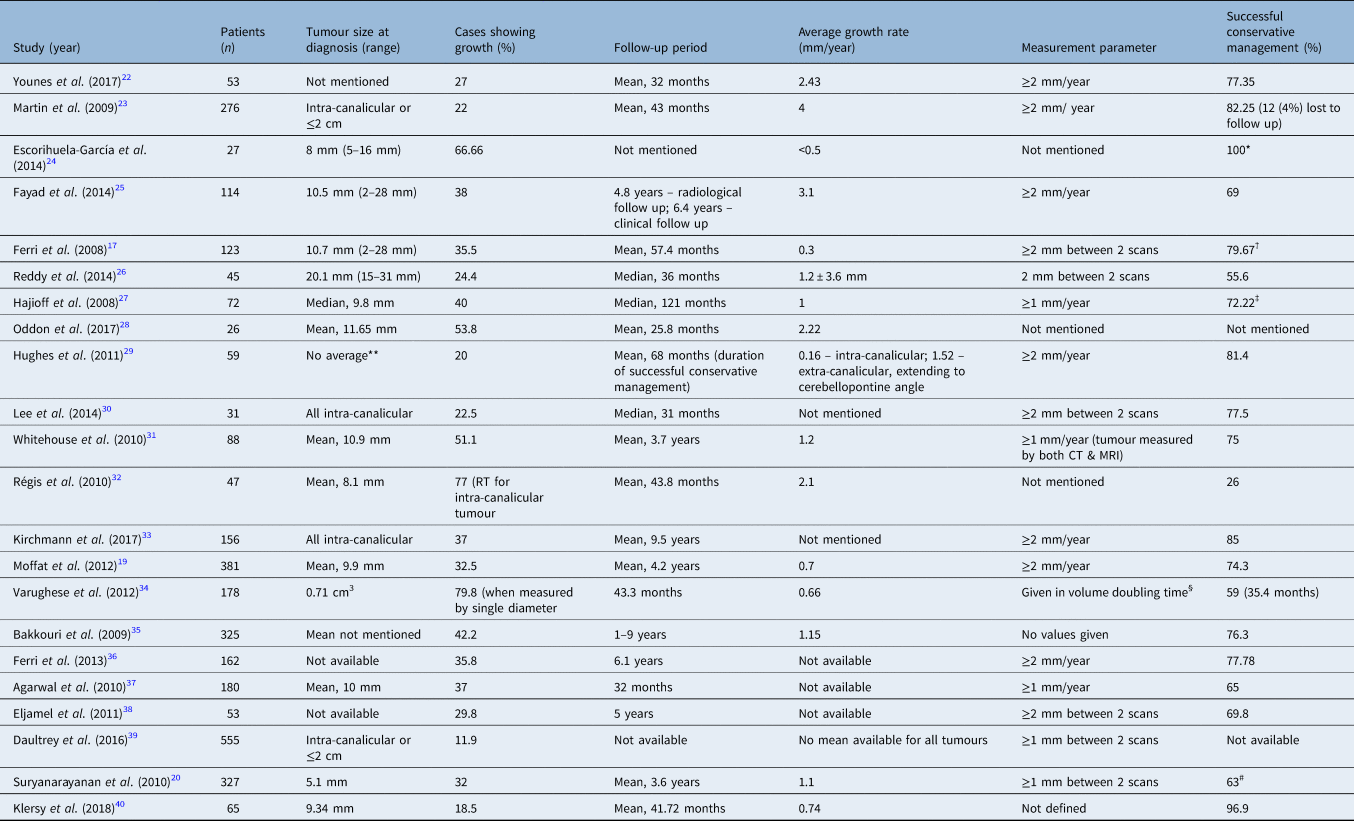
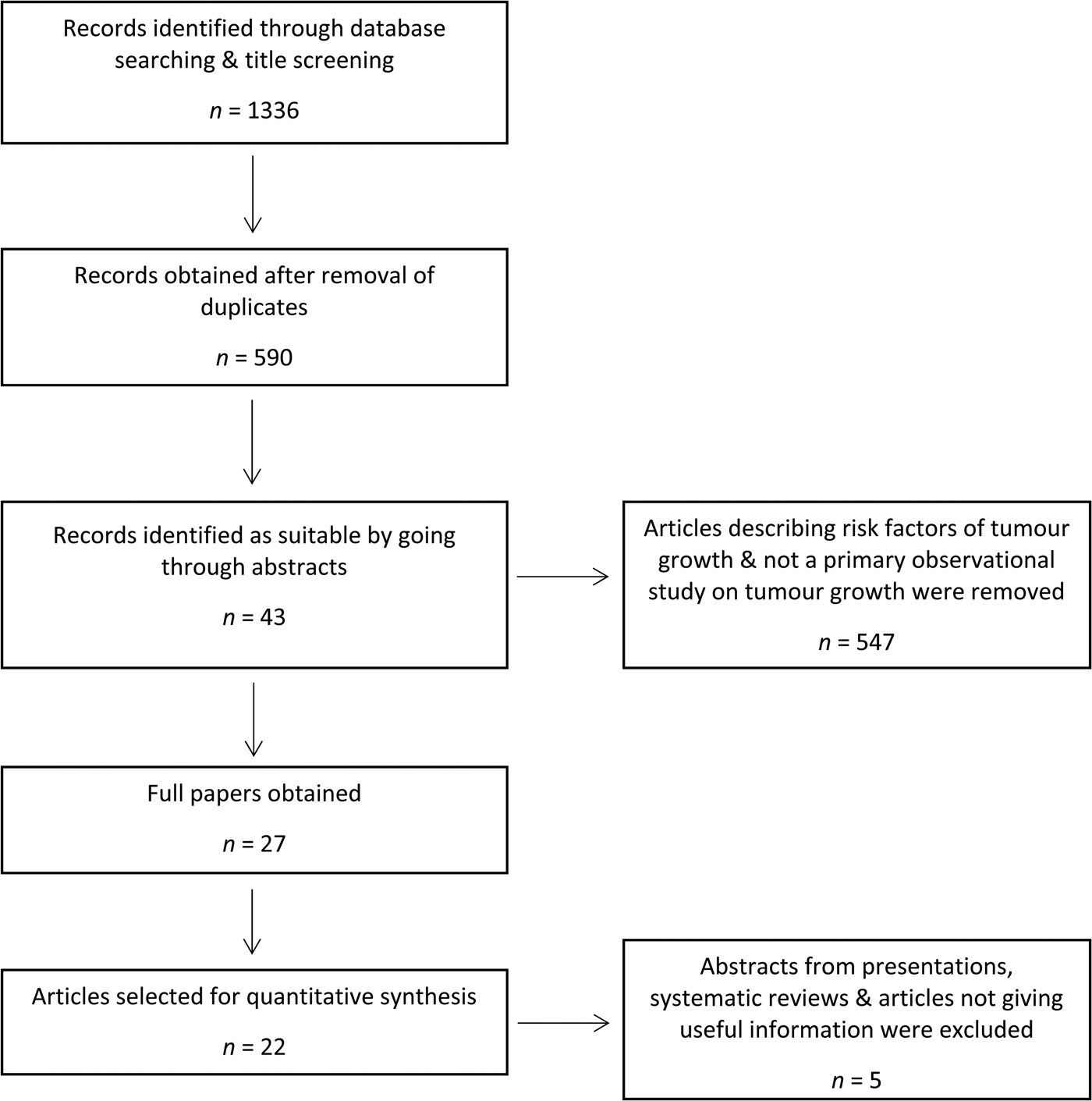
Our search in this section identified 1336 records. Twenty-two papersReference Ferri, Modugno, Pirodda, Fioravanti, Calbucci and Ceroni17,Reference Moffat, Kasbekar, Axon and Lloyd19,Reference Suryanarayanan, Ramsden, Saeed, Aggarwal, King and Rutherford20,Reference Younes, Montava, Bachelard-Serra, Jaloux, Salburgo and Lavieille22–Reference Klersy, Arlt, Hofer and Meixensberger40 were ultimately included by following the Preferred Reporting Items for Systematic Reviews and Meta-Analyses flow chart (Figure 2); these are summarised in Table 4. In addition to these, a systematic review on tumour growth – published during the search period – was identified, along with two other systematic reviews published before 2008; these are summarised separatelyReference Paldor, Chen and Kaye42,Reference Smouha, Yoo, Mohr and Davis43,Reference Yoshimoto45 (Table 5).
Tumour growth and conservative management outcome

*Only picked up patients who completed conservative management between 2007 and 2013. †Two patients lost to follow up, one died, 47.6 per cent of tumours were intra-canalicular. ‡Excluding those who showed tumour growth but did not have any treatment, and one who died from cerebral oedema. **Number of patients according to tumour size: intra-canalicular = 34; 1–10 mm = 14; 11–20 mm = 10; 21–30 mm = 1. §Mean volume doubling time was 4.4 years; any tumour showing volume doubling time of more than 0 years was considered in the growing group. #Article involved neurofibromatosis type 2, but data for sporadic tumours were given separately. CT = computed tomography; MRI = magnetic resonance imaging; RT = radiotherapy
Systematic reviews on vestibular schwannoma growth

Preferred Reporting Items for Systematic Reviews and Meta-Analyses (‘PRISMA’) 2009 flow diagram for growth and conservative management outcome of vestibular schwannoma.

Our review of the included papers revealed a lack of uniformity in measuring tumour growth. While most papers considered an increase in extra-canalicular diameter as growth,Reference Ferri, Modugno, Pirodda, Fioravanti, Calbucci and Ceroni17,Reference Moffat, Kasbekar, Axon and Lloyd19,Reference Suryanarayanan, Ramsden, Saeed, Aggarwal, King and Rutherford20,Reference Younes, Montava, Bachelard-Serra, Jaloux, Salburgo and Lavieille22–Reference Hughes, Skilbeck, Saeed and Bradford29,Reference Whitehouse, Foroughi, Shone and Hatfield31,Reference Régis, Carron, Park, Soumare, Delsanti and Thomassin32,Reference Bakkouri, Kania, Guichard, Lot, Herman and Huy35,Reference Klersy, Arlt, Hofer and Meixensberger40 some studies used an increase in tumour volume or volume doubling time.Reference Varughese, Breivik, Wentzel-Larsen and Lund-Johansen34 Even when diameter was considered, some papers defined growth as 2 mm or more per year,Reference Ferri, Modugno, Pirodda, Fioravanti, Calbucci and Ceroni17,Reference Moffat, Kasbekar, Axon and Lloyd19,Reference Younes, Montava, Bachelard-Serra, Jaloux, Salburgo and Lavieille22,Reference Martin, Senthil, Chavda, Walsh and Irving23,Reference Fayad, Semaan, Lin, Berliner and Brackmann25,Reference Hughes, Skilbeck, Saeed and Bradford29,Reference Kirchmann, Karnov, Hansen, Dethloff, Stangerup and Caye-Thomasen33,Reference Ferri, Pirodda, Ceroni, Fioravanti, Calbucci and Modugno36 while others defined it as 1 mm or more.Reference Suryanarayanan, Ramsden, Saeed, Aggarwal, King and Rutherford20,Reference Hajioff, Raut, Walsh, Bath, Bance and Guha27,Reference Whitehouse, Foroughi, Shone and Hatfield31,Reference Agrawal, Clark, Limb, Niparko and Francis37 The time interval used to measure growth was also variable. While most considered growth per annum,Reference Moffat, Kasbekar, Axon and Lloyd19,Reference Suryanarayanan, Ramsden, Saeed, Aggarwal, King and Rutherford20,Reference Younes, Montava, Bachelard-Serra, Jaloux, Salburgo and Lavieille22,Reference Martin, Senthil, Chavda, Walsh and Irving23,Reference Fayad, Semaan, Lin, Berliner and Brackmann25,Reference Hajioff, Raut, Walsh, Bath, Bance and Guha27,Reference Hughes, Skilbeck, Saeed and Bradford29,Reference Whitehouse, Foroughi, Shone and Hatfield31,Reference Kirchmann, Karnov, Hansen, Dethloff, Stangerup and Caye-Thomasen33,Reference Ferri, Pirodda, Ceroni, Fioravanti, Calbucci and Modugno36,Reference Agrawal, Clark, Limb, Niparko and Francis37 others considered the growth between two successive scans,Reference Ferri, Modugno, Pirodda, Fioravanti, Calbucci and Ceroni17,Reference Reddy, Lewis-Jones, Javadpour, Ryland and Lesser26,Reference Régis, Carron, Park, Soumare, Delsanti and Thomassin32,Reference Eljamel, Hussain and Eljamel38,Reference Daultrey, Rainsbury and Irving39 although imaging is not always conducted at one-year intervals.
The average tumour size at diagnosis varied from 5.1 mmReference Suryanarayanan, Ramsden, Saeed, Aggarwal, King and Rutherford20 to 20.1 mm.Reference Reddy, Lewis-Jones, Javadpour, Ryland and Lesser26 No average value was reported in five articles;Reference Younes, Montava, Bachelard-Serra, Jaloux, Salburgo and Lavieille22,Reference Hughes, Skilbeck, Saeed and Bradford29,Reference Bakkouri, Kania, Guichard, Lot, Herman and Huy35,Reference Ferri, Pirodda, Ceroni, Fioravanti, Calbucci and Modugno36,Reference Eljamel, Hussain and Eljamel38 two articlesReference Lee, Park, Kim and Cho30,Reference Kirchmann, Karnov, Hansen, Dethloff, Stangerup and Caye-Thomasen33 included intra-canalicular tumours only, two articlesReference Martin, Senthil, Chavda, Walsh and Irving23,Reference Daultrey, Rainsbury and Irving39 included intra-canalicular tumours and up to 2 cm of extra-canalicular tumours, while one articleReference Varughese, Breivik, Wentzel-Larsen and Lund-Johansen34 considered tumour volume. We calculated the weighted average diameter of tumours at diagnosis as 9.32 mm. This is based on data gathered from 12 papers.Reference Ferri, Modugno, Pirodda, Fioravanti, Calbucci and Ceroni17,Reference Moffat, Kasbekar, Axon and Lloyd19,Reference Suryanarayanan, Ramsden, Saeed, Aggarwal, King and Rutherford20,Reference Escorihuela-García, Llópez-Carratalá, Orts-Alborch and Marco-Algarra24–Reference Oddon, Montava, Salburgo, Collin, Vercasson and Lavieille28,Reference Whitehouse, Foroughi, Shone and Hatfield31,Reference Régis, Carron, Park, Soumare, Delsanti and Thomassin32,Reference Agrawal, Clark, Limb, Niparko and Francis37,Reference Klersy, Arlt, Hofer and Meixensberger40 We must remember that these tumours were treated using a conservative approach.
Great disparity was apparent in the percentage of tumours showing growth during the observation period, ranging from 11.9 per centReference Daultrey, Rainsbury and Irving39 to 79.8 per cent.Reference Varughese, Breivik, Wentzel-Larsen and Lund-Johansen34 This raises a serious question regarding how vestibular schwannoma growth is measured. The weighted mean percentage of tumours showing growth was approximately 33.79 per cent. This was calculated using data obtained from 22 papers.Reference Ferri, Modugno, Pirodda, Fioravanti, Calbucci and Ceroni17,Reference Moffat, Kasbekar, Axon and Lloyd19,Reference Suryanarayanan, Ramsden, Saeed, Aggarwal, King and Rutherford20,Reference Younes, Montava, Bachelard-Serra, Jaloux, Salburgo and Lavieille22–Reference Klersy, Arlt, Hofer and Meixensberger40
The growth rate was also variable, ranging from 0.3 mm per yearReference Ferri, Modugno, Pirodda, Fioravanti, Calbucci and Ceroni17 to 4 mm per year.Reference Martin, Senthil, Chavda, Walsh and Irving23 This figure was reported as low as 0.16 mm per year for intra-canalicular tumours.Reference Hughes, Skilbeck, Saeed and Bradford29 Data on average growth rates were missing from six articles.Reference Lee, Park, Kim and Cho30,Reference Kirchmann, Karnov, Hansen, Dethloff, Stangerup and Caye-Thomasen33,Reference Ferri, Pirodda, Ceroni, Fioravanti, Calbucci and Modugno36–Reference Daultrey, Rainsbury and Irving39
Lastly, the rate of conservative management success (i.e. the patient did not have to switch treatment to surgery or radiosurgery during the study period) ranged from 26 per centReference Régis, Carron, Park, Soumare, Delsanti and Thomassin32 to 100 per centReference Escorihuela-García, Llópez-Carratalá, Orts-Alborch and Marco-Algarra24 (follow-up period not available) or 96.9 per centReference Klersy, Arlt, Hofer and Meixensberger40 (known follow-up period). These data were not available in two articles.Reference Oddon, Montava, Salburgo, Collin, Vercasson and Lavieille28,Reference Daultrey, Rainsbury and Irving39 The weighted mean for this (from 20 articlesReference Ferri, Modugno, Pirodda, Fioravanti, Calbucci and Ceroni17,Reference Moffat, Kasbekar, Axon and Lloyd19,Reference Suryanarayanan, Ramsden, Saeed, Aggarwal, King and Rutherford20,Reference Younes, Montava, Bachelard-Serra, Jaloux, Salburgo and Lavieille22–Reference Hajioff, Raut, Walsh, Bath, Bance and Guha27,Reference Hughes, Skilbeck, Saeed and Bradford29–Reference Eljamel, Hussain and Eljamel38,Reference Klersy, Arlt, Hofer and Meixensberger40 ) was 73.66 per cent.
Next, we investigated published studies that had carried out systematic reviews on the growth and success of conservative management. Two papersReference Nikolopoulos, Fortnum, O'Donoghue and Baguley41,Reference Paldor, Chen and Kaye42 were published between 2018 and 2008, and threeReference Smouha, Yoo, Mohr and Davis43–Reference Yoshimoto45 were published before that time. Of these five systematic review papers, threeReference Paldor, Chen and Kaye42,Reference Smouha, Yoo, Mohr and Davis43,Reference Yoshimoto45 used a weighted average (the number of patients in the included articles was used as weight), oneReference Nikolopoulos, Fortnum, O'Donoghue and Baguley41 did not give any average value and anotherReference Yamakami, Uchino, Kobayashi and Yamaura44 used mean value. In order to avoid any confusion in comparing data with our article, only values from those articles that used weighted averagesReference Paldor, Chen and Kaye42,Reference Smouha, Yoo, Mohr and Davis43,Reference Yoshimoto45 are given, in Table 5. These three articles reported the percentage of tumours showing growth as between 43 per cent and 50 per cent. The growth rate was 1.11–1.9 mm per year, and the conservative management success rates were 80 per centReference Smouha, Yoo, Mohr and Davis43 and 82 per cent.Reference Yoshimoto45
Asymmetrical sensorineural hearing loss and vestibular schwannoma
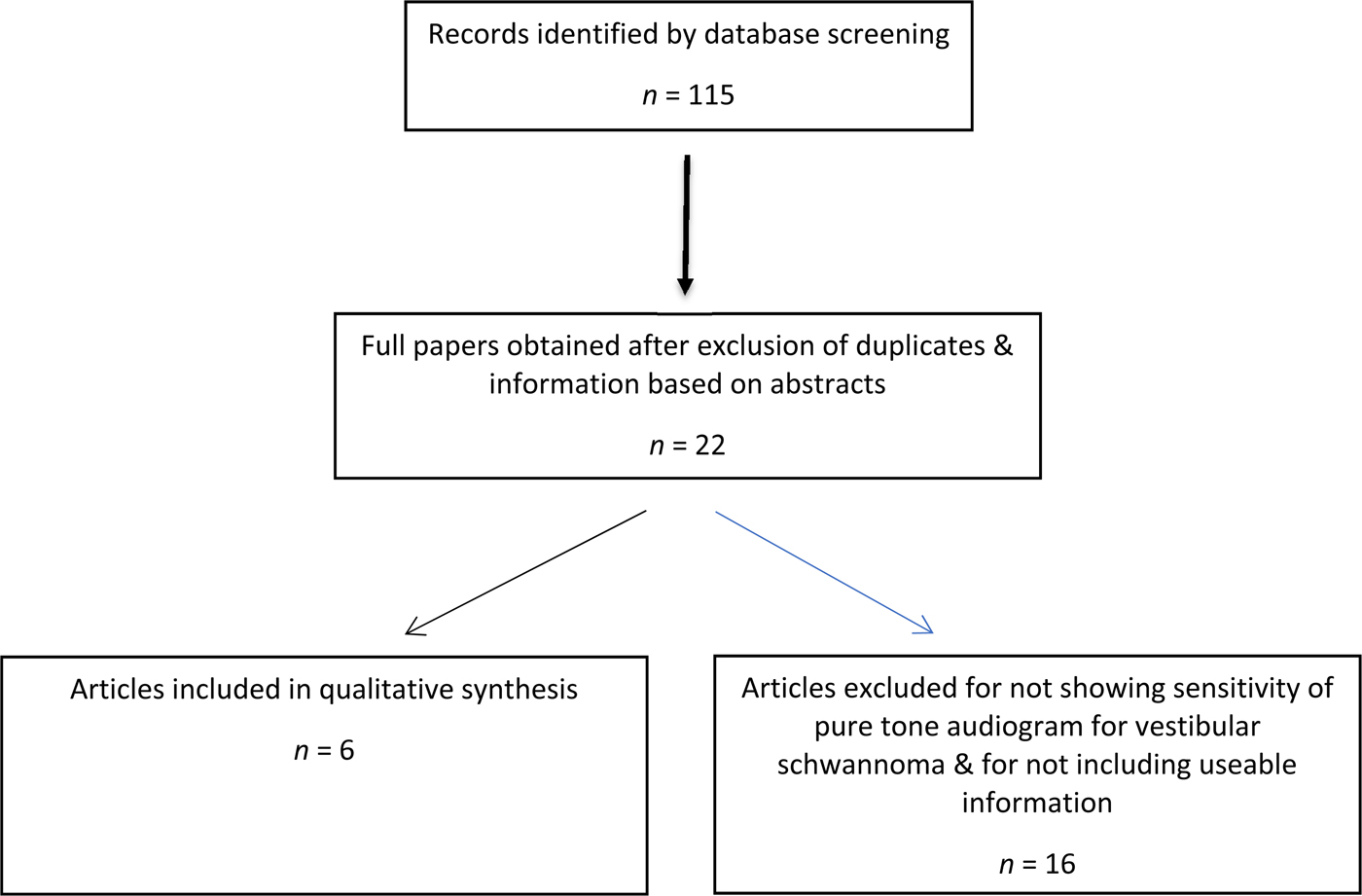
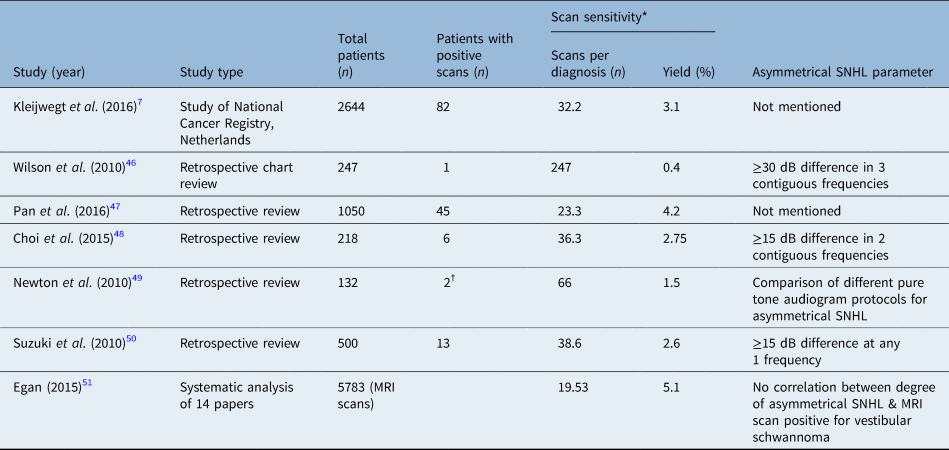
Here, we tried to determine the chance of detecting vestibular schwannoma from MRI scans that were requested on the basis of asymmetrical SNHL and unilateral tinnitus. A literature search using the key words mentioned earlier revealed 115 studies. By following the Preferred Reporting Items for Systematic Reviews and Meta-Analyses flow chart (Figure 3), we included six articlesReference Kleijwegt, Ho, Visser, Godefroy and van der Mey7,Reference Wilson, Gandolfi, Ahn, Yu, Huang and Kim46–Reference Suzuki, Hashimoto, Kano and Okitsu50 for our qualitative synthesis. All of these were based on asymmetrical SNHL. One paper was found to be a systematic analysis.Reference Egan51 Three out of six articlesReference Wilson, Gandolfi, Ahn, Yu, Huang and Kim46,Reference Newton, Shakeel, Flatman, Beattie and Ram49,Reference Suzuki, Hashimoto, Kano and Okitsu50 in the study by EganReference Egan51 were included, and that is why the data from this article are not included in weighted mean calculation. The results of these articles are shown in Table 6.
Preferred Reporting Items for Systematic Reviews and Meta-Analyses (‘PRISMA’) flowchart for sensitivity of pure tone audiogram, showing asymmetrical sensorineural hearing loss, for vestibular schwannoma.

Vestibular schwannoma detection rate from MRI scans requested on basis of asymmetrical SNHL

*Scans per diagnosis reflect the number of scans required to obtain one positive result, and yield represents the percentage value of positive results divided by the total number of scans performed. †Paper states number of scans, not patients (presumed one scan per patient). MRI = magnetic resonance imaging; SNHL = sensorineural hearing loss
It must be mentioned that there was a lack of consensus on how asymmetrical SNHL should be defined. A guideline from the USAReference Sweeney, Carlson, Shepard, McCracken, Vivas and Neff52 recommended a 10 dB or more difference at two or more contiguous frequencies, or a 15 dB or more difference at one frequency. The article also states that a 15 dB or more difference at 3 kHz was the most reliable guideline. Nine different types of definition for asymmetrical SNHL were found in the thesis by Egan.Reference Egan51
As mentioned earlier, 6 studiesReference Kleijwegt, Ho, Visser, Godefroy and van der Mey7,Reference Wilson, Gandolfi, Ahn, Yu, Huang and Kim46–Reference Suzuki, Hashimoto, Kano and Okitsu50 included in our qualitative analysis showed that the number of scans per diagnosis (the number of MRI scans per 1 diagnosis of vestibular schwannoma) ranged from 247 scansReference Wilson, Gandolfi, Ahn, Yu, Huang and Kim46 to 23.3 scans.Reference Pan, Huang, Morioka, Hathout and El-Saden47 The diagnostic yield (the percentage of positive scans against the total number of scans performed) ranged from 4.2 per centReference Pan, Huang, Morioka, Hathout and El-Saden47 to 0.4 per cent.Reference Wilson, Gandolfi, Ahn, Yu, Huang and Kim46 The systematic review by Egan showed the average number of scans per diagnosis as 19.53 and the diagnostic yield as 5.1 per cent.Reference Egan51
When calculating the weighted mean using the data from these 6 articles, there were 84.15 scans per diagnosis, with a diagnostic yield of 1.18 per cent. When the total number of patients (n = 4791) and positive scans (n = 149) in these six studies was added, and assuming each MRI scan was requested for one asymmetrical SNHL result in a pure tone audiogram, the positive predictive value for asymmetrical SNHL in the diagnosis of vestibular schwannoma was 3.1 per cent.
In addition to the above six papers, our literature search also identified two abstracts for which we could not access the full papers; the yields quoted in those were 1.3 per centReference Amiraraghi, Lim and Kontorinis53 and 2.4 per cent.Reference Aaron, Gildener-Leapman, Trivedi, Reinstadler, Zimmerman and Casazza54
‘Yield’ or ‘pick-up rate’ were the terms used by different authorsReference Wilson, Gandolfi, Ahn, Yu, Huang and Kim46,Reference Pan, Huang, Morioka, Hathout and El-Saden47,Reference Egan51,Reference Amiraraghi, Lim and Kontorinis53 to describe the effectiveness of MRI, requested for asymmetrical SNHL cases, in diagnosing vestibular schwannoma; we selected the former term for use in our study. Some papers have used the terms ‘sensitivity’ and ‘specificity’ in this context, but those papers were mainly focused either on comparing MRI with other non-imaging diagnostic tools for vestibular schwannoma or comparing the best predictive value of different audiological protocols for asymmetrical SNHL.Reference Hentschel, Scholte, Steen, Kunst and Rovers1,Reference Pena, Chew, Landau, Breen, Zevallos and Vrabec55,Reference Rajeev, Babur, Karakitsou and Mehta56
The results of our literature search for vestibular schwannoma and unilateral tinnitus were sparse. The incidence rate quoted was very low in most of the published articles. One systematic reviewReference Sweeney, Carlson, Shepard, McCracken, Vivas and Neff52 gave this as less than 1 per cent for patients whose presenting symptom was unilateral tinnitus. Another articleReference Hoekstra, Prijs and van Zanten57 found that the incidence of vestibular schwannoma in patients with tinnitus was 0.3 per cent. Choi et al.Reference Choi, Sajisevi, Kahmke and Kaylie48 found no vestibular schwannoma in patients with unilateral tinnitus and with no hearing loss or symmetric hearing loss. One articleReference Reddy, Lewis-Jones, Javadpour, Ryland and Lesser26 with a small number of patients reported detecting vestibular schwannoma in 4.4 per cent of patients with tinnitus as the only presenting symptom.
Discussion
The reported incidence of vestibular schwannoma has increased over time.Reference Gal, Shinn and Huang4 The reasons for the rising number of tumours diagnosed include: the increased use of advanced MRI, with higher accuracy and easier access to MRI for patients; an increased awareness among physicians and patients regarding vestibular schwannoma symptoms; and the increasing life span of the population.Reference Carlson, Lees, Patel, Loshe, Neff and Link58
An MRI scan of the internal auditory meatuses is frequently obtained in the investigation of patients who present with various otological symptoms, in order to diagnose (or refute the likelihood of) vestibular schwannoma. The most common symptom requiring MRI scanning in this way is asymmetrical SNHL.Reference Broomfield and O'Donoghue59 However, the indiscriminate use of MRI scanning has been criticised in an article from the Congress of Neurological Surgeons.Reference Sweeney, Carlson, Shepard, McCracken, Vivas and Neff52 Another articleReference Hentschel, Scholte, Steen, Kunst and Rovers1 suggested more rational use of MRI in the diagnosis of vestibular schwannoma. Unfortunately, at the present time, no investigation other than MRI has shown higher sensitivity and specificity in the diagnosis of vestibular schwannoma.
An article by Wilson et al.,Reference Wilson, Gandolfi, Ahn, Yu, Huang and Kim46 published in 2010, calculated that the average cost of each MRI scan for people presenting with asymmetrical SNHL was $1800 USD. The amount quoted by Pan et al.Reference Pan, Huang, Morioka, Hathout and El-Saden47 was $11 436 USD per new diagnosis (with each scan costing $490.10 USD), and the figure quoted by Aaron et al.Reference Aaron, Gildener-Leapman, Trivedi, Reinstadler, Zimmerman and Casazza54 for the same was $42 294 USD. The estimated cost of this imaging in the UK National Health Service was £130 GBP.Reference Armstrong60
Of note, some vestibular schwannomas can regress after diagnosis, in as many as 22 per cent of cases.Reference Lau, Olivera, Miller, Downes, Danner and van Loveren6 Some papers have shown that the quality of life and life expectancy of patients who followed a conservative management pathway were not inferior to those of patients who underwent surgery or radiotherapy, or to the general population.Reference Klersy, Arlt, Hofer and Meixensberger40,Reference Carlson, Tveiten, Driscoll, Goplen, Neff and Pollock61–Reference Soulier, van Leeuwen, Putter, Jansen, Malessy and van Benthem63
We have determined the cost-effectiveness of MRI via statistical analysis of the data collected. The weighted mean of the yield of MRI was 1.18 per cent. This means that, out of 100 MRI scans, 1.18 patients will be diagnosed with vestibular schwannoma. Considering that the estimated cost of MRI is £130 GBP,Reference Armstrong60 the cost per diagnosis of one vestibular schwannoma would be £11 016.95 GBP (based on the calculation: (130 × 100) / 1.18).
We found that: the number of small sized tumours has increased with time,Reference Gal, Shinn and Huang4,Reference Stangerup and Caye-Thomasen5,Reference Stepanidis, Kessel, Caye-Thomasen and Stangerup8–Reference Foley, Shirazi, Maweni, Walsh, McConn Walsh and Javadpour14 elderly people are more likely to have smaller tumours,Reference Gal, Shinn and Huang4,Reference Stangerup and Caye-Thomasen5,Reference Babu, Sharma, Bagley, Hatef, Friedman and Adamson10,Reference Stangerup, Tos, Thomsen and Caye-Thomasen12,Reference Harun, Agrawal, Tan, Niparko and Francis13 there has been a shift in the management strategy of vestibular schwannoma over time (Table 3), and conservative management is favoured for small tumours and in elderly patients.Reference Babu, Sharma, Bagley, Hatef, Friedman and Adamson10 Given the above, most of the patients aged 70 years or older will have small tumours managed by the wait and scan method.
Our statistical analysis also showed that, among patients who followed a conservative management pathway, only 33.79 per cent (weighted mean) of the tumours will show growth, and 73.66 per cent (weighted mean) of patients will not need to switch treatment to surgery or radiotherapy.
All of the above shows that, as a screening tool for vestibular schwannoma, more than £11 000 GBP needs to be spent on MRI scans to detect one patient with vestibular schwannoma whose tumour will be less likely to grow and will, most likely, not need any treatment.
There are other potential negative aspects of indiscriminate MRI scanning of the brain and internal auditory meatus in the elderly, including anxiety, and the extra work caused by the finding of incidental pathologies, such as old infarcts, cerebral atrophy and meningiomas, that almost never need treatment.Reference Vernooji, Ikram, Tanghe, Vincent, Hofman and Krestin64
The cost-effectiveness for patients with unilateral tinnitus will be even lower, as the quoted yieldsReference Choi, Sajisevi, Kahmke and Kaylie48,Reference Sweeney, Carlson, Shepard, McCracken, Vivas and Neff52,Reference Hoekstra, Prijs and van Zanten57 are lower than those found for asymmetrical SNHL.
Conclusion
An appreciation of the natural history of vestibular schwannoma has led to the majority of tumours being managed by observation with serial MRI scanning. In addition, the growth rate of vestibular schwannoma appears to be lower in the elderly population, with the implication that the overwhelming proportion of vestibular schwannomas in this population group will never require active treatment. A prospective analysis of elderly patients presenting with asymmetric auditory symptoms needs to be undertaken from both a clinical and cost–benefit standpoint. We hope that this article will stimulate discussion among clinicians who encounter these patients, so that management decisions can be taken and discussed with patients on a rational basis.
Acknowledgement
The authors would like to acknowledge Chris Foy.
Competing interests
None declared