Significant outcomes
-
∙ Patients who relapse after receiving transcranial pulsating electromagnetic fields (T-PEMF) for treatment-resistant depression improve significantly after a second course of T-PEMF treatment.
Limitations
-
∙ A total of 16 patients (25%) were not considered for a second course of transcranial pulsating electromagnetic field (T-PEMF) treatment at follow-up 2 years after the first T-PEMF because of multivariate problems such as long-standing psychosocial problems, misuse of cannabis or alcohol, and severe somatic disorders.
Introduction
For 4 decades, there has been concern about depression that is refractory to antidepressants (Reference Lehmann1,Reference Greden, Riba and McInnis2). It is estimated that the rate of treatment-resistant depression is ~30% (Reference Kasper and Montgomery3). However, the costs in connection with these patients (directly or indirectly) are over 50% of the total costs for depressive disorders (Reference Carvalho, Berk, Hyphantis and Mcintyre4).
We have recently used transcranial pulsating electromagnetic fields (T-PEMF) as principal augmentation approach in patients who were not able to achieve remission after at least two well-established antidepressant treatments given in acceptable doses and duration (Reference Straasø, Lauritzen and Lunde5). In this study the remission rate after 8 weeks of T-PEMF was surprisingly high (~70%) (Reference Straasø, Lauritzen and Lunde5).
In the present study we revisit these patients ~2 years later. The follow-up issues were: the course of depression in these patients according to their own assessments of their status, the effect of repeat T-PEMF in patients who achieved remission and later relapsed, and the factors contributing to treatment-resistant depression in patients who do not respond to T-PEMF.
Ethics
The study was carried out in accordance with the Declarations of Helsinki and the European Union directive of Good Clinical Practice (6). The study was monitored by an external contract company (Norma, Hørsholm, Denmark). The study was approved by the Danish Health and Medicines Authority (2013030959) and the Committee on Biomedical Research Ethics (H-1-2010-031) and was reported to the Danish Data Protection Agency (PSV-2010-2). The trial was registered at ClinicalTrials.gov (ID NCT01353092).
Patients were given information as requested by the Biomedical Research Ethics, and all patients signed an informed consent.
Methods
We carried out a 2-year follow-up status of 65 patients who had participated in the Straasoe et al. (Reference Straasø, Lauritzen and Lunde5) study. This took place between May and August 2014. The Longitudinal Expert Assessment of All Data (LEAD) was used (Reference Spitzer7). In accordance with this approach an experienced psychiatrist (P.B.) classified the patients in four categories; A, B, C, and D:
-
A. Patients who after 8 weeks of T-PEMF augmentation were judged to have remitted and who at the time of the follow-up status retrospectively agreed with that assessment.
-
B. Patients who at the follow-up status retrospectively communicated that the effect of the T-PEMF augmentation had been very doubtful.
-
C. Patients who had obtained no effect of the 8 weeks of the T-PEMF augmentation and at follow-up retrospectively reported that they had experienced no improvement.
-
D. A hard-to-assess group of patients who initially had achieved no remission or brief remission and who in retrospect had been misdiagnosed or who were found to suffer from co-morbid conditions or have encountered extreme and long-standing psychosocial stressors.
Psychometric assessment scales
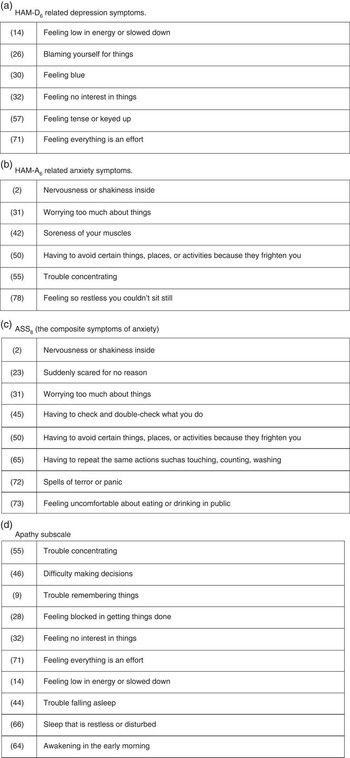
In the T-PEMF study (Reference Straasø, Lauritzen and Lunde5), the primary outcome scale was the Hamilton Depression Scale (HAM-D17) (Reference Bech8). In the follow-up status the Symptom Checklist (SCL-90) (Reference Bech, Bille, Moller, Hellstrom and Ostergaard9), was focussed on because we wanted to capture the full clinical picture (Fig. 1). The SCL-90 study (Reference Bech, Bille, Moller, Hellstrom and Ostergaard9) found the following subscales valid:
-
a. ‘HAM-D6’ (the core symptoms of depression in the Hamilton Depression Scale (HAM-D) as covered by SCL-90);
-
b. ‘HAM-A6’ (the core symptoms of anxiety in the Hamilton Anxiety Scale (HAM-A) as covered by SCL-90);
-
c. ASS8 (anxiety symptom scale covering the subsyndromes of generalised anxiety, panic disorder, obsessive–compulsive disorder, and phobic anxiety including social anxiety disorder as covered by SCL-90);
-
d. Apathia subscale measuring depression apathy as covered by SCL-90.
The four Symptom Checklist-90 subscales a, b, c, and d (Reference Bech8).

Second course of T-PEMF augmentation
The 13 patients in group A, who fulfilled our criteria for a second T-PEMF augmentation, received one dose daily over 8 weeks. We used the same T-PEMF apparatus as the one employed in the Straasoe et al. (Reference Straasø, Lauritzen and Lunde5) study.
In the T-PEMF apparatus, coil applicators introduced pulsating electrical fields (50 Hz) of a very low magnitude (0.1–4 mV/cm) into brain tissue. The pulses were constructed to mimic the pulsating electrical fields (E-fields) measured outside excitable tissue. The E-fields induced into neural tissue by the coils were five orders of magnitude (10–5) smaller than the E-field across a biological membrane with a V m of −70 mV. Thus, this device distinguishes itself in this regard from rTMS and electroconvulsive therapy (ECT). A total of seven coils were applied. The treatment helmet incorporates one pair of coils in the anterior and one pair in the posterior temporal region on both sides, one pair in the upper parietal region, and one coil in the centre of the lower occipital region. All patients were treated for 30 min in a session.
Statistical analysis
Non-parametric statistical tests were applied (Wilcoxon and Mann–Whitney) (Reference Siegel10). We used SAS version 9.0 2000. The level of statistical significance was p≤0.05 (two sided).
Results
Based on the interview conducted by P.B. at follow-up or by contact with the relatives of the patients as well as their treating psychiatrists or family doctors, we were able to classify the 65 patients according to the four categories A, B, C, and D.
Group A
In total 27 patients acknowledged that they had obtained a clear remission after the T-PEMF augmentation. Within this group of 27 patients with a clear remission, 14 patients had no relapse during the follow-up period. However, five patients in this group were not available for interview as their employment situation made it difficult for them to present for an interview (e.g. two patients now worked in Greenland, and one was a North Sea fisherman), and these five patients agreed to complete the SCL-90 by mail. The remaining 13 patients had experienced a relapse after their remission.
Group B
In total, nine patients experienced a partial effect of the T-PEMF augmentation. In all, four of these patients had obtained a remission according to our previous publication (Reference Straasø, Lauritzen and Lunde5), but they themselves had felt just after the end of the augmentation that the effect was doubtful. In all, two of these patients did not make an appearance but contacted us about their reaction. At the interview one patient reported that he had developed signs of Parkinson’s Disease just after completion of the augmentation study, a diagnosis that still is not ultimately confirmed.
Group C
Out of the 13 patients in this group, one had actually obtained remission according to Straasø et al. (Reference Straasø, Lauritzen and Lunde5) but when interviewed told that there was absolutely no clear effect. The other 12 patients agreed that the T-PEMF augmentation was without any effect.
Group D
This group is a post-hoc exclusion group of patients in whom for diverse reasons it was difficult to evaluate the effect of T-PEMF augmentation at follow-up.
A total of 12 of the 16 patients in group D experienced a very brief remission (typically of 4-weeks duration) after the T-PEMF augmentation. In all, five patients recalled that when their depression-like symptoms reappeared, they decided that these symptoms were actually caused by such factors as childhood trauma, social avoidance behaviour, or long-term marital conflicts. Many of these patients had started a more intensive psychodynamic therapy.
In all, four patients reported that their depression-like symptoms resulted from a physical disease, which was now progressing (diabetes mellitus, liver disease, cancer, and cardiovascular disorder).
In all, three patients communicated at the follow-up interview that in their case the remission-like effect of the T-PEMF augmentation was ultra-short. When the depressive symptoms reappeared they used this negative outcome when contacting their treating psychiatrist to apply for a disability pension. One of them had already obtained such a disability pension.
Concerning the remaining four patients in group D, none had obtained any degree of remission. At the time of the T-PEMF augmentation two of these patients had had a masked abuse (cannabis and alcohol), which now was manifest. The other two patients had long-standing psychosocial problems.
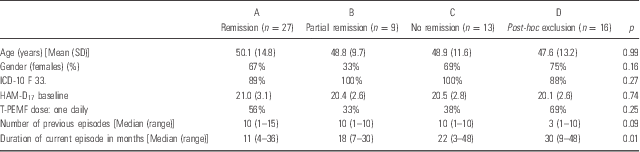
Table 1 shows the background characteristics of the patients within the four classification categories A, B, C, and D. No statistically significant differences between the groups of patients (A, B, C, and D) were seen concerning age, gender, ICD-10 diagnosis of depression, baseline scores on HAM-D17 or dose of T-PEMF. The group of patients in category D differs from the other groups of patients with a smaller number of previous depressive episodes (p=0.09) and a longer duration of the current episode (p=0.01). The median duration of the current episode in months was 11 for group A and 30 for group D patients with group B and group C in between.
Background characteristics within the four groups of patients

HAM, Hamilton Depression Scale; T-PEMF, transcranial pulsating electromagnetic fields.
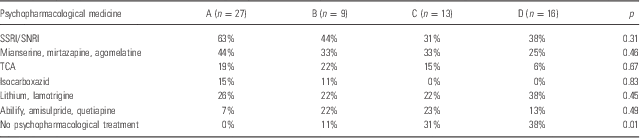
Table 2 shows the psychopharmacological treatment at time of follow-up status in the four groups of patients A, B, C, and D. In category A all the patients still received psychopharmacological treatment, whereas in both category C and D approximately one-third had stopped psychopharmacological treatment (p=0.01). No statistically significant difference between the four categories of patients was seen for the different classes of psychopharmacological treatments.
Psychopharmacological treatment at follow-up in the four groups of patients
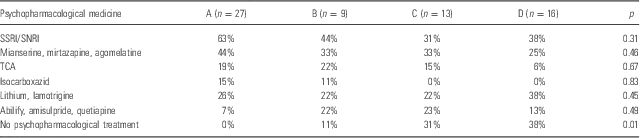
SNRI, serotonin norepinephrine reuptake inhibitor; SSRI, selective serotonin reuptake inhibitor.
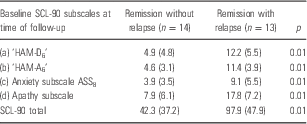
Table 3 shows the results of the SCL-90 at the time of follow-up within the group A patients.
Baseline SCL-90 at the time of follow-up within the group A patients

ASS, anxiety symptom scale; HAM, Hamilton Depression Scale; SLC, Symptom Checklist.
In total 14 patients had achieved a remission without relapse during the period before follow-up, and 13 patients had experienced a relapse. This relapse had occurred between 4 and 16 months after the T-PEMF augmentation given by Straasoe et al. (Reference Straasø, Lauritzen and Lunde5) with a median of 8 months. The group of 14 patients with remission without relapse scored significantly lower on all the SCL-90 subscales including the total SCL-90 when compared with the 13 patients with relapse (p<0.01).
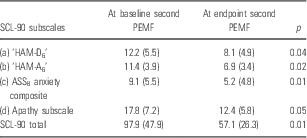
Table 4 shows the SCL-90 scores in the 13 patients in group A who obtained remission in the first T-PEMF augmentation (Reference Straasø, Lauritzen and Lunde5), but had relapsed at the follow-up (new baseline). After 8 weeks of the second T-PEMF augmentation the scores were significantly reduced on all the SCL-90 subscales as well as on the total SCL-90 (Table 4).
The SCL-90 score at follow-up before and after the second PEMF augmentation in the 13 category A patients with relapse

ASS, anxiety symptom scale; HAM, Hamilton Depression Scale; PEMF, pulsating electromagnetic field; SLC, Symptom Checklist.
Mean (SD).
When comparing the endpoint scores on SCL-90 subscales (Table 4) with the baseline SCL-90 scores among the 14 patients without relapse (Table 3), no statistically significant difference was obtained (p>0.05).
Discussion
In this follow-up analysis of the 65 patients with treatment-resistant depression who had participated in our T-PEMF augmentation study (Reference Straasø, Lauritzen and Lunde5) we were, using the LEAD principle, able to place the patients in the categories of A (clear remission), B (partial remission), C (no remission), and D (hidden non-depressive problems or dimensions on which antidepressant medication has no effect).
We identified 16 patients in category D (~25% of the 65 patients) who had hidden factors or dimensions such as long-standing psychosocial problems with no clear solution, personality problems, and medical co-morbidity (cannabis/alcohol abuse or severe somatic disorders). These factors were hidden at the time of the T-PEMF augmentation study (Reference Straasø, Lauritzen and Lunde5) and these group D patients should be considered as post-hoc drops outs.
Concerning the psychosocial factors and personality problems, treatment with dynamic-oriented psychotherapy might be considered. Briefly, cognitive psychotherapy would obviously not be effective in such cases as the mechanism of action in this kind of psychotherapy would seem to refer to the same underlying disease process as that of antidepressants (Reference Karlsson, Hirvonen, Salminen and Hietala11).
Sartorius (Reference Sartorius12) claimed that problems of treatment-resistant depression might be solved when the diagnosis was operatively defined. Here, Sartorius (Reference Sartorius12) referred to the revision of ICD-9 (Reference Sartorius13). However, neither ICD-9 nor ICD-10/DSM-5 has any category of treatment-resistant depression (14,15). Our clinical judgement analysis at follow-up identified several cases in which hidden non-depressive factors had been in operation but had not been identified by ICD-10 because this classification system (like the Hamilton Depression Scale) is based on the present state symptoms of depression and not on aetiological factors.
When excluding the 16 category D patients our follow-up analysis found that 27 patients or 55% had a clear remission, 9 patients or 18% had a partial remission, and 13 patients or 27% had no effect from the T-PEMF augmentation.
When compared with the three other groups (A, B, and C) group D patients had a significantly longer duration of the current depressive episode (30 vs. 11 months). In all, 9 of the 16 group D patients confirmed at the LEAD assessment that they had experienced a remission after the T-PEMF augmentation but reported that this remission was ultra-brief (<2 months). The number of previous depressive episodes was much lower in the D group compared with the other groups (3 vs. 10). This is in accordance with previous studies on the prognosis of depression (Reference Murphy16,Reference Shea, Glass, Pilkonis, Watkins and Docherty17).
As regards consumption of alcohol and cannabis it has been shown that the degree of abuse is a significant predictor of poor response to antidepressant medication (Reference Worthington, Fava and Agustin18). Co-morbidity to severe somatic disorders has also been found to be a significant predictor of poor outcome of antidepressants (Reference O’Reardon and Amsterdam19).
Within category A (patients with a clear remission) we identified 13 patients or 48% who had experienced a relapse. In this group of patients, the second T-PEMF course (one dose daily over 8 weeks) significantly reduced the symptom profiles in the SCL-90 covering depression, anxiety, and apathy.
A comparison of category A with the other categories in terms of psychopharmacological treatment at follow-up showed that category A patients all still received psychopharmacological treatment, whereas the percentage of patients without psychopharmacological treatment at follow-up ranged from 11% to 38% for B, C, and D patients (p=0.01). The psychopharmacological treatment at the follow-up status (Table 2) reflected the profile of the antidepressants recommended in treatment-resistant depression. Thus, the combination of selective serotonin reuptake inhibitor/serotonin norepinephrine reuptake inhibitor and the group of serotonin-2 receptor blockers (mianserin, mirtazapine, agomelatine) and the use of atypical antipsychotics (aripiprazol, amisulpride, or quetiapine) or mood-stabilisers (lithium, lamotrigine) is in agreement with (Reference Carvalho, Berk, Hyphantis and Mcintyre4).
In contrast to ECT, T-PEMF treatment has until now not proved to have an antidepressant effect on its own. We have previously shown (Reference Lauritzen, Odgaard and Clemmesen20) that when ECT is combined with a placebo-antidepressant drug, the remission rate is as high as when ECT is combined with paroxetine or imipramine. However, at follow-up 6 months later the relapse rate was 65% in the group of ECT patients receiving placebo medication compared with 30% in the imipramine-treated patients and 10% in the paroxetine-treated patients (Reference Lauritzen, Odgaard and Clemmesen20).
A major limitation of our follow-up analysis is the selective focus on background information in the group D patients. We have named this category a ‘hard-to-assess’ sample and therefore made an attempt to identify misdiagnostic factors both concerning the very event of remission after T-PEMF augmentation and concerning the aetiology of the individual cases. We have not found it necessary to obtain the same level of information about the background factor in the three other categories of patients. It would, however, be of great importance to perform an adequate prospective analysis, early and late, in a larger trial; thus ensuring an adequate level of informativeness as regards all the patients, in the same way as attempted in the present study for the category D patients. Such a trial is actually already planned to start next year.
In this analysis of a 2-year follow-up of the T-PEMF treated patients, 48% had relapsed in the category A group. However, a second T-PEMF course of treatment reduced both depressive and anxiety symptoms significantly.
Our finding: that treatment-resistant depressed patients with the best outcome, group A patients, had a duration of the index episode of depression of ~1 year, indicates that it is important to screen for treatment-resistance as early as possible in order to prevent persistence. In this screening process it is very important to identify components beyond the range of action of antidepressant medication. These factors had been masked in our T-PEMF study (Reference Straasø, Lauritzen and Lunde5). Finally, adequate remission should be defined as a score of ≤7 on the HAM-D17 sustained over a period of at least 2 months.
Acknowledgement
The authors thank Professor Peter D Kramer for very valuable comments and suggestions. Per Bech: Involvement in planning the study, methodological design as well as selection of rating instruments and performing the interviews. Responsible for the statistical analysis. Lone Lindberg: Involvement in planning the study and procedures in connection with patient interviews and questionnaire completion. Birgit Straasø: Involvement in planning the study and methodological design. Erik Roj Larsen: Active in clarification of the theoretical part of the study as well as drafting and revising the article.
Financial Support
The T-PEMF-II study was financially supported by a grant from the Lundbeck Foundation (Grant R54-A5567).