Introduction
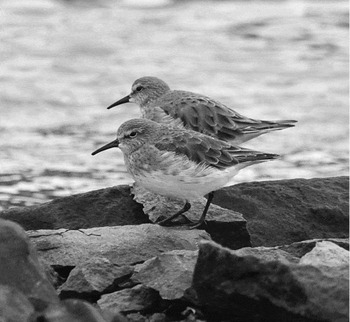
The white-rumped sandpiper Calidris fuscicollis (Fig. 1) is one of the world's most extreme long distance migratory birds. It breeds in the high Arctic tundra of northern Canada and Alaska, and makes extraordinary flights over the Atlantic Ocean to winter in southern South America (Parmelee Reference Parmelee and Poole1992). The most common wintering area for this species is Patagonia, both the Argentine and the Chilean parts (Wetmore Reference Wetmore1927; Harrington and others Reference Harrington, Leeuwenberg, Resende, McNeil, Thomas, Grear and Martinez1991; Vuilleumier Reference Vuilleumier1995; Ribeiro and others Reference Ribeiro, Iribarne, Navarro and Jaureguy2004). On the South America flyway during southbound and northbound migrations this species of shorebird was recorded in Venezuela, Suriname, Brazil (Harrington and others Reference Harrington, Leeuwenberg, Resende, McNeil, Thomas, Grear and Martinez1991) and Paraguay (Hayes and Fox Reference Hayes and Fox1991). According to Sikora (Reference Sikora1998), the white-rumped sandpiper also occurs in Europe, a dozen or so each year. This species has also been recorded as a vagrant on South Atlantic islands, such as Inaccessible Island and the Falkland Islands (Shirihai Reference Shirihai2002).
Two white-rumped sandpipers observed in front of the Polonia Glacier (King George Island, South Shetland Islands, Antarctica) from 13 December to 24 January 2001 (Photo by P. Angiel).

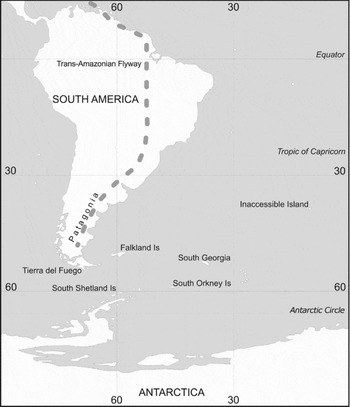
Harrington and others (Reference Harrington, Leeuwenberg, Resende, McNeil, Thomas, Grear and Martinez1991) who studied the migration of white-rumped sandpipers suggested that these birds employ both nonstop, and short distance multiple stop flights. Southbound migrants fly over the Atlantic Ocean from northeastern North America to South America. Travel requires approximately one month as birds gradually move southeast along the northeastern coasts of South America before turning inland in the trans-Amazonian flyway (Fig. 2). Northward migration routes from Patagonia are evidently similar, but are traversed in a rapid series of long nonstop flights (Harrington and others Reference Harrington, Leeuwenberg, Resende, McNeil, Thomas, Grear and Martinez1991). The potential range of the nonstop flight can amount to 4200 km (Cramp and Simmons Reference Cramp and Simmons1983).
The main migration route of the white-rumped sandpiper (dashed grey line) across South America. The named South Atlantic Ocean islands are places where the occurrence of the white-rumped sandpiper has been confirmed.

During the non-breeding season the white-rumped sandpiper migrates to South America, reaching Tierra del Fuego and the Falkland Islands (Shirihai Reference Shirihai2002), but only as a vagrant to South Georgia, and the South Orkneys (see Montalti and others Reference Montalti, Arambarri, Soave, Darrieu and Camperi2003).
In Antarctica this North American migrant species was first recorded on Ardley Island, South Shetland Islands, in 1981 (Bannasch Reference Bannasch1984). Subsequently, it has been reported several times on islands of King George, Nelson and Livingston (Gajardo and Yañez Reference Gajardo and Yañez1982; Bannasch Reference Bannasch1984; Bannasch and others Reference Bannasch1984; Trivelpiece and others Reference Trivelpiece, Geupel, Kjelmyr, Myrcha, Sicinski, Trivelpiece and Volkman1987; Lange and Naumann Reference von Lange and Naumann1990; Aguirre Reference Aguirre1995). On King George Island the first reported occurrence was at Stranger Point where 5 birds were observed in December 1993 and January 1994 (Silva and others Reference Silva, Coria, Favero and Casaux1995). The first year round scientific station on King George Island was open in 1948 (Rakusa-Suszczewski Reference Rakusa-Suszczewski1998) however it is important to mention that the first bird observation information was reported irregularly and mostly in specific, mainly non-English, literature (for example Gajardo and Yañez. Reference Gajardo and Yañez1982; Bannasch Reference Bannasch1984; Bannasch and others Reference Bannasch, Feiler and Rauschert1984).
A programme to monitor non-breeding bird species in the vicinity of Arctowski Station, King George Island has been conducted over the past 30 years. The observations of the distribution and abundance of the white-rumped sandpiper presented in this paper suggests that this species visits the region of the South Shetland Islands more frequently than was previously thought.
Study area and methods
The study area covers the South Shetland Islands archipelago situated in west Antarctica, 120 km north of the Antarctic Peninsula and 1000 km south of the Cape Horn in South America (Fig. 2). King George Island, the largest island (1 300 km2) of the archipelago, is dominated by glaciers which cover over 90% of its surface. On the ice free areas 24 research stations and refuges, belonging to 12 countries, are situated, of which 8 are permanent.
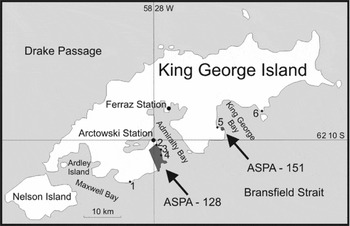
The ornithological data presented in this paper were gathered from both literature and previously unpublished data collected by year round observations made by the Polish Antarctic research programme on the western shore of Admiralty Bay, King George Island, covering Antarctic Specially Protected Area 128. This programme (regular observation of bird and pinniped populations) has been running since the austral summer of 1977 when the Polish Antarctic research station Arctowski (62°09’41”S and 58°28’10”W, Fig. 3) was established. Since 2007 a new avifaunal monitoring programme in King George Bay (on Antarctic Specially Protected Area 151, Fig. 3) was established by Polish observers and has been conducted during each Antarctic summer season since then.
A map of King George Island, South Shetland Islands, Antarctica. King George Island: numbered locations are as follows: 1 Stranger Point; 2 Ecology Glacier; 3 Llano Point; 4 Sphinx Hill; 5 Polonia Glacier; 6 Turret Point; ASPA 128 – Antarctic Specially Protected Area 128; ASPA 151 – Antarctic Specially Protected Area 151

Meteorological data reported in this paper (air temperature, wind direction and wind velocity) were collected at two meteorological stations located in Admiralty Bay: Arctowski and the Brazilian station Ferraz (Fig 3).
Results
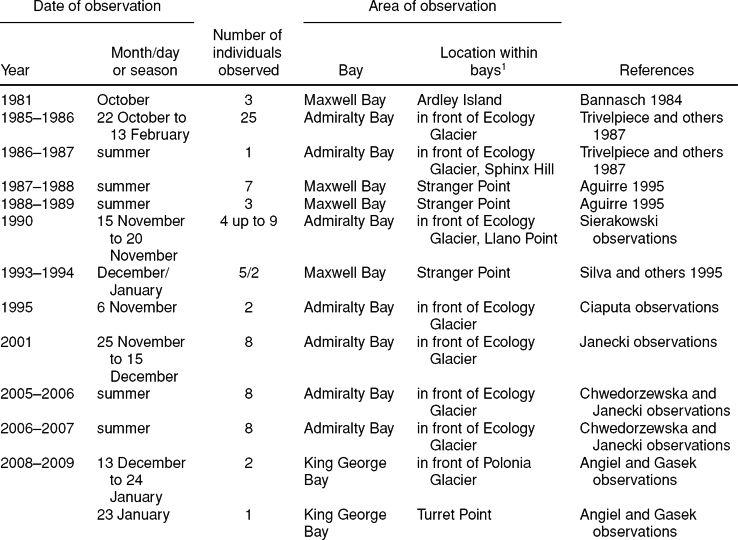
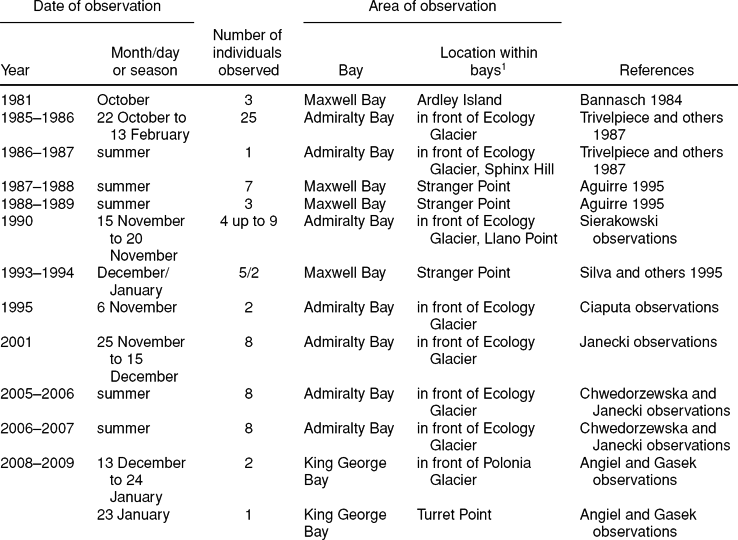
The ornithological data found in literature and other unpublished materials are presented in Table 1. The white-rumped sandpiper was first seen in Antarctica in 1981 on Ardley Island (Bannasch Reference Bannasch1984) and on Livingstone Island in 1982 (Gajardo and Yañez Reference Gajardo and Yañez1982).
Occurrence of white-rumped sandpipers on King George Island
1 Locations are shown on Fig. 2.
During the subsequent years the occurrence of white-rumped sandpipers in the South Shetland Islands area was very variable. The number of observed birds was mostly low and varied from 1 to 9 individuals, with the exception of the 1985–1986 season when the biggest flock consisting of 25 individuals was observed (Trivelpiece and others Reference Trivelpiece, Geupel, Kjelmyr, Myrcha, Sicinski, Trivelpiece and Volkman1987).
It is noteworthy that most of these observation occurred in the austral spring (October and November) and early midsummer (December and January). Individuals were always observed in the ice free oases located between the front of glaciers and the sea. The white-rumped sandpiper has never been recorded during autumn and winter in Antarctica. Their period of stay is very difficult to estimate, however, it cannot last for more than 5 months, which is about the length of the summer season.
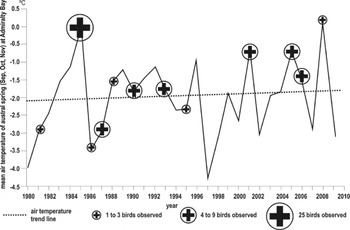
To investigate the relationship between the occurrence of this species in the study area and weather conditions, the mean air temperature of austral springs at Admiralty Bay over the last 30 years was studied. The results are presented in Fig. 4, where meteorological data are compared with ornithological data from Table 1. The absence of observations of white-rumped sandpipers in the South Shetland Islands was noted in the seasons of 2007–2008 and 2009–2010. There was a positive relationship between number of birds observed and mean air temperature during the austral spring (Fig. 4). Over the last 30 years white-rumped sandpipers were observed in 12 seasons, 8 of which were warmer than average. It is significant to note that a flock consisting of 25 individuals occurred in spring 1985, which was the second warmest spring over 30 years of meteorological observations at Admiralty Bay. However, birds were also reported during 4 colder seasons but in smaller numbers. There were no white-rumped sandpipers observed during the two coldest seasons over the last five years (2007–2008 and 2009–2010).
Occurrence of white-rumped sandpipers on King George Island (data from Table 1) compared with the mean air temperature during austral springs at Admiralty Bay.

Other meteorological factors could be significant in determining the numbers of birds seen in the study area, such as average wind speed and direction. It is difficult to determine the role of this extremely dynamic feature for the migration of the birds. The occurrence of 25 specimens on 22 October 1985 was chosen as a case study because the observation represented the highest number of individuals and the earliest date of their appearance ever documented on the South Shetland Islands. The wind velocity and direction at the Arctowski Station in a three day period before 22 October 1985, when the observation of the 25 birds at Admiralty Bay occurred were, that there had been a very strong wind event which lasted 36 hours. The wind direction during the event was north northwest and the mean wind velocity was 11.6 ms−1. During such events air masses from southern Patagonia, Tierra del Fuego and Falkland Islands can reach the South Shetland Islands in 1–2 days.
Discussion
Weather patterns are a very important selective force in the evolution of bird migration and in shaping a migration route (Holmgren and others Reference Holmgren, Ellegren and Petterson1993; Williams and Webb Reference Williams and Webb1996; Butler and others Reference Butler, Williams, Warnock and Bishop1997). In Admiralty Bay, the main section of the study area, 34 species of birds have been recorded. Of that number 13 are breeding species, four are present regularly, and the remaining 17 are visiting only sporadically. All 17 visiting birds except for the snow petrel were observed during the warm season, primarily during the summer (ATCM Reference Rakusa-Suszczewski2002). Occurrences of the white-rumped sandpiper in the South Shetland Islands area have been recorded for 12 austral springs and summers during 30 years of observations. It is possible that the white-rumped sandpipers occurred in the Archipelago before 1981, but there is no information available. For this 30 years period, the presence of white-rumped sandpipers correlated well with the warmest years. This could be a result of special favorable conditions on the shoreline environment during warm spring and summer seasons. Unfrozen sea, the lack of snow at seashore and forelands of glaciers seem to be encouraging for birds usually wintering in Patagonia, Tierra del Fuego and the Falkland Islands. The frequency, direction and duration of favorable winds are important variables shaping the migration strategy of many birds migrating at high altitudes (Butler and others Reference Butler, Williams, Warnock and Bishop1997). Strong winds, from north and northwest, a common feature of the South Shetland Islands, could be an important factor connected with increasing the numbers of vagrant birds in the study area.
Wind conditions
A few birds migrate in almost any weather conditions. However, maximum numbers migrate with fair weather, with tailwinds and with temperature, pressure and humidity conditions that accompany tailwinds (Richardson Reference Richardson1978). Many birds including large shorebirds (for example bar-tailed godwit Limosa lapponica, great knot Calidris tenuirostris and bristle-thighed curlew Numenius tahitiensis) and small-bodied (western sandpiper Calidris mauri) require favorable tailwinds to complete their long distance migrations (Butler and others Reference Butler, Williams, Warnock and Bishop1997). In the South Shetland Islands area winds are very strong with hurricane winds occurring frequently (Wierzbicki Reference Wierzbicki2009; Angiel and others Reference Angiel, Potocki and Biszczuk-Jakubowska2010). The mean wind velocity at Arctowski Station is 6.6 ms−1 (Styszyńska Reference Styszyńska, Marsz and Styszyńska2000). The most frequent wind directions at Admiralty Bay are southwest (22%), west (15%) and northwest (14%). It is possible that during storm events the relationship between the wind direction and migration pattern exists. Occurrences of vagrant birds on the South Shetland Islands could be related to storm events however, more detailed investigations should be conducted, especially concerning behaviour and migration possibilities during strong (>10 ms−1) winds.
In warmer years, when white-rumped sandpipers were observed, winds from the southwest direction were less frequent (19%) while the west and northwest wind directions were more frequent (16% each) (Styszyńska Reference Styszyńska, Marsz and Styszyńska2000). Due to very strong winds, in such conditions white-rumped sandpipers can take advantage of northwest circulation and use tail winds while heading to the South Shetland Islands, in keeping with our case study result. So far in Admiralty Bay the occurrence of a black-necked swan Cygnus melanocoryphus, cattle egret Bubulcus ibis (Sierakowski unpublished data, personal author observation) and welcome swallow Hirundo neoxena (personal author observation, photographic documentation) after strong hurricane events was recorded. Therefore, strong storms events can blow birds off their regular migration routes.
Food conditions
Strong winds from north and northwest at Admiralty Bay are extremely turbulent and gusts reach velocities typical of hurricanes, up to 80m/s−1 (Wierzbicki Reference Wierzbicki2009). Following storms, 45.5 km of shoreline at Admiralty Bay was covered by seaweed (Rakusa-Suszczewski Reference Rakusa-Suszczewski1980), a potential food source for birds. This generates conditions in which the white-rumped sandpiper can find food and shelter.
The white-rumped sandpiper is an aquatic prober-gleaner that feeds in marshes and on mud flats. The reported diet of this species is principally invertebrates (Montalti and others Reference Montalti, Arambarri, Soave, Darrieu and Camperi2003). However, a report of adult white-rumped sandpiper stomach contents from Argentina (Montalti and others Reference Montalti, Arambarri, Soave, Darrieu and Camperi2003), showed that they will eat seeds. This indicates that they forage on different items depending on the area, season and availability, and may be opportunistic feeders.
The birds appearing on King George Island were seen feeding on accumulations of macroalgae remains at waterline on the shore after storms and exposed seaweed flora stranded in shallow waters at low tide. Studying cast ups on beached seaweed flora after storms Oliveira and others (Reference Oliveira, Absher, Pellizzari and Oliveira2009) collected and identified 42 species, including Himantothallus grandifolius, the largest seaweed in the Antarctic. Holdfasts of this dominant brown alga provide habitats for complex zoobenthic assemblages, which include invertebrates like polychaetes as well as amphipod and isopod crustaceans (Siciński Reference Siciński and Rakusa-Suszczewski1993; Pabis and Siciński Reference Pabis and Siciński2010). This abundance of food and apparently little prey competition is the likely cause of more frequent and prolonged visits of the white-rumped sandpiper on the South Shetland Islands during warm seasons.
Conclusions
Rapid changes in the three major environmental variables: temperature, wind and precipitation have occurred in the Antarctic region during the last decades. Recent data show a strong warming in the Antarctic Peninsula region (Vaughan and others Reference Vaughan, Marshall, Connolley, Parkinson, Mulvaney, Hodgson, King, Pudsey and Turner2003; King and others Reference King, Turner, Marshall, Connolley, Lachlan-Cope, Domack, Burnett, Leventer, Conley, Kirby and Bindschadler2003; Turner and others Reference Turner, Colwell, Marshall, Lachleton, Carleton-Cope, Jones, Lagun, Reid and Iagovkina2005; Chwedorzewska Reference Chwedorzewska2009). This climate change poses a new challenge to the survival of Antarctic wildlife. It is likely to have impacts on all trophic levels and can manifest in a variety of ways (Chambers and others Reference Chambers, Hughes and Weston2005). For seabirds and marine mammals, most responses are manifested as changes in behaviour, phenotypic expression or in genotype (Trathan and others Reference Trathan, Forcada and Murphy2007). Penguins on the South Shetland Islands have responded to the recent variable Antarctic Peninsula ecosystem by changes in population distribution and abundance of three Pygoscelis species: Adélie P. adeliae, chinstrap P. antarctica, and gentoo P. papua (Hinke and others Reference Hinke, Salwicka, Trivelpiece, Watters and Trivelpiece2007; Sander and others Reference Sander, Balbão, Polito, Costa and Bertoldi Carneiro2007; Ballerini and others Reference Ballerini, Tavecchia, Olmastroni, Pezzo and Focardi2009). According to the study by Hinke and others (Reference Hinke, Salwicka, Trivelpiece, Watters and Trivelpiece2007) on King George Island, breeding colonies of Adélie and chinstrap penguins have declined by more than 50% since the mid–1970s, but no such patterns are evident for gentoo penguins. These divergent responses among the penguin populations suggest that penguins in the South Shetland Islands live under an increasingly food abundance limited system that existed due to climate changes (Hinke and others Reference Hinke, Salwicka, Trivelpiece, Watters and Trivelpiece2007).
Fluctuations in the number of white-rumped sandpiper individuals and the length of period of their presence on the South Shetland Islands could be one of the results of climate warming in the Antarctica. Migration routes between summer and winter foraging grounds may be altered. More frequent appearances of the bird on King George Island in recent years could be an effect of strong storm events, which blow birds away from their normal migration routes. A higher air temperature in the austral spring is a result of predominant northern winds bringing relatively warm and moist air (Carrasco and Bromwich Reference Carrasco and Bromwich1993, Ferron and others Reference Ferron, Simões, Aquino and Setzer2004) to the South Shetland Islands. Better feeding conditions due to climate warming (higher air temperatures) could attract birds and allow them to stay longer in Antarctica than normal. The absence of the white-rumped sandpiper noted in the extremely cold seasons of 2007–2008 and 2009–2010 suggests that temperature has an effect on their presence in the study area. More frequent northwest and west winds witch reach the highest velocities are relatively warm and can cause more favorable living conditions for new existing food resources. During warmer spring and summer seasons prevailing conditions on the beaches of King George Island are likely to be similar to the conditions found around the Falkland Islands, the most common wintering area of white-rumped sandpiper.
Acknowledgements
The authors wish to thank Dr Katarzyna Chwedorzewska, Dr Tomasz Janecki, Anna Gasek and Tadeusz Sobczak who collected data during the 25th, 30th, 31st, and 33rd Polish Antarctic expeditions at the Arctowski station. Authors would also like to thank Professor Krzysztof Zdzitowiecki for his critical comments, two anonymous referees for their valuable suggestions and Meriem Grifi for the English revision of the preliminary version of this article.