1. Introduction
Mobile robots blending the attributes of both vehicles and robots have a mobile range far exceeding their own size, garnering increasing attention [Reference Zheng, Zheng, Shao, Zhao, Xie and Wang1, Reference Wang, Wang, Cao and Sun2]. Ground mobile robots categorized by driving forms can be roughly divided into wheeled [Reference Zambella, Caporale, Grioli, Pallottino and Bicchi3, Reference Li, Ren, Liu, Liu and Wan4], legged [Reference Qi, Chen, Yu, Huang, Liu, Meng and Huang5, Reference Dush, Parhi, Muni and Das6], etc. In recent years, as the application scenarios of ground mobile robots expand continuously, the more complex and diverse terrains in new scenarios impose stricter performance requirements on mobile robots. The aforementioned works, for instance, the barrier function sliding mode control in ref. [Reference Zheng, Zheng, Shao, Zhao, Xie and Wang1], the multi-strategy improved ant colony algorithm for path planning in ref. [Reference Wang, Wang, Cao and Sun2], the composite whole-body control in ref. [Reference Zambella, Caporale, Grioli, Pallottino and Bicchi3], the force feedback event-triggering control in ref. [Reference Li, Ren, Liu, Liu and Wan4], the humanoid robot jumping control in ref. [Reference Qi, Chen, Yu, Huang, Liu, Meng and Huang5], and the humanoid robot path navigation in ref. [Reference Dush, Parhi, Muni and Das6], primarily focus on traditional wheeled or legged robots, addressing their control, path planning, or specific dynamic motion tasks, and have laid a solid foundation for mobile robot navigation and control. However, their capabilities can be limited by their inherent mechanical morphology when facing scenarios that require both high-speed mobility on flat ground and agile traversal over discontinuous terrain. To bridge this gap, bipedal wheeled robots, which combine the advantages of both wheeled and legged locomotion, have emerged as a promising solution [Reference Yu, Guan, Li, Feng, Zhang and Fu7]. They possess rapid transit capability on flat roads and higher adaptability to complex terrains, showing broad application prospects in tasks like battlefield reconnaissance, factory area patrol, and disaster-site rescue.
Currently, jumping serves as a primary method for bipedal wheeled robots to traverse unstructured terrain. Enhancing jumping performance can significantly improve their capability to navigate complex environments. Several renowned bipedal wheeled robots currently exhibit proficient jumping capabilities, such as ETH Zurich’s “Ascento” [Reference Klemm, Morra, Salzmann, Tschopp, Bodie, Gulich, Küng, Mannhart, Pfister, Vierneisel, Weber, Deuber and Siegwart8, Reference Klemm, Morra, Gulich, Mannhart, Rohr, Kamel, de Viragh and Siegwart9], Boston Dynamics’s “Handle” [10], and Tencent’s “Ollie” [Reference Cui, Wang, Zhang, Zhang, Lai, Zheng, Zhang and Jiang11].
Joint-actuated robot jumping trajectory planning algorithms were initially proposed for legged robots. Due to the computational complexity associated with directly utilizing their full dynamic models, the most prevalent current approaches are based on simplified models. These primarily include jumping trajectory planning based on centroidal motion and trajectory planning based on the spring-loaded inverted pendulum (SLIP) model. Specifically, reference [Reference Kajita, Nagasaki, Kaneko, Yokoi and Tanie12] proposed a centroidal motion-based approach. It equates the robot’s mass to a point mass, combines it with the angular momentum principle to plan the robot’s center of mass (CoM) trajectory, and then maps the planned values to the joint space via kinematics and dynamics to achieve jumping. Reference [Reference Zuo and Liu13] introduced a SLIP model-based method. Its core concept abstracts the leg as a massless linear spring and the body as appoint mass atop the spring. The jumping trajectory is calculated based on this model, and the resulting state variables are then mapped to the joint space. Both aforementioned methods incorporate only a single massive component. Such simplified models are primarily suitable for robots where the body mass is significantly greater than the leg mass. However, for bipedal wheeled robots, the wheel mass is relatively substantial. If the single-point mass model abstraction is still applied, it will lead to significant discrepancies between the model and the actual physical properties. Consequently, relevant literature addressing the jumping trajectory planning for bipedal wheeled robots has proposed dual-mass modeling method to describe the robot’s kinematic and dynamic characteristics more accurately.
Reference [Reference Zhuang, Xu, Huang, Chao, Shi, Yang, Zhang and Fu14] proposed a jumping trajectory planning method based on a dual-mass linear spring model (DMLSM), combined with a novel Bayesian optimization for torque planning method to optimize the planned joint torques. Reference [Reference Xie, Han, Zhao and Liu15] introduced a trajectory planning approach using a dual-mass spring-damper model, achieving joint trajectory tracking through inverse dynamics. Reference [Reference Chen, Wang, Hong, Shen, Wensing and Zhang16] developed a wheeled SLIP model where the wheel possesses significant mass. Building on this, they formulated the robot’s jumping trajectory as a quadratic programming problem and achieved precise trajectory following via a disturbance observer. Reference [Reference Xin, Li, Chai, Rong and Li17] presented a vertical obstacle-jumping motion planning strategy using dual-mass modeling with polynomial interpolation. This was integrated with their proposed whole-body torque control framework for implementation, with simulation validating the method’s effectiveness and robustness. Reference [Reference Gao, Jin, Zhu, Gao, Lv, Zhao and Cai18] devised a jumping trajectory planning method based on a dual-mass nonlinear spring model. Compared to linear spring models, this approach substantially reduces required leg supporting forces during jumping. Reference [Reference Lu, Xiong, Liu, Yao and Wang19] established a wheeled jump inverted pendulum dynamics model based on an asymmetric five-bar linkage structure. They proposed a soft-landing capable jumping method dividing the jump into six phases, generating trajectories via constant force profiles per phase. Virtual linkages coordinated wheel hub and body motion, enabling high-precision vertical control. However, the aforementioned methods conduct trajectory planning only on simplified models and do not incorporate leg dynamics and joint motor constraints into the trajectory optimization process. Integrating the dynamics and constraints of low-level actuators or controllers deeply into the planning layer represents a key approach to enhancing system performance and robustness. As exemplified in autonomous driving, explicitly embedding controller dynamics into the optimization problem enables the unification of planning and tracking [Reference Mi, Shao, Liu, Wan and Xu20]. This paradigm of integrated design has also been applied to the domain of bipedal wheeled robots. Reference [Reference Lu, Cao, Hao, Fang and Tang21] optimized energy consumption during take-off by analyzing take-off/landing-phase dynamics equations and generating trajectories under joint constraints and motor capability limits. A sliding mode balance controller and a posture regulator maintained stability through coordinated action, while hardware experiments and simulations jointly verified the scheme’s validity.
Current literature demonstrates substantial progress in studying the jumping process of bipedal wheeled robots. However, during jumping maneuvers, the hip joint motors serving as the primary power source exhibit a critical dependency: their maximum output torque directly determines the robot’s achievable maximum jump height under given control strategies. To enhance maximum jump height, the maximum hip torque required for equivalent jump performance must be reduced. Concurrently, minimizing the maximum hip joint rotational speed is essential to decrease motor wear and improve system stability. No prior studies have addressed this dual-optimization objective of simultaneous torque and speed reduction. To bridge this gap, this work implements a second-order wheeled inverted pendulum model to build the foundation for jumping, achieving stable balancing and locomotion. Subsequent kinematic and dynamic analysis of the leg mechanisms bridges virtual model parameters to physical quantities, establishing a force–torque mapping relationship between virtual supporting forces and hip joint motors across variable leg lengths. This analysis reveals a fundamental conflict between the DMLSM and hip torque minimization. To address this, we propose a trajectory planning method based on hip joint motor state optimization (TPM-HJMSO). Within this framework, the jumping process is segmented into four sequential stages: take-off, ascending, descension, and landing. Building upon the dual-mass model, we employ a nonlinear spring model integrated with cubic polynomial interpolation for the take-off and ascending phases, optimized via min–max nonlinear constrained optimization. For the descension and landing phases, symmetric trajectory generation is applied relative to the composite take-off and ascending profile. The trajectories are executed through a feedforward-PD feedback control framework deployable in both simulation and physical platforms. Standalone trajectory simulation validates the planner’s superiority, while integrated framework verification via simulation and hardware experiments confirms the full approach’s feasibility and effectiveness.
Overall control block diagram.

Figure 1. Long description
A diagram of the overall control system. The diagram includes several key components and their interactions. The jump control section involves jump trajectory planning, leg trajectory tracking controller, and leg dynamics mapping. The balance and travel control section includes a virtual model, balance and travel controller, state estimation for balance and travel, and leg kinematics mapping. A remote controller provides input commands for both jump control and balance and travel control. The robot section shows the physical structure of the bipedal wheeled robot with various torque and angle parameters indicated. Arrows and lines illustrate the flow of information and control signals between these components, showing how the system integrates to manage the robot’s movements and balance.
Based on the above contents, the contributions of this work can be summarized as follows.
-
1) This paper proposes a TPM-HJMSO. It integrates a nonlinear spring model and cubic polynomial interpolation, combined with a min–max optimization approach with nonlinear constraints, thereby achieving co-optimization of motor torque and rotational speed at the trajectory generation level to maximize jump height under identical motor constraints. For the descension and landing phases, trajectories are generated using symmetric mapping relative to the composite take-off and ascending profile to mitigate wheel impact forces upon ground contact.
-
2) Building upon the trajectory planning framework, an integrated control architecture for bipedal wheeled robots is proposed to enable jumping maneuvers. The feedforward term accurately maps the optimized virtual support force and leg motion, while feedback compensation is used to account for model errors and external disturbances. Simulation and experimental results ultimately validate the effectiveness and superiority of the proposed trajectory planning method.
The rest of this article is organized as follows. Section 2 briefly introduces the structure of the bipedal wheeled robot and the utilized models. Section 3 presents the optimization method for the jumping trajectory. Section 4 presents the balance locomotion controller and jumping trajectory tracking controller. Section 5 provides the simulation and experimental results. Finally, Section 6 concludes this article.
2. Overview of robot structure
2.1. Structural description
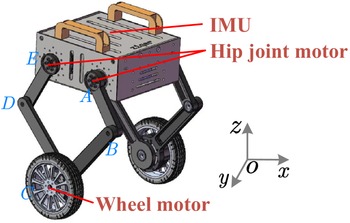
Figure 2 shows the structure of the bipedal wheeled robot. It comprises six actuated components: four hip joint motors and two wheel motors. Due to its symmetrical configuration, Figure 2 illustrates and annotates only the actuated components on one side.
Schematic of the bipedal wheeled robot.

The top section serves as the main body of the robot, housing core elements such as attitude sensors and the motion control chip. Additionally, the significantly heavier battery is mounted here, resulting in the main body concentrating the majority of the robot’s mass.
The middle section features a parallel leg mechanism, composed of four links. Through rotation of the hip joints, the leg length can vary within the range of
 $0.08\,\mathrm{m} - 0.3\,\mathrm{m}$
.
The bottom section consists of the driven wheels actuated by the wheel motors. These wheels function as the primary actuators for achieving robot balance and locomotion.
Schematic of the second-order wheeled inverted pendulum.

2.2. Second-order wheeled inverted pendulum
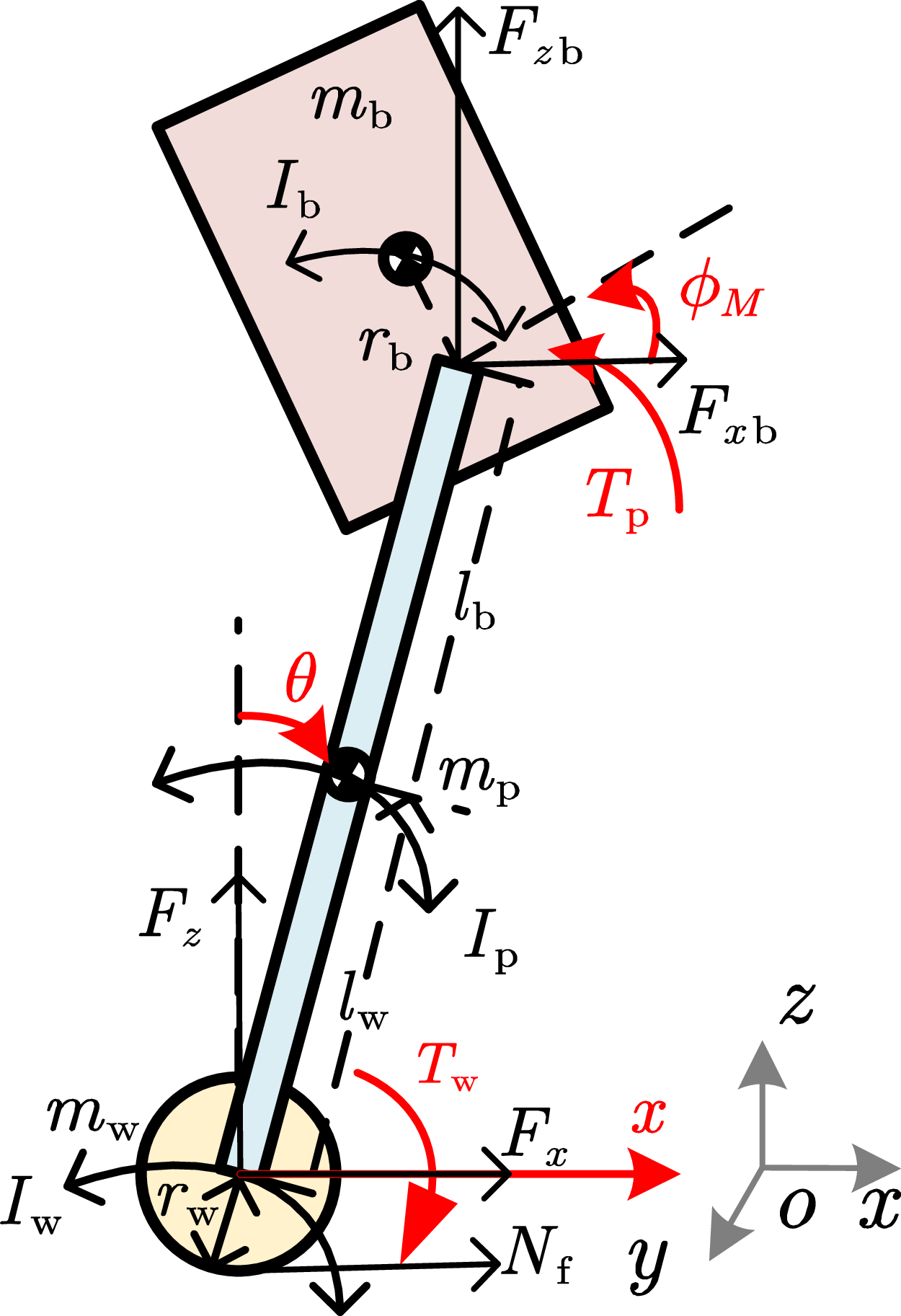
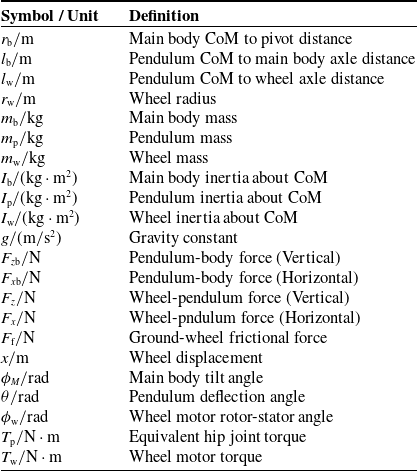
Achieving balance and locomotion is fundamental for robotic jumping. To this end, the robot is modeled as a second-order wheeled inverted pendulum, as illustrated in Figure 3. This model comprises three primary components: the main body, the pendulum link, and the wheel. The definitions of the physical parameters and system states are listed in Table I.
The system has six state variables: the forward displacement x, the main body’s tilt angle relative to the horizontal
 $\phi _{M}$
, the pendulum link’s deflection angle relative to the vertical
 $\theta$
, and their respective derivatives
 $x' , \phi '_{M}$
and
 $\theta '$
. Among these,
 $\phi _{M}$
and
 $\phi '_{M}$
can be directly measured using attitude sensors.
 $x , x' , \theta$
and
 $\theta '$
are computed comprehensively from the data returned by the attitude sensors and the joint motors.
Physical parameters of the second-order wheeled inverted pendulum

By analyzing the forces acting on the main body, pendulum link, and wheel assembly, we obtain the moment balance Eqs (1), (2), and (3), respectively. The second-order wheeled inverted pendulum can then be solved by simultaneously considering these equations [Reference Chen, Wang and Zhang22].
 \begin{align} \begin{cases} F_{x\mathrm{b}}=m_{\mathrm{b}}[x+(l_{\mathrm{w}}+l_{\mathrm{b}})\sin \theta -r_{\mathrm{b}}\sin \phi _{M}]^{''}\\[3pt] F_{\mathrm{zb}}-m_{\mathrm{b}}g=m_{\mathrm{b}}[(l_{\mathrm{w}}+l_{\mathrm{b}})\cos \theta +r_{\mathrm{b}}\cos \phi _{M}]^{''}\\[3pt] T_{\mathrm{p}}+F_{x\mathrm{b}}r_{\mathrm{b}}\cos \phi _{M}+F_{\mathrm{zb}}r_{\mathrm{b}}\sin \phi _{M}=I_{\mathrm{b}}\phi ''_{M} \end{cases} \end{align}
 \begin{align} \begin{cases} F_{x}-F_{x\mathrm{b}}=m_{\mathrm{p}}(x+l_{\mathrm{w}}\sin \theta )^{''}\\[3pt] F_{\mathrm{z}}-F_{\mathrm{zb}}-m_{\mathrm{p}}g=m_{\mathrm{p}}(l_{\mathrm{w}}\cos \theta )^{''}\\[3pt] T_{\mathrm{p}}-T+(F_{z}l_{\mathrm{w}}+F_{\mathrm{zb}}l_{\mathrm{b}})\sin \theta -(F_{x}l_{\mathrm{w}}+F_{x\mathrm{b}}l_{\mathrm{b}})\cos \theta =I_{\mathrm{p}}\theta '' \end{cases} \end{align}
 \begin{align} \begin{cases} F_{\mathrm{f}}-F_{x}=m_{\mathrm{w}}x''\\[3pt] T-F_{\mathrm{f}}r_{\mathrm{w}}=I_{\mathrm{w}}\dfrac{x''}{r_{\mathrm{w}}} \end{cases} \\[-30pt] \nonumber \end{align}
2.3. Leg kinematic model
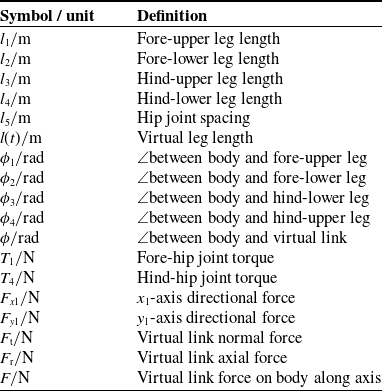
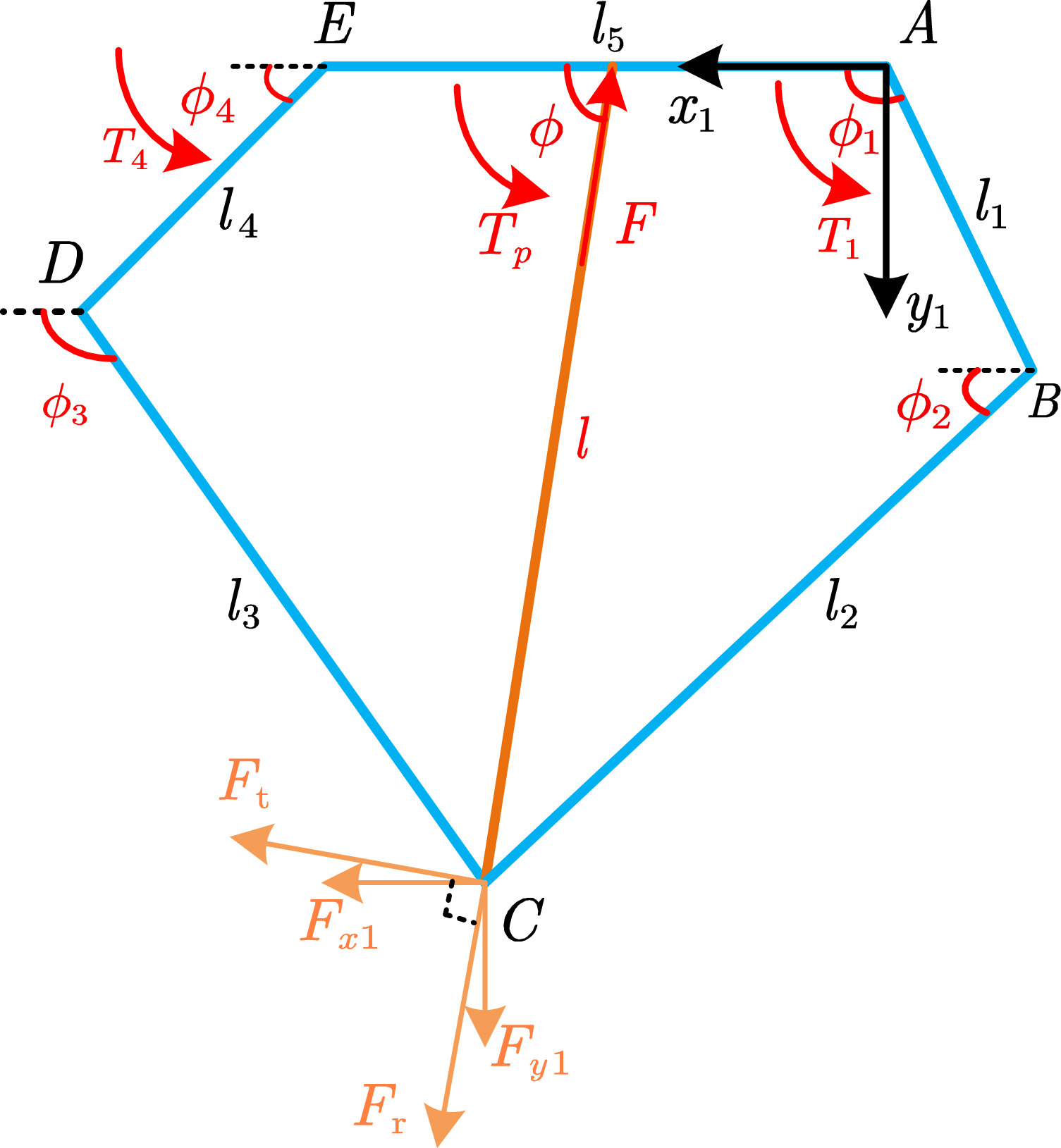
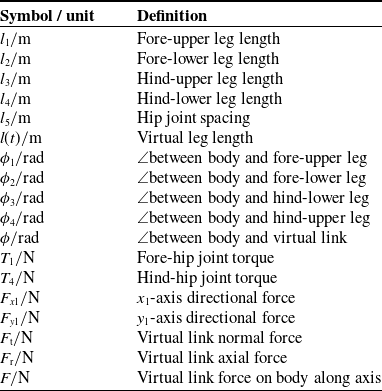
Although the aforementioned model abstracts the leg as a pendulum link, the actual leg structure is a five-bar linkage as depicted in Figure 4. Points A, B, C, D, and E in this figure correspond to the same positions shown in Figure 4. To establish the mapping between the virtual hip joint and physical hip joints, computational analysis is required. The physical quantities of the leg are defined in Table II, where
 $\phi _{1}$
and
 $\phi _{4}$
are directly measurable. This section establishes a Cartesian coordinate system
 $x_{1}Ay_{1}$
with point A as the origin. Based on this frame, we derive the relationships of
 $\phi _{2} , \phi _{3} , \phi , l , x_{c}$
and
 $y_{c}$
with respect to
 $\phi _{1}$
and
 $\phi _{4}$
, ultimately solving for the Jacobian matrix.
Leg physical parameters
Schematic of the leg structure.

Figure 4. Long description
A schematic of the leg structure. The diagram represents the structure of a bipedal wheeled robot leg. It includes labeled parts such as points A, B, C, D, and E, and segments l1, l2, l3, l4, and l5. The diagram also shows forces and tensions like T1, T4, Tp, F, Ft, Fx1, Fy1, and Fr. Angles phi1, phi2, phi3, phi4, and phi are indicated at various joints. The structure illustrates the mechanical morphology and the interaction of forces within the leg mechanism.
Within this coordinate system, the coordinates of points B and D are expressed as:
 \begin{align} \begin{cases} x_{B}=l_{1}\cos\!(\phi _{1})\\[3pt] x_{D}=l_{4}\cos\!(\phi _{4})+l_{5}\\[3pt] y_{B}=l_{1}\sin\!(\phi _{1})\\[3pt] y_{D}=l_{4}\sin\!(\phi _{4}). \end{cases} \end{align}
By expressing the coordinates of point C in alternative forms and equating the equations, we obtain:
 \begin{align} \begin{cases} x_{B}+l_{2}\cos \phi _{2}=x_{D}+l_{3}\cos \phi _{3}\\[3pt] y_{B}+l_{2}\sin \phi _{2}=y_{D}+l_{3}\sin \phi _{3}. \end{cases} \\[-30pt] \nonumber \end{align}
Solving yields the expression for
 $\phi _{2}$
:
 \begin{equation} \phi _{2}=2\arctan \left(\frac{B_{0}+\sqrt{{A}_{0}^{2}+{B}_{0}^{2}-{C}_{0}^{2}}}{A_{0}+C_{0}}\right) \end{equation}
where:
 \begin{align} \begin{cases} A_{0}=2l_{2}(x_{D}-x_{B})\\[5pt] B_{0}=2l_{2}(y_{D}-y_{B})\\[5pt] C_{0}\,=\,{l}_{2}^{2}+{l}_{BD}^{2}-{l}_{3}^{2}\\[5pt] l_{BD}=\sqrt{(x_{D}-x_{B})^{2}+(y_{D}-y_{B})^{2}}. \end{cases} \end{align}
Accordingly, the coordinates of point C are:
 \begin{align} \begin{cases} x_{C}=l_{1}\cos\!(\phi _{1})+l_{2}\cos\!(\phi _{2})\\[3pt] y_{C}=l_{1}\sin\!(\phi _{1})+l_{2}\sin\!(\phi _{2}). \end{cases} \end{align}
Subsequently,
 $\phi _{3} , \phi$
, and
 $l$
are solved as:
 \begin{align} \begin{cases} \phi _{3}=\arccos \Big(\dfrac{x_{C}-x_{D}}{l_{3}}\Big)\\[10pt] \phi =\arctan \Big(\dfrac{y_{C}}{x_{C}-0.5l_{5}}\Big)\\[10pt] l=\sqrt{(x_{C}-0.5l_{5})^{2}+{y}_{C}^{2}} \end{cases} \end{align}
Differentiating both sides of (5) and eliminating
 $\phi '_{3}$
, the expression for
 $\phi '_{2}$
is derived:
 \begin{equation} \phi '_{2}=\frac{(x'_{D}-x'_{B})\cos \phi _{3}+(y_{D}-y'_{B})\sin \phi _{3}}{l_{2}\sin\!(\phi _{3}-\phi _{2})} \end{equation}
where
 $x'_{D} , x'_{B} , y'_{D} , y'_{B}$
are obtained by directly differentiating (4), omitted here for brevity.
Differentiating (8) and substituting (9) into the resulting derivative yields:
 \begin{equation} \left[\begin{array}{l} x'_{C}\\[3pt] y'_{C} \end{array}\right]\,=\,\boldsymbol{J}_{\mathrm{r}}\left[\begin{array}{l} \phi '_{1}\\[3pt] \phi '_{4} \end{array}\right] \end{equation}
where the Jacobian matrix is defined as:
 \begin{align} \boldsymbol{J}_{\mathrm{r}}=\left[\begin{array}{ll} \dfrac{l_{1}\sin\!\left(\phi _{1}-\phi _{2}\right)\sin \phi _{3}}{\sin\!\left(\phi _{2}-\phi _{3}\right)} & \dfrac{l_{4}\sin\!\left(\phi _{3}-\phi _{4}\right)\sin \phi _{2}}{\sin\!\left(\phi _{2}-\phi _{3}\right)}\\[12pt] -\dfrac{l_{1}\sin\!\left(\phi _{1}-\phi _{2}\right)\cos \phi _{3}}{\sin\!\left(\phi _{2}-\phi _{3}\right)} & -\dfrac{l_{4}\sin\!\left(\phi _{3}-\phi _{4}\right)\cos \phi _{2}}{\sin\!\left(\phi _{2}-\phi _{3}\right)} \end{array}\right]. \end{align}
2.4. Leg dynamics model
According to the principle of virtual work, the mapping relationship between the joint torques and the virtual forces is given by:
 \begin{equation} \left[\begin{array}{l} T_{1}\\[3pt] T_{4} \end{array}\right]\,=\,{\boldsymbol{J}}_{\mathrm{r}}^{\mathrm{T}}\left[\begin{array}{l} F_{x1}\\[3pt] F_{y1} \end{array}\right]. \end{equation}
The forces along the coordinate axes can be transformed into components along the direction of the virtual link and perpendicular to it:
 \begin{align} \left[\begin{array}{l} F_{x1}\\[3pt] F_{y1} \end{array}\right]=\boldsymbol{R}\left[\begin{array}{l} F_{\mathrm{t}}\\[3pt] F_{\mathrm{r}} \end{array}\right]=\left[\begin{array}{ll} \sin \phi &\quad \cos \phi \\[3pt] -\cos \phi &\quad \sin \phi \end{array}\right]\left[\begin{array}{l} F_{\mathrm{t}}\\[3pt] F_{\mathrm{r}} \end{array}\right]. \end{align}
The force perpendicular to the virtual link can be converted into an equivalent virtual torque acting at the other end of the virtual link:
 \begin{align} \left[\begin{array}{l} F_{\mathrm{t}}\\[3pt] F_{\mathrm{r}} \end{array}\right]=M\left[\begin{array}{l} F\\[3pt] T_{p} \end{array}\right]=\left[\begin{array}{l@{\quad}l} 0 & -\dfrac{1}{l}\\[8pt] 1 &\quad 0 \end{array}\right]\left[\begin{array}{l} F\\[3pt] T_{\mathrm{p}} \end{array}\right]. \end{align}
Substituting (14) and (15) into (13) yields the mapping relationship between the actual joint torques and the virtual force/torque:
 \begin{equation} \left[\begin{array}{l} T_{1}\\[3pt] T_{4} \end{array}\right]\,=\,\boldsymbol{J}\left[\begin{array}{l} F\\[3pt] T_{\mathrm{p}} \end{array}\right] \end{equation}
where:
 \begin{align} \begin{array}{c} \boldsymbol{J}\,=\,{\boldsymbol{J}}_{\mathrm{r}}^{\mathrm{T}}\boldsymbol{RM}\\[6pt] =\left[\begin{array}{ll} \dfrac{l_{1}\sin\!\left(\phi _{1}-\phi _{2}\right)\sin\!\left(\phi _{3}-\phi \right)}{\sin\!\left(\phi _{2}-\phi _{3}\right)} & -\dfrac{l_{1}\sin\!\left(\phi _{1}-\phi _{2}\right)\cos\!\left(\phi _{3}-\phi \right)}{l\sin\!\left(\phi _{2}-\phi _{3}\right)}\\[13pt] \dfrac{l_{4}\sin\!\left(\phi _{3}-\phi _{4}\right)\sin\!\left(\phi _{2}-\phi \right)}{\sin\!\left(\phi _{2}-\phi _{3}\right)} & -\dfrac{l_{4}\sin\!\left(\phi _{3}-\phi _{4}\right)\cos\!\left(\phi _{2}-\phi \right)}{l\sin\!\left(\phi _{2}-\phi _{3}\right)} \end{array}\right]. \end{array} \end{align}
3. Jump trajectory planning
3.1. Jump process description
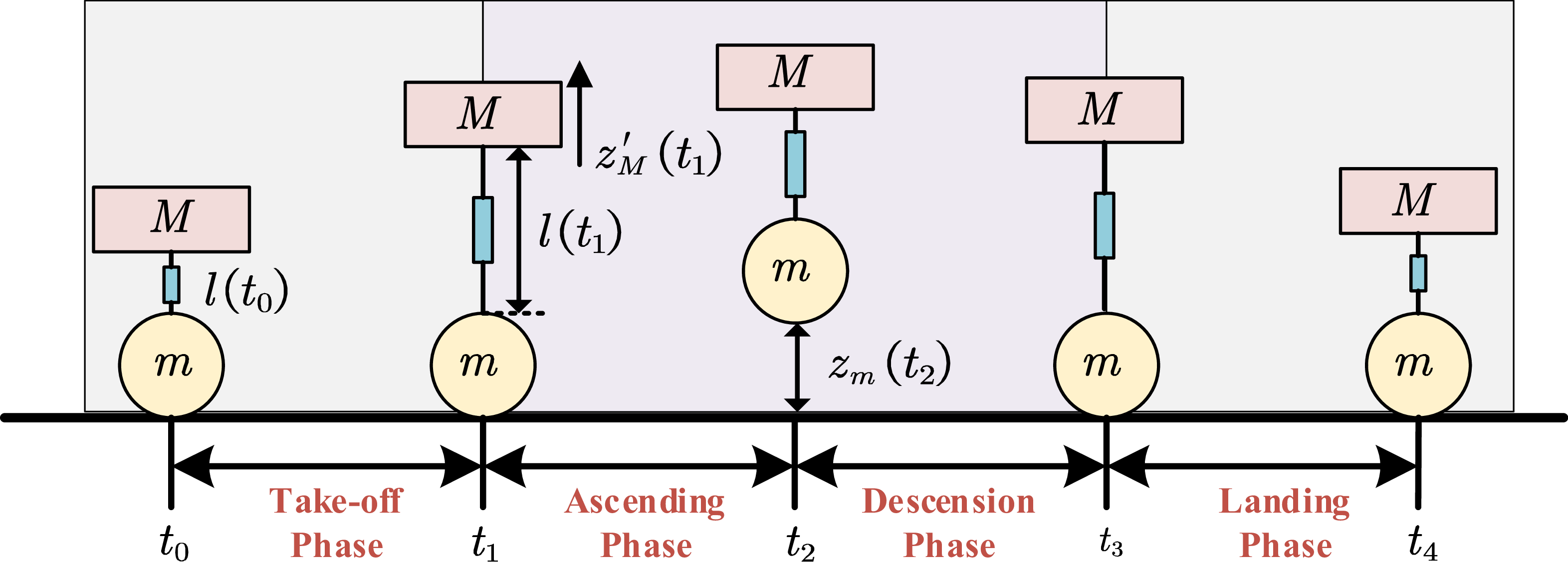
The bipedal wheeled robot utilizes wheels to provide forward velocity while legs generate vertical propulsion during jumping, achieving coordinated jumping functionality. As depicted in Figure 5, the jumping process comprises four sequential phases: the take-off phase initiates rapid leg extension to impart upward velocity to the main body; subsequently, the ascending phase enables ground clearance through leg retraction; during the descension phase, leg-length adjustment mitigates wheel-ground impact forces; finally, the landing phase restores nominal body height for operational recovery.
Schematic of jump process.

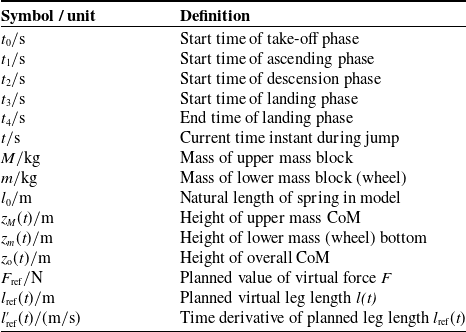
The core optimization of the proposed method focuses on the take-off and ascending phases. The take-off phase trajectory is planned using a nonlinear spring model, primarily aimed at minimizing the maximum hip joint torque. The ascending phase trajectory is planned using cubic polynomial interpolation of the lower mass acceleration, primarily aimed at minimizing the maximum leg retraction speed (a proxy for hip motor speed). These two core phases are coupled through the upper mass velocity at their boundary, forming an integrated optimization loop. Conversely, the trajectories for the descension and landing phases are generated via symmetric mapping relative to the ascending and take-off phases, respectively, to simplify planning and reduce impact forces. The physical parameters involved in the jumping process are listed in Table III. It is important to note that the masses
 $M$
and
 $m$
in the dual-mass model are not numerically equivalent to the masses
 $m_{\mathrm{b}}$
and
 $m_{\mathrm{w}}$
in the second-order wheeled inverted pendulum model. Therefore, distinct physical symbols have been introduced to avoid confusion.
Physical parameters of jumping process

3.2. Take-off phase trajectory planning
Practical implementation is constrained by the fixed torque limits of hip joint motors
 $T_{1} , T_{4}$
, which fundamentally restrict maximum jump height. To maximize jump height under fixed motor specifications, the maximum joint torque required to achieve a target jump height must be minimized.
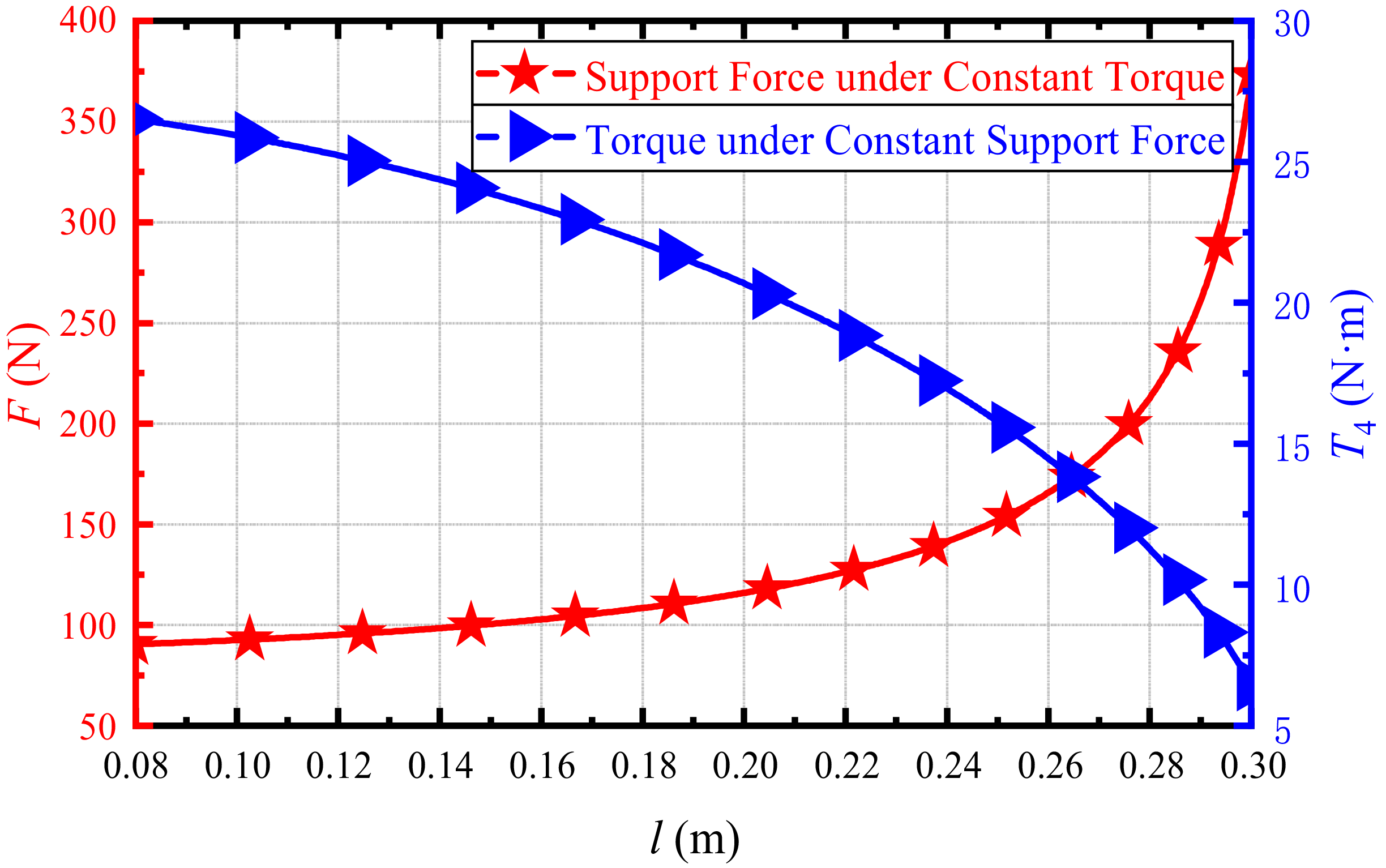
During the jumping process, the leg support force acts as the direct control input. Consequently, the correlation between leg support force and hip joint torque must first be analyzed. Under symmetric leg angles, combining (4), (5), (6), (7), (9) and (17) yields the relationships depicted in Figure 6, including: the variation of leg support force
 $F$
with leg length when the hip joint torques attain their maximum magnitudes in opposite directions
 $T_{1}=-12\,\mathrm{N}\cdot \mathrm{m} , T_{4}=12\,\mathrm{N}\cdot \mathrm{m}$
, and the variation of hip joint torque
 $T_{4}$
with leg length for a constant support force
 $F=200\,\mathrm{N}$
. It can be observed that the maximum achievable support force increases monotonically with increasing leg length. Similarly, to generate a constant support force, the required hip joint torque increases as the leg length decreases.
Schematic of hip joint torque and support force under different leg length.

Therefore, to reduce the maximum hip joint torque during the jumping process, the support force must be properly planned throughout the motion. Currently, the widely adopted approach employs a DMLSM, for which the expression of the resultant force is given by:
 \begin{equation} F_{\mathrm{ref}}=k(l-l_{0}) \end{equation}
where k denotes the spring stiffness coefficient. It is evident that the support force is a linear function of the spring length, with the absolute magnitude of the force increasing as the deviation from the natural length grows. During the take-off phase, this implies that the maximum required support force occurs at the shortest leg length, which inevitably increases the maximum required hip joint torque.
To address this limitation, we first introduce additional degrees of freedom for regulation. This study employs a cubic nonlinear spring model, where the relationship between the generated force and length is given by:
 \begin{equation} F_{\mathrm{ref}}=a(l-l_{0})^{3}+b(l-l_{0}) \end{equation}
where
 $a$
and
 $b$
represent the coefficients of the cubic and linear terms, respectively. The parameters of the nonlinear spring are tuned using the optimization method described in (20). By optimizing parameters
 $a$
and
 $b$
, this model can reshape the relationship between the support force
 $F_{\mathrm{ref}}$
and the leg length
 $l$
, thereby actively “shifting” the occurrence of the maximum virtual support force to a phase where the leg is longer. This effectively reduces the required peak hip joint torque for achieving the same jumping performance. The cubic form was chosen after comparative studies showed that introducing higher-order polynomial terms (e.g., a quintic term) did not yield further performance gains, indicating that the cubic model provides a sufficient and parsimonious representation under the given physical constraints. Furthermore, by planning jumps only within a pre-determined feasible height range, the approach implicitly ensures that all planned motions comply with the hardware torque limits.
 \begin{align} \begin{array}{c} \,\,\min _{a,b}\left(\max \left| T_{4}\right| \right)\\[5pt] s.t.\dfrac{M}{2}g\left[z_{M}\left(t_{1}\right)-z_{M}\left(t_{0}\right)\right]+\dfrac{1}{2}\dfrac{M}{2}\left[z'_{M}\left(t_{1}\right)\right]^{2}\\[8pt] =\dfrac{1}{4}a\left\{\left[l\left(t_{0}\right)-l_{0}\right]^{4}-\left[l\left(t_{1}\right)-l_{0}\right]^{4}\right\}\\[8pt] +\;\dfrac{1}{2}b\left\{\left[l\left(t_{0}\right)-l_{0}\right]^{2}-\left[l\left(t_{1}\right)-l_{0}\right]^{2}\right\}\\[8pt] a\left[l\left(t_{1}\right)-l_{0}\right]^{3}+b\left[l\left(t_{1}\right)-l_{0}\right]=mg\\[8pt] \,\,a\left[l_{0}-l\left(t_{0}\right)\right]^{3}+b\left[l_{0}-l\left(t_{0}\right)\right]\gt \dfrac{Mg}{2} \end{array} \end{align}
The primary optimization objective is to minimize the maximum absolute value of the hip joint torque throughout the motion. The optimization process is subject to two equality constraints and one inequality constraint. Due to the symmetrical operation of the bipedal legs, the following analysis is based on the upper mass
 $0.5\,M$
borne by a single leg. The first equality constraint, based on the conservation of mechanical energy during the take-off phase, ensures the upper mass reaches the desired velocity
 $z'_{M}(t_{1})$
at the end of the take-off phase (the magnitude of
 $z'_{M}(t_{1})$
is computed during trajectory planning for the subsequent ascending phase). The second equality is a kinematic continuity condition for achieving a smooth liftoff. It guarantees that the spring force equals the gravitational force on the lower mass at take-off completion. This condition ensures zero contact force between the lower mass and the ground at the initial moment of the ascending phase, facilitating trajectory planning for that stage. The inequality constraint is a motion feasibility condition, which requires the spring force at the initial moment to be greater than half the gravitational force on the upper mass. This ensures the leg length is minimized at the initial configuration.
To solve the aforementioned optimization problem, it is necessary to establish the relationship between
 $T_{4}$
and
 $l$
. Given the bilateral symmetry of the leg structure, we have:
 $\phi _{4}=\pi -\phi _{1} , \phi _{3}=\pi -\phi _{2}$
, and
 $\phi =\pi /2$
. Subsequently, (21) can be derived from (5) and (9). This allows us to solve for expressions
 $\phi _{1}$
and
 $\phi _{2}$
in terms of
 $l$
. Subsequently, combining this result with (17) yields the functional relationship between
 $T_{4}$
and
 $l$
.
 \begin{align} \begin{cases} l_{1}\cos \phi _{1}+l_{2}\cos \phi _{2}=\dfrac{l_{5}}{2}\\[3pt] l_{1}\sin \phi _{1}+l_{2}\sin \phi _{2}=l \end{cases} \\[-30pt] \nonumber \end{align}
3.3. Ascending phase trajectory planning
The planning of the ascending phase ensures that the lower mass attains the desired jump height, when the overall CoM reaches its highest point. During the ascending phase, the overall CoM undergoes free-fall motion. The duration of this entire phase is:
 \begin{equation} t_{\mathrm{as}}=t_{2}-t_{1}=\sqrt{\frac{2\left[z_{\mathrm{o}}\left(t_{2}\right)-z_{\mathrm{o}}\left(t_{1}\right)\right]}{g}}. \end{equation}
Since the transition between ascending and descension phases is no longer directly related to the virtual leg length but is instead directly linked to time, the acceleration of the lower mass is planned in the time domain using a cubic polynomial. This choice allows the motion profile to smoothly satisfy the kinematic boundary conditions, specifically zero velocity at the transition instants and the desired jump height, while retaining two free coefficients for further optimization of leg retraction speed. The accelerations of the upper and lower masses are:
 \begin{align} \begin{cases} z''_{m}=c_{1}\left(t-t_{1}\right)^{3}+c_{2}\left(t-t_{1}\right)^{2}+c_{3}\left(t-t_{1}\right)+c_{4}\\[5pt] z''_{M}=\dfrac{-mz''_{m}-mg-0.5Mg}{0.5M} \end{cases} \end{align}
where
 $c_{1} , c_{2} , c_{3}$
, and
 $c_{4}$
are parameters to be tuned, determined through the optimization method shown in (24).
 \begin{align} \begin{array}{c} \,\,\min\limits _{c_{1},c_{2},c_{3},c_{4}}\left(\max \left| z'_{M}-z'_{m}\right| \right)\\[10pt] s.t.\dfrac{1}{4}c_{1}{t_{\mathrm{as}}}^{4}+\dfrac{1}{3}c_{2}{t_{\mathrm{as}}}^{3}+\dfrac{1}{2}c_{3}{t_{\mathrm{as}}}^{2}+c_{4}t_{\mathrm{as}}=0\\[10pt] \dfrac{1}{20}c_{1}{t_{\mathrm{as}}}^{5}+\dfrac{1}{12}c_{2}{t_{\mathrm{as}}}^{4}+\dfrac{1}{6}{t_{\mathrm{as}}}^{3}+\dfrac{1}{2}c{t_{\mathrm{as}}}^{2}=z_{m}\left(t_{2}\right) \end{array} \\[-10pt] \nonumber \end{align}
The maximum hip joint motor speed often occurs during the ascending phase. To mitigate wear on mechanical components, extend the robot’s service life, and enhance its reliability, it is necessary to minimize this maximum value. Here, since the trajectory planning uses time as the independent variable, establishing its relationship with the hip joint angle is complex. Therefore, the optimization objective function is set to minimize the maximum absolute value of the rate of leg length change during the jump. The optimization must also satisfy two equality constraints: The first equality constraint is the terminal velocity boundary condition for the ascending phase, ensuring the lower mass velocity is zero at the final time. The second equality constraint is the mathematical expression of the performance index. It translates the requirement for the expected jump height
 $z_{m}(t_{2})$
of the lower mass into a constraint on the integral of its motion acceleration, ensuring the jump height meets the expectation.
The following equation is derived based on integrating the lower expression in (23) and expresses the velocity constraint of the upper mass at the final moment:
 \begin{equation} -\frac{m}{0.5M}z'_{m}\left(t_{2}\right)-\frac{\left(0.5M+m\right)}{0.5M}gt_{\mathrm{as}}+z'_{M}\left(t_{1}\right)=0 \end{equation}
where
 $z'_{M}(t_{1})$
is the only unknown parameter to be solved. After solution, it can be utilized as the take-off phase parameter.
3.4. Descension phase trajectory planning
To mitigate the impact force exerted on the wheels upon ground contact, the vertical wheel velocity at touchdown must be minimized in accordance with the impulse–momentum theorem, with the ideal goal of reducing it to zero. Given that the wheel velocity is zero at the start of the ascending phase, the trajectory planning for the descension phase adopts a symmetric approach relative to the ascending phase, thereby theoretically ensuring zero vertical wheel velocity at touchdown. The acceleration of the lower mass is thus defined as:
 \begin{align} z''_{m}=c_{1}(t_{3}-t)^{3}+c_{2}(t_{3}-t)^{2}+c_{3}(t_{3}-t)+c_{4}. \\[-25pt] \nonumber \end{align}
3.5. Landing phase trajectory planning
Similarly, to reduce post-impact forces on the upper mass, restore the initial jump height, and constrain hip joint torque, the landing trajectory planning employs a symmetric approach relative to the take-off phase. This symmetry helps ensure a smooth transition of the support force from the beginning of landing, avoiding abrupt force changes. The reference support force during this phase is:
 \begin{align} F_{\mathrm{ref}}=a(l-l_{0})^{3}+b(l-l_{0}). \\[-25pt] \nonumber \end{align}
3.6. Summary of trajectory planning
 \begin{align} F_{\mathrm{ref}}=\begin{cases} a(l-l_{0})^{3}+b(l-l_{0}),\,t\in \left[t_{0},t_{1}\right]\cup \left[t_{3},t_{4}\right]\\[4pt] -mg-mz''_{m}\,\qquad \quad ,\,t\in \left[t_{1},t_{3}\right] \end{cases} \end{align}
 \begin{align} l'_{\mathrm{ref}}\left(t\right)=\begin{cases} \displaystyle{\int }_{t_{0}}^{t}\dfrac{F_{\mathrm{ref}}}{0.5M}\mathrm{d}t+z'_{M}\left(t_{0}\right), &t\in \left[t_{0},t_{1}\right]\\[9pt] \displaystyle{\int }_{t_{1}}^{t}(z''_{M}-z''_{m})\mathrm{d}t+z'_{M}\left(t_{1}\right)-z'_{m}\left(t_{1}\right), &t\in \left[t_{1},t_{2}\right]\\[9pt] \displaystyle{\int }_{t_{2}}^{t}(z''_{M}-z''_{m})\mathrm{d}t+z'_{M}\left(t_{2}\right)-z'_{m}\left(t_{2}\right), &t\in \left[t_{2},t_{3}\right]\\[9pt] \displaystyle{\int }_{t_{3}}^{t}\dfrac{F_{\mathrm{ref}}}{0.5M}\mathrm{d}t+z'_{m}\left(t_{3}\right), &t\in \left[t_{3},t_{4}\right] \end{cases} \end{align}
 \begin{align} l_{\mathrm{ref}}\,=\,{\int }_{t_{0}}^{t}l'_{\mathrm{ref}}\mathrm{d}t+l\left(t_{0}\right),t\in \left[t_{0},t_{4}\right] \\[-5pt] \nonumber \end{align}
Based on the preceding analysis, the physical parameters governing the robot’s complete jumping trajectory can be fully characterized. The expressions for
 $F_{\mathrm{ref}} , l'_{\mathrm{ref}}$
and
 $l_{\mathrm{ref}}$
are formally summarized in (28), (29), and (30) respectively.
4. Controller design
4.1. Balancing and locomotion controller
The balancing and locomotion controller is designed based on the second-order wheeled inverted pendulum model depicted in Figure 3. Utilizing a state feedback control algorithm, it achieves displacement command tracking while ensuring robot balance stability. The control law is expressed as:
 \begin{align} \left[\begin{array}{l} T_{\mathrm{p}}\\[3pt] T_{\mathrm{w}} \end{array}\right]=K\left[\begin{array}{c} x-x_{\mathrm{ref}}\\[3pt] x'\\[3pt] \theta \\[3pt] \theta '\\[3pt] \phi _{M}\\[3pt] \phi '_{M} \end{array}\right] \end{align}
where
 $K$
denotes the feedback gain matrix (defined in (32)), and
 $x_{\mathrm{ref}}$
represents the position command. This configuration deactivates the wheel motor torque output during both ascending and descension phase. Gain parameters can be systematically configured through pole placement or linear quadratic regulator methods.
 \begin{align} K=\begin{cases} \left[\begin{array}{llllll} k_{11} &\quad k_{12} &\quad k_{13} &\quad k_{14} &\quad k_{15} &\quad k_{16}\\[3pt] k_{21} &\quad k_{22} &\quad k_{23} &\quad k_{24} &\quad k_{25} &\quad k_{26} \end{array}\right],\quad t\in \left[t_{0}, t_{1}\right]\cup \left[t_{3},t_{4}\right]\\[12pt] \left[\begin{array}{llllll} k_{11} &\quad k_{12} &\quad k_{13} &\quad k_{14} &\quad k_{15} &\quad k_{16}\\[3pt] 0 &\quad 0 &\quad 0 &\quad 0 &\quad 0 &\quad 0 \end{array}\right],\quad t\in \left[t_{1},t_{3}\right] \end{cases} \\[-30pt] \nonumber \end{align}
4.2. Jumping controller
Although Section 3 computes the reference trajectories for jumping motion, realizing these trajectories on the physical robot requires dedicated control implementation. To achieve robust tracking performance, a feedforward-feedback control strategy is adopted as expressed in (33). The feedback control component
 $F_{\mathrm{b}}$
is formulated in (34).
 \begin{align} &F=F_{\mathrm{ref}}+F_{\mathrm{b}} \\[-8pt] \nonumber\end{align}
 \begin{align} F_{\mathrm{b}}=&k_{\mathrm{p}}\left(l_{\mathrm{ref}}-l\right)+k_{\mathrm{d}}\left(l'_{\mathrm{ref}}-l'\right) \\[12pt] \nonumber \end{align}
where
 $k_{\mathrm{p}} , k_{\mathrm{d}}$
denote the proportional, derivative gains of the controller, respectively.
The controller’s stability is analyzed by grouping the phases: the ground-contact phases (take-off/landing) and the flight phases (ascending/descension). Within each group, the linearized leg-length tracking error dynamics satisfy the Routh–Hurwitz criterion when PD gains
 $k_{\mathrm{p}}\gt 0$
and
 $k_{\mathrm{d}}\gt 0$
are selected, ensuring exponential convergence. The planned trajectories are constraint-compliant, facilitating smooth transitions between phases. Simulation and experimental results in Section 5 validate the robustness of this integrated strategy.
5. Simulation and experimental verification
5.1. Trajectory planning simulation validation
To demonstrate the superiority of the proposed trajectory planning method, we first analyze the planned trajectories in isolation without considering control effects. This approach clearly reveals the characteristics of the planned trajectories. Simulation results include height profiles of both masses, along with hip joint torque and rotational speed curves.
The hip joint motor in the experimental prototype has a nominal maximum torque of
 $12\mathrm{N}\cdot \mathrm{m}$
. To ensure safe robot operation, the maximum hip joint torque during jumping trajectory planning is constrained to
 $85\%$
of its nominal value (
 $10.15\mathrm{N}\cdot \mathrm{m}$
). The robot parameters are as follows:
 \begin{equation*} M=6.10\mathrm{kg},\,{m}=1.08\mathrm{kg},r_{\mathrm{w}}=0.075\mathrm{m}. \end{equation*}
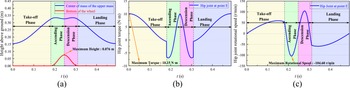
When the hip joint motor torque reached its saturation limit, the jumping trajectory planned using DMLSM is shown in Figure 7, achieving a maximum jump height of
 $0.076\mathrm\,\mathrm{m}$
. In contrast, the jumping trajectory planned using TPM-HJMSO is shown in Figure 8, achieving a significantly higher maximum jump height of
 $0.200\,\mathrm{m}$
. This represents a
 $163.16\%$
improvement in maximum jump height using TPM-HJMSO.
Performance of the DMLSM under maximum hip joint torque constraints. (a) Height, (b) hip joint torque, and (c) hip joint rotational speed.

Figure 7. Long description
Three line graphs depict the performance of a bipedal wheeled robot under maximum hip joint torque constraints. Panel A: A line graph shows the height above ground in meters (m) on the vertical axis and time in seconds (s) on the horizontal axis. The graph includes three lines representing the center of mass of the upper mass, the bottom of the wheel, and the maximum height. The phases are labeled as take-off, ascending, descending, and landing. Panel B: A line graph displays hip joint torque in Newton-meters (N m) on the vertical axis and time in seconds (s) on the horizontal axis. The graph shows the maximum torque and includes phases labeled as take-off, ascending, descending, and landing. Panel C: A line graph illustrates hip joint rotational speed in revolutions per minute (r/min) on the vertical axis and time in seconds (s) on the horizontal axis. The graph indicates the maximum rotational speed and includes phases labeled as take-off, ascending, descending, and landing.
Performance of the proposed TPM-HJMSO under maximum hip joint torque constraints. (a) Height, (b) hip joint torque, and (c) hip joint rotational speed.

Performance with the proposed TPM-HJMSO at fixed jump height 0.076 m. (a) Height, (b) hip joint torque, and (c) hip joint rotational speed.

To achieve the same jump height of
 $0.076\,\mathrm{m}$
using TPM-HJMSO, the resulting jumping trajectory is shown in Figure 9. Analysis reveals that the maximum hip joint torque required is
 $7.12\,\mathrm{N}\cdot \mathrm{m}$
and the maximum hip joint rotational speed reached
 $72.00\,\mathrm{r}/\min$
. Conversely, when DMLSM is employed to achieve this identical jump height, it demanded a maximum hip joint torque of
 $10.15\text{ Nm}$
and a maximum rotational speed of
 $104.60\,\mathrm{r}/\min$
. Compared to DMLSM, TPM-HJMSO achieved the target jump height with reductions of
 $29.85\%$
in maximum torque and
 $31.17\%$
in maximum rotational speed. Quantitative analysis demonstrates that this optimization reduces the peak motor thermal load by
 $50.80\%$
and is expected to increase the theoretical bearing life by approximately
 $45.27\%$
, significantly enhancing the long-term reliability of the system.
To demonstrate the superiority of TPM-HJMSO more clearly, Table IV lists the maximum jump height, maximum hip joint torque, and maximum hip joint rotational speed under three operating conditions.
Meanwhile, to comprehensively evaluate the performance of TPM-HJMSO, we conducted numerical comparisons with recent related research under identical model parameters. For the same jump height of
 $0.\,\mathrm{m}$
, the maximum hip joint torque of TPM-HJMSO is
 $7.12\,\mathrm{N}\cdot \mathrm{m}$
, which is lower than the
 $8.52\,\mathrm{N}\cdot \mathrm{m}$
of reference [Reference Gao, Jin, Zhu, Gao, Lv, Zhao and Cai18], and its maximum rotational speed of
 $72.00\,\mathrm{r}/\min$
is also superior to the
 $81.75\,\mathrm{r}/\min$
of ref. [Reference Gao, Jin, Zhu, Gao, Lv, Zhao and Cai18]. In comparison with ref. [Reference Lu, Cao, Hao, Fang and Tang21], under the same upper-mass velocity at the end of the take-off phase (
 $\mathrm{z}'_{M}(t_{1})=1.0761\,\mathrm{m}/\mathrm{s}$
), TPM-HJMSO strictly satisfies the terminal constraints while reducing the maximum torque
 $7.12\,\mathrm{N}\cdot \mathrm{m}$
by approximately
 $12.3\%$
compared to the
 $8.12\,\mathrm{N}\cdot \mathrm{m}$
in ref. [Reference Lu, Cao, Hao, Fang and Tang21]. This highlights the difference in optimization objectives: TPM-HJMSO focuses on precise control and peak load minimization, whereas the framework of ref. [Reference Lu, Cao, Hao, Fang and Tang21] emphasizes comprehensive optimization and flexibility. This comparison validates the effectiveness of TPM-HJMSO under the described structure and working conditions, while the idea of not constraining the virtual force form in ref. [Reference Lu, Cao, Hao, Fang and Tang21] also holds significant reference value for future research.
Comparison of trajectory planning method

5.2. Jumping process simulation validation
To validate the effectiveness of the proposed jumping trajectory planning algorithm under hip joint torque constraints, this study implements the trajectory in Figure 5 with the control framework shown in Figure 1.
Comparison of reference and simulation values

Schematic diagram of jumping trajectory in simulation.

A full-scale 3D model matching the prototype is developed in Webots 2020a, with gravity set to the standard
 $9.81\,\mathrm{m}/\mathrm{s}^{2}$
and control code executed at
 $1\text{ kHz}$
. The robot accelerates to
 $1\,\mathrm{m}/\mathrm{s}$
and maintains steady-state motion until a jump command is triggered at
 $t=0.2\,\mathrm{s}$
. The subsequent motion follows the planned phases in Figure 5: take-off, ascending, descension, and landing. Figure 10 shows the schematic diagram of the jumping trajectory in simulation , with its key comparative data provided in Table V.
Figure 11(a) shows the wheel bottom height reaching a maximum of
 $0.200\,\mathrm{m}$
, matching the theoretical reference. Figure 11(b) indicates the maximum leg-length tracking error of
 $0.01\,\mathrm{m}$
during the descension flight phase. Analysis of Figure 11(c) and (d) reveals the maximum hip joint torque of
 $10.41\,\mathrm{N}\cdot \mathrm{m}$
(
 $2.56\%$
above reference) and maximum rotational speed of
 $109.57\,\mathrm{r}/\min$
(
 $0.02\%$
below reference). These results confirm precise tracking of joint references and demonstrate successful optimization of torque and speed. The proposed algorithm enables superior jumping performance under torque constraints.
Simulation results of jumping process. (a) Height curves of the center of mass of the upper mass and the wheel bottom, (b) virtual leg length, (c) hip joint torque, and (d) hip joint rotational speed.

Figure 11. Long description
The figure contains four line graphs depicting simulation results of a jumping process for bipedal wheeled robots. Panel A: A line graph shows the height curves of the center of mass of the upper mass and the wheel bottom over time. The x-axis represents time in seconds, and the y-axis represents height above ground in meters. The graph includes reference and simulation values for both the upper mass center of mass and the wheel bottom. Panel B: A line graph displays the virtual leg length over time. The x-axis represents time in seconds, and the y-axis represents leg length in meters. The graph includes reference and simulation values. Panel C: A line graph illustrates the hip joint torque over time. The x-axis represents time in seconds, and the y-axis represents torque in Newton-meters. The graph includes reference and simulation values. Panel D: A line graph shows the hip joint rotational speed over time. The x-axis represents time in seconds, and the y-axis represents rotational speed in revolutions per minute. The graph includes reference and simulation values.
5.3. Jumping process experiment validation
To further validate the effectiveness of the jump trajectory planning algorithm proposed in this paper, prototype experiments are conducted on a hard indoor floor. In the experimental prototype, four hip joint motors and two wheel motors are selected as the CyberGear micro motors from Xiaomi Corporation, each with a maximum torque of
 $12\,\mathrm{N}\cdot \mathrm{m}$
. The inertial measurement unit used to measure body angle and rotational speed is the MPU6050. The motion control algorithm runs on an STM32H723 microcontroller at a control frequency of 1 kHz. Communication between the motion control chip and the six motors was established via a CAN bus.
Similar to the simulation, the robot is first accelerated to
 $1\,\mathrm{m}/\mathrm{s}$
, followed by steady-state motion. At
 $t=0.2\,\mathrm{s}$
, the jump command is issued. Subsequently, the robot executes the jump sequence comprising take-off, ascending, descension, and landing phases according to the trajectory planning shown in Figure 5. Figure 12 shows the schematic diagram of the jumping trajectory in prototype experiment , with its key comparative data provided in Table VI.
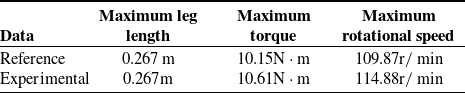
Comparison OF reference and experimental values

In the prototype experiment, direct measurement of the height of the CoM of the upper masses or the wheel bottom was unavailable. Nevertheless, the robot’s maximum jump height can be characterized by other states during the jump process: specifically, the velocity of the upper mass during take-off and the leg length during the ascending phase. Since the wheel remained grounded throughout take-off, the velocity of the upper mass center coincides with the rate of change of the virtual leg length. This rate of change can be further characterized by the hip joint rotational speed. As shown in Figure 13(c), the hip joint rotational speed at the end of the take-off phase is
 $111.56\,\mathrm{r}/\min$
, representing a
 $2.93\%$
increase over the planned value of
 $108.38\,\mathrm{r}/\min$
. Meanwhile, Figure 13(a) shows that the virtual leg length at the end of the ascending phase was
 $0.104\,\mathrm{m}$
, a
 $4.00\%$
increase over the planned value of
 $0.100\,\mathrm{m}$
. These results indicate close tracking of the planned jump height.
Schematic diagram of jumping trajectory in prototype experiment.

Prototype experiment results of jumping process. (a) Virtual leg length, (b) hip joint torque, and (c) hip joint rotational speed.

Figure 13. Long description
Three line graphs depict the results of a prototype experiment during a jumping process. Panel A: A line graph shows the virtual leg length over time. The x-axis represents time in seconds, ranging from 0 to 1. The y-axis represents leg length in meters, ranging from 0.05 to 0.30. The graph includes two lines: a solid blue line for the reference value and a dashed red line for the experimental value. The inset zooms in on specific time intervals to highlight detailed variations. Panel B: A line graph displays the hip joint torque over time. The x-axis represents time in seconds, ranging from 0 to 1. The y-axis represents hip joint torque in Newton-meters, ranging from -8 to 14. Similar to Panel A, this graph includes a solid blue line for the reference value and a dashed red line for the experimental value, with insets zooming in on specific intervals. Panel C: A line graph illustrates the hip joint rotational speed over time. The x-axis represents time in seconds, ranging from 0 to 1. The y-axis represents hip joint rotational speed in revolutions per minute, ranging from -120 to 120. This graph also includes a solid blue line for the reference value and a dashed red line for the experimental value, with insets zooming in on specific intervals.
Furthermore, Figure 13(b) reveals that the maximum hip joint torque during the jump was
 $10.61\,\mathrm{N}\cdot \mathrm{m}$
, exceeding the planned value by
 $4.53\%$
while remaining within the torque constraint. Figure 13(c) shows the maximum hip joint rotational speed reached
 $114.88\,\mathrm{r}/\min$
, a
 $4.56\%$
increase over the planned value. This demonstrates successful achievement of the optimization objectives for maximum hip joint torque and rotational speed. These experimental results further verify that under actual torque constraints, the proposed algorithm achieves enhanced jump performance, confirming its effectiveness in practical control scenarios.
To evaluate the robustness of the proposed algorithm against real-world uncertainties, the jumping experiment was repeated 10 times under identical conditions. All trials were successful, with key performance indicators (e.g., maximum hip joint torque and rotational speed) showing strong consistency (the maximum deviation was less than
 $3\%$
). This adequately demonstrates the robustness of the proposed method.
6. Conclusion
To address the challenges faced by bipedal wheeled robots during jumping, this paper proposes a TPM-HJMSO that enhances maximum jump height under identical hip joint torque constraints while reducing the maximum hip joint rotational speed required to achieve equivalent jump heights. A comprehensive control framework is presented, with simulation and prototype experiments validating the algorithm’s superiority and effectiveness.
Future work will focus on extending TPM-HJMSO to standing long-range jumps, where legs provide both vertical propulsive force and forward thrust to enhance obstacle negotiation capability, while optimizing the model by replacing the current nonlinear spring model and cubic polynomial interpolation to additionally reduce maximum motor torque and rotational speed demands during jumps. However, during forward jumping, the robot’s motion pattern no longer maintains symmetry, and the degree of dynamic coupling increases significantly, necessitating a redesign of the existing cost function and constraint conditions. Meanwhile, for uneven terrain, the current trajectory planning method for the descension and landing phases, based on symmetry assumptions, will face challenges. These limitations also highlight important directions for future research.
Author contributions
Tianzheng Wang conceived the methodology, conducted experimental validation, and drafted the manuscript; Guolin He built the hardware platform and debugged the low-level communication code; Tao Fan initiated and funded the project, established the control-theoretic framework and technical roadmap; Zhongyong Liu and Jing Guo provided control-theoretic guidance and technical consultation; Xuhui Wen supervised overall project direction and progress.
Funding statement
This work has received funding from the Strategic Priority Research Program of Chinese Academy of Sciences (XDA28040100) and by the Youth Innovation Promotion Association CAS(2022135).
Competing interests
The authors declare no conflicts of interest.
Ethical standards
Not applicable.
Use of AI
During the preparation of this work, the authors used DeepSeek (the version available in September 2025) to check the manuscript for spelling and language errors and to refine the wording of some sentences. After using this tool, the authors reviewed and edited the content as needed and take full responsibility for the content of the publication.