


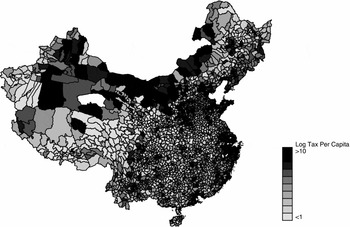
China has been one of the most rapidly growing economies in the world, as shown by a remarkable 738.23% growth in GDP from 1994 to 2010. Although its unparalleled economic performance has been extensively researched,Footnote 1 few studies have investigated the determinants of even more remarkable growth in fiscal revenues, which registered a massive 1492.56% increase over the same period.Footnote 2 The degree of fiscal extraction, measured by the share of budgetary revenue in GDP, rose from 10.85% in 1994 to 20.61% in 2010.Footnote 3 More importantly, county fiscal revenues vary substantially across China (Figure 1).
County-level Fiscal Extraction in China (2005)

This pattern of subnational fiscal extraction is puzzling for two reasons. First, the variation in subnational economic development cannot fully account for the variation in fiscal revenues. Although scholars have identified a positive correlation between taxation and economic development (Besley and Persson Reference Besley, Persson, Auerbach, Chetty, Feldstein and Saez2013), the bivariate correlation is small and sometimes even negative among Chinese counties. Second, an important argument about China's economic success hinges on the institutions that unleash competition between localities, coined “market-preserving federalism.”Footnote 4 If interjurisdiction competition indeed generates incentives to promote economic development, each locality is expected to vie to attract investment to its own turf. We should then observe a “race-to-the-bottom” tax competition when local jurisdictions can influence effective tax rates (Oates Reference Oates1972; Wibbels and Arce Reference Wibbels and Arce2003), yet Chinese overall fiscal revenue has been increasing much faster than GDP since 1994.
Current theories concerning state fiscal capacity cannot fully explain the subnational variation in China because they usually treat the state as a unitary actor. Several influential studies emphasize that bargaining between state and society over fiscal extraction is the impetus for institutional change and regime stability.Footnote 5 We extend this line of research by showing that the fiscal capacity of authoritarian states hinges on the institutional design of subnational political competition, a factor that has not been explored systematically in existing research. We contend that studying the institutional structures of local political competition improves standard accounts of authoritarian resilience.
Specifically, we argue that the intensity of interjurisdiction political competition has a nonlinear relationship with local fiscal revenue. When competition for promotion among local officials increases, raising additional fiscal revenues helps local officials credibly signal competence and loyalty to their principal(s) in the administrative hierarchy. However, excessive political competition eventually leads to the fear that excessive taxation may result in political instability, thus inducing uncompetitive officials to exert less effort in taxation.
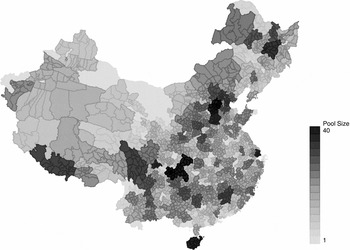
The intensity of interjurisdiction political competition is inherently difficult to observe and quantify in authoritarian settings; nonetheless, we contend that in a polity where power is allocated by appointment instead of election in a multilevel hierarchy of government, the spatially heterogeneous organization of the administrative jurisdictions directly influences the expected probability of promotion of local officials to the next level of the bureaucratic ladder. This conceptualization allows us to capture the variation in the intensity of subnational political competition through the legacy of administrative districting in China, which has resulted in a highly heterogeneous administrative structure: Whereas some prefecture-level governments control only a handful of county-level jurisdictions, others manage as many as 40 units.
In China, the supply of leadership positions is largely fixed because the set of party and government institutions in prefectures is mandated by central authorities through a quota system (bianzhi) comparable to the nomenklatura of the former Soviet Union. Thus, the degree of political competition is primarily driven by the number of contenders for promotion, which depends on the number of county-level units controlled by a prefecture. We use this subnational variation in the number of county-level units across prefecture-level governments as an indicator of the intensity of political competition among local leaders and evaluate its impact on local fiscal revenues. This measure is empirically advantageous because it helps address the reverse causality problem in which fiscal extraction affects local officials’ expected promotion probability.
We provide empirical support to our argument by using a dataset on local government fiscal revenues that covers all Chinese county-level units from 1999 to 2006. We find strong evidence for an inverse U-shaped relationship between the intensity of interjurisdiction political competition and fiscal extraction, both in terms of the level and the degree of fiscal extraction. The marginal effect is positive at first but decreases as the number of county-level jurisdictions increases, and eventually it becomes negative. We further show that this inverse U-shaped pattern is identified only in ordinary provinces, but does not hold in regions where ethnic tensions undermine political stability. Hence, the logic of interjurisdiction political competition on fiscal revenues operates best in politically stable regions.
We provide several robustness checks by conditioning on heterogeneous county endowment for tax potential as well as other factors, such as the consequences of the 1994 fiscal reform and local economic structure. Our estimates of the intensity of political competition remain robust. We also adopt spatial analysis to account for the interdependence of fiscal extraction resulting from peer pressure and emulation, and we find consistent evidence.
Understanding the logic of fiscal extraction is important to the study of fiscal capacity and political development in autocracies. Regime survival hinges on overall economic performance in part because the state needs to raise sufficient fiscal resources to maintain regime support, because both repression and redistribution are costly. Scholars have long sought to understand the roles of windfall revenues (i.e., natural resources) on regime dynamics in the Middle East, Latin America, and Africa.Footnote 6 In the absence of windfall revenues, it is crucial for elites to design incentives to motivate local agents to collect fiscal revenue. Promotion can be used as the incentive in this context. We show that there is a delicate balance between too much or too little competition for promotion, because it generates different incentives to tax among local agents.
This work also contributes to studies of central–local relations in China. The extent to which economic performance vis-à-vis personal relations contributes to leadership promotion in China is still subject to debate (Jia, Kudamatsu, and Seim Reference Jia, Kudamatsu and Seim2013; Kung and Chen Reference Kung and Chen2013; Li and Zhou Reference Li and Zhou2005; Shih, Adolph, and Liu Reference Shih, Adolph and Liu2012). However, scholars agree that political appointments are an important mechanism by which upper level governments can control local policy implementation (Edin Reference Edin2003; Huang Reference Huang1996; Landry Reference Landry2008; Xu Reference Xu2011). Contributing to this literature, we suggest that competence is an important criterion in cadre promotion despite the influence of political connection. Previous studies that have found mixed evidence regarding the role of economic performance may be impaired by their reliance on GDP as the measure of competence, whereas local governments focus more on competing over fiscal extraction.Footnote 7
Finally, our study contributes to the understanding of local governments’ responsiveness to fiscal policy. Existing research has largely emphasized the ways through which China's various built-in mechanisms in fiscal institutions shape local government behavior regarding economic development and taxation.Footnote 8 Numerous scholars stress the fiscal constraints that many local governments face as a result of the 1994 fiscal reform.Footnote 9 Our article makes an important departure from this literature. Although we control for various features of the fiscal system, we focus instead on the political institution that shapes competition among local officials and evaluate how variation in competition affects taxation across China.
Proceeding from here, we first briefly describe the taxation system in China since 1994 to place our argument in the institutional context in which local officials operate. We then present our theoretical framework and discuss the operationalization of interjurisdiction political competition in China. We corroborate our arguments by offering empirical evidence from various analyses, including spatial analysis that takes into account the spatial interdependence of local government behavior.
THE TAXATION SYSTEM IN CHINA SINCE 1994
The Chinese central government adopted several fiscal arrangements with provinces and local governments after 1949.Footnote 10 The current system is based on the tax-sharing scheme (TSS) introduced in 1994 as a package of fiscal reforms that sought to recentralize fiscal revenues, as well as improve regional revenue mobilization and equalization and bring about tax simplification. Through this fiscal reform, the central government eliminated much of the prior transaction costs of constantly bargaining with different provinces over tax revenue sharing and enhanced its own fiscal capacity (Oksenberg and Tong Reference Oksenberg and Tong1991; Wang Reference Wang1997; Wong and Bird Reference Wong, Bird and Brandt2008). Nonetheless, the TSS has also generated adverse consequences for local public finance, particularly in the form of a serious fiscal imbalance at subnational levels (e.g., Bernstein and Lü Reference Bernstein and Lü2003; Dabla-Norris Reference Dabla-Norris2005; Oi et al. Reference Oi, Singer Babiarz, Zhang, Luo and Rozelle2012; Park et al. Reference Park, Rozelle, Wong and Ren1996; World Bank 2002).
Key to this reform is the tax-sharing system between the center and the localities.Footnote 11 Specifically, the TSS stipulated that the central government retains 100% of the tax revenue from sources such as tariffs, consumption tax, and state-owned enterprises controlled by the central government. Meanwhile, local governments retain 100% of revenue from sources such as business tax, personal income tax, agricultural taxes, and state-owned enterprises controlled by local governments. Finally, the central and local governments share tax revenues from several sources such as VAT, the stock exchange transaction tax, and natural resources taxes.Footnote 12
To facilitate tax collection under the TSS, tax bureaus were divided into two distinct entities: a National Tax Bureau (Guojia Shuiwu Ju) and a Local Tax Bureau (Difang Shuiwu Ju). The national bureau deploys local officers to collect revenues earmarked for the central government, whereas local bureaus collect only the taxes specifically designated for local governments. For shared taxes, the offices of the national bureau first collect them and then return the local shares to local governments. Notably the personnel appointments of county tax bureaus are controlled by the tax bureau at the provincial level—not by county governments—as is the case for most local government agencies. This so-called vertical administration seeks to avoid collusion and data manipulation by county governments.Footnote 13
Although tax rates are set by the central government and local governments do not directly control personnel appointments at the local tax offices, local officials can still influence effective tax rates.Footnote 14 First, local governments compete with one another to register businesses and thus generate stable tax revenues. They also provide various benefits to local tax offices to persuade them to exert greater effort in collecting taxes.Footnote 15 Finally, local government officials sometimes work alongside local tax officers to visit local businesses for tax collection.
Data on fiscal revenues are difficult to manipulate in this context.Footnote 16 Because shared taxes are directly collected by national tax bureaus, local governments cannot easily pressure the chiefs of local offices to inflate reported taxes artificially because these revenues are ultimately remitted to upper level governments. Furthermore, the vertical administration of tax bureaus implies that county governments cannot easily intervene in the operation of local tax offices by making personnel changes. Despite the risk of collusion between local governments and tax officials, county governments are more likely to focus on collecting more tax revenues than on manipulating the numbers.Footnote 17
POLITICAL COMPETITION AND TAXATION IN NONDEMOCRATIC REGIMES
At the risk of oversimplifying the complexity of the Chinese promotion and fiscal systems, we first present a stylistic model of subnational political competition and fiscal extraction in nondemocratic regimes. We then situate China in our theoretical framework and offer justifications that our theoretical model approximates the working of fiscal and promotion systems in China.
The Logic of Interjurisdiction Political Competition and Fiscal Extraction
Our theoretical framework builds on insights from the theory of multiregional governance form (M-form)Footnote 18 and theories of promotion as incentives in organizational studies and labor economics.Footnote 19 We begin with the principal–agent framework. In nondemocracies, the principals are upper level government officials, who are empowered to appoint or remove local officials, and the agents are local officials.
The political survival of principals requires selecting not only loyal agents but also competent ones, who are in turn rewarded with promotion if they perform well. We assume that the number of agents (n) is greater than the number of promotions (k) even if all these agents are competent. We thus conceptualize the political competition among agents as a tournament for promotion in which only k promotions are available to n contestants (k < n). Because competence and loyalty are hard to observe in practice, principals often look for observable and tangible indicators.
For local officials, tax collection constitutes a clear and tangible signal of competence because fiscal revenue serves two purposes. First, higher fiscal revenue is a credible signal of one's ability to promote economic growth and extract fiscal resources. This is particularly important when other indicators of local economic performance (e.g., GDP) are noisy and unreliable. Fiscal revenue, by contrast, is more credible, especially when shares of the revenue are remitted to upper level governments because of the intergovernmental fiscal arrangements. Second, higher fiscal revenue allows local governments to enhance their own capacity to finance public expenditures. In addition to using fiscal revenue to signal competence in taxation to their principals, local officials can use the fiscal revenue to show competence by financing public projects in easily visible areas.
The principal motivates agents to exert effort through granting promotions. Similar to models of promotion as incentives, we specify that local officials maximize the expected reward from promotion minus the disutility of effort. We further assume that the size of the reward is identical across agents; thus local officials’ efforts in fiscal extraction depend on the probability of promotion. Although individuals’ propensity to be promoted differs, the intensity of political competition is shaped by the structure of the promotion contest, which is determined by the number of contestants (n) and the number of promotions (k). That is, the expected probability of promotion is E(P) = k/n.
We assume that fiscal revenue is a function of local officials’ effort, local economic endowments, and luck, where local economic endowments and luck have systematic distributions with means of 0. Promotion probability is a function of a local official's fiscal revenue, the revenue of his or her competitors, and political connections. We acknowledge the role of political connections in promotion and that the degree of an official's political connections is relative to each other. Hence, we assume that political connections have a symmetric distribution with a mean of 0. In other words, we standardize local officials’ political connections in our model.
We first analyzed cases when E(P) = 0 or E(P) = 1 where the intensity of political competition for promotion is exceedingly high or low. We contend that local officials are unlikely to exert effort if they expect to be promoted for certain or otherwise, because promotion does not depend on fiscal revenue in both cases. Once the expectation of promotion deviates from these two extreme cases, officials start to exert greater efforts monotonically. At some point along the continuum of expected promotion rate, officials exert the greatest effort in fiscal extraction at P*, where effort yields the highest marginal return at this expected promotion probability. When the actual expected promotion rate exceeds P*, officials exert less effort, both because of rising marginal costs of greater taxation and the belief that only intangibles (e.g., bad luck and poor political connections) stand in the way of a better job, given a higher probability of promotion. Conversely, when the expected promotion rate is smaller than P*, officials also exert less effort because costly efforts have much lower marginal returns and intangibles (e.g., good luck and political connections) loom larger for a potential promotion. If the number of promotions (k) is fixed, then the number of contestants (n) solely determines the expected promotion rate. Thus, we should observe an inverse U-shaped relationship between fiscal extraction and the number of contestants.
Underlying the foregoing model is the assumption that officials are from localities with relatively homogeneous local economic endowments for taxation potential. Cai and Treisman (Reference Cai and Treisman2005) argue that heterogeneity in regional endowment reduces the intensity of competition for mobile capital. Similarly, heterogeneous local endowments could reduce fiscal extraction because officials in disadvantaged localities might exert less effort, knowing that they cannot outperform better endowed ones. Nonetheless, the heterogeneity shifts only the distribution of efforts in fiscal extraction, but the inverse U-shaped relationship remains intact. The intuition is that, if the expected promotion rate is P*, a heterogeneous endowment suggests that the official in a county whose endowment is exactly at the 1 − P* percentile of endowment will exert the greatest effort in fiscal extraction because his or her effort makes the greatest difference in being promoted or not. The officials in localities whose endowments are further away from either side of the 1 − P* pcentile will exert less effort because officials in more (less) endowed counties have higher (lower) promotion probabilities, following the same logic in the homogeneous case.
Notably, local politicians’ disincentives in fiscal extraction come not only from costly efforts but also the risk of social upheaval due to over-taxation. The fear of instability has two implications for local taxation. First, when the risk of political instability is high and well understood by risk-averse officials, the incentive of fiscal extraction is low because principals value maintaining order over fiscal revenues. Second, even ambitious officials must be careful not to outdo their competitors (whose behaviors are revealed only ex post) by increasing taxation so much as to trigger protests or riots. Hence, rising intensity in political competition results in greater tax revenues, but only up to a point.
Interjurisdiction Political Competition and Local Taxation in China
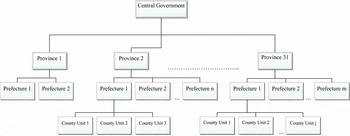
In this section, we contextualize the theoretical framework with interjurisdiction political competition and fiscal extraction in China. The Chinese state is well suited to evaluate the ways through which a multilevel government system creates institutional constraints that influence political behavior. The formal structure of Chinese local government is highly heterogeneous, and thus the structure of political competition varies spatially. The largest authoritarian polity in the world incorporates nearly one million villages and neighborhoods nested in townships (~50,000), counties/districts (~2500), municipalities/prefectures (~330), and provinces (31) under the central government. Figure 2 illustrates the hierarchy of multilevel governments in China.Footnote 20 This hierarchy is also quite heterogeneous in ways that reflect the historical experience of the former Chinese dynasties, as well as the policy priorities of subsequent regimes that have adjusted jurisdictional boundaries and the size of local governments.
The Hierarchy of the Chinese Multilevel Government System

We focused on county-level jurisdictions because this level of government under a prefecture (or municipality) varies widely across space, allowing us to explore the spatial variation in competition.Footnote 21 We conceptualized the number of county-level jurisdictions in a prefecture as the proxy for the intensity of interjurisdiction political competition. For the time period under investigation (1999–2006), it ranged from 1 to 40 with a mean of 10.65 (standard deviation: 5.50). Figure 3 maps this indicator in 2005.Footnote 22
County-Level Interjurisdiction Political Competition in China (2005)

The promotion and fiscal systems in China are inherently complex, and we argue that our theoretical model applies in China if the following two key assumptions are satisfied: (1) promotion incentivizes local officials to collect fiscal revenues, and (2) the number of county-level jurisdictions in a prefecture affects the expected probability of promotion of county leaders.
We contend that local officials are always incentivized to engage in activities that enhance their promotion probability while serving in their current positions, regardless of actual career outcomes (e.g., promotions, transfers, etc.). Even among officials approaching retirement, most seek to at least accomplish the tasks assigned by the upper level governments in order to obtain a better semi-retirement post after leaving office (Manion Reference Manion1993). The implication is that the actual outcomes resulting from the promotion system do not necessarily undercut local officials’ incentives to exert effort. As suggested in our theoretical model, it is the expected promotion probability that drives officials’ effort.
Does the possibility of promotion provide incentives for local officials to exert effort in fiscal extraction? Previous studies have indeed shown that fiscal revenues are “hard targets” and that they play an important role in the political careers of local officials (e.g., Bo Reference Bo2002; Edin Reference Edin2003; Guo Reference Guo2007; Shih, Adolph, and Liu Reference Shih, Adolph and Liu2012; Tsui and Wang Reference Tsui and Wang2004). Kennedy (Reference Kennedy, Perry and Goldman2007) claims that “township cadres are responsible for the fulfillment of hard target—especially taxes and birth control.” As Ong (Reference Ong2012) puts it, “the Chinese Communist Party's cadre-evaluation and dual accountability systems make it an imperative for local officials to augment fiscal revenue.” Our fieldwork research also reveals that county governments often aim to exceed tax collection quotas set by the prefecture government, because only outperforming the benchmark allows them to stand out in a crowed pool of contestants. In short, fiscal revenue is a necessary but not sufficient condition for promotion. However, the necessary condition itself induces local officials to exert effort in fiscal extraction.
One could argue that local officials’ effort in fiscal extraction may vary across time and space because of heterogeneous local cadre evaluation criteria and length of tenure. However, fiscal extraction is one of the most important policy targets in evaluating the performance of local officials, even though it may not always be the top policy target. For example, Liu et al. (Reference Liu, Xu, Su and Tao2012), in a panel dataset of county and township governments in six provinces between 2000 and 2007, show that tax revenue collection is always one of the top five policy targets in the cadre evaluation criteria reported by local officials. Similarly, Zhong (Reference Zhong2003) details how annual performance contracts tie the careers of officials to their performance. Furthermore, although local officials have a theoretical five-year term, they rarely finished their first term during the time period of our investigation.Footnote 23 High turnover suggests that local officials cannot know when they will be promoted or transferred ex ante, making it difficult to calibrate efforts in fiscal extraction at different points of their tenure. As a result, they must continually demonstrate competence, and fiscal extraction is such an important task that officials cannot overlook it at any point during their tenure.
A second important assumption is that the number of county-level jurisdictions in a prefecture affects county officials’ expected probability of promotion. County-level officials usually belong to the same pool of contestants within a municipality/prefecture because cadre evaluations are administered by the same organization or department in the corresponding prefecture (Landry Reference Landry2008). Regardless of population size or economic importance, every municipality has a very similar number of high-ranking government positions at the prefecture level. Hence, the variation in the number of competitors whom county officials face is primarily driven by the number of counties within a prefecture. Even if county officials are promoted elsewhere, they still need to demonstrate competence; their performance is compared with their current counterparts—officials in other counties within the same prefecture.Footnote 24
Note that an important scope condition of our argument is that tax collection is costly and that local officials fear political instability. The fear of local instability is deeply rooted among Chinese politicians because a sanctioning regime has been institutionalized since the 1990s. If mass incidents occur under their watch, they face demotion or dismissal regardless of their performance in other domains (Chen Reference Chen2012; Liu et al. Reference Liu, Xu, Su and Tao2012; O’Brien and Li Reference O’Brien and Li2006). This type of accountability breeds very high degrees of risk aversion among officials posted in regions perceived to be politically and socially volatile (Edin Reference Edin2003). If local political stability is of major concern to the national leadership, local politicians are first and foremost required to maintain order and prevent riots, demonstrations, and “collective incidents.” In regions where the fear of political instability clearly outweighs concerns over fiscal extraction (such as Tibet, Xinjiang, and Ningxia, where ethnic strife is recurrent), the promotion tournament focuses on securing political stability instead of fiscal extraction.
EMPIRICAL STRATEGY
We now provide empirical evidence for our main argument that the intensity of political competition has an inverse U-shaped relationship with fiscal extraction. We first discuss the data sources before outlining the identification strategy of the data analysis. We then present the main results and evaluate them via several robustness checks.
Data
Most variables in our panel dataset come from the National Prefecture and County Finance Statistics Compendium (Quanguo Di Shi Xian Caizheng Tongji Ziliao) from 1999 and 2006, which has comprehensive coverage of government budgetary revenues and expenditures for all county-level jurisdictions.Footnote 25 These data are especially appropriate to our main hypotheses because they contain very detailed information on budgetary revenues at the county level.Footnote 26
Our primary measure of local fiscal extraction is the sum of all local taxes and fees plus the shared tax revenues remitted to upper level government. We label this variable all tax 1. We are aware that this measure does not reflect extra-budgetary revenues (EBR) collected by local governments, which usually include fees and subtaxes. Although EBR is an important source of income for local governments since the 1994 fiscal reform (Zhan Reference Zhan2013), it is normally unreported in released government budgets. Furthermore, upper level governments often have little information about local EBRs and related expenditures. Thus, EBRs cannot be used as a signaling mechanism to upper level government, and omitting them in our dependent variable has little impact on the estimate of our key independent variable. In our dataset, additional government revenues, probably some forms of the EBRs, were listed after the year 2000 as government fund revenues, consisting of fees and subtaxes collected by various local bureaus. Hence, we generate a second measure of local tax extraction by adding this new source to our first measure all tax 1, and we label it all tax 2. Using either measure, we detect significant variation in fiscal extraction both within and across provinces. Table A1 in the Online Appendix reports the means and standard deviations of the level (per capita) and degree (as percentage of GDP) of fiscal extraction by county-level jurisdictions in each province between 1999 and 2006.
Identification Strategy
Although using the county as the unit of analysis is natural, we started with the prefecture as our unit of analysis. We termed our measure of interjurisdiction political competition pool size, because the number of counties/districts approximates the size of the contestant pool in a prefecture.Footnote 27 Because all county-level governments in any given prefecture are exposed to the same treatment of pool size at any given time, the average fiscal revenue by county-level government should be correlated with the pool size in the prefecture; therefore, little is lost by aggregating to the prefecture level. We used equation (1) to estimate the nonlinear effects of interjurisdiction political competition at the prefecture levelFootnote 28 :
 \begin{eqnarray}
\overline {y_{kpt} } &=& \gamma _1 PoolSize_{kpt} + \gamma _2 PoolSize_{kpt}^2 + \beta \overline {X_{kpt} } + \delta _p + \sigma _t\nonumber\\
&&+\, \theta \sum ( \delta _p \times \sigma _t ) + \overline {\varepsilon _{kpt} }\end{eqnarray}
where overbars denote county averages for prefecture k in province p at year t and
 $\overline {y_{kpt} } $
is the average county fiscal revenue (all tax 1). Our primary measure was log tax per capita, which captures the level of fiscal extraction. We also used tax as % of GDP as a secondary measure for the degree of fiscal extraction, which is commonly used when studying tax burden. This measure could help address the problem of data manipulation by local officials because those who manipulate the fiscal data are also likely to manipulate the GDP data, leaving the ratio closer to the actual degree of taxation in the locality. Our key independent variables were PoolSizekpt
and PoolSize
2
kpt
. Therefore, the key parameters of interest were γ1 and γ2, which capture the inverse U-shaped relationship between pool size and local fiscal revenue. We used clustered standard errors at the prefecture level to account for serial correlation of our dependent variable across time.
 $\overline {X_{kpt} } $
is a vector of variables controlling for local conditions. In our baseline specification, we used log(population) to control for demographic size. Meanwhile, one may argue that the number of counties/districts within a prefecture is a function of the area size of the prefecture. Hence, we included log(area size) in our specification. The level of local fiscal extraction is also a function of the scarcity of local human capital, and we measured it as the percentage of rural residents in the population (% of rural population). We used log(GDP) as a proxy for the level of local economic development. Finally, we included both provincial dummies and year dummies to control for unobserved factors across provinces and time. On one hand, the fiscal arrangement designed by the TSS is more clearly defined between the central and provincial governments than at the subprovincial levels of government. Thus, the provincial dummy variables captured the unobserved heterogeneity across provinces in the below-province fiscal arrangements.Footnote
29
Time dummies, on the other hand, helped us control for economic shocks and fiscal arrangement changes in any given year, such as the state-owned enterprises tax revenue sharing in 2002 and the abolition of agricultural taxes and fees in 2006. We also included the interaction terms between provincial and time dummies to control for the unobserved time and province covarying characteristics. For example, county governments may face different cadre evaluation criteria set by the provincial governments across time and space, or some provinces may introduce new fiscal and government policies that shape local governments’ effort in fiscal extraction.
In our extended specification, we considered several potential omitted variables that account for local conditions. On one hand, politicians from minority counties and prefectures may be disadvantaged in the promotion process;Footnote 30 hence they may or may not want to exert more effort in local fiscal extraction to prove their competence. On the other hand, maintaining local stability is a high-priority task in areas with large minority populations; thus, signaling competence in maintaining stability may undermine fiscal extraction. We included two variables indicating the minority prefecture/county status. These two variables were coded 1 when the prefectures or counties are formally minority autonomous units (zizhi), and 0 otherwise.
Second, because Chinese GDP data are fraught with measurement error (Holz 2004), we relied on an alternative measure of development that is entirely independent of the data produced by the Chinese statistical system. The DMSP-OLS Nighttime Lights Time SeriesFootnote 31 makes available satellite images that capture stable electrical refraction of the earth at night on a scale of 0 to 63. These data have been shown to correlate with economic growth (Henderson, Storeygard, and Weil Reference Henderson, Storeygard and Weil2012); thus we used Log(Brightness per capita) as another indicator of local economic performance that is not captured by the Chinese GDP data.
Main Empirical Results
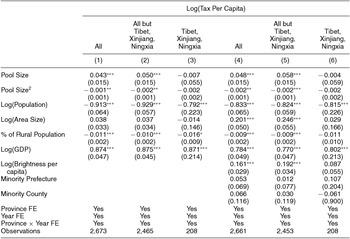
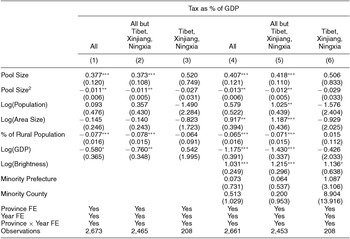
Table 1 reports the results based on the specification of equation (1). First, we find strong evidence of an inverse U-shaped relationship between pool size and the level of fiscal extraction in our baseline model (Column 1). The estimate of pool size is positive and the estimate of pool size2 is negative; both are statistically significant at the 0.01 level.Footnote 32 The marginal effect diminishes as pool size increases, and it becomes negative when the number of county-level jurisdictions in a prefecture reaches around 14.
The Level of Fiscal Revenue Extraction (Prefecture)

Note: Clustered standard errors at the prefecture level are reported in the parentheses. We did not report the coefficient estimates of the constant as well as provincial and yearly dummies. *p<0.1, **p<0.05, ***p<0.01.
Next, we disaggregated our data to evaluate our argument that the logic of signaling competence is different between politically stable and unstable regions. Columns 2 and 3 in Table 1 suggest that this correlation in the pool sample is driven by observations in ordinary provinces but not in autonomous regions that face challenges in maintaining local stability.Footnote 33 The coefficient estimates for the model with all the county-level jurisdictions except Xinjiang, Tibet, and Ningxia are similar in magnitude to the baseline model, and they are statistically significant. The coefficient estimates of pool size and pool size2 in the model restricted to observations of Tibet, Xinjiang, and Ningxia do not have the expected signs and are not statistically significant. These results indicate that politicians do not signal competence through fiscal extraction in these autonomous regions that are confronting challenges in political stability. Hence, we find consistent evidence for our argument that maintaining political stability but not fiscal extraction is an important task in these politically unstable regions.
The results of the extended model specification (Columns 4–6) with additional control variables tell a similar story. The estimation results suggest a robust nonlinear relationship between pool size and the level of fiscal extraction, and they remain consistent with the baseline model because coefficient estimates are similar in magnitude and statistically significant. Once again, the nonlinear correlation is identified only among observations in provinces excluding Tibet, Xinjiang, and Ningxia.
Next, we evaluated the effect of political competition on the degree of fiscal extraction. We measured the degree of extraction by calculating fiscal revenue as percent of GDP. We used the same model specification—equation (1)—and Table 2 reports the estimation results. Again, we find consistent evidence of an inverse U-shaped relationship between pool size and the degree of fiscal extraction (Columns 1 and 4). Yet again, this result holds only in provinces excluding Tibet, Xinjiang, and Ningxia (Columns 2, 3 5, and 6).
The Degree of Fiscal Revenue Extraction (Prefecture)

Note: Clustered standard errors at the prefecture level are reported in the parentheses. We did not report the coefficient estimates of the constant as well as provincial and yearly dummies. *p<0.1, **p<0.05, ***p<0.01.
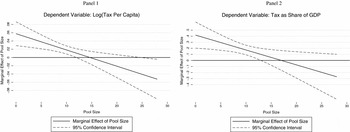
We simulated the marginal effect of pool size based on models in column 4 in both Tables 1 and 2: Figure 4 shows a clear pattern of diminishing marginal return of pool size on the level and degree of fiscal extraction in ordinary provinces.
Marginal Effect of Pool Size on County Fiscal Extraction

Addressing Competing Explanations and Concerns
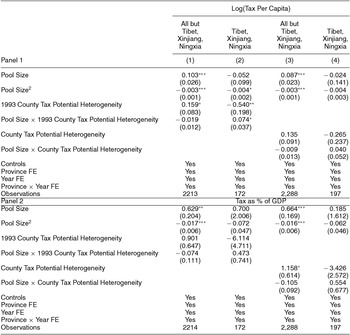
Scholars have noted the variation in subnational fiscal extraction; thus we must account for a number of competing explanations. First, previous theories suggest that heterogeneity in the local endowment for tax potential shapes local officials’ efforts in fiscal extraction. Although the assumption underlying our theoretical framework is that the tournament is within the prefecture where counties are geographically close and similar, difference in local endowments may still generate different tax potentials. To account for the heterogeneity of county tax potential, we followed Cai and Treisman (Reference Cai and Treisman2005) and constructed an index of initial endowments in 1993 for each county.Footnote 34 In our model, we included the standard deviation of 1993 endowments for counties within the prefecture as the measure of heterogeneity of the initial endowment, and its interaction with pool size.
Table 3 reports the results. We show that the inverse U-shaped relationship between pool size and fiscal revenues remains intact for observations in ordinary provinces because the estimates for pool size and its squared term have consistent signs and are statistically significant (Column 1). Again, we find no statistical relationship between pool size and fiscal extraction in Tibet, Xinjiang, and Ningxia (Column 2). One caveat of the measure of 1993 endowment is that some Chinese counties have gone through redistricting since the mid-1990s; thus a county's “competitor” in 1993 could be different by 2003 because this county may now be under the purview of a nearby prefecture. As a result, heterogeneity in endowments that a county faces in 1993 could be inconsistent with the heterogeneity in endowments this county faces in later years. To address this limitation, we substituted the current year's heterogeneity for the 1993 measure. Our main results remain consistent (Columns 3–4).
Robustness Check with County Heterogeneity (Prefecture)

Note: Clustered standard errors at the prefecture level are reported in the parentheses. We did not report the coefficient estimates of the constant as well as provincial and yearly dummies. We also did not report the coefficient estimates for control variables, which include Log(Population), Log(Area Size), % of Rural Population, Log(GDP), Minority Prefecture Status, Minority County Status, Log(Brightness per capita). *p<0.1, **p<0.05, ***p<0.01.
Note that contrary to Cai and Treisman (Reference Cai and Treisman2005), we find little evidence for the conditional effect of heterogeneous county endowment on pool size. The lack of statistical significance could result from the measurement error of heterogeneity. Alternatively, our interpretation is that county governments receive tax quotas from upper level governments and seek to outperform these benchmarks. Given that different counties receive different quotas based on their economic development, counties are effectively homogeneous.
A second concern is that the 1994 TSS reform, instead of interjurisdiction competition, is the main mechanism shaping local officials’ incentives for fiscal extraction because the TSS dramatically shifted the fiscal burden to the localities, leaving local governments with little choice but to raise taxes and fees to meet unfunded spending mandates. The subnational variation in fiscal extraction could be driven by variation in the tinkering with the tax system by provincial or prefecture governments. For example, local officials’ effort in fiscal extraction could be driven by the fiscal revenues quota set by the prefecture government instead of by the promotion tournament. Additionally, the provincial or prefecture government may provide fiscal transfers to incentivize local governments in fiscal transfers.
Although subnational variation in the built-in mechanisms of local tax systems could have a substantial impact on local fiscal extraction, these factors are independent of the number of counties in the prefecture; omitting these variables, which are often unobserved, does not bias our estimates of pool size. Empirically, we evaluated several alternative mechanisms of fiscal institutions through two additional sets of analyses: (1) different dependent variables and (2) different model specifications.
Our first alternative dependent variable was all tax 2. This measure was only available for 2000−06, but it included some extra-budgetary revenues (EBRs). We reanalyzed the data using the model specification as equation (1). Panel 1 in Table A2 in the Online Appendix shows that the coefficient estimates of our key independent variables, pool size and pool size2, are consistent with the main results when we use this alternative dependent variable. The marginal effects are slightly larger in magnitude and are statistically significant for ordinary provinces. Again, we do not find any evidence for the models that analyze observations in Xinjiang, Tibet, and Ningxia.
We created a second set of dependent variables by dividing the primary dependent variable, all tax 1, into two categories: (1) tax revenues shared with upper level governments and (2) tax revenues that belong entirely to county governments. If county governments’ effort in fiscal extraction is primarily devoted to their own tax revenues but not to shared tax revenues, it indicates that the incentives for tax collection are for financing local spending instead of signaling competence to upper level governments. Panels 2 and 3 in Table A2 report the results, showing that estimates of our key independent variables, pool size and pool size2, remain statistically significant for both models, especially in the models where shared tax revenues are the dependent variables.
Next, we explored different model specifications by including three potential omitted variables that shape local government's taxation behaviors as a result of TSS. Table A3 in the Online Appendix reports the results. First, the fiscal extraction effort by county-level governments could be a function of explicit fiscal demands made by their corresponding prefecture government. Specifically, if the prefecture government requires more fiscal revenues from district/county governments by setting a higher fiscal revenue quota, and then rewards those who comply with it, all the counties/districts should respond to this demand. To measure fiscal demand from prefecture governments, we included a variable that measures the revenues collected only by prefecture governments themselves but not by counties within the same prefecture. The results based on this alternative model remain consistent in that we find evidence for ordinary province observations but not in Tibet, Xinjiang, and Ningxia (Table A3, columns 1–2). In addition, prefecture governments’ own fiscal revenues have a positive correlation with fiscal extraction, contradicting the hypothesis that prefecture governments’ own fiscal needs lead to greater fiscal extraction at the local level.
Second, receiving fiscal transfers may influence local governments’ effort in tax collection. In some cases, transfers reduce county governments’ effort in fiscal extraction because of the substitution effect. In other cases, provincial governments may use matching funds through transfers to incentivize county governments to collect more fiscal revenues. To evaluate this claim, we included a variable measuring the transfers received by counties and found that they have little impact on the estimate of our key independent variables. As expected, this variable has a positive correlation with county-level fiscal extraction in ordinary provinces but a negative one in Xinjiang, Tibet, and Ningxia (Table A3, columns 3–4), and both are statistically significant. The positive correlation between transfers and fiscal extraction in ordinary provinces provides supporting evidence that provincial governments offer small fiscal incentives for local governments to collect taxes. Notably the estimates of pool size, our main independent variable measuring the intensity of political competition, remain consistent with the main results.
Third, county economic structure is another important factor in the level of fiscal extraction after implementation of the TSS. In particular, more industrialized regions have greater potentials for fiscal extraction than more agricultural regions. We controlled for the shares of GDP from agricultural production and from industrial production in our models. Note that our data only have consistent measures of these two variables since 2001, restricting our analysis to 2001−06. As shown in Table A3 (Columns 5–6), our main results remain consistent after controlling for local economic structure.
Finally, some scholars argue that factional politics and political connections are key determinants of local governments’ behavior, rather than the signaling of competence through fiscal revenues (Cai and Treisman Reference Cai and Treisman2006; Nathan Reference Nathan1973; Shih, Adolph, and Liu Reference Shih, Adolph and Liu2012). If local officials align with factions that are formed in the upper echelon of the Communist Party, the relationship between formal structures of authority and observable outcomes should be weak. Unfortunately, factions in local politics are largely unobservable. Our claim is that our estimates of interjurisdiction political competition are biased downward when we fail to account for the unobserved factional politics because the unobserved factional ties are likely positively correlated with the size of the pool (a greater number of competitors implies more factions) and negatively correlated with taxation (factional loyalty reduces the pressure to demonstrate competence through revenues collection). Controlling for factional politics would only strengthen our estimate of pool size. Alternatively, officials with good political connections could be assigned to wealthier counties. Promotion would thus depend on political connections instead of fiscal revenues. In unreported analysis, we replicated all the results by using the median county fiscal revenues and characteristics instead of the averages, because medians are unlikely to be influenced by assignments of those officials who have great (poor) political connections in very wealthy (poor) counties. We still identified consistent evidence for the inverse U-shaped relationship in the data by using the median measures.
INTERJURISDICTION COMPETITION AND SPATIAL INTERDEPENDENCE
To this point, the empirical results support our argument that interjurisdiction political competition among county-level governments has an inverse U-shaped relationship with fiscal extraction. In the prefecture-level analysis, however, the dynamics of interdependence among county-level governments may be overlooked. One alternative mechanism could be peer pressure instead of the intensity of interjurisdiction competition. To address this concern, we employed a spatial model to analyze county-level observations. We first discuss the theoretical underpinning of the empirical model specification and then present the analytical results based on county-level data.
The key motivation behind a spatial model is that the outcome variable is interdependent among spatial units because of factors such as peer pressure or emulation.Footnote 35 Neglecting this relationship may introduce omitted variable bias in the analysis, particularly if a variable serves as a common shock to all the spatial units (Franzese and Hays Reference Franzese and Hays2007). In the context of fiscal extraction in China, the level of a county's tax collection is likely to be correlated with that of the other counties within the prefecture. If one county exerts more effort in tax collection, other counties are under peer pressure to increase their own tax collection. Because our key independent variable—the number of counties/districts under a prefecture—is fixed for all county units under the same prefecture, the estimate of this variable could be susceptible to the omitted variable bias if we failed to account for spatial interdependence when analyzing county-unit observations.
To properly take into account this dynamic when analyzing county-level observations, we adopted the spatial 2SLS model discussed in Franzese and Hays (Reference Franzese and Hays2007). This model specification provides consistent estimates of a spatial lag parameter. The model specification is as follows:
 \begin{eqnarray}
&& \hspace*{-1.5pc}y_{ikpt} = \rho Wy_{ - ikpt} + \gamma _1 PoolSize_{ikpt} + \gamma _2 PoolSize_{ikpt}^2 \nonumber\\
&&\quad + \,
\beta X_{{\it ikpt}} + \delta _p + \sigma _t + \theta \sum \delta _p \times \sigma _t + \varepsilon _{ikpt}
\end{eqnarray}
 \begin{eqnarray}
Wy_{ - ikpt} &=& \tau _1 WPoolSize_{ikpt} + \tau _2 WPoolSize_{ikpt}^2 \nonumber\\
&& +\, \alpha WX_{ - ikpt} + \vartheta _{ - ikpt}\end{eqnarray}
where yikpt is the dependent variable for county i in prefecture k of province p at year t. Because we are modeling political competition among county-level jurisdictions under the same prefecture k, the only relevant spatial units for county i are the remaining county-level jurisdictions under prefecture k. Hence Wy −ikpt is the spatial lag, which is calculated as the weighted average of y −ikpt for all the other county-level jurisdictions –i within prefecture k. In the first stage, Wy −ikpt is instrumented by the spatially weighted values of the exogenous variables in the second stage. The exogenous variables, X −ikpt , are the same as equation (1), which controls for demographic and economic conditions. We use clustered standard errors at the county level to account for serial correlation of our dependent variable across time.
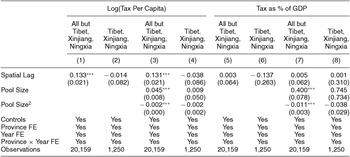
Table 4 reports the result based on equations 2.1 and 2.2. We first investigated spatial lags in models without including our measure of political competition to gauge the degree of interdependence. Results in columns 1–2 and 5–6 suggest that spatial interdependence exists only in the model with ordinary province observations and the level of fiscal extraction as the dependent variable. The coefficient estimate for the spatial lag is positive and statistically significant in column 1, suggesting a positive correlation between the level of tax collection by a county and that of its competitors within the same prefecture. This pattern does not change when we include our key independent variables of political competition in the model (Columns 3–4 and 7–8). This suggests that county-level jurisdictions use the level of fiscal revenues as the benchmark in their competition with their peers. They are not competing on the degree of fiscal extraction among themselves because it was the level of fiscal revenue, not the degree of fiscal extraction, that was reported to the upper level government.
Fiscal Revenue Extraction (County-level Spatial Analysis)

Note: Clustered standard errors at the county level are reported in the parentheses. We did not report the coefficient estimates of the constant as well as provincial and yearly dummies. We also did not report the coefficient estimates for control variables, which include Log(Population), Log(Area Size), % of Rural Population, Log(GDP), Minority Prefecture Status, Minority County Status, Log(Brightness per capita). *p<0.1, **p<0.05, ***p<0.01.
More importantly, the estimates of our key independent variables remain consistent with the prefecture-level analysis reported in Tables 1 and 2. First, we only observe strong evidence for the inverse U-shaped relationship between pool size and fiscal extraction in provinces except for Xinjiang, Tibet, and Ningxia (Columns 3 and 7). The coefficient estimates of our key independent variables are strikingly similar in magnitude when compared to the models at the prefecture-level in Tables 2 and 3, and they are statistically significant. Meanwhile, the estimates of pool size remain statistically insignificant when analyzing observations in Tibet, Xinjiang, and Ningxia (Columns 4 and 8).
In sum, we detect spatial interdependence for the level of fiscal extraction among county-level jurisdiction but not in the degree of fiscal extraction. In addition, pool size retains its inverse U-shaped relationship with both the level and degree of fiscal extraction for ordinary provinces but not in Tibet, Xinjiang, and Ningxia. These results show the existence of the inverse U-shaped relationship between interjurisdiction political competition and fiscal revenues, even controlling for peer pressure among county-level governments.
CONCLUSION
Using a novel measure to capture the intensity of interjurisdiction political competition, we find strong evidence that subnational political competition has a nonlinear effect on fiscal extraction among county-level governments in China. These results shed light on the recent debate about the reorientation of central–local fiscal and political institutional arrangements in China. Wang and Hu (Reference Wang and Hu2001) argue that the TSS reform initiated in 1994 has been successful because it strengthened central government fiscal capacity, tied the fate of local politicians to the fiscal goals of the regime through tax sharing, and generated additional revenue for the central and provincial governments. However, local leadership incentives can also lead to counterproductive outcomes—particularly in the form of excessive taxation—through two mechanisms. First, an overeagerness to signal loyalty and competence through fiscal extraction may force officials to tax beyond what the local population is willing to bear, resulting in tax revolts. From a historical perspective, the famine resulting from China's Great Leap Forward offers an example of the dire consequences of tying local officials’ careers too closely to performance in an authoritarian system (Kung and Chen Reference Kung and Chen2011). Second, the paucity of local fiscal resources to implement unfunded mandates forces officials to seek alternative sources of revenue, lawful or otherwise. Local governments’ collection of nontax revenues through various fees has always been an issue of social contention in China. Land grabs and hidden Chinese local debts are harbingers of the unintended consequences of excessive taxation and centralization of fiscal revenues.
These difficulties have been magnified by various initiatives to increase the decree of administrative centralization. In the late 1990s, the Chinese government debated shifting from prefecture–county government (shi guan xian) to a system of province–county government (sheng guan xian) and experimented with the new system in several regions. Embedding counties into much larger units produces unintended consequences, as suggested by the findings of this article, because it reshapes the intensity of subnational political competition among local officials.
Our results have important implications for the dynamics of authoritarian endurance. Regimes may consider using promotion to incentivize local governments to improve fiscal compliance. Our theory suggests that, ceteris paribus, there is an optimum level of competition, as shown by the nonlinear relationship between the degree of political competition and fiscal revenue. When the administrative system is centralized—in the sense that many local agents are accountable to the same principal—excessive fiscal extraction and lack of effort in fiscal extraction could coexist because more competitive politicians are likely to engage in too much fiscal extraction while less competitive politicians are likely to shirk. At the extreme ends of the spectrum, excessively decentralized regimes will fail to incentivize officials by making it too easy to obtain political promotions and thus produce insufficient revenue streams needed to meet the needs of the central authorities.
We are aware that some of the features of the Chinese regime are not applicable to all autocracies. One-party rule facilitates monitoring and promotions of local agents, something lacking in many autocracies. This may make officials more responsive to the center's needs than elsewhere, but regimes that lack this sort of supervisory authority may struggle to link local taxation with the promotion of local officials. Our main point, however, is that the way in which the multilevel structure of local governments is organized has a critical impact on the behavior of local agents in authoritarian regimes, in sharp contrast with democracies.
Supplementary materials
To view supplementary material for this article, please visit http://dx.doi.org/10.1017/S0003055414000252




Comments
No Comments have been published for this article.