This is a tale of two directors. The setting is the Republic of Cape Verde, a former Portuguese colony and a tiny archipelago nestled off the coast of Senegal in West Africa. Framing the story is Cape Verde's annual Mindelact International Theatre Festival, which since 1997 has invited Lusophone theatre artists from three continents to perform a wide array of theatre genres on a mainstage program alongside Cape Verdean troupes. João Branco, a Portuguese director who moved to the islands in the early 1990s, is the artistic director of both the Mindelact Festival and the veteran Cape Verdean theatre troupe GTCCPM (Grupo de Teatro do Centro Cultural Português do Mindelo/Theatre Group of the Mindelo Portuguese Cultural Center). For Mindelact 2003, GTCCPM performed an abridged version of King Lear rendered in Cape Verdean Crioulo, a mix of Portuguese and several West African languages.Footnote 1 Beyond bolstering Branco's cherished goal of creolizing Shakespeare's plays by transporting them to Cape Verde's Afro-European cultural milieu, Rei Lear worked in concert with the festival's media blitz to extol local spectators in Mindelact's host city, Mindelo, for their good taste. Two years later, Herlandson Duarte, a young Cape Verdean director and Branco's former theatre student, staged a Crioulo-language Midsummer Night's Dream at Mindelact with his new theatre company, Solaris. Duarte's production transformed Bottom's play-within-a-play into a searing critique of Mindelense audiences and the structures of authority that prop up the festival itself.
Much postcolonial theory on adaptations of Western plays dwells on the methods by which non-Western novelists, playwrights, and performers radically deconstruct the literary “classics” that dominated their country's colonial curricula.Footnote 2 In Cape Verde, however, Shakespeare's visibility on the contemporary theatre scene is due less to colonial education systems than to a burgeoning festival culture, which has showcased various Portuguese- and Crioulo-language Shakespeare adaptations since Mindelact was founded.Footnote 3 Herlandson Duarte, a staunch admirer of Shakespeare's plays, did not attempt to subvert, dismantle, or undermine the Western canon. His incisive reworking of Midsummer talks back not to Shakespeare or one easily pinpointed colonial center but to the mishmash of power centers encapsulated in an international theatre festival context. Crucially, these two Shakespeare adaptations prompted their respective directors to engage in a heated polemics that had a vibrant afterlife in Cape Verde's healthy blog culture and the local press. It also led to the Solaris theatre company's absence from the Mindelact 2006 program and then, in reaction to the ensuing consternation, its double bill at the 2007 festival.
Drawing on the two directors' divergent adaptation aesthetics and the prolonged debate that ensued, I argue that Cape Verdean Shakespeare adaptations are paradigmatic examples of how the realities of postcolonialism and globalization are now irrevocably intertwined and foregrounded on African stages. The adaptations were postcolonial in that they triggered an intergenerational cross-cultural debate that allowed a Portuguese and a Cape Verdean director to negotiate their own positions of power within the local theatre scene, confront each other's performance methods, and formulate decisive stances on the role of audience in the selection process at Mindelact. However, this postcolonial dialogue was made possible by an international festival venue, itself the quintessence of a globalized cultural economy that launches theatre into circulation and draws artists from disparate geographical spaces and socioeconomic contexts into close contact. Because Mindelact's focus is on theatre from the Portuguese-speaking world, it shores up an emerging “minor transnationalism,” Françoise Lionnet and Shu-mei Shih's term for networks of intercultural exchange among nation-states that operate on the margins of the global economic and political centers of power.Footnote 4 Lusophone minor transnationalism means that the postcolonial condition, the colonial legacy and residual linguistic web that binds together seven Lusophone countries on three continents, enables the globalized condition. This condition now unites on festival stages theatre artists from Portugal, Brazil, Cape Verde, Mozambique, Angola, Guinea-Bissau, and São Tomé, nations once distanced from each other by the abyss of Portuguese fascism (1932–74). On festival stages that privilege one linguistic identity, such as those that link the Lusophone theatre circuit,Footnote 5 the global–postcolonial dialectic facilitates a crucial intercultural conversation among artists struggling to voice their own subjectivity within this new social condition.
In making this argument, I work against the assumption that a theatre festival's potential to perform significant cultural work is limited by its finite temporal framework. While some important recent scholarship claims that the here-and-now meeting of performer and spectator is paramount in the festival process,Footnote 6 I place greater stock in the questions that linger after a festival production has entered the domain of public discourse.Footnote 7 Festivals, in fact, carry tremendous potential to sustain deeply embroiled cultural discussions over many years because of their regularity and the archive of productions and memories they generate within a particular community.
I also challenge a stream of scholarship that presumes that the Shakespeare “name brand” functions primarily to commodify non-Western theatre traditions and facilitate their export into global markets.Footnote 8 In this line of thinking, arts festivals, with their Midas-like tendency to commodify local performance traditions for voyeuristic spectators seeking a glimpse of the exotic, undercut the potential for intercultural Shakespeare productions to make potent social statements.Footnote 9 Mindelact is an example of a festival that resists this paradigm. It is not a profit-making venture: ticket sales cover the festival's operational expenses, the organizational team of sixty-plus comprises all volunteers, and none of the performers is paid. Mindelact is not of the ilk of festivals that, according to Ric Knowles, function as global conglomerates that churn out packaged culture and attract a flock of affluent tourists unified only by a “formalist interest in theatre itself.”Footnote 10 Like other smaller-scale festivals in peripheral spaces on the globe, Mindelact attracts a highly specific spectatorship. Local Mindelo theatregoers, Cape Verdean performers attending from other islands, and visiting artists from other Portuguese-language countries constitute the roughly 250-member audience that attends the nightly mainstage shows. Since the vast majority of spectators come armed with a high degree of cultural literacy about Cape Verde, they are more apt to recognize the social intervention a Shakespeare adaptation may set in motion instead of solely buying into its cultural cachet.
Within this kind of festival context, the role of Shakespeare's plays is not restricted to that of a signifier of Western imperialism. Rather, as Yong Li Lan writes, Shakespeare may also function as a “trade route, an international stage on which the partialness of our cultural identities, and the history of their collocations, is dramatized.”Footnote 11 In other words, Shakespeare's plays may serve as conduits for the reformulation, reenvisioning, and reinvention of national identities. This approach, however, does not ignore the fact that performing Shakespeare, even in a heavily adapted manner, always already confirms his canonical status and perpetuates his cultural authority.Footnote 12 Nor does it overlook the reality that a seemingly endless stream of scholarship on intercultural Shakespeare productions, to which this article admittedly contributes, adds to the information retrieval on an already “burnt-out Bard.”Footnote 13 Rather, taking Sonia Massai's cue, I acknowledge that performances of Shakespeare are always imbricated in the existing power dynamics of a particular context. This maze of authoritative structures, which resonates with Bourdieu's notion of the cultural field, “determines what it is possible to say about or do with Shakespeare” in any given space and time.Footnote 14 Whenever Shakespeare crosses the threshold of a festival, itself a shrine of dictates, rules, and rigid schedules, the field of power intensifies. Temple Hauptfleisch identifies a nexus of forces that define a festival's polysystem, including the local politics and economy, national governing bodies, artists, and sponsors. The “rancour and wrangling” that accompany most festivals is caused by each of these constituencies asserting ownership rights to the festival.Footnote 15
Mindelact's Lusophone–Cape Verdean Polysystem
Mindelact's polysystem is largely defined by its situatedness within both Lusophone transnationalism and Cape Verde's burgeoning national culture. In the festival's first two years, 1995–6, Mindelact featured only Cape Verdean theatre troupes hailing mainly from three islands: São Vicente, the northern island home of Mindelo city; Santo Antão, a close neighbor; and Santiago, the southern island home to Cape Verde's capital city, Praia, and the most populous in the archipelago. (Mindelo is the second largest city, after Praia.) The festival relied on funding from both national and local governing bodies, including Cape Verde's Ministry of Culture and São Vicente's municipal government, as well as companies in the country's private sector, such as Shell Oil and PROMEX, then the archipelago's premiere tourism agency.Footnote 16 Many of these entities continued their economic support over the years, and local hotels, banks, and airlines added their patronage as Mindelact's prestige grew.
Financial support from the national government bridged even an important party switch in 2001. That year, the PAICV (Partido Africano da Independência de Cabo Verde/African Party for the Independence of Cape Verde) regained legislative and executive control of the government, defeating the major opposition party, the MpD (Movement for Democracy), which had been in power since 1991. The MpD government had explicitly aligned itself with Mindelact at the opening ceremony of the 1996 edition, when Minister of Culture António Delgado declared the festival a watershed moment in Cape Verde's theatre history.Footnote 17 In 2001, the PAICV party voiced its own resounding support when Prime Minister José Maria Neves pledged that the new government would back all of Mindelact's theatre initiatives.Footnote 18 The PAICV government fulfilled its promise in 2004 and again in 2007, when it signed multiple-year funding contracts with Mindelact.
What is significant is that the MpD and PAICV have vastly different visions for Cape Verde's national identity. The PAICV party, a social-democratic party birthed in the midst of Cape Verde and Guinea-Bissau's eleven-year joint liberation struggle,Footnote 19 views the Cape Verdean archipelago as intimately connected to the cultural, historical, and geopolitical contexts of mainland African countries. The MpD, which has often defined itself against the PAICV's explicit Africanist bent, is right of center, courting foreign investment and promoting privatization.Footnote 20 The fact that both of Cape Verde's major political parties have demonstrated almost unwavering support for Mindelact over the years indicates their common perception of the festival as a cornerstone of Cape Verde's national culture, which often manifests itself as a veritable tug-of-war between African- and European-identified cultural markers.
Mindelact's coveted position as a darling of both national and municipal governments has generated a degree of resentment among some local theatre groups. During my fieldwork in Cape Verde, actors and directors often informally told me anecdotes about how they asked local governments for funds for their theatre projects, only to be told, “We're already supporting Mindelact.” Others said that Cape Verde's Ministry of Culture presumes that funding Mindelact is a blanket economic package for all theatre groups in the archipelago, which thus absolves the ministry of the responsibility of supporting alternative theatre activities. This, however, is not the case, since not all theatre groups on the islands apply to Mindelact and not all applicants are accepted. Thus, the Mindelact Festival, which has acquired a gargantuan stature within Cape Verde's theatre scene, functions as a double-edged sword: while it has accrued international prestige for the nation, it also poses as arbiter of the country's already limited arts funding. Small wonder, then, that less-established Cape Verdean theatre directors such as Herlandson Duarte might use the Mindelact stage to call into question the festival's position of dominance.
The Mindelact Festival likewise occupies a remarkably visible position within a Lusophone transnational arts scene. From Mindelact's inception, its organizational team had launched a campaign to be included in a new initiative then sponsored by Portugal's Ministry of Culture, Cena Lusófona (Lusophone Scene). Cena, a theatre association based in Coimbra, Portugal, has committed itself to organizing a series of intercultural theatre exchanges (called “stations”) among the seven Lusophone countries. Before Mindelact 1995, João Branco gave a series of press interviews, published in both Cape Verde and Portugal, that repeated his goal of gaining access to this newly established fount of support for Lusophone theatre. In one interview, he said, “We don't want to miss the Cena Lusófona train.”Footnote 21 In 1996, when Branco and his Cape Verdean collaborators drafted the Mindelact Association's statutes, they furthered the case for including Mindelact in Cena's project by pointing out that Cape Verde's mid-Atlantic location, which is equidistant from “Lusophone brothers” in South America, Europe, and on mainland Africa, made the islands the ideal nodal point for Lusophone cultural exchange.Footnote 22 In 1997, Branco's persistence paid off when Cena Lusófona made the Mindelact Festival for that year the site of its third theatre station.Footnote 23 Cena provided the structural and financial support to help Mindelact internationalize, and for the first time local Cape Verdean theatre groups shared the festival stage with troupes from Brazil, Angola, and Portugal. For the next ten years, Mindelact's official statutes included two primary objectives that explicitly echoed Cena's Lusophonist agenda: “to present theatre productions by foreign theatre groups, privileging contact with groups coming from Lusophone countries” and “to serve as a link between Cape Verdean theatre practitioners and programs promoting theatre exchange among Lusophone countries.”Footnote 24
Mindelact's financial predicament, however, is such that it must piece together funding from a multitude of sponsors annually; in a sense, the festival reinvents itself from year to year. As a result, Mindelact uses the discourse of Lusophone transnationalism only sporadically and strategically, mainly during years when there are funds available for cultural initiatives that foreground the Lusophone identity. Mindelact's courting of Cena Lusófona in its early years provides one example; another occurred in 2003, the year that Mindelo was named Capital of Lusophone Culture by UCCLA (União de Cidades Capitais de Língua Portuguesa/Union of Portuguese-Language Capital Cities). That year, the Mindelact Association structured its budget around attracting funds from UCCLA, justifying its request for funding by emphasizing the unprecedented number of theatre troupes from other Lusophone nations slated to perform for the annual festival.Footnote 25 In recent years, without monetary incentives from Lusophone organizations, Mindelact has been free to reinvent itself as a truly global theatre festival that does not feature just Portuguese-language troupes. In 2007, for example, Mindelact's general assembly approved a revision to its statutes that excised all explicit references to other Lusophone countries.Footnote 26 This critical revision to the festival's statutes reflects an emerging trend, evident since the early 2000s, toward including a wider range of French- and Spanish-language productions on Mindelact's mainstage. Mindelact's choice to adopt or eschew the Lusophone identity provides an example of the inherent flexibility of discourses of minor transnationalism; in this case, Mindelact uses such a discourse to acquire cultural capital but casts it aside when it is no longer profitable.
These shifting material, geopolitical, and discursive conditions provide the backdrop against which intercultural dialogue at Mindelact takes place. For example, Branco's production of Rei Lear debuted at Mindelact 2003, the year that Mindelo was celebrated as the Capital of Lusophone Culture. This status positioned the adaptation as a manifestation of Cape Verde's own brand of Lusofonia (the notion that Portuguese-language nations share a language, a colonial history, and cultural commonalities). Duarte's production of Sonho de uma noite de verão (i.e., Midsummer) debuted at Mindelact 2005, a year that troupes from Mozambique and Guinea-Bissau participated for the first time because Portugal's Instituto Camões sponsored their travel to Cape Verde. Thus, both Cape Verdean Shakespeare adaptations appeared at festival editions that staged the postcolonial Lusophone question, What does it mean to be Lusophone three decades after the demise of Portuguese colonialism? While Branco's Rei Lear explicitly engaged the question of Cape Verde's creolized cultural identity, an end product of long-term Portuguese occupation of the islands, Duarte's Midsummer adaptation addressed the underlying power dynamics of a festival selection process entangled not only in national and international funding sources but also in perceptions about the preferences of local audiences.
Methodology
Since most Cape Verdean plays staged for Mindelact are unpublished because of the limited financial resources of the playwrights, ethnography is one way to uncover the intercultural work they accomplish. By tracing trends in productions and reception over several festival editions, an ethnographer can chart the afterlife of provocative festival performances. My ethnographic work at the Mindelact Festival spans the 2004–7 editions. I attended all mainstage performances during these years, interviewed performers and spectators, and participated in roundtable discussions and theatre workshops. Adopting the “co-performative witnessing” approach proposed by Dwight Conquergood,Footnote 27 I participated actively in rehearsals with Cape Verdean theatre groups preparing for Mindelact. In summer 2005, I happened to be staying at the Mindelo cultural research center where Solaris was rehearsing Sonho de uma noite de verão. This felicitous circumstance afforded ample opportunity for me to observe, question, misunderstand, and seek clarification about the ways that Herlandson Duarte shaped the mechanicals' play-within-a-play into a potent social critique. In turn, it forced me to confront my own positionality as a white North American theatre scholar to whom Duarte and his actors looked as an “authority” on Shakespearean performance. While I did offer my input on Duarte's staging choices when asked, I also used postrehearsal discussions with Duarte and the actors to convey my own ambivalence about Cape Verdean theatre groups staging Shakespeare at all instead of prioritizing works by local playwrights.
Similarly, I often asked João Branco why Shakespeare was so visible in the annual introductory theatre course he offers in Mindelo, whereas prominent African playwrights, such as Wole Soyinka and Athol Fugard, were not. I discovered that the isolation of the Cape Verdean archipelago from the African mainland, coupled with its linguistic boundaries, meant that neither Branco nor Duarte even recognized the names of these two giants of African drama.Footnote 28 While I did not concede my point about the importance of performing local plays and works from Africa at large, I slowly overcame my resistance to viewing Cape Verdean Shakespeare adaptations as vehicles of cultural dialogue. Consequently, I became interested in analyzing Branco's Rei Lear (which had achieved a certain local fame after its debut at Mindelact 2003) in tandem with Duarte's Sonho.
This comparative approach also made sense in light of the fact that the Midsummer adaptation was first conceived as Duarte's final project for Branco's 2004 introductory theatre class, for which all of the graduating students devised twenty-minute adaptations of assigned Shakespearean plays. Since I was present for Mindelact 2005, I was able to see Sonho de uma noite de verão on the festival mainstage. For my analysis of Rei Lear, which debuted at a festival edition that preceded my fieldwork period, I rely on a videotape of the production, interviews with Branco and others, and media articles about how it was received. As my research revealed, Crioulo-language versions of Shakespeare's plays, which are translations of Portuguese translations from the English, are fascinating vehicles for charting the snaking path from Portuguese colonialism, with its legacy of hand-me-downs from British culture and colonial formations, to postcolonial identities in Cape Verde. To that end, it is helpful first to introduce some historical and theoretical parameters.
Lusophone Postcolonialism, Shakespeare, and the Cape Verdean Crioulo Identity
In recent years, scholars have pointed out that postcolonial frameworks steeped in Anglophone histories and literatures cannot capture the nuances of Portuguese colonialism. In a generative 2002 essay, Portuguese scholar Boaventura de Sousa Santos strove to differentiate hybridity and power negotiations in the Lusophone colonial context from those in Homi K. Bhabha's theory, which is rooted in a British colonial context. Claiming that Portugal could only enact a “subaltern colonialism” on the African continent because of its own long-term economic dependency on Britain, Santos locates Portugal somewhere between the colonial master and the slave or, as his title indicates, “Between Prospero and Caliban.”Footnote 29 Paradoxically, even while Santos warns Lusophonists against haphazardly borrowing theoretical paradigms from Anglophone postcolonial contexts, he himself adopts a Shakespearean metaphor to characterize the Portuguese colonial predicament.Footnote 30 Thus, Santos's very vocabulary reveals the degree to which Anglophone cultural referents have infiltrated Lusophone epistemological frameworks.
Traces of a secondhand colonial discourseFootnote 31 that was inherited from England along with British cultural icons are evident even in Portugal today. For example, Francesca Rayner detects a deferential tone in the marketing of certain contemporary Portuguese Shakespeare productions, such as the 1998 staging of Rei Lear by Teatro Nacional D. Maria II. Rayner notes the irony of Lisbon's national theatre using the rhetoric of British authenticity to sell the production, even inviting in a guest British director to lend it “a veneer of English . . . respectability.”Footnote 32 This obsequious attitude toward British culture perhaps reinforces Santos's claim that Portuguese national identity is shaped by a persistent preoccupation with its peripheral status vis-à-vis the major European economic powers and cultural centers.
Seemingly, it was this same inferiority complex that drove the then-fascist Portuguese state to appropriate Brazilian sociologist Gilberto Freyre's theory of luso-tropicalism in the mid–1950s. In the wake of World War II, the United Nations was exerting massive pressure on European powers to decolonize. Fearing the loss of African colonies that ostensibly bolstered Portugal's image as a world power commensurate with England and France, the Portuguese government renamed those colonies “overseas provinces” and justified retaining them by positioning the Portuguese imperial legacy as a unique brand of beneficent colonialism. To this end, the Portuguese state, then led by the authoritarian António de Oliveira Salazar, officially endorsed Freyre's luso-tropicalist views, which celebrated the historical tendencies of Portuguese colonizers toward miscegenation in Portugal's colonial territories. Deeming this acculturation, Freyre advanced the utopian view that Portugal created “racial democracies” in its colonies.Footnote 33
Freyre's theory, although it has been long since debunked, has nevertheless been identified as a precursor to a contemporary transnational political, cultural, and economic alliance, the CPLP (Comunidade dos Países de Lingua Portuguesa/Community of Portuguese-Speaking Countries), and its accompanying philosophy of Lusofonia. Scholars have identified the perils of this situation, underscoring the risk that perhaps Portugal has neocolonial motives in spearheading the CPLP.Footnote 34 Others cite the abundant cultural disparity among the five African countries for which Portuguese is an official language (Angola, Mozambique, Guinea-Bissau, Cape Verde, and São Tomé), noting that lumping them together replicates the colonial tendency to “reify . . . ‘communities’ that do not exist as essences.”Footnote 35 Lusophone artists, however, have celebrated Lusofonia as a conduit for collaboration and greater exposure for their work, especially in the face of a global cultural economy dominated by French and English speakers.Footnote 36 Curiously, Santos claims that the very failures of the CPLP, namely its economic weakness and political inefficacy, are what enable the Lusofonia project to accomplish productive intercultural exchange:
Unlike the English and French Prosperos in their respective commonwealths, the Portuguese Prospero has not been able to impose his hegemony. Not only has he contended for hegemony with his former colony—Brazil; he has also been unable to prevent some of the new countries from integrating ‘rival’ language communities, as is the case of Mozambique and Guinea-Bissau. [Mozambique entered the British Commonwealth in 1995; Guinea-Bissau joined La Francophonie in 1979.—CSM] Since the hegemony of the latter communities has amounted to the legitimation of neocolonialism, the weakness of the Portuguese Prospero opens enormous potentialities for democratic and truly postcolonial relationships.Footnote 37
One might question, however, to what extent it is possible to separate ideology from cultural exchange. It is no coincidence that Cena Lusófona came to fruition in 1996, the same year that the CPLP codified its statutes for strengthening social and economic bonds among Portuguese-language countries.Footnote 38 Acknowledging that this correlation might invite accusations of imperialist intent, Cena Lusófona's artistic director, António Augusto Barros, stresses that Cena's aim is not to assume a “colonizer's role” and “impose a language” but to celebrate cultural continuities and linguistic diversity among Lusophone nations.Footnote 39 This is also the rhetoric of the Mindelact Festival, which embraces Cape Verdean troupes' use of Crioulo in festival productions rather than demanding that all its theatrical performances be done in Portuguese. However, the prominence of Shakespeare's plays in Cape Verde today—both at Mindelact and in João Branco's introductory theatre classes—perhaps suggests an alternative way in which the “Portuguese Prospero,” in Santos's terms, may reify and transmit Western hegemony through pedagogical structures in postcolonial African countries.
It is significant to note here that Cape Verde's colonial education system favored not Shakespeare but “classic Portuguese literature,”Footnote 40 with students reading plays by Portuguese playwright Almeida Garrett and novels by Eça de Queirós in school.Footnote 41 Yet given Britain's vast cultural influence on the Portuguese metropole, which informed Branco's theatre upbringing, Branco's propensity for Shakespeare adaptations is perhaps a conflation of two empires and a reframing of them in a postcolonial context.Footnote 42 His six-month introductory theatre class, which is offered yearly in Mindelo and includes students both of high-school age and older, covers acting techniques, character development, and Western theatre history. Branco's curriculum materials identify Greece as the cradle of universal theatre and playwrights such as Shakespeare, Molière, and Beckett as “universal” playwrights.Footnote 43 His coding of the theatre universe as white, occidental, and male has been reinforced by Mindelact's festival fare, which has long featured doses of Euro-American classics, including many adaptations inspired by Shakespearean drama and plays such as Waiting for Godot, Les Liaisons dangereuses, Three Sisters, and Of Mice and Men, many of which are performed by visiting Portuguese and Brazilian troupes.
One need look no further than Branco's speech at the 1996 closing ceremony for an explanation of the prevalence of the Western canon at Mindelact: “Mindelact is a [successful] attempt to copy other theatre festivals that I have personally experienced, principally in Europe.”Footnote 44 We can perhaps view the Mindelact Festival as an indigenization on the Cape Verde Islands of Portuguese theatre festivals such as the Festival Internacional de Teatro de Expressão Ibérica (FITEI), which is held annually in the large northern city of Porto, where Branco grew up. Yet here indigenization, or the means by which global cultural phenomena are received, interpreted, and constructed differently in disparate localities, does not amount to a simplistic dislocation of the center, as theorists such as Appadurai and Roland Robertson have argued.Footnote 45 Rather, here the center, in the guise of a pack of Western canonical dramatists led by William Shakespeare, travels to Cape Verde at the behest of various Lusophone Prosperos (Branco, Cena Lusófona, the CPLP, Instituto Camões, and an array of Portuguese and Brazilian artists).
While Mindelact's myriad adaptations may replicate a Eurocentric discourse, the festival's framing of them as creolizations (Branco's term for his adaptations of Western plays) also pays service to a nationalist agenda. Branco maintains that creolizations of foreign texts are distinctly Cape Verdean because of changes made to the time period, location, and story details as well as the transformative nature of the Crioulo language.Footnote 46 Thus, in its 2000 production of Médico à força (The Doctor in Spite of Himself), GTCCPM transformed Molière's play about a quack doctor into a satire of upper-crust Mindelense society. For Rei Lear (2003), Branco seized upon the notion of inheritance disputes, using the adaptation to draw parallels between the carving up of Lear's kingdom and similar situations in Cape Verde, where numerous siblings (often from different mothers) vie for the money and land left behind by a departed father.Footnote 47 Significantly, creolizations more broadly are also Cape Verde's most celebrated measure of national identity.
In Cape Verde, the term Crioulo covers a wide range of signifiers reflecting the islands' complex history of compelled cultural syncretism. Portuguese merchants dominated the mix of European settlers, which also included Italians, French, and Spanish, who trickled over to the archipelago from the late fifteenth century on. Portuguese traders also engineered the forced removal of enslaved West Africans from the so-called Guinea Rivers region, between Senegal and Sierra Leone, during the transatlantic trade.Footnote 48 Portuguese settlers often took African women as concubines, forging mixtures in phenotypes and cultural legacies that contributed to the emerging Crioulo identity.Footnote 49 Cape Verde continued to absorb new waves of arrivals over the years, with Mindelo serving as the primary point of entry in the late nineteenth and early twentieth centuries. Mindelo, a port city in the North, hosted many British-run coal depots, which drew sailors from all over the world who were crisscrossing the oceans.Footnote 50 The term Crioulo thus refers to the way Cape Verdean culture has absorbed these disparate influences, for example in the Crioulo tongue, a mixture of Portuguese and West African languages, and in syncretic music and dance styles like funana and morna (the latter made popular by Cape Verde's famous “barefoot diva” singer, Cesaria Evora).
Both historically and in contemporary discourses, the Cape Verdean national identity is imagined as occupying a space somewhere in between Europe and Africa.Footnote 51 This traces back to Portuguese colonialism, when Cape Verdeans were actually considered Portuguese citizens. The islanders were accorded a special “assimilated” status because of their supposed cultural similarities to the Portuguese, their inhabitation of a land to which they were not indigenous, and their largely mestiço (racially mixed) population.Footnote 52 This entitled them to state education, some voting rights, and positions as civil servants and administrators in Cape Verde and elsewhere in Africa.Footnote 53 During the archipelago's eleven-year struggle against Portuguese colonialism, Amílcar Cabral, leader of the PAIGC party, attempted to reverse this identity discourse by promoting a policy of re-Africanization.Footnote 54 This embracing of an explicitly African identity, however, remained largely limited to the independence period. Many Cape Verdeans today identify simply as Cape Verdean, which connotes both African and European influences.
Patterns of theatre productions on the islands actively participate in the construction of Cape Verde's in-between identity, which is constituted in part through a now-hegemonic association of some islands and populations with Africa and of others with Europe. Santiago Island, in the South, is often considered the most “African” of the islands, as it was the entry point for newly arrived African slaves. True to this historical reputation, Santiago theatre troupes often use the Mindelact stage to debut original plays about the history of slavery, forced labor, and national liberation on the archipelago.Footnote 55 Conversely, the northern island of São Vicente, home to the city of Mindelo, is popularly regarded to be the most “European” because of the intensive European presence at the height of the port era. Shakespeare adaptations, which are performed at Mindelact exclusively by Mindelo theatre groups, keep the association of Mindelo with Europe firmly intact.
Mindelact's slate of Cape Verdean theatre productions thus helps to sediment the islands' differing social taxonomies, revealing how the Crioulo identity is sustained through a constant reiteration of regional differences. The commentaries of Cape Verdean artists about these production patterns also disclose how a theatre festival venue can host an ongoing debate about a contested national identity. Santiago Island theatre directors criticize the Mindelense proclivity for adaptations, remarking that Shakespeare's plays have nothing to do with a Cape Verdean reality despite Mindelo theatre directors' best efforts to creolize them.Footnote 56 In turn, many Mindelo performers disparage Santiago theatre by saying, “We're tired of plays about colonialism. We want to see new themes from Santiago groups.”Footnote 57 Curiously, to many Mindelo artists, four-hundred-year-old Shakespeare plays represent newer themes than the nation's forty-year-old independence movement because Shakespeare is newer to Cape Verde.
Branco's substitution of the term “creolizations” for the term “adaptations” is a pivotal point in this national debate. Branco explained to me that creolizations of Western plays buoy Cape Verdean theatre by introducing new aesthetic and thematic references.Footnote 58 This rationale is in line with the more sanguine connotations attributed to the term creolization in some scholarly and cultural discourses. In “The World in Creolization,” Ulf Hannerz remarks that foreign influences can endow local cultures with the “technological and symbolic resources for dealing with their own ideas, managing their own culture, in new ways.”Footnote 59 Other theorists, however, argue that defining creolization simply as cultural mixing evacuates the term of its specific links to violence and loss.Footnote 60 At its root, creolization is a historically grounded yet often ongoing encounter among peoples and cultures that, in Cape Verdean scholar Gabriel Fernandes's terms, is “intrinsically asymmetric,” obeying the relationships of dominance and subordination that conquest entails.Footnote 61 Syncretism, in other words, does not happen in a vacuum. European colonialism ignited the persisting cultural hegemony that dictates that theatre groups in non-Western spaces perform occidental plays, while the reverse situation is rarely the case. Perhaps Branco's position as a Portuguese theatre director working in Cape Verde obscures this reality to him, enabling him to view creolization in purely celebratory terms.
In Cape Verde, however, the concept of Crioulo always already signals conflict. While the festival's advertising rhetoric used phrases such as “another creolization of a universal classic” to describe GTCCPM's debut of Rei Lear in 2003 and Três irmãs (Three Sisters) in 2004, Herlandson Duarte resisted applying the term creolization to his production of Sonho de uma noite de verão in 2005. Rather, he insisted that the production was simply Shakespeare's Midsummer Night's Dream performed in Cape Verdean Crioulo. The difference is subtle yet important. While Branco's notion of creolizing classics suggests a wholesale cultural translation to a Cape Verdean worldview, Duarte's rhetoric promises only a linguistic translation. Nevertheless, Duarte's adaptation was perhaps more explicitly national in that it shaped Shakespeare's drama into a social critique leveled primarily at theatre practitioners in Cape Verde. In other words, the Mindelact Festival provided the ground for a contestational moment by a young theatre director who confronted issues of creolization from a much different perspective than did Branco. Overall, the relationship between the two directors epitomizes the complex ways that Lusophone postcolonialism manifests itself through theatre. As Lusophone subjects from various national backgrounds come into increased contact with each other through common festival venues and local theatre scenes, Lusofonia is unveiled as simultaneously productive creative collaboration and uncomfortable cultural clash.
Rei Lear: Creolization, Media, and Body Politics
Patrice Pavis describes “translation for the stage” as a process whereby an adapter appropriates a source text by closing a gap between its language and the language of a target culture.Footnote 62 Similarly, Branco's approach to creolizing a Shakespearean drama entails summoning its linguistic and semiotic signifiers toward a Cape Verdean reality. A close look at the Rei Lear production and its accompanying media rhetoric compels us to think more seriously about the forces governing the magnetic field that allow the two objects—source text and target culture—to be drawn together. In this case, the power that Branco wields as artistic director of Mindelact worked in concert with the prestige of the Shakespeare name to make several larger statements about the festival dynamic itself. Further, the Rei Lear adaptation reveals the slipperiness of applying the term creolization to adaptation. In theory, creolizing may mean transforming a foreign play into a mosaic of the Cape Verdean Crioulo identity, but in practice it means choosing cultural markers selectively from a particular local context (Mindelo). Thus, creolizing Shakespeare necessarily engages the politics of locality on the islands.
Since moving to Cape Verde in 1992, Branco has occupied a number of leadership positions on the local theatre scene. He is the artistic director of Mindelo's Portuguese Cultural Center; he directs Mindelo's most active theatre group, GTCCPM; and he is a cofounder of Mindelact. Branco is also the author of the only comprehensive book on Cape Verdean theatre history, Nação Teatro: História do teatro em Cabo Verde (2004). As such, he determined the categories by which Cape Verdean theatre can be studied textually. For example, he includes GTCCPM's long list of creolizations of Western plays in his chapter on new themes in Cape Verdean playwriting, signifying his firm belief that such adaptations are inherently national.Footnote 63 As artistic director of Mindelact, Branco also exerts a high degree of control over the festival's themes, productions, and presentational devices, all of which may construct specific interpretive frameworks for individual performances.Footnote 64 He has also used his position as artistic director to cultivate rules for theatre spectatorship and set norms for festival audiences' taste.
Rei Lear's media rhetoric provides a good example of how a Shakespeare adaptation may bolster an artistic director's command over a festival's proceedings. In Mindelo, it is generally known that Mindelact has trained its audiences in “proper” theatre etiquette. Volunteers collecting tickets at the Mindelo Cultural Center, which houses the 250-seat auditorium where mainstage productions are held, close the doors five minutes after the show's official start time, allowing no late seating. For Mindelact productions, Cape Verdean audiences arrive on time and remain seated and generally quiet throughout. This is a stark contrast to theatre events in local venues on the islands, at which spectators often trickle in late (usually after that evening's Brazilian telenovela has finished) and engage in a lively dialogue with the actors onstage.Footnote 65 Interestingly, in 2003, the publicity image for Rei Lear—a picture of an Anglicized, distinctly uncreolized king with a long white beard—became a visual cue for audiences to mind the codes of conduct that theatre festivals demand of spectators. This picture accompanied much of the Cape Verdean media's coverage of Mindelact 2003, at which Rei Lear debuted. One article ran it alongside a headline reading, “Silêncio, o teatro vai começar!” (Silence! The theatre is about to start).Footnote 66 Here, an iconic image of Shakespearean theatre, a signifier of the authority embedded in the Western canon, participated in the audience training that Branco advocates as director of the Mindelact Festival.
The media rhetoric surrounding Rei Lear also reinforced the idea that “good” festival audiences appreciate the kind of highbrow theatre that Shakespeare exemplifies. The Cape Verdean press heralded Rei Lear as a certain highlight of Mindelact 2003 in advance of the first performance. One journalist celebrated the fact that Shakespeare, “the best playwright of all time,” would be presented in Cape Verde, while another applauded the translation of “great European classics” into the Crioulo tongue.Footnote 67 By emphasizing both the nationalist appeal and cultural cachet of Rei Lear, the press bestowed a large stock of the Mindelact Festival's cultural capital that year on Branco and the GTCCPM theatre troupe. This line of media coverage presaged the adaptation's popular success among Mindelense audiences. In March 2003, just six months before Rei Lear's debut at the Mindelact Festival, the Mindelact Association awarded its annual theatre merit prize to the Mindelense theatregoing public. Branco called Mindelenses the “best public ever,” praising their sharp critical apparatuses, which he claimed have been shaped in part by consistently attending the Mindelact Festival every year.Footnote 68 Following on the heels of an affirmation of Mindelo spectators' “good taste,” Rei Lear's preperformance hype prompted Mindelo's elite theatregoers in advance to applaud GTCCPM's adaptation.
As the preceding examples illustrate, the process of drawing a target audience toward a source text may operate even outside the boundaries of the actual staged adaptation. Here, media rhetoric helped win over a Cape Verdean audience in advance. Branco considers audience appreciation paramount for the adaptations he produces, especially since Shakespeare's plays are not taught in the national high-school curriculum and are therefore unfamiliar to many Cape Verdeans. As he explains it, GTCCPM has an imperative to perform transcultural translation, beginning even with the title of an adaptation. For example, Rei Lear's subtitle, Nhô Rei já bá cabeça (The King's Head Has Gone), uses a quintessential Crioulo phrase to convey leadership and madness so that Cape Verdean audiences can grasp the play's theme before even entering the theatre.Footnote 69 This is what Patrice Pavis calls a “reception-adapter,” or an amendment to a script that illuminates for the target audience unfamiliar aspects of the play's “source culture.”Footnote 70
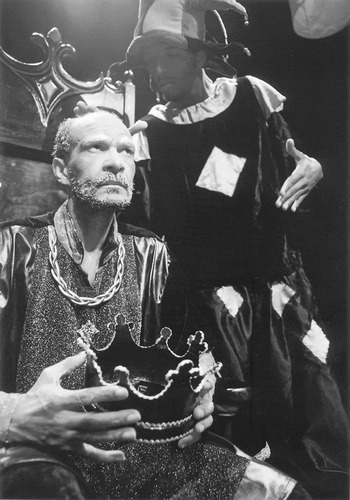
On the surface, Rei Lear contained far fewer reception-adapters than many of Branco's other creolizations, such as his 1998 production of Romeu e Juliet, which pitted Mindelo families from rival neighborhoods against each other. Rei Lear is a rare example of a creolization that Branco did not explicitly place within a Cape Verdean context. Key plot points were not adjusted to fit the country's history (Cape Verde has never had a king, for example), and the mise-en-scène did not conjure up an image of island culture. Lear's gold jewelry and crown created an abstract vision of royalty. The white masks the three sisters held in front of their faces, Goneril's Medusa-like hairstyle, the eerie rattling tones that accompanied scene changes, and the somber stage hues suggested a surreal theatrical motif. Historical epochs were deliberately confounded: the Fool rapped his rhymed verses like a modern-day hip-hop artist, while his floppy hat and patchy costume suggested an early modern court jester.
The reception-adapters that Branco added at the play's thematic level, however, gestured to a national setting. After identifying inheritance disputes as the common thread connecting Shakespeare's tragedy to Cape Verdean society, Branco and his coadapter, Mindelo journalist and actor Fonseca Soares, who also played Lear, cut the play significantly in order to focus on such disputes and their impact on the nuclear family. They lopped off the war and the subplot about Edmund's sedition. The Fool and Kent became quasi-protagonists, taking on dialogue from deleted characters (Edgar, Edmund, and Gloucester). These excisions rendered the storyline truer to Cape Verdean history. The islands have never seen a war: their independence struggle was waged on mainland Africa, in Guinea-Bissau and Guinea-Conakry. Natural disasters, mainly droughts, are what have killed masses of Cape Verdeans, especially the more susceptible elderly population, over the centuries. In Rei Lear, a storm substitutes for drought, but the effect, the death of the elderly, is the same. The adaptation reduced King Lear's colossal body count to one: Lear himself. The final tableau depicts a Cordélia who must continue the family's legacy in the aftermath of familial conflicts and natural disaster, which translates to a Cape Verdean reality easier than the battles governing Shakespeare's last scenes.
While these deletions and plot shifts rendered the adaptation more national, the most crucial reception-adapter, the Crioulo language, achieved a more ambiguous effect. Recall that in 2003, Mindelact featured an unprecedented number of theatre groups from other Lusophone countries in honor of Mindelo being named that year's Capital of Lusophone Culture. The Cape Verdean press emphasized the heightened Lusophone presence, referring to the 2003 festival as having a distinctly “Lusophone flavor.”Footnote 71 Thus, Branco's decision to mount a Crioulo-language production that year instead of catering to the many Portuguese-speaking attendees conveyed the importance of couching individual performances in discrete national cultures rather than effacing differences in the service of Lusofonia. Within the Mindelact context, Crioulo interpellates a specifically national audience within the larger Lusophone crowd, rendering Cape Verdeans the most capable receivers of the production's meaning, since Crioulo is not easily intelligible to Portuguese speakers.Footnote 72
Following Gilbert and Tompkins's argument that the choice of a specific language within postcolonial drama is a political act in itself that determines an implied audience, we might also scrutinize the particular brand of Crioulo employed in Rei Lear. Footnote 73 The adaptation's dialogue evidences the coarse rhythms and consonant-dominated tones that characterize Crioulo from São Vicente Island, rendering all of the characters explicitly Mindelense. Branco's explanation of the kind of Crioulo he employs in such adaptations, what he calls “Shakespearean Crioulo,” suggests that Shakespeare's dialogue can be rendered only in São Vicentian Crioulo. He describes “Shakespearean Crioulo” as having a “different sentence structure than what we hear every day in quotidian life, a different sonority, a more accentuated poetic quality.”Footnote 74 To honor the lyricism of Shakespeare's original text, Branco explains, Shakespearean Creole “re-invents Crioulo” and often “creolizes” Portuguese words.Footnote 75 According to Branco, “Shakespearean Crioulo” is necessarily more Portuguese-sounding. Since a Portuguese-inflected Crioulo is linked explicitly to the São Vicente Island variant,Footnote 76 the notion of “Shakespearean Crioulo” excludes more African-derived variants, such as the badiu form spoken on Santiago Island.Footnote 77 Thus, the linguistic palette of Rei Lear is deeply embroiled in the politics of locality that maintain a North–South divide in Cape Verde's Afro-European culture.
A closer look at the path some of Rei Lear's dialogue takes as it moves from Shakespeare's English text to the Portuguese translation from which Branco and Soares worked to the Crioulo language illuminates another significant feature of the adaptation: the corporeal texture it adopts throughout. One concrete example of this bodily emphasis is that in the Cape Verdean Lear, the king constantly frames his madness as a deterioration of his actual head. For example, in Shakespeare's text, Lear's ominous words before the storm are, “O fool, I shall go mad!”Footnote 78 Álvaro Cunhal's Portuguese translation, which Branco and Soares consulted for their Crioulo translation, renders this line as “Enlouqueço, bobo, enlouqueço!” (I'm going mad, Fool, I'm going mad!)Footnote 79 The Crioulo version reads: “Um ti ta vrá dod, bobe, um ti ta bá cabéça!” (I'm going mad, Fool, my head is going!)Footnote 80 This conveys a particular mind–body connection intrinsic to the Crioulo language. As Cape Verdean linguist Dulce Almada Duarte notes, Crioulo uses the Portuguese word for “head” (kabésa/cabeça) in a way that the Portuguese language does not: as a reflexive pronoun referring to one's self, which is a residue from certain mainland West African languages that contributed to Crioulo's formation. For example, to express suicide in Crioulo, one would say “Maria mata kabésa” (Maria killed her own head).Footnote 81 Thus, in the Crioulo-language Rei Lear, the king losing his “head” takes on a shade of meaning that gets at the very core of insanity: Lear is gradually losing his very essence, his own self. Shakespearean Crioulo can thus never entirely exclude its African etymologies. Here, the head–self connection, a survival from the African mainland, contributes critically to the meaning produced by the mise-en-scène. In production, the Fool further emphasized this mind–body link by interacting physically with Lear's head whenever he discussed his madness. In one instance, he mimed cutting it open to see if there was anything inside (Fig. 1).
Nuno Delgado (the Fool) interacts with the head of Fonseca Soares (Lear) in GTCCPM's 2003 production of Rei Lear. Photo by Luís Couto, courtesy of the Mindelact Association.

In making these scenic choices, Branco was much in line with Pavis's theory of adaptation, which places great stock in the ability of director and actors to meld text with corporeality. Pavis writes, “Theatre translation is never where one expects it to be: not in words, but in the gestures, [. . .] not in the letter, but in the spirit of a culture [. . .].”Footnote 82 Branco's adaptation and staging of Lear lends symmetry to word (head/crown), metaphorical meaning (self/sanity), and gesture. However, other staging choices contributed purely to a raw sensual feel for the production, which perhaps reifies stereotypical associations of African and Africa-descended peoples with the body. For example, the Fool's rap performances, like many contemporary hip-hop videos, drew attention to the lower body, such as when he grabs his crotch before beginning a rhymed passage. Also, at Lear's reference to Goneril's hypothetical children, the actress turns profile to the audience to reveal an actual pregnant body.
How may these intensely corporeal moments have resonated with what non–Cape Verdean visiting artists, such as those coming from Portugal or Brazil, might have expected to encounter during a visit to Africa? In a documentary about Mindelact 2005, Portuguese actor and playwright Nuno Pino Custódio, who attended in 2003, spoke admiringly about Rei Lear's Crioulo dialogue and the production's sensual feel. He suggested that Cape Verdean actors perform well under these circumstances because of intrinsic differences from Western theatre, which is “more connected to the intellect.”Footnote 83 Custódio's comments come dangerously close to reiterating a “West and the Rest” mind–body binary that is a relic of colonial thinking. His observations also raise questions about Branco's positionality as a Portuguese director staging a Cape Verdean adaptation for a global Lusophone audience. Did he, self-consciously or not, choreograph the production to cater to cultural outsiders' desire for a creolized Lear that substitutes corporeality for cerebration? This would flirt with the much-theorized tendency of intercultural Shakespeares to exoticize African cultures for Western viewers.
The Cape Verdean Lear thus suggests a crucial amendment to Pavis's notion of adaptation as an act of pulling a source text toward a target audience. A festival audience is always multilayered: Cape Verdean spectators may intuit the cultural nuances of the head–self connection, whereas other Lusophone spectators may interpret the corporeal references in an essentialist manner. Thus, the adapter planning for a festival venue may engage in a kind of cultural tug-of-war, heaving the source text toward the host country's national audience during some moments, toward the specific spectatorship of the host city at others, and toward the festival's visiting attendees at others. In this case, the “target audience” is forever shifting, forging differing ideological interpretations of the adaptation as it moves.
Sonho de uma noite de verão: Metatheatre and the Art of Tactical Resistance
While Rei Lear suggests an inability to pin down a specific spectatorship, Duarte's production of Sonho de uma noite de verão for Mindelact 2005 very meticulously addressed the Cape Verdean theatre community. In contrast to Lear, Sonho had a distinctly unsensual feel to it, causing one Portuguese attendee to call the production “cold.”Footnote 84 Seemingly, Duarte took the sensual aspect out of one of Shakespeare's most beloved romantic comedies, in which fairies and humans alike indulge their illicit sexual fantasies, and replaced it with social critique. This is adaptation for a different purpose than Branco's. Rather than drawing a Shakespearean text closer to Cape Verdean culture, Duarte made Shakespeare ventriloquize the Solaris theatre company's own prescriptions for Cape Verdean theatre. This is perhaps a compensation device: lacking the authority that Branco wields as the Portuguese artistic director of the festival, Duarte cannot officially establish the rules for spectator behavior and audience taste like Branco can. Thus, adaptation became his most potent device for making his own theatre philosophy heard.
Herlandson Duarte, a graduate of Branco's 2004 Mindelo theatre course, was a mere nineteen years old when he made his directorial debut on the Mindelact mainstage with his Midsummer adaptation, Sonho de uma noite de verão. Although in some ways Branco's protégé, Duarte has gradually striven to distance himself from his former mentor's approach to both theatre and spectatorship. Whereas Branco uses reception-adapters to usher Cape Verdean audiences into the world of his adaptations, Duarte considers this a form of coddling that leaves spectators unchallenged. For example, while Duarte generally admired the staging of Branco's Rei Lear, he also critiqued what he calls certain facile comedic choices, such as depicting the Fool as a rapper.Footnote 85 This criticism is emblematic of Duarte's overall perspective on the state of contemporary Cape Verdean theatre: it is too reliant on comedy and not sufficiently invested in provoking audience members to engage in critical evaluation of the art they witness. Duarte himself insists on an aesthetic designed to leave audience members “shaken up” or perplexed when they exit the theatre. Ostensibly, Sonho de uma noite de verão achieved this objective at its Mindelact 2005 debut. Matilde Dias, a Cape Verdean journalist and blogger, characterized audience reception of Sonho as follows: “The performance text seemed cold, and many people left the theater without fully understanding the story.”Footnote 86 This is a far cry from GTCCPM's sensibility that adaptations need to perform transcultural translation for Cape Verdean audiences. Further, the two adaptations represent an intriguing instance of genre bending: in Branco's hands, King Lear, a Shakespearean tragedy, became more comedic; in Duarte's hands, Midsummer Night's Dream, a comedy, albeit a dark one, took on shades of tragedy.
Edouard Glissant discusses issues of genre at length in his important essay on Caribbean theatre, “Theatre, Consciousness of the People.” For Glissant, theatre can shape, critique, and interrogate nationhood only if it comes from the people. Such a theatre would place folkloric performance modes (or “street scenes”) at the center of a staged performance, thereby subjecting them to reflexive critique by discerning spectators.Footnote 87 Glissant asserts that this brand of theatre is crucial to formerly colonized nations because it can productively replace the dramatic genre of tragedy, which, from his perspective, remains an alienating cultural import.Footnote 88 Considering that Glissant is also critical of highly educated, cultural elites who rely on “colonial handouts,” such as Western plays, in their construction of theatre,Footnote 89 he might be doubly suspicious of Duarte's melding of the tragic genre and a Shakespearean comedy in an island culture not unlike the Caribbean. I want to suggest, however, that within international theatre festival venues, wherein Shakespeare becomes a staple because of his cultural cachet and proven ability to attract sponsors, adapting his plays is a viable option for postcolonial theatre directors who want to create the kind of consciousness-raising theatre that Glissant theorizes. Glissant seeks a theatre that possesses an “internal capacity to challenge and refute” and impels spectators to “discuss . . . the significance of the performance,”Footnote 90 and Duarte's production of Sonho, coupled with its polemical aftermath, fit this bill.
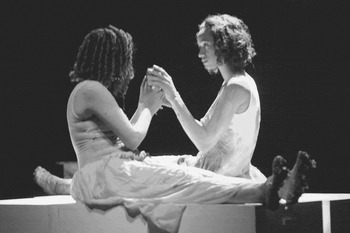
Rather than the folkloric modes that Glissant recommends, the Solaris theatre troupe relied on its own self-described strategy of ousadia, a Portuguese term meaning “boldness” or “daring.” Duarte first used this term in 2004, right after he joined forces with other graduating actors from Branco's theatre class to form a theatre company. He announced publicly that the pillars of the new Solaris theatre would be “a qualidade artística e ousadia criativa” (artistic quality and creative daring).Footnote 91 The Cape Verdean press latched onto the term ousadia, applying it to all of Solaris's subsequent productions, including Julietas (Juliets), a loose adaptation of Romeo and Juliet that merged Shakespeare with biblical lore (Fig. 2). Julietas, which debuted in March 2005, featured two women kissing (a first in Cape Verdean theatre), bathing in blood, and masturbating with the decapitated head of John the Baptist.Footnote 92 The performance was particularly risky given that lesbianism is still a taboo topic in Mindelense society. Although Julietas was a much-anticipated production (tickets sold out a week before the debut)Footnote 93 the Mindelo public demonstrated a resistance to its subject matter. As Duarte recalls, one local reviewer disparaged it as a blatant “commercial for homosexuality.”Footnote 94 Solaris, however, did not concern itself with public opinion as they were preparing the production. In fact, Julietas formed part of the group's pointed refusal to do the kind of “low comedy” that they perceive that Mindelense audiences crave. Before Julietas debuted, they warned, “Whoever expects to see a traditional Crioulo comedy, a play that makes people laugh, can forget it, because our show goes in a completely divergent direction.”Footnote 95
Patricia Leite and Josina Fortes play two Juliets in love in Solaris's 2005 production of Julietas. Photo by João Barbosa, courtesy of the Mindelact Association.

Solaris actors told me that after Branco saw Julietas, he cautioned them not to turn their backs to the public. Significantly, Branco did not commission the overtly ousada Julietas for Mindelact 2005. What he requested from Solaris instead was Sonho de uma noite de verão, a much tamer Shakespeare adaptation that Duarte had first presented, in an abridged version, for his final directing project for Branco's class. As I observed Solaris's rehearsals for Sonho, it became clear to me that Duarte resisted having to debut this particular play on the mainstage not because it was by Shakespeare but because it was a comedy. This resistance became manifest in both his overall scenic approach to Midsummer and the critical alterations he made to the mechanicals' play-within-a-play. As Duarte explained to me, the social critique embedded in Sonho is aimed at all theatregoers who equate seeing theatre with “sitting back and laughing” and the Cape Verdean artists who cater to this whim.Footnote 96 Thus, while Rei Lear's debut constellated around a celebration of the festival public's “good taste,” Solaris's adaptation let no one off the hook.
Solaris's Midsummer Night's Dream posed a significant challenge to me as an ethnographer because I could not recognize it as a comedy. From the gravity of the actors' speeches to their lethargic motion to the gloomy piano sonatas haunting scenic interludes, the production bore a dark palette. Most remarkable is the final scene at the Duke's court, when the servant-class players stage the tragedy of Pyramus and Thisby as an actual tragedy rather than Shakespeare's farcical rendition of one. When I first observed the ending at a rehearsal, my initial reaction was, “They're missing the point. Bottom's play is supposed to bring down the house.” My mistake was in assuming that the actors were misunderstanding the text rather than deliberately reading against its grain. Indeed, Solaris carefully crafted new dialogue in order to convey an explicit demand for a comedic performance. In an early scene in the adaptation, Duke Tezeu and his nobleman, Filostrato, command the two palace slaves, Neca Fundos and Chico Bico (the names Solaris gave to the Nick Bottom and Francis Flute characters of Shakespeare's play), to rehearse a play for Hermia's impending wedding. Filostrato warns that it had better not be a tragedy or drama because the court “kré ari, ari, ari” (just wants to laugh, and laugh, and laugh).Footnote 97 The duke reiterates that their play must be a comedy, “e bem divertide!” (and a very funny one). The penalty, if the slaves do not comply, is death: their heads will go to the crocodiles. Significantly, the slaves do not comply with the authoritative demand for a comedy—a situation that replicates Solaris's own anticomedy stance in Mindelo theatre.
Interestingly, the Solaris actors never clarified to me who exactly Duke Tezeu and Filostrato were meant to represent in the Cape Verdean theatre world. During one group interview, Elton Silva, who played Robin (Robin Goodfellow or Puck in Shakespeare's play), said, “The court is Mindelact.” Nuno Costa, who played Neca Fundos, said, “No, the court is Mindelo's public.”Footnote 98 Yet the distinction between the Mindelact Association and the Mindelense public seems immaterial since Mindelact claims to have shaped its own audiences and their spectatorial tastes. Further, the Mindelact Association, like all festival programming boards, needs to be responsive to audience demand. What is significant is that Solaris's commentary on comedy preferences was readable in the production. Silva remarked that anyone in the Cape Verdean arts circle would recognize the line “the court just wants to laugh, and laugh, and laugh” as a critique.
Also significant is that Solaris directed the thrust of this message to an insider community: Cape Verdean theatre artists. The global Lusophone audience present at the Mindelact Festival was merely incidental; instead, the advantage for Solaris of staging its critique at Mindelact was that the festival venue allowed its message to reach the widest spectrum of Cape Verdean theatre artists. Here, it is a metatheatrical intervention, more so than the particular choice of a theatre language, that determines that the implied audience is a national one. Matilde Dias's online review of Sonho, which appeared at a time when her Lantuna blog was widely read in Cape Verdean artistic circles, confirms the readability of the critique to Cape Verdean “insiders.” Dias's review singles out the scene between Duke Tezeu, Filostrato, and the two palace slaves as a provocation to the Mindelo theatre community, particularly the fact that the slaves do not succumb to the demand for comedy. As Dias notes, Solaris did much the same thing with Sonho: they presented a somber version of a Shakespearean comedy that did not make anyone laugh.Footnote 99
Yet clarity and entertainment, Dias continues, were not Solaris's goals. The goal instead was ousadia, and the two scenes that best conveyed Solaris's objective were the ones in which the slave characters perform Pirámo e Tisbe. In these scenes, Solaris signaled its appropriation of Shakespeare's text for its own act of resistance to local theatre practices, to comedy as a genre, and to the Mindelact Festival's selection process. Act II depicted Neca Fundos and Chico Bico (played by Nuno Costa and Marco Freitas) meeting in the forest to rehearse. Neca exclaimed, “It's always the same! We're always the only ones who show up. There's almost no time left and we haven't rehearsed once. At this rate, the show we're going to present is ‘the slave in the crocodile's head.’ What's worse, that's a tragedy!” This first critique was directed at what Solaris perceives as a weak work ethic in the Cape Verdean theatre community: the fact that some actors continually miss rehearsals or show up hours late.Footnote 100 After these new lines were inserted into Shakespeare's scene, the slave characters shifted back into the play's dialogue to perform the inane love scene between Pirámo and Tisbe. Neca, as Pirámo, dropped to one knee to tell Chico, as Tisbe, that her breath is like an “odious” flower. Chico stood with a green cloak draped around him like a long dress and directed a beatific smile at Neca.
This absurd tableau, one of Solaris's rare concessions to staging comedy, did indeed make the Mindelact audience laugh. Yet when the players repeated the love scene for the court in the final scene, it was no laughing matter. Visually, the tableau was the same: Neca/Pirámo on his knees, Chico/Tisbe standing and cloaked in a green cape. However, the mood was completely revised. Sober lighting shrouded the scene, and Tisbe and Pirámo delivered their professions of love in somber Portuguese rather than the playful Crioulo they used while rehearsing in the woods. Duke Tezeu and his court watched in stony silence as Pirámo and Tisbe pierced their chests with a sword in earnest. This is a far cry from Duke Theseus's jovial, mocking commentary that constantly interrupts the lovers' hilarious death scene in Shakespeare's text. Solaris's version transforms Shakespeare's comic ending into high tragedy. The last line in Sonho revealed how Neca Fundos and Chico Bico would be punished for performing a tragedy, thereby disobeying the court's earlier demand for a comedy. Filostrato menaced, “Your heads are going to the crocodile!”—after which the stage went abruptly dark. With this ominous conclusion, Solaris perhaps foresaw the stark repercussions of their own refusal to perform comedy in Mindelo, such as the possibility that spectators would stop coming to their theatre.Footnote 101 If, as Kevin Wetmore suggests, successful adaptations rearrange the cultural codes of the original play to create a text that speaks to its target spectators, asks them new questions, and addresses pertinent issues,Footnote 102 Solaris's new questions were about audiences themselves, daring them to engage in self-reflection about their own spectatorial practices.
Duarte, however, has resisted using the term adaptation to describe Sonho, since Solaris did not explicitly transplant the story of Midsummer Night's Dream to a Cape Verdean setting. No local markers were evident: the actors wore Greek togas, and all references to Athens remained intact. Rather than an adaptation, Duarte called their performance a straightforward translation into Crioulo. In an interview, I pressed him further on this, reminding him of the significant alterations he had made to Shakespeare's text, particularly in the play-within-a-play scenes. Subsequently, Duarte and I decided that perhaps Solaris's performance was most aptly termed a transformation of Shakespeare's text.Footnote 103 In other words, the group had transformed Shakespeare into a vehicle for advancing their own theatre philosophy.
I construe Solaris's recoding of Shakespeare's metatheatre as a veiled critique of the festival mechanism itself. Solaris's choice to depict Neca and Chico as palace slaves rather than as laboring workers completely alters power relationships in the play. Authority hovers over the rehearsal process in the form of Filostrato and the Duke. Also, in Solaris's version, the court commands Neca to prepare a play, whereas in Shakespeare's original text, Bottom submits the mechanicals' proposal to an open contest to perform at court. This critical alteration speaks to the difference between an artistic director soliciting a production for a festival mainstage and selecting it from a range of submitted proposals. In Mindelact's early years, festival representatives would go to various islands to watch theatre groups work in order to evaluate quality and appropriateness for the Mindelact stage. In some cases, the Mindelact association would request a performance especially for this purpose. To this day, even though Mindelact annually calls for formal proposals from national theatre groups who want to perform on the mainstage, more often than not the artistic director will simply ask a theatre group for a specific play. Recall that in Solaris's case, Sonho had originated in coursework with Branco. In an interview, Duarte hinted to me that had it been up to him, he would have chosen a different play.Footnote 104
Significantly, Solaris's critique of both audience and festival politics, like any good tactic à la de Certeau, was subtle.Footnote 105 Far from taking offense, Branco bounded onto the stage after Sonho de uma noite de verão and congratulated Duarte, declaring that Cape Verde had gained a prodigious directing talent in the young artist. However, Sonho set in motion a whole new series of dialogues with Branco about theatre and audience in Cape Verde. This was perhaps foreshadowed by the way that Matilde Dias concluded her performance review of Sonho with a clear distinction between Solaris's role in Mindelo theatre and the role of Branco's theatre group: “On the one side, there is ‘comédia crioula’ [Creole comedy], represented by the Portuguese Cultural Center's theatre group [GTCCPM], and on the other, there is Solaris, with their more visually oriented stage conceptions, which are bold and not at all innocent.”Footnote 106 With this, Dias enunciated a gap between the two directors that would widen over the next two years. Yet it was from within the space of this discord that Sonho's ability to provoke a “revaluation from the inside,” in Glissant's terms, became clear.Footnote 107
Conclusion: Festival Transformations
The dissonance that marked Duarte's and Branco's relationship in the ensuing years crystallizes the potential pitfalls of the Lusofonia discourse within the postcolonial Lusophone world. Far from marking a harmonious exchange of ideas between two members of “brother nations,” their dialogue became increasingly accusatory and contentious. Yet, as Rustom Bharucha notes, conflict surfacing within intercultural encounters is actually a positive sign that differences have not been dissolved within an uncontested and unquestioned hegemonic agenda.Footnote 108 The most visible installment of the directors' debate about spectatorship occurred on Solaris's blog in August 2006. Duarte posted an entry called “Termómetro teatral em São Vicente” (Theatre Thermometer in São Vicente), in which he suggested that because Mindelo theatregoers have not been exposed to provocative performances that serve a valid social function, they possess “rudimentary” evaluation skills to which Mindelo theatre groups cater by measuring the success of a production by the guffaws it provokes in the house. Duarte also cited a lack of genuine artistic debate within the theatre community.Footnote 109 Branco posted the sole response. He disputed the assumption that laughter always indicates an uncritical, unthinking spectator and the idea that theatre can exist without taking into account audience taste, which he claimed could only be developed through “quality” theatre. Finally, Branco claimed that Duarte's call for more engaged artistic dialogue was directly contradicted by his own recent actions of going straight to the press to air his concerns about Mindelact rather than discussing them face to face with the artists involved.Footnote 110
This terse online exchange was a direct result of an incident that had occurred earlier in the summer. In June 2006, Solaris went public with its critique of the Mindelact Association's selection process for the festival program. In an editorial in Cape Verde's major newspaper, it announced that it had been the only Mindelo theatre group to receive a letter from Mindelact explaining the procedures for submitting a proposal for the 2006 festival edition, whereas other Mindelo troupes had been directly invited to participate. In the same newspaper issue, Branco contended that there was no discrimination involved and that Solaris had already submitted proposals for two performances. He also stated that Mindelact was under no obligation to accept every theatre group's proposals.Footnote 111 The upshot was that Solaris did not perform at Mindelact 2006, which provoked complaints from many regular festival supporters who consider their productions edgy and indispensable to Mindelact.Footnote 112
Theatre festivals are riddled with asymmetric power relations between artist-performers and artist-administrators. However, the Solaris case study reveals that even theatre artists on the “lower” end of that power scale can use a festival's resources to their own advantage. A festival's programming committee must ultimately bend to the sovereignty of the theatregoing public and the press. Solaris's absence from Mindelact 2006 stirred so much controversy that they received a double bill at Mindelact 2007, performing two original pieces by the group's resident playwright, Valódia Monteiro: Martur, about a suicide bomber on the Gaza Strip, on the mainstage, and Psycho, a play in which two women hash through phobias of sex, germs, and public places, for the Festival “Off” program. Neither was a comedy; neither was a solicited adaptation. Thus, Solaris's participation in 2007 took place on the group's own terms.
More important, the group's double bill was the result of a productive compromise reached jointly with João Branco. After Solaris had proposed Psycho for the mainstage program for 2007, Branco had told them that he preferred debuts on the main program and noted that the group had already staged Psycho several times in Mindelo. Therefore, he suggested that they perform Psycho for “Off” and a new piece for the mainstage, to which Duarte and the other actors agreed. This arrangement closed the circle of a vibrant artistic debate that cycled through two Shakespearean adaptations and their aftermath, engendering a transformation in the diplomatic and communicative relations between two Lusophone directors in a shared festival venue and a postcolonial space. Thus, Rei Lear and Sonho de uma noite de verão may be regarded as two stops on a journey that became transformative of festival processes and discourses in Cape Verde.
In calling these productions transformative, I respond to Julie Sanders's call for a more dynamic vocabulary to discuss adaptations.Footnote 113 While the noun “adaptation” focuses on an end product, the collection of semiotic signifiers that constitute the unique cultural syncretism of an adaptation, “transformative” is an adjective that summons an action: a spiraling motion that stimulates alterations, provocations, and deliberations within a local theatre community during the afterlife of an adaptation. As Elin Diamond reminds us, performance is both a “doing” and a “thing done.”Footnote 114 Perhaps by thinking about adaptations as transformative, we can begin to set our sights more on the valuable doing accomplished by directors, actors, and spectators alike. It is particularly important to dissect this “doing” within festival spaces wherein Shakespeare, for better or worse, becomes an arbiter for postcolonial relationships among directors from disparate nations and geopolitical backgrounds. If Lusofonia succeeds only where transnational political alliances such as the CPLP fail, then perhaps Portuguese–Cape Verdean intercultural dialogues, when channeled through Western adaptations, succeed only where Shakespeare's prescribed rules, language constructions, and genres find themselves hopelessly out of place.