INTRODUCTION
New Zealand is a known hotspot for cetacean strandings (Pyenson, Reference Pyenson2011) with 43 species or sub-species described from these waters (Baker et al., Reference Baker, Chilvers, Constantine, DuFresne, Mattlin, van Helden and Hitchmough2010). Of particular interest are the enigmatic beaked whales, family Ziphiidae. Including the specimen reported here, 13 of the 21 described species have been identified in New Zealand to date, including the only recently observed spade-toothed beaked whale (Mesoplodon traversii) (Thompson et al., Reference Thompson, Baker, van Helden, Patel, Millar and Constantine2012). Despite the high diversity of beaked whales in the New Zealand stranding record these whales remain unstudied at a population level. As ziphiids have a preference for deep waters, often in remote locations (Mead, Reference Mead, Ridgeway and Harrison1989; Pitman, Reference Pitman, Perrin, Würsig and Thewissen2009) it is possible that populations of beaked whales exist in offshore New Zealand waters. The New Zealand stranding record suggests that certain species of beaked whale are resident year-round (e.g. the Gray's beaked whale (Mesoplodon grayi) (Thompson et al., Reference Thompson, Millar, Baker, Dalebout, Steel, van Helden and Constantine2013)) but others may have resident populations that are unknown to us through lack of appropriate surveys. Other species however may simply be vagrants.
There is a well-established stranding report network in New Zealand whereby members of the public report live and dead stranded cetaceans to the Department of Conservation (DOC). Data are collected from dead cetaceans including morphometric measurements and photographs (curated at DOC as part of their central archives) and a small tissue sample for genetic identification is included in the New Zealand Cetacean Tissue Archive (NZCeTA) curated at the University of Auckland (Thompson et al., Reference Thompson, Millar, Baker, Dalebout, Steel, van Helden and Constantine2013). These archives are important repositories of information on rarely sighted or difficult to identify specimens such as beaked whales, and the NZCeTA is effective in the species identification of highly degraded carcasses (Dalebout et al., Reference Dalebout, van Helden, Van Waerebeek and Baker1998).
The True's beaked whale (Mesoplodon mirus) was originally considered solely a North Atlantic species until a stranding in south-east South Africa expanded the species known range (Talbot, Reference Talbot1960). Globally the species is most regularly reported from the North Atlantic, in particular along the eastern seaboard of the USA with the majority of reports from stranded animals (Mead et al., Reference Mead, Ridgeway and Harrison1989; MacLeod, Reference MacLeod2000). There are few records of True's beaked whales from the southern hemisphere with the majority from south-east of southern Africa, one from Brazil and two from South Australia (summarized in Baker, Reference Baker1999; MacLeod et al., Reference MacLeod, Perrin, Pitman, Barlow, Ballance, D'Amico, Gerrodette, Joyce, Mullin, Palka and Waring2006).
Here we report on the first sighting of a True's beaked whale from New Zealand and one of few sightings of the species in the southern hemisphere. The whale was reported as a stranded individual and we used molecular markers to confirm the species identification.
MATERIALS AND METHODS
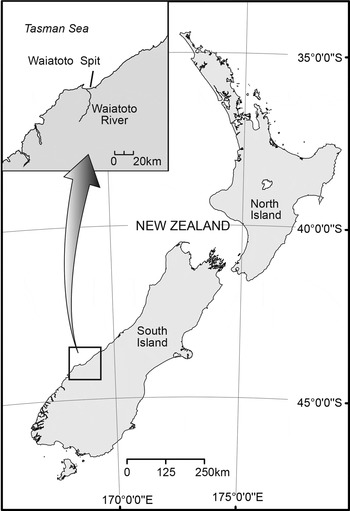
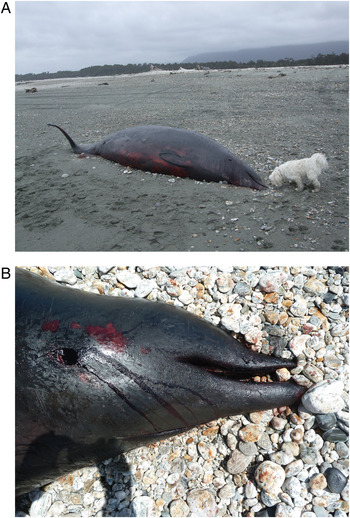
On 27 November 2011, a 5.06 m female beaked whale carcass was found at Waiatoto Spit, South Westland, New Zealand (Grid ref Topo 50 Map Series 1264358N 5123407E; Figure 1). Measurements and photographs were taken of the carcass, which was estimated to have died less than two days prior (Figure 2). A skin sample was taken, preserved in 70% ethanol and transported to the NZCeTA, University of Auckland. Total genomic DNA was extracted using the Puregene DNA isolation kit (Gentra). The whale was confirmed as a female by PCR amplification of the male-specific SRY gene, multiplexed with an amplification of the ZFY/ZFX region as positive control (Aasen & Medrano, Reference Aasen and Medrano1990; Gilson et al., Reference Gilson, Syvanen, Levine and Banks1998). Sex was also confirmed by the presence of a foetus discovered when the bones were being recovered for repository at the Museum of New Zealand Te Papa Tongarewa (specimen identification number; adult female—NMNZ MM3000; foetus—NMNZ MM3001).
Location of the stranded True's beaked whale Mesoplodon mirus; Waiatoto Spit, South Westland, New Zealand.

Stranded female True's beaked whale Mesoplodon mirus: (A) whole carcass (5.06 m) (photograph: Liz Hawker); (B) right side of the head (photograph: Department of Conservation)

To confirm species identification, two regions of the mitochondrial (mtDNA) genome were sequenced: mtDNA control region and cytochrome b gene. PCR amplification was done following Thompson et al. (Reference Thompson, Baker, van Helden, Patel, Millar and Constantine2012) with the primers Dlp1.5 (Baker et al., Reference Baker, Medrano-Gonzalez, Calambokidis, Perry, Pichler, Rosenbaum, Straley, Urban Ramirez, Tamaguchi and Von Ziegesar1998) and Dlp8G (Lento et al., Reference Lento, Patenaude and Baker1997) for the mtDNA control region and primers Gludg-L and CB2-L for the cytochrome b gene (Dalebout et al., Reference Dalebout, van Helden, Van Waerebeek and Baker1998).
Polymerase chain reaction products were purified for sequencing with ExoSAP-IT (USB) and sequenced in forward and reverse direction with BigDyeTM Dye Terminator Chemistry (Applied Biosystems) on an ABI 3130XL. The resulting sequences were edited in Geneious v6.1 (Biomatters, 2012). Species identification was made using the DNA surveillance website (Ross et al., Reference Ross, Lento, Dalebout, Goode, Ewing, McLaren, Rodrigo, Lavery and Baker2003) and through comparison of the candidate sequence to the holotype sequence, available from GenBank (http://www.ncbi.nlm.nih.gov/genbank/). Both mtDNA control region and cytochrome b gene sequences most closely matched the holotype sequence (mtDNA control region: 379 bp, 97% pairwise identity, e-value 2e-178, GenBank Accession number KF435027; cytochrome b gene: 381 bp, 94% pairwise identity, e-value: 2e-148, GenBank Accession number KF435028) and a neighbour-joining tree provided robust support for a species-specific clade (mtDNA control region: 95% bootstrap support; cytochrome b gene: 94% bootstrap support). The museum number for the holotype of Mesoplodon mirus is USNM 175019.
RESULTS AND DISCUSSION
The whale was confirmed as a pregnant, female True's beaked whale. This specimen is the first report for New Zealand and for the region, and confirms New Zealand's place as a hotspot for beaked whale diversity with a total of 13 ziphiids now reported; five of which were first reported in New Zealand (the Arnoux's (Berardius arnuxii), Gray's, Andrew's (Mesoplodon bowdoini), Hector's (Mesoplodon hectori) and spade-toothed beaked whales (Mesoplodon traversii)).
Examination of the carcass when undergoing bone recovery revealed the presence of small bones from a foetus; unfortunately the advanced state of decay prevented reliable measurements being taken to determine the age of the foetus. Squid beaks and unidentified fish remains were observed in the stomach. These prey items are typical for the species and the whale may have been foraging in the deep-water canyons near the stranding site. In addition, small pieces of hard plastic of unknown provenance were also found in the whale's stomach.
Stranded cetaceans are regularly reported from coastal New Zealand and as some parts of the country are remote, stranded animals may wash away before samples can be collected, or are reported well after the stranding event. The stranding reported here was from a remote area and is due to the excellent reporting systems by a network of individuals from this region. This record could be regarded as extra-limital, however the species distribution is poorly understood with few records globally (MacLeod et al., Reference MacLeod, Perrin, Pitman, Barlow, Ballance, D'Amico, Gerrodette, Joyce, Mullin, Palka and Waring2006; Pitman, Reference Pitman, Perrin, Würsig and Thewissen2009). The species' behaviour generally keeps individuals away from near-shore environments which lessens the chance of observation. This report represents an important contribution to the global record for the species. In addition, the submission of genetic material to GenBank may help resolve questions around the suggestion of a sub-species level of genetic divergence between the northern hemisphere and southern hemisphere True's beaked whales (Pitman, Reference Pitman, Perrin, Würsig and Thewissen2009).
ACKNOWLEDGEMENTS
The authors thank Te Runanga o Makaawhio and the Department of Conservation (DOC) for allowing and assisting with access to the whale (named Niho Ngore) for conducting this research. Thanks to the following people from the west coast involved in the reporting and recovery of the whales: Rebecca Wilson, Nathanieal Scott, Susan Wallace, Kerry Eggeling, Sally Sims, Liz Hawker, Jane Neale and Bill Croft. We also thank Debbie Steel and Kirsten Thompson for assisting with species identification and the DOC for funding this work.