

Conodonts had elaborate oral apparatuses of complexity comparable to that of teeth sets of advanced tetrapods. They differed in the number of element locations, as well as in the spatial disposition of elements differentiated into a number of morphological types. It has already been determined how many kinds of elements occurred in most of the conodonts. It is probable that all the apparatuses in the traditionally understood ozarkodinid clade were composed of 15 elements (Purnell & Donoghue Reference Purnell and Donoghue1997); 17 elements occurred in the icriodontids (Aldridge et al. Reference Aldridge, Murdock, Gabbott and Theron2013); and at least one species of the prioniodontids had an apparatus with nineteen elements (Aldridge et al. Reference Aldridge, Purnell, Gabbott and Theron1995). There was hardly any direct correspondence between the number of element types and the number of paired or unpaired element locations in the apparatus. Some of them are so similar to each other that differences between locations are smaller than the extent of their population variability. Frequently, there was a gradation of element morphologies within the apparatus, which makes the number of recognised element types dependent on a subjective perception, or on the meticulousness of a researcher. Only in some species is the exact number of element locations known. It has been determined due to findings of whole apparatus element sets, mostly stacked together into clusters. The three-dimensional disposition of elements in the apparatus is known in even fewer cases. This requires apparatus element sets to be preserved on the rock bedding plane with various patterns of predepositional deformation.
The number of elements in conodont apparatuses restored in such a way ranged from just two to 19, but which of the apparatus ground plans was the ancestral one and how the diversity of apparatuses originated remains unsettled. The present author wishes to address this problem in an alternative way to that offered by Donoghue et al. (Reference Donoghue, Purnell, Aldridge and Zhang2008). The main difference will be in the value given to geological time and space distance between fossil samples, with respect to purely morphological data, as commented on more extensively below in section 2.1.
This can be done based on three sources of evidence: (1) element type numbers exclusive for a specific apparatus ground plan may be used to identify a member of the group. New evidence on an Ordovician lineage from Siberia shows that conodonts with apparatuses of high complexity, with at least 17 elements, were diverse in exotic refugia much before their Early Silurian acme; (2) published restorations of apparatus structure, derived from clusters and natural assemblages, offer a reference standard to which the sets of isolated elements can be compared. Stratigraphic succession of findings and their geographic context may then be used to construct an evolutionary scenario of the conodont apparatus Bauplan transformation. The record of early ontogeny (organogeny) in the crown tissue increments may provide a phylogenetic signal, enabling homologisation of processes in morphologically complex elements; (3) the specific way in which the three-dimensional disposition of elements within the apparatuses changed in their evolution may be used to infer selection pressure on the apparatus function which controlled these transformations. This requires the conodont skeletal structures to be fleshed out. The desire is to disclose the biological meaning of the evolution of conodont oral apparatuses.
1. Material
Most of the material used in this work comes from samples collected by the present author in 2007, from sections of the Ordovician along the upper Lena River in central Siberia. They were processed in the Institute of Paleobiology of the Polish Academy of Sciences in Warsaw in the routine way, using the Franz laboratory electromagnetic separator. Diluted acetic acid was used to dissolve the rock; in the case of rocks with a high content of quartz grains, heavy liquid was used. Specimens, picked out by hand, were held in Franke cells, usually all elements of one species in one cell, which made examining them from all sides easier than if they had been glued to the cardboard slides. SEM photographs were taken of specimens mounted on stubs with sticky tape and coated with carbon and gold. Camera lucida drawings and tracings of the photographs with a graphic tablet were used to make restorations of the elements and to count the growth increments.
Geological results of the Siberian expedition in 2007 have been published by Kanygin et al. (Reference Kanygin, Dronov, Timokhin and Gonta2010a). A brief description of each of the localities sampled for conodonts, with an excerpt of information from the Russian literature, is given below.
1.1. Balysheva (“Kudrina”)
This is an exposure of the stratigraphically oldest strata sampled for this work on the Lena River. Loaf-like concretions of sandy limestone within a sandy grey mudstone represent the Kirensk Member of the Krivaya Luka Formation. They are exposed in a small ravine about 800 m upstream from Balysheva (or Balashevo; exposure VK743 in Kanygin et al. Reference Kanygin, Moskalenko, Yadrenkina, Abaimova, Sychev and Timokhin1989), on the left bank of the Lena River opposite the village of Makarovo. The concretions are very fossiliferous and yielded poorly-preserved nautiloid and hypseloconid mollusc (?) shells (Dzik Reference Dzik2010), preserved with their presumably aragonitic shells in calcite sparite. About 6 kg of concretions were dissolved. The phosphatic debris includes mostly broken carapaces of the aglaspidid chelicerates. Phosphatic nuclei of juvenile bellerophontid gastropods are common. The conodont fossil assemblage comprises mostly Ptiloconus anomalis (Moskalenko, Reference Moskalenko1970), with the apparatus partially reconstructed by Moskalenko (in Kanygin et al. Reference Kanygin, Moskalenko, Yadrenkina and Semenova1977); and Erraticodon gratus (Moskalenko, 1977 in Kanygin et al. Reference Kanygin, Moskalenko, Yadrenkina and Semenova1977), of apparatus restored by Moskalenko (in Kanygin et al. Reference Kanygin, Moskalenko, Yadrenkina, Abaimova, Sychev and Timokhin1989). The former species was used as an index fossil for the Kirenskian-Kudrinian local stage by Moskalenko (Reference Moskalenko1983). Less common is Cyrtoniodus flexuosus (Moskalenko, Reference Moskalenko1973). Rare M elements of ‘Microcoleodus’ tunguskaensis Moskalenko, 1970 and P1 of ‘Bryantodina’ lenaica Moskalenko, 1973 may belong to the same apparatus, but the available material is too small to decide on its structure. Cahabagnathus cf. sweeti (Bergström, Reference Bergström1971), found in this locality by Moskalenko (in Kanygin et al. Reference Kanygin, Moskalenko, Yadrenkina, Abaimova, Sychev and Timokhin1989), correlates to the stratum with the Pygodus anserinus Zone of the Kukruse Baltic stage and with the early Sandbian (Bergström Reference Bergström1983; Leslie & Lehnert Reference Leslie and Lehnert1999; Kanygin et al. Reference Kanygin, Dronov, Timokhin and Gonta2010a, Reference Kanygin, Koren, Yadrenkina, Timokhin, Sychev, Tolmacheva, Finney and Berryb).
In this area, the quartz sandstone of the Krivaya Luka Formation is overlain with the black shale of the Chertovskaya Formation, with a phosphate conglomerate at the base, which marks the beginning of the Mangazea depositional sequence in the Irkutsk Basin (Kanygin et al. Reference Kanygin, Dronov, Timokhin and Gonta2010a, Reference Kanygin, Koren, Yadrenkina, Timokhin, Sychev, Tolmacheva, Finney and Berryb). This shallowing upward sequence continues into the red mudstone and claystone of the Makarovo Formation.
1.2. Makarovo
A sample was taken near the VK744 exposure of Kanygin et al. (Reference Kanygin, Moskalenko, Yadrenkina, Abaimova, Sychev and Timokhin1989), on the left (western) bank of the Lena River downstream from the village of Makarovo.
The sample comes from the lower part of the Makarovo Formation. Its acid resistant residue abounds in phosphatic microfossils. These are mostly disintegrated carapaces of the aglaspidid chelicerates, with a spine-like long telson (probably incorrectly interpreted by the present author as an archaeostracan; Dzik Reference Dzik1980) and phosphatic nuclei of problematic tubular fossils with a tetragonal cross-section. They are associated with superficially similar phosphatic nuclei of the trepostome bryozoan zooecia. Bellerophontids and ostracods are also common. Phosphatised minute cylindrical coprolites form complex tangled aggregates. The fossil assemblage is surprisingly similar to that of the Krivaya Luka Formation, despite a significant difference in geological age. Apparently, organisms adapted to the extreme Ordovician environment of the Irkutsk Basin in Siberia continued to form an isolated community for several million years.
1.3. Zaborie
Exposure VK745 of Kanygin et al. (Reference Kanygin, Moskalenko, Yadrenkina, Abaimova, Sychev and Timokhin1989) is located on the left bank of the Lena River, 1 km upstream from the village of Zaborie. The red, locally variegated sandy limestone bed sampled contains poorly preserved ormoceratid nautiloids and skeletal detritus of various benthic organisms. Despite a different rock colouration, the fossil assemblage is similar to that from Makarovo, except for the lack of Cyrtoniodus, which is probably an expression of shallowing of the basin. A red mudstone and claystone, with desiccation fissures occurring above it, marks the beginning of the extremely shallow-water sedimentation of the Makarovo Formation. The formation is probably Sandbian (Mid Caradoc), corresponding to the Jõhvi, Keila or Oandu Baltic stages (Kanygin et al. Reference Kanygin, Dronov, Timokhin and Gonta2010a).
In addition, a few samples from the Tunguz Basin of Siberia, transferred to the present author by Tamara Moskalenko in 1977, have been processed by the author in Warsaw. Two of them are of importance in interpreting the apparatuses of Siberian conodonts. Sample 7672/71, collected on the right bank of the Moyero River in northern Siberia downstream from the Bugarikhta Creek, according to Moskalenko (Reference Moskalenko1970), is from the Volgina Member, but the bed of the unit (these are 40–47) is not specified. The fossil assemblage from the sample is of surprisingly high taxonomic diversity for Siberia. The most common is a generalised species of Panderodus (295 specimens), followed by a species of Tokognathus (152) and Cyrtoniodus flexuosus (92). A rather cosmopolitan aspect is given to the fauna by Drepanoistodus suberectus (60), Panderodus ex gr. furnishi (52), Besselodus sp. (46), Diaphorodus sp. (37), Drepanodistacodus sp. (31), Erraticodon gratus (17), Prattognathus sp. n. (17), Drepanodus sp. n. (15) and Semiacontiodus sp. (5). This was apparently a rather deep-water environment. The stratum is correlated with the Lasnamägi or Uhaku Baltic stages (Kanygin et al. Reference Kanygin, Dronov, Timokhin and Gonta2010a).
The present author was unable to locate the sample collected from exposure 572, beds 4–2, near the mouth of the Kokui Creek at the Podkamennaya Tunguzka River on the sections described by Moskalenko (Reference Moskalenko1973). The rock is a sandy limestone with coarse quartz grains. The conodont assemblage is of low diversity, with dominant Ptiloconus anomalis (Moskalenko, Reference Moskalenko1970) (95 specimens), the index fossil for the Kirenskian-Kudrinian local stage (Moskalenko Reference Moskalenko1983). Cyrtoniodus flexuosus is second in number (74), being associated with Plectodina restricta (Moskalenko, Reference Moskalenko1973) (26), Erraticodon? sp. (17) and Moskalenkodus cruciformis (Moskalenko, Reference Moskalenko1970) (3).
To test the earlier proposed restoration of Complexodus pugionifer (Drygant, Reference Drygant1974) apparatus, additional large samples of the Mójcza Limestone were taken from the beds immediately below and above the main bentonite horizon at the Mójcza section in the Holy Cross Mountains, Poland (see Dzik & Pisera Reference Dzik and Pisera1994 for stratigraphy). 891 specimens of the species were identified; most (553) representing P1 elements.
2. Methods of inference
2.1. Tracing evolution and phylogeny
The approach to the fossil record of evolution used in this work is basically different from that nowadays preferred by palaeontologists studying the phylogeny of extinct animals (e.g., Donoghue et al. Reference Donoghue, Purnell, Aldridge and Zhang2008) and may be considered out of date by some of them. Therefore, a brief explanation of the methodological basis of the presented research seems necessary.
The fossil record of the evolution of conodonts is probably the most complete of all organisms, although Wickström & Donoghue (Reference Wickström and Donoghue2005, p. 195) used cladistic analysis to show that it is relatively incomplete. The method does not allow for ancestor–descendant relationships, and assumes that all evolutionary change is concentrated in dichotomies, being out of reach to palaeontology. Unavoidably, most of the phylogeny appears thus as represented by ‘ghost lineages.’ This is a false presentation of evolutionary reality. The extensive literature on conodont evolution shows many continuous series of populations, each subdivided into several chronospecies, or even genera (reviewed by Dzik Reference Dzik1999, Reference Dzik2006; also Leslie & Lehnert Reference Leslie and Lehnert1999, Reference Leslie and Lehnert2005).
However, the completeness of the conodont fossil record is highly uneven. Along with the high-latitude faunas comprising many lineages which can be studied biometrically bed-by-bed, with stratophenetics as the method of inference (e.g., Dzik Reference Dzik1984, Reference Dzik1994; Albanesi & Barnes Reference Albanesi and Barnes2000; Löfgren & Tolmacheva Reference Löfgren and Tolmacheva2008), there are low-latitude faunas of species extremely sensitive to local environmental changes, with a punctuated fossil record which requires a different approach for it to be deciphered (e.g., Dzik 1983, Reference Dzik2006). Whether a lineage represented in a stratigraphic succession shows determinable evolutionary change in morphology depends mostly on how long it persisted in the area of study. In the case of the low-latitude Late Devonian (Famennian) of central Europe, among 101 identified lineages, 31 show more or less apparent evolution (Dzik Reference Dzik2006, p. 185).
The conodonts which are the subject of this study are extremes of this kind. These are mostly low-latitude shallow-water species sparsely distributed in the fossil record, suddenly and unexpectedly emerging in various places in the world, hidden in unknown refugia for most of their evolution. Stratophenetics can rarely be applied to study them (only a brief incursion of Complexodus to the Małopolska Massif provided such an opportunity; Dzik Reference Dzik1994).
Every period of geological time has its own set of recurrent homoplastic morphologies of conodont elements as a result of convergence and parallel evolution. This may yield misleading phylogenies (Dzik Reference Dzik2005). The alternative to basing evolutionary inference purely on morphology is to arrange data along their stratigraphic succession, in an attempt to recover chronomorphoclines as an expression of the evolution. A network of ancestor–descendant relationships is then constructed, possibly parsimonious in respect to morphology, without giving any a priori value to characters, or even defining them a priori. Such an approach also allows the evolution of particular structures to be traced; that is, to identify their homology. Most of the discussion on homology in the last two hundred years has been directed towards the search of a way to determine a priori such correspondence between characters without any notion of evolutionary change (reviewed, e.g., by Kleisner Reference Kleisner2007). Homology is here understood as resemblance (or lack of resemblance) caused by a continuity of (genetic) information (Van Valen Reference Van Valen1982), which means that it is identified a posteriori. Such a concept of homology explicitly links it with the physical process of evolution. To claim homology understood in such a way, one has to propose, at least implicitly, the ancestor–descendant chain of records connecting the two (or more) species with traits believed to be homologous. The chain leads back in time from one species to the common ancestor and then returns along another lineage to the time horizon with the other species.
Wickström & Donoghue (Reference Wickström and Donoghue2005, p. 186) are correct in that the ancestor–descendant approach to homology “lacks any formal criteria for reconciling between competing data and datasets”; but such an approach hardly “considers the significance of subjectively chosen characters”, as there is no rigid requirement to specify any distinct character. An anatomical structure referred to in such an inference does not necessarily need to be specified as a character, or be subdivided into a set of characters. No doubt there are kinds of characters which may rather strictly correspond to discrete units in nature. Such distinctions are, for instance, those between segments with their appendages in arthropods, or somites with their organs in vertebrates. In such cases, the criterion of topology, as discussed by Rieppel & Kierney (Reference Rieppel and Kearney2002), is a sufficient constraint to identify homology with a high degree of confidence. Such clarity in separating different aspects of the anatomy is not offered by, for instance, mollusc conches. It is completely arbitrary as to whether its geometry, sculpture or internal structure is referred to as a discrete character. In stratigraphy-based ancestor–descendant theorising, the whole body morphologies can be considered whilst comparing organisms neighbouring in time succession, without separating particular traits. These are whole organisms or even their populations (samples, chronospecies), instead of characters, which are followed along the ancestor–descendant succession. Which aspects of the neighbours in time are compared is a matter of arbitrary choice. They should approach the evolutionary morphological change as close as possible. Only the time frames of samples (unlike characters and taxa) are absolute and thus completely objective.
The term ‘chronophyletic’ was first used for the approach outlined above by the present author in a book in Polish (Dzik Reference Dzik1996, p. 77) and, somewhat later, in an English-language paper (Dzik Reference Dzik1999, p. 219). Quite independently, it was applied in archaeology to a method of interpreting directional cultural evolution expressed in successions of artifacts (O'Brien & Lyman Reference O'Brien and Lyman1998, referring to work by Ford (Reference Ford1962)). The core idea of the approach is that individuals and populations, not taxa (which are products of human mind rather than objective units), are subjects of the physical process of evolution. The basic assertion of the chronophyletics is that a fossil or sample of fossils is a representation of an episode in the process of evolution. The objective, unchangeable time and space coordinates, as well as morphological characteristics, are not theories to be questioned. Only the hypotheses on ancestor–descendant relationships connecting fossil populations are subjects of testing (by retrodiction; Wächtershäuser Reference Wächtershäuser1992; Dzik Reference Dzik1999, Reference Dzik2005). This attitude is followed in the present work, in which inference about ancestry is directed backward in geological time, namely from the Early Silurian to the Mid Ordovician.
2.2. Inference on element locations from isolated elements
A number of element types in the apparatus, identified statistically from samples of isolated elements, give the minimum number of element locations in the animal mouth (i.e., Purnell & Donoghue Reference Purnell and Donoghue2005). Such data may offer evidence that some locations (usually most) are paired, if the elements are asymmetric and form mirror-image pairs. But clusters and bedding plane assemblages also show that some element pairs were duplicated in the apparatus. This is why, from the very beginning of the apparatus studies on conodonts, it has been tempting to use the quantitative data to infer not only the number of element types but also the true number of element locations in the apparatus. There have been repeated attempts to base such inference on the frequency distribution of isolated elements (e.g., Marsal & Lindström Reference Marsal and Lindström1972; Miller & Aldridge Reference Miller and Aldridge1993). These failed because of the general unbalancing, taphonomically caused by departure from the original ratios, of virtually all samples available. This may have resulted from post-mortem element sorting and their differential degradation, either while settling in water, in the guts of predators and scavengers, during the bioturbation of sediment, or during its compaction and diagenesis. The data have appeared unavoidably biased (Boogaard & Kuhry Reference Boogaard and Kuhry1979), the pattern of deformation being only partially predictable on the basis of the hydrodynamic properties of the elements (McGoff Reference McGoff1991). As shown by von Bitter & Purnell (Reference von Bitter and Purnell2005) in their study on the Silurian Ozarkodina excavata clusters from the Eramosa locality in Ontario, the main cause of unbalancing of samples is element fragmentation during sediment compaction and diagenesis.
The present study attempts to overcome the bias caused by unbalancing by referring not to the contribution of particular element types, but rather to trends recognisable in a series of samples. The degree of unbalancing (or balancing) can be quantified, and a measure for it has been proposed (Dzik & Pisera Reference Dzik and Pisera1994) as a ratio between the total number of elements representing a species in a sample and its platform series elements. Depending on the type of apparatus, the conodont element balancing index (CEBI) for an undistorted sample is either 3.75 (e.g., Ozarkodina) or 3.16 (e.g., Promissum). Samples showing the expected proportions between elements are extremely rare. However, one may suppose that they depart systematically from the original ones in a specific mode. It seems reasonable to assume that depletion of S elements depends on their gracility (susceptibility of being suspended in water or fragmented), whereas the contribution of the P elements increases proportionally to their robustness. If the path of distortion is extrapolated towards high balancing levels, it presumably points to the original proportion.
Obviously, the proposed method is not sensitive enough to give exact results and survive rigorous statistical tests, as pointed out already by Boogaard & Kuhry (Reference Boogaard and Kuhry1979) with respect to statistical apparatus reconstruction. It may only help in an ‘educated guess’ – in making a choice between different interpretations of the apparatus structure.
3. Possible Ordovician distomodontids
The Ordovician continent of Siberia hosted a few shallow-water-restricted marine ecosystems (Kanygin et al. Reference Kanygin, Dronov, Timokhin and Gonta2010a, Reference Kanygin, Koren, Yadrenkina, Timokhin, Sychev, Tolmacheva, Finney and Berryb), with tropical conodont communities of a rather unusual composition. Along with some species related to those from the North American Midcontinent province, there are many forms unknown from elsewhere. Amongst them is a distomodontid of highly derived morphology. This bizarre conodont species was identified by Moskalenko (1977, in Kanygin et al. Reference Kanygin, Moskalenko, Yadrenkina and Semenova1977) at locality 748 of the Chertovskaya Formation at Kudrino on the Lena River in Siberia and attributed to her new species Ambalodus (?) insolens and Amorphognathus quinquiradiatus. The latter species name is here chosen and the new generic name Moskalenkodus is proposed for it. More specimens from the same stratum were later illustrated under the label ‘Amorphognathus’ cf. inaequalis (Kanygin et al. Reference Kanygin, Moskalenko, Yadrenkina, Abaimova, Sychev and Timokhin1989). In the present author's sample from the roughly coeval extremely shallow-water deposits of the Makarovo Formation at Zaborie, of late Sandbian or early Katian (mid Caradoc) age, four robust element types are associated with S elements of a Distomodus morphology. The number of elements is rather small, but the colouration and denticulation of these conodont elements is different from that of associated elements of Cyrtoniodus, and from hyaline tropical conodonts typical of the Ordovician of Siberia. Owing to this distinction, it is easy to separate them from other species in the sample.
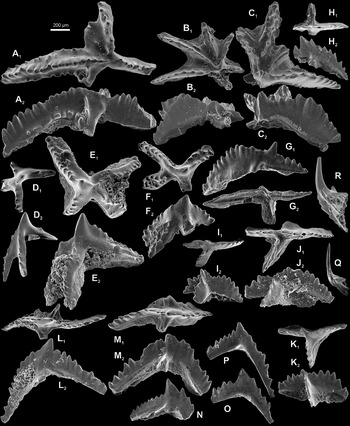
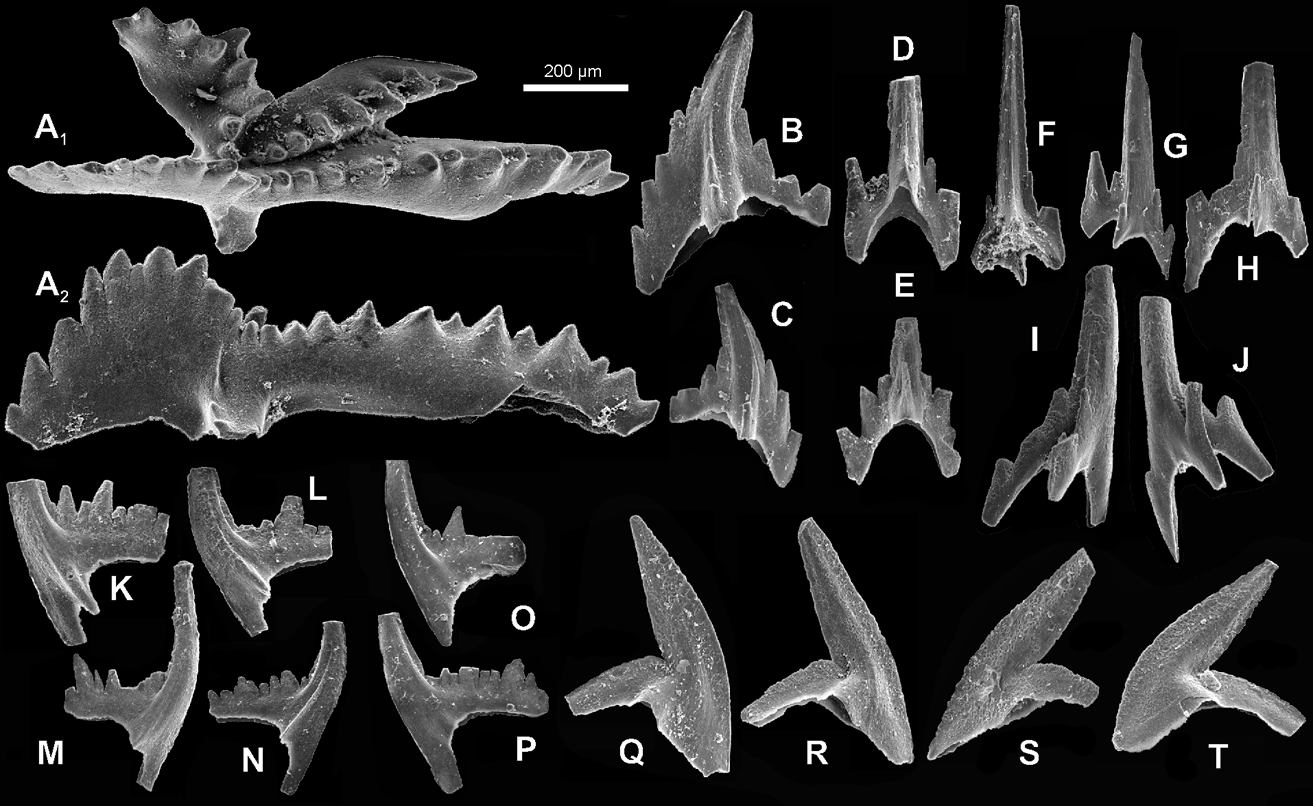
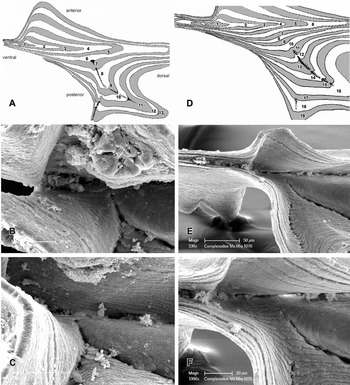
The stelliform shape of presumed P1 elements of M. quinquiradiatus resembles that of advanced Distomodus, but this is almost certainly a result of evolutionary parallelism. As in Distomodus, the relative size and distribution of the processes is very variable (Fig. 1A–C). Unfortunately, the massive basal body development prevents the tracing of growth increments within the basal cavity. Only the order of ramification of the processes, recognisable especially well in juveniles, enables their homologisation with the processes of the P1 elements of other prioniodontids. The first, anterior ramus developed together with the cusp, as in all typical prioniodontids. The second, posterior ramus originated significantly ventral of the cusp and the process develops posterodorsal orientation immediately after its origin. Subsequent ramification of these four principal processes seems to be rather chaotic and results in the formation of a bird-foot appearance of mature elements in various ways.
Moskalenkodus quinquiradiatus (Moskalenko, 1977 in Kanygin et al. Reference Kanygin, Moskalenko, Yadrenkina and Semenova1977) from exposure VK745 (Kanygin et al. 1989) of the Sandbian (mid Caradoc) Makarovo Formation near the village of Zaborie, Lena River, Siberia: (A) sinistral P1 element ZPAL c.XXII/8; (B) sinistral P1 element ZPAL c.XXII/9; (C) dextral P1 element ZPAL c.XXII/10; (D) sinistral P2 element ZPAL c.XXII/14; (E) sinistral P2 element ZPAL c.XXII/12; (F) sinistral P2 element ZPAL c.XXII/13; (G) sinistral M2 element ZPAL C/; (H) dextral juvenile M2 element ZPAL c.XXII/15; (I) dextral M2 element ZPAL c.XXII/19; (J) dextral M2 element ZPAL c.XXII/16; (K) dextral M2 element ZPAL c.XXII/18; (L) sinistral M1 element ZPAL c.XXII/20; (M) dextral M1 element ZPAL c.XXII/21; (N) dextral M1 element ZPAL c.XXII/24; (O) dextral juvenile M1 element ZPAL c.XXII/23; (P) dextral juvenile M1 element ZPAL c.XXII/22; (Q) So element ZPAL c.XXII/26; (R) sinistral S1 element ZPAL c.XXII/25.

In addition, the organogeny of P2 elements is specific for this Siberian conodont. The initial triramous prioniodontid pattern is supplemented by ramification of the ventral process, which developes an anteroventral ramus. As a result, the element develops a tetraramous appearance (Fig. 1D–F).
There are two more robust element types in the sample, which are more difficult to interpret in terms of the standard prioniodontid apparatus notation. Their carinae are rather high and their lateral processes, if developed, relatively short. One of them shows a low arching (planate disposition) of processes and the presence of an anterodorsally oriented anterior process (Fig. 1G–K). The other high-arched element has a swollen base both anteriorly and posteriorly, which gives it a cruciform appearance in occlusal view (Fig. 1L–P). This is most likely to be the M element. Both element types have a rather short and robust cusp. Their possible homology will be discussed below in connection with the probable phylogenetic position of this Siberian conodont species.
The rare S series elements found in the sample (Fig. 1Q, R) are of a morphology closely similar to those of the Silurian Distomodus and pterospathodontids (e.g., Bischoff Reference Bischoff1986; Wang & Aldridge Reference Wang and Aldridge2010).
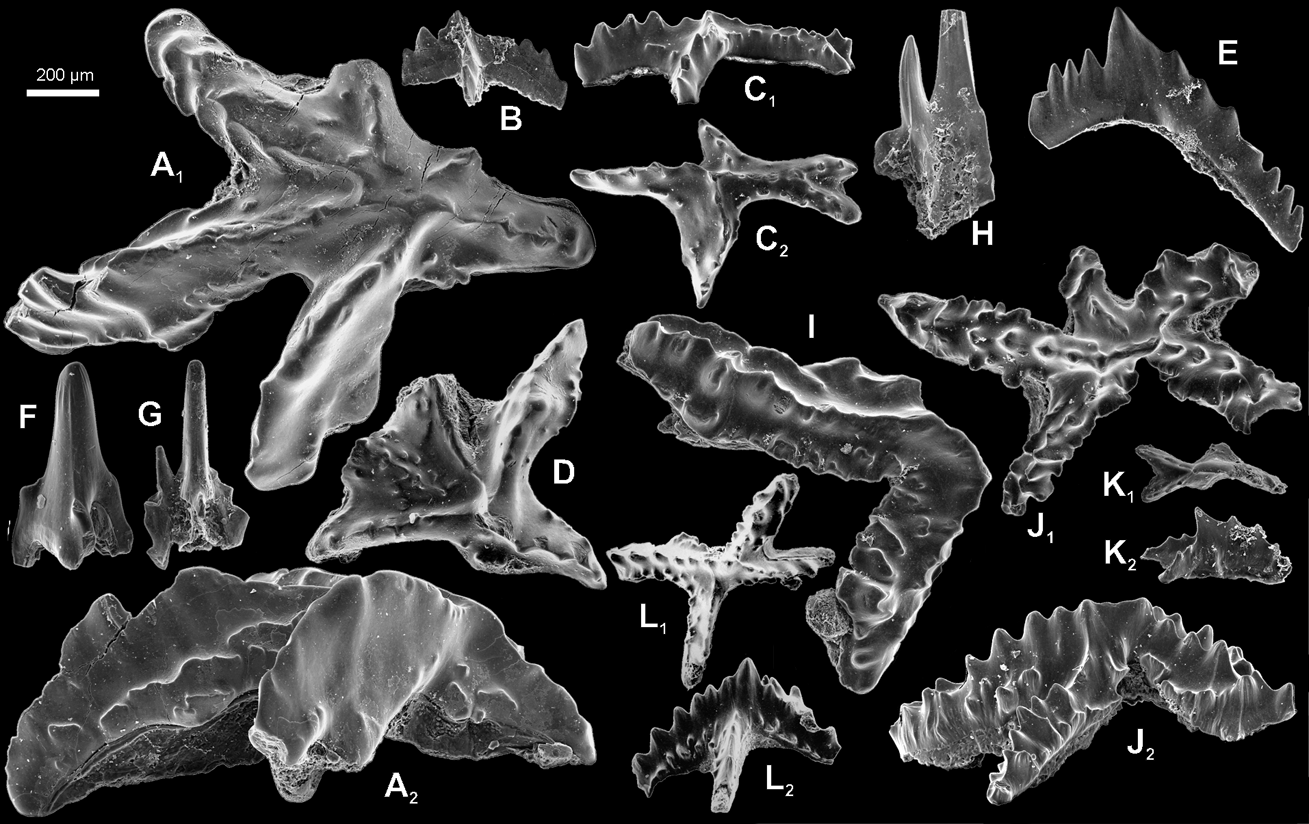
Closely similar, if not conspecific, conodont elements have been found in the presumably slightly older, and deposited in a slightly less shallow sea, lower part of the Makarovo Formation at Makarovo (Fig. 2). Because of the small sample size, it is difficult to decide whether morphological differences are due to different stages of evolution or just to chance. The most instructive is a juvenile P1 element (Fig. 2B), showing an incipient posterior process, already curved ventrally, and much more prominent rami of the bifurcating dorsal process. Apparently, later in the ontogeny, the posterior process grew much faster and eventually dominated the posterodorsal one (Fig. 2A).
(A–H) Moskalenkodus quinquiradiatus (Moskalenko, 1977 in Kanygin et al. Reference Kanygin, Moskalenko, Yadrenkina and Semenova1977) from exposure VK744 (Kanygin et al. Reference Kanygin, Moskalenko, Yadrenkina, Abaimova, Sychev and Timokhin1989) of the Sandbian (mid Caradoc) lower Makarovo Formation near the village of Makarovo, Lena River, Siberia: (A) sinistral P1 element ZPAL c.XXII/34; (B) dextral P1 element ZPAL c.XXII/29; (C) sinistral juvenile P1 element ZPAL c.XXII/28; (D) dextral P1 element ZPAL c.XXII/27; (E) dextral M1 element ZPAL c.XXII/30; (F) So element ZPAL c.XXII/33; (G) So element ZPAL c.XXII/32; (H) probable aberrant S1 element ZPAL c.XXII/31. (I, J) Moskalenkodus sp. aff. M. cruciformis (Moskalenko, 1970) from exposure VK743 (Kanygin et al. Reference Kanygin, Moskalenko, Yadrenkina, Abaimova, Sychev and Timokhin1989) of the early Sandbian Kirensk Member of the Krivaya Luka Formation near Balysheva, Lena River, Siberia: (I) sinistral P1 element ZPAL c.XXII/36; (J) sinistral P1 element ZPAL c.XXII/35 (K, L) Moskalenkodus cruciformis (Moskalenko, Reference Moskalenko1970) from exposure 572 of the Kirenskian-Kudrinian local stage (Moskalenko Reference Moskalenko1973, Reference Moskalenko1983) near the mouth of the Kokui Creek at the Podkamennaya Tunguzka River, Siberia: (K) sinistral juvenile P1 element ZPAL c.XXII/37; (L) sinistral P1 element ZPAL c.XXII/7.

This order of events in the ontogeny of members of the Makarovo population of M. quinquiradiatus may be a ‘recapitulation of phylogeny’, reflecting the status in mature P1 elements from the much older probable predecessor of the species from the latest Darriwilian or early Sandbian (latest Llanvirn or earliest Caradoc) Krivaya Luka Formation concretions at Kudrina. Only two large P1 elements have been found there, one of them complete, but they show the sequence of bifurcation in the ontogeny more clearly than those discussed above. The posterodorsal process remained longer than the posteroventral one, even at maturity (Fig. 2J). The basic prioniodontid plane of three processes is supplemented there by successive formation of two radiating posterior processes in a pattern similar to that in Distomodus.
The dorsal ramification of the P1 element provides a hint to suggest that these are members of an endemic Siberian lineage which can be traced even deeper in time. Moskalenkodus cruciformis from the Kirenskian–Kudrinian local stage at Kokui creek on the Podkamennaya Tunguzka River may represent this earlier stage in evolution. It shows a bifurcation of the dorsal process which precedes in the ontogeny even the development of a prominent anterior process (Fig. 2K). The posteroventral process remained incipient until an advanced stage of ontogeny (Fig. 2L). The type horizon of the species is pre-Volginian (Coleodus and Neocoleodus beds on the Moyero River; Moskalenko Reference Moskalenko1970).
3.1. Silurian Distomodontidae
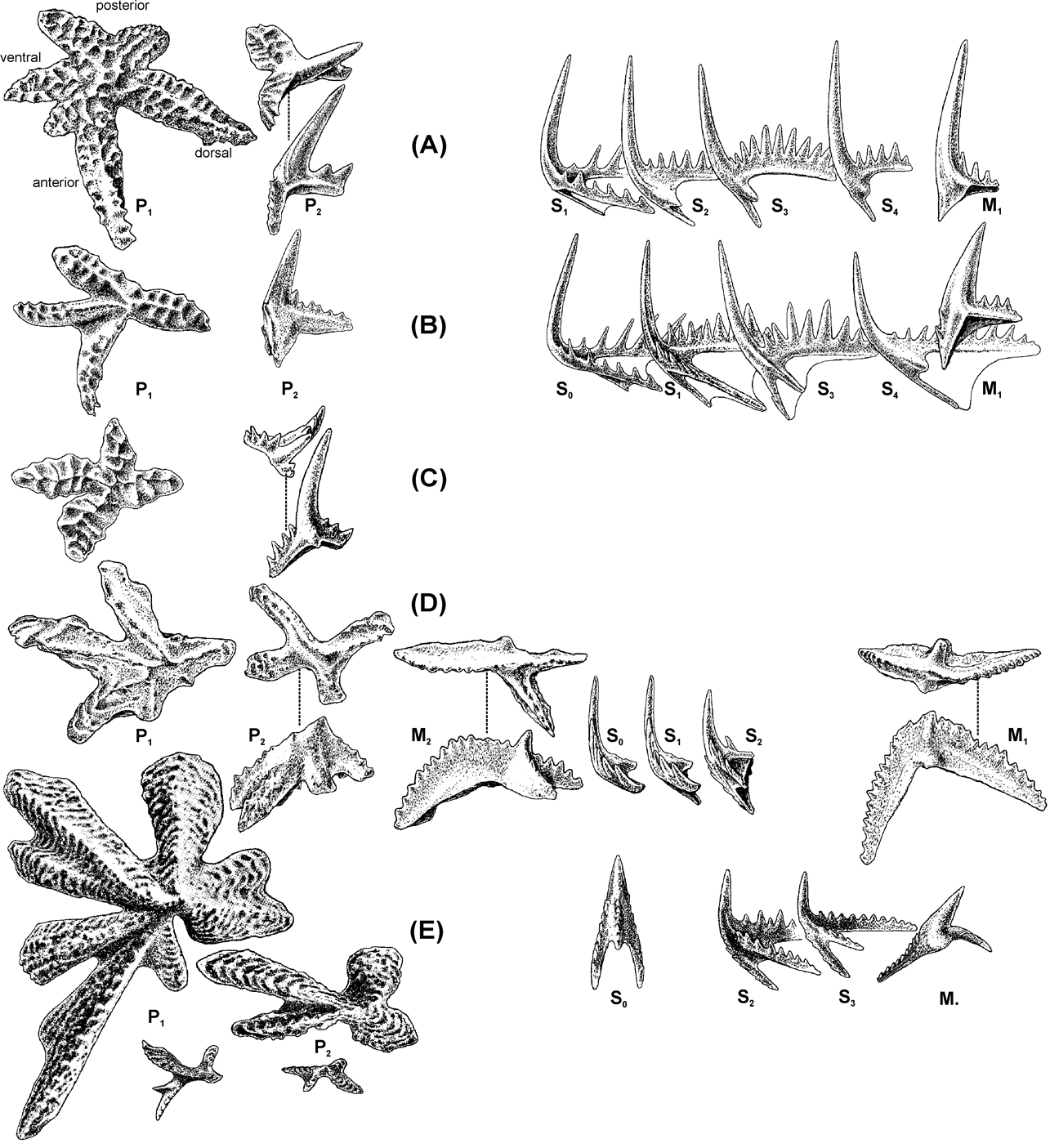
If Moskalenkodus is truly a relative of the Silurian Distomodus, the starting point of the latter lineage should merge somewhere with the Ordovician one. The most morphologically derived species of Distomodus is the bizarre D. staurognathoides (Waliser, Reference Walliser1964), with the irregular and variable appearance of its complex P1 elements (Fig. 3A). In D. staurognathoides, all the processes diverge from the cusp, which means they emerged almost simultaneously in the early organogeny. Apparently, this is a result of acceleration of ontogeny (heterochrony), as suggested by the morphology of its less derived probable predecessor D. cathayensis Wang & Aldridge, Reference Wang and Aldridge2010 from China. It seems that in D. cathayensis, the longest process is the anterior one, which originated directly from the cusp and later furcated to develop an anteroventral short process, as in other prioniodontid P1 elements. The two posterior processes developed in succession, shortly one after the other.
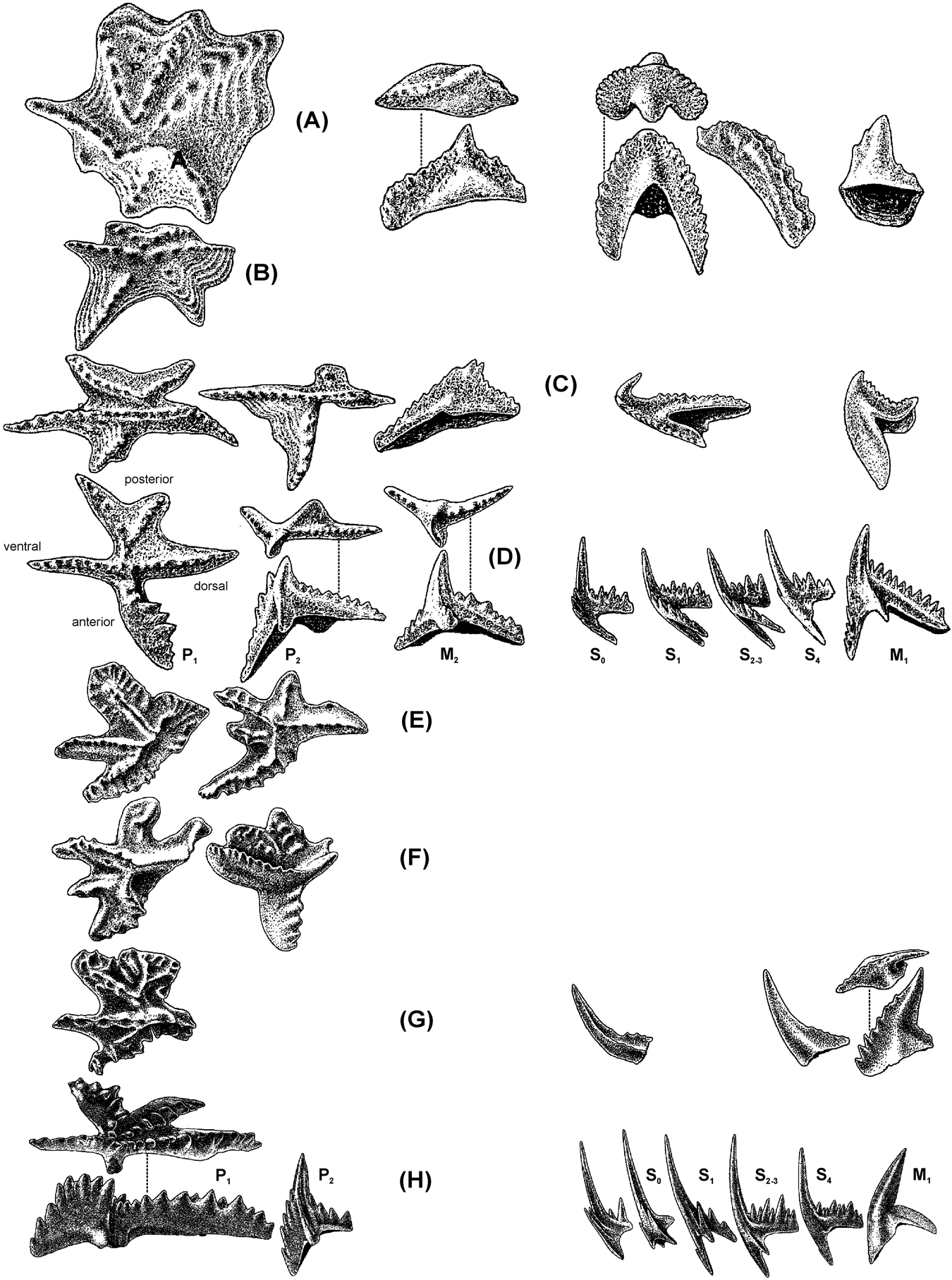
Proposed homology of identified apparatus elements and their processes within the Distomodontidae (the remaining elements have not been found because of inadequate sampling, or are hard to distinguish from elements of neighbouring locations): (A) Distomodus staurognathoides (Walliser, Reference Walliser1964) (based mostly on Bischoff Reference Bischoff1986); (B) D. pseudopesavis Bischoff, 1986; (C) D. kentuckyensis Branson & Branson, Reference Branson and Branson1947 (after Rexroad & Nicoll Reference Rexroad and Nicoll1971); (D) Moskalenkodus quinquiradiatus (Moskalenko, 1977 in Kanygin et al. Reference Kanygin, Moskalenko, Yadrenkina and Semenova1977); (E) Polonodus (Dzikodus) tablepointensis Stouge, 1984 (based on Stouge Reference Stouge1984; Löfgren Reference Löfgren1990; Zhang Reference Zhang1998).

Bischoff (Reference Bischoff1986) recognised a succession of Distomodus in the Llandovery of New South Wales which supports the proposed homology of processes. In D. pseudopesavis Bischoff, 1986, which stratigraphically precedes D. staurognathoides with a gap that may correspond to the D. cathayensis segment of the evolutionary succession, the anterior process shows an incipient bifurcation, being relatively short (Fig. 3B). There is no posterodorsal process. In even older Australian occurrences of Distomodus, P1 elements with an almost linear arrangement of posterior and dorsal processes occur, the latter being inclined posteriorward with respect to the ventral process (D. combinatus Bischoff, Reference Bischoff1986). Co-occurring specimens with the dorsal and ventral processes in the same line were classified in D. tridens Bischoff, 1986.
Such is also the disposition of processes in the oldest known species of Distomodus, the type species of the genus, D. kentuckyensis Branson & Branson, Reference Branson and Branson1947 (e.g., Zhang & Barnes Reference Zhang and Barnes2002a; Männik Reference Männik2007). This shallow-water conodont (Fig. 3C) appeared in Laurentia at the beginning of the Rhuddanian transgression (Melchin et al. Reference Melchin, McCracken and Oliff1991). All processes of its P1 elements have well developed icrions (transverse widening of denticle tips) instead of a platform, which makes Distomodus superficially similar to members of the lineage of Icriodella. However, if the evolutionary trend disclosed by the Llandovery succession of forms is extrapolated back to the Ordovician, the ancestral form would be unlike Icriodella. It should have P1 elements with a prominent anterior process directed ventrally and a posterior process with a tendency to lobation. The Distomodus apparatus had already developed a high complexity at the beginning of the Silurian. This implies that its lineage had a long within-Ordovician history, which has not been yet traced. It is possible that Siberia was the source region of the lineage, and that the still inadequately known Moskalenkodus lineage is close to the distomodontid ancestor.
If Moskalenkodus quinquiradiatus, with its four robust element types in the apparatus (Fig. 3D), is truly related to Distomodus, then Distomodontidae also had apparatuses of higher complexity than is assumed. Unfortunately, the published evidence is not conclusive in this respect. The partial bedding plane assemblage of Distomodus elements illustrated by Purnell (Reference Purnell2003, fig. 1) does not help much in restoring the complete apparatus composition. Four robust elements and their morphology also make Moskalenkodus similar to the Pterospathodontidae.
4. Possible Ordovician pterospathodontids
Moskalenkodus quinquiradiatus is not the only Ordovician conodont endemic to Siberia with stellate P1 elements. The prominent and ventrally directed anterior process seems to be its plesiomorphic aspect. In this respect, it is similar to the balognathids with an elaborate platform, including the Siberian Eoplacognathus angarense (Moskalenko, 1984 in Kanygin et al. Reference Kanygin, Moskalenko, Divina, Matukhina and Yadrenkina1984) from the middle Darriwilian (early Llanvirn) Mukteian stage on the Angara River (Moskalenko Reference Moskalenko1983; Kanygin et al. Reference Kanygin, Moskalenko, Divina, Matukhina and Yadrenkina1984). However, the pattern of bifurcation there is quite different, unless these are P2 elements, which does not seem likely due to the proportions of the processes and their rather planar disposition.
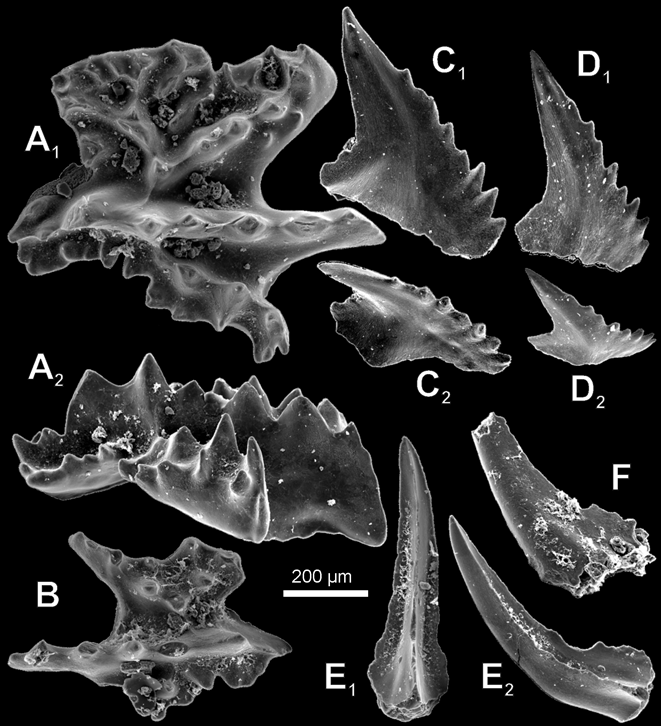
Another peculiar conodont species with ramified processes of the P1 element occurs in the Volgina Member of the Krivaya Luka Formation on the Moyero River in northern Siberia (Fig. 4). The sample includes eight P1 specimens associated with fragmentary elements of the S series and two specimens which may represent M elements. The ramiform elements are dissimilar to any other Siberian conodonts, but remotely resemble those of the pterospathodontid apparatuses.
Prattognathus sp. n. from sample 7672/71 of the latest Darriwilian (Llanvirn) Volgina Member of the Krivaya Luka Formation at the Moyero River, downstream of Bugarikhta Creek, Siberia (Moskalenko Reference Moskalenko1970): (A, B) dextral and sinistral P1 elements ZPAL c.XXII/38 and c.XXII/39; (C, D) possible M or P2 elements ZPAL c.XXII/40 and c.XXII/41 of the species; (E) associated So element ZPAL c.XXII/42; (F) associated S4 element ZPAL c.XXII/43.

The pattern of ramification of processes in these Siberian P1 elements is comparable with that of the Silurian Pranognathus or Aulacognathus, too distant in time to exclude convergence, but also of Prattognathus rutriformis (Sweet & Bergström, Reference Sweet and Bergström1962) from the Pratt Ferry Formation of the Appalachians (Fig. 5). This lithic unit can be correlated with the Baltic Uhaku stage, based on the occurrence of Cahabagnathus friendsvillensis; thus a little younger than the Volgina Member of Siberia. Bergström (Reference Bergström1983) included the second stellate P element (‘Polyplacognathus’ stelliformis Sweet & Bergström, Reference Sweet and Bergström1962) in the same apparatus. It has a disposition of processes somewhat similar to that in the platform elements of Distomodus cathayensis.
Suggested homology of identified apparatus elements within the Pterospathodontidae: (A) Apsidognathus tuberculatus Walliser, 1964 (after Wang & Aldridge Reference Wang and Aldridge2010); (B) Apsidognathus n. sp. 3 (after McCracken Reference McCracken1991); (C) Astropentagnathus araneum McCracken, 1991; (D) Pranognathus tenuis (Aldridge, Reference Aldridge1972) (after Männik & Aldridge Reference Männik and Aldridge1989); (E) Prattognathus rutriformis (Sweet & Bergström, Reference Sweet and Bergström1962) (after Bergström Reference Bergström1983); (F) Prattognathus? sp. (after Zhao Reference Zhao2000); (G) Prattognathus sp. n. (see Fig. 4); (H) Complexodus pugionifer (Drygant, Reference Drygant1974) (see Fig. 7).

Similar elements are also known from a depth of 5579.8 m in the Lunnan-50 drilled borehole in the Chinese province of Xinjiang, from the late Pygodus serra Zone (Zhao Reference Zhao2000, pl. 29: 20, but not listed on table 1-31). It may possibly be conspecific with (or ancestral to) a probable P1 element (both identified as Complexodus originalis Chen & Zhang, Reference Chen and Zhang1984) from the Yingmai-3 borehole, having a bifurcated posterior process, resembling the Siberian species (Zhao Reference Zhao2000, pl. 29: 22). The borehole core sample comes from a depth of 6257.36 m; that is, immediately below the Pygodus serra–P. anserinus transition. Both samples are intermediate in age between the Pratt Fery Formation and the Volgina Member. It is possible that these are two kinds of platform series elements of the apparatus, homologous to those of Astropentagnathus (Fig. 5).
The Siberian Prattognathus species differs from the American P. rutriformis, and from the Chinese species, in a less derived disposition of processes in the P1 elements, which seems consistent with its geological age. The ventral and dorsal processes are in a linear arrangement, instead of being sinuously bent towards the posterior processes, which merge together in the North American form. In its general appearance, it resembles rather the Llandovery Aulacognathus than any other Ordovician conodont.
4.1. Silurian Pterospathodontidae
Pterospathodus is the geologically youngest conodont, with four robust element types (labelled P and M) in the apparatus (Männik & Aldridge Reference Männik and Aldridge1989; Männik Reference Männik1998). It emerged as almost cosmopolitan in distribution at the beginning of the late Llandovery (late Aeronian and Telychian); presumably its invasion to the Baltic and Canadian seas was connected with an environmental change (Männik Reference Männik1998; Bader Reference Bader2007; Wang et al. Reference Wang, Chen, Wang and Tang2010). Although generally shallow-water, two separate lineages of different bathymetric preferences developed, according to Männik (Reference Männik1998). Both evolved towards larger individual size and a more complex platform of P1 elements in adults.
The diagnostic character of Pterospathodus is a supressed anterior (conventional ‘lateral’) process in the P1 elements, which initially developed before the bifurcating posterior process (Wang & Aldridge Reference Wang and Aldridge2010, p. 40). One may infer that the ancestor of the lineage had this process fully developed. This is the case in Pranognathus tenuis (Aldridge, Reference Aldridge1972), which preceded the oldest chronospecies of Pterospathodus in the early Aeronian (Männik & Aldridge Reference Männik and Aldridge1989; Radcliffe Reference Radcliffe1998), having other elements of the apparatus closely similar. The anterior process in the P1 is prominent there. It is perpendicular to the main processes, or even dorsally bent, which seems to be an apomorphy exclusive for the genus (Fig. 5D). Although separated by some gap in its stratigraphic occurrence (Männik & Aldridge Reference Männik and Aldridge1989; Männik Reference Männik1998), the hypothesis that Pranognathus was ancestral to Pterospathodus seems reasonable (an alternative interpretation was offered by Zhang & Barnes Reference Zhang, Barnes, Beaudoin and Head2002b).
A relatively long anterior process is also a feature of Aulacognathus, representing a relatively deeper-water lineage in the Telychian. The Aulacognathus lineage was mostly coeveal to that of Pterospathodus, but they occurred separately in different environments (Bader Reference Bader2007). As suggested by their stratigraphic occurrence, this was a succession of populations, with the evolution between the former two proven by the occurrence of transitional forms (Bader Reference Bader2007, p. 48). The morphology of A. bullatus, the most ancient member of the pterospathodontid clade, may be informative regarding its possible ancestry.
Although only two kinds of platform elements have been recognised in Aulacognathus, it remains a possibility that more were present. Even more uncertain is the identification of S series elements by Armstrong (Reference Armstrong1990) and Bader (Reference Bader2007), based on just a couple of elements. According to those authors, the S elements were biramous. This is why Wang & Aldridge (Reference Wang and Aldridge2010) classified Aulacognathus in the ozarkodinid family Kockelellidae Klapper, 1981 (in Clark et al. Reference Clark, Sweet, Bergström, Klapper, Austin, Rhodes, Mülle, Ziegler, Lindström, Miller and Harris1981).
The first occurrence of A. bullatus slightly precedes the appearance of Astropentagnathus irregularis Mostler, 1967 and its sister species A. araneum McCracken, 1991, both having three pairs of elements with a well developed platform. The elements labelled Pa1 and Pa2 by Armstrong (Reference Armstrong1990), or g and f by McCracken (Reference McCracken1991), are similar in shape to each other and differ mostly in that the latter has its posterior process reduced, instead of being prominent and bifurcated. The third robust element of the apparatus has an “ambalodiform” shape, with the anterior process relatively smaller than others. Both authors attribute closely similar elements to M location, with a twisted cusp and relatively short denticulated processes. However, in their interpretations, the S series elements are basically different. According to McCracken (Reference McCracken1991) the b/c elements are triramous, with a strongly curved cusp, also closely similar to the probable M element in general shape and denticulation. Such element morphology strongly suggests prioniodontid affinity of the genus. This makes the Astropentagnathus apparatus similar to that of Aulacognathus.
Until more convincing evidence on the nature of the S series elements in Astropentagnathus and Aulacognathus is accumulated, McCracken's (Reference McCracken1991) interpretation has to be accepted as characterising the whole clade.
Apsidognathus is probably the most morphologically derived of the widely understood pterospathodontids. Its lineage emerged as the last in low-latitude regions of the Early Silurian world, after Astropentagnathus, certainly by immigration; although the stratigraphic succession may roughly reflect evolution. At first glance, the P1 elements of Apsidognathus are completely unlike those of other Llandovery conodonts. However, Apsidognathus n. sp. 3, which co-occurs with Apsidognathus tuberculatus Walliser, 1964 (McCracken Reference McCracken1991, p. 102), offers a connecting link elucidating homology of processes (Fig. 5A). In addition, the juveniles of Apsidognathus tuberculatus lobatus Bischoff, 1986 from New South Wales show how the intermediate stage of evolution from Astropentagnathus to Apsidognathus probably looked (Bischoff Reference Bischoff1986, pl. 2:7, 16).
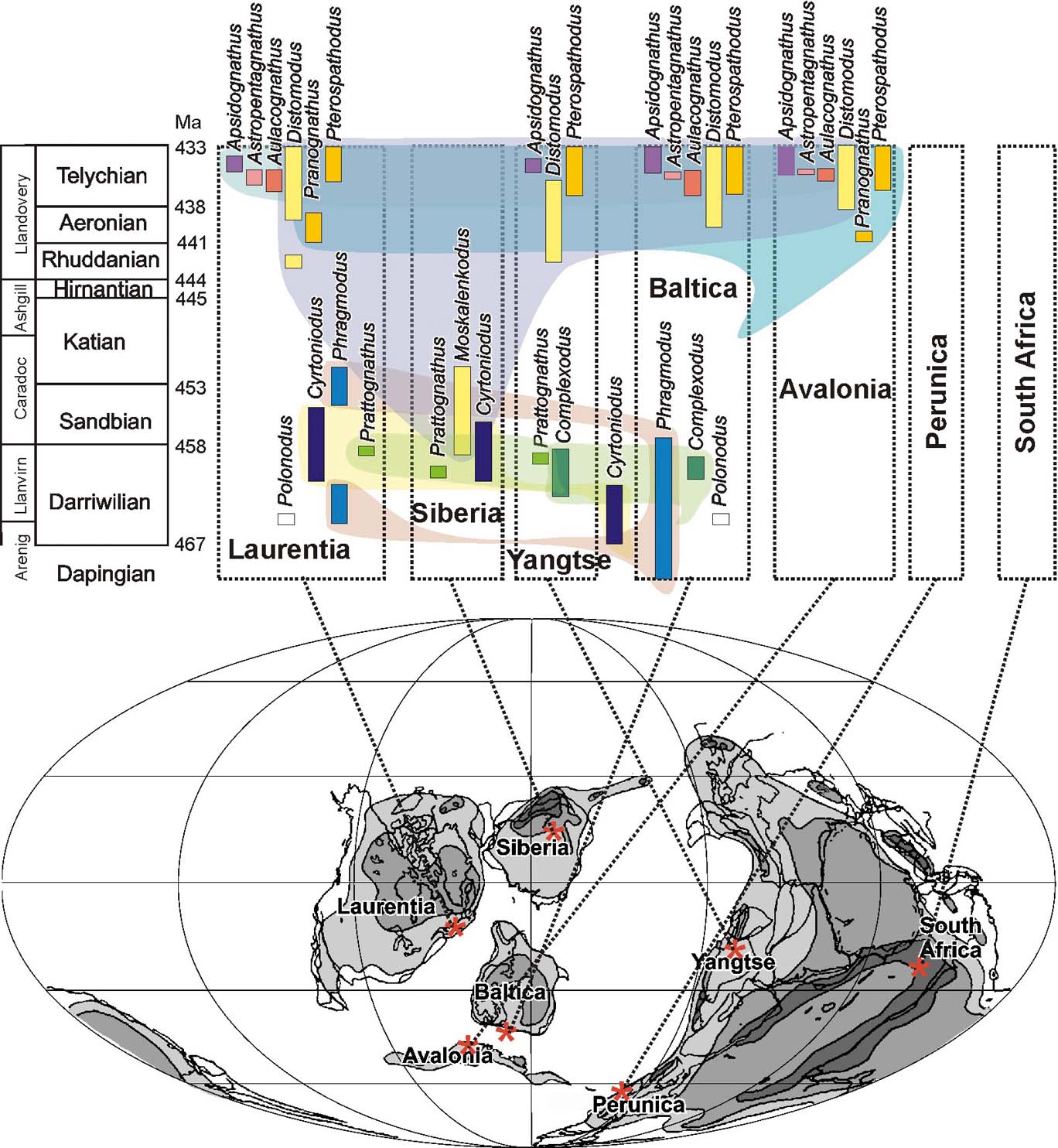
The pterospathodontids were very diverse and virtually cosmopolitan in the late Llandovery, at least in low latitudes (Fig. 6). Within this epoch, several chronomorphoclines can be traced, from the older forms of a generalised prioniodontid morphology to highly derived younger ones. Their possible Ordovician relatives are too distant in time and too incompletely known to offer support to an ancestor–descendant relationship hypothesis. The most apparent similarity between them is the disposition and relative size of processes in P1 elements. Such a morphology of P1 elements developed independently many times in the evolution of conodonts and there is a risk that similarities are homoplastic. In order to evaluate its taxonomic strength, it is necessary to understand its ontogenetic development and range of variability, which probably expresses strength of the selection pressure on particular morphologies. This is possible, owing to growth increments visible inside the basal cavity of various pterospathodontids s.l. (e.g., Bischoff Reference Bischoff1986, pl. 2:7 and 11:10, 11). Of special interest may be the record of ontogeny which can be traced within the basal cavity of the P1 elements of Complexodus, the oldest conodont with a morphology of P1 elements and S series showing similarities to the pterospathodontids and distomodontids.
Geographic and stratigraphic distribution of the known members of Pterospathodontidae and related forms, suggesting migration pattern during evolution.

4.2. Development of processes in pterospathodontid P1 elements
A powerful tool for studying the course of events and their timing in the ontogeny of conodont apparatuses is offered by growth increments exposed within the basal cavity of their elements. To gain access to them, specimens lacking a mineralised basal body are required. The growth increments show extreme rhythmicity, comparable with daily increments in the fish otoliths or mammalian tooth enamel (Dzik Reference Dzik2008). Regularity in their spacing, usually of a few micrometres, suggests that these are truly daily increments (Dzik Reference Dzik2000, Reference Dzik2008). Counts of increments can be used to determine not only the duration of particular growth stages, but also the timing of the formation of processes in the histogeny of the elements.
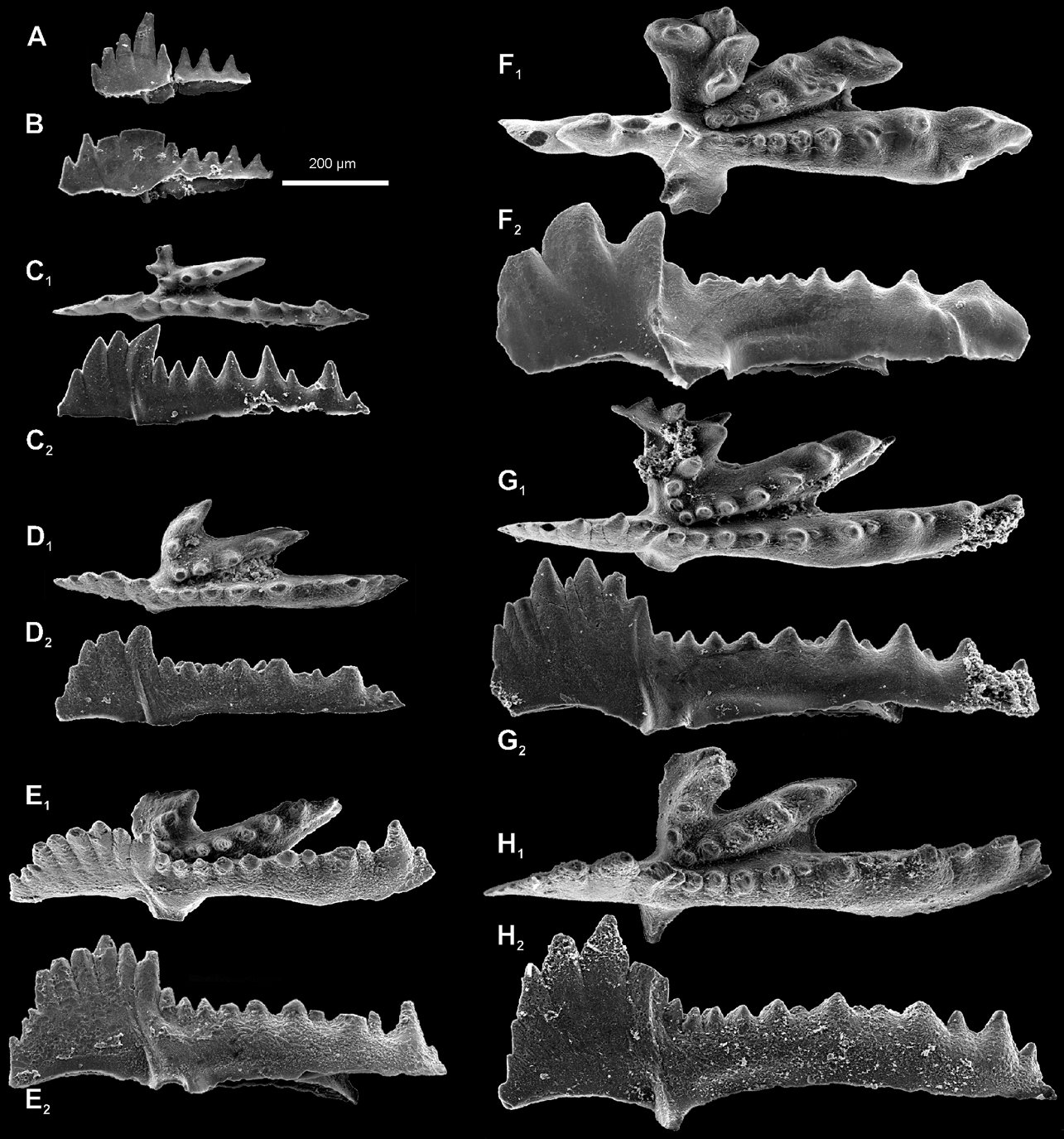
Growth increments are clearly visible in most P1 elements of Complexodus pugionifer (Drygant, Reference Drygant1974) (Fig. 7) from the Mójcza Limestone of Poland, but the present author has been unable to trace them throughout the whole ontogeny. They tend to be unreadable in places because of diagenesis and are etched too deeply to distinguish true boundaries between increments from apatite crystals layers within increments. Only in a few specimens are the early developmental stages readable with enough precision to enable the probable days of the ontogeny to be counted. Two specimens are especially informative, ZPAL c.VI/1038 and 1070 (Fig. 9). The first few increments are not visible in either specimen, being too deep within the cusp basal cavity, but their size and shape can be inferred from the distribution of the increments that follow.
Apparatus of Complexodus pugionifer (Drygant, Reference Drygant1974) from the late Darriwilian (late Llanvirn) of the Mójcza Limestone at Mójcza, Poland: (A) sinistral P1 element ZPAL c.VI/991, sample 67a; (B) sinistral P2 element ZPAL c.VI/991, sample 68a; (C) dextral P2 element ZPAL c.VI/1005, sample 67a; (D) S0 element ZPAL c.VI/1049, sample 68a; (E) S0 element ZPAL c.VI/1004, sample 67a; (F) dextral S1 element ZPAL c.VI/999, sample 67a; (G, H) dextral S1 elements ZPAL c.VI/1002 and c.VI/1003, sample 67a; (I, J) dextral and sinistral S2 elements ZPAL c.VI/1047 and c.VI/1048, sample 68a; (K) sinistral S3 element ZPAL c.VI/1046, sample 68a; (L) sinistral S3 element ZPAL c.VI/1001, sample 67a; (M) dextral S3 element ZPAL c.VI/1044, sample 68a; (N) dextral S3 element ZPAL c.VI/1000, sample 67a; (O, P) sinistral S4 elements ZPAL c.VI/1010 and c.VI/1011, sample 67a; (Q, R) dextral M elements ZPAL c.VI/1042 and c.VI/1043, sample 68a; (S, T) sinistral M elements ZPAL c.VI/1008 and c.VI/1009, sample 67a.

The anterior process was already developed in the earliest stage of ontogeny of Complexodus, as is the case in P elements of most prioniodontids. Also, the development of Pterospathodus P1 elements starts from three processes emerging directly from the cusp (Wang & Aldridge Reference Wang and Aldridge2010, text-fig. 13). The posterior process was a novelty, which emerged somewhat later as a bulge on the element base and then developed a crest with denticulation. This is a standard way of developing processes in conodont elements. The anterior process in Complexodus may develop denticulation in large mature specimens (Fig. 8F). The aspect of the early ontogeny which makes Complexodus similar to Moskalenkodus, but different from balognathids of similar mature P1 elements morphology, is that the anterior process continues to be a bulge of the basal cavity long after the denticulation of the posterior process developed. The pattern typical of M. cruciformis (Fig. 2K, L) can be easily derived from this kind of ontogeny.
Ontogeny of the sinistral P1 element of Complexodus pugionifer (Drygant, Reference Drygant1974) from the late Darriwilian (late Llanvirn) of the Mójcza Limestone at Mójcza, Poland: (A–E, G, H) ZPAL c.VI/992–996, c.VI/997 and c.VI/998, sample 67a; (F) ZPAL c.VI/1035, sample 68a.

Unlike Moskalenkodus, having separate origin of posteroventral and posterodorsal processes, a similar final configuration developed in Complexodus through bifurcation of the initially singular posterior process, shortly after its emergence. This is the course of events typical rather for the pterospathodontids than for the distomodontids. Interestingly, there is a great variability in timing of events between individuals, as shown by the number of increments separating events of bifurcation (Fig. 9). In specimen ZPAL c.VI/1038, the posterior process emerged with the 7th increment; whereas in ZPAL c.VI/1070, it took 11 increments to reach the same stage. Also, bifurcation occurred at different times in these specimens. In ZPAL c.VI/1038, it took three more increments to start it; in ZPAL c.VI/1070, this required seven increments. The pattern of ramification of P1 elements in Complexodus is so similar to that of the Silurian Pterospathodus and other pterospathodontids that homology is likely. In Pranognathus, the anterior process was the longest (in other words, its growth rate was the fastest), but the order of developing processes was the same as in Complexodus (see Wang et al. Reference Wang, Chen, Wang and Tang2010, fig. 3).
Calibration in days of the early ontogeny of the P1 element of Complexodus pugionifer (Drygant, Reference Drygant1974) from the late Darriwilian (late Llanvirn) of the Mójcza Limestone at Mójcza, Poland. Note that emergence of the posterior process precedes increase in size of the anterior process (compare with Fig. 2K): (A–C) ZPAL c.VI/1038, sample 68a; (D–F) ZPAL c.VI/1070, sample 68a.

The variable timing of the formation of processes shows that the genetic control of morphogenesis was not very strict, even in a species as morphologically uniform as Complexodus pugionifer. In Distomodus-like conodonts, it was apparently loose. This provided a background for differentiation of their growth rates, well exemplified by distinctions between homologous processes in various genera (Fig. 5).
In addition, the S elements of Complexodus are of an appearance similar to that of pterospathodontids, with relatively few denticles on short processes. The main difference between them is in that the primitive M element of Complexodus was undenticulated, and there were still only two morphological classes of robust elements. The available evidence does not allow us to determine whether this is because the apparatus was composed of only 15 elements, or because some locations were already duplicated, but not differentiated morphologically.
Admittedly, there is a large morphological gap between Complexodus and Prattognathus, and a long time distance separates their species and the Silurian pterospathodontids. Until these gaps are filled with findings of transitional forms, the pterospathodontid nature of Complexodus remains a hypothesis. Neither does Complexodus have any obvious relative amongst coeval and older prioniodontids, although some hypothetical connections may be suggested.
4.3. Possible ancestry of Complexodus
Complexodus pugionifer shows a tendency to develop icrions on the processes of its P1 elements, with a disposition resembling that of the Siberian Prattognathus and early pterospathodontids, except for a rather short anterior process (Figs 8, 9). Its apparatus is known owing to material from the Mójcza Limestone in Poland (Dzik Reference Dzik1994); some elements of the apparatus from the Guniutan Formation of south China were also illustrated by Zhang (Reference Zhang1998). C. originalis Chen & Zhang, Reference Chen and Zhang1984 preceded it in time and was its probable ancestor. At Mójcza, it replaced C. pugionifer, apparently by competitive exclusion, and re-emerged after a gap in the occurrence of the lineage (Dzik Reference Dzik1994). According to An (Reference An1987, p. 135), his Amorphognathus complexoides from the Miaopo Formation in the Zigui County and from the Guniutan Formation in the Gufu County, both the Hubei Province, South China, was the ancestor of the Complexodus lineage. The Miaopo Formation does not extend below the latest Pygodus serra and earliest P. anserinus Zones (Chen et al. Reference Chen, Bergström, Zhang, Goldman and Chen2010); it is thus younger than occurrences of C. originalis in China (Eoplacognathus reclinatus Subzone of the P. serra Zone), or even in Poland (E. lindstroemi Subzone). The anterior process of the P1 element of A. complexoides is not bifurcated (An Reference An1987, pl. 29:10); therefore it does not belong to the Amorphognathus branch. Perhaps it is a robust morph within the variability range of C. originalis. Anyway, the lineage is presumably of Yangtse origin. The migration route from the Yangtze continent towards Baltica (or Siberia and further to Laurentia) corresponds to the distribution of oceanic currents inferred from the disposition of the continents in the Ordovician (Stouge & Rasmussen Reference Stouge and Rasmussen1996).
The plesiomorphic M element excludes any direct relationship of Complexodus to the platform-bearing Balognathidae. Instead, the Phragmodus lineage, as suggested by the morphology of undenticulated M elements, seems to be the closest one to Complexodus amongst those with well known apparatuses. Presumably, it is an early offshoot of the balognathids (Dzik Reference Dzik1994; Bagnoli & Stouge Reference Bagnoli and Stouge1997; Gutiérrez-Marco et al. Reference Gutiérrez-Marco, Albanesi, Sarmiento and Carlotto2008). Such a position on the phylogenetic tree is crucial to the discussion on the origin of supernumerary element pairs that characterise pterospathodontid apparatuses. Unfortunately, the issue is greatly complicated by nomenclatorial inconsistencies.
The ancestral chronospecies of the lineage under discussion is Gothodus costulatus Lindström, Reference Lindström1955, which appeared in the Baltic region in the Oepikodus evae Zone. The subsequent segment in the evolutionary series is Phragmodus polonicus Dzik, 1978, being different in the sinuousity of the dorsal process of its S0–2 elements (Dzik Reference Dzik1994). This species is known to occur in the Lenodus variabilis Zone in the Holy Cross Mountains, Poland, and appeared somewhat later in the Canning Basin, Australia (as Phragmodus polystrophos of Watson Reference Watson1988). Bagnoli & Stouge (Reference Bagnoli and Stouge1997, p. 140) suggested the inclusion of species with undenticulated (‘oistodiform’) M elements, earlier classified in Phragmodus, into the genus Gothodus. Ironically, as shown by Leslie & Bergström (Reference Leslie and Bergström1995), the type species of Phragmodus, P. primus Branson & Mehl, Reference Branson and Mehl1933, is synonymous with P. undatus, which also had undenticulated M elements. Phragmodus Branson & Mehl, 1933 is thus the senior synonym of Gothodus Lindström, Reference Lindström1955. Cyrtoniodus Stauffer, 1935 and Subcordylodus Stauffer, 1935 are available generic names for the denticulated (‘cyrtoniodiform’) M lineage, their type species being C. complicatus Stauffer, 1935 and S. elongatus Stauffer, 1935, respectively. It is probable that both are conspecific with Phragmodus cognitus Stauffer, 1935, the holotype of which is from the same sample (Stauffer Reference Stauffer1935). There is no continuity of the lineage in the North American Midcontinent warm-water environments and its re-emergence in the Late Ordovician, with P. undatus Branson & Mehl, 1933, was an immigration event from a refuge.
Somewhat surprisingly, the apparently more advanced Cyrtoniodus spicatus (Watson, Reference Watson1988), with denticulated M elements, was already present in the Histiodella holodentata Zone (earlier than L. variabilis Zone) of the Canning Basin, Australia (Watson Reference Watson1988). This lineage expanded to the low latitudes of Siberia as Cyrtoniodus flexuosus Moskalenko, 1970. One may speculate that the sequence of evolutionary and biogeographic events was connected with the migration of these originally cold-water conodonts to the tropics; first to Siberia and then to the North American Midcontinent. The subsequent stages of evolution of the lineage, with C. inflexus (Stauffer, Reference Stauffer1935) and C. cognitus (Stauffer, Reference Stauffer1935), are typically Midcontinent conodonts (Leslie & Bergström Reference Leslie and Bergström1995).
The rooting of Complexodus in underived Prioniodontida close to the Balognathidae, and its possible relationship to the Pterospathodontidae, may mean that it already had its M elements pair duplicated, although not differentiated morphologically; that is, only slightly less derived than the apparatus of the Icriodontidae.
5. Relationships of the icriodontids
The Icriodontidae is the longest lasting branch of the Prioniodontida. Its evolution was generally towards simplification of the apparatus connected with dismembering of non-P1 elements into a set of separate denticles connected, presumably, by a purely organic process base. Numerous clusters reported by several authors (e.g., Lange Reference Lange1968; Nicoll Reference Nicoll1982) show a pair of simplified P1 elements associated with hundreds of coniform isolated denticles. It is probable that the latest Devonian icriodontids of the family Jablonnodontidae (Dzik Reference Dzik2006) had apparatuses composed exclusively of coniform elements, sometimes of bizarre shape imitating that of the Ordovician protopanderodontids. But at least until the earliest Devonian, the icriodontids had S elements with long denticulated processes (Serpagli Reference Serpagli1983). Such was also the apparatus structure of the Late Ordovician Icriodella (McCracken & Barnes Reference McCracken and Barnes1981).
Its apparatus structure is known owing to bedding plane assemblages from the latest Ordovician Soom Shale of South Africa (Aldridge et al. Reference Aldridge, Murdock, Gabbott and Theron2013). Aldridge et al. (Reference Aldridge, Murdock, Gabbott and Theron2013) named their finding Notiodella keblon Aldridge et al., 2013, basing its generic distinction on the morphology of its M elements with gently curved long dorsal processes, not reported earlier in Icriodella. They declare that “if a comparable element is recognised for Icriodella, then synonymy between Icriodella and Notiodella will have to be considered.” In fact, such gently curved dorsal process of the M element (‘dentatid’ in Webers Reference Webers1966, pl. 13: 8) characterises an Icriodella species with narrow icrion-bearing P1 elements from the Dubuque Formation of Minnesota. The Icriodella keblon apparatus is composed of 17 elements with morphologies not significantly departing from the prioniodontid standard (Fig. 10). The main difference with respect to the ozarkodinid apparatuses is in the presence of an additional element pair located dorsally in between the posterior P series elements and the anteriormost M elements. These elements, designated as P3 by Aldridge et al. (Reference Aldridge, Murdock, Gabbott and Theron2013), are morphologically close to the anterior M elements, except that their processes, serially homologous (as structures repetitive in the same organism) to the dorsal processes of the anterior M elements, are straight and relatively short (Aldridge et al. Reference Aldridge, Murdock, Gabbott and Theron2013, fig. 11). They are unlike P series elements and it is proposed that they originated by duplication of the M, not the P2, location. This may explain the discrepancy between published illustrations of isolated M elements of Icriodella superba; they are dimorphic.
Proposed homology of identified apparatus elements within the early Icriodontidae: (A) Gamachignathus ensifer McCracken et al., 1980 (after McCracken et al. Reference McCracken, Nowlan and Barnes1980); (B) Notiodella keblon Aldridge et al., 2013 (after Aldridge et al. Reference Aldridge, Murdock, Gabbott and Theron2013); (C) ‘Icriodella’ praecox Lindström et al., Reference Lindström, Racheboeuf and Henry1974 (after Bergström Reference Bergström1983); (D) ‘Icriodella’ cerata (Knüpfer, Reference Knüpfer1967) (after Dzik Reference Dzik1990).

Such a reinterpretation of the supernumerary element pair in the apparatus of Icriodella makes it similar to the coeval, Late Ordovician Gamachignathus. There are two M elements in both, with either a more prominent dorsal (‘cyrtoniodiform’) or ventral (‘falodiform’) process (e-1 and e-2 in the notation of McCracken et al. Reference McCracken, Nowlan and Barnes1980; Aldridge et al. Reference Aldridge, Murdock, Gabbott and Theron2013). Sweet (Reference Sweet1988, p. 64) attempted to remove this discrepancy in the apparatus Bauplan with respect to better known conodonts, by suggesting a dimorphic nature of Gamachignathus species. This appears unnecessary, in that two types of M elements, one with both processes denticulated, the other being undenticulated on one side, have also been later identified by Männik (Reference Männik1998) in Pterospathodus pennatus procerus (Walliser, Reference Walliser1964).
Gamachignathus shows similarities both to the earliest icriodontids and to the early members of the pterospathodontid branch. McCracken & Barnes (Reference McCracken and Barnes1981, pl. 5: 27) illustrated a large P1 element with a well developed platform and a prominent posterior (‘lateral’) process. The morphologically transitional Icriognathus from the Llandovery of Estonia, having P1 elements with an incipient icrion on its external process and the rest of the apparatus of pterospathodontid morphology, well exemplifies the proximity of Icriodella to Pterospathodus (Männik Reference Männik1992). Already, Orchard (Reference Orchard1980, p. 19) pointed out the similarity between elements of Birksfeldia (=Gamachignathus) and the homologous non-icriodontan elements of Distomodus. He proposed a close relationship between Gamachignathus and Icriodella. These genera share triramous S1 and S2 elements, which makes them different from typical prioniodontids. They also resemble the latest Ordovician Promissum, with its 19-element apparatus.
5.1. Geographic dimension of the icriodontid evolution
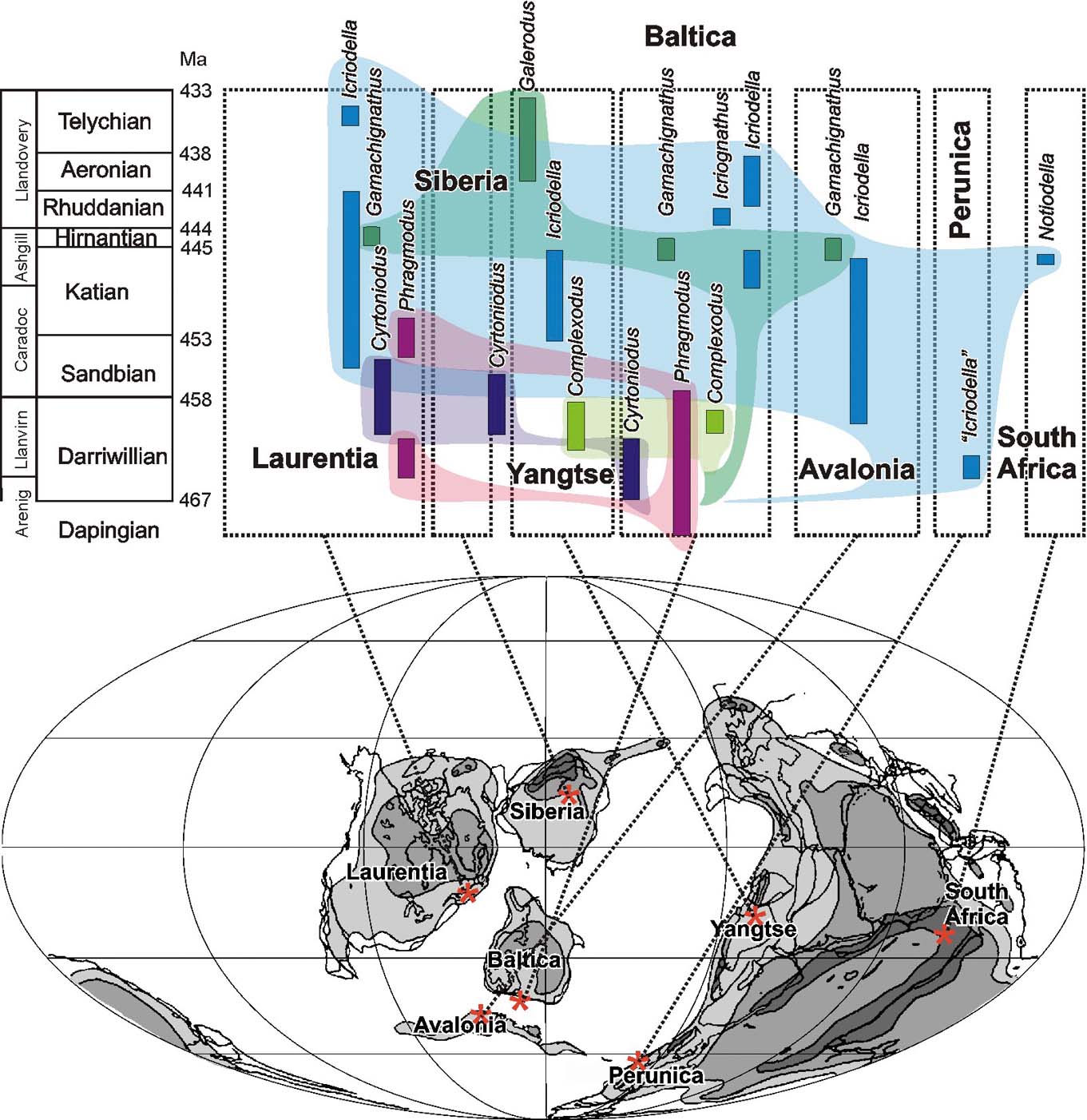
The Gondwanan location of the Soom shale findings of Icriodella may be meaningful. In addition, the oldest known probable icriodontid ‘Icriodella’ cerata (Knüpfer, Reference Knüpfer1967), of earliest Llanvirn (early Darriwilian; Kundan) age, is known from the lower iron ore horizon of Thuringia and from the phyllites of Rzeszówek in the Sudetes (Dzik Reference Dzik1990, fig. 7B), regions located at that time close to the Perunica microcontinent, near the northern margin of Gondwana.
The earliest unquestionable member of the Icriodontidae is ‘Icriodella’ praecox Lindström et al., Reference Lindström, Racheboeuf and Henry1974, which still lacked an icrion on the ventral process of its P1 element, had its S elements weakly denticulated, and the undenticulated M element geniculate. It occurs in the Postolonnec Formation of the Armorican Massif of France; in the earliest Caradoc (Llandeilian–Costonian transition beds) of Wales (Bergström Reference Bergström1983); and in the La Cierva Quartzite of the central Iberian Massif (Sarmiento et al. Reference Sarmiento, Gutiérrez-Marco, Rodríguez-Cañero, Martín Algarra, Navas-Parejo, Gutiérrez-Marco, Rábano and García-Bellido2011).
Widely gaping basal cavities of all the elements of these apparatuses are typical for many other high latitude prioniodontids of the Ordovician, but no predecessor of the lineage has been reliably identified as yet. It is possible that it was the Baltic latest Arenig Trapezognathus (e.g., Bagnoli & Stouge Reference Bagnoli and Stouge1997; Carlorosi & Heredia Reference Carlorosi and Heredia2013).
As commented above, the Gamachignathus apparatus elements show some similarity to early icriodontids, but its ancestry remains unknown. Its lineage remains cryptic for the Mid and most of the Late Ordovician, until it made a brief incursion to the tropics during the glacial epoch of the Hirnantian (Sweet Reference Sweet and Bruton1984). Gamachignathus ensifer and G. hastatus are known only from the Ellis Bay Formation on Anticosti Island, where they are numerically dominant in a significant part of the succession. In Baltica, Gamachignathus is known from strata below the Hirnantian (Kaljo et al. Reference Kaljo, Hints, Männik and Nõlvak2008; Hints et al. Reference Hints, Hints, Kaljo, Kiipli, Männik, Nõlvak and Pärnaste2010), which suggests its earlier evolution in high latitudes.
Like that of Icriodella, the lineage of Gamachignathus passed across the Ordovician boundary in the tropics, giving origin to the Llandovery Galerodus characterised by P1 elements without any anterior process (Wang & Aldridge Reference Wang and Aldridge2010). The even more structurally simplified apparatuses of Coryssognathus continued this trend of P series elements reduction to the Late Silurian, still in a warm-water environment. It was only in the Silurian that they became truly cosmopolitan, after the termination of the Late Ordovician glaciations, in the epoch of climate relatively uniform across the world.
Although the sudden appearance of several exotic conodont lineages in low latitudes of the earliest Llandovery is frequently interpreted as a result of extremely fast cladogenesis, with little contribution from Lazarus taxa (e.g., Armstrong Reference Armstrong and Hart1996, p. 106; Zhang & Barnes Reference Zhang, Barnes, Beaudoin and Head2002b), this is not likely to be the case.
The very nature of a glaciation event is a large-scale shift in distribution of environments across geographic latitudes. There is no doubt that the Late Ordovician glaciations had such a shift (e.g., Brenchley et al. Reference Brenchley, Marshall and Underwood2001), with temperate and warm climatic zones pushed periodically towards lower latitudes than before. Temperature gradients increased the intensity of oceanic circulation, which must have also resulted in climate differences between western and eastern margins of the continents. As a result, whole fossil assemblages representing warm-water communities disappeared from low-latitude localities at the beginning of each glaciation event. Warm-water communities returned with the end of the glaciation, but not necessarily from the same biogeographic source. It is hard to prove whether or not this was connected with the extinction and subsequent evolutionary radiation of particular species (Brenchley et al. Reference Brenchley, Romano, Young and Storch1991; Sheehan Reference Sheehan2001). Possible refugia may have been scattered over the world. Moreover, the terminal Ordovician eustatic sea level fall, connected with glaciations and resulting in an increase of erosion, prevented these events being widely recorded in the rocks (as listed in Zhang & Barnes Reference Zhang, Barnes, Beaudoin and Head2002b).
Despite those methodological and empirical limitations, it seems that the celebrated Ordovician–Silurian biotic revolution resulted mostly from climate-controlled migrations (more precisely, changing areas of distribution), rather than from a global extinction event followed by a sudden evolutionary recovery (Fig. 11). The immigrant from an unknown source, Gamachignathus, marks the Hirnantian cooling event in the classic Ellis Bay Formation succession on Anticosti Island. First, typically Silurian ozarkodinids appeared within its range, with no evidence of reworking (McCracken & Barnes Reference McCracken and Barnes1981; Zhang & Barnes Reference Zhang, Barnes, Beaudoin and Head2002b). These are Ozarkodina and Rexroadus of equally exotic ancestry, as shown by their dorsal (‘posterior’) process of the M elements curved in a way unknown in the Ordovician. The same happened in Estonia, with the Hirnantian cooling marked by the appearance of Noixodontus (Männik & Viira Reference Männik and Viira2012) of apparently Gondwanan ancestry.
Geographic and stratigraphic distribution of the known early members of the Icriodontidae and possible relatives, suggesting migration pattern during evolution.

Icriodella and Distomodus followed these first Silurian invaders into the relatively shallow-water environment of Anticosti Island with little delay (Radcliffe Reference Radcliffe1998), having no evolutionary roots in preceding local faunas. Aspelundia, with its Ordovician Yaoxianognathus-like straight process of the M elements, was an even later emerging Lazarus lineage. A similar succession was also recorded in Sweden (Bergström & Bergström Reference Bergström and Bergström1996). An indication that the sudden appearance of the pterospathodontid fauna was also a Lazarus event is offered by the association of Pterospathodus and Apsidognathus with a species of the typically Ordovician conodont Ansella in the late Llandovery to early Wenlock of Australia (Bischoff Reference Bischoff1997). It seems at the moment that the lineage with the most complex apparatus of all the conodonts did not survive the latest Ordovician environmental transformations.
6. Balognathid roots of Promissum
The palm of priority in complexity of the apparatus has to be given to the latest Ordovician Soom Shale Promissum pulchrum, with its 19 elements (Aldridge et al. Reference Aldridge, Purnell, Gabbott and Theron1995; Purnell et al. Reference Purnell, Donoghue and Aldridge2000).
In the presence of both tetraramous (S2) and triramous (S1, S3) elements of the S series, Promissum resembles the platform-bearing successors of Lenodus amongst the Balognathidae. Amongst them, only Sagittodontina also shows a triramous appearance of its M elements (Dzik Reference Dzik1990, Reference Dzik1994; Ferretti & Barnes Reference Ferretti and Barnes1997) and a tendency to develop bifurcation on the dorsal process of the P2 elements (known also in Rhodesognathus; Dzik Reference Dzik1994). Sagittodontina bifurcata Knüpfer, 1967, the species immediately preceding Promissum pulchrum in time, is still poorly known and only one relatively complete P1 type specimen has yet been found, which seems to show a smaller dorsal than posterior process (Fig. 12B; Knüpfer Reference Knüpfer1967). It is possible that the dorsal process was further reduced in the course of evolution towards Promissum.
Proposed homology of identified apparatus elements within the Promissum lineage of the Balognathidae: (A) Promissum pulchrum Kovács-Endrödy in Theron & Kovács-Endrödy, Reference Theron and Kovács-Endrödy1986 (after Aldridge et al. Reference Aldridge, Purnell, Gabbott and Theron1995); (B) Sagittodontina bifurcata Knüpfer, 1967 (after Dzik Reference Dzik1990); (C) S. kielcensis (Dzik, Reference Dzik1976) (after Dzik Reference Dzik1994).

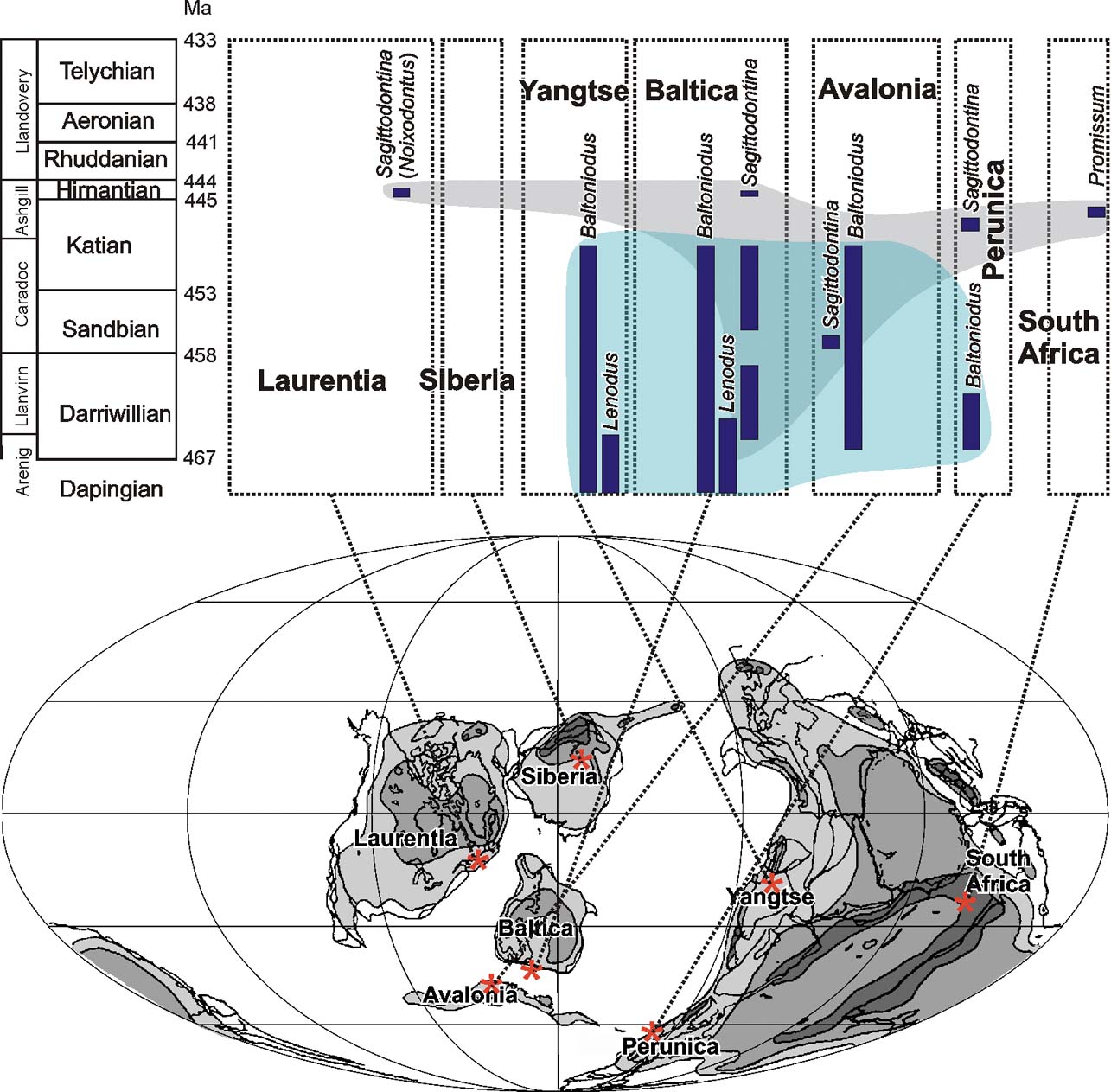
Although there is still a wide gap in the morphocline to be filled, this scenario seems consistent with the palaeogeographic distribution of the balognathids (Fig. 13). They were rooted in the Early Ordovician high-latitude continents of Baltica and Yangtse. The lineage of Sagittodontina has its oldest occurrence in the Małopolska Massive of southern Poland (Dzik Reference Dzik1994), but later it expanded to the slightly lower latitudes of the Baltic region (Männik & Viira Reference Männik and Viira2012). Its probable successor (and congener) is the latest Ordovician Noixodontus girardeauensis (Satterfield, Reference Satterfield1971) which expanded to the Ordovician tropics during climatic changes at the beginning of the Hirnantian glaciation (Männik & Viira Reference Männik and Viira2012).
Geographic and stratigraphic distribution of the Balognathidae, suggesting migration pattern during evolution.

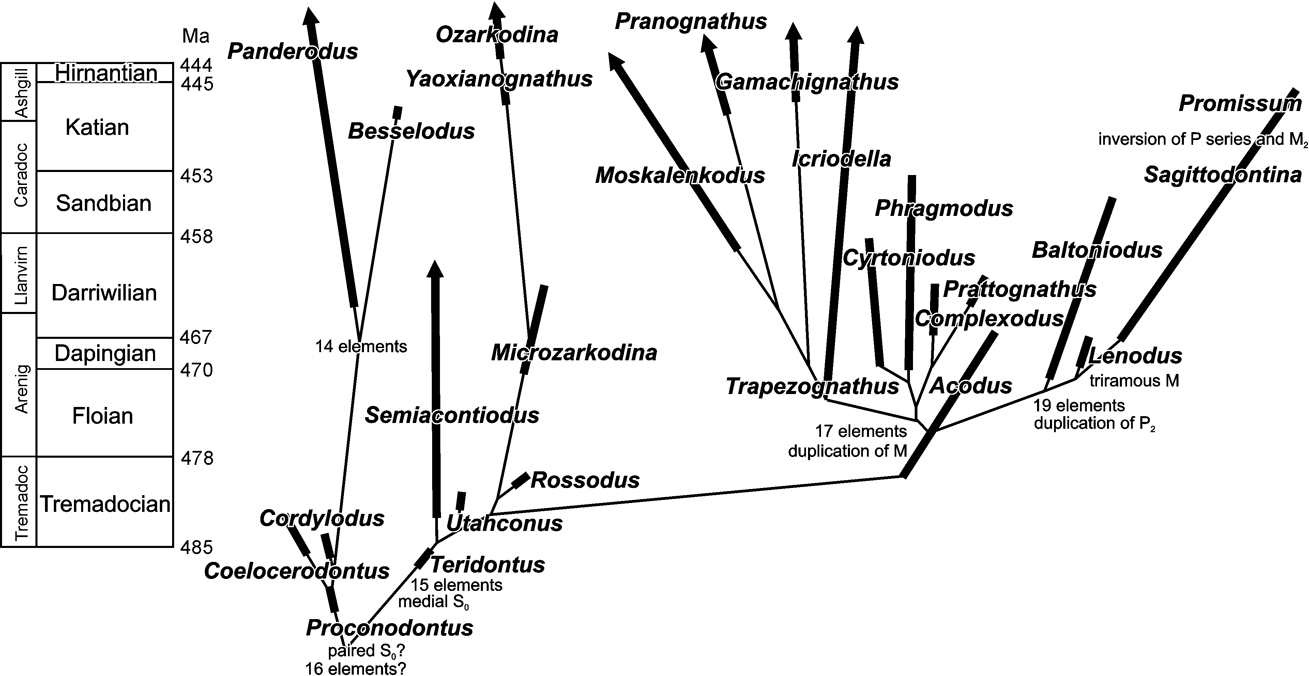
The question of when the apparatus developed its extraordinary complexity requires the elucidation of the element homology, between both the 19-element apparatus of Promissum (orthology) and the 17-element Icriodella, and serial homology (paralogy) within the apparatus. There is little doubt that the two pairs of virtually identical tetraramous platform elements in the apparatus of Promissum originated by duplication of a P series pair. These are clearly paralogues. The pairs had not yet differentiated, but this does not necessarily mean that the duplication was recent. Also, the orthology of the element pair proposed to be the fourth P element (Pd; Aldridge et al. Reference Aldridge, Purnell, Gabbott and Theron1995; also Purnell et al. Reference Purnell, Donoghue and Aldridge2000), with the Icriodella element located between undoubted M and P series, seems well supported. This location was apparently already present before the split of lineages; i.e., in the Arenig. This dates the latest possible time of transformation of the apparatus equipped with 15 elements. It is not so apparent, however, which of the element pairs, P2 or M, underwent duplication. To solve this problem, the evolution of the tridimensional organisation of the apparatus, and its functional meaning, has to be considered.
7. Functional anatomy of complex conodont apparatuses
The apparatuses of Promissum and Notiodella share with each other not only their number of elements higher than the ozarkodinid standard. Unlike underived ozarkodinids, in which the processes of the S and M elements only slightly deviate from being parallel to each other (Fig. 14A; Aldridge et al. Reference Aldridge, Smith, Norby, Briggs and Aldridge1987; Purnell & Donoghue Reference Purnell and Donoghue1997, Reference Purnell and Donoghue1998), the S series elements in Promissum and Notiodella are virtually perpendicular to the P series (Fig. 14C, E; Aldridge et al. Reference Aldridge, Purnell, Gabbott and Theron1995, Reference Aldridge, Murdock, Gabbott and Theron2013). In both apparatuses, there is a centrally located pair of elements immediately above the S series (Pd in Aldridge et al. Reference Aldridge, Purnell, Gabbott and Theron1995; P3 in Aldridge et al. Reference Aldridge, Murdock, Gabbott and Theron2013). These are biramous and, in Notiodella, similar to associated M elements; whereas in Promissum, the M element is triramous, being similar only in the strong arching of the anterior process. This similarity was already noticed by Armstrong et al. (Reference Armstrong, Johmson and Scott1996), who homologised elements of the Birksfeldia (=Gamachignathus) apparatus with those of Promissum, interpreting its ‘falodiform element’ as Pc (P3) and ‘cyrtoniodiform’ element as M, but placing them in proximity on the diagrammatic presentation of the apparatus composition. The present author has proposed (Dzik Reference Dzik2000) that they originated as a result of duplication from a single ancestral paired location, being thus M2, not P4 (Pd) elements.
Restoration of soft parts surrounding the apparatus elements of conodonts with known tridimensional disposition of elements: (A) right half of the apparatus of Idiognathodus in medial view (based on Aldridge et al. Reference Aldridge, Smith, Norby, Briggs and Aldridge1987); (B) hypothetical restoration of the head of Idiognathodus in medial section; (C) right half of the apparatus of Icriodella (Notiodella) in medial view (based on Aldridge et al. Reference Aldridge, Murdock, Gabbott and Theron2013); (D) hypothetical restoration of the head of Icriodella (Notiodella) in medial section; (E) Apparatus of Promissum (based on Aldridge et al. Reference Aldridge, Purnell, Gabbott and Theron1995); (F, G) hypothetical restoration of head of Promissum in resting and half-protruded positions.

However, there are differences in the disposition of these elements in Promissum and Notiodella. In the former (Aldridge et al. Reference Aldridge, Purnell, Gabbott and Theron1995), the proposed M2 elements have their cusps oriented dorsally, instead of anteriorly. Their bases face the cusps and denticles of the symmetry transition series elements. If this was their working position, the symmetry transition series elements would bite the soft tissue surrounding the bases of the M2 elements. Thus, the fleshing out of the three-dimensional reconstruction of the Promissum apparatus of Aldridge et al. (1995) results in some functional discrepancies. To avoid this, Aldridge et al. (Reference Aldridge, Purnell, Gabbott and Theron1995) proposed that the S array of elements could move forward by rotation about an axis located close to the P2 elements.
Another puzzling aspect of the Promissum apparatus is the reverse gradation of morphologies within the platform series elements located above the S series (Aldridge et al. Reference Aldridge, Purnell, Gabbott and Theron1995). The posteriormost P1 elements in the ozarkodinid apparatuses, as well as in the icriodontid Notiodella, differ from the preceding P2 in having an almost linear (or at least less curved) basal profile. In Promissum, the elements with a planar distribution of processes stand in front of those with reclined processes.
To explain these peculiarities, the present author has proposed (Dzik Reference Dzik2000) that the apparatus of Promissum was protrusible to a greater extent than originally proposed by Aldridge et al. (Reference Aldridge, Purnell, Gabbott and Theron1995). When in action (Fig. 14G), the symmetry transition series was in front of the platform series; the order of locations was thus the same as in the ozarkodinids. The element in the middle, interpreted as M2, faced forward whilst in action, as in Notiodella. In a resting position (Fig. 14F) the P series and M2 were reversed. If this interpretation is correct, the element pair within the platform series which underwent duplication in the ancestors of Promissum was first M and then P2. In both cases, their origin may have been enabled by an expansion of the areas at which buds of new elements originated. The formation of supernumerary elements was no longer inhibited by the morphogenetic fields of the neighbouring elements. The first step in duplication was perhaps promoted by an axial plane rotation of the S series, opening up an empty space behind the M element (Fig. 14C, D). The second duplication event would result from oppositely-directed rotation of the P series, generating an element location free space at its back (Fig. 14E–G).
The hypothesis of evolutionary change which resulted in the unusual composition and arrangement of elements in Promissum is a good exemplification of van Valen's (Reference Van Valen1982) definition of homology. Such a solution would be difficult to reach using topological evidence in the sense of Rieppel & Kierney (Reference Rieppel and Kearney2002), and it is not parsimonious in this respect. Although it resolves some functional problems with the Promissum apparatus, it has its weak points, even if Notiodella is used as a link connecting it with less complex apparatuses. This is just a hypothesis awaiting additional evidence to be tested.
No direct evidence is available for the three-dimensional disposition of elements at the beginning of the supplementation of element locations, which eventually resulted in the development of the most complex conodonts apparatuses. Another way of reasoning has to be used to complete this task.
7.1. Apparatus structure of early balognathids
The most parsimonious phylogenetic interpretation of the evidence discussed above is that the common ancestor of Promissum and Icriodella already had 17 elements and two pairs of M series elements. This also suggests that Baltoniodus, one of the most primitive balognathids, already had 17, and possibly 19, elements. To test this hypothesis, it is necessary to complete a bedding plane assemblage, which may never be found. The alternative is to infer the original apparatus element proportions from statistics of isolated elements.
Unfortunately, samples of isolated elements of Baltoniodus (e.g., Viira et al. Reference Viira, Aldridge and Curtis2006) are invariably highly unbalanced; i.e., they are enriched in some element types in respect to others. As already commented above, the pattern of unbalancing may potentially allow element types occupying single or double locations to be differentiated. This reasoning is here used to determine the original composition of the Baltoniodus apparatus, based on numerical data from the Ordovician Mójcza Limestone of the Holy Cross Mountains, Poland (Fig. 15).
Relationship between balancing index of samples from the Mójcza Limestone of the Holy Cross Mountains, Poland (Dzik Reference Dzik1994) and contribution of particular elements of Baltoniodus praevariabilis (Fåhræus, Reference Fåhraeus1966) to the total number of elements of the species in a sample. Note that the clouds of points (within shadowed fields) poorly fit the regressions expected for Ozarkodina or Promissum (broken lines), although there are apparent differences between element types occupying a single location (A: S0), a pair of locations (C: P1) or double paired locations in Promissum (A, B, D: M1–2, P2–3, possibly S1–2 and S3–4).

As expected, the pattern shown by the symmetrical S0 elements, which occupy a single location in the apparatus, is clearly different from that of all other elements, known to be paired. The ‘amorphognathid’ elements interpreted as P1 elements, which represent a single pair irrespective of proposed apparatus ground plan, differ in this respect from the remaining ‘ambalodiform’ elements of the P series. This may be interpreted as a support to the apparatus reconstruction, with their occupying two distinct locations, P1 and P2.
Whereas the contribution of robust P series elements to the sample decreases with general sample balancing, the opposite characterises the gracile S elements. The ‘cordylodiform’ S element type is known to originate in the evolution of Baltoniodus from two morphologically different types, representing two locations in the apparatus (Dzik Reference Dzik1990, Reference Dzik1994) by simplification. Their Early Ordovician ‘keislognathiform’ homologue probably represented an S3 location, the ‘cordylodiform’ one an S4 location. Interestingly, the same pattern of change in frequency is shown by the ‘tetraprioniodiform’ S and ‘falodiform’ M element types. It is possible that these types of elements were also each represented in two locations.
In Promissum, there is just one pair of tetraramous elements in the S series (S2), S1 and S3 being triramous and S4 biramous (Aldridge et al. Reference Aldridge, Purnell, Gabbott and Theron1995). It is possibile that Baltoniodus differed from Promissum in also having its S1 location occupied by tetraramous elements. In Icriodella, all the S elements were triramous (Aldridge et al. Reference Aldridge, Murdock, Gabbott and Theron2013).
The similarity in pattern of the contribution to samples between the two S series element types and P2 or M elements of Baltoniodus may mean that Baltoniodus already had these locations in the apparatus duplicated.
The anatomical arrangement of elements in these early prioniodontids remains unknown. Although the proposal of Purnell et al. (Reference Purnell, Donoghue and Aldridge2000) that descriptives of conodont elements should refer to true biological orientation is reasonable, this may not be without difficulties. The alternative is to base terminology on serial homology, which would be more convenient for students of isolated conodont elements.
8. Linnean taxonomic nomenclature
Subphylum Conodonta Sweet, 1988
Class Conodonta Eichenberg, Reference Eichenberg1930
Order Prioniodontida Dzik, 1976
Family Distomodontidae Klapper, 1981 (in Clark et al. Reference Clark, Sweet, Bergström, Klapper, Austin, Rhodes, Mülle, Ziegler, Lindström, Miller and Harris1981)
Moskalenkodus gen. n.
Type species. Amorphognathus quinquiradiatus Moskalenko, 1977 (in Kanygin et al. Reference Kanygin, Moskalenko, Yadrenkina and Semenova1977)
Diagnosis. Apparatus with stellate P1 elements and tetraramous P2 elements; cusps of both triramous M2 and biramous M1 elements low; S series elements with short processes, each bearing only a few denticles.
Species included. The type species from the the Makarovo Formation; Moskalenkodus sp. from the Krivaya Luka Formation of the Irkutsk Basin; and Moskalenkodus cruciformis (Moskalenko, Reference Moskalenko1970) from the slightly older strata of the Tunguz Basin, Siberia.
9. Conclusions
The difference between the 19-element apparatus of Promissum and the 17-element Ozarkodina-type apparatus is usually interpreted as a result of the basal split between the main conodont clades (orders Ozarkodinida and Prioniodontida; e.g., Purnell & Donoghue Reference Purnell and Donoghue1997, Reference Purnell and Donoghue1998). The recent discovery of natural assemblages of an early icriodontid (Aldridge et al. Reference Aldridge, Murdock, Gabbott and Theron2013) has provided a connecting link between apparatuses typical of these orders, and shows that the true picture of evolution was more complex (Fig. 16). The apparatus complexity of Promissum apparently developed stepwise within the Prioniodontida. The available evidence is still too limited to identify and date particular steps of this process. However, the statistical inference on Baltoniodus, presented above, weakly suggests that it was already at the grade of Promissum in its number of elements, but much behind it in its diversification of duplicated M and P2 element pairs.
Basal part of the chronophyletic evolutionary tree of conodonts showing the succession of events leading to the apparatuses with 17 and 19 elements. The horizontal axis roughly corresponds to morphological distance. The available fossil record of lineages is shown by thick lines; the proposed ancestor–descendant relationships by thin lines.

If this is true, then the Icriodontidae, bearing 17 apparatus elements and thus representing the stage prior to duplication of P2, and presumably having their roots in the balognathid Trapezognathus, differentiated the morphology of their M1 and M2 pairs independently of Promissum. The same applies to the Pterospathodontidae and Distomodontidae, which probably both evolved in the late Mid Ordovician from a relative of Complexodus. It remains unknown when this apparatus structure developed in the evolution of prioniodontids. A possibility which has to remain unresolved is that the Darriwillian (Kundan) Polonodus is close to the ancestry of Moskalenkodus. Its apparatus structure is incompletely known, but the pattern of ramification of its P series elements resembles that of the distomodontids (Fig. 3E; Stouge Reference Stouge1984). The ‘falodiform’ M element, if correctly identified (Löfgren Reference Löfgren1990; Zhang Reference Zhang1998), is quite underived. Some species of Polonodus show a conical appearance and very thin crowns of P elements, and the separate genus Dzikodus has been proposed for them (Zhang Reference Zhang1998; Mestre & Heredia Reference Mestre and Heredia2013). This distinction resembles that between Astropentagnathus irregularis and A. araneum (McCracken Reference McCracken1991), which casts doubt on its generic rank.
Cyrtoniodus inflexus is the only underived prioniodontid with an apparatus structure supported by a reasonably complete bedding plane assemblage. Specimens found in the drilling core from the infill of the Ames impact crater in Oklahoma show a complete set of symmetry transition series elements arranged parallel to each other, and probable platform series elements in close proximity (Repetski Reference Repetski1997, fig. 3). This may mean that the ancestral prioniodontid apparatus was not basically different from that of the ozarkodinids, and presumably consisted of 15 elements (Repetski et al. Reference Repetski, Purnell, Barrett and Bagnoli1998; Wang & Aldridge Reference Wang and Aldridge2010).
The common ancestor of the ozarkodinid and prioniodontid conodonts was the early Arenig Diaphorodus, with undenticulated processes of the elements, thus at the grade of coniform element morphology. Its ancestry is within Paltodus of the Distacodontidae (see Löfgren Reference Löfgren1997), which can be conveniently classified within the paraphyletic Linnean order Protopanderodontida, of disputed ancestry (Szaniawski & Bengtson Reference Szaniawski and Bengtson1998; Pyle & Barnes Reference Pyle and Barnes2002). Only incomplete clusters of elements (McCracken Reference McCracken1989) can be used to test the homology of discrete series within their apparatuses with those of more advanced conodonts. Usually, a symmetrical element showing statistical underrepresentation in samples is represented in the protopanderodontids (Dzik Reference Dzik1994), which seems missing in the most probable basal clade of ‘euconodonts’, the Panderodontida (Aldridge Reference Aldridge1982; Dzik & Drygant Reference Dzik and Drygant1986). This would mean that the posterior two element pairs were still not separated from the rest of the apparatus by the medial junction of the single symmetrical S0 element (Fig. 16). According to Andres (Reference Andres1988), symmetrical elements were also paired in the 16-element apparatus of the Tremadoc Coelocerodontus, which appears to have been a chaetognath (Szaniawski Reference Szaniawski2015).
The proposed scenario implies a profound transformation of the mouth region in the evolution of conodonts. The original state was a chaetognath-like arrangement of coniform elements in pairs of relatively uniform morphology. This was modified by the introduction of a medial S0 element at the origin of protopanderodontids, which resulted in the separation of the exposed unit of the M and S series elements from the P series elements hidden in the throat. A rotation of S series elements in early prioniodontids resulted in duplication of the M element pair (Fig. 14). In Gamachignathus, Icriodella and Pterospathodus lineages, these pairs differentiated morphologically (Fig. 10). Subsequent anteriorward bending of the P element series caused duplication of the balognathid P2 element pair, which remained undifferentiated even in the otherwise advanced Promissum.
10. Acknowledgements
I am grateful to Aleksandr Kanygin (Institute of Petroleum Geology and Geophysics, Novosibirsk) and Andrey Dronov (St. Petersburg State University) for introducing me to the Ordovician Irkutsk Basin geology. My participation in the expedition to the upper Lena River in 2007 (led by Andrey Dronov and Taras Gonta) was possible owing to the exchange program between the Polish Academy of Sciences and the Russian Academy of Sciences. Dr Jianni Liu (Early Life Institute, Department of Geology, Northwest University, Xi'an, China) kindly translated a Chinese text. Improvement to the text introduced by anonymous reviewers is highly appreciated.