Introduction
Depression during pregnancy is common, occurring in 6.5–12.9% of women worldwide (Gavin et al. Reference Gavin, Gaynes, Lohr, Meltzer-Brody, Gartlehner and Swinson2005), though symptoms are often under-reported (Boots Family Trust Alliance, 2013). A recent meta-analysis showed that women with a higher body mass index (BMI) are at greater risk of anxiety and depression (A&D) symptoms [odds ratio (95% confidence interval) = 1.41 (1.10–1.80) and 1.43 (1.26–1.61), respectively] during pregnancy compared with normal-weight women (Molyneaux et al. Reference Molyneaux, Poston, Ashurst-Williams and Howard2014). This is of concern as 1 in 5 women in the UK are obese at antenatal booking (Heslehurst et al. Reference Heslehurst, Rankin, Wilkinson and Summerbell2010). Moreover, maternal obesity and mood disorders have been independently shown to be associated with various obstetric complications, poorer birth outcomes, infant health (Alder et al. Reference Alder, Fink, Bitzer, Hösli and Holzgreve2007; Lawlor et al. Reference Lawlor, Relton, Sattar and Nelson2012), cognitive and behavioural development (Mina & Reynolds, Reference Mina, Reynolds, Pariante and Bluhm2014) and increased risk of postpartum depression (Molyneaux et al. Reference Molyneaux, Poston, Ashurst-Williams and Howard2014).
Excess gestational weight gain (GWG) is closely linked with maternal obesity (Institute of Medicine, 2009). Both maternal obesity and excessive GWG increase the risk of adverse obstetric outcomes such as gestational diabetes mellitus (GDM), macrosomia, stillbirth and excessive postpartum weight retention (PPWR) (Norman & Reynolds, Reference Norman and Reynolds2011). These in turn are associated with an increased risk of complications in further pregnancies, and risk of future metabolic and cardiovascular disorders in the mother (McClure et al. Reference McClure, Catov, Ness and Bodnar2013) and offspring (Reynolds et al. Reference Reynolds, Allan, Raja, Bhattacharya, McNeill, Hannaford, Sarwar, Lee, Bhattacharya and Norman2013). Nevertheless, approximately 20–40% of women exceed recommended international guidelines for GWG (Crozier et al. Reference Crozier, Inskip, Godfrey, Cooper, Harvey, Cole and Robinson2010).
Psychosocial and/or psychological factors may explain the limited outcomes identified in a meta-analysis of randomized trials of lifestyle interventions aimed at reducing excessive GWG in obese pregnancy (Gardner et al. Reference Gardner, Wardle, Poston and Corker2011). Obese pregnant women also reported an unwillingness to discuss weight issues with health professionals (Strychar et al. Reference Strychar, Chabot, Champagne, Ghadirian, Leduc, Lemonnier and Raynauld2000) and a negative attitude towards weight gain (DiPietro et al. Reference DiPietro, Millet, Costigan, Gurewitsch and Caulfield2003). Mood is known to influence weight gain in non-pregnancy (Luppino et al. Reference Luppino, De Wit, Bouvy, Stijnen, Cuijpers, Penninx and Zitman2010) and GWG has been linked with an increased risk of major depressive disorder during pregnancy (Bodnar et al. Reference Bodnar, Wisner, Moses-Kolko, Sit and Hanusa2009), but most lifestyle interventions in pregnancy have not addressed maternal mood symptoms such as A&D.
Recently a randomized trial using a motivational interview in obese pregnant women was found to reduce both GWG and the level of anxiety (Bogaerts et al. Reference Bogaerts, Devlieger, Nuyts, Witters, Gyselaers, Guelinckx and Van den Bergh2013b ). Although this strongly implies that maternal mood symptoms influence weight in obese pregnancy, these findings are in contrast with observations in populations of low-income women with lower rates of obesity, where higher psychosocial stress predicts lower GWG (Winkvist et al. Reference Winkvist, Stenlund, Hakimi, Nurdiati and Dibley2002; Ota et al. Reference Ota, Haruna, Suzuki, Anh, Tho le, Tam, Thiem, Anh, Isozaki, Shibuya, Ariyoshi, Murashima, Moriuchi and Yanai2011). Therefore in order to better understand how GWG and PPWR are influenced by mood symptoms, we need to simultaneously consider the effect of both maternal obesity and mood symptoms including A&D.
Mechanisms linking obesity with increased A&D remain unclear, but both are known to share many dysregulated biological pathways in non-pregnant individuals. These include altered homeostasis of neurotransmitters, metabolism, inflammation, clearance of oxidative stress and altered hypothalamic–pituitary–adrenal (HPA) axis activity (Lopresti & Drummond, Reference Lopresti and Drummond2013). In healthy pregnancy, the maternal HPA axis undergoes dramatic changes with circulating cortisol levels rising three-fold higher than in non-pregnancy (Mastorakos & Ilias, Reference Mastorakos and Ilias2003), yet our recent studies show that cortisol levels are lower in obese pregnancy (Stirrat et al. Reference Stirrat, O'Reilly, Riley, Howie, Beckett, Smith, Walker, Norman and Reynolds2014). Whether alterations in circulating glucocorticoids underpin the link between maternal obesity and mood symptoms in pregnancy is unknown.
We hypothesized that, first, maternal obesity would be associated with increased A&D symptoms during pregnancy even after adjusting for an array of obesity-linked and/or mood-linked confounders. Second, the predicted increased A&D symptoms in obese pregnancy would be associated with increased GWG, postpartum A&D symptoms and increased PPWR. Third, the increased A&D symptoms in obese pregnancy would correlate with increased circulating cortisol levels. We aimed to test these hypotheses in a prospective cohort study of over 200 very severely obese (SO) women (World Health Organization obese class III, BMI ⩾40 kg/m2) and lean controls who were assessed for symptoms of both A&D during the antenatal and postnatal periods and were characterized in detail during pregnancy.
Method
Participants
Women identified during their first community midwifery visit as having a BMI ⩾ 40 kg/m2 (SO) were referred to the Antenatal Metabolic Clinic, Simpson's Centre for Reproductive Health, Royal Infirmary of Edinburgh. These women, and lean controls with BMI ⩽ 25 kg/m2 at the booking antenatal visit, were invited to participate in a prospective cohort study from 2008 to 2013. Ethical approval and written informed consent were obtained (reference: 08/S1101/39). Details of recruitment, exclusions and participation in the study during pregnancy and postpartum are illustrated in online Supplementary Fig. S1.
All women were weighed around weeks 17, 28 and 36 of pregnancy and at 3 months postpartum (Tanita scales BC-418MA, Tanita Ltd, USA). We defined total GWG as body weight at 36 weeks – 17 weeks of pregnancy, and used the 2009 Institute of Medicine (IOM) guidelines to categorize total GWG (obese women BMI ⩾ 30 kg/m2: recommended GWG = 4.9–9.1 kg; normal-weight women BMI 18–25 kg/m2: recommended GWG = 11–16 kg). Women with SO were reviewed by a specialized dietitian and advised about healthy eating and about how to maintain their weight during pregnancy. Community midwives discussed diet and exercise with lean controls during pregnancy. PPWR was defined as – (postnatal weight loss) = weight at 36 weeks of gestation – weight at the postnatal visit. A greater difference indicates lower PPWR.
We evaluated various demographic factors preceding pregnancy (collectively termed maternal factors) and those arising during pregnancy (collectively termed pregnancy factors) which potentially influence maternal mood during pregnancy and may confound the analyses of mood assessment through questionnaire and verified the data with hospital records. Questions about traumatic obstetric history (Mota et al. Reference Mota, Burnett and Sareen2010), reproductive problems (Stanton et al. Reference Stanton, Lobel, Sears and DeLuca2002) and inflammatory disorders (Rosenblat et al. Reference Rosenblat, Cha, Mansur and McIntyre2014) were included, as these have been independently shown to affect non-pregnant women's mood. Information about major obstetric complications including GDM and pre-eclampsia was extracted from the maternity records. Women identified their minor pregnancy complications from lists provided in the questionnaire: symphysis pubic dysfunction, chest infection, heartburn, headache, carpal tunnel syndrome, constipation, sciatica, hyperemesis and urinary tract infection (Denison et al. Reference Denison, Norrie, Graham, Lynch, Harper and Reynolds2009).
Breastfeeding is known to reduce PPWR. Women were given a questionnaire about breastfeeding habits at the postnatal visit alongside mood assessments. A component of the questionnaire – responses to the question ‘Are you breastfeeding your baby now? (yes/no)’ – was included for the subsequent analysis. A ‘yes’ answer included both exclusive breastfeeding and a mix of breastfeeding and bottle-feeding with infant formula.
Mood assessments
Questionnaires were administered at the first study visit (about week 17 of pregnancy; visit 1), about week 28 of pregnancy (visit 2) and at the postpartum visit. The questionnaires comprised five previously validated self-rating items in printed format: (1) psychosocial risk factor assessment (Rosengren et al. Reference Rosengren, Hawken, Ounpuu, Silwa, Zubaid, Almahmeed, Blacket, Sitthi-amorn, Sato and Yusuf2004); (2) Satisfaction with Life Scale (SWLS; Diener et al. Reference Diener, Emmons, Larsen and Griffin1985); (3) General Health Questionnaire (GHQ; Goldberg, Reference Goldberg1972); (4) Hospital Anxiety and Depression Scale (HADS; Zigmond & Snaith, Reference Zigmond and Snaith1983); and (5) State–Trait Anxiety Index (STAI; Spielberger, Reference Spielberger1983). Total scores from each questionnaire and their clinical cut-offs were considered for further analysis.
The psychosocial risk factor assessment measures perceived stress at home, at work and financial stress using scales of ‘never’, ‘some of the time’, ‘several periods’ and ‘severe’. We also asked about the occurrence of stressful major life events such as divorce, job dismissal and bereavement. Participants’ responses to this section were later categorized into ‘none’ or ‘one and/or more major life events’.
The SWLS uses 1–7 Likert scales (1 = strongly disagree, 7 = strongly agree, range: 5–35), and was previously validated in a longitudinal pregnancy population (Dyrdal et al. Reference Dyrdal, Røysamb, Nes and Vittersø2010). Cronbach's α for the lean group was 0.929, 0.905 and 0.89 for 17 and 28 gestational weeks and postpartum, respectively. A score ⩽19 was used to define life satisfaction as ‘slightly below average’.
GHQ-12 uses binary scoring (range: 0–15). A cut-off score of 3 and 4 was recommended by the World Health Organization for the UK population (Goldberg et al. Reference Goldberg, Gater, Sartorius, Ustun, Piccinelli, Gureje and Rutter1997), but since a cut-off of 4 has been shown not to differentiate stress levels between pregnant and non-pregnant controls (Van Bussel et al. Reference Van Bussel, Spitz and Demyttenaere2006), we used a cut-off of 3 in this study.
The HADS evaluates A&D symptoms (range: 0–21 each) and has been reported to help in differentiating transient and enduring stress during pregnancy (Matthey & Ross-Hamid, Reference Matthey and Ross-Hamid2012). A score ⩾10 per component was used to indicate high risk of clinical A&D.
The STAI evaluates both state (transient) and trait (persistent) anxiety (range: 20–80 each), and has been previously validated in pregnant women with SO (Gunning et al. Reference Gunning, Denison, Stockley, Ho, Sandhu and Reynolds2010). A cut-off of 39 per component was used to indicate high risk of clinical anxiety (Spielberger, Reference Spielberger1983).
A single question ‘Have you consulted your general practitioner (GP) about mood issues in the last 2 years?’ was included. Hospital records were used to verify previous history of mood disorders, and, where applicable, the type and status of the diagnosis, counselling attendance and/or treatment with antidepressants or anxiolytic medication. At the same time points, the risk of sleep apnoea and daytime sleepiness were evaluated using self-rating paper questionnaires containing the Berlin Sleep Questionnaire (Netzer et al. Reference Netzer, Stoohs, Netzer, Clark and Strohl1999) and the Epworth Sleepiness Scale (Johns, Reference Johns1991), respectively. This is because sleep-disordered breathing is strongly associated with mood disorders (Alvaro et al. Reference Alvaro, Roberts and Harris2011), and increasingly observed in obese pregnancy (Maasilta et al. Reference Maasilta, Bachour, Teramo, Polo and Laitinen2001).
The researcher (T.H.M.) was blinded to participants’ SO/lean status during the scoring of mood questionnaires.
Serum cortisol measurement
Serum cortisol levels were measured with radioimmunoassay using the ImmuChem Cortisol 125I kit (USA) as per the manufacturer's protocol in fasting maternal samples collected at 09.00 hours during the first visit (week 17), and weeks 28 and 36 of pregnancy (Stirrat et al. Reference Stirrat, O'Reilly, Riley, Howie, Beckett, Smith, Walker, Norman and Reynolds2014). The intra- and inter-assay coefficients of variation were 6.1–8.9% and 7.6–9.3% (low and high concentrations), respectively.
Statistical analyses
Statistical analyses were performed using SPSS 19 (USA) and figures drawn with SPSS 19 and Graphpad 6 (USA). Prior to any analyses, data distribution was determined by Q-Q Plot and by histogram visualization. Where required, the data were log-transformed. For descriptive data, p ⩽ 0.05 was used as a cut-off of statistical significance.
Regression analyses were carried out with BMI as the independent variable and each mood assessment scores and other potential confounders as dependent variables for each study time point. Linear regression analyses were performed to adjust for demographic factors preceding pregnancy (maternal factors, P1), during pregnancy (pregnancy factors, P2), and both (P3). Previous history of mood diagnosis was further considered by: (1) omitting participants with a previous mental health diagnosis (P4); and (2) performing further linear regression adjusting for history of mental health diagnosis (P5). Mood assessments data were also analysed using clinical cut-offs for each questionnaire using logistic regression.
In testing the correlations among maternal mood, GWG, PPWR and serum cortisol levels, maternal mood outcomes were grouped into ‘anxiety symptoms’ and ‘depression symptoms’. Anxiety symptoms were represented by Hospital Anxiety (HA from the HADS) and both the state and trait components of the STAI, whilst depression outcomes were represented by Hospital Depression (HD, from the HADS) and the GHQ. To avoid multiple testing and the need for including a Bonferroni correction, the z-score was calculated for each outcome and we used averaged z-scores for each symptom group in the analysis. We confirmed that the z-scores reflected the general observations that A&D symptoms are highly correlated across weeks 17 and 28 of pregnancy (all Pearson's correlations >0.7, p ⩽ 0.0001) and that generally the SO group displayed poorer mood outcomes (online Supplementary Table S1). We repeated the analysis following missing data imputation using the Markov Chain Monte Carlo algorithm. No significant differences were found after comparing the original data of mood assessments and the imputed data (online Supplementary Table S2) and as the missing data were not large and there were no differences in overall findings, the analysis using the original dataset is presented.
Linear and quadratic curve-fitting was used to test whether there was any non-linear relationship between z-score anxiety and z-score depression with GWG and PPWR. MEDCURVE SPSS plug-in (http://www.afhayes.com/) was used to test whether there was any non-linear mediation by serum cortisol levels.
Ethical standards
All procedures contributing to this work comply with the ethical standards of the relevant national and institutional committees on human experimentation and with the Helsinki Declaration of 1975, as revised in 2008.
Results
Subject characteristics and confounding factors
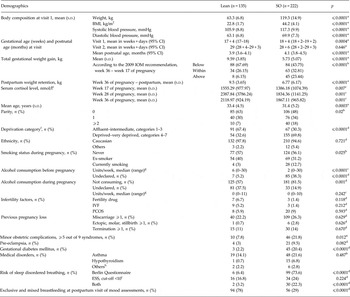
The population of this study included all women with singleton pregnancies that completed mood assessments during pregnancy in the cohort – 135 lean and 222 SO women. Table 1 presents the characteristics of the participants. Although the SO group participants were heavier than the lean group participants at each time point, they had significantly lower GWG.
Maternal body composition, gestational age at visit and demographics

SO, Severely obese; s.d., standard deviation; BMI, body mass index; CI, confidence interval; IOM, Institute of Medicine; IVF, in vitro fertilization; PCOS: polycystic ovarian syndrome; ESS, Epworth Sleepiness Scale.
Statistical tests include a t test, b χ2 test, c Mann–Whitney test, d Fisher's exact test.
e For further analysis the log-transformed serum cortisol levels were used.
f Deprivation category (McLoone, Reference McLoone2004).
g One alcohol unit follows the National Health Service guideline.
h Others include eczema, rheumatoid arthritis, multiple sclerosis and Crohn's disease.
i Johns (Reference Johns1991).
The SO group members were younger, had higher parity, and were less affluent. They consumed fewer units of alcohol preceding pregnancy, but were more likely to smoke during pregnancy than the controls. There were no significant differences between the lean and SO groups in other possible sources of maternal stress preceding the current pregnancy (Table 1). More participants in the SO group developed GDM than in the lean group, but the rates of pre-eclampsia were similar. The SO group reported a greater number of minor obstetric complications, and an increased risk of developing sleep-disordered breathing than the lean group during pregnancy (Table 1).
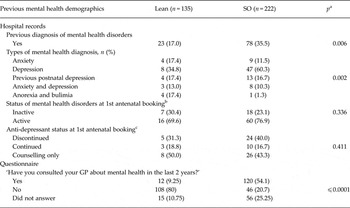
More SO women had a history of a prior mental health diagnosis, which was dominated by depression (Table 2). However, the proportions of clinically active symptoms and antidepressants prescriptions at the first antenatal booking were similar between groups. The response to the direct question ‘Have you consulted your GP about mood issues in the last 2 years?’ was consistent with the hospital records (Table 2). Altogether the SO group had more maternal and pregnancy factors that have been recognized to negatively influence maternal mood.
Mental health demographics

Data are given as number (percentage).
SO, Severely obese; GP, general practitioner.
a p Value for χ2 and/or Fisher's exact test.
b The tabulation only includes participants with previous diagnosis of mental health disorders.
c The tabulation only includes participants with active mental health disorders at the 1st antenatal booking.
SO women had higher psychosocial stress and lower mood throughout pregnancy even after adjusting for confounding factors
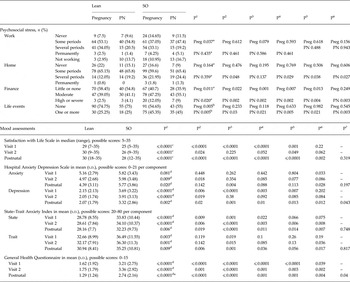
SO mothers had a higher proportion of unemployment and higher finance-related stress (Table 3). When the unemployed individuals were excluded from the analysis, the work-related stress was higher among SO mothers (p = 0.013). More SO mothers also experienced one or more traumatic life events preceding pregnancy.
Psychosocial stress, survey on consulting general practitioner regarding mental health, and mood assessments of research participants throughout pregnancy and at the postnatal stage

SO, Severely obese, PN, postnatal; P1, unadjusted; P2, adjusted for maternal factors prior to current pregnancy: age, smoking status, alcohol consumption (units/week), parity, deprivation category; P3, adjusted for maternal factors arising during pregnancy: minor complications, gestational diabetes, risks of sleep apnoea, differences of gestational visit time between the lean and obese groups at visit 1 and postnatal; P4, adjusted for factors in P2 and P3; P5,adjusted for previous history of mental health diagnosis; P6, after omitting individuals with previous history of mental health diagnosis; Preg, Pregnancy, s.d., standard deviation; P7, P5 adjusted for the results of anxiety or depression symptom assessment in pregnancy.
P1 was obtained from a χ2 test, b Fisher's exact test, c Mann–Whitney test and d unpaired t test. Linear regression was used to obtain P2, P3 and P4.
In unadjusted analyses SO mothers were less satisfied with life and had higher A&D symptoms during pregnancy (P1, Table 3). Adjusting for pregnancy factors reduced the significance of the SWLS and HADS at visit 2 (P3, Table 3); however, the SO group generally displayed poorer results in mood assessment during pregnancy (P4, Table 3). Analysing the data using clinical cut-off values of each questionnaire revealed that SO mothers were still at higher risks of A&D symptoms (P1, online Supplementary Table S3). Adjusting for maternal and/or pregnancy factors reduced the significance of the SWLS, HADS and STAI (P2, P3, P4, online Supplementary Table S3), implying that maternal and/or pregnancy factors may play a larger role in influencing mood in SO participants with higher levels of anxiety. The GHQ remained significant even after adjusting for both maternal and pregnancy factors (P4, online Supplementary Table S3).
Based on the results of the direct question and hospital records, we investigated whether the poorer mood assessment result in the SO group was independent of participants’ previous history of mental health diagnosis. We observed similar findings when we either included adjustment for – or excluded individuals with – a previous history of mental health diagnosis (Table 3). We concluded that SO prior to pregnancy was independently associated with higher A&D symptoms throughout pregnancy, independent of various demographic and pregnancy factors and previous history of mental health diagnosis.
Postpartum mood outcomes
The overall study attrition rate at postnatal follow-up for each group was approximately 30% (CONSORT table, online Supplementary Fig. S1). Women who attended for postnatal follow-up had better mood symptom scores during pregnancy than those who did not attend. In particular, SO women reported significantly better mood scores at the second visit in all domains other than HD than those who did not attend for follow-up (online Supplementary Table S4). Despite this SO was associated with increased postpartum A&D symptoms compared with lean (P4, Table 3) other than the perceived life satisfaction which increased following childbirth in both groups (online Supplementary Fig. S2). The significance of the anxiety subsection of the HADS at the postpartum visit was reduced after adjusting for maternal factors (P2, Table 3). Higher postnatal anxiety symptoms in SO mothers were dependent on earlier anxiety symptoms during pregnancy, but not depression symptoms (P7, Table 3).
Inverted U-shape relationship between GWG and maternal mood symptoms
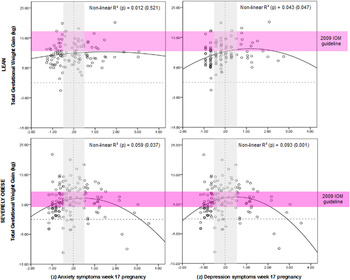
No linear correlations between maternal mood symptoms at week 17 of pregnancy and total GWG were found in either group. Mood symptoms formed an inverted U-shaped relationship with total GWG (Fig 1). At (z) anxiety and (z) depression symptoms = 0, GWG of both groups was within the 2009 IOM guideline recommendations, but gains were below the guideline with lower and higher levels of A&D symptoms. Both (z) anxiety and (z) depression symptoms were correlated significantly with GWG in the SO group, whereas only the (z) depression symptoms were correlated significantly with GWG in the controls. The majority of the scatters with (z) depression symptoms ⩽0 aggregated very tightly, implying that the majority of the correlation was due to participants with higher depression symptoms. Overall, Fig. 1 implies that either low or high maternal symptoms of anxiety and/or depression result in lower total GWG than the 2009 IOM guideline, particularly in SO women.
Anxiety and depression symptoms in week 17 of pregnancy correlate non-linearly with total gestational weight gain. Total gestational weight gain = weight (kg) at week 36 of pregnancy – weight at week 17 of pregnancy. (z) Anxiety symptoms = average of (z) Hospital Anxiety and (z) State–Trait Anxiety Index. (z) Depression symptoms = average of (z) Hospital Depression and (z) General Health Questionnaire. The 2009 Institute of Medicine (IOM) guideline for the lean group = 11–16 kg, and for the severely obese group = 5–9 kg.

Maternal mood symptoms are associated with increased PPWR in the SO group, independent of total GWG and breastfeeding
The SO group had significantly lower PPWR and lower proportion of breastfeeding at the postnatal visit as compared with the controls (Table 1). Increased PPWR was associated with increased maternal A&D symptoms at week 17 of pregnancy in the SO group, but not in the controls (online Supplementary Table S5). Therefore regression analyses were performed in the SO group only. Table 4 shows that increased maternal A&D symptoms at week 17 of pregnancy were associated with significantly increased PPWR in the SO group, independent of total GWG and breastfeeding.
Increased maternal anxiety and depression symptoms in week 17 of pregnancy are associated with increased postpartum weight retention a in the severely obese group

P1, All demographic factors as defined in the demographic table and time points at postnatal visits; P2, demographic factors + breastfeeding; P3, demographic factors + breastfeeding + total gestational weight gain.
a Postpartum weight retention = – (postnatal weight loss).
* Significant at p⩽0.05.
The associations of increased A&D symptoms in maternal SO with GWG and PPWR are independent of circulating glucocorticoids
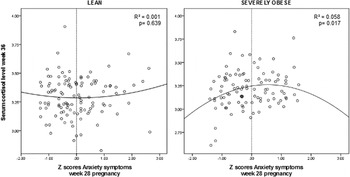
Serum cortisol levels were lower in pregnancy with SO (Table 1), consistent with our previous observations (Stirrat et al. Reference Stirrat, O'Reilly, Riley, Howie, Beckett, Smith, Walker, Norman and Reynolds2014). In the SO group, anxiety symptoms at week 17 of pregnancy formed an inverted U-shape correlation with serum cortisol level at late gestation such that cortisol levels were lowest in those with the lowest or highest anxiety symptoms (Fig. 2). Serum cortisol level at week 28 of pregnancy formed a U-shape relationship with total GWG in the SO group such that the lowest and highest cortisol levels were associated with greatest GWG (R 2 = 0.051, p = 0.03). Increased serum cortisol level at week 36 of pregnancy was associated with increased PPWR in the SO group in adjusted analyses (β = −0.45, p = 0.03). A mediation analysis showed that serum cortisol level did not mediate the association of anxiety symptoms with total GWG (p = 0.08) or with PPWR (p = 0.50) in SO women.
Anxiety symptoms are correlated non-linearly with the level of serum cortisol at week 36 of pregnancy in severely obese women. R 2 = the coefficient of correlation, the curve-fitting result of the quadratic function. No significant linear correlation was found.

Serum cortisol levels were not related to depression symptoms in SO, and no correlations were observed in the lean group. Serum cortisol level at week 28 of pregnancy was associated with reduced total GWG in controls in unadjusted and adjusted analyses (r = 1.9, p < 0.05; β = −2.2, p < 0.05, respectively). There were no associations between cortisol levels and PPWR in lean women.
Discussion
In this prospective cohort study, we demonstrated for the first time that maternal SO is associated with higher antenatal and postnatal A&D symptoms compared with normal-weight controls, independent of a large number of confounders including several maternal and pregnancy factors and previous mental health diagnosis. We further showed the adverse associations between anxiety symptoms in early pregnancy and weight outcomes were not mediated by serum cortisol levels.
Many of the anxiety, but not depression, outcomes were attenuated after adjusting for pregnancy factors, implying that the majority of antenatal anxiety symptoms were pregnancy-specific, and can therefore be targeted for intervention during pregnancy. In contrast to findings in an intervention trial using motivational interviews in an obese (BMI > 30 kg/m2) pregnant cohort from the Netherlands (Bogaerts et al. Reference Bogaerts, Devlieger, Nuyts, Witters, Gyselaers, Guelinckx and Van den Bergh2013b ), we did not find significant changes in the STAI scores in SO women during the course of pregnancy. This was unlikely to be due to the higher severity of obesity in our cohort, as the mean STAI scores were similar to those of the women in the Netherlands cohort (Bogaerts et al. Reference Bogaerts, Devlieger, Nuyts, Witters, Gyselaers, Guelinckx and Van den Bergh2013b ). A decrease of anxiety symptoms therefore seems achievable only when they are specifically addressed during antenatal care.
On the other hand, the higher antenatal GHQ scores in the SO group as compared with controls, which remained significant following adjustments for multiple confounders, indicate that depression symptoms are not pregnancy-specific. Whilst the antenatal care given in our study and the motivational interview in the Netherland cohort (Bogaerts et al. Reference Bogaerts, Devlieger, Nuyts, Witters, Gyselaers, Guelinckx and Van den Bergh2013b ) appear sufficient in preventing the aggravation of depression symptoms, a more specific pharmacological or behavioural intervention such as counselling and/or cognitive behavioural therapy may be required to significantly reduce depression symptoms in obese pregnant women.
Our findings support the view that antenatal anxiety symptoms are one of the leading risk factors for postnatal anxiety symptoms (Lancaster et al. Reference Lancaster, Gold, Flynn, Yoo, Marcus and Davis2010). Although antenatal depression symptoms remain a major risk factor for postpartum depression, our findings, albeit that we have studied symptoms rather than clinically diagnosed disease, support the argument that postpartum depression has a distinct aetiology (birth and parenting) from antenatal depression (demographic factors). Ultimately antenatal mood symptoms in a vulnerable subpopulation such as SO pregnant women should be highlighted to healthcare professionals to help prevent possible postpartum mood disorders, and hopefully improve maternal and infant wellbeing.
In considering whether an intervention in early pregnancy could prevent the potential negative effect of antenatal mood symptoms, we evaluated the link between maternal mood symptoms at the first visit (week 17 of pregnancy) and pregnancy outcomes of GWG and PPWR. The reason for a non-linear correlation between maternal mood and GWG is unknown but this may partly explain the previous conflicting literature about mood and patterns of GWG in women with different levels of obesity (Guelinckx et al. Reference Guelinckx, Devlieger, Mullie and Vansant2010; Rauh et al. Reference Rauh, Gabriel, Kerschbaum, Schuster, Von Kries, Amann-Gassner and Hauner2013). Whilst there is currently a lack of guidance of optimal GWG for women with very SO, and a lack of consensus about the best way to measure GWG (Gilmore & Redman, Reference Gilmore and Redman2015), this non-linear correlation appears to be more physiologically relevant in the SO group as the proportion of pregnant women with high mood symptoms and the magnitude of total GWG deviation from the IOM guidelines was greater in the SO group as compared with controls. Mothers with SO and lower levels of A&D symptoms may have possibly invested greater effort in managing their diet, resulting in less GWG. Nevertheless, the management of obese pregnancies should strongly consider addressing A&D symptoms since the more extreme the mood symptoms, the further the total GWG deviated from that of women with average levels of mood symptoms.
The association between antenatal A&D symptoms and PPWR has not been previously reported in obese pregnancy. Bogaerts et al. (Reference Bogaerts, Devlieger, Nuyts, Witters, Gyselaers, Guelinckx and Van den Bergh2013a ) recently reported the association between antenatal anxiety symptoms, but not depression symptoms, with increased PPWR in obese women. But unlike our study, the Bogaerts et al. (Reference Bogaerts, Devlieger, Nuyts, Witters, Gyselaers, Guelinckx and Van den Bergh2013a ) study lacked healthy-weight controls and the participants were less SO (BMI = 34.4 kg/m2). Both the non-linear correlation between maternal A&D symptoms and GWG and the lack of a specific intervention for mood symptoms may explain why lifestyle interventions targeting GWG and/or PPWR have had limited success so far (Gardner et al. Reference Gardner, Wardle, Poston and Corker2011).
The findings in a meta-analysis in a non-pregnant population, where acute stress promotes increased cortisol levels (Dickerson & Kemeny, Reference Dickerson and Kemeny2004) but prolonged stress promotes blunted cortisol reactivity, resulting in lower systemic cortisol (Burke et al. Reference Burke, Davis, Otte and Mohr2005), may explain the inverted U-shape correlation between anxiety symptoms, but not depression, and serum cortisol level at late gestation. Such a time-specific correlation is possibly due to the transforming maternal HPA axis during early pregnancy, together with a higher trajectory of cortisol level with anxiety in pregnancy (Kane et al. Reference Kane, Dunkel- Schetter, Glynn, Hobel and Sandman2014) and the generally lower levels of circulating cortisol in SO women as compared with controls. The U-shape correlation between cortisol levels and GWG found in the SO group was unexpected and was in contrast to the inverse linear relationship observed in the lean women. A recent observation showed that obese pregnant women with excessive GWG had the highest evening cortisol levels as compared with lean women (Aubuchon-Endsley et al. Reference Aubuchon-Endsley, Bublitz and Stroud2014). However, we did not observe any direct mediation by cortisol of the links between A&D symptoms on either GWG or PPWR. We acknowledge that a single measurement of cortisol in the morning, when levels are likely to be highest, provides limited information about activity of the maternal HPA axis, thus limiting the interpretation of our data. Future studies should consider the assessment of free cortisol, daily profiling, and/or the circadian, placental and fetal effects on the maternal HPA axis.
The main strength of our study is the prospective study design. The detailed characterization of women during pregnancy enabled us to adjust for multiple important risk factors that have not been considered simultaneously in pregnancy such as sleep-disordered breathing, infertility and inflammation disorders. Furthermore, the very clear differences in obesity levels between our SO and control groups enabled us to determine independent effects of obesity, unlike other studies with overweight and less SO women (Molyneaux et al. Reference Molyneaux, Poston, Ashurst-Williams and Howard2014). The higher proportion of deprivation among the SO mothers than in the lean group is a limitation; nevertheless, this is consistent with findings from the UK national survey where maternal obesity correlates with deprivation and income level (Heslehurst et al. Reference Heslehurst, Rankin, Wilkinson and Summerbell2010) and we adjusted all analyses for deprivation category. The total GWG, which as calculated between 17 and 36 weeks of gestation, may have underestimated the actual total GWG as defined by the IOM. However, since the total GWG at (z) score anxiety and depression = 0 was within the IOM guideline in both groups, this did not seem to pose significant problems. Finally, we collated our anxiety and depression questionnaires using z-scores to minimize multiple statistical testing.
We were limited by the 30% attrition rate at postnatal follow-up, though this was similar in both lean and SO groups. Of note, those who did not attend for follow-up had poorer antenatal mood scores than those who did, particularly in the SO group and so it is likely that we may have underestimated the postpartum mood differences between groups. Further, the opportunistic sampling of women attending our antenatal clinic could have introduced a selection bias towards SO women with more or fewer A&D symptoms, though the socio-economic status of SO women in this study were representative of SO women delivering in the hospital but not attending the clinic (R. M. Reynolds, unpublished observations). We were also unable to define PPWR by subtracting postnatal weight with weight preceding the pregnancy, as these data were unavailable. However, our calculation of PPWR was free from any bias of maternal recall. We could not segregate exclusive breastfeeding from mixed breast/bottle-feeding, as the proportion of exclusive breastfeeding was very low, even in the controls. This has not been previously discussed (Bogaerts et al. Reference Bogaerts, Devlieger, Nuyts, Witters, Gyselaers, Guelinckx and Van den Bergh2013a ). Finally, despite the detailed characterization of the cohort, it is possible that other unmeasured and not fully measured confounders could have accounted for the associations.
In conclusion, SO during pregnancy is associated with significantly poorer antenatal and postnatal maternal mood symptoms. Both anxiety and depression symptoms formed an inverted U-shape relationship with total GWG where either few or several adverse mood symptoms were associated with less total GWG. This information should inform strategies to optimize GWG in SO women.
Supplementary material
For supplementary material accompanying this paper visit http://dx.doi.org/10.1017/S0033291715001087
Acknowledgements
We thank the research participants, Sister Yvonne Greig, Sister Norma Forson and the Wellcome Trust Clinical Research Facility. We are grateful to the generous funding from Tommy's the Baby Charity. T.H.M. is funded by a Principal Development Scholarship, Charles Darwin Scholarship and Global Research Scholarship, University of Edinburgh, Scotland. We acknowledge the support of the British Heart Foundation.
Declaration of Interest
None.