Introduction
Background
Anti-N-methyl-d-aspartate receptor encephalitis (ANMDARE) represents a multidisciplinary clinical challenge. It is a neurological disease presenting with acute psychiatric features, which requires immunological treatment. At a molecular level, it is defined by the presence of immunoglobulin G (IgG) autoantibodies against the N-methyl-d-aspartate (NMDA) receptor's NR1 subunit, that are related to polymorphic neuropsychiatric manifestations (Al-Diwani et al., Reference Al-Diwani, Handel, Townsend, Pollak, Leite, Harrison and Irani2019; Gibson et al., Reference Gibson, Pollak, Blackman, Thornton, Moran and David2018; Warren, Siskind, & O'Gorman, Reference Warren, Siskind and O'Gorman2018).
The discovery of ANMDARE has meant an essential change in the diagnostic approach to patients with acute behavioral disturbances (Espinola-Nadurille et al., Reference Espinola-Nadurille, Flores-Rivera, Rivas-Alonso, Vargas-Cañas, Fricchione Gregory, Bayliss and Ramirez-Bermudez2019; Maneta & Garcia, Reference Maneta and Garcia2014). ANMDARE occurs generally in the absence of prior psychiatric history. Before progressing to unequivocal neurological signs, most patients debut with acute or subacute psychiatric features, leading to frequent psychiatric referrals, misdiagnoses, and treatment delays (Al-Diwani et al., Reference Al-Diwani, Handel, Townsend, Pollak, Leite, Harrison and Irani2019; Lejuste et al., Reference Lejuste, Thomas, Picard, Desestret, Ducray, Rogemond and Honnorat2016; Warren et al., Reference Warren, Siskind and O'Gorman2018). As delayed immunotherapy is associated with poorer prognosis and higher mortality (Titulaer et al., Reference Titulaer, McCracken, Gabilondo, Armangué, Glaser, Iizuka and Dalmau2013), different research groups worldwide are concerned with defining the early neuropsychiatric phenotype of ANMDARE. Psychomotor agitation and aggressive behavior have been recognized as frequent behavioral features, and psychotic symptoms are among the most consistently reported disturbances, with frequencies ranging from 45% to 67% (Al-Diwani et al., Reference Al-Diwani, Handel, Townsend, Pollak, Leite, Harrison and Irani2019; Warren et al., Reference Warren, Siskind and O'Gorman2018). In retrospective studies, catatonia occurred in roughly one-third of the patients' samples (Al-Diwani et al., Reference Al-Diwani, Handel, Townsend, Pollak, Leite, Harrison and Irani2019; Warren et al., Reference Warren, Siskind and O'Gorman2018), but a higher prevalence has been documented in prospective research (Espinola-Nadurille et al., Reference Espinola-Nadurille, Flores-Rivera, Rivas-Alonso, Vargas-Cañas, Fricchione Gregory, Bayliss and Ramirez-Bermudez2019). Data variability is related to the lack of consistent operational definitions, as most reports have been done by specialists without a training in psychopathology (who account for less behavioral details), and without a systematic use of psychopathologic measures, which could lead to an underestimation or misdiagnosis of the psychiatric syndromes (Al-Diwani et al., Reference Al-Diwani, Handel, Townsend, Pollak, Leite, Harrison and Irani2019).
There is still no consensus about when cerebrospinal fluid (CSF) testing for NMDAR antibodies must be ensured in patients presenting with a new onset of acute behavioral disturbances (Lennox, Coles, & Vincent, Reference Lennox, Coles and Vincent2012; Pollak & Lennox, Reference Pollak and Lennox2018). Exclusive serum testing is not considered appropriate, since false-positive and false-negative cases can occur (Pollak & Lennox, Reference Pollak and Lennox2018; Viaccoz et al., Reference Viaccoz, Desestret, Ducray, Picard, Cavillon, Rogemond and Honnorat2014). Since lumbar puncture is not available in many mental health services and represents an invasive procedure, it is crucial to have a clear picture of which patients should undergo CSF testing (Al-Diwani et al., Reference Al-Diwani, Handel, Townsend, Pollak, Leite, Harrison and Irani2019).
Aims of the study
To specify the neurobehavioral phenotype of ANMDARE, we developed a prospective study with systematic assessments of psychopathological and neurological features in patients with a clinical suspicion of autoimmune encephalitis and confirmation of ANMDARE by means of a positive antibody determination in CSF.
Methods
Design
We conducted a prospective study which was revised and approved by the Institutional Research Committee (protocol no. 53/16). The research project was approved by the Ethics Committee of the National Institute of Neurology of Mexico (NINN), and it conforms to the provisions of the Declaration of Helsinki in 1975 (as revised in 2008). All the diagnostic and therapeutic procedures were considered necessary to fulfill clinical standards of care. Anonymity has been preserved in all cases.
Patients
We included all patients admitted from January 2014 to December 2020 to the National Institute of Neurology and Neurosurgery of Mexico (NINN) with a diagnostic suspicion of ANMDARE. Sampling was consecutive according to inclusion and exclusion criteria. The clinical suspicion was given by the Graus et al. criteria for possible autoimmune encephalitis, which require: (1) A subacute onset (rapid progression of less than 3 months) of short-term memory loss, altered mental status, or psychiatric symptoms, along with at least one of the following: (a) new focal central nervous system findings, (b) seizures not explained by a previously known seizure disorder, (c) CSF pleocytosis, and (d) magnetic resonance imaging (MRI) features suggestive of encephalitis, and (2) reasonable exclusion of other causes (Graus et al., Reference Graus, Titulaer, Balu, Benseler, Bien, Cellucci and Dalmau2016). Individuals included before the publication of Graus criteria were revised and classified accordingly. Since some patients with acute psychosis due to ANMDARE might not fulfill, before testing, the possible autoimmune encephalitis criteria by Graus et al., we also used a red flag system to suspect this entity (Herken & Prüss, Reference Herken and Prüss2017; Maneta & Garcia, Reference Maneta and Garcia2014; Restrepo Martínez, Paola Bautista, Espínola-Nadurille, & Bayliss, Reference Restrepo Martínez, Paola Bautista, Espínola-Nadurille and Bayliss2019), including (1) catatonia and/or delirium, (2) neuroleptic malignant syndrome or worsening of symptoms with antipsychotics, (3) autonomic instability, (4) dyskinesia, (5) decreased level of consciousness, (6) aphasia or dysarthria, (7) headache, (8) cognitive impairment, and/or (9) flu-like prodrome. Some patients from this cohort have been described in previous studies by our group (Espinola-Nadurille et al., Reference Espinola-Nadurille, Flores-Rivera, Rivas-Alonso, Vargas-Cañas, Fricchione Gregory, Bayliss and Ramirez-Bermudez2019; Restrepo-Martinez, Ramirez-Bermudez, Bayliss, & Espinola-Nadurille, Reference Restrepo-Martinez, Ramirez-Bermudez, Bayliss and Espinola-Nadurille2020a, Reference Restrepo-Martinez, Ramirez-Bermudez, Bayliss and Espinola-Nadurille2020b).
CSF analysis, NMDAR antibodies determination and diagnostic studies
On admission, all patients were tested for antibodies against the NR1 subunit of NMDA glutamate receptor in CSF. These were processed at Labco Nous Diagnostics (Barcelona, Spain) with rat brain immunohistochemistry and cell-based assays with NMDA expressing cells. Since antibodies against NMDAR were processed abroad, the results were received 4–8 weeks after the samples were taken. Other antibodies known to be related to autoimmune encephalitis were not requested systematically as these were not available in Mexico and due to international testing costs.
All participants underwent a complete medical examination to rule out reasonable causes of complex neuropsychiatric symptoms. Conventional blood tests, including a complete blood count, blood chemistry (electrolytes, glucose, liver, and kidney function), enzyme-linked immunoassay for HIV, VDRL for syphilis, and antinuclear antibodies as a screening for systemic autoimmune diseases, were completed. Lumbar puncture and CSF analysis were performed in all patients. Also, a CSF FilmArray meningitis/encephalitis panel that includes the detection of multiples viruses (cytomegalovirus, enterovirus, herpes simplex virus 1, herpes simplex virus 2, human herpes virus 6, human parechovirus, varicella zoster virus, bacteria, including Escherichia coli K1, Haemophilus influenzae, Listeria monocytogenes, Neisseria meningitidis, Streptococcus agalactiae, Streptococcus pneumoniae, and yeast, including Cryptococcus neoformans/gattii) was completed in all patients. Electroencephalogram (EEG), MRI, and fluorodeoxyglucose 18F−FDG positron-emission tomography scans were obtained during the first days of hospitalization. This allowed us to rule out alternative etiological explanations, including vascular lesions, malignant tumors, and others. Transvaginal ultrasound was obtained in female patients to screen for ovarian teratomas. The neuroradiological, molecular imaging, and electrophysiological assessments were done by specialized professionals who were blinded to the final status of the patients regarding antibodies in CSF.
Neuropsychiatric assessments
All clinical measures were obtained before the start of immunotherapy, and before knowing the results of antibody determination. Clinical data were registered prospectively using a structured format, including sociodemographic variables, red flags, and diagnostic criteria for possible autoimmune encephalitis, as well as probable anti-NMDAR encephalitis (Graus et al., Reference Graus, Titulaer, Balu, Benseler, Bien, Cellucci and Dalmau2016). A bespoke inventory was used at admission to register a broad scope of neurological and psychiatric features which are seen in the polymorphic states of encephalitis. This measurement tool was obtained through a review of former cases of encephalitis attended at our center since 1991 (Espinola-Nadurille et al., Reference Espinola-Nadurille, Ramirez-Bermudez, Fricchione, Ojeda-Lopez, Perez-González and Aguilar-Venegas2016; Ramírez-Bermúdez et al., Reference Ramírez-Bermúdez, Lopez-Gómez, Sosa Ana, Aceves, Nader-Kawachi and Nicolini2006, Reference Ramírez-Bermúdez, Soto-Hernández, López-Gómez, Mendoza-Silva, Colin-Piana and Campillo-Serrano2005). The Neuropsychiatric Inventory was rated at admission by trained neuropsychiatrists, as well as the Clinician Rated Dimensions of Psychosis Symptom Severity (American Psychiatric Association, 2013), the Bush–Francis Catatonia Rating Scale (BFCRS) (Bush, Fink, Petrides, Dowling, & Francis, Reference Bush, Fink, Petrides, Dowling and Francis1996), and the Confusion Assessment Method (CAM) (Smith et al., Reference Smith, Rivelli, Waters, Reynolds, Hoyle, Flowers and Blumenthal2014). The Montreal Cognitive Assessment (MoCA) (Nasreddine et al., Reference Nasreddine, Phillips, Bédirian, Charbonneau, Whitehead, Collin and Chertkow2005), and the Rankin scale were used to measure cognitive performance and global functional and physical disability (De Haan, Limburg, Bossuyt, Van Der Meulen, & Aaronson, Reference De Haan, Limburg, Bossuyt, Van Der Meulen and Aaronson1995). As many patients with ANMDARE are not able to complete the MoCA test, we analyzed this measure as a quantitative variable and also as a categorical variable (0 = not able to complete the test; 1 = a score between 0 and 15; 2 = a score between 16 and 25; 3 = a score above 25).
Neuropsychiatric diagnostic patterns
For the purposes of syndromic classification, each case was classified into the most frequent neuropsychiatric syndromes that have been reported in ANMDARE (Al-Diwani et al., Reference Al-Diwani, Handel, Townsend, Pollak, Leite, Harrison and Irani2019; Espinola-Nadurille et al., Reference Espinola-Nadurille, Flores-Rivera, Rivas-Alonso, Vargas-Cañas, Fricchione Gregory, Bayliss and Ramirez-Bermudez2019; Warren et al., Reference Warren, Siskind and O'Gorman2018), according to the following criteria: (A) To classify the patients as having or not a psychosis syndrome, we used the DSM-5 symptoms for Psychotic Disorder due to General Medical Condition (criteria A: clear evidence of hallucinations or delusions). (B) We used the DSM-5 symptoms enlisted in the Anxiety Disorder due to Medical Condition category, and symptoms enlisted in the Depressive Disorder due to Medical Condition category, to integrate a category of Anxiety-Depression. (C) To classify the patients as having or not a Mania syndrome, we used the DSM-5 symptoms for Bipolar Disorder due to general medical condition (criteria A). (D) To classify the patients as having delirium, we used the CAM algorithm and the DSM-5 criteria for Delirium due to Medical Condition. (E) To classify the patients as having or not a catatonia syndrome, we used the DSM-5 symptoms for Catatonic Disorder due to General Medical Condition (criteria A). (F) We also measured the catatonia–delirium comorbidity as this construct has been shown to be relevant in patients with diffuse encephalopathy and autoimmune encephalitis (Espinola-Nadurille et al., Reference Espinola-Nadurille, Flores-Rivera, Rivas-Alonso, Vargas-Cañas, Fricchione Gregory, Bayliss and Ramirez-Bermudez2019; Grover, Ghosh, & Ghormode, Reference Grover, Ghosh and Ghormode2014; Oldham & Lee, Reference Oldham and Lee2015; Wilson et al., Reference Wilson, Carlson, Duggan, Pandharipande, Girard, Wang and Ely2017). Regarding the final nosological classification, each case was classified as having a secondary psychiatric disorder only if there was a significant amount of evidence for a valid neurological diagnosis (by means of clinical examination and diagnostic studies). If a neurological explanation of the psychiatric pattern was not achieved and a substance/medication-induced disorder was ruled out, the case was classified as a primary psychiatric disorder according to DSM-5 categories.
Statistical analysis
The final classification of the cases was done according to the Graus criteria for definite ANMDARE (panel 4), including the presence of one or more of the six major groups of symptoms, a positive determination of IgG anti-GluN1 antibodies in CSF, and a reasonable exclusion of other disorders (Graus et al., Reference Graus, Titulaer, Balu, Benseler, Bien, Cellucci and Dalmau2016). The comparison group had a negative anti-NMDAR antibodies determination in CSF and did not fulfill the Graus criteria for definite ANMDARE (panel 4). Descriptive statistics and normality tests (Kolmogorov–Smirnov test) were obtained, as well as a bivariate analysis to compare both groups, with use of t tests and χ2 tests. Odds ratios [95% confidence interval (CI)] were calculated as a measure of the association between the clinical data and the presence of the antibodies. The associations with statistical significance were enlisted and adjusted according to Bonferroni corrections for multiple comparisons. The analysis of the main psychopathologic diagnostic patterns was visualized with the resource of a Venn diagram, and the categories were included in a logistic regression model to control for confounding effects. The Hosmer and Lemeshow test for goodness of fit was done. Data analysis was performed with the SPSS software (21 version).
Results
General features of the sample
In total, 160 patients with a diagnostic suspicion of ANMDARE were included. After obtaining the CSF antibody determination, 100 patients (62.5%) had positive results, and were classified as definite ANMDARE, according to Graus et al. (Reference Graus, Titulaer, Balu, Benseler, Bien, Cellucci and Dalmau2016). The remaining 60 patients (37.5%) had a negative determination. Patients in the negative anti-NMDAR antibodies group presented the following diagnosis at discharge: (1) autoimmune encephalitis with negative determination of NMDAR antibodies (n = 38). These patients were classified as having ‘autoantibody-negative but probable autoimmune encephalitis', as they fulfilled Panel 7 in Graus criteria: (a) rapid progression of psychiatric symptoms with altered mental status, (b) exclusion of well-defined syndromes as typical limbic encephalitis, Bickerstaff's brainstem encephalitis, or acute disseminated encephalomyelitis, (c) absence of well characterized autoantibodies in CSF (we looked systematically for NMDAR antibodies but not for all possible antibodies, due to financial restrictions), (d) MRI abnormalities suggestive of autoimmune encephalitis, or CSF pleocytosis or oligoclonal bands, and (e) exclusion of other reasonable cases. The remaining patients were classified as: (2) other acute neurological diseases (n = 10) or (3) primary psychiatric disorders (n = 12).
Neuropsychiatric phenotype of ANMDARE
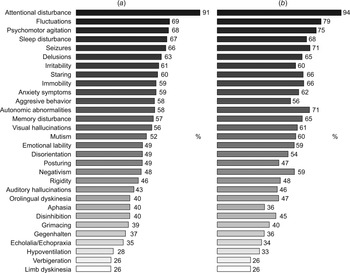
Figure 1 presents the most common neurologic and psychiatric signs and symptoms in the ANMDARE group: a wide and heterogeneous collection of cognitive abnormalities, psychotic, catatonic, and affective symptoms, sleep and eating behavior disturbances, and disruptive behavioral abnormalities. The neurological signs included seizures, movement disorders (mainly orolingual dyskinesia, limb dyskinesia, and dystonia), and autonomic disturbances.
Most frequent neurologic and psychiatric features in patients with ANMDARE admitted to the National Institute of Neurology and Neurosurgery of Mexico: (a) definite ANMDARE (n = 100) and (b) probable ANMDARE (n = 85).

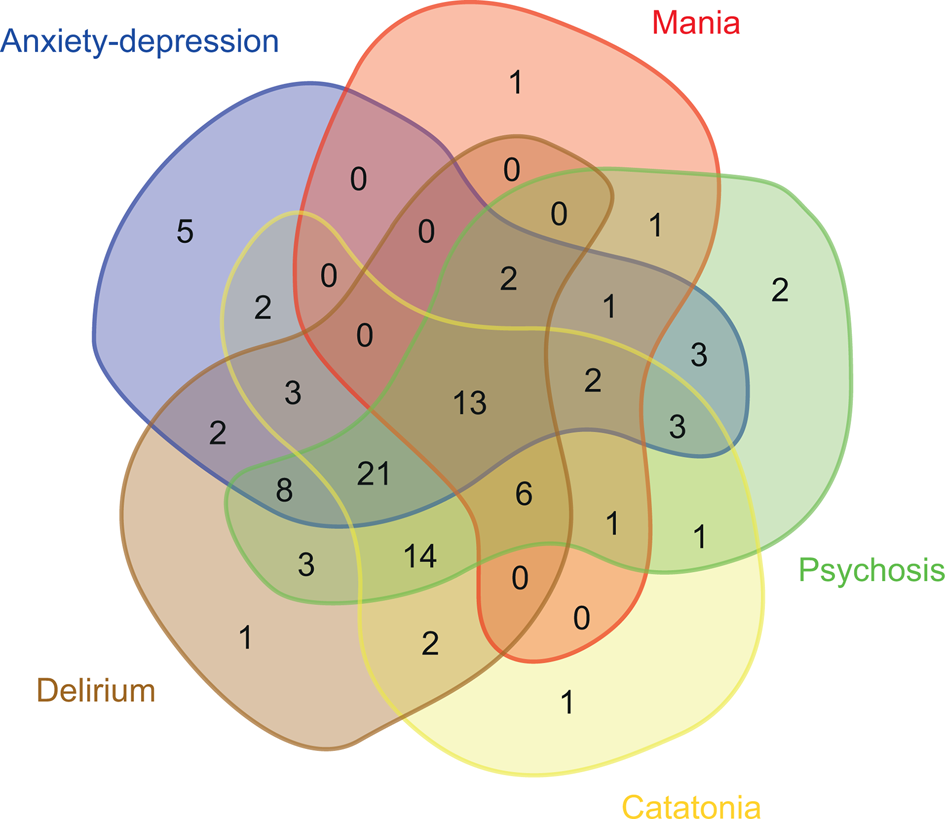
Each case of ANMDARE was classified into the most frequent neuropsychiatric syndromes that have been reported in this entity, as described in the ‘Methods’ section, with the following results: (A) psychotic syndrome (81%), (B) anxiety-depression (65%), (C) mania syndrome (27%), (D) catatonia syndrome (69%), (E) delirium syndrome was the most frequent diagnosis (75%), including the hyperactive (15%), hypoactive (10%), and mixed forms (50%). In total, 98% of the patients were classified in any of the five main syndromes. However, the main neurobehavioral syndromes had a high degree of overlapping (as may be seen in Fig. 2). Most cases, initially, had features of psychosis, mania, or anxious-depressive syndrome, and progressed toward an overlap and toward a catatonia syndrome and/or a delirium syndrome.
Neurobehavioral features of ANMDARE in a cohort of patients admitted to the National Institute of Neurology and Neurosurgery of Mexico may be categorized into five main syndromatic categories: (1) anxiety-depression, (2) mania, (3) psychosis, (4) catatonia, and (5) delirium.

Comparative analysis between patients with ANMDARE v. patients with negative NMDAR antibodies
Patients with ANMDARE were significantly younger (26.5 ± 8.5 v. 34.4 ± 15.5, p < 0.001, t test). There were no significant differences regarding sex (47% women in the ANMDARE group v. 55% women in the comparison group, p = 0.327, Pearson's χ2 test). Teratoma was found in 12 cases (25.5% of female patients in the ANMDARE sample) v. 2 cases in the comparison group (6.1% of female patients in the comparison group). This difference reached statistical significance (p = 0.024. Pearson's χ2 test).
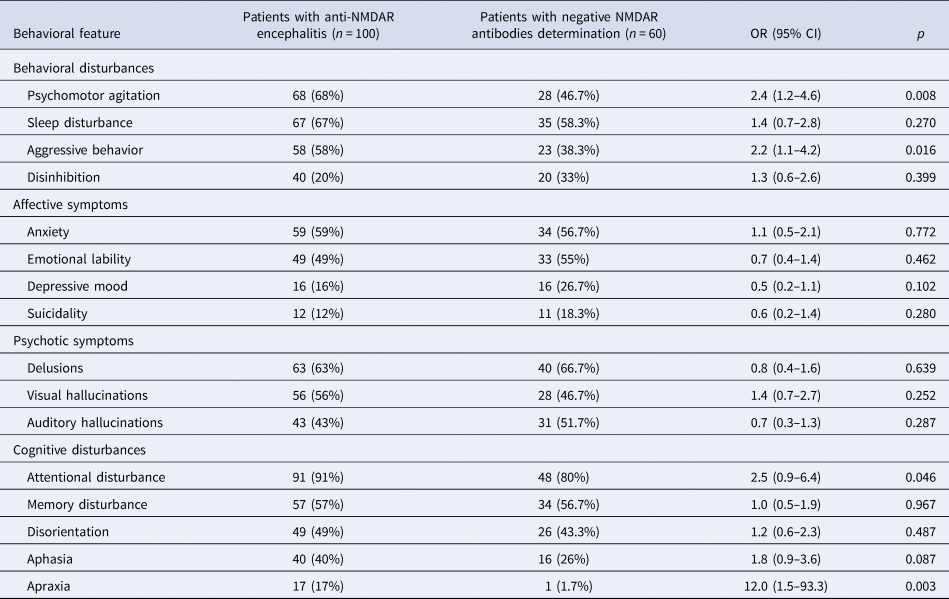
As may be seen in Table 1, several psychopathologic features showed higher frequencies in the ANMDARE group, mainly psychomotor agitation (OR 2.4), aggressive behavior (OR 2.2), attentional disturbances (OR 2.5), and apraxia (OR 12.0). After Bonferroni correction for multiple comparisons, the difference between groups was not statistically significant. Psychotic and affective symptoms, as well as sleep and eating disturbances, were frequent in the whole sample and these features were not significantly different between groups. Regarding the signs of catatonia, several items were higher in the ANMDARE group (p < 0.05), including excitation, catalepsy/posturing, grimacing, echolalia/echopraxia, verbigeration, withdrawal, Gegenhalten sign, and perseveration. Regarding cognition, the ANMDARE group had a significantly worse performance in the MoCA test according to mean differences (p = 0.01, t test) and according to categories (p = 0.044, Pearson's χ2 test).
Psychopathologic profile in patients with ANMDARE admitted to the National Institute of Neurology and Neurosurgery of Mexico

There were no significant p values after Bonferroni correction for multiple comparisons, 0.05/16 = 0.0031.
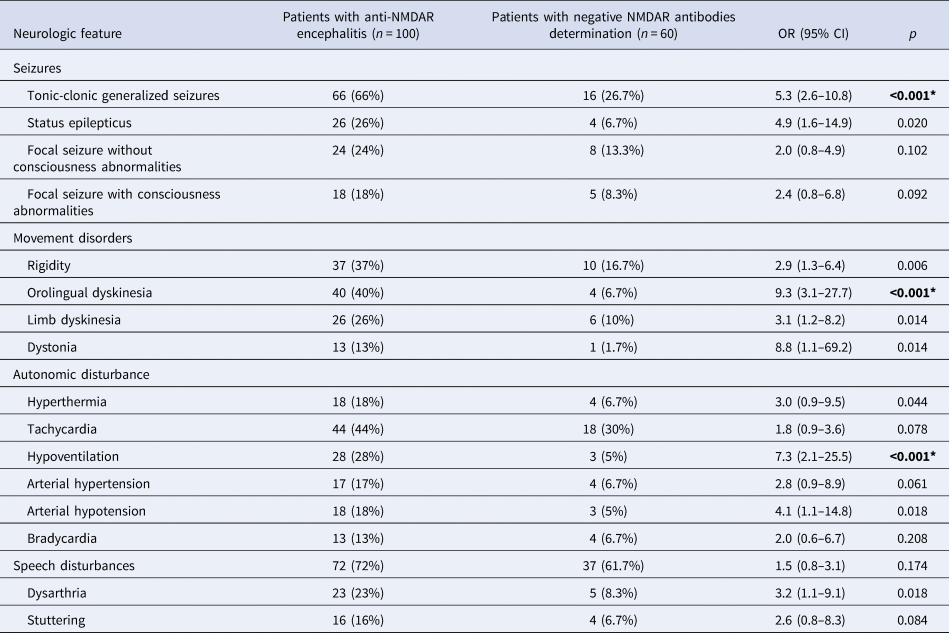
As may be seen in Table 2, several neurological signs were significantly more frequent in the ANMDARE group. After Bonferroni correction for multiple comparisons, several variables remained with statistical significance: tonic-clonic seizures (OR 5.3), orolingual dyskinesia (OR 9.3), and hypoventilation (OR 7.3). Frequently, the subgroup of patients without tonic-clonic seizures was more misdiagnosed initially as having a primary psychiatric disorder, as they also have more depressive features (p = 0.009, χ2 test), less dyskinetic movements (p = 0.005, χ2 test), and less EEG abnormalities (p = 0.045, χ2 test).
Neurologic features in patients with ANMDARE admitted to the National Institute of Neurology and Neurosurgery of Mexico

* The significant p value, after Bonferroni correction, was 0.0029 (0.05/17).
EEG abnormalities were more frequent in patients with ANMDARE (86% v. 57%, p < 0.001, χ2 test), being the extreme delta brush pattern the most specific feature (13% v. 0%, p = 0.004, χ2 test). The most common abnormality was generalized slowing (72% v. 45%, p = 0.001, χ2 test). CSF analysis showed clinical abnormalities (defined as an increase in cells and/or proteins above the standard values) in 59% of patients with ANMDARE and 33% of the comparison group (p = 0.002, Pearson's χ2 test). Pleocytosis was observed in 59% of the ANMDARE group v. 20% of the comparison group (p < 0.001, Pearson's χ2 test). Brain MRI was suggestive of encephalitis according to Graus et al. description (Graus et al., Reference Graus, Titulaer, Balu, Benseler, Bien, Cellucci and Dalmau2016), in 64% of patients with ANMDARE v. 45% in the comparison group (p = 0.022, χ2 test). The main abnormality was a hyperintense signal in T2-weighted FLAIR sequence in the hippocampus (51% v. 35%, p = 0.088). Brain FDG-PET showed the highest sensitivity: metabolic abnormalities were observed in 97% of patients with ANMDARE v. 80% in the comparison group (p < 0.001, χ2 test).
Neuropsychiatric diagnostic patterns and clinical predictors of a definite diagnosis of ANMDARE
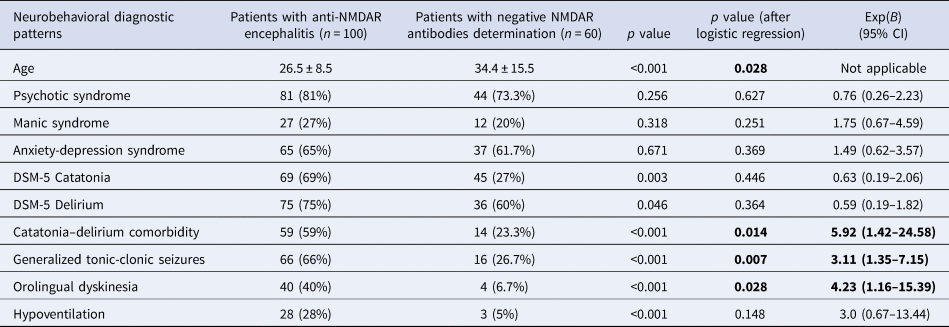
As may be seen in Table 3, there were no significant differences between groups regarding the psychosis syndrome (81% v. 73.3%, p = 0.256), the mania syndrome (27% v. 20%, p = 0.318), and the anxiety-depression construct (65% v. 61.7%, p = 0.671). Some neuropsychiatric diagnostic patterns were significantly more frequent in the ANMDARE group, including catatonia (69% v. 27%, p = 0.003) and delirium (75% v. 60%, p = 0.046). Regarding the issue of comorbidity, the ANMDARE group met a higher number of psychopathologic diagnosis (3.1 ± 1.2 v. 2.6 ± 1.2, p = 0.005, t test). Some of the patterns of syndromatic comorbidity depicted in Fig. 2 were significantly higher in the group with definite ANMDARE as compared to the comparison group: (A) psychosis–delirium (67% v. 41.7%, sensitivity = 67%, specificity = 58%, positive predictive value = 72%, negative predictive value = 51%, accuracy = 63%, p = 0.002). (B) psychosis–catatonia (61% v. 45%, sensitivity = 61%, specificity = 55%, positive predictive value = 69%, negative predictive value = 45%, accuracy = 58.7%, p = 0.049). The most significant results were observed regarding the catatonia–delirium comorbidity (59% v. 23%, sensitivity = 59%, specificity = 76%, positive predictive value = 80%, negative predictive value = 53%, accuracy = 65%, p < 0.001). Due to the significant overlapping of the syndromes, the diagnostic patterns were included in a logistic regression model, including the catatonia–delirium comorbidity and the main neurological clinical predictors that had been identified by means of bivariate analysis. As may be seen in Table 3, age, generalized tonic-clinic seizures, orolingual dyskinesia, and the catatonia–delirium comorbidity reached statistical significance according to the logistic regression model.
Multivariate analysis to determine psychiatric diagnostic patterns and predictors of a definite diagnosis of anti-NMDAR encephalitis in a sample of patients admitted to the National Institute of Neurology and Neurosurgery of Mexico with a suspicion of autoimmune encephalitis (N = 160)

After Logistic Regression, the significant p value is <0.05.
Discussion
Neuropsychiatric phenotype of ANMDARE
ANMDARE has established itself as an important differential diagnosis in patients with an acute neuropsychiatric presentation (Baumgartner et al., Reference Baumgartner, Rauer, Hottenrott, Leypoldt, Ufer, Hegen and Stich2019) and may be why lumbar puncture could become a frequent psychiatric investigation in the future (Pollak & Lennox, Reference Pollak and Lennox2018). The characterization of neuropsychiatric symptoms in ANMDARE is a crucial step for the rapid and opportune recognition of patients with this diagnostic suspicion (Lejuste et al., Reference Lejuste, Thomas, Picard, Desestret, Ducray, Rogemond and Honnorat2016).
Al-Diwani et al. presented the analysis of 464 published cases of ANMDARE, and proposed a psychiatric phenotype including behavior (68%), psychosis (67%), mood (47%), catatonia (30%), and sleep disturbance (21%) (Al-Diwani et al., Reference Al-Diwani, Handel, Townsend, Pollak, Leite, Harrison and Irani2019). Similar findings were reported by Warren et al., who found behavioral disturbances in 80.3% of patients with ANMDARE: 55.5% had aggression/agitation, 45.8% psychosis, and catatonia was present in 32.7% of the cases (Warren et al., Reference Warren, Siskind and O'Gorman2018). Our study is consistent with most of the results previously described by these retrospective studies. Through a prospective and systematic neuropsychiatric assessment, we found that catatonia and delirium, accompanied by psychotic symptoms, psychomotor agitation, aggressive behavior, and severe cognitive dysfunction, are predominant neuropsychiatric manifestations of ANMDARE. Some of these features, as agitation, aggressive behavior and psychotic symptoms, have been highlighted by previous reviews (Sarkis, Coffey, Cooper, Hassan, & Lennox, Reference Sarkis, Coffey, Cooper, Hassan and Lennox2019). Other features, particularly the catatonia–delirium comorbidity, may have been underestimated by previous studies.
Psychotic symptoms
Previous retrospective studies stressed the frequency of psychosis in patients with ANMDARE, from 45% to 67% (Al-Diwani et al., Reference Al-Diwani, Handel, Townsend, Pollak, Leite, Harrison and Irani2019; Sarkis et al., Reference Sarkis, Coffey, Cooper, Hassan and Lennox2019; Warren et al., Reference Warren, Siskind and O'Gorman2018). Our current work found psychotic symptoms (delusions and/or hallucinations) in 81% of the patients with ANMDARE. This suggests that a prospective, systematic recording of psychosis might find frequencies above previous estimations, and supports the value of the concept of ‘autoimmune psychosis’ proposed by Pollak et al. (Reference Pollak, Lennox, Müller, Benros, Prüss, Tebartz van Elst and Bechter2020). According to this proposal, which results from an international consensus, psychosis of autoimmune origin should be suspected when patients with acute or subacute psychotic symptoms present with at least one of the following data: currently or recently diagnosed with a tumor, movement disorder (catatonia or dyskinesia), adverse response to antipsychotics, severe or disproportionate cognitive dysfunction, a decreased level of consciousness, seizures, and autonomic dysfunction (Pollak et al., Reference Pollak, Lennox, Müller, Benros, Prüss, Tebartz van Elst and Bechter2020). These features are consistent with our approach based on red flags, which might increase the detection of ANMDARE and other autoimmune encephalitis in patients with acute psychosis. Without the use of red flags, the detection of CSF antibodies in patients with a first psychotic episode could be very low (Theorell et al., Reference Theorell, Ramberger, Harrison, Mgbachi, Jacobson, Waters and Irani2021).
In a retrospective study, Gibson et al. reported clinical clues of the ANMDARE psychosis: severe cognitive disturbance, prominent thought disorders, and bizarre behaviors in contrast with the typical presentation of first-episode psychosis and schizophrenia (Gibson et al., Reference Gibson, Pollak, Blackman, Thornton, Moran and David2018). This disproportionate cognitive dysfunction and the EEG abnormalities reported by Gibson et al. suggest that patients with ANMDARE may develop forms of disorganized psychosis or delirium.
Acute cognitive disturbances and encephalopathy
Most of our patients with psychotic symptoms had a delirium diagnosis. Delirium is a source of hallucinations and delusions, within a fluctuating pattern of dysfunction of the attentional matrix and generalized cognitive disturbance (Inouye, Reference Inouye2013; Trzepacz et al., Reference Trzepacz, Mittal, Torres, Kanary, Norton and Jimerson2001). In the context of ANMDARE, psychotic symptoms may be an expression of encephalopathy (Oldham, Reference Oldham2017), as compared to patients with primary psychosis of the schizophrenia or affective spectrums. This significant overlap between the concepts of delirium and encephalopathy has been increasingly recognized, and instead of being opposite terms, they seem to be concepts from different traditions which indicate similar phenomena (Maldonado, Reference Maldonado2018; Oldham & Holloway, Reference Oldham and Holloway2020; Slooter & Stevens, Reference Slooter and Stevens2020).
In our study, the most frequent cognitive abnormality was attentional disturbance (91%), followed by memory disturbances, disorientation, and language disturbances. These are common features of delirium (Inouye, Reference Inouye2013; Trzepacz et al., Reference Trzepacz, Mittal, Torres, Kanary, Norton and Jimerson2001). The diagnosis of delirium is relevant because it is considered a red flag for the suspicion of a neurological or general medical condition in patients with psychiatric presentations. Although delirium has been reported in a few studies of pediatric patients with ANMDARE (Chandra et al., Reference Chandra, Padmanabha, Koti, Kalya Vyasaraj, Mailankody and Pai2019), it has been rather scarcely reported in adults with this condition (Ziaeian & Shamsa, Reference Ziaeian and Shamsa2015). A possible explanation for this omission should consider that many reports have been done by specialists without training in psychopathology, and that prospective studies with appropriate clinimetric tools have been scarcely reported.
Catatonia–delirium comorbidity in patients with ANMDARE
Systematic reviews have reported that approximately 30% of patients had catatonia during the disease (Al-Diwani et al., Reference Al-Diwani, Handel, Townsend, Pollak, Leite, Harrison and Irani2019; Warren et al., Reference Warren, Siskind and O'Gorman2018). However, these were based mostly on retrospective studies that did not use systematic tools to assess catatonia. In our study, catatonia was diagnosed in 69% of patients with ANMDARE. The presence of catatonia should warn of the risk of neuroleptic malignant syndrome and preclude the use of typical antipsychotics: intolerance to antipsychotics has been documented in a significant percentage of patients with ANMDARE (Lejuste et al., Reference Lejuste, Thomas, Picard, Desestret, Ducray, Rogemond and Honnorat2016; Sarkis et al., Reference Sarkis, Coffey, Cooper, Hassan and Lennox2019). In our study, 12% of patients with ANMDARE developed neuroleptic malignant syndrome. Electroconvulsive Therapy (ECT) could be useful in cases of ANMDARE with catatonia (Sarkis et al., Reference Sarkis, Coffey, Cooper, Hassan and Lennox2019; Warren, Grote, O'Gorman, & Siskind, Reference Warren, Grote, O'Gorman and Siskind2019).
In total, 59% of our patients with ANMDARE presented a catatonia–delirium comorbidity, and this pattern was the most specific among the different psychiatric diagnoses, after logistic regression analysis. Even if this diagnosis is not recognized by DSM-5, it has been proposed by several researchers in the neuropsychiatric field (Grover et al., Reference Grover, Ghosh and Ghormode2014; Oldham & Lee, Reference Oldham and Lee2015; Wilson et al., Reference Wilson, Carlson, Duggan, Pandharipande, Girard, Wang and Ely2017). The catatonia–delirium comorbidity warrants an extensive medical workup and could guide clinicians to an autoimmune condition (Llesuy, Coffey, Jacobson, & Cooper, Reference Llesuy, Coffey, Jacobson and Cooper2017; Oldham, Reference Oldham2017; Oldham & Lee, Reference Oldham and Lee2015). According to our study, this phenotype could be conceptualized as a strong indicator of ANMDARE instead of a manifestation of primary psychiatric disorder.
Neurologic context of ANMDARE psychopathology
In our study, clinical neurological features were common, mainly seizures, status epilepticus, limb and orolingual dyskinesia, and hypoventilation. After correcting for multiple comparisons and logistic regression analysis, seizures and orolingual dyskinesia remained as the stronger hallmarks for differential diagnosis. However, 34% of our patients with ANMDARE had no seizures. This is consistent with previous studies reporting that 37% of ANMDARE patients have no seizures (Warren et al., Reference Warren, Siskind and O'Gorman2018). Seizures and dyskinesia are relevant to increase the diagnostic suspicion, but its absence should not rule out ANMDARE.
Diagnostic studies provided objective data supporting neurologic abnormalities in most cases: pleocytosis in the CSF and generalized slowing in the EEG showed a significant discriminating value. The delta brush sign was seen in a minority of cases, but it was highly specific. This is consistent with the well-established diagnostic value of delta brush, although the frequency in our sample is below the percentages reported in other studies, as high as 58% (Jeannin-Mayer et al., Reference Jeannin-Mayer, André-Obadia, Rosenberg, Boutet, Honnorat, Antoine and Mazzola2019). Generalized rhythmic delta activity was observed in 50% of patients with ANMDARE in a previous study (Jeannin-Mayer et al., Reference Jeannin-Mayer, André-Obadia, Rosenberg, Boutet, Honnorat, Antoine and Mazzola2019). It is essential to notice these paraclinical resources may offer false-negative results in ANMDARE. In our sample, 41% of the ANMDARE cases showed a normal CSF cytochemical analysis, and 36% had a normal MRI. EEG and FDG-PET were the most sensitive tools. EEG was normal in only 14%, and brain metabolic abnormalities were absent in only 3% of the ANMDARE patients. Occipital hypometabolism in FDG-PET may be a frequent pattern in ANMDARE (Kerik-Rotenberg et al., Reference Kerik-Rotenberg, Diaz-Meneses, Hernandez-Ramirez, Muñoz-Casillas, Reynoso-Mejia, Flores-Rivera and Aguilar-Palomeque2020; Probasco et al., Reference Probasco, Solnes, Nalluri, Cohen, Jones, Zan and Venkatesan2018).
In our sample, teratoma was found in 12 cases (25.5% of female patients), a low prevalence compared with the first studies regarding teratoma and ANMDARE (Dalmau, Lancaster, Martinez-hernandez, Rosenfeld, & Balice-gordon, Reference Dalmau, Lancaster, Martinez-hernandez, Rosenfeld and Balice-gordon2011; Kayser, Titulaer, Gresa-Arribas, & Dalmau, Reference Kayser, Titulaer, Gresa-Arribas and Dalmau2013). Notwithstanding, a low frequency (13–16%) has been documented by other researchers in more recent studies (Nissen et al., Reference Nissen, Ørvik, Nilsson, Ryding, Lydolph and Blaabjerg2021; Zhang et al., Reference Zhang, Wu, Hao, Chiang, Shuang, Lin and Li2017). This suggests that different etiological factors could be related to the pathobiology of ANMDARE.
Limitations of the study
The sample size is insufficient to perform a multivariate analysis including all the clinical features that could be relevant for differential diagnosis, so we focused on the strongest ones according to bivariate analysis with correction for multiple comparisons. An important limitation is that the comparison group is rather heterogeneous. By using the ‘possible autoimmune encephalitis’ criteria to include a larger scope of psychiatric presentations, we introduced variance and heterogeneity in the comparison group. An alternative approach, such as using the ‘probable anti-NMDA receptor antibody’ criteria would allow us to select a more specific sample, although a significant number of patients with atypical psychiatric presentations would have been excluded. The heterogeneous composition of the control group is the result of a real clinical scenario in which the use of Graus criteria (Graus et al., Reference Graus, Titulaer, Balu, Benseler, Bien, Cellucci and Dalmau2016) and the concept of red flags allows the identification of ANMDARE cases which could be misclassified as having a primary psychiatric disorder. The lack of access to specialized services in our country could increase the delay between onset of symptoms and admission, leading to more severe forms of encephalopathy and hence, a more severe clinical expression.
Conclusion
This prospective study supports the notion of a neuropsychiatric phenotype of ANMDARE characterized by a fluctuating course with psychotic and affective symptoms, disruptive behavior, catatonic signs, and severe cognitive dysfunction, often with seizures, dyskinesia, and autonomic abnormalities. According to multivariate analysis, the catatonia–delirium comorbidity could be a distinctive neurobehavioral phenotype of ANMDARE.
Financial support
This work was supported by CONACYT, Consejo Nacional de Ciencia y Tecnologia de Mexico (M. E. N. and J. R. B., Sistema Nacional de Investigadores).
Conflict of interest
None.
Supplementary material
The supplementary material for this article can be found at https://doi.org/10.1017/S0033291722001027