INTRODUCTION
Vocabulary knowledge has been identified as an important proxy for children's oral language skills, and it is also a particularly critical source of variation in the reading comprehension performance of second-language (L2) learners (Lervåg & Aukrust, Reference Lervåg and Aukrust2010; Rydland, Aukrust, & Fulland, Reference Rydland, Aukrust and Fulland2012). L2 learners in Norway have in elementary school years been observed to fall behind their language-majority peers with respect to vocabulary knowledge and reading comprehension (Lervåg & Aukrust, Reference Lervåg and Aukrust2010), and it is therefore of urgent importance to identify how the talk children are exposed to prior to elementary school entrance, as well as the demography they are embedded in, may support their L2 vocabulary development. The present study explores the L2 vocabulary trajectories of Turkish immigrant children growing up in Norway from preschool (age five) to fifth grade (age ten). We designed the study to examine the impact of preschool talk exposure (in teacher-led talk and peer talk) and demographic variables (maternal education and co-ethnic concentration in the neighborhood) on children's L2 vocabulary acquisition. To investigate these issues longitudinally, we used growth curve analysis. In our growth models, we predict differences in children's L2 vocabulary scores at age five, which is the onset of this study (intercept), as well as their rate of L2 vocabulary development up to age ten (growth slope).
Vocabulary development during the preschool and elementary years
Evidence based on monolingual samples suggests that children's rate of vocabulary learning varies widely during the preschool period, depending on factors such as socioeconomic status (SES) and talk exposure (Farkas & Beron, Reference Farkas and Beron2004; Hart & Risley, Reference Hart and Risley1995). During the elementary years, monolingual children make large gains in vocabulary, but they tend to do so at more similar rates (compared to the preschool period). Both cross-sectional (Farkas & Beron, Reference Farkas and Beron2004) and longitudinal (Snow, Porche, Tabors & Harris, Reference Snow, Porche, Tabors and Harris2007) studies indicate that the individual differences in children's vocabulary learning established by the time they transition to school may be difficult to alter later on – due to a high degree of stability in vocabulary acquisition after the preschool years.
Few studies have, to date, traced the vocabulary trajectories of L2 learners longitudinally from preschool through elementary school (but see Mancilla-Martinez & Lesaux, Reference Mancilla-Martinez and Lesaux2011a, Reference Mancilla-Martinez and Lesaux2011b). Thus, there is still much that needs to be understood about the L2 vocabulary trajectories of immigrant children and the factors that may support these children's learning in the long term.
Talk exposure in early childhood: adults and peers
Accumulating evidence demonstrates that attending high-quality preschools may have positive effects on children's verbal and academic performance (Connor, Morrison & Slominski, Reference Connor, Morrison and Slominski2006; Dickinson & Porche, Reference Dickinson and Porche2011; Vandell, Belsky, Burchinal, Steinberg & Vandergrift (NICHD ECCRN), Reference Vandell, Belsky, Burchinal, Steinberg and Vandergrift2010). Studies that address the role of talk exposure in early childhood have predominantly investigated the L1 development. This is the case for the body of research that has looked at parent–child interactions (Hart & Risley, Reference Hart and Risley1995; Hurtado, Marchman & Fernald, Reference Hurtado, Marchman and Fernald2008; Pan, Rowe, Singer & Snow, Reference Pan, Rowe, Singer and Snow2005), as well as studies dealing with the role of teacher talk in preschool and kindergarten classrooms (Dickinson, Reference Dickinson, Dickinson and Tabors2001; Dickinson & Porche, Reference Dickinson and Porche2011; Han, Roskos, Christie, Mandzuk & Vukelich, Reference Han, Roskos, Christie, Mandzuk and Vukelich2005; Huttenlocher, Vasilyeva, Cymerman & Levine, Reference Huttenlocher, Vasilyeva, Cymerman and Levine2002). Taken together, these studies suggest that young children who experience rich caregiver talk (in both amount and diversity) are likely to develop stronger language capacities themselves. Extended discourse during book-reading and play, in particular, seems to encompass and encourage the development of a rich and complex language (Dickinson & Porche, Reference Dickinson and Porche2011; Zucker, Justice, Piasta & Kaderavek, Reference Zucker, Justice, Piasta and Kaderavek2010). Furthermore, children who are in the early stages of acquiring vocabulary may learn new labels by overhearing third-party conversations if they strategically orient to and monitor the conversation (Martínez-Sussmann, Akhtar, Diesendruck & Markson, Reference Martínez-Sussmann, Akhtar, Diesendruck and Markson2011). These research findings are important in understanding the language-learning environment of the preschool classroom, in which children are largely exposed to speech within multi-party interactions that require children to monitor and listen to conversations without being directly engaged. In preschools, peers are present in most contexts, including conversations that involve interaction with teachers.
Research on language exposure has been characterized by a pronounced emphasis on the adult's role in shaping children's learning trajectories. However, there has been surprisingly little research interest on the impact of peer talk on young children's language development (see discussion in Cekaite, Blum-Kulka, Grøver & Teubal, forthcoming). This is worth noting as the degree of contact with L2-speaking peers may be particularly important in developing proficiency in the L2 (Jia & Aaronson, Reference Jia and Aaronson2003). A few studies conducted with low-SES monolingual preschoolers (Connor et al., Reference Connor, Morrison and Slominski2006; Dickinson, Reference Dickinson, Dickinson and Tabors2001; Schechter & Bye, Reference Schechter and Bye2007) indicate that peer interaction may support children's vocabulary acquisition. The Harvard Home–School study (Dickinson, Reference Dickinson, Dickinson and Tabors2001), which examined how preschool talk exposure (extended discourse and sophisticated vocabulary) affected low-income monolingual children's vocabulary development, measured talk exposure as a composite variable that included both teacher talk and peer talk. Thus, unfortunately, the unique effects of talk exposure from teachers and peers could not be estimated in that study.
Although recent large-scale studies have documented that the ability level (e.g., oral language skills) of the peers in a child's classroom has direct effects on preschoolers' vocabulary development (Henry & Rickman, Reference Henry and Rickman2007; Mashburn, Justice, Downer & Pianta, Reference Mashburn, Justice, Downer and Pianta2009), they do not single out the peers that children interact with the most. As children assert increasing agency in their selection of friends in the preschool period, and the talk between friends becomes more elaborate (Pellegrini, Galda, Bartini & Charak, Reference Pellegrini, Galda, Bartini and Charak1998), it seems pertinent to investigate the talk that children are exposed to when playing with their peers.
While some have found that the impact of childcare (Colwell, Pettit, Meece, Bates & Dodge, Reference Colwell, Pettit, Meece, Bates and Dodge2001) and preschool interventions (Henning, McIntosh, Arnott & Dodd, Reference Henning, McIntosh, Arnott and Dodd2010) may fade away over time, others have documented the preschool effects that are evident many years later (Dickinson & Porche, Reference Dickinson and Porche2011; Snow et al., Reference Snow, Porche, Tabors and Harris2007; Vandell et al., Reference Vandell, Belsky, Burchinal, Steinberg and Vandergrift2010). Snow et al. (Reference Snow, Porche, Tabors and Harris2007) conducted a follow-up study on some of the children that participated in the Harvard Home–School study. They investigated if talk exposure in preschool predicted receptive vocabulary when children were in kindergarten, second grade, fourth grade, and sixth grade, and whether teacher talk during preschool was related to subsequent word-learning rates. The findings from their longitudinal growth analyses revealed a high degree of stability in children's vocabulary trajectories during the elementary years; i.e., preschool talk exposure did not negatively affect the growth in children's vocabulary scores after they left the preschool environment (which would have suggested that the benefit attenuated across grades), and neither did it predict steeper growth trajectories across subsequent years. Instead, the vocabulary trajectories of children seemed to be set by the end of preschool so that the advantage of being exposed to a rich language in preschool was maintained across subsequent years.
Most studies of long-term preschool quality effects on vocabulary, in particular, have not included or examined the particular challenges that L2 learners face (e.g., the NICHD ECCRN study and the Harvard Home–School study). An urgent issue for parents, educators, and researchers therefore concerns how preschool talk exposure may support L2 learners' vocabulary development.
Demographic factors: maternal education and co-ethnic concentration in the neighborhood
Researchers generally concur that SES factors (commonly determined as maternal or parental education and/or current job situation and/or income level) greatly influence both L1 (Farkas & Beron, Reference Farkas and Beron2004; Hart & Risley, Reference Hart and Risley1995; Hoff, Reference Hoff2006) and L2 (e.g., Golberg, Paradis & Crago, Reference Golberg, Paradis and Crago2008) development. It seems that children from higher SES families get further access to the type of language learning experiences that most effectively propel vocabulary acquisition (Farkas & Beron, Reference Farkas and Beron2004; Hart & Risley, Reference Hart and Risley1995; Hoff, Reference Hoff2006). In a cross-sectional study from age three up to middle school, Farkas and Beron (Reference Farkas and Beron2004) investigated how SES was related to vocabulary skills in a large sample of English-speaking children in the US. These researchers concluded that the effect of SES on vocabulary skills occurred entirely during the preschool period (although the specific timing of this effect varied among racial groups). Subsequent to the preschool age, vocabulary skills increased essentially in a parallel manner, suggesting that the SES differences manifested at the younger ages remained more or less unchanged during elementary and middle school.
However, because immigrant children are typically exposed to an L1 at home and begin acquiring a substantial L2 vocabulary at a later stage compared to monolingual children, it seems plausible to assume that SES may differently relate to vocabulary growth in young L2 learners. For instance, Scheele, Leseman, and Mayo (Reference Scheele, Leseman and Mayo2010) found no relationship between SES (measured as parental education and job type) and L2 vocabulary skills among three-year-old Turkish immigrant children in the Netherlands, while Golberg et al. (Reference Golberg, Paradis and Crago2008) saw an effect of SES (measured as maternal education) on children's L2 vocabulary acquisition over a period of two years from age five.
Moreover, immigrant children, whose L1 is among the dominant languages spoken in the neighborhood and by many other students at preschool and school, are likely to have different language trajectories from that of children whose L1 is not spoken in their community. This issue was addressed in a recent study of fifth-grade immigrant students in Norway (Rydland et al., in press). The language use and vocabulary skills (in the L1 Turkish and L2 Norwegian) of students living in neighborhoods characterized by a relatively high co-ethnic concentration were compared to the vocabulary skills of students living in neighborhoods characterized by fewer co-ethnics. The study found that the students living in the neighborhoods with more Turkish speakers, while demonstrating more advanced L1 vocabulary skills, had significantly lower L2 vocabulary skills compared to the students living in neighborhoods with relatively few Turkish speakers. As the L1 use with parents and siblings did not vary significantly along the neighborhood dimension, while the reported language use with peers in and out of school did, the researchers suggested that access to L1- and L2-speaking peers may partly account for these neighborhood differences in students' vocabulary skills.
Factors related to SES, or more specifically maternal education, and characteristics of the linguistic community (access to peers who speak the L1 and L2) may account for why some immigrant children acquire the L2 at a faster rate compared to others (for a discussion of the impact of maternal education and neighborhood on L2 vocabulary acquisition, see Golberg et al., Reference Golberg, Paradis and Crago2008). However, to our knowledge, no studies have investigated the extent to which growing up in neighborhoods with many or few co-ethnics may exert an influence on children's L2 vocabulary growth longitudinally.
The Norwegian context
The preschools in Norway follow a national curriculum that emphasizes the interdependencies between play and learning in early development. A common characteristic of the Norwegian preschools is the tendency to de-emphasize direct instruction and value informal and incidental learning more than the comparable curricula used in the US, for example. A considerable part of the day is allocated to free peer play with little teacher involvement. This emphasis on the independently active child is reflected in the physical conditions of the preschools, where relatively large spaces equipped with toys accommodate uninterrupted indoor and outdoor play (see discussion in Einarsdottir & Wagner, Reference Einarsdottir and Wagner2006).
Norwegian preschools are heavily subsidized by the government, and they are available to most children from age one for a relatively low monthly fee. Preschools across communities operate under more or less the same financial conditions and are similar with regard to structural quality (e.g. teacher–child ratio). Preschool teachers have completed a three-year teacher training education (a bachelor degree in a university college) regulated by national curriculum standards. Nearly all preschools in the larger cities offer full-time day care (approximately 40 hours per week), and classes are led by a preschool teacher accompanied by two assistants. Children in Norway commonly attend preschools in the neighborhood of their homes. They enter school when they turn six years old (no kindergarten year), typically the school that is located close to their home. The preschools visited for the purpose of this study were traditionally organized with classrooms serving fifteen to eighteen children between three and five years of age. Thus, the children attended the same classes – largely with the same peers and teachers – for about three years. As is the case in many other countries, L2 learners growing up in the big cities in Norway are predominantly concentrated in preschools and schools with a large portion of immigrant children. The dominant language for communication and learning in the preschools and schools is Norwegian, while mother-tongue teaching is only offered in some schools, depending on a variety of factors (e.g., the availability of mother-tongue teachers, parental preferences, and principals' educational priorities).
Research objectives and analysis
The present longitudinal study investigated the influence of teacher-led group talk and peer talk on children who were mainly exposed to their L1 (Turkish) at home and their L2 (Norwegian) at preschool. For these children, the preschool classroom constituted a crucial source of L2 exposure. While a few previous studies have demonstrated that teacher talk exposure predicts L2 learners' vocabulary development during preschool (Aukrust, Reference Aukrust2007; Bowers & Vasilyeva, Reference Bowers and Vasilyeva2011), we aimed at revealing whether or not talk exposure in preschool was (in both teacher-led and peer-driven conversational contexts) related to the sampled children's L2 vocabulary skills right before transitioning to first grade and whether potential early effects could predict L2 vocabulary growth up to the age of ten.
To our knowledge, no previous studies have investigated L2 vocabulary growth longitudinally from preschool to middle school as an effect of preschool talk exposure. Given Snow et al.'s (Reference Snow, Porche, Tabors and Harris2007) findings in a study conducted with a monolingual sample, we did not expect talk exposure at the end of the preschool period to affect the continued growth in children's L2 vocabulary after they left the preschool environment. Instead, we wanted to look at the effects of preschool talk exposure vis-à-vis broader demographic factors. More specifically, we wanted to explore the extent to which SES factors, in this study measured as level of maternal education, and the co-ethnic concentration of the neighborhood could predict the L2 vocabulary skills of children who predominately used Turkish at home. The relative access to the same L1-speaking peers in L2 learners' neighborhoods is an understudied demographic factor in the current research on L2 learners. This study looked at the L2 vocabulary trajectories of children, aged five (preschool) to ten (fifth grade), across four waves of data collection. Our research questions were as follows:
1. To what extent can teacher-led group talk (amount and diversity) and peer talk (amount and diversity) in preschool predict L2 vocabulary skills up to the age of ten?
2. To what extent can maternal education and co-ethnic concentration in the neighborhood predict L2 vocabulary skills up to the age of ten?
Before proceeding, it should be noted that we use casual terms (e.g., ‘impact’) for reasons of viability in the subsequent text, and we fully acknowledge that this is a correlational study that cannot determine questions of causality.
METHOD
Sample
For this study, twenty-six children (15 boys and 11 girls) growing up in Turkish immigrant families in Norway were recruited from twenty different preschool classrooms (two of which left the study by grade five, as described below). In order to recruit the children, we contacted public preschools located in multi-ethnic neighborhoods in two larger cities in Norway (hereafter referred to as Northville and Westville; see more in-depth description below) and asked them to distribute information (in both Turkish and Norwegian) about the study to parents of Turkish origin. All recruited children had attended preschool for at least two years before graduating from preschool at the end of the spring term in which they were first observed. The mean age at the first observation was 5;11 (range 5;3–6;4).
The parents of the recruited children were all born in Turkey, while the target children were born in Norway. When the children attended the last year in preschool (age five), their mothers had resided in Norway for an average of 14·5 years (SD = 6·1) and their fathers had resided in Norway for an average of 16·2 years (SD = 6·3).
About two-thirds of the target children's mothers and fathers had attained all their education in Turkey. Eight mothers and five fathers were unemployed when the target children attended fifth grade, while the other parents held jobs with low vocational and educational demands (e.g., cleaning personnel and taxi drivers).
It has been reported that the Turkish immigrant population in Norway tends to maintain their use of the Turkish language to a large extent (Blom & Henriksen, Reference Blom and Henriksen2009). Interviews and questionnaires conducted with the parents when the target children attended first and fifth grade confirmed that the families mainly spoke Turkish at home; although the children would often speak Norwegian with their siblings as they grew older.
The observed preschool classrooms were noticeably similar in terms of structural features and organization. Teachers were asked to use the videotaped circle time session to engage in conversations with the children as they typically would do. Circle time conversations typically started with some routinized aspects (e.g., talk about children who were absent), then focused on an upcoming event, what the children had done during the weekend, or a general discussion question. Some few teachers introduced the circle time session by reading a short book that was used as a starting point for a discussion with the children. The whole class participated in the observed circle times. All classrooms had at least two separate rooms or corners equipped with toys that could be used in pretend play (e.g., garages and cars, a well-equipped play kitchen). Play was predominantly peer driven and teachers had a relatively passive presence during free playtime (accommodating different play activities or solving conflicts between children).
In first grade, children entered twenty-two different classrooms. The lead teachers in the preschool and school classrooms were mainly ethnic Norwegians, but many classrooms also had teacher assistants or mother-tongue teachers with non-ethnic Norwegian backgrounds. The preschools and schools attended by the children were located in close proximity. As a result, the student compositions of the preschool and first-grade classrooms were relatively similar, reflecting the ethnic composition of the neighborhood.
Procedure
The target children were visited in their classrooms three or four times over a period of five years. All children were visited during the last year of preschool (age five; 26 observations), in first grade (age six; 26 observations), and in fifth grade (age ten; 24 observations due to attrition). Because of limited resources, only ten of the children were visited in second grade (age seven). All visits were conducted at the end of the spring semester.
The rate of attrition was relatively low. We lost two children in fifth grade: one boy moved back to Turkey with his family and one girl's family did not want to sign a new consent for reasons unrelated to the research. For the fifth-grade observations, fresh consents were collected from the parents.
L2 vocabulary skills
Target children's vocabulary skills were assessed in Norwegian, and each year of observation used translated versionsFootnote 1 of the Peabody Picture Vocabulary Test – III (PPVT-III; Dunn & Dunn, Reference Dunn and Dunn1997). During individual testing, target children were shown successive panels each containing four pictures and asked to point out the picture that matched a word said by the assessor. The Norwegian translation consists of 144 items (5 items were omitted from the English version either because of their cultural inappropriateness or because of dialectical variation). Raw scores were used because the PPVT-III has not been standardized for Norwegian.Footnote 2 The translated version of the PPVT-III in Norwegian has been found to correlate highly with other measures of oral language skills (Rydland et al., Reference Rydland, Aukrust and Fulland2012). The Cronbach's alpha of the PPVT-III with this sample was .81 at age five, .83 at age six, and.94 at age ten. The children contributed three or four waves of PPVT-III vocabulary data.
Talk exposure in preschool
When the target children attended the last year in preschool (age five), they were videotaped in teacher-led circle time and peer play. As some of the targeted children attended the same preschool classrooms, we chose to sample the same circle time for these children. Twenty different circle times were sampled with a mean length of 18·5 minutes.
Peer interaction was videotaped during the free playtime when the target children played with peers of their choice. Teachers asked target children to bring their friends to the playroom in order to ensure good sound quality. The playgroups comprised two to six children, with an average group size of 3·5 (SD = 1·2), and each group was videotaped for 30 to 60 minutes.
We did not instruct the children about what to play. Although the specific play topics varied among the peer groups, all groups engaged in pretend-play talk. For each target child, the consecutive 20 minutes characterized by the most joint pretend-play talk among the children was selected for transcription. We sampled twenty-five peer-play episodes because two target children appeared in the same recording (which also included other peers).
In a few instances, we scheduled a new observation of the circle time or peer play because the teacher (or we, the researchers) was uncertain of how representative the situation was (e.g., children became preoccupied with the camera). The talk occurring during the circle times and the peer-play episodes was transcribed following the transcription conventions of the Child Language Data Exchange System (MacWhinney, Reference MacWhinney1995). In the case of multiple threads of talk occurring simultaneously, transcriptions focused on the conversations in which the target children participated as either speakers or listeners. During the circle time, the few occurrences of teacher book-reading that appeared was not included in the transcripts, while the conversation between the teacher and the children (following the reading) about the topic of the book was included. Furthermore, only utterances in Norwegian were transcribed. Based on the transcripts of the circle time and peer play, the amount and diversity of the talk were computed using Computerized Child Language Analysis (MacWhinney, Reference MacWhinney1995).
For the amount of talk, we identified the number of tokens produced during the circle time and peer play, respectively, and computed the number of tokens per minute. As the amount of talk (tokens) and diversity of talk (types) in previous studies have been found to correlate highly (Aukrust, Reference Aukrust2007; Hart & Risley, Reference Hart and Risley1995; Pan et al., Reference Pan, Rowe, Singer and Snow2005), we also wanted to establish a diversity index that excluded the most common words. To measure the diversity of talk (types), we screened the transcripts against a list of exclusion words. This list comprised the 150 most common words in Norwegian (typically function words like men ‘but’, her ‘here’, and gjøre ‘do’) as well as words that are common in the everyday oral conversations in the preschool classroom (ja ‘yes’, du ‘you’, counting, personal names, and vocal gestures with discursive significance). In the count of types, morphological variants of the same root were treated as the same word. Finally, we computed the number of types per minute to establish a measure of word-type density for the circle time and peer play, respectively.
Note that the talk in circle time includes all talk contributed by the teacher and the children, acknowledging the fact that some teachers sparked some highly dialogical and elaborate conversations with the children. Similarly, talk in peer play included all the talk contributed by the target child and the peers.
Demographic factors
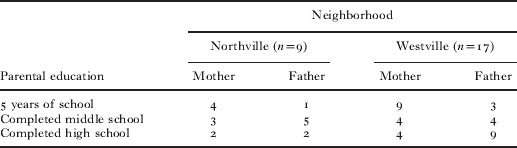
Years of parental education were divided in three main categories (from five years of schooling to high school) without distinguishing between education attained in Turkey or Norway (see Table 1).
Parental education in Northville and Westville
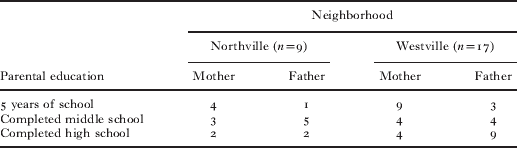
note: Two children lived only with their mother.
Nine of the recruited children lived in the city we refer to as Northville, within a densely populated area characterized by a fairly large concentration of Turkish immigrant residents (in school, there was an average number of six Turkish–Norwegian speakers across the classrooms attended by the target children). The remaining seventeen children were from the city we refer to as Westville, and they grew up in neighborhoods (more spread out in the city) with many immigrant residents but with relatively fewer residents of a Turkish origin (in school, there was an average of two Turkish–Norwegian speakers across the classrooms attended by the target children). Thus, for the children involved in this study, these two cities afforded different contexts for Turkish and Norwegian language use, both inside and out of school (for a more in-depth description of these neighborhood types and the language contexts, see Rydland et al., in press). For the frequency distributions of parental education in the two cities, see Table 1.
Preliminary analyses revealed that gender, length of preschool attendance (measured in months), paternal education level, and siblings (total number of siblings and number of older siblings) were not significantly related to children's L2 vocabulary skills and did not affect the relationships investigated in this study. Thus, the analyses presented do not include these variables.
Data-analytic plan
We answer our two research questions by fitting a series of multilevel models for change (Singer & Willett, Reference Singer and Willett2003). Using our maternal education data, we created two bivariate dummy variables (coded 0 or 1) so that we did not have to make assumptions about a linear relationship between years of schooling and the predictive impact in the model. The first dummy variable indicates if the mother had completed middle school, while the second indicates if the mother had completed high school.Footnote 3 Maternal education is a time-invariant variable. Neighborhood type is also a time-invariant variable that specifies whether the children attended school in Northville or in Westville. Finally, time is an individual (level-1) variable that records how many years have passed since the start of the study (wave 1 = 0 years, wave 2 = 1 year, wave 3 = 2 years, wave 4 = 5 years). Both the amount (tokens) and the diversity (types) were analyzed as predictors in the multilevel model for change. In order to facilitate easier interpretation of the relative importance of exposure from these different sources, we conducted a z-score transformation on all talk exposure data so that the average score for all the children on each measure, at age five, was zero and the standard deviation was one. The specific model-fitting strategy that we used is described in detail below, but the basic model is described as follows:
Level 1:
(Equation (1)) $$\widehat{VOCAB} \equals \pi _{\setnum{0}i} \plus \pi _{\setnum{1}i} TIME_{ij} \plus \pi _{\setnum{2}i} TIME_{ij} ^{\setnum{2}} \plus \varepsilon _{ij} \hfill$$
Level 2:
$$\eqalign{ \pi _{\setnum{0}i} \equals \tab \gamma _{\setnum{00}} \plus \gamma _{\setnum{01}} MATERNAL\_ED\_2_{i} \plus \gamma _{\setnum{02}} NEIGHBORHOOD_{i} \cr \tab \plus \gamma _{\setnum{03}} TEACHER\_TOK_{i} \plus \gamma _{\setnum{04}} TEACHER\_TYPE_{i} \cr \tab \plus \gamma _{\setnum{05}} PEER\_TOK_{i} \plus \gamma _{\setnum{06}} PEER\_TYPE_{i} \plus \xi _{\setnum{0}i} \cr} $$$$\eqalign{ \pi _{\setnum{1}i} \equals \tab \gamma _{\setnum{10}} \plus \gamma _{\setnum{11}} MATERNAL\_ED\_2_{i} \plus \gamma _{\setnum{12}} NEIGHBORHOOD_{i} \cr \tab \plus \gamma _{\setnum{13}} TEACHER\_TOK_{i} \plus \gamma _{\setnum{14}} TEACHER\_TYPE_{i} \cr \tab \plus \gamma _{\setnum{15}} PEER\_TOK_{i} \plus \gamma _{\setnum{16}} PEER\_TYPE_{i} \plus \xi _{\setnum{1}i} \cr} $$$$\pi _{\setnum{2}i} \equals \gamma _{\setnum{20}} $$




where  $\varepsilon _{ij} \sim N\lpar 0\comma \sigma _{\varepsilon } ^{\setnum{2}} \rpar \and \left[ {\matrix{ {\zeta _{\setnum{0}i} } \cr {\zeta _{\setnum{1}i} } \cr} } \right] \sim N\left( {\left[ {\matrix{ 0 \cr 0 \cr} } \right]\comma \left[ {\matrix{ {\sigma _{\setnum{0}}^{\setnum{2}} } \cr {\sigma _{\setnum{10}} } \cr} \matrix{ {\sigma _{\setnum{01}} } \cr {\sigma _{\setnum{1}}^{\setnum{2}} } \cr} } \right]} \right).$
In these equations, the subscript i denotes individual children and the subscript j denotes the years that have passed since the start of data collection (i.e., 0, 1, 2, or 5 years). Since NEIGHBORHOOD is centered on children in Northville (the neighborhood with more co-ethnics) and MATERNAL_ED_2 indicates children whose mothers have attended high school, the regression parameters have the following interpretation: γ00 is the population average for children in Northville whose mothers did not attend high school; γ01MATERNAL_ED_2i is the difference between baseline vocabulary scores of children whose mothers attended high school and those who did not and is explored as a level-2 predictor; γ02NEIGHBORHOOD i is the average difference in baseline scores between children in the two neighborhood types; and γ03TEACHER_TOKi, γ04TEACHER_TYPE i, γ05PEER_TOK i, and γ06PEER_TYPE i describe the difference in baseline vocabulary predicted by one standard deviation of difference in each talk exposure measure controlling for neighborhood and maternal education. These level-2 parameters explain the variance between individual trajectories in the model.
Similarly, γ10 is the average rate of vocabulary improvement per year for children in Northville whose mothers did not attend high school, controlling for baseline talk exposure; γ11MATERNAL_ED_2i represents the difference in average rates of learning between children whose mother attended high school and those whose mothers did not; γ12NEIGHBORHOOD i describes the average difference in rates of vocabulary learning for children at each of the two neighborhood types; and γ13TEACHER_TOK i, γ 14TEACHER_TYPE i, γ15PEER_TOK i, and γ16PEER_TYPE i represent the average differences in rates of learning predicted by a one-unit change in the tokens and types used in the teacher-led talk and in peer talk. The inclusion of a parameter estimate associated with word learning acceleration (γ20) allows us to explore non-linear specifications of vocabulary growth.
RESULTS
The nature of talk exposure in teacher-led group talk and peer talk
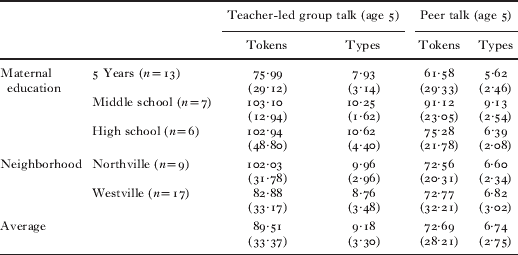
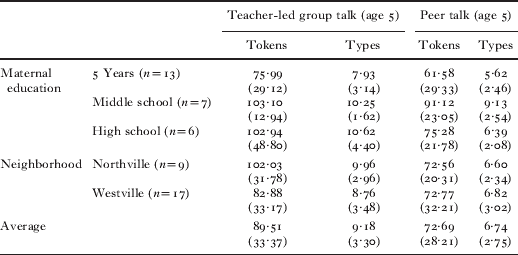
During the circle time, the teachers were the main contributors (offering 74·18% of the tokens). In peer play, the target children contributed 38·07% of the tokens.Footnote 4 As seen in Table 2, the circle time contained more tokens (amount) and types (diversity) per minute than the peer-play situation, and this was the case for children in both Northville and Westville, regardless of maternal education. We also investigated whether there were significant differences between Northville and Westville concerning the L2 talk the target children were exposed to in preschool (Table 2). No significant differences were detected, although the mean density of tokens and types in teacher-led group talk were higher in Northville (the neighborhoods with more co-ethnics) than in Westville (the neighborhoods with fewer co-ethnics).
Teacher-led group talk and peer talk at age five by maternal education and neighborhood
There appeared to be considerable variation across the classrooms with respect to the L2 talk to which the target children were exposed. During the circle time, the target child exposed to the most diverse talk heard about four times as many types per minute compared to the target child exposed to the least diverse talk. Two examples will serve to illustrate teacher-led group talk varying in talk diversity. The first example is excerpted from one of the circle times with a high density of tokens and types. Before this extract, the teacher had just lit a candle to celebrate the birthday of a boy in the group. When one of the children notes that it smells like smoke, the teacher explains that matches are covered with sulfur.
(1) child: Det lukter røyk # flamme.
‘It smells like smoke # fire.’
teacher: Ja, det lukter /svovel heter det # fyrstikken den har sånn at den kan begynne å tenne og lyse og det er /svovel.
‘Yes, it smells /sulfur; it is called # a match; it has this thing that makes it start to light and burn, and that is /sulfur.’
The second example is excerpted from a conversation about friendships in a circle time with a low density of tokens and types.
(2) teacher: Er du venn med Melike?
‘Are you Melike's friend?’
child 1: Jeg er ikke venn med henne.
‘I'm not her friend.’
child 2: Jo!
‘Yes!’
child 1: Nei # jeg er ikke hans venn nå.
‘No # I'm not his friend now.’ (points to another child, Jon)
child 2: Nei.
‘No.’
child 1: Ja.
‘Yes’
child 2: Nei.
‘No’
child 1: Jeg er ikke venn med Jon.
‘I'm not Jon's friend.’
teacher: Er du ikke venn med Jon?
‘Are you not Jon's friend?
Compared to the circle time in Example 1, both the teacher and children in the circle time talk that Example 2 is excerpted from participated in the conversation in a fairly repetitive manner, using a limited set of words. The variation in peer talk that the target children were exposed to was even more substantial. The child exposed to the most diverse talk in the peer play heard about seven times as many word types per minute compared to the target child exposed to the least diverse talk. The subsequent example was drawn from one of the peer play episodes containing the most tokens and types. As seen in this extract, the children introduced (and discussed) different words like ‘broomstick’, ‘arrow’, and ‘bow’ within the pretend-play frame inspired by the plot of the last Harry Potter movie.
(3) peer 1: Jeg tok # jeg tok i sopelimen og /skøyt han.
‘I touched # I touched the broomstick and /shot him.’
peer 2: Det ekke sopelimen det er; # det er pil og buen.
‘It is not a broomstick; # it is a bow and arrow.’
Conversely, Example (4) illustrates a peer conversation in which the participants to a little extent exposed each other to different word types. The example is excerpted from a much longer conversation about cars crashing, going on in a similar vein for long stretches of talk:
(4) peer 1: Jeg kræsja!
‘I crashed’
peer 2: Kræsj!
‘Crash!’
peer 3: Bare kræsj du!
‘Just crash!’
peer 2: Nei ikke /kræsj # kræsj.
‘No don't /crash # crash.’
peer 1: Nå skal jeg kræsje?
‘Shall I crash now?’
peer 2: Nei.
‘No’
peer 1: Jo.
‘Yes.’
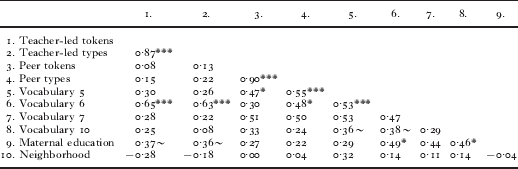
Table 3 presents the correlations between the demographic, exposure, and vocabulary variables. As seen in this table, tokens and types were highly correlated, indicating that the teacher-led groups and peer groups who talked at a higher rate also produced the most diverse talk per minute. However, no significant correlations were found between the teacher-led talk and the peer talk. This finding suggests that some children had access to relatively language-rich conversations during the circle time but not during the play with peers (and vice-versa).
Correlations between teacher-led talk (tokens and types), peer talk (tokens and types), vocabulary (PPVT-III score) at each age, maternal education and neighborhood
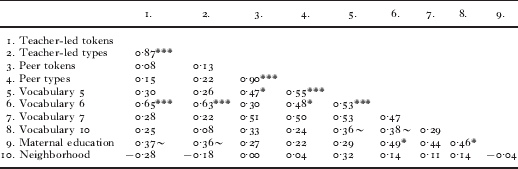
notes: ∼=p < ·10, *=p < ·05, ***=p < ·001.
Both the tokens and types of the teacher-led talk in preschool (age five) were linked to the children's vocabulary scores in first grade at age six. For the preschool peer talk, both tokens and types were significantly correlated with vocabulary skills concurrently at age five, but only types was significantly related to vocabulary skills in first grade at age six. The correlational relationships between the teacher-led talk and the peer talk in preschool and vocabulary skills at age ten were not significant.
The correlations in Table 3 further demonstrate that maternal education was related to children's vocabulary scores in first grade at age six and in fifth grade at age ten. Surprisingly, maternal education also appeared to be marginally related to the tokens and types of teacher-led talk in preschool. In the discussion, we will elaborate on how we understand this link between maternal education and teacher-led talk.
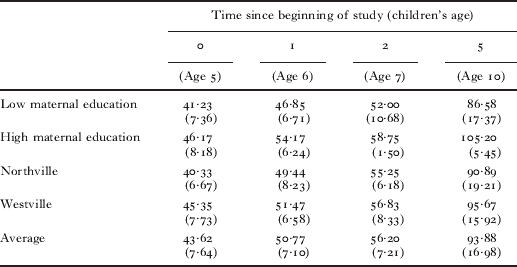
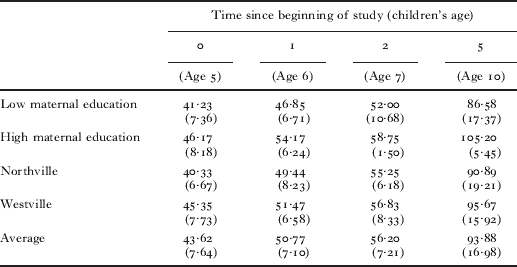
The trends seen in the correlation matrix are further explored in Table 4, which presents the average vocabulary scores for the subgroups in the sample. The vocabulary scores of children from high and low maternal education homes suggest that children from high maternal education homes had about a five-point advantage in vocabulary scores at the age of five, and this advantage grew to nearly twenty points by the end of the study. There also seemed to be differences between the average scores of children in Northville and Westville. However, as these descriptive and correlational analyses ignore the nested structure of the data (e.g., that the same child is contributing data at ages five, six, and ten), longitudinal growth modeling is appropriate in exploring these relationships over time (see discussion in Singer & Willett, Reference Singer and Willett2003).
Children's vocabulary (PPVT-III score) at each wave of data collection by maternal education and neighborhood type
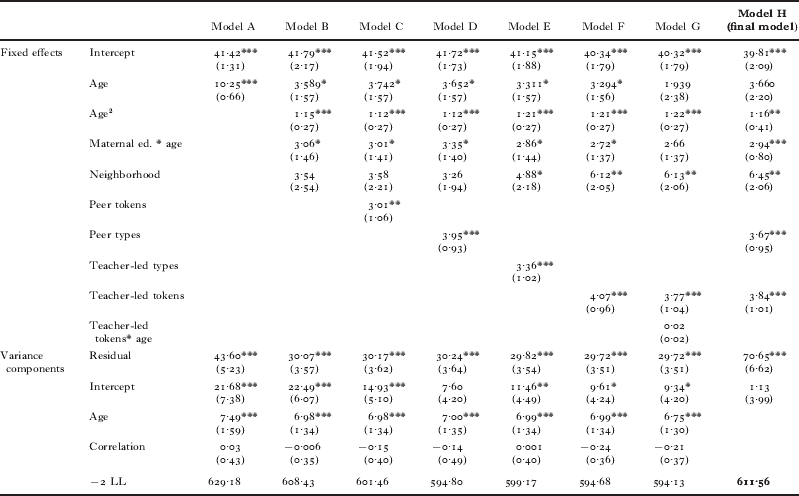
In order to answer our research questions, we fit a series of multilevel models predicting Norwegian vocabulary (Table 5). Model A presents the unconditional model; it converged after three iterations. The variance parameters associated with children's vocabulary skills at the start of the study (the intercept) and how rapidly they learned words (the growth parameter) suggest that there is unexplained variance related to the children's baseline scores and the learning growth, and that additional predictors related to these outcomes should be explored. Model B includes parameters to estimate acceleration on word learning, the effect of high maternal education (high school) on growth, and baseline differences between the two neighborhood types. This model shows that children from higher maternal-education homes seemed to learn the Norwegian vocabularies more rapidly (γ11MATERNAL_ED_2i = 3·06, p < ·05). Models C through F demonstrate the isolated effects of teacher-led talk and peer talk on age-five vocabulary knowledge (the intercept). Model G explores the effect of teacher-led talk (tokens) on vocabulary growth, and Model H presents the final fitted model we used to answer our research questions. Although Model H uses the best predictors of teacher-led talk and peer talk from previous models, and the estimates in this model are similar to those in exploratory models, the variance components in Model H are different. We found that the inclusion of the two talk-exposure measures in Model H exhausted the unexplained level-2 variance and resulted in unacceptably high covariance between the variance components associated with age and intercept. Therefore, we eliminated the variance component associated with age in the final model. The estimate of fixed effects are similar in every respect to the exploratory models (presented in Table 5), and also with the full model (i.e., one which includes a variance component associated with age).Footnote 5
Results of fitting a taxonomy of multilevel models for change predicting vocabulary performance (PPVT-III score) across all waves of data collection

notes: Standard errors in parentheses. *p < ·05, **p < ·01, ***p < ·001.
Teacher-led talk in preschool and L2 vocabulary development
As demonstrated in Table 5, the amount (tokens) of talk that children were exposed to in the teacher-led group conversations predicted a unique variance in the intercept, when controlling the other factors in the model (γ03TEACHER_TOK i = 3·84, p < ·001). Models E and F were improvements of Model B, suggesting that both the tokens and types of the teacher-led talk explained variation in intercept and improved models of vocabulary learning; this is not surprising, given the strong correlation between these variables as demonstrated in Table 3. Nonetheless, it was the tokens rather than the types of teacher-led talk that best explained variation in age-five vocabulary and, for that reason, tokens was retained in the final fitted model.
In addition, we were interested to see if the improvement in the vocabulary associated with the teacher-led talk at age five would attenuate or accumulate in later years. We explored models that used teacher-led talk as a predictor of children's vocabulary at age five and subsequent vocabulary growth. Model G is an example of this type of analysis. We found that teacher-led talk was associated with higher scores at age five but not with changes in subsequent learning rates (γ13TEACHER_TOK i = 0·02, n.s.). We conducted a post-hoc power analysis based on the standard errors of the estimate and determined that we had power of.8 to detect an effect of at least γ13TEACHER_TOK i= 0·05 (Bloom, Reference Bloom1995). Thus, it is possible that the non-significance of this estimate is due to the fact that we were underpowered to detect it. However, given the size of the actual estimate and its standard error, and the fact that inclusion of this parameter did virtually nothing to improve the model (based on the deviance statistic), we are confident in our final fitted model. In any case, given that the obtained estimate is positive, it is likely that if there is an undetected effect of age-five talk exposure on intercept and growth, it would predict improved baseline vocabulary and steeper subsequent growth.
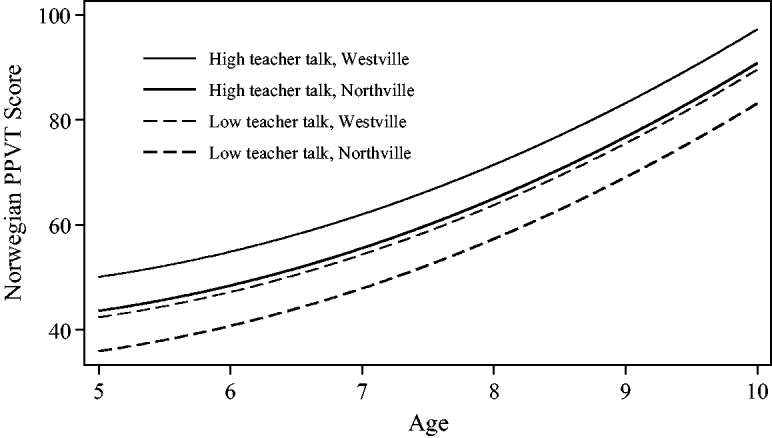
Figure 1 plots the prototypical trajectories of children who were exposed to either high or low levels of teacher-led talk exposure in preschool (controlling all the predictors in the model). The solid lines in the figure represent children who were exposed to a high density of tokens in teacher-led group talk (+1 SD), and the dashed lines represent children who were exposed to a relatively low density of tokens in teacher-led group talk (−1 SD). This figure demonstrates how exposure to talk during teacher-led group discussions in preschool is associated with higher vocabulary scores at the end of preschool (age five). The figure also reveals how these early differences associated with teacher-led talk, at the age of five, persisted across the entire study.
Fitted trajectories for prototypical children exposed to high and low amounts (tokens) of teacher-led talk in each neighborhood type.
Peer talk in preschool and L2 vocabulary development
In addition to the effect of a teacher-led talk, we found a robust effect of peer talk on the children's vocabulary trajectories. The types of the peer talk predicted the baseline vocabulary scores γ06PEER_TYPE i = 3·67, p < ·001) just as tokens of teacher-led talk had. A comparison of Models B, C, and D demonstrates that both the tokens and the types of the peer talk predicted the children's baseline vocabulary knowledge; however, the measure of types was the better predictor. We therefore chose to include the types of the peer talk in the final fitted model.
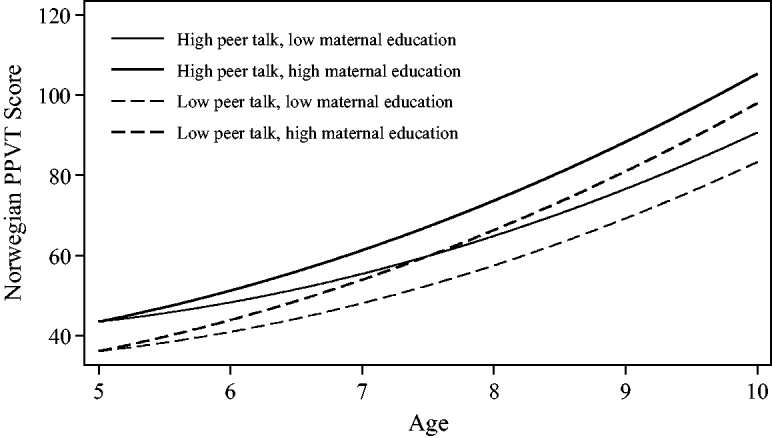
The predicted impact of exposure to many different types in the peer talk on the intercept is demonstrated in Figure 2. The solid lines plot the prototypical trajectories of children who were exposed to a relatively high density of different word types in the peer play (+ 1 SD), and the dashed lines plot the prototypical trajectories of children who were exposed to a relatively low density of different word types in the peer play (−1 SD). Figure 2 demonstrates that the differences in vocabulary scores associated with age-five peer talk do not attenuate with age, even after controlling all other variables. Although the differences associated with the peer talk (+1 SD) were greater than the differences associated with the teacher-led talk, a chi-square test revealed that these differences were not significant in the final fitted model (χ2 = 0·1, p < n.s.). This suggests that standardized increases in the teacher-led group talk and peer talk measures were associated with similar levels of improvement in the children's vocabulary skills.
Demographic factors and L2 vocabulary development
In the final fitted model (Model H), the children whose mothers had attended high school improved their vocabulary skills more rapidly each year (γ11MATERNAL_ED_2i = 2·94, p < ·001) compared to the children whose mothers had not attended high school. Thus, among the variables included in our models, maternal education was the only predictor of children's vocabulary growth over the study period. However, maternal education was not significantly related to the intercept at age five. The significance of this finding is demonstrated in Figure 2, which plots the prototypical trajectories of children from high or low maternal education homes with children who were exposed to high or low levels of peer talk (types) in preschool. When other predictors are controlled, this figure suggests that a child exposed to one standard deviation below the average of peer talk (types) in preschool and whose mother had more years of schooling would start out with relatively low L2 vocabulary skills at the age of five. At the opposite end, a child who was exposed to one standard deviation above the average of peer talk in preschool but whose mother had little schooling would start out with relatively high L2 vocabulary skills at the age of five. However, over the five-year study period, the first child, whose mother had more years of schooling, would still acquire superior levels of L2 vocabulary compared to the second child, who was exposed to more diverse peer talk in preschool.
Fitted trajectories for prototypical children exposed to high and low peer talk diversity (types) from high and low maternal education homes.
Finally, neighborhood type was related to children's vocabulary skills at the onset of the study. Children in Westville (the neighborhoods with fewer co-ethnics) had significantly higher vocabulary skills at the age of five (γ02NEIGHBORHOOD i = 6·45, p < ·001) compared to the children in Northville (the neighborhoods with more co-ethnics). This finding is demonstrated in Figure 1, which plots the prototypical trajectories of children in Northville and Westville who were exposed to relatively high or low levels of tokens in the teacher-led talk during circle time. Figure 1 provides a visual representation of the learning differences between the two types of neighborhoods, hinted at by the descriptive statistics (Table 4) and specified in the final fitted model. Children in Westville (thin lines) started the study with higher vocabulary scores than children in Northville (bold lines), even controlling for maternal education and talk exposure in preschool. Within each neighborhood type, there are also differences in the baseline scores of children based on their exposure to teacher-led talk (controlling for the other predictors).
DISCUSSION
This study investigated talk exposure within several Norwegian preschool classrooms serving mainly immigrant children who grew up in multi-ethnic neighborhoods. Based on growth analyses, we found that the children's vocabulary skills at the age of five (intercept) could be uniquely predicted based on the talk they were exposed to in teacher-led group conversations and peer driven play in preschool, as well as the neighborhood type they grew up in (relative degree of co-ethnic concentration). Maternal education did not significantly predict the children's vocabulary skills at the end of preschool (age 5), but the children differed in their rate of vocabulary acquisition over the period from age five to age ten depending on the level of education attained by their mothers. In the subsequent discussion, we attend to each of these four main findings.
There appeared to be relatively large variations in the amount and quality of talk offered to young L2 learners across the preschool classrooms we visited. Moreover, it is important to note that talk exposure during the circle time and peer play were not strongly related, suggesting that rich talk in teacher-led group conversations may not necessarily result in rich talk in peer play situations (and vice versa). While adults may scaffold children's comprehension and production of language to a large extent (e.g., by distributing turns and clarifying misunderstandings), the more symmetrical and competitive conversational context characterizing peer group talk make it more complex as an arena for L2 exposure and learning (see discussion in Cekaite et al., forthcoming). With regard to this point, it seems pertinent to look at various participatory contexts (talk with teachers and talk with peers in preschool) to understand individual children's vocabulary trajectories.
In this study, teacher-led talk and peer talk appeared to play distinctive roles, each being uniquely related to children's L2 vocabulary development. More specifically, we found that teacher-led talk and peer talk predicted where children started out in terms of vocabulary skills at the end of preschool, and also that the differences associated with early talk exposure were evident even up to the age of ten. As expected, talk exposure did not affect additional vocabulary growth beyond these initial effects.
With respect to teacher-led talk, our findings are very similar to those obtained by Snow and colleagues (Reference Snow, Porche, Tabors and Harris2007) with low-SES monolingual speakers of English. The children in our sample scored lower on age-five vocabulary (this is not surprising because all children were L2 learners), but the children in both samples improved by roughly ten points per year on the PPVT-III from ages five to ten in the unconditional growth model. Both research teams also found that higher vocabulary levels associated with high levels of preschool teacher-led talk were evident across the entire study, and that these did not attenuate as children got older. These results strongly suggest the importance of quality preschool programs and teacher-led talk in establishing a foundation for L2 word learning.
Bowers and Vasilyeva (Reference Bowers and Vasilyeva2011) found that only the amount of teacher talk affected the vocabulary development of the L2 learners in their study, while both the amount and diversity of talk affected their monolingual classmates' vocabulary development in preschool. They suggested that the overall amount of speech was the more relevant input for L2 learners who were in the earlier stages of building their vocabulary with high-frequency words. This interpretation is partly supported in this study with the findings that the amount (tokens) of teacher-led talk was a stronger predictor of L2 vocabulary than the diversity (types). However, in this study, we also demonstrated that the diversity of teacher-led talk was related to L2 vocabulary. The high correlation between the amount and diversity of talk observed in previous studies was also found in this study, but we used a slightly stricter definition of diversity than, for instance, Bowers and Vasilyeva (Reference Bowers and Vasilyeva2011). That is, we excluded the most common words in Norwegian, thus making the two dimensions of talk exposure somewhat more distinguishable.
The present study makes a unique contribution to the research on relationships between peer discourse and vocabulary development. While multilevel analyses of peer vocabulary (Henry & Rickman, Reference Henry and Rickman2007; Mashburn et al., Reference Mashburn, Justice, Downer and Pianta2009) and the extent of participation in play (Connor et al., Reference Connor, Morrison and Slominski2006) suggest that peer talk is a conduit for language development, to date, no researchers have used peer observational data to predict long-term vocabulary growth trajectories. In the present study, the diversity (types) of peer talk was related to children's L2 vocabulary skills at the age of five, and these initial differences between children were evident up to fifth grade.
There is, however, another possible explanation for the direction of the relationship between peer talk and L2 vocabulary. Children with stronger initial vocabulary skills are more likely to interact with peers who use a more sophisticated language – without the peer talk pushing that child's vocabulary skills further. A closer inspection of our data suggests that relatively talkative target children did not necessarily play with the more talkative peers. This suggests that other factors beyond the children's verbal productions, such as power relations within specific peer groups (i.e., who has the right to speak) and access to peer language models in the classroom, determine the amount and diversity of talk that the children are exposed to when playing with their peers.
While the amount (tokens) of teacher-led talk was a slightly stronger predictor of child vocabulary than the diversity (types) of teacher-led talk, an opposite pattern was observed in peer talk. In peer talk, diversity seemed to be the strongest predictor of child vocabulary. Suspecting that there could be both quantitative and qualitative differences in the tokens children were exposed to in teacher-led group talk and peer driven pretend play contexts, we inspected the talk data to shed further light on this issue. These analyses revealed that the tokens in peer talk included, to a larger extent than in teacher-led talk, fictive names that were either invented by the peer group or drawn from children's popular culture (films and computer games), and play verbalizations signaling the pretend frame to the peer group. These play verbalizations represented expressive exclamations to mark an event (warn of danger, surprise, or sadness), semi-conventional words accompanied by gestures and actions (making the sound of a snake or the sound of a ringing doorbell), and play with words for the purpose of humor or joking. They were included in the counting of tokens, but excluded in the counting of types (see exclusion criteria above). Although preschoolers' use of fictive names and play verbalizations have clear pragmatic functions and support the collaborative pretending among peers, these tokens may not directly contribute in building children's vocabulary skills (at least not in the way this is measured by the PPVT-III). Thus, this may explain why exposure to different types (and not tokens) in peer play appeared to a better predictor of vocabulary skills.
An important element in interpreting the findings of this study is the fact that we measured the amount and diversity of talk within two conversational contexts where we expected participants to engage in the extended discourse and be highly motivated to monitor, understand, and produce language. The examples we presented of the teacher's explanation during the circle time (Example 1) and the pretend-play talk between the two children (Example 3) reveal the close bond between extended discourse participation and the use of many tokens and types (e.g., Aukrust, Reference Aukrust2007). Moreover, our measure of density of tokens and types may have served to identify conversations that were also characterized by other discourse qualities that in previous studies have been found to impact vocabulary such as the use of attention-getting utterances (Dickinson & Porche, Reference Dickinson and Porche2011) or the pragmatic support for meaning in the conversations (Weizman & Snow, Reference Weizman and Snow2001).
Although this study suggests that the development of L2 vocabulary may be substantially enhanced by being exposed to a rich L2 in preschool, our findings also point out the limitations of preschools in affecting L2 learners' vocabulary trajectories. This was demonstrated, for instance, by the way maternal education level was related to growth in children's L2 vocabulary between the ages of five and ten; i.e., a child whose mother had more years of schooling would surpass the vocabulary skills of a child whose mother had fewer years of schooling, even though the first child left preschool with superior vocabulary skills due to being exposed to a rich language in preschool (see Figure 2). These findings underscore the need for more research into the role of home language exposure, teacher talk and peer talk in predicting L2 learners' long-term vocabulary development.
The importance of maternal education level for children's growth in L2 vocabulary is interesting in light of the facts that these families mainly spoke Turkish at home and that the education levels among the mothers were generally low. One possible explanation for the finding that maternal education affected children's L2 vocabulary development is that mothers with more schooling had their children enrolled in higher-quality preschools (as seen in the positive correlation between maternal education levels and teacher-led talk). However, maternal education affected growth in L2 vocabulary even when preschool talk exposure was included in the growth analysis. This finding may indicate that mothers with more education have been able to support their children's L2 development either directly – by communicating with their children in Norwegian – or indirectly – through L1 interactions (e.g., book-reading, challenging conversations) and school involvement. However, it should be mentioned that previous research has not been able to demonstrate consistent effects of L2 use in the homes on children's L2 vocabulary development (e.g., Golberg et al., Reference Golberg, Paradis and Crago2008; Mancilla-Martinez & Lesaux, Reference Mancilla-Martinez and Lesaux2011a). Although L2 learners may enter educational settings with different vocabulary skills depending on the degree of exposure to the L2 at home, the vocabulary growth of the initially weaker L2 learners may surpass the vocabulary growth of the initially stronger L2 learners so that the vocabulary gaps are narrowed over time (Mancilla-Martinez & Lesaux, Reference Mancilla-Martinez and Lesaux2011a). These issues underscore the need for more research into the conditions that support vocabulary skills (in both L1 and L2) within immigrant families.
In the present study, we also found that the degree of co-ethnic concentration in the neighborhood was related to initial L2 vocabulary skills, and that this difference was maintained across the study period. Although all the children in the present study lived in multi-ethnic urban neighborhoods, the children growing up in Westville (lower co-ethnic concentration) entered school with superior L2 vocabulary skills compared to the children in Northville (higher co-ethnic concentration). As all the target children mostly spoke Turkish with their parents, one explanation for this finding is that the children in Westville had more access to peers speaking Norwegian as the common language (and less access to Turkish-speaking peers) compared to the children in Northville (see also Rydland et al., in press). Moreover, considering the fact that the L2 vocabulary levels of the target children's siblings were probably affected by the co-ethnic concentration in the neighborhood, the siblings' L2 proficiency may be a factor that strengthens the effects of neighborhood types detected in this study.
A few notes of caution should be considered when interpreting the findings of this study. First, we underscore that the present study is based on a relatively small sample that is vulnerable to selection bias. It is also a limitation that we were only able to collect data on a fraction of the sample at age seven, although we were able to follow the larger sample up to age ten. Models' fit without inclusion of the age-seven data yield the same results as those with the age-seven data, except that the best specification of growth is linear.
Second, we sampled one teacher-led circle time and one peer-play situation for each target child as indicators of the children's language environment in preschool. Although we made various efforts to ensure that we sampled situations that represented typical preschool experiences for the target children, these situations only provided a glimpse of the talk that these children were exposed to in preschool. However, it is important to note that studies, which utilize this approach, of describing verbal exposure within a relatively limited observation time, have been able to predict rather substantial variation in children's oral language skills (see discussion in Dickinson & Porche, Reference Dickinson and Porche2011).
Third, although we employed different measures of L1 and L2 oral skills in the overall study, the PPVT-III was the only one out of these tests that allowed an analysis of children's growth curves across the age range we explored. Clearly, a broader assessment of children's language and reading comprehension skills (in both their L1 and L2) will contribute to our understanding of how preschools play a role in shaping L2 learners' development over time. A reanalysis of the Harvard Home–School data on monolingual children did, for instance, reveal that talk exposure (i.e., teacher use of sophisticated vocabulary during free play) in preschool predicted fourth-grade reading comprehension and that this effect was mediated by literacy skills at the end of kindergarten (Dickinson & Porche, Reference Dickinson and Porche2011).
While the present study did not detect a cumulative effect of preschool talk exposure for L2 vocabulary learning (in the sense that the immediate effect of being exposed to rich input in preschool snowballed to yield bigger effects over time), experimental intervention studies are needed to explore these possibilities further. Such studies should ideally track children's L2 reading comprehension and academic performance into adolescence. Vandell et al. (Reference Vandell, Belsky, Burchinal, Steinberg and Vandergrift2010) did, for instance, detect an additional benefit of having attended high-quality preschools on fifteen-year-old students' achievement that was not evident at earlier ages. In addition, intervention evidence from middle school suggests that L2 learners who receive appropriate instruction may make better vocabulary gains than their monolingual counterparts, and that these gains are associated with improved reading comprehension (Lawrence, Capotosto, Branum-Martin, White & Snow, Reference Lawrence, Capotosto, Branum-Martin, White and Snow2012; Snow, Lawrence & White, Reference Snow, Lawrence and White2009). Finally, the possibility that improved reading comprehension may have effects on vocabulary learning after students become fluent readers should also be explored.
Most importantly, as the results of this study demonstrate the power of peers with rich vocabularies to help L2 learners acquire the school language, future studies of L2 learners should consider peer contexts (both in the preschool classroom and in the neighborhood) as a site for L2 development.