I. INTRODUCTION
Piezoelectric ceramics based on Pb(Zr1−x Ti x )O3 (abbreviated as PZT) system are widely used as sensors and actuators because of their excellent dielectric, piezoelectric, and electrostrictive properties. Reference Jaffe, Cook and Jaffe1–Reference Wang, Wang, Li and Fei6 However, the major disadvantage of PZT-based ceramics is the relatively low Curie temperatures T C (300–380 °C). This low T C comes with the disadvantages of more temperature-dependent properties and less polarization stability, which in turn restricts the operating temperature range (∼1/2 T C) to less than 180 °C. Further limitation for high-temperature applications is also partially ascribed to the increased electrical conductivity at high usage temperature. Searching for piezoelectric ceramics with high T C has been a continuous work in the field of electroceramics due to the expanding demand from high temperature piezoelectric applications. Reference Damjanovic7,Reference Eitel, Randall, Shrout, Rehrig, Hackenberger and Park8 However, piezoelectric materials with a higher T C usually show a worse piezoelectric response. Reference Damjanovic7 Excitingly, a new binary Bi-based system has been found to have a morphotropic phase boundary (MPB) with high transition temperatures and high electromechanical properties, such as BiScO3-PbTiO3 (BS-PT), which may be used as piezoelectric sensors and actuators for these high-temperature environments. Reference Eitel, Randall, Shrout, Rehrig, Hackenberger and Park8–Reference Yao, Liu, Hao and Cao19 Among these binary systems, many intensive studies were focused on BS-PT ceramics due to their excellent piezoelectric property d 33 (460 pC/N) and high T C (450 °C), showing an increasing prospect for some of the applications, comparable to PZT-based ceramics. Reference Eitel, Randall, Shrout, Rehrig, Hackenberger and Park8,Reference Eitel, Randall, Shrout and Park9 However, one of the disadvantages of this material is the high cost of Sc2O3, which means that the production of BS-PT ceramics is not economically viable. On the other hand, the mechanical quality factor (Q m) of BS-PT is low, making scandium-free complex perovskite high temperature piezoelectric ceramics with improved Q m highly desirable. Reference Zhang, Xia, Lebrun, Anderson and Shrout20,Reference Ansell and Cann21 Those two shortages work together and prohibit the large-scale commercial applications of BS-PT. Therefore, searching for some appropriate substitutes is badly required. The only notable success in decreasing costs whilst sustaining usable piezoelectric activity was described in the work of Sterianou et al. Reference Sterianou, Reaney, Sinclair, Bell and Hall22,Reference Sterianou, Sinclair, Reaney, Comyn and Bell23 who substituted Sc2O3 with up to 80% Fe2O3 in the solid solution (1 − x)BiSc1−y Fe y O3-xPbTiO3 (BSF-PT). However, piezoelectric properties significantly deteriorated for y > 0.5 due to partial immiscibility of the two perovskite compositions. Reference Sterianou, Sinclair, Reaney, Comyn and Bell23 To overcome the problems of immiscibility encountered by Sterianou et al., Reference Sterianou, Sinclair, Reaney, Comyn and Bell23 Bi(Mg1/2Ti1/2)O3 was introduced into BSF-PT to form a new pseudo-quaternary system 1 − x(0.35Bi(Mg1/2Ti1/2)O3-0.30BiFeO3-0.35BiScO3)-xPbTiO3. Reference Sebastian, Sterianou, Sinclair, Bell, Hall and Reaney24 The relative reduction in the Sc2O3 content gives a significant cost saving which may prove a commercial advantage. Eitel et al. Reference Eitel, Randall, Shrout, Rehrig, Hackenberger and Park8 put forward such a mechanism in the perovskite structure ceramic: the smaller the tolerance factor (t), the higher the T C, and when t is between 0.88 and 1.09, the stability of perovskite structure is better. Furthermore, the more close to 1, the greater the stability of the perovskite structure. Based on this mechanism, many attempts have been carried out to improve the comprehensive performance of this type piezoelectric material. And BiMeO3-PbTiO3 (BMe-PT) systems with high T C and high piezoelectric response have been achieved, where Me can be a single or mixture of cations with an average valence of +3, e.g., BiFeO3-PbTiO3(BF-PT), BiAlO3-PbTiO3(BA-PT), Bi(Mg1/2Ti1/2)O3-PbTiO3(BMT-PT), Bi(Zn1/2Ti1/2)O3-PbTiO3(BZT-PT), Bi(Ni1/2Nb1/2)O3-PbTiO3(BNN-PT), Bi(Ni1/2Ti1/2)O3-PbTiO3(BNT-PT), and Bi(Li1/3Zr2/3)O3-PbTiO3(BLZ-PT). Reference Choi, Stringer, Shrout and Randall13,Reference Rai, Kholkin, Pandey and Singh25–Reference Zhang, Stringer, Xia, Choi, Randall and Shrout30
Among the BMe-PT type piezoelectric ceramics, the BiYbO3-PbTiO3 (BY-PT) binary system has a high T C up to 630 °C due to its rather low tolerance factor. Reference Eitel, Randall, Shrout, Rehrig, Hackenberger and Park8,Reference Stringer, Shrout, Randall and Reaney14 However, it has a low d 33 (∼28 pC/N), and the large difference in the tolerance factor of BY (0.863) and PT (1.02) causes a low solubility of BY in the composite system (less than 10 mol%), leading to difficulties in fabrication. Reference Grinberg, Suchomel, Davies and Andrew31 In the mean time, the Pb(Mg1/3Nb2/3)O3 (PMN) ceramic, a prototype relaxor ferroelectric with a moderate tolerance factor of 0.986, demonstrates a quite high maximum dielectric constant around −10 °C with diffuse phase transition phenomena. Reference Chen and Hu32–Reference Prakash, Kumar, Thakur, Chatterjee and Goel34 However, it is of rather difficult to obtain pure PMN perovskite by solid-state reaction because of the unwanted pyrochlore phase. In our previous work, BYPT and PMN were combined to fabricate a new ternary system, with the aim of producing ferroelectric ceramics with a purer and more stabilized perovskite structure, which may exhibit high Curie temperatures and excellent piezoelectric properties. The investigations on (1 − x)(0.1BiYbO3-0.9PbTiO3)-xPb(Mg1/3Nb2/3)O3 (BYPT-PMN x , x = 0–0.5) ternary piezoelectric ceramics have shown that sample with 30 mol% of PMN (x = 0.3) exhibited an excellent piezoelectric response and a T C of around 370 °C. It is interesting to note that the sintering temperature has also a profound impact on the structure and properties of piezoelectric ceramics, especially for materials containing volatile elements. Reference Zuo, Rodel, Chen and Li35,Reference Kim, Lee, Lee, Lee and Lee36 These ceramics are rather difficult to obtain dense and well-sintered samples using normal sintering processes because of the volatility of elements at the high sintering temperature, such as potassium, sodium, lead, and bismuth.
Initiated by the motivation to further study the relationship among sintering temperature, structure, and properties, in this study, 0.7(0.1BiYbO3-0.9PbTiO3)-0.3 Pb(Mg1/3Nb2/3)O3 (0.7BYPT-0.3PMN) ternary piezoelectric ceramics were sintered at 1100–1250 °C. To suppress the formation of pyrochlore phase as far as possible, the columbite precursor method was chosen, which have been proved to be an effective way to inhibit the generation of pyrochlore phase. Reference Swartz and Shrout37 The Mn2+ and Nb5+ ions in the MgNb2O6 precursor are easier to form with Ti4+ into mesophase of (TiO4)1−x -(MgNb2O6) x solid solution with perovskite structure, Reference Lv, Hu, Wu and Yan38 thus notably inhibiting the formation of pyrochlore phase. Then, the influences of sintering temperature on the crystalline phase, microstructure, and electrical properties of the ceramics were intensively investigated.
II. EXPERIMENTAL PROCEDURE
A. Sample preparation
0.7(0.1BiYbO3-0.9PbTiO3)-0.3 Pb(Mg1/3Nb2/3)O3 (0.7BYPT-0.3PMN) ternary piezoelectric ceramics were prepared by a columbite precursor method. The raw materials were Bi2O3 (99.9%), Yb2O3 (99.99%), Pb3O4 (99%), TiO2 (99.99%), MgO (99%), and Nb2O5 (99%). Magnesium niobate (MgNb2O6) was first prepared by calcining MgO with Nb2O5 at 1250 °C for 2 h and then used as a precursor. The MgNb2O6 precursor was mixed with other analytically oxide powder according to the stoichiometric ratio (with 1 wt% excess amounts of PbO) and ball-milled, dried, ground, and calcined at 750 °C for 3 h. The final powders were pressed into pellets with a diameter of 12 mm and a thickness of ∼1.5 mm. Ceramic samples were obtained after sintering at different soaking temperatures (1100–1250 °C) for 3 h in a sealed alumina crucible with the samples covered by their original powders to minimize lead loss.
B. Sample characterization
The phase development after sintering was analyzed using a Bruker D8 Advance x-ray diffractometer (Karlsruhe, Germany) with Cu K α1 radiation. The Archimedes' method was used to determine the density of sintered pellets. The grain morphology of the fractured samples was examined by scanning electron microscopy (SEM). For dielectric and ferroelectric measurements, sintered pellets were polished and electroded with silver paste. An impedance analyzer (HP-4294A, Hewlett-Packard, Palo Alto, CA) in conjunction with a high temperature sample holder cell system (ProboStat, NorECs) was used to measure the temperature dependence of dielectric constant (1 kHz) and loss tangent during heating from room temperature to 550 °C at the rate of 4 °C/min. The high temperature d 33 was directly measured 24 h after poling with a modified ZJ-3DHT quasistatic piezoelectric type d 33-meter (Institute of Acoustics, Chinese Academy of Sciences) equipped with a high temperature sample chamber and a Pt/Rh thermalcouple. The polarization versus electric field hysteretic loops were characterized by the RT-66A standardized ferroelectric test system (Radiant Technologies, Albuquerque, NM) at room temperature at approximately 4 Hz. The planar electromechanical coupling factor (k p) and the Q m were measured by using the resonance and antiresonance methods.
III. RESULTS AND DISCUSSION
A. Phase structure
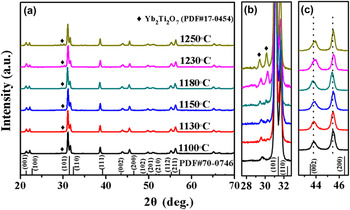
As presented in Fig. 1(a), the x-ray diffraction (XRD) patterns of all samples sintered at 1100–1220 °C for 3 h exhibit a perovskite main phase. The patterns correspond well to the typical tetragonal-symmetry PbTiO3 (PDF#70-0746) with splitted (001)/(100), (101)/(110), (002)/(200), and (112)/(211) peaks. All samples possessed impurity phase Yb2Ti2O7 (PDF#17-0454), which can be clearly identified from Fig. 1(b). Relatively purer perovskite phase seems to be obtained at low sintering temperature, although pyrochlore phase Yb2Ti2O7 is hard to be removed completely. The formation of Yb2Ti2O7 is attributed to the volatility of Pb and Bi at high temperature, both of which have oxides with high vapor pressures. And the higher the temperature, the more severe of the volatilization, which can significantly reduce the structural stability. The mechanism on the volatile characterization of Pb is as follows:
 $${\rm{PbTi}}{{\rm{O}}_3}\buildrel { > 890{}^ \circ {\rm{C}}} \over \longrightarrow {\rm{PbO}} + {\rm{Ti}}{{\rm{O}}_2}\quad ,$$
 $${\rm{PbO(s)}}\buildrel {890{}^ \circ {\rm{C}}} \over \longleftrightarrow {\rm{PbO}}({\rm{g}})\buildrel {890{}^ \circ {\rm{C}}} \over \longleftrightarrow {\rm{Pb}}({\rm{g}}) + {1 \over 2}{{\rm{O}}_2}({\rm{g}})\quad .$$
XRD patterns of 0.7BYPT-0.3PMN ceramics sintered at 1100–1220 °C for 3 h.

When the sintering temperature was above 890 °C, the partial pressure of PbO decreased with the volatilization of Pb, thus facilitating the chemical equilibrium of reaction (1) to shift to the right. Homoplastically, BiYbO3 is also liable to decompose into Bi2O3 and Yb2O3:
 $$2{\rm{BiYb}}{{\rm{O}}_3}\buildrel { > 820{}^ \circ {\rm{C}}} \over \longrightarrow {\rm{B}}{{\rm{i}}_2}{{\rm{O}}_3} + {\rm{Y}}{{\rm{b}}_2}{{\rm{O}}_3}\quad ,$$
 $${\rm{B}}{{\rm{i}}_2}{{\rm{O}}_3}({\rm{s}})\buildrel {820{}^ \circ {\rm{C}}} \over \longleftrightarrow {\rm{B}}{{\rm{i}}_2}{{\rm{O}}_3}({\rm{g}})\buildrel {820{}^ \circ {\rm{C}}} \over \longleftrightarrow 2{\rm{Bi}}({\rm{g}}) + {3 \over 2}{{\rm{O}}_2}({\rm{g}})\quad .$$
Due to the severe volatilization of Pb and Bi at high temperature, the content of TiO2 and Yb2O3 significantly increased, and then more Yb2Ti2O7 was generated Reference Yao, Wang, Yang and Li39 :
 $$2{\rm{Ti}}{{\rm{O}}_2} + {\rm{Y}}{{\rm{b}}_2}{{\rm{O}}_3}\buildrel { \ge 900{}^ \circ {\rm{C}}} \over \longrightarrow {\rm{Y}}{{\rm{b}}_2}{\rm{T}}{{\rm{i}}_2}{{\rm{O}}_7}\quad .$$
The existence of Yb2Ti2O7 pyrochlore phase greatly deteriorates the piezoelectric property of the material. Reference Hou, Zhu, Gao, Wang, Tian and Yan40 While the peak of Yb2Ti2O7 pyrochlore phase was observed being significantly enhanced when the temperature was above 1180 °C [Fig. 1(b)]. It can be seen that selecting an appropriate sintering temperature is indispensable to improve the performance of the material. When the sintering temperature was lower than 1180 °C, the positions of (002) and (200) peaks almost remained unchanged [Fig. 1(c)], indicating that the lattice distortion is not obvious under this circumstance. The peaks of (002) and (200) shifted toward higher angle as the sintering temperature was above 1180 °C, indicative of the reduction of cell volume according to the Bragg equation 2d sinθ = λ. As Pb and Bi in this system are volatile elements, which can be evaporated during the sintering process at high temperature, so it is reasonable that numerous cation vacancies in A-sites can be formed, leading to the shrinkage of cell.
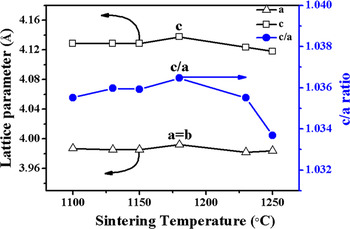
Figure 2 shows the sintering temperature dependence of lattice parameters and tetragonality (c/a) derived from the XRD patterns of 0.7BYPT-0.3PMN ceramics. It can be considered a = b<c as the dominant crystal phase of the ceramic is tetragonal phase structure. The lattice parameters a and c were almost constant in the sintering temperature range of 1100–1150 °C, and the corresponding values of c/a maintained around 1.0359. Then, a and c increased to 3.9920 and 4.1376, and c/a simultaneously obtained its maximum value of 1.0365 at 1180 °C. A higher c/a generally means a higher polarization and lattice deformation; meanwhile, it may cause difficulty in polarization reversal. Reference Mitoseriu, Ciomaga, Buscaglia, Stoleriu, Piazza, Galassi, Stancu and Nanni41 Further increasing the sintering temperature to 1250 °C, a and c reduced to 3.9838 and 4.1180. The c/a followed the same trend as a and c, which decreased from 1.0365 to 1.0337. It suggests that there was a serious distortion of ceramic crystal lattice when the sintering temperature was above 1180 °C, which is consistent with the previous analysis on XRD patterns. The decrease of the c/a ratio should be a result of the increased cation vacancies in A-sites, which are formed due to the severe volatilization of Pb and Bi at high sintering temperature. And it should be noted that the reduction of c/a can improve poling conditions for the decrease in coercive field, possibly as a new high-temperature candidate available. Therefore, a suitable c/a is of very importance for acquiring high piezoelectric performance.
The sintering temperature dependence of lattice parameters and tetragonality (c/a).

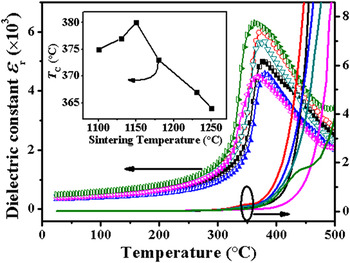
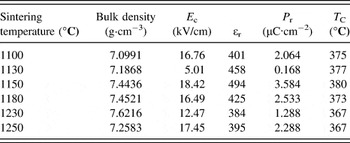
To distinguish the temperature of phase transition, the temperature dependence of dielectric constant (measured under the frequency of 1 kHz) is shown in Fig. 3, and the illustration gives the sintering temperature dependence of Curie temperature T C. All samples show the ferroelectric–paraelectric phase transformation determined from sharp dielectric peaks, corresponding to Curie point T C. Dielectric properties of 0.7BYPT-0.3PMN ceramics sintered at different temperatures are all listed in Table I. It is noted that for all samples, the T C increased initially and then decreased with increasing sintering temperature, reaching the optimal value of 380 °C when the sintering temperature was 1150 °C. It is well-known that the Curie temperature in perovskite ferroelectric oxides is correlated with the room temperature lattice distortion. Reference Yao, Peng, Liu, Hao, Cao and Yu42,Reference Leist, Granzow, Jo and Rödel43 In the BY-PT-PMN ternary system, the lattice distortion can be represented by the c/a ratio (tetragonality) of the tetragonal phase in the MPB compositions. When the perovskite structure displays more distortion (greater c/a), more energy is needed to transform to the parent cubic structure, leading to a higher Curie temperature, namely that high tetragonality generally often owns high T C. When the c/a ratio changed slightly when the sintering temperature was below 1150 °C, the increase of T C might be mainly affected by the raise of density. Reference Fujii, Nakashima, Kumada and Wada44,Reference Zhen and Li45 The system's internal energy significantly increased with increasing density, which contributed to the raise of the transition temperature to an extent. While the sintering temperature was above 1180 °C, the reduction of c/a ratio resulted in the decline of T C. Reference Yao, Peng, Liu, Hao, Cao and Yu42,Reference Hong, Lee, Lim, Lee and Chae46 Considering tetragonality merely, the optimal value of T C should have been acquired at 1180 °C. Curie point T C, however, achieved its optimal value of 380 °C in samples sintered at 1150 °C. The definite origin of this discrepancy is still unclear. However, this experimental result also implies that the c/a ratio is not the only one factor to evaluate T C, other factors such as density, impurity, and structure stability should be also taken into consideration. Further work is ongoing to elucidate the mechanism on T C in the studied system. In addition, the dielectric loss tanδ maintained below 0.05 and slightly changed within the scope of temperature from room temperature to 350 °C, showing excellent temperature stability in this material. Above T C, it decreased dramatically, which can be interpreted by the increased electrical conductivity at high temperature.
Temperature dependence of dielectric constant (1 kHz) for 0.7BYPT-0.3PMN ceramic.

Dielectric properties of 0.7BYPT-0.3PMN ceramics sintered at 1100–1250 °C for 3 h.

E c—Coercive field; εr—Dielectric constant; P r—Remnant polarization; T C—Curie temperature.
B. Microstructure and density
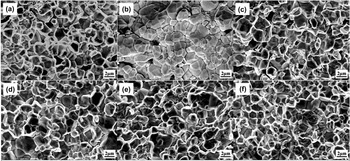
Figure 4 exhibits SEM fractographs of 0.7BYPT-0.3PMN ceramics sintered at 1100–1250 °C. The grain boundary can be clearly observed from the fracture surface of the ceramics, specifying that the fracture mode of 0.7BYPT-0.3PMN ceramics was given priority to the intergranular fracture. As is shown in Figs. 4(a)–4(e), samples sintered at 1100–1230 °C presented the bimodal grain size distribution with a small grain size of 1–2 μm while big grain size of 4–5 μm. Small grains tightly inlaid among the large ones, and the degree of the inlay was more obvious with increasing sintering temperature. Further increasing sintering temperature, however, the size of grain decreased significantly and tended to be homogeneous with a grain size of 0.5–1.5 μm as is shown in Fig. 4(f). This should be attributed to the formation of more liquid phase at grain boundary in high temperature, which suppressed grains to grow.
SEM fractographs of 0.7BYPT-0.3PMN ceramics sintered at different temperatures: (a) 1100; (b) 1130; (c) 1150; (d) 1180; (e) 1230; and (f) 1250 °C.

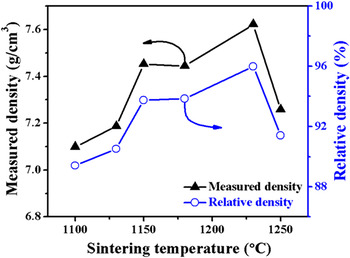
The temperature dependence of measured density and relative density of 0.7BYPT-0.3PMN ceramics is demonstrated in Fig. 5. The measured density and relative density turned out to be increased initially from 7.099 g/cm3 and 89.4% to 7.444 g/cm3 and 93.75% with increasing sintering temperature from 1100 to 1150 °C. Such an observation is perhaps not unexpected. According to the theory of sintering, with increasing sintering temperature, the significantly strengthened spread among the particles, as well as obviously accelerated mutual transportation of substances and charges, plays an important role in promoting structural densification. Reference Radecka and Rekas47 Furthermore, the measured density and relative density further increased from 1180 to 1230 °C, reaching their maximum values of 7.622 g/cm3 and 95.99% at 1230 °C, regardless of the volatility of Pb and Bi during a sintering process. However, when raising the sintering temperature to 1250 °C, the measured density and relative density decreased rapidly, which is consistent with the micrographs. It is evidently caused by the severe volatility of Pb and Bi at such a high temperature.
Measured density and relative density of 0.7BYPT-0.3PMN ceramics sintered at different temperatures.

C. Electrical properties
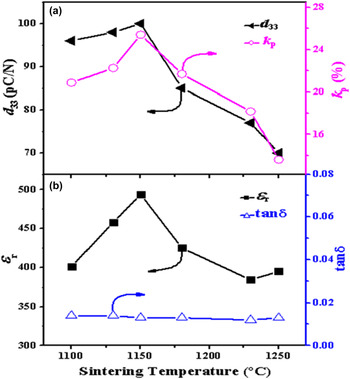
Figure 6 gives the piezoelectric and dielectric properties of 0.7BYPT-0.3PMN ceramics sintered at 1100–1250 °C for 3 h. As shown in the figure, d 33, k p, and εr values increased initially and then decreased with increasing sintering temperature, reaching the maximum values of d 33 = 100 pC/N, k p = 25.4%, and εr = 494, respectively, when the sintering temperature was 1150 °C. Piezoelectric properties of ceramics are usually affected by phase structure density, grain size, impurity phase, c/a ratio, and so on. When the sintering temperature was below 1150 °C, all the samples had an increased density (Fig. 5). A denser structure may reduce the dissipated energy and improve the piezoelectric response. Also, combining the SEM and XRD results, the samples sintered below 1150 °C showed relatively purer peroviskite phase with tetragonal phase and more homogeneous morphology. Therefore, the improved piezoelectric performance may be partly attributed to the improved structural stability and homogeneity. Reference Shi, Liao, Zhang, Zhang and Guo48 At the same time, the c/a ratio maintained below 1.036. It is known that the reduction of c/a ratio around the MPB composition of piezoceramics enhances the piezoelectric properties. The compound, whose c/a is lower than 1.04, especially achieves a high d 33. Reference Leist, Granzow, Jo and Rödel43,Reference Li, Yang, Tian, Li, Cheng and Chen49 The common results of the above several factors made piezoelectric properties gradually increased with increasing sintering temperature, obtaining their maximum values of d 33 = 100 pC/N, k p = 25.4% at 1150 °C. However, due to the severe volatility of Bi and Pb, the c/a ratio increased to 1.0366 at 1180 °C. The stress resulted from the domain switching was enhanced with the increase of c/a ratio, which limited the electrical domain switching and contributed to a higher polarization, lattice deformation, and difficulty in polarization reversal. More seriously, there was more pyrochlore phase forming along grain boundaries at such a higher sintering temperature. Eventually, the piezoelectric activity of the ceramic was severely suppressed.
Piezoelectric and dielectric properties of 0.7BYPT-0.3PMN ceramics: (a) Piezoelectric coefficient d 33 and k p, (b) dielectric constant εr and dielectric loss tanδ.

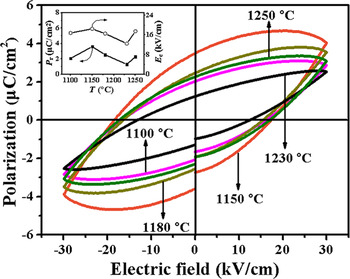
Figure 7 gives the polarization–electric field (P–E) hysteresis loops of 0.7BYPT-0.3PMN ceramics, and the illustration shows the remnant polarization (P r) and coercive electric field (E c) as a function of sintering temperature. One can see in Fig. 7 that the shape of the hysteresis loops shows asymmetric for all samples. The asymmetric P–E hysteresis loops indicate that there is an internal electric bias field in the polycrystalline grains, caused by the space charge produced by the aliovalent displacing of Nb5+ ions in B-sites of the ABO3-type perovskites. Reference Okazaki and Maiwa50 Both P r and E c increased initially and then decreased as sintering temperature increased, and obtained their maximum values of 3.58 μC/cm2 and 18.42 kV/cm at 1150 °C, respectively. By contrast, P r and E c had similar values in other sintering temperature. A lower content of pyrochlore phase and a denser structure at 1150 °C, which made electric domain shifting easier, were both beneficial to increase the rate of electric domain polarization, thus raising the value of P r. Reference Leist, Granzow, Jo and Rödel43,Reference Li, Yang, Tian, Li, Cheng and Chen49–Reference Long, Chen and Meng51
Polarization–electric field (P–E) hysteresis loops of 0.7BYPT-0.3PMN ceramics sintered at 1100–1250 °C for 3 h.

IV. CONCLUSIONS
In summary, the BY-PT-PMN ternary solid solution system was investigated for the development of piezoelectric ceramics with high Curie temperatures. Incorporation of PMN into BYPT largely increases the piezoelectric response, and an appropriate sintering temperature can also help to improve the microstructure and electric properties. In this study, the effects of sintering temperature on the microstructures, piezoelectric, and dielectric properties of the 0.7BYPT-0.3PMN ternary piezoelectric ceramics were systematically investigated. The result was further revealed that the formation of impurity phases, ceramic density, grain morphology, dielectric as well as piezoelectric properties are all very sensitive to the sintering temperature. The 0.7(0.1BiYbO3-0.9PbTiO3)-0.3 Pb(Mg1/3Nb2/3)O3 (0.7BYPT-0.3PMN) ternary piezoelectric ceramics sintered at 1150 °C exhibited enhanced piezoelectric and dielectric properties with the optimum properties of d 33 = 100 pC/N, k p = 25.4%, εr = 494, and T C = 380 °C, respectively, which were attributed to the combined effect of a higher density, structural homogeneity with decreased tetragonality as well as a small amount of pyrochlore phase. It is expected that these system piezoelectric materials can be applied in high-power piezoelectric devices, such as transformers and certain types of actuators.
ACKNOWLEDGMENTS
This work was supported by National Student Research Training Program from University of Science and Technology Beijing (Grant No. 13030215) and National Natural Science Foundation of China (Grant Nos. 11074277, 51472026, and 51332002).