Jones deserves enormous credit for first applying OT grammar to kin classification nearly a decade ago (Jones Reference Jones2003). His latest model, however, founders when he extends Seneca terms to second cousins because he tries to conjure lineal/collateral and parallel/cross distinctions from interactions among many constraints. This strategy is surprising since he incorporated those distinctions into his earlier model, and he cites Hage (Reference Hage2001), who used them in binary tree representations to account for markedness relationships and diachronic change in terminologies.
Here I describe an OT-based model that does properly assign Seneca G0 terms. This account illustrates what I think is at stake in Jones's attempt to bootstrap an underlying representation (UR) for kin space.
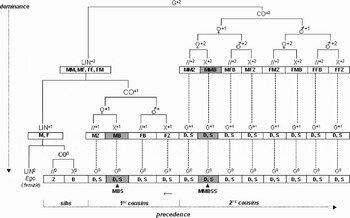
My model's UR is a nested set of asymmetric binary classification trees (Fig. 1). Kin types are classes defined at terminal nodes for each generational tree, and second collaterals in a descending generation are partitioned by projections from collateral terminals in ascending generations. Left-to-right precedence is fixed relative to the LIN0 Ego node by the nodal dominance hierarchy. Input to the grammar can be any chunk of this nested structure and output is the surjective mapping of the input onto itself that best satisfies a strict ranking of one faithfulness and two markedness constraints: Max, which requires expression of each input marker in the output; NoCo, which bans collateral (CO) and side markers (♀, ♂) in the output; and NoAlign, which bans expression of side and parity markers (//, X) in the output.
Figure 1.
Nested binary classification trees for 3G kin space: G=generation; LIN=lineal; CO=collateral; ♀=matrilateral; ♂=patrilateral; X=cross; //=parallel; M=mother; F=father; Z=sister; B=brother; D=daughter; S=son. Dashed lines=projections of terminal nodes.
There are four effective rankings of these constraints, each of which generates an optimal partitioning corresponding to one of the classification systems first proposed by Lowie (Reference Lowie1928):
(1) 
Bifurcate collateral rankings mark both cross and parallel collateral classes; bifurcate merging rankings only mark cross collateral classes and merge parallel collaterals with lineals; lineal rankings, indifferent to parity, merge all collaterals; generation rankings merge all collaterals with lineals.
Constraint rankings, coupled with parity checking, cause MMBSS (mother's mother's brother's son's son) to merge with MBS in a Seneca cross collateral G0 output class (see Fig. 1). UR terminal markers define first collateral parity, but local rules determine which side marker is used to check the parity of second collaterals in descending generations. Seneca exhibits “Iroquois” rather than “Dravidian” parity in G+1 (Trautman & Barnes Reference Trautmann, Barnes, Godelier, Trautmann and Tjon Sie Fat1998): Parity for a descendent of any G+1 second collateral is determined by checking its sex against the G+1 side marker that most immediately dominates its G+2 parent. G0 parity in both systems is inherited from the G+1 parent. Since MMBS is cross in Seneca, MMBSS is also cross. “Dravidian” parity for descendents of G+2 cross types is checked against the parent kin type's contralateral side. In that case, MMBS is parallel, and the MMBSS G0 descendent type can't merge with MBS.
Consistent with Hage's argument (Hage Reference Hage2001), different rankings can be applied in parallel to different generations. The optimal output tree for Seneca is:
(2)
The G+2 ranking merges all collateral types with lineal types in the LIN+2 class. The G+1 ranking merges parallel first and second collateral types with the LIN+1 class and combines cross first and second collateral types into a superordinate X+1 class that occupies the position held by the neutralized CO+1 marker. The G0 ranking merges all child types of LIN+1 parallel types in a single LIN0 class and all child types of X+1 cross types into a single class defined by the projection of the X+1 marker onto G0.
Lexical coding trees for each generation are formed from (2). The Seneca G0 tree is:
(3)
An optimal output tree partitions classes only to the level of expressed UR markers. Within-class partitionings, for example the partitioning of the LIN0 class in (3), result from interaction between constraints on the lexicon and partial ordering of generations by the number of partitions in an optimal output tree. Interactions between parity checking and constraint rankings impose these partial orders. If, for example, G0 parity were checked against Ego's sex and G0 partitioning were determined only by a ranking rather than by a ranking and the projected X+1 marker, the Seneca output tree (2) could have a different partial order. Terminological “skewing” (Lounsbury Reference Lounsbury and Goodenough1964) is a mechanism for subverting partial ordering. A lexical tree for the Omaha terminology (Ackerman Reference Ackerman1976) would be a composite nested structure that projects seven classes onto G0.
Jones uses many constraints to do all the classification work because he believes the logic of human kin classification stems from a domain independent OT “grammar faculty.” My model suggests a domain specific grammaticalization scenario in which a dedicated kin classification mechanism evolved to mark unilineal descent in primate social organizations (Kapsalis 2004; Strier Reference Strier, Chapais and Berman2004). The nested tree structure emerged as protohuman reproductive coalitions required representations marking bilateral descent and affinity (Chapais Reference Chapais2008; Fox Reference Fox1967). Strict ranking coupled with variable parity checking evolved as a “once and for all” solution to the problem of tracking forms of structural endogamy (White 1996) created by the extension of kinship to second and higher cross and parallel collaterals. Constraint rankings do not define marriage “rules” but rather denominate kinds of relatedness. A classification tree is thus a cognitive spread sheet used to generate reference terms for recruiting and counting social partners. An account of this model, “Structural endogamy and the grammar of human kin classification,” is available at my website.





 You have
Access
Jones deserves enormous credit for first applying OT grammar to kin classification nearly a decade ago (Jones Reference Jones2003). His latest model, however, founders when he extends Seneca terms to second cousins because he tries to conjure lineal/collateral and parallel/cross distinctions from interactions among many constraints. This strategy is surprising since he incorporated those distinctions into his earlier model, and he cites Hage (Reference Hage2001), who used them in binary tree representations to account for markedness relationships and diachronic change in terminologies.
Here I describe an OT-based model that does properly assign Seneca G0 terms. This account illustrates what I think is at stake in Jones's attempt to bootstrap an underlying representation (UR) for kin space.
My model's UR is a nested set of asymmetric binary classification trees (Fig. 1). Kin types are classes defined at terminal nodes for each generational tree, and second collaterals in a descending generation are partitioned by projections from collateral terminals in ascending generations. Left-to-right precedence is fixed relative to the LIN0 Ego node by the nodal dominance hierarchy. Input to the grammar can be any chunk of this nested structure and output is the surjective mapping of the input onto itself that best satisfies a strict ranking of one faithfulness and two markedness constraints: Max, which requires expression of each input marker in the output; NoCo, which bans collateral (CO) and side markers (♀, ♂) in the output; and NoAlign, which bans expression of side and parity markers (//, X) in the output.
Nested binary classification trees for 3G kin space: G=generation; LIN=lineal; CO=collateral; ♀=matrilateral; ♂=patrilateral; X=cross; //=parallel; M=mother; F=father; Z=sister; B=brother; D=daughter; S=son. Dashed lines=projections of terminal nodes.
There are four effective rankings of these constraints, each of which generates an optimal partitioning corresponding to one of the classification systems first proposed by Lowie (Reference Lowie1928):
(1)
Bifurcate collateral rankings mark both cross and parallel collateral classes; bifurcate merging rankings only mark cross collateral classes and merge parallel collaterals with lineals; lineal rankings, indifferent to parity, merge all collaterals; generation rankings merge all collaterals with lineals.
Constraint rankings, coupled with parity checking, cause MMBSS (mother's mother's brother's son's son) to merge with MBS in a Seneca cross collateral G0 output class (see Fig. 1). UR terminal markers define first collateral parity, but local rules determine which side marker is used to check the parity of second collaterals in descending generations. Seneca exhibits “Iroquois” rather than “Dravidian” parity in G+1 (Trautman & Barnes Reference Trautmann, Barnes, Godelier, Trautmann and Tjon Sie Fat1998): Parity for a descendent of any G+1 second collateral is determined by checking its sex against the G+1 side marker that most immediately dominates its G+2 parent. G0 parity in both systems is inherited from the G+1 parent. Since MMBS is cross in Seneca, MMBSS is also cross. “Dravidian” parity for descendents of G+2 cross types is checked against the parent kin type's contralateral side. In that case, MMBS is parallel, and the MMBSS G0 descendent type can't merge with MBS.
Consistent with Hage's argument (Hage Reference Hage2001), different rankings can be applied in parallel to different generations. The optimal output tree for Seneca is:
(2)
The G+2 ranking merges all collateral types with lineal types in the LIN+2 class. The G+1 ranking merges parallel first and second collateral types with the LIN+1 class and combines cross first and second collateral types into a superordinate X+1 class that occupies the position held by the neutralized CO+1 marker. The G0 ranking merges all child types of LIN+1 parallel types in a single LIN0 class and all child types of X+1 cross types into a single class defined by the projection of the X+1 marker onto G0.
Lexical coding trees for each generation are formed from (2). The Seneca G0 tree is:
(3)
An optimal output tree partitions classes only to the level of expressed UR markers. Within-class partitionings, for example the partitioning of the LIN0 class in (3), result from interaction between constraints on the lexicon and partial ordering of generations by the number of partitions in an optimal output tree. Interactions between parity checking and constraint rankings impose these partial orders. If, for example, G0 parity were checked against Ego's sex and G0 partitioning were determined only by a ranking rather than by a ranking and the projected X+1 marker, the Seneca output tree (2) could have a different partial order. Terminological “skewing” (Lounsbury Reference Lounsbury and Goodenough1964) is a mechanism for subverting partial ordering. A lexical tree for the Omaha terminology (Ackerman Reference Ackerman1976) would be a composite nested structure that projects seven classes onto G0.
Jones uses many constraints to do all the classification work because he believes the logic of human kin classification stems from a domain independent OT “grammar faculty.” My model suggests a domain specific grammaticalization scenario in which a dedicated kin classification mechanism evolved to mark unilineal descent in primate social organizations (Kapsalis 2004; Strier Reference Strier, Chapais and Berman2004). The nested tree structure emerged as protohuman reproductive coalitions required representations marking bilateral descent and affinity (Chapais Reference Chapais2008; Fox Reference Fox1967). Strict ranking coupled with variable parity checking evolved as a “once and for all” solution to the problem of tracking forms of structural endogamy (White 1996) created by the extension of kinship to second and higher cross and parallel collaterals. Constraint rankings do not define marriage “rules” but rather denominate kinds of relatedness. A classification tree is thus a cognitive spread sheet used to generate reference terms for recruiting and counting social partners. An account of this model, “Structural endogamy and the grammar of human kin classification,” is available at my website.