Growth and nutritional abnormalities are common in infants with CHD and have a significant impact on outcomes.Reference Mitting, Marino, Macrae, Shastri, Meyer and Pathan1–Reference Ross, Latham and Joffe3 Ensuring adequate growth and nutrition is an important modifiable risk factor for improving outcomes in children requiring cardiac surgery. In addition, in critically ill children, early attainment of nutritional goals has been associated with improved outcomes.Reference Mehta, Bechard and Cahill4,Reference Mikhailov, Kuhn and Manzi5 However, overfeeding and obesity may be an under-recognised problem that may contribute to worse outcomes in CHD.Reference Tamayo, Manlhiot, Patterson, Lalani and McCrindle6–Reference Mehta8 Obesity is associated with important secondary co-morbidities that impact cardiovascular health, including hypertension, obstructive sleep apnoea, and associated metabolic disorders.Reference Skilton, Marks and Ayer9,Reference Chung, Onuzuruike and Magge10
The need for tracheostomy following surgery for CHD is rare but is associated with high mortality and resource utilisation.Reference LoTempio and Shapiro11–Reference Maxwell and McMillan18 Indications for tracheostomy include tracheo-bronchomalacia, acquired airway obstruction (e.g., subglottic stenosis), chronic respiratory failure, and vocal cord paresis with uncontrolled aspiration.Reference LoTempio and Shapiro11,Reference Hoskote, Cohen, Goldman and Shekerdemian12,Reference Cotts, Hirsch, Thorne and Gajarski15,Reference Maxwell and McMillan18 DiGeorge syndrome; Pierre-Robin sequence; vertebral defects, anal atresia, cardiac defects, treacheo-oesophageal fistula, renal anomalies, and limb anomalies (VACTERL) association; and Down syndrome are known to have anatomical substrates associated with poor airway integrity.Reference Butnaru, Colreavy, Ayari and Froehlich19,Reference Trachsel and Hammer20 Unstable haemodynamic status may require long-term mechanical ventilation, thus necessitating tracheostomy. Current nutritional guidelines for infants with CHD may not consider the unique metabolic derangements that accompany chronic positive pressure ventilation and may contribute to inappropriate nutritional management.
By following standard nutritional management for these vulnerable infants with underlying heart disease, we not infrequently introduce overfeeding and obesity.Reference Letton, Chwals, Jamie and Charles21,Reference Mitchell, Logan, Pollock and Jamieson22 Here, we describe outcomes related to standard nutritional management guided by accepted equations for the prediction of estimated energy expenditure on indices of growth in a cohort of children with CHD who underwent tracheostomy with positive pressure ventilation.
Methods
Patients
We reviewed inpatient hospital charts of infants who underwent surgical repair or palliation of underlying heart diseases from January 2004 to December 2016 and who also underwent tracheostomy placement for chronic respiratory management before or after cardiac surgery at Nemours Cardiac Center, Nemours/Alfred I. duPont Hospital for Children, Wilmington, DE, United States of America. This retrospective study was approved by the Institutional Review Board of the hospital. Inclusion criteria were as follows: young children with structural heart disease less than 2 years of age; and history of heart surgery and tracheostomy within the first year of life. End points were decannulation of tracheostomy, transfer to another institution, or death. Initial post-operative care was provided in a designated cardiac ICU. Once stabilised, patients were transitioned to the cardiac step-down unit for additional care until discharge. All inpatient care was delivered within the Nemours Cardiac Center, an integrated care unit.
Ventilator management
Routine respiratory support for tracheostomy patients was provided by the multidisciplinary care team during the inpatient stay. Initial ventilatory support was provided either by Servo I® (Soma Technology, Inc., Bloomfield, CT, USA) synchronised intermittent mandatory ventilation/pressure-regulated volume control or by Dräger® (Dräger Inc., Lübeck, Germany)/volume guarantee, and transitioned to either LTV® (Cardinal Health, Dublin, OH, USA)/synchronised intermittent mandatory ventilation/pressure control or volume control prior to discharge. During initial hospitalisation, ventilator settings were titrated based on clinical goals directed by the inpatient cardiac intensive care team with the input of respiratory therapy and pulmonary medicine. Following hospital discharge, settings were adjusted weekly by the tracheostomy team based upon oxygen saturation and end-tidal CO2, unless there was any medical indication to change ventilator settings.
Nutritional assessment and diet therapy
Initial nutritional assessment and recommendation were performed upon admission and again following cardiac surgery. Ongoing clinical nutrition management occurred with the guidance of a staff nutritionist/dietitian. The actual body weight was used to calculate total caloric intake (cal/kg per day) and growth velocity. Initial calorie goals were set by nutrition consult according to standard equations. Target nutrition was set at 100–130 cal/kg per day as tolerated, and enteral feeding was preferred unless it was contraindicated, such as with necrotising enterocolitis, symptomatic sepsis, or severe haemodynamic instability. Physical growth was assessed via weight-for-age z score, length-for-age z score, and weight-for-length z score. Length was measured with a standard length measuring board for infants. Definition of obesity was determined by weight:length ratio over 95th percentile (weight-for-length z score > 1.7) and a persistent excessive weight gain trend surpassing the standard curve on the growth chart.
For the patients who developed obesity after our standard nutritional support for CHD, nutritional adjustment or reduction of daily caloric intake (diet therapy) was introduced by decreasing total caloric intake by 10% or greater to reduce excessive body weight. Nutritional adjustment was performed weekly with careful follow-up with weight-for-age z score, weight-for-length z score, and weight gain trend.
Statistics
Data are shown in mean ± standard deviation unless otherwise stated. Multiple comparisons were performed by the one-way analysis of variance, followed by Dunnett’s multiple comparison test to assess the significance on data values (GraphPad 6, Prizm; Claritas LLC, Cincinnati, OH, United States of America). A p value less than 0.05 was regarded as statistically significant.
Results
Clinical background of the patients
A total of 19 patients were included in this study. None of these patients were obese before cardiac surgery or tracheostomy. Underlying CHDs include single ventricle physiology with surgical palliation (n = 6), tetralogy of Fallot (n = 3), isolated aortic arch anomalies/coarctation of aorta (n = 3), interrupted aortic arch (n = 2), and miscellaneous (n = 4). Most of our patients had complex medical backgrounds, including DiGeorge syndrome (n = 3), vertebral defects, anal atresia, cardiac defects, treacheo-oesophageal fistula, renal anomalies, and limb anomalies association (n = 3), Pierre-Robin sequence (n = 2), trisomy 21 (n = 2), prematurity (n = 2), and heterotaxy syndrome (n = 2). Thirteen patients had complete repair of underlying CHD (129 ± 115 days), whereas six patients underwent palliative surgery for single ventricle physiology, including aortopulmonary shunt (n = 3), bidirectional Glenn surgery or hemi-Fontan surgery (n = 2), and Fontan surgery (n = 1) (68 ± 69, 180 ± 54, and 426 days, respectively). Thirteen patients (68.4%) had more than one heart surgery. Fourteen patients (73.7%) developed obesity, whereas five patients did not.
Age and indications for tracheostomy
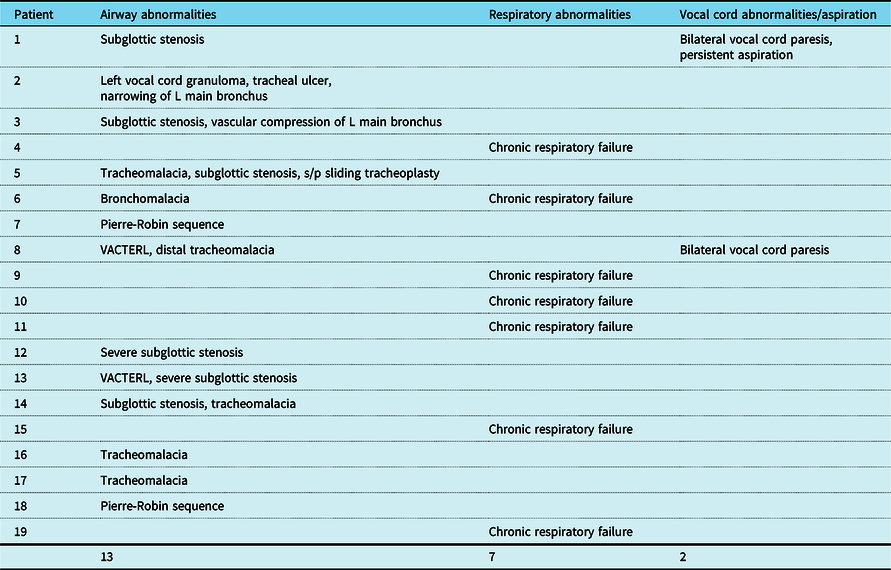
Age of tracheostomy placement ranged from 7 to 364 days (160 ± 109 days); one patient had tracheostomy before cardiac surgery and the rest had after surgery. The indications for tracheostomy are shown in Table 1. One patient developed distal tracheal stenosis after prolonged intubation; tracheoplasty was performed in addition to tracheostomy (patient 5). All patients with tracheostomy were mechanically ventilated with positive pressure ventilation at the installation of tracheostomy. All, except patient 6, underwent gastrostomy tube placement with Nissen fundoplication by the time of the study (130 ± 92 days).
Indications for tracheostomy

L = left; s/p: status post; VACTERL = vertebral defects, anal atresia, cardiac defects, tracheo-oesophageal fistula, renal anomalies, and limb anomalies.
Nutritional management and outcome
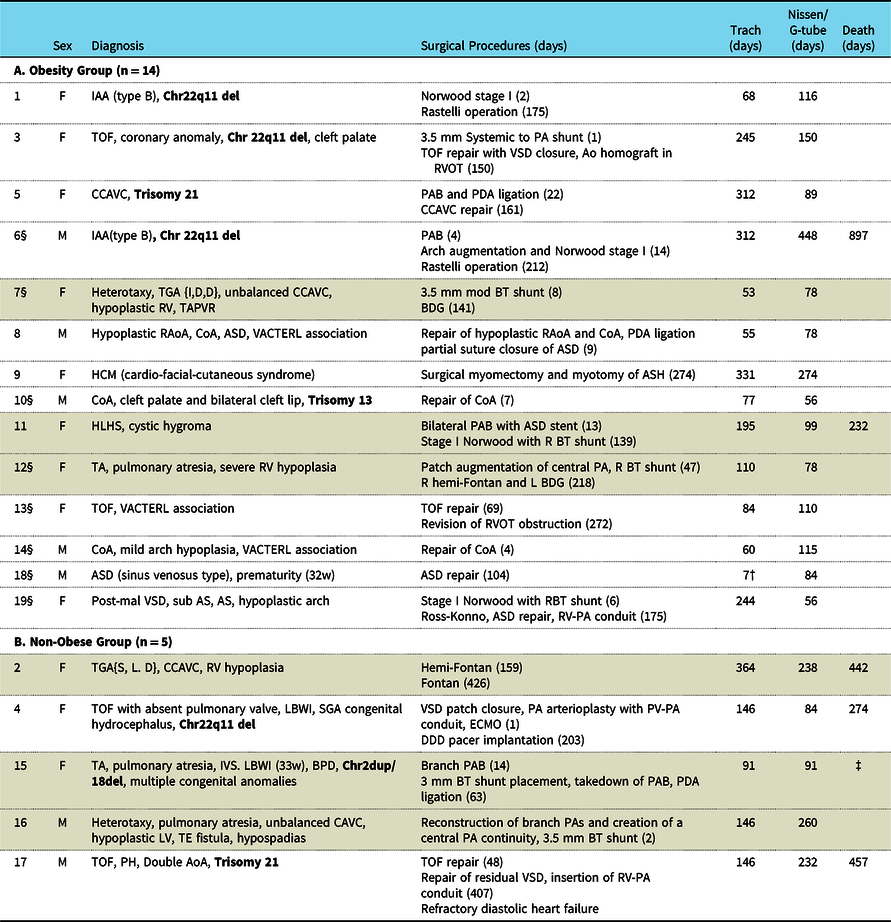
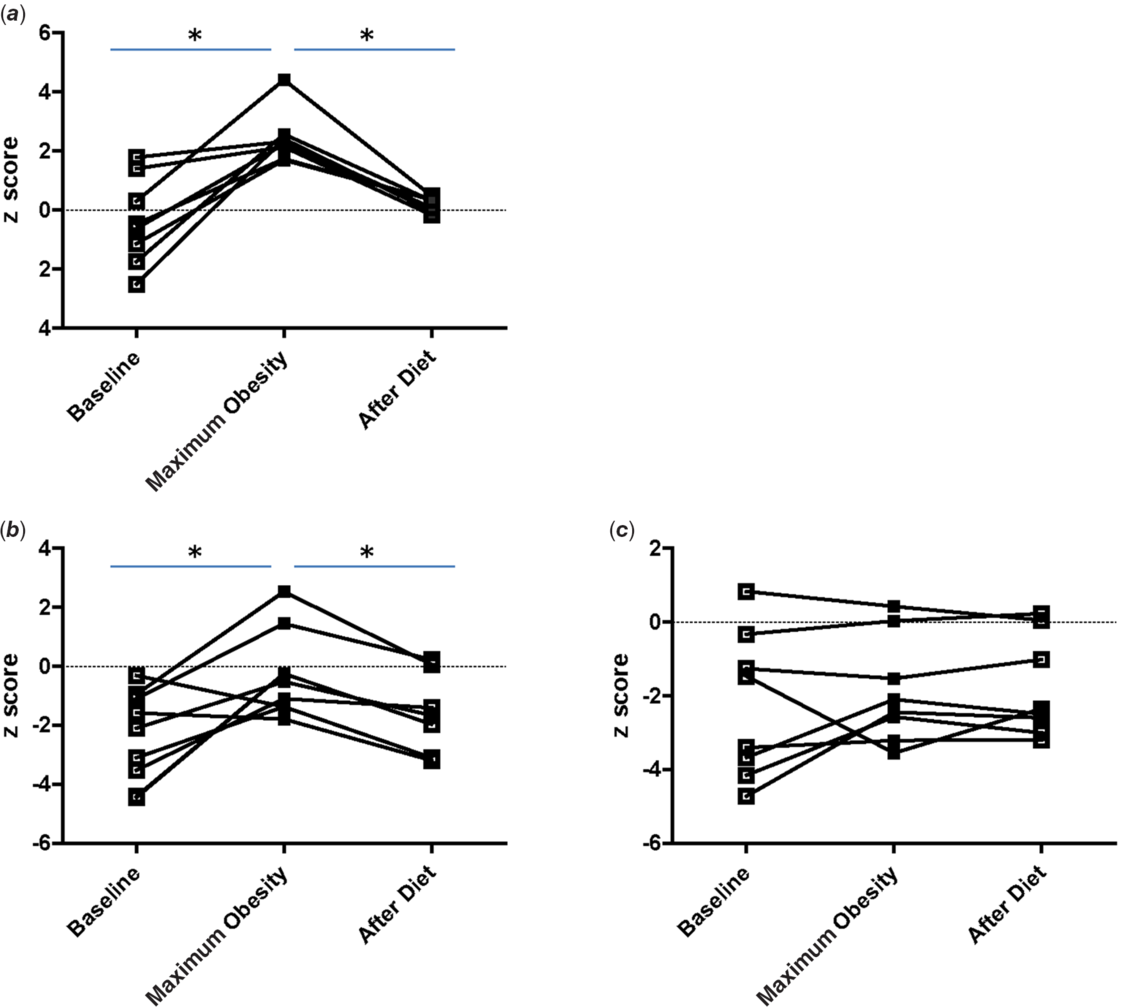
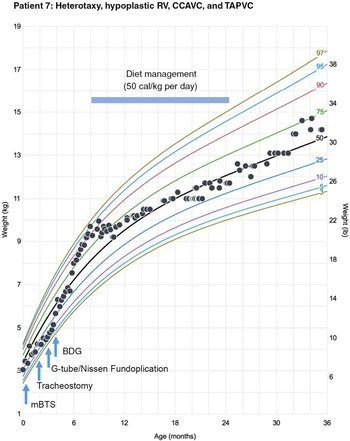
Once haemodynamic status was stabilised, an initial nutritional target was set at 100–130 kcal/kg per day to promote optimum physical growth. The outcome of nutritional management is summarised in Table 2 along with primary cardiac diagnosis; cardiac surgery performed; and ages at tracheostomy, Nissen/G-tube, and death. Fourteen patients (73.7%) became obese (maximum weight-for-length z score: 2.59 ± 0.47) with physical appearance of increased adiposity within 6 months after tracheostomy and gastrostomy feeding, whereas five patients did not (maximum weight-for-length z score: 0.2 ± 0.83). In eight patients who developed obesity (maximum weight-for-length z score: 2.44 ±0.85), daily caloric intake (diet) was reduced; all showed successful weight-for-length z score reduction within 6 months (weight-for-length z score: 0.18 ± 0.23; p < 0.05 compared with pre-diet) after appropriate feeding changes (40–90 cal/kg per day) (Fig 1). During this period, we also examined the changes in weight-for-age z score and length-for-age z score. The weight-for-age z score changed from −2.57 ± 1.53 to −0.65 ± 1.02 (p < 0.05) by maximum nutritional support. The weight-for-age z score decreased to −2.02 ± 1.51 within 6 months after diet treatment (p < 0.05 compared with the peak). Figure 2 shows one typical case of successful diet management. However, length-for-age z score did not significantly change during the study period (Fig 1).
Clinical Profile of the Patients who underwent Cardiac Surgery and Tracheostomy

Shaded are the patients with single ventricle palliation. The rest of the patients are with biventricular physiology. Non-obese patients (B) tend to have more complicated and haemodynamically unstable conditions than those who developed obesity (A).
Ao homograft = aortic homograft; AS = aortic stenosis; ASD = atrial septal defect; ASH = asymmetric septal hypertrophy; BDG = bidirectional Glenn; BPD = brochopulmonary dysplasia; BT shunt = Blalock−Taussig shunt; CCAVC = complete common atrio-ventricular canal; Chr2dup/18del = chromosome 2 duplication and 18 deletion; Chr22q11 = chromosome 22 q11 deletion; CoA = coarctation of aorta; ECMO = extracorporeal membrane oxygenation; HCM = hypertrophic cardiomyopathy; HLHS = hypoplastic left heart syndrome; IAA = interrupted aortic arch; IVS = intact ventricular septum; L = left; LBWI = low birth weight infant; PA = pulmonary artery; PAB = pulmonary artery banding; PDA = patent ductus arteriosus; PH = pulmonary hypertension; post-mal VSD = posterior malalignment type ventricular septal defect; R = right; RAoA = right aortic arch; RV = right ventricle; RVOT = right ventricular outflow obstruction; SGA = small for gestational age infant; TA = tricuspid atresia; TAPVR = total anomalous pulmonary venous return; TE fistula = tracheo-oesophageal fistula; TGA = transposition of the great arteries; TOF = tetralogy of Fallot; Trach = tracheostomy; VACTERL association = vertebral defects, anal atresia, cardiac defects, tracheo-oesophageal fistula, renal anomalies, and limb abnormalities.
§ Patients who developed obesity that resolved within 6 months after nutritional adjustment.
† Patient was born with a critical airway due to Pierre-Robin syndrome.
‡ Lost to follow-up at 4 months of age as the patient was transferred back to the referring institution.
Changes in parameters of physical growth including weight-for-length z score (a), weight-for-age z score (b), and length-for-age z score (c) in eight patients who developed obesity, which was reversed by diet management (patients 6, 7, 10, 12, 13, 14, 18, and 19; also see Table 2). Three time points are all after the placement of tracheostomy. “Baseline” refers to the condition when the initial stable feeding schedule was started. “Maximum Obesity” is the highest weight-for-length z score before diet treatment was introduced. “After Diet” represents the lowest weight-for-length z score within 6 months after the initiation of diet treatment. *p < 0.05.

A growth chart of patient 7 with heterotaxy and single ventricle physiology who underwent placement of tracheostomy and gastrostomy tube (G-tube)/Nissen fundoplication in addition to modified Blalock-Taussig shunt and bidirectional Glenn surgery during infancy. After bidirectional Glenn with stabilisation of haemodynamic status, the patient started to gain weight progressively. Diet management was initiated around 8 months of age, after which her obesity was resolved. BDG = bidirectional Glenn; CCAVC = complete common atrioventricular canal; mBTS = modified Blalock–Taussig shunt; RV = right ventricle; TAPVC = total anomalous pulmonary venous connection.

Six patients died in this group during and after the study period (mortality 31.6%). One patient died in our hospital after intractable haemodynamic abnormality (patient 2), but the others died outside the hospital (two at a referring hospital and three at a chronic care facility). Causes of death were undetermined or unclear in the five patients who died outside the hospital.
Discussion
Our current study indicates that overfeeding and consequent obesity are common in infants with CHD requiring positive pressure ventilation via tracheostomy. To our knowledge, this finding has not been previously described in this population. For those patients who developed obesity by overfeeding, we also demonstrated that multidisciplinary nutrition management directed by a registered dietician resulted in correction of iatrogenic obesity in most cases. It is likely that standard equations used for estimation of energy requirements in this population do not account for the specific metabolic derangements associated with this complex population, and frequent reassessment of indices of growth and nutrition is necessary.
Growth and nutritional requirements in CHD
Patients with CHD are vulnerable to growth failure both during the pre-operative period and long-term following surgical repair or palliation.Reference Mitting, Marino, Macrae, Shastri, Meyer and Pathan1,Reference Varan, Tokel and Yilmaz23 Factors contributing to growth failure in CHD include inadequate calorie intake, high metabolic demands, gastrointestinal pathology, and genetic and extra-cardiac abnormalities. As a result of these challenges, infants with significant haemodynamic burdens may require higher-than-normal caloric intake and the use of supplementary tube feeding. However, in patients supported by positive pressure ventilation, metabolic needs may be lower as activity is typically restrained physically or by sedation to prevent complications related to tracheostomy. Associated non-cardiac defects may also contribute to lower basal metabolic rate.
In this study, patients with relatively stable haemodynamic status tended to develop obesity (11/14 or 79% were with biventricular physiology), whereas non-obese patients had multiple co-morbidities, including haemodynamic instability, genetic anomalies, and other congenital anomalies (see Table 2). Three of the non-obese patients had single ventricle palliation (one after Fontan and two after shunt), and one developed pulmonary hypertension with persistent left ventricular diastolic dysfunction after surgical repair. In addition, four patients had chromosomal abnormalities (two chromosome 22q11 deletion, one trisomy 21, and one chromosome 2 duplication/18 deletion), and one patient was born with heterotaxy, hypoplastic left heart syndrome variant with pulmonary atresia, and tracheo-esophageal fistula. Of note, three patients had single ventricle palliation in the obese group (patients 7, 11, and 12; see Table 2 and Fig 2). There was higher mortality in non-obese group (3/5 or 60%) than in obese group (3/14 or 21%), suggesting that medically more complicated and clinically unstable patients did not develop obesity under the same nutritional strategy.
Because of the heterogeneous nature of congenital heart lesions, physiology varies tremendously across the spectrum of disease making the prediction of energy requirements problematic. Children undergoing single ventricle palliation are the most well-described population in regards to nutritional management.Reference Hehir, Rudd and Slicker24 The metabolic demands of these infants during the perioperative period are often assumed to be high, and the provision of adequate nutrition may be limited by fluid restriction and other factors related to critical illness, including haemodynamic instability, genetic abnormalities, prematurity, infectious complications, and gastrointestinal disease. In a study of 120 neonates undergoing stage 1 palliation, Hong et alReference Hong, Moffett, Payne, Rich, Ocampo and Petit25 found a significant drop in weight-for-age z score from time of surgery to time of discharge. This was associated with a median caloric intake of 54 kcal/kg per day in the ICU during the neonatal hospitalisation, significantly below their predicted requirements. Li et alReference Li, Zhang and Herridge26 found a surprisingly high energy deficit during the early post-operative period following stage 1 palliative surgery. Neonates in this study were found to be hypermetabolic and did not reach a positive energy balance until post-operative day number 3 despite the use of standard parenteral nutrition regimens.
Infants with tracheostomy after heart surgery consist of a group with high mortality
Tracheostomy after cardiac surgery in infants with CHD has been known to correlate with high mortality, ranging from 22 to 50%.Reference Hoskote, Cohen, Goldman and Shekerdemian12,Reference Edwards, Kun, Keens, Khemani and Moromisato13,Reference Cotts, Hirsch, Thorne and Gajarski15–Reference Rosner and Mastropietro17,Reference Costello, Emerson and Shu27 The mortality is even higher, from 50 to 83%, in the infants with single ventricle palliation.Reference Cotts, Hirsch, Thorne and Gajarski15,Reference Maxwell and McMillan18 This is consistent with the mortality seen in our cohort, 31.6%. This may be due to limited cardiac reserve in patients with marginal haemodynamic status or co-morbid conditions. The causes of death of these patients are not entirely clear, but they may be attributed to limited cardiac and respiratory reserve to overcome unexpected stress caused by sudden airway obstruction.Reference Cotts, Hirsch, Thorne and Gajarski15 Recurrent respiratory infections, especially tracheitis or pneumonia, may compromise the integrity of the respiratory system. Their compliant chest cage, relative immobility, and lack of respiratory muscle strength are all possible contributing factors. Because of overwhelming concern for high mortality in these patients, it is not uncommon to overemphasise the necessity of providing nutrition to promote growth. This overprotection may be, in part, responsible for overfeeding in this population.
Outcomes and energy requirements following tracheostomy
Linear growth, rather than increase in weight, is known to be associated with improved respiratory function as it correlates with total lung capacity.Reference Torres, Martinez and Manco28 Promoting linear growth is one important incentive to providing more nutrition rather than less nutrition. However, our study indicates that excessive caloric intake did not promote linear growth but significantly increased body fat mass, as shown in Figure 1. Suppressed linear growth after cardiac surgery has been previously reported and is also described in the general critical care population,Reference Mehta, Bechard, Dolan, Ariagno, Jiang and Duggan29,Reference Cohen, Zak and Atz30 and this may, in part, contribute to our current findings. This is likely due to a complex multifactorial interaction and deserves increased research attention. However, there has been very little scientific data to support this hypothesis. Hypotheses to explain linear growth suppression include the normal response to overwhelming stress or critical illness in young children mediated by neuroendocrine system.Reference Charmandari, Kino, Souvatzoglou and Chrousos31 It may also be secondary to co-morbid conditions as seen in our cohort.
Undernutrition with failure to thrive is one of the most concerning health risks for infants with CHD.Reference Mitting, Marino, Macrae, Shastri, Meyer and Pathan1,Reference Mitchell, Logan, Pollock and Jamieson22,Reference Krieger32,Reference Eskedal, Hagemo and Seem33 Thus, careful dietary management is imperative in avoiding malnutrition in these infants.Reference Jackson and Poskitt34,Reference Unger, DeKleermaeker, Gidding and Christoffel35 Medically complicated patients, especially infants with tracheostomy and positive pressure ventilation, have an altered metabolic status and can easily become malnourished due to emaciation or obesity, by underfeeding or overfeeding, respectively.Reference Mehta, Bechard, Dolan, Ariagno, Jiang and Duggan29,Reference Reid36 Excessive caloric intake does not help them wean from positive pressure ventilation and/or tracheostomy. Caloric needs of critically ill children are most often estimated using predictive equations known to be imprecise. The “gold standard” for estimating energy requirements remains the indirect calorimetry. However, its clinical usefulness has been limited by access, expense, and labour intensiveness.
Resting metabolic demand is not necessarily increased in critically ill children,Reference Mehta, Bechard, Dolan, Ariagno, Jiang and Duggan29 patients after cardiac surgery,Reference Mitchell, Davies, Day, Pollock and Jamieson37,Reference Gebara, Gelmini and Sarnaik38 or patients with tracheostomy and chronic mechanical ventilation.Reference Siirala, Olkkola, Noponen, Vuori and Aantaa39 Clinical research has demonstrated a tremendous variation in the energy requirements as predicted by standard equations and indirect calorimetric measurements in hospitalised children: Dokken et alReference Dokken, Rustoen and Stubhaug40 found that in 30 pediatric ICU patients, 61% were overfed and 21% were underfed when evaluated by the indirect calorimetry. Challenges in predicting energy requirements are especially problematic for children requiring tracheostomy and can extend beyond the period of critical illness to become long-term complications. Martinez et alReference Martinez, Smallwood, Bechard, Graham and Mehta41 studied 20 children at home with tracheotomy with the indirect calorimetry and found 65% to be over- or underfed and 55% to have a diet deficient in protein. The authors proposed the standard use of indirect calorimetry as part of a multidisciplinary nutrition management team both in hospital and at home to more accurately guide nutrition management in this high-risk population. In our study, we encountered a similar high incidence of overfeeding and obesity following tracheostomy. Potential explanations for the lower energy requirements in this cohort may include the following: high incidence of underlying genetic syndromes; decreased activity factor related to relatively sedentary state; and impaired linear growth resulting in overestimation of caloric goals when based on weight alone. Overfeeding may negatively impact respiratory work due to increased carbon dioxide production and impaired respiratory mechanics due to increased fat deposition.Reference Reid36,Reference Martinez, Smallwood, Bechard, Graham and Mehta41
Limitations
This was a retrospective study in a single centre with a relatively small cohort, which may limit the study’s generalisability. The other limitation is that major nutritional parameters used in this study were weight, length, and weight:length ratio. Metabolic demand of each patient was not assessed by the indirect calorimetry or other techniques. Accurate measurement of length in infants was challenging, which also significantly affected weight:length ratio. However, patients had weight measured daily and height weekly, and discordant measures were repeated. Thus, while it is true that a single measurement may be inaccurate, we reviewed an entire growth curve as a trend; those diagnosed as obesity were all well above the normal range of weight:length ratio. Finally, due to long study time (13 years), there might have been some unmeasured practice changes impacting outcomes.
Conclusion
We found a high incidence of obesity in infants following cardiac surgery and chronic positive pressure ventilation via tracheostomy (74%). Real energy requirement varies significantly in these patients as is frequently seen in sick infants.Reference Mehta8,Reference Mehta42 Obesity in this population may be attributed to overfeeding. Optimal nutritional management in this population is facilitated by a multidisciplinary team with frequent reassessment of standardised growth indices. It is imperative that a staff nutritionist/dietician is secured to participate in a daily round with the team consisting of physicians, nurses, a respiratory therapist, and a pharmacist to participate in daily rounds. A staff nutritionist/dietician can then contribute to the daily clinical discussion of nutritional management and the assessment of outcome.
Acknowledgement
None.
Conflict of interest
None.
Financial support
Not applicable.