

Introduction
Most clinicians working in brain injury rehabilitation use goal setting as part of their routine practice to provide direction for rehabilitation activities (Barnes & Ward, Reference Barnes and Ward2000; Pagan et al., Reference Pagan, Ownsworth, McDonald, Fleming, Honan and Togher2015; Scobbie, Duncan, Brady, & Wyke, Reference Scobbie, Duncan, Brady and Wyke2015; Wade, Reference Wade2009). At the outset of rehabilitation, clinicians may identify goal areas by collaborating with clients and their families about activities that are important and meaningful to them (Randall & McEwen, Reference Randall and McEwen2000; Schut & Stam, Reference Schut and Stam1994; Wade, Reference Wade2009). After this, goals may be operationalised to focus rehabilitation activities towards their achievement (Wade, Reference Wade2009). This includes documentation of goals to enable provision of feedback to clients about their progress and to demonstrate intervention effectiveness (Wade, Reference Wade2009). Increasingly, it is argued that rehabilitation in general, and goal setting in particular, is more effective if it is client-centred (Prescott, Fleming, & Doig, Reference Prescott, Fleming and Doig2015; Turner-Stokes, Rose, Ashford, & Singer, Reference Turner-Stokes, Rose, Ashford and Singer2015). A client-centred approach implies that clients are engaged in the goal setting process, and in collaboration with significant others where applicable, goals are identified that are perceived to be important, meaningful and relevant to the client (Bright, Boland, Rutherford, Kayes, & McPherson, Reference Bright, Boland, Rutherford, Kayes and McPherson2012; Cott, Reference Cott2004; Doig, Prescott, Fleming, Cornwell, & Kuipers, Reference Doig, Prescott, Fleming, Cornwell and Kuipers2015; Doig, Prescott, Fleming, Cornwell, & Kuipers, Reference Doig, Prescott, Fleming, Cornwell and Kuipers2016; Prescott et al., Reference Prescott, Fleming and Doig2015; Sumsion, Reference Sumsion2004). This study examines the characteristics, content and client recall of client-centred goals in brain injury rehabilitation, and the extent to which client-centredness relates to goal outcomes.
Levack and Siegert (Reference Levack, Siegert, Siegert and Levack2015) recommended that both the characteristics and content of goals should be considered for effective goal setting. Characteristics of high-quality goals typically relate to whether goals can be objectively rated. Commonly, this is achieved through SMART goal documentation, or a variation thereof (Barnes & Ward, Reference Barnes and Ward2000; Bovend’ Eerdt, Botell, & Wade, Reference Bovend’ Eerdt, Botell and Wade2009; Hassett et al., Reference Hassett, Simpson, Cotter, Whiting, Hodgkinson and Martin2015; Marsland & Bowman, Reference Marsland and Bowman2010; Schut & Stam, Reference Schut and Stam1994). The acronym SMART refers to goals that are Specific, Measurable, Achievable, Relevant and Time limited (Barnes & Ward, Reference Barnes and Ward2000). Arguably, these goal characteristics are useful for the purpose of measuring outcomes from the service provider’s perspective. However, it is not clear to what extent these goal characteristics are important to clients or lead to better goal outcomes. When considering the characteristics that are important from a client’s perspective, other factors such as the use of non-jargonistic language have been suggested (Bergquist & Jacket, Reference Bergquist and Jacket1993; Schut & Stam, Reference Schut and Stam1994).
In terms of the content of goals, Levack and Siegert (Reference Levack, Siegert, Siegert and Levack2015) noted that there is dissonance about whether goal content should be restricted or not. Some authors have suggested that goals may be conceptually ordered using established frameworks, such as the World Health Organisation’s International Classification of Functioning, Disability and Health (ICF) (Wade, Reference Wade2009). Participation level goals are suggested as the preferred focus of rehabilitation goal setting, especially for clients who are living in the community (Siegert & Taylor, Reference Siegert and Taylor2004). Inclusion of the client’s name in goal statements may also enhance goal ownership (NSW Agency for Clinical Innovation, 2014). Although studies have documented the characteristics and content of goals that are important from a service or clinician perspective (Randall & McEwen, Reference Randall and McEwen2000; Schut & Stam, Reference Schut and Stam1994; Wade, Reference Wade2009), no studies have considered whether these features influence the perceived importance of rehabilitation goals to clients.
Another essential consideration when formulating goals is the extent to which goals are recalled by clients, given that changes in cognitive impairment after acquired brain injury (ABI) have been identified as a barrier to participation in goal setting in rehabilitation (Bouwens, van Heugten, & Verhey, Reference Bouwens, van Heugten and Verhey2009; Doig, Fleming, Cornwell, & Kuipers, Reference Doig, Fleming, Cornwell and Kuipers2009; Van De Weyer, Ballainger, & Playford, Reference Van De Weyer, Ballainger and Playford2010; Ylvisaker, McPherson, Kayes, & Pellett, Reference Ylvisaker, McPherson, Kayes and Pellett2008). Accurate goal recall may reinforce the generalisation of strategies outside of therapy sessions; therefore, maximising opportunities for behaviour directed at achieving rehabilitation goals (Culley & Evans, Reference Culley and Evans2010). As goal recall may impact on client participation in interventions, there is a need to examine goal recall and whether goals perceived as highly client-centred are more memorable to clients.
Rehabilitation may be more effective when elicited goals are more client-centred. It has been demonstrated that a rehabilitation program that targeted the achievement of client-centred goals, resulted in significant improvements in client engagement between admission and discharge, and client engagement in goal setting was strongly correlated with goal achievement and functional gain (Turner-Stokes et al., Reference Turner-Stokes, Rose, Ashford and Singer2015). Client engagement in goal setting was measured using the Goal Engagement Scale. This scale includes rehabilitation team ratings of engagement using a six-point visual analogue scale, ranging from unable-to-engage to excellent engagement (Turner-Stokes et al., Reference Turner-Stokes, Rose, Ashford and Singer2015). Other studies have also established that client-centred goals are associated with goal attainment (Ownsworth, Fleming, Shum, Kuipers, & Strong, Reference Ownsworth, Fleming, Shum, Kuipers and Strong2008; Webb & Glueckauf, Reference Webb and Glueckauf1994), and that these gains are maintained in the longer term (Webb & Glueckauf, Reference Webb and Glueckauf1994). Clearly, there are benefits of implementing client-centred goals in brain injury rehabilitation, but previous studies have measured client engagement in goal setting rated by clinician observation (Turner-Stokes et al., Reference Turner-Stokes, Rose, Ashford and Singer2015). It is not known the extent to which goal outcomes are influenced by levels of client-centredness as perceived by clients. This investigation may provide rehabilitation practitioners with increased knowledge of how to make goal setting truly client-centred.
Therefore, this study aimed to: (1) describe the characteristics, content and client recall of goals in a sample of clients with ABI; (2) compare levels of client-centredness of goals that are specific, measurable, non-jargonistic, participation focused, include a time frame as well as the client’s name and are recalled by the client to those that are not; and (3) investigate the relationship between client-centredness and goal outcome. Four hypotheses were generated: (1) goals containing the client’s name, written in the client’s language and targeted at the participation level of the ICF would be associated with higher levels of client-centredness; (2) higher goal recall would be associated with higher client-centredness; (3) higher levels of client-centredness of goals would be associated with better goal outcomes; and (4) goals characterised as being specific, measurable or including a time frame would demonstrate no relationship with client-centredness as these factors appear to be more important for services to measure outcome.
Method
Design
A prospective cohort design was used with data collected at two time points. Goal statements were recorded and questionnaires relating to the client-centredness of goals were completed by clients immediately after goal setting in brain injury rehabilitation services. Follow-up data were collected 12 weeks after goals were set, or at discharge if this occurred prior, to determine goal outcomes.
Participants
Participants were community-dwelling clients with ABI receiving rehabilitation at a metropolitan hospital outpatient service or private community-based services in Queensland, Australia. These services used a multidisciplinary rehabilitation model, meaning that goals were set within individual disciplines. Inclusion criteria were (a) aged between 18 and 65 years, (b) diagnosis of ABI, (c) living in the community, (d) able to communicate in English and (e) about to either plan or review their rehabilitation goals with a clinician (occupational therapist, physiotherapist, speech pathologist, social worker or neuropsychologist). Client participants were excluded if assessed by a clinician as not having adequate cognitive and communication skills to provide informed consent and complete the questionnaires required for the study.
Participants were recruited between October 2013 and November 2014. Initially, all consecutive admissions to the outpatient service were screened and eligible clients identified for the study (n = 51). Later, in an attempt to obtain a more even spread across the different therapies, under-represented disciplines were targeted and asked to refer eligible clients directly to the researchers. Participants from the private community-based services were also obtained by referral from the clinicians at the services. Clients who met the eligibility criteria were approached by a researcher and invited to participate in the study after they had given verbal consent to be contacted. It was a requirement of the study that the clinician conducting the goal setting also consented to participate in the study. Recruitment ceased when the project funding ended, at which point 45 participants with ABI had been recruited. The number of eligible client participants, and those who declined or were excluded, and the reasons for exclusion are outlined in Fig. 1.
Flow diagram of client participant referral, screening, consent and follow-up.

Measures
Client-centredness of Goal Setting Scale (C-COGS; Doig et al., Reference Doig, Prescott, Fleming, Cornwell and Kuipers2015, Reference Doig, Prescott, Fleming, Cornwell and Kuipers2016): the C-COGS is a newly developed self-report questionnaire. It measures a client’s perceived level of involvement in the goal setting process, and ownership, importance, meaning and relevance of the resultant rehabilitation goals. It includes 13 statements which are rated on a five-point Likert scale (1 = strongly disagree to 5 = strongly agree). Two sub-scale scores, a goals sub-scale and a participation sub-scale, can be generated. The goals sub-scale measures the perceived ownership of, importance, meaning and relevance of each individual goal. These are averaged across all goals to calculate an overall goal-sub-scale score (out of 20). The participation sub-scale measures the client’s perceived level of participation in the goal setting process (out of 30). A total score may be generated by summing the sub-scale scores (out of 50). The construct validity of this measure has been supported (Doig et al., Reference Doig, Prescott, Fleming, Cornwell and Kuipers2015), as well as reliability, with a Cronbach’s alpha of 0.82 (x = 55.19, SD = 5.7) for the study sample (Doig et al., Reference Doig, Prescott, Fleming, Cornwell and Kuipers2016). Prior to administering the C-COGS, clients were asked to recall their rehabilitation goals, enabling the C-COGS to be used to also measure the recall of individual goals (yes/no).
Canadian Occupational Performance Measure (COPM; Law et al., Reference Law, Baptiste, Carswell, Mccoll, Polatajko and Pollick1998): the COPM is designed to identify problems with occupational performance for the purpose of establishing treatment goals (Phipps & Richardson, Reference Phipps and Richardson2007). Participants rate the importance of each identified occupational performance problem on a 10-point visual analogue scale (1 = not important at all and 10 = extremely important). It also measures a client’s perceived performance (1 = not able to perform and 10 = able to perform it extremely well) and satisfaction (1 = not satisfied at all and 10 = extremely satisfied) with the identified occupational performance areas. The COPM can be used as an outcome measure to evaluate change in response to treatment, by calculating change in performance and satisfaction ratings for each goal or average change across all goals by dividing the total change scores by the total number of goals (Law et al., Reference Law, Baptiste, Carswell, Mccoll, Polatajko and Pollick1998). A change of two or more points represents a clinically significant change (Law et al., Reference Law, Baptiste, Carswell, Mccoll, Polatajko and Pollick1998). The COPM’s psychometric properties have been extensively evaluated (Carswell et al., Reference Carswell, McColl, Baptiste, Law, Polatajko and Pollock2004) including its sensitivity in ABI populations (Doig, Fleming, Kuipers, & Cornwell, Reference Doig, Fleming, Kuipers and Cornwell2010; Jenkinson, Ownsworth, & Shum, Reference Jenkinson, Ownsworth and Shum2007). The COPM importance ratings were used as a second measure of client-centredness of goals and change in COPM performance and satisfaction ratings were used as a measure of goal outcome.
Procedure
Ethical clearance was obtained from the Queensland Health and The University of Queensland ethics committees. Informed consent was obtained from all participants. After setting goals with clients, goal statements were documented by clinicians according to local service requirements with no goal writing restrictions or guidelines provided by the researchers. The clinicians provided copies of the goal statements to the research team. The C-COGS was administered to the participants by a researcher as soon as possible after goals were set, in a quiet room in the outpatient service, or in client’s homes for those participants recruited from private practices. At this time, the COPM was also administered by asking the client to rate the importance, performance and satisfaction scales for each of their rehabilitation goals. The participant’s clinician also rated the participant’s performance on the COPM performance scale. Twelve weeks later, or at discharge in the cases where clients had shorter rehabilitation programs, the COPM performance and satisfaction scales were readministered to participants and the performance scale was completed by the clinicians to obtain goal outcome data. COPM performance and satisfaction change scores were calculated by subtracting initial performance and satisfaction scores from follow-up scores for each goal. Change scores were then averaged across all goals to calculate mean performance and satisfaction change scores.
To describe the characteristics and content of rehabilitation goals, each goal, as documented by the participant’s clinician, was categorised by two independent raters as to whether it met or did not meet predetermined criteria. The criteria included whether the goal was: (1) specific, (2) measurable, (3) written to include a time frame, (4) non-jargonistic, (5) written to include the client’s name, (6) accurately recalled by participants and (7) included the participation domain of the ICF. These criteria were rated dichotomously (i.e., yes/no). Goals were classified as accurately recalled by clients if the client was able to recall the general theme of the goal without prompting. Consistent with other studies (Hassett et al., Reference Hassett, Simpson, Cotter, Whiting, Hodgkinson and Martin2015), the ‘achievable’ and ‘relevant’ components of SMART goal documentation were not rated, as raters only had access to goal statements and additional clinical information would have been required to make a judgement about these components. In cases where there was disagreement between the two independent raters, a third rater was consulted to make an independent and final decision about whether or not the goal statement met the specified criteria.
Data Analysis
Data were analysed using IBM SPSS statistics (Version 24). To address Aim 1, the characteristics, content and recall of goal statements were summarised descriptively using frequencies. To address Aim 2, Generalised Estimating Equations (GEE) were used to compare COPM goal importance ratings and C-COGS goals sub-scale ratings for individual goals that met and did not meet the screen criteria. The GEE analysis was indicated given that multiple goals were collected from the same participant (i.e., the goal statements could not be treated as independent cases for individual participants) and this analysis enables correction of correlated response data (Hanley, Negassa, Edwardes, & Forrester, Reference Hanley, Negassa, Edwardes and Forrester2003).
To address Aim 3, the relationship between the level of client-centredness (total and sub-scale C-COGS and mean COPM importance scores) and goal outcome (mean COPM patient and clinician-rated performance change scores and mean COPM patient-rated satisfaction change scores) was examined using Spearman’s correlations. Prior to the analysis, QQ plots and histograms were visually inspected and skewness and kurtosis were calculated. This indicated that none of the variables approximated a normal distribution. Therefore, non-parametric statistical methods were used to address this aim. For each set of rehabilitation goals (i.e., goals set by a client with each treating clinician; n = 66), C-COGS total and sub-scale scores, mean COPM importance and mean COPM performance and satisfaction change scores were calculated. In one case, there was missing data for COPM client performance and satisfaction follow-up ratings and this was handled by including baseline data in the aggregated data analysis. Post-hoc power analyses for Spearman’s correlations were conducted to address the small sample size.
Results
Participant characteristics
The demographic and diagnostic characteristics of the 44 participants who completed the measures at the initial and follow-up data collection time points are shown in Table 1. The majority of participants were male and had sustained a severe traumatic brain injury, and were 1–2 years post-injury. On average, clinicians were qualified in their profession for 14.5 years (SD = 10.47) and had worked 9.65 years (SD = 7.54) in brain injury rehabilitation.
Participant Demographics (N = 44)

ASCCEG, Australian Standard Classification of Cultural and Ethnic Groups; ANZSCO, Australian and New Zealand Standard Classification of Occupations; GCS, Glasgow Coma Scale; M, mean; PTA, posttraumatic amnesia; SAH, subarachnoid haemorrhage; SD, standard deviation; SDH, subdural haemorrhage; TBI, traumatic brain injury.
In total, 45 participants completed goal setting with 20 clinicians (eight occupational therapists, five speech pathologists, five physiotherapists, one neuropsychologist and one social worker). Some participants set goals within only one therapy discipline (n = 27), and others within two disciplines (n = 15), three disciplines (n = 2) or four disciplines (n = 1), with a varying number of goals set on each occasion. Goal setting was completed in occupational therapy (n = 36), speech pathology (n = 17), physiotherapy (n = 10), social work (n = 3) and neuropsychology (n = 1). This resulted in 67 sets of goals and a total of 223 goals being set. Three goals was the most common number set in a therapy session (n = 54/67 sets of goals). Of the 223 rehabilitation goals, four of the goals were not analysed as the participant who set these goals did not attend rehabilitation and subsequent data collection appointments.
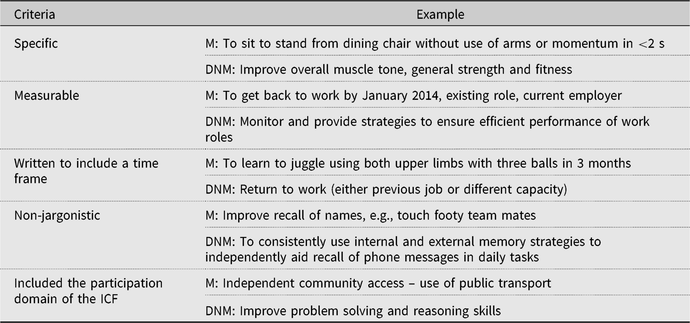
Examples of goal statements that met or did not meet the criteria are shown in Table 2. Inter-rater agreement was 100% for the classification of goals according to the time-frame, client-name and goal-recall criteria. For the remaining criteria, rater agreement varied depending on the criteria: measurable (71%), participation (65%), non-jargonistic (58%) and specific (53%) and were decided by the third rater.
Examples of Goal Statements That Met and Did Not Meet the Criteria
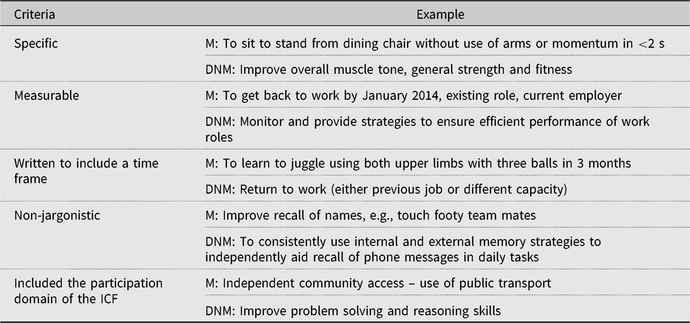
M, Met criteria; DNM, Did not meet criteria.
The characteristics, content and recall of goals
Table 3 shows the number of goal statements that met each criteria. Generally, less than half of the goal statements met the criteria, except for goal recall where 61% of goals were accurately recalled. In terms of the SMART goal criteria, 48% were specific, 35% were measurable and 5% included a time frame. The client’s name was contained in 2% of goal statements. Mean COPM importance and C-COGS goals sub-scale ratings indicate that individual goals were considered to be highly client-centred.
Comparison of Client-Centredness of Goals According to Their Characteristics, Content and Recall

C-COGS, Client-centredness of goal setting scale; COPM, Canadian Occupational Performance Measure; ICF, International Classification of Functioning, Disability and Health.
a Goal sub-scale ratings relate to individual goals set.
Table 3 also shows comparisons between COPM importance scores and C-COGS goal sub-scale scores when goals met or did not meet the criteria. When goals were written without using the ‘specific’ criteria, they were rated significantly higher on the COPM importance scale (p = 0.005) and the C-COGS goals sub-scale (p = 0.03). There were no significant differences in C-COGS goal sub-scale or COPM importance scores according to presence or absence of other criteria (i.e., whether they were measurable, included the client’s name, a time frame or jargon or were accurately recalled).
Client-Centredness and Goal Outcome
A summary of COPM and C-COGS scale scores for the sample is presented in Table 4. The high mean total and sub-scale C-COGS scores and COPM importance score show that the sample perceived the goal setting as highly client-centred. The mean COPM clinician and client performance change scores and satisfaction change score are greater than two points, indicating that on average, the sample achieved a clinically meaningful change on all goal outcome variables.
Mean C-COGS and COPM Scores (n = 66 Sets of Goals)

C-COGS, Client-centredness of goal setting scale; COPM, Canadian Occupational Performance Measure.
a C-COGS goal sub-scale scores averaged across all goals.
Table 5 displays correlations between COPM importance scores and C-COGS scores and the goal outcome variables (COPM change scores). All correlations were significant and positive, with the strength in the fair range (Portney & Watkins, Reference Portney and Watkins2009), except for a weak, non-significant correlation between COPM importance score and COPM client performance change score. Power (i.e., the chance of Type II error) ranged from 0.28 to 0.47.
Spearman's Correlations between COPM Importance and C-COGS Scores and Mean COPM Change Scores across All Client Goals (n = 66 Sets of Goals)

C-COGS, Client-centredness of goal setting scale; COPM, Canadian Occupational Performance Measure.
*p < 0.05; **p < 0.01(2-tailed).
Discussion
Goal setting documentation has traditionally and necessarily been shaped by SMART criteria to facilitate outcome measurement. Goal setting implementation in clinical practice may be enhanced by understanding how documentation of goals relate to client-centredness, which encompasses the meaning and importance of rehabilitation goals to the client. Therefore, this study aimed to examine levels of client-centredness in relation to the characteristics, content and client recall of goals. Furthermore, the relationship between client-centredness and goal outcome was examined to provide insight into whether client-centred goals enhance rehabilitation outcomes, something which has been scarcely investigated. The findings indicate that goals set within the ABI rehabilitation services in this study were generally perceived to be highly client-centred, and there were no differences in the degree of goal importance to clients when goals statements were measurable, non-jargonistic, participation-focussed, included a time frame as well as the client’s name and were recalled by the client to those that were not. However, higher levels of client-centredness in goal setting were related to significantly greater improvements in performance and client satisfaction with performance.
The first hypothesis, that goals that included the client’s name were written without jargon and addressed the participation domain of the ICF, would be perceived by clients to be more client-centred was not supported. Furthermore, as anticipated, there was no difference in the level of perceived client-centeredness for goals characterised as being measurable or including a time frame. However, ‘specific’ goals were perceived to be significantly less client-centred, which is an interesting finding contrary to our hypothesis. This may mean that clients do not need goals to be written according to standard criteria to ensure that goals are client-centred. Furthermore, when goals are broken down to be very specific, clients may perceive that they do not reflect what is important and meaningful to them, suggesting that goals may need to be documented more broadly. Collectively, the findings suggest that documentation of goal statements that are measurable, non-jargonistic, participation-focused, recalled by the client and include a time frame as well as the client’s name is more for the purpose of objective measurement by the service and, with the exception of writing goals specifically, these criteria do not enhance or detract from the importance and meaning of goals to clients.
The hypothesis that goals that were recalled would be more client-centred was not supported. In total, 40% of rehabilitation goals were not recalled. When considering that the prevalence of memory impairment in populations with brain injury is around 70% (Ponsford et al., Reference Ponsford, Downing, Olver, Ponsford, Archer, Carty and Spitz2014), this recall rate for goals is reasonably high. However, as there were goals that were unable to be recalled in this highly client-centred sample of goals, these results provide further justification in practice for use of additional strategies to support goal recall when a memory impairment is identified (Culley & Evans, Reference Culley and Evans2010). For example, text messaging has been identified as an effective strategy to enhance goal recall (Culley & Evans, Reference Culley and Evans2010). Culley and Evans (Reference Culley and Evans2010) found that sending text messages three times per day for 14 days after goals were set significantly improved recall compared to the no text condition. The text messages detailed the content of the client-centred goals (Culley & Evans, Reference Culley and Evans2010).
The third hypothesis that highly client-centred goals would be associated with better goal outcomes was supported. High levels of client-centredness on the C-COGS were associated with significantly higher scores on nearly all of the goal outcome variables. The relatively weak relationship between mean COPM importance scores and client-rated performance change may reflect that COPM importance ratings are a single measure of goal importance, whereas C-COGS scores comprehensively capture client participation in goal setting. The C-COGS uses a range of questions to evaluate the ownership, importance, meaning and relevance of each goal set as well as client’s perceived participation in goal setting (Doig et al., Reference Doig, Prescott, Fleming, Cornwell and Kuipers2015, Reference Doig, Prescott, Fleming, Cornwell and Kuipers2016). Comprehensive measures of client-centredness may, therefore, help clinicians better understand client-perceived participation in goal setting.
Goal setting is undertaken for multiple reasons in clinical practice (Levack, Dean, Siegert, & McPherson, Reference Levack, Dean, Siegert and McPherson2006; Levack, Dean, McPherson, & Siegert, Reference Levack, Dean, McPherson and Siegert2006). Reasons include to practise client-centred care, to enhance client motivation and to evaluate outcomes and measure progress, with the overall aim of enhrancing rehabilitation outcome (Levack, Dean, Siegert, et al., Reference Levack, Dean, Siegert and McPherson2006). As goal setting activities are performed for different reasons, clinicians adapt their approach to suit the intended audience of the goal (Levack, Dean, McPherson, et al., Reference Levack, Dean, McPherson and Siegert2006). For example, clinicians may informally discuss goals with clients, whilst documenting goals differently in clinical notes to meet organisational requirements (Levack, Dean, McPherson, et al., Reference Levack, Dean, McPherson and Siegert2006). It also means that typically clinicians objectively evaluate improvement to demonstrate outcomes to service providers (Levack, Dean, McPherson, et al., Reference Levack, Dean, McPherson and Siegert2006; Wade, Reference Wade2009), whereas clients subjectively evaluate their progress (Playford et al., Reference Playford, Siegert, Levack and Freeman2009). Use of standardised criteria when formulating goal statements enables objective measurement, which is especially helpful in services that have a high staff turnover. The use of such criteria in this cohort did not detract from the importance and meaning of the goals to the participants, except for the ‘specific’ criteria.
Overall, the findings from this study indicate that rehabilitation goals focussed on the essence of what is important and meaningful to the individual are associated with significantly greater improvements in performance and satisfaction, which is consistent with other studies (Ownsworth et al., Reference Ownsworth, Fleming, Shum, Kuipers and Strong2008; Turner-Stokes et al., Reference Turner-Stokes, Rose, Ashford and Singer2015; Webb & Glueckauf, Reference Webb and Glueckauf1994). Interestingly, Turner Stokes et al. (Reference Turner-Stokes, Rose, Ashford and Singer2015) generally found stronger correlations between goal engagement and functional outcomes. This may have been due to their larger sample size or may reflect differences in the way that goal engagement and outcome were measured (i.e., clinician ratings on the Goal Engagement Scale vs. client ratings on the COPM and C-COGS). Concerns have been raised about the reliability of self-rated measures in ABI populations due to the influence of cognitive impairment (McColl et al., Reference McColl, Law, Baptise, Pollock, Carswell and Polatajko2005). Cognitive impairment may also influence clinician perceptions of the achievability of the goals that are set (Barnard, Cruice, & Playford, Reference Barnard, Cruice and Playford2010), as well as the client’s ability to work towards achieving goals (Culley & Evans, Reference Culley and Evans2010). Regardless of the impact of cognitive impairment on goal setting, the findings of the current study support the measurement of clients’ perception of their involvement in goal setting and the client-centredness of their goals to enhance rehabilitation practice.
The length of time required to set rehabilitation goals has been identified as a contextual barrier in goal setting for clients with ABI, even though rehabilitation experts agree that time availability impacts on goal setting success (Playford et al., Reference Playford, Siegert, Levack and Freeman2009; Van De Weyer et al., Reference Van De Weyer, Ballainger and Playford2010). This suggests that spending time with individual clients to elicit and understand what is important and meaningful for them should be prioritised in goal setting. Furthermore, given that time spent writing goals using standard criteria does not appear to benefit clients, it may be beneficial to use indirect therapy time to operationalise and document goals for measurement purposes, as opposed to doing this in the client’s presence.
Limitations and future directions
Overall, this study provides preliminary evidence as the sample was relatively small. Future studies with larger samples are required to confirm the findings. There was limited variability in our sample in terms of client-centredness. Most goals were rated as being highly client-centred, which may reflect ceiling effects on the C-COGS. Additional evaluation of the C-COGS is indicated, or alternatively the development of other measures, to ensure that psychometrically sound measures which incorporate the client’s perspective are available to enhance practice. Alternatively, the high C-COGS ratings could represent brain injury rehabilitation services which use client-centred goal setting practices to motivate clients to participate in rehabilitation. However, levels of client motivation were not measured and clients with higher levels of motivation may have been more likely to achieve their goals regardless of whether a client-centred goal setting process was used or not. The use of participant self-ratings of performance to measure outcomes also has limitations, but this was supplemented by clinician-rated observations of performance change on the COPM which has established psychometric properties as an outcome measure in ABI populations (Bodiam, Reference Bodiam1999; Chen et al., Reference Chen, Rodger and Polatajko2002; Cup et al., Reference Cup, Scholte op Reimer, Thijssen and van Kuyk-Minis2003; Jenkinson et al., Reference Jenkinson, Ownsworth and Shum2007; Trombly et al., Reference Trombly, Radomski, Trexel and Burnet-Smith2002).
This study was also limited, as goal recall was not assessed at follow-up and recall of goals may have been enhanced by repetitively working on goals in rehabilitation sessions. Additionally, clinicians were not asked about the strategies they used to enhance goal recall. It is possible the goals that were perceived to have higher levels of client-centredness were generated by clinicians who used more effective strategies to enhance goal recall, and this may have mediated the relationship between client-centredness and outcome. Research which provides insight into how to set goals is needed as this study did not measure the effect that other cognitive impairments had on participation in goal setting. Given that self-awareness impairment has been identified as a factor which may influence client perception of their level of engagement in goal setting (D’Cruz et al., Reference D’Cruz, Unsworth, Roberts, Moraty, Turner-Stokes, Wellington-Boyd and Lannin2016), further research is required to better understand how impaired self-awareness impacts on the development of client-centred goals.
Results from this study are limited to clients who live in the community and further investigation is required to determine whether results are applicable in the inpatient setting. Some professions were under-represented in this study, such as social work and neuropsychology. This may indicate that goal setting is less of a focus within these professions, or that clients were not referred to the study due to the sensitive nature of issues being discussed.
Finally, this study did not explore the amount of direct clinical time required to set goals with clients nor the time used to document rehabilitation goals. Further investigation would enable rehabilitation services to understand the amount of time needed to effectively set client-centred goals, as it would appear that time spent in this area may enhance outcome.
Conclusion
This study has added to the emerging body of evidence that working on the important and meaningful goals of clients is a factor that is related to the achievement of positive rehabilitation outcomes. In order to improve rehabilitation outcomes, it is recommended that clinicians spend sufficient time with clients to elicit what is important and meaningful to them. Comprehensive measures of client-centredness are recommended to adequately capture client involvement in goal setting. Writing goals according to objective criteria may be necessary to demonstrate intervention effectiveness to service providers, but these factors do not necessarily impact on the client-centredness of goals. It is recommended that clinicians be mindful that when documenting goals for clients, more general goal statements that are not highly specific appear to have greater meaning and importance for clients.
Financial support
This research was conducted with the assistance of a Community Rehabilitation Workforce Project Grant from the Division of Rehabilitation at Princess Alexandra Hospital. The first author was supported by an Australian Government Research Training Program Scholarship (Formerly an Australian Postgraduate Award). The second author conducted this research with the assistance of a National Health and Medical Research Council postdoctoral research fellowship awarded by the Centre for Research Excellence in Traumatic Brain Injury (Grant No. 1023043).
Conflict of interest
The authors have no conflicts of interest to declare.
Ethical standards
The authors assert that all procedures contributing to this work comply with the ethical standards of the relevant national and institutional committees on human experimentation and with the Helsinki Declaration of 1975, as revised in 2008.