
Introduction
YBa2Cu3O7−x (YBCO) coated conductors, deposited on metallic tapes (e.g., NiW tapes), have the potential for application in power systems due to their high J cs. Low-cost solution deposition of YBCO layers has attracted much attention in past decades.[Reference Chen, Tang, Bian, Li, Jiang and Zhao1, Reference Obradors, Puig, Pomar, Sandiumenge, Mestres, Coll, Cavallaro, Romà, Gázquez, González, Castaño, Gutierrez, Palau, Zalamova, Morlens, Hassini, Gibert, Ricart, Moretó, Piñol, Isfort and Bock2] Nowadays, YBCO coated conductors with J c larger than 1 MA/cm2 can be routinely prepared through a solution route, with trifluoroacetates (TFA) as precursors. In this route, a pyrolysis process (300–500 °C), in humidified oxygen, is used on a coated gel film to form an organic precursor film. After that, the precursor film is annealed at 750–800 °C in a controlled atmosphere, and then post-annealed (400–450 °C) in oxygen to obtain high-performance YBCO superconducting films.[Reference Bian, Chen, Yin, Tang, Feng, Zhang, Wu, Li, Hong, Zhao and You3, Reference Chen, Wu, Zhao and You4]
After decades of investigation, it has been found, that in addition to the high-temperature anneal, the chemistry of the precursor solution has a significant influence on the film quality and on the resulting superconductivity of the TFA solution-processed YBCO films. The amount of TFA in the solution directly influences the film roughness, pyrolysis duration, intermediate phases, and the final film quality. Different chemical paths caused by variation of the precursor solution result in films with diverse physical properties. It has also been found that pyrolysis process control is very important. The heating rate of the pyrolysis is strongly dependent on the TFA content in the solution. During pyrolysis, the gel films decompose, and gases are released from the film. Finally, the inorganic precursor film is formed. This inorganic precursor film is porous, with residual holes due to decomposition of the organic species. As a result, solution-processed YBCO films show inferior superconductivity compared with films deposited by physical vapor deposition methods. In addition, sublimation of the copper organic species has also been observed during the pyrolysis. This causes the precursor film to be deficient in copper, and can also cause the aggregation of Cu ions on the film surface.[Reference Llordés, Zalamova, Ricart, Palau, Pomar, Puig, Hardy, Van Bael and Obradors5, Reference Dawley, Clem, Boyle, Ottley, Overmyer and Siegal6] All of these are factors that influence the performance of solution-processed YBCO coated conductors.
In our previous research, we developed solutions with low TFA-contents, which could be used to rapidly prepare YBCO films with high superconductivity.[Reference Chen, Wu, Zhao and You4, Reference Chen, Yin, Feng, Bian, Li and Niu7] In the present study, the effect of the TFA content in the solution, on the quality and superconductivity of the resulting YBCO film, is investigated. To overcome the porosity of the film and the aggregation of Cu ions on the film surface, we also developed an ultraviolet (UV)-assisted solution method. Using this novel UV-assisted solution route, dense YBCO films with enhanced superconductivity were obtained.
Experimental
A YBCO precursor solution, with Y:Ba:Cu = 1:2:3, was prepared using yttrium acetate, copper acetate, barium acetate, and barium TFA (Ba-TFA) as precursors. To control the content of TFA in the solution, different amounts of Ba-TFA were used. LaAlO3 (LAO) single crystal substrates were used as substrates. YBCO gel films were dip-coated on LAO, pyrolyzed and finally annealed under a controlled atmosphere. For films prepared using the UV-assisted method, the solution preparation and heat treatment process of the films were further modified. The gel films were kept at 150 °C and irradiated under UV light for different time durations, and finally annealed under a certain atmosphere. (Detailed information is provided in the supplementary material section of this paper.)
The film's surface morphologies were characterized using scanning electron microscopy (SEM, JEM-6700F). Theta-2theta scanning of the samples was conducted with an x-ray diffractometer (XRD, 7000S-type). x-ray phi-scanning and ω-scanning of the YBCO films were performed on a Rigaku Smartlab high-resolution XRD. x-ray photoelectron spectroscopy (XPS) and FTIR spectrometry were used to detect the element valence and distribution, and the organic species of the YBCO precursor films. The superconductivity of the YBCO films was measured using a magnetization method. I–V curves of the patterned YBCO films were also measured to determine the J c. (Detailed information can be found in the supplementary material.)
Results and discussion
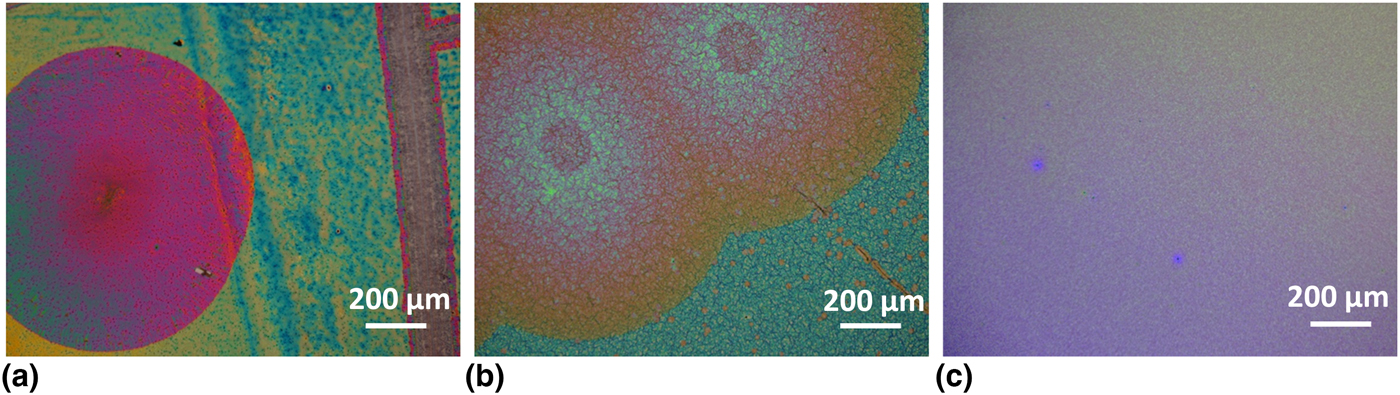
To obtain high-performance YBCO coated conductors, continuous and pore-free films are desirable. We investigated the influence of the content of TFA in the solution, on the film surface morphology. Figure 1 shows the macroscopic morphologies of the pyrolyzed films prepared using solutions with different TFA/Ba ratios. All of the films were heated to 310 °C with a ramp of 5 °C/min from 200 to 310 °C. Inspection of the samples reveals that bubbles and cracks are formed in the films when solutions with TFA/Ba ≥3.50 are used. When the TFA/Ba ratio is decreased to 1.50, pyrolyzed films with smooth surfaces are obtained. This phenomenon indicates that the TFA content directly influences the film integrity. When high-fluorine solutions are used, more fluorine-containing gases (such as CF3COF, COF2, HF, etc.) are generated in the film due to the decomposition of TFA. This is believed to be detrimental to the film integrity.[Reference Llordés, Zalamova, Ricart, Palau, Pomar, Puig, Hardy, Van Bael and Obradors5]
Surface morphologies of pyrolyzed films. The films were prepared using solutions with (a) TFA/Ba = 6.5, (b) TFA/Ba = 3.5, and (c) TFA/Ba = 1.5, respectively.

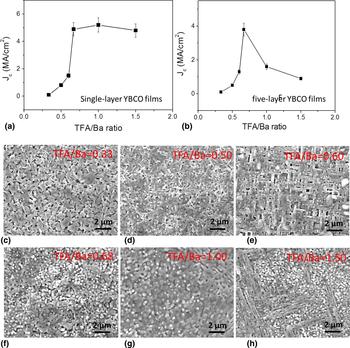
Further, precursor solutions with TFA/Ba ratios ranging from 0.33 to 1.50 were prepared. Using these solutions, YBCO films were coated on LAO substrates. The thickness of the final annealed films is about 0.22 µm (single-layer). Their surface morphologies are shown in Figure S1. As can be seen, using solutions of TFA/Ba = 0.33 and 0.60, the resulting YBCO films showed smooth surfaces. However, the films contained fewer grains. These findings indicate that these films are not well crystallized. YBCO films prepared using solutions of TFA/Ba ≥0.68 show different phenomena. c-axis oriented grains, together with some a-axis oriented grains, are observed on the film surface, indicating that the films are highly textured. XRD patterns from these films are shown in Figure S2. Inspection of the data shows weak intensities of (00l) peaks from films fabricated using solutions with TFA/Ba = 0.33 and 0.50. When the TFA/Ba ratio is higher than 0.50, the intensity of the (00l) peaks increases to a large degree, confirming that the crystallinity of the films is improved with increased TFA/Ba ratios. Figure 2(a) presents J c values (at 77 K, 0 T) of all of the single layer YBCO films prepared using solutions with TFA/Ba of 0.33–1.50. The figure shows that when solutions with TFA/Ba < 0.68 are used, the resulting YBCO films have low J c values. This is due to the poor crystallinity and texture of the films. However, when solutions with TFA/Ba ≥ 0.68 are used, the YBCO films show J c values of about 5 MA/cm2 at 77 K, 0 T, much closer to the results that have been reported elsewhere.[Reference Jin, Li, Feng, Yu, Wang, Lei, Zhao, Sulpice and Zhang8, Reference Wu, Feng, Zhao, Tang, Grivel, Han, Hong and Jin9]
(a) and (b) shows J c values of single-layer and five-layer YBCO films prepared from solutions with different TFA/Ba ratios, respectively;. (c–h) show the surface morphologies of the five-layer YBCO thick films prepared using different TFA/Ba ratio solutions.

Subsequently, thick YBCO films were prepared using solutions with TFA/Ba = 0.33–1.5. The thickness of these films is about 1.1 µm. These films were produced by repeating the coating and pyrolysis process five times. The films prepared using solutions with TFA/Ba < 0.68 show rather low values of J c, as shown in Fig. 2(b). When the TFA/Ba ratio reaches 0.68, the highest J c value is obtained. A further increase of the F/Ba ratio makes the J c decrease again. Surface observation of these 1.1 µm thick films [shown in Fig. 2] indicates that randomly oriented grains or a-axis oriented grains are formed in films cast from solution with TFA/Ba < 0.68 or F/Ba > 0.68. However, when the TFA/Ba ratio is maintained at 0.68, the film surface is mainly covered by c-axis oriented grains. XRD results in Figure S3 indicate that the (00l) peak intensity is enhanced when the TFA/Ba ratio is increased. In addition, when the TFA/Ba ratio is higher than 0.68, two diffraction peaks are detected, at 28.8° and 34.0°. The peak located at 28.8° corresponds to the Y2Cu2O5 phase. There is a high likelihood that the peak located at 34° corresponds to the (400) peak of Y2O3,[Reference Sebastian, Reichart, Ratcliff, Bullard, Burke, Ebbing, Panasyuk, Tsai, Zhang, Huang, Wang, Wu and Haugan10] since the Y2O3(l00) plane has a rather low mismatch (−2.8%) with YBCO(00l) plane.[Reference Luo, Liao, Li and Chen11].
In addition to the TFA/Ba ratio, there is another important issue that needs to be addressed. As we know, when the YBCO precursor film is pyrolyzed at about 300–500 °C, the organic species decompose and produce gases. In the case of the TFA-solution derived films, the fluorine-containing gases are destructive to the film. This results in the formation of holes in the film, and therefore, the resulting precursor films have high porosity. In addition, it has been reported that copper organic species tend to sublime when the film is heated. This sublimation can be reduced to some degree by the introduction of water gas during the heating process. However, any sublimation that occurs can cause Cu aggregates on the film surface.[Reference Llordés, Zalamova, Ricart, Palau, Pomar, Puig, Hardy, Van Bael and Obradors5, Reference Dawley, Clem, Boyle, Ottley, Overmyer and Siegal6] As a result, the finally processed YBCO films show poor superconductivity.
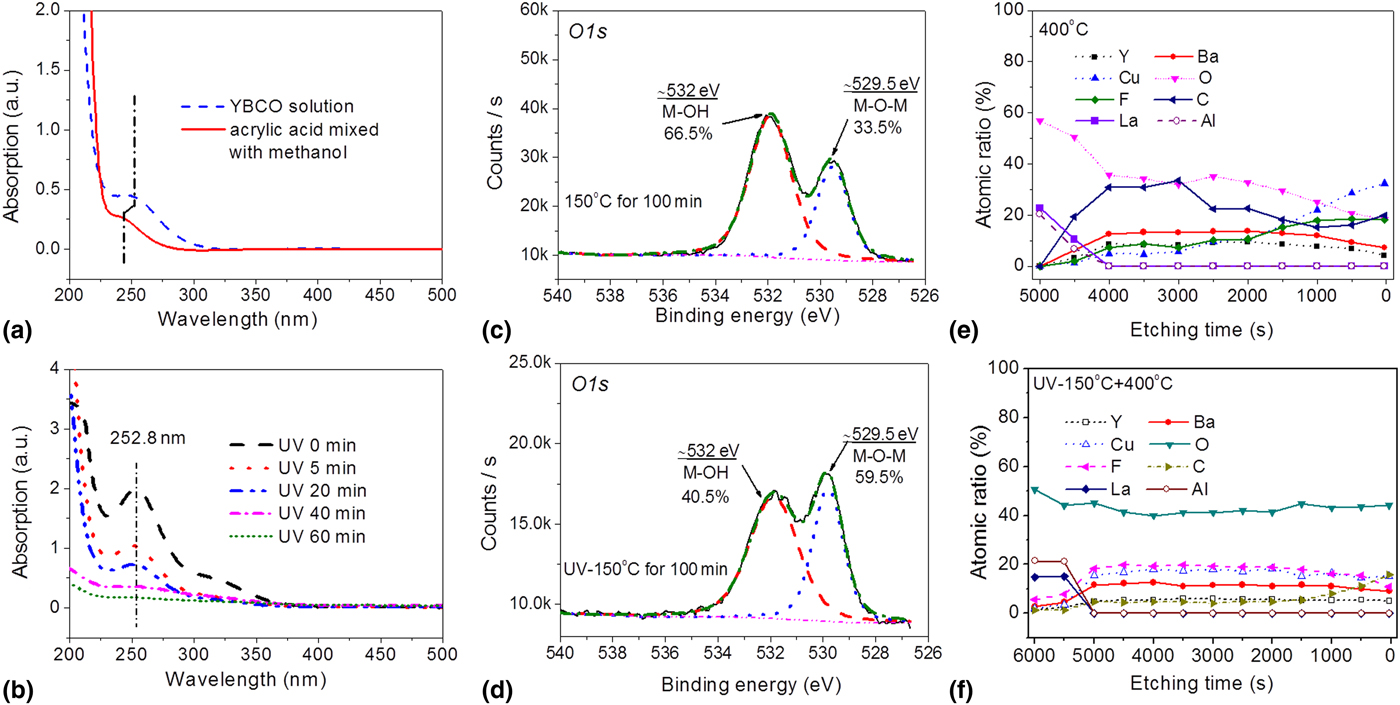
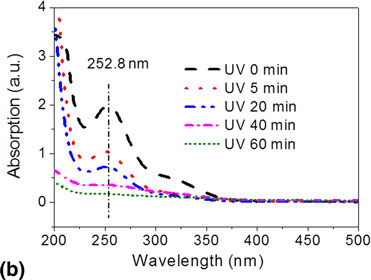
To minimize these problems, we have developed a UV-assisted solution deposition method using the solution with TFA/Ba = 0.68. We first synthesize a solution (using acrylic acid as a complexing agent) that is sensitive to UV light with a wavelength of 254 nm. So, when gel films, that are formed from this solution, are illuminated under UV light with wavelengths of 253.7 (90%) and 184.9 nm (10%) (the UV lamp information is shown in Figure S4), ligands in the gel films decompose, and gases are gently emitted from the films at a low temperature. Figure 3(a) shows UV-visible spectra from the corresponding solutions and films. As can be seen, the characteristic peak of the acrylic acid is located at 243 nm. However, the characteristic peak of the YBCO solution using acrylic acid as an additive is shifted to 253 nm. This indicates that the metallic ions have reacted with the acrylic acid. In addition, we found that the intensity of the characteristic peak decreases with the UV soaking time. After illumination for 60 min, the peak disappears, as indicated by Fig. 3(b). These phenomena indicate that the organic species in the YBCO precursor film decomposes as a result of exposure to UV light.
(a) UV-visible absorption spectra of a YBCO solution, and a solution of acrylic acid; (b) UV-visible spectra of YBCO gel films exposed to UV light for different time durations; (c) O (1 s) spectra of the YBCO film heated at 150 °C for 100 min; (d) O (1 s) spectra of the YBCO film exposed to UV light for 100 min at 150 °C; (e) XPS depth profile of YBCO film pyrolyzed at 400 °C; (f) shows the XPS depth profile of YBCO film exposed to UV light and heated to 400 °C.

FTIR spectra shown in Figure S5 also show the decomposition of the organic species of the YBCO films when exposed to UV light. It can be seen, that with an increase of the UV soaking time, the intensity of the peak located at wavenumber 1429 cm−1 (~7 µm) gradually decreases, and the peak shifts towards lower wavenumbers. This is the result of the formation of disordered carbon in the film.[Reference Umeda, Miyasako, Sugiyama, Tanaka, Suzuki, Tokumitsu and Shimoda12, Reference Hu, Zou, Chen, Qin, Li and Bao13] However, this phenomenon is not observed for the sample that is not irradiated with UV light (hereafter, called the control sample). The formation of disordered carbon indicates that the UV light splits the organic species. The results from XPS examination of the O1s peaks are shown in Figs. 3(c) and 3(d). As can be seen, for the film irradiated with UV light, the oxygen in the lattice totals 59.5%, which is much higher than that of the control sample. These results confirm that photochemical cleavage of some organic groups has occurred, and this makes metal-oxygen-metal (M-O-M) networks form in the films. It should be noted that in the traditional solution route, the film is pyrolyzed to form the M-O-M network. Therefore, when we use the UV-assisted solution route, pyrolysis is not needed after the film is UV irradiated, and thus copper aggregation can be minimized. To confirm this, we performed XPS depth profiling. The resulting XPS data, shown in Figs. 3(e) and 3(f), indicate that the Y, Ba, Cu elements are uniformly distributed in the film that is irradiated by UV light. In contrast, copper was found to have aggregated on the film surface, in the case of the control sample.
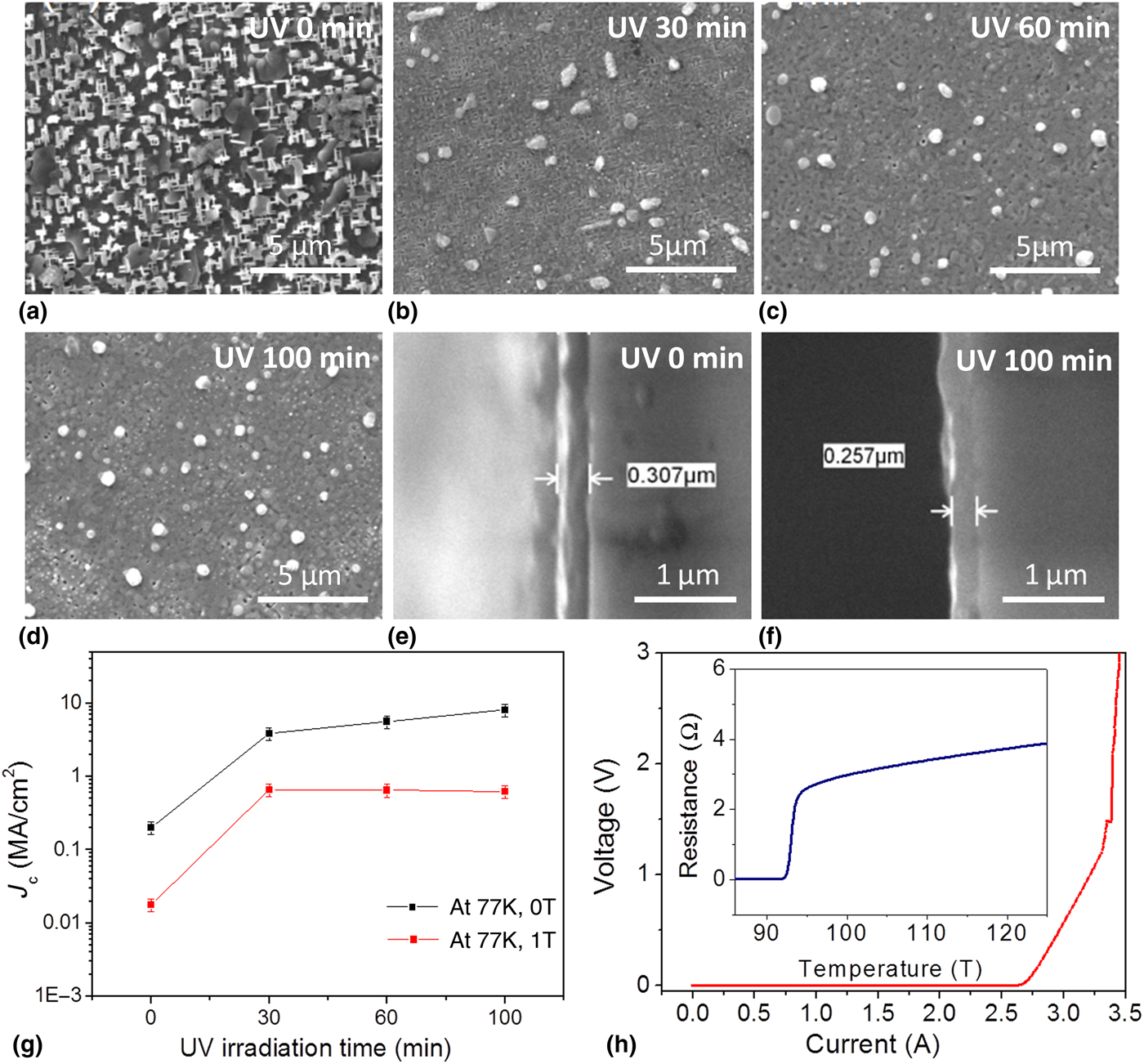
The surface morphology of the YBCO films was examined by SEM. The control sample showed a loose structure with mosaic morphology [Fig. 4(a)]. This mosaic morphology was due to the presence of the Cu-rich phase (white-particles) and a-axis oriented grains on the film surface. In contrast, YBCO films that experienced the UV soaking process showed a dense structure [Fig. 4(b)–4(d)]. The thickness of the films was determined by cross-sectional microprobe analysis. The thickness of films exposed to UV light for 100 min was about 0.25 µm, lower than that of the control sample (0.28 µm). This indicates that UV light soaking improved the film density. The improved film density is believed to be related to the splitting of the organic species at low temperature. We examined the J c of films that were irradiated under UV light for different time durations. The control sample [Fig. 4(g)] showed a J c of ~0.2 MA/cm2 at 77 K, 0 T. The low J c value of the control sample was a result of its undesirable crystallinity and morphology, as well as Cu-aggregation on its surface. Samples exposed to UV light showed higher J c values, and the J c values increased with UV light soaking time, as can be seen in Fig. 4(g). A sample irradiated under UV light for 100 min reached a maximum J c of nearly 8.0 MA/cm2. An I–V curve of a 150 µm wide micro-bridge of this sample was tested using a four probe method. The resulting critical current is 2.66 A and the calculated J c is 6.8 MA/cm2. This value is very close to the J c value measured by the magnetization method using the Bean Model.[Reference Gyorgy, van Dover, Jackson, Schneemeyer and Waszczak14] The R-T curve of the UV-processed film shows a T c of ~92 K.
(a–d) Surface morphology of different YBCO films, (e) and (f) are cross-sectional images of YBCO films. The YBCO films are illuminated under UV light for different time durations; (g) shows the relationship between J c and the UV irradiation time; (h) shows the V-I curve and R-T curve of a micro-patterned bridge of YBCO film (exposed to UV light for 100 min).

We further modified the UV-assisted solution route by the introduction of water vapor during the UV soaking process. With the help of water vapor, segregation of Cu-rich particles on the film surface was further reduced, as compared with the film irradiated by UV light without water vapor (see S7(a–d)). This results from the formation of *OH during the combinatorial process, which then promotes oxidation.[Reference Hu, Zou, Chen, Qin, Li and Bao13] So, the *OH facilitates the oxidization of the copper and prevents its aggregation. The underlying mechanism is discussed in the supplementary material. The J c-H curves of the YBCO films shown in Figure S6(e) indicate that with the help of water vapor, J c is further enhanced. Although the J c improvement is not very much, the J c value of the YBCO film irradiated with UV light for 30 min with water vapor is higher than that of the film irradiated for 100 min without the presence of water vapor. Therefore, the presence of water vapor greatly shortened the UV light soaking process for fabrication of YBCO films with high superconductivity.
Conclusion
The TFA/Ba ratio of the precursor solution greatly influences the resulting YBCO film's properties. A broad range of fluorine contents (TFA/Ba = 0.68–1.5) can be used to fabricate high-quality YBCO thin films. In contrast, for thick YBCO films (with thicknesses over 1 µm), a TFA/Ba ratio of 0.68 is optimal to obtain high-J c YBCO films. Based on this low-fluorine solution, a UV light soaking technique to prepare YBCO films was developed. As opposed to using a thermal pyrolysis based process to fabricate the precursor film, an UV light-based process is used to decompose the precursor. This results in the elemental constituent being uniformly distributed in the films, and this then causes enhanced J c. The addition of water vapor produces the radical OH* during the UV soaking process. This efficiently reduces carbon residue in the films, and further increases the J c of the resulting YBCO films.
Supplementary material
The supplementary material for this article can be found at https://doi.org/10.1557/mrc.2018.136
Acknowledgment
This work was supported by the Natural Science Foundation of China (Grant: 51402233) and Xi'an science and technology plan project (Grant: 2017080CG/RC043 (XALG002)).