I. INTRODUCTION
Trace elements represent an aspect in the field of complex mixtures and have the potential to influence human life, health, and the environment. For example, the element zinc (Zn) is one of the most important trace elements in the body and is essential as a catalytic, structural, and regulatory ion. Reference Wang, Wang, Xuan, Zeng, Jin, Ma and Tian1 As regards the levels of toxic trace elements, such as cadmium (Cd) and lead (Pb), they are detrimental to human beings to a certain degree. Large amounts of selenium (Se), which are mainly present as oxyanion in groundwater, can be toxic to human health. Reference Lunge, Singh and Sinha2 Stibium (Sb) is also regarded as a pollutant. Reference Shan, Ma and Tong3 Thus, the study of the removal of toxic trace elements is necessary. Conventional methods used for the removal of hazardous metal ions from complex mixtures include precipitation, ion exchange, activated carbon adsorption, and electrolysis. However, all these methods have limitations, such as high cost, low removal efficiency, or difficulty of regeneration and reuse.
The efficiency of adsorbents depends on their specific surface area, number of adsorption sites, and chemical stabilities. Nanomaterials have unique features and possess a high surface area to volume ratio because of their small size. Magnetic nanoparticles (MNPs) are one of the prevalent kinds of sorbents. Reference Khajeh, Laurent and Dastafkan4 The most important advantage of using MNPs is the simplicity of their manipulation. Reference Laurent, Forge, Port, Roch, Robic, Vander Elst and Muller5,Reference Huang and Keller6 A recent development in the field of toxic trace element removal is the use of adsorbents prepared by functionalized magnetic nanoparticles (FMNPs). FMNP is increasingly attracting interest as an efficient sorbent for the elimination of metallic contaminants in environmental samples. Reference Malekpour and Khodadadi7–Reference Yantasee, Warner, Sangvanich, Addleman, Carter, Wiacek, Fryxell, Timchalk and Warner9 FMNPs can also be used as efficient sorption for the preconcentration of the studied ions in trace analyses. Reference Ali10,Reference Reddy, Arias, Nicolas and Couvreur11 To date, carboxyl@Fe3O4, Reference Shi, Li, Lu and Zhao8 albumin@Fe3O4, Reference Malekpour and Khodadadi7 thiol@Fe3O4, Reference Yantasee, Warner, Sangvanich, Addleman, Carter, Wiacek, Fryxell, Timchalk and Warner9 maghemite nanoparticles, Reference Shan, Ma and Tong3,Reference Chowdhury, Yanful and Pratt12–Reference Hu, Chen and Lo14 humic acid@Fe3O4, Reference Liu, Zhao and Jiang15 and chitosan@Fe3O4 Reference Liu, Hu, Fang, Zhang and Zhang16 have been explored for their ability to remove toxic trace elements. In fact, ion removal from solutions using magnetic fields has been demonstrated to be more efficient than by centrifugation or filtration. Reference Laurent, Forge, Port, Roch, Robic, Vander Elst and Muller5,Reference Giakisikli and Anthemidis17,Reference Lu, Salabas and Schüth18 However, the fact that nanoparticles tend to aggregate or to partially decompose should be considered given that this poses a challenge to all conventional bulk characterization techniques. A number of researchers reported the adsorption capacity of amino-FMNPs. Reference Xin, Wei, Yang, Yan, Feng, Chen, Du and Li19–Reference Hao, Man and Hu21 However, their experimental results are surprisingly in disagreement with one another, although the same amino-FMNPs have been used.
Medicinal plant extracts constitute a complicated architectural system: Rhodiola rosea (R. rosea) extract is a commercially successful product containing approximately 140 compounds, isolated from roots and rhizomes. Reference Panossian, Wikman and Sarris22 Influent water mainly contain sugar, alcohol, and other higher-concentration organic matter. Based on their constituent difference and complex nature, influent water and R. rosea extracts are chosen as complex mixture models for the selective extraction of As, Sb, and Se.
In recent years, the application of inductively coupled plasma mass spectrometer (ICP-MS) Reference Liao, Gan, Zhao, Luo, Rahmadini, Giannotta, Fu, Rui and Wang23 for the analysis of the trace elements has increased, given its uniqueness, simplicity, accuracy, sensitiveness, and rapidness. This method can also simultaneously detect several trace elements. Thus, in this study, we provide a method to research R. rosea extract and influent water and offer some scientific proofs for its reasonable application in environmental security and drug safety.
Considering all these aspects, our aim is to synthesize and characterize the FMNP and to investigate its ability to remove the selected metal ions from complex matrices, such as R. rosea extract and influent water. We also intend to introduce FMNPs as an effective and reliable adsorbent for the preconcentration of the selected ions in trace analyses.
II. EXPERIMENTAL
A. Reagents and chemicals
FeCl3·6H2O, ethylene glycol, 1,6-hexanediamine, ethanol, and anhydrous sodium acetate were purchased from Shanghai Chemical Reagent Company. All the chemicals were of analytical grade and were used without further purification. Double-distilled water was used throughout the study.
R. rosea extracts were prepared by pouring dry R. rosea rhizome powder (0.30 g) into a round bottom flask (50 mL). The powder was then rinsed with double-distilled water (20 mL), extracted from water boiled for 5 h and the filtrate was diluted in a volumetric flask (25 mL). Reference Wang and Zhang24 Influent water was obtained from the sewage treatment unit of Yanji Budweiser Brewery.
B. Apparatus
Transmission electron microscopy (TEM) images were obtained using a JEM-2100 microscope (JEOL Ltd., Tokyo, Japan). Surface area measurement was performed on Micromeritics (Norcross, Georgia) ASAP 2020 surface area and porosity analyzer (Quantachrome, Boynton Beach, Florida). Pore distributions and pore volumes were calculated using the adsorption branch of the NR2R isotherms based on the Barrett–Joyner–Halenda model. The specific surface area was calculated based on the Brunauer–Emmett–Teller equation. X-ray diffraction (XRD) patterns were acquired with a Rigaku D/MAX 2200 x-ray diffractometer (Tokyo, Japan) at a CuKα radiation (40 kV, 300 mA) of 0.154 nm wave length to confirm the structure of the materials. The infrared spectra were recorded with a Fourier transform infrared spectrometer (FT-IR) (IRPrestige-21, KBr). The magnetic properties were investigated, and the magnetization curves of the magnetite nanoparticle were recorded with a vibrating sample magnetometer (Quantum Design MPMS-XL-7, San Diego, California). The ion content was determined with ICP-MS (Agilent 7500a, Santa Clara, California).
C. Preparation of MNP and FMNP
FMNPs were prepared following the reported hydrothermal method. Reference Wang, Bao, Wang, Zhang and Li25 Sodium acetate (4.0 g), FeCl3·6H2O (1 g), and 1,6-hexanediamine (3.6 g) were dissolved in 40 mL of ethylene glycol with vigorous mechanical stirring and ultrasound. The obtained solution was sealed in a Teflon-lined stainless-steel autoclave, and the reaction was conducted at 195 °C for 15 h. Upon cooling, the resultant sediment was first separated with a permanent hand-held magnet and was washed with ethanol and deionized water several times. The product was then dried in a vacuum at 60 °C for 6 h. The naked MNPs were prepared using the same method and amount as FMNP, except for the absence of 1,6-hexanediamine.
D. Procedure of ions adsorption and desorption
FMNP (4.0 mg) was mixed into a complex solution (5.0 mL) containing As, Sb, Se, Cu, Cd, Zn, and Pb ions (10.0 mg/L). The mixture is vortexed by ultrasonication for 10 min. The FMNP, with the adsorbed As, Sb, and Se, was then separated from the mixture with a permanent hand-held magnet. ICP-MS was used to determine the concentration of the residual ions. The experiments were designed such that the lowest metal concentrations in the samples to be measured by the ICP-MS were threefold larger than the experimental detection limit of the instrument. The results obtained using FMNP were compared with those acquired with MNP, using the same procedure. The desorption of As, Sb, and Se from FMNP was performed by mixing As-, Sb-, and Se-loaded FMNP in hydrochloric acid solution (5 mL, 0.1 mol/L) and by sonication for 1 min. FMNP were then separated from the solution with a permanent magnet, washed with distilled water three times, and dried for reuse. The adsorption capacity at equilibrium and the percentage removal (removal, %) were calculated. Reference Wang, Zhao, Li, Zhu, Peng and Gao26
III. RESULTS AND DISCUSSION
A. Morphology, particle size, and structure of FMNP
To obtain a controlled and homogeneous size, FMNP is prepared by fixing the starting material and reaction condition. Reference Hao, Man and Hu21,Reference Feng, Cao, Ma, Zhu and Hu27 A TEM image of the FMNP shows monodisperse particles with a mean diameter of 70 nm (Fig. S1). The XRD patterns of the FMNP indicate six characteristic peaks of Fe3O4 at 30.1, 35.5, 43.1, 53.4, 57.0, and 62.6 (Fig. S2). The FT-IR spectra (Fig. S3) indicate that the 1,6-hexanediamine molecule is indeed modified on the surface of FMNP. Reference Chowdhury, Yanful and Pratt12 The plot of magnetization versus magnetic field (M–H loop) illustrated in Fig. S4 shows that the saturation magnetization of the FMNP is 50.6 emu/g.
B. Adsorption performance of MNP and FMNP
To validate the accuracy and precision of the method, SRM 1547 peach leaves (i.e., certified reference materials) are analyzed for their corresponding elements.
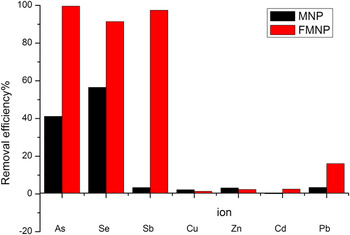
The removal efficiency is obtained following the methods in the literature. Reference Tan, Chen and Hao20 MNP and FMNP are used to adsorb the solution (5 mL, 5 mg/L) containing As, Sb, Se, Cd, Pb, Zn, and Cu. Figure 1 shows that the adsorption capacity of FMNP is better than that of MNP for As, Sb, and Se. The BET surface area of MNP is 13.66 m2/g (Fig. S5), whereas that of FMNP is 139.73 m2/g (Fig. S6). The BET surface area of MNP is then one order of magnitude smaller than that of FMNP. FMNP possess a high surface area to volume ratio when compared with those of MNP. Furthermore, FMNP can be easily dispersed in water (Fig. S7), whereas MNP dispersion is very weak. 1,6-Hexanediamine is used to modify the clay structure and to evaluate the removal capability for Pb, Cd, and Zn. Reference Stathi, Litina, Gournis, Giannopoulos and Deligiannakis28 In this work, the presence of 1,6-hexanediamine is demonstrated to be a very important factor for the selective removal of As, Sb, and Se. The adsorption of As, Sb, and Se may be due to the coordination between the metal ion and amino group.
Removal efficiency of As, Se, Sb, Cu, Zn, Cd, Pb ions using MNP and FMNP.

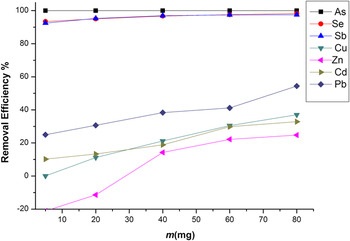
To evaluate the optimum dosage, different amounts of FMNP (from 4.0 mg to 80 mg) are added to the solution containing As, Sb, Se, Cd, Pb, Zn, and Cu (2 mL, 5.0 mg/mL). The removal efficiencies of As, Sb, and Se range from 92% to 100%; those of Cd, Zn, and Cu from 0% to 30%; and those for Pb from 25% to 50% (Fig. 2). These results appear to be in disagreement with the data from the literature. Reference Hao, Man and Hu21 However, these results seem quite predictable because increasing the amount of FMNP increases the number of available adsorption sites, which in turn increases the removal percentage of As, Sb, Se, Cd, Pb, Zn, and Cu from the matrices. As Fig. 2 shows, the adsorption capacity reaches a plateau that is dependent on the metal: 10 mg/mL for As, Se, and Sb, 20 mg/mL for Zn, Cu, and Cd, 60 mg/mL for Pb.
Removal efficiency of As, Se, Sb, Cu, Zn, Cd, Pb ions using different FMNP dose.

C. Adsorption kinetics
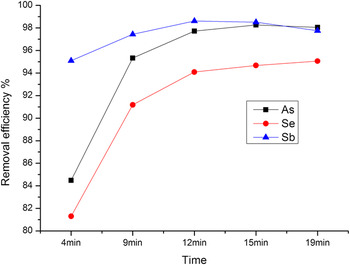
To examine the influence of time on the adsorption of As, Sb, and Se, kinetic experiments are conducted by changing the adsorption time after the addition of FMNP to the solution of As, Sb, and Se (2.0 mL, 10.0 mg/L, Fig. 3). The results indicate that As, Sb, and Se reach their adsorption equilibrium within 12 min. The short time it takes to reach the adsorption equilibrium, similar with some previous results, Reference Hao, Man and Hu21,Reference Feng, Cao, Ma, Zhu and Hu27 indicates that this phenomenon occurs mainly on the surface of the adsorbent.
Adsorption kinetics of As, Se, Sb ions with immobilized FMNP dose.

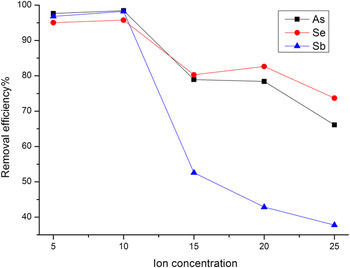
The synergistic effects of electrostatic attraction and coordination may be ascribed to the high ion adsorption onto FMNP Reference Yu, Tian and Wang29,Reference Li, Xiao, He, Lin and Zuo30 when the solution concentration is below 10 mg/L. The removal efficiencies of As, Sb, and Se decrease with an increase in the ion concentration (Fig. 4). The adsorption strength is probably significantly correlated with the average lengths of the metal–nitrogen bonds. Reference Yu, Tian and Wang29
Removal efficiency of FMNP for different As, Se, Sb ions concentration with immobilized FMNP dose.

D. Selective removal of As, Sb, and Se in real complex mixture
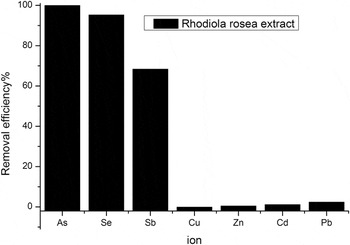
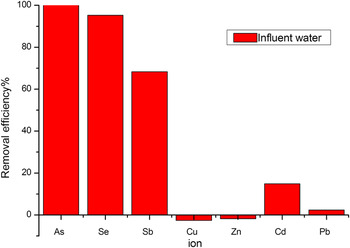
Influent water and R. rosea extracts are used in this study as models of complex mixtures. Following the same procedure in the batch adsorption experiments, FMNPs are tested at the same dosage used in the previous experiments (10 mg/L) for the removal performance of As, Sb, Se, Cd, Pb, Zn, and Cu in complex mixtures. After treatment with FMNP, the removal efficiency of As, Sb, and Se ranged from 70% to 100%. A low removal efficiency is observed for Cu and Zn in R. rosea extracts, which confirms the low tendency of these ions to be adsorbed to the FMNP (Fig. 5). For the same reason, the weak removal efficiency of Zn and Cu is observed in influent water (Fig. 6). A similar removal efficiency is observed using double-distilled water. FMNP can then be used as a highly effective adsorbent for As, Sb, and Se in influent water and R. rosea extract. Reference Hu, Chen and Lo14,Reference Gavrilescu31
Removal efficiency of As, Sb and Se ions in Rhodiola rosea extracts as real complex mixture.

Removal efficiency of As, Sb and Se ions in influent water as real complex mixture.

For a more detailed study of FMNP behavior in complex mixtures, the simulated multicomponent mixture is spiked into three groups: the first group contains As, Sb, and Se; the second group Cd, Zn, and Cu, and the last group only Pb. The experimental results in this case confirm that Cu, Cd, and Zn are not adsorbed on FMNP, whereas Pb is only weakly adsorbed (Fig. S8). On the contrary, As, Sb, and Se are selectively adsorbed by FMNP. These results demonstrate that the low adsorption recovery values recorded for Cd, Pb, and Cu are completely independent of the presence of As, Sb, and Se. In addition, the coexistence of other ions in the solution, such as Cd, Pb, Zn, and Cu, has no influence on the removal efficiency of As, Sb, and Se by FMNP. Similar results are obtained with other ions explored, such as Fe, Cr, Al, Ca, Co, and Ni. Their presence in fact insignificantly affects the adsorption values of As, Sb, and Se.
E. Reusability of FMNP for As, Sb, and SE removal
Each adsorption process is conducted in a batch experiment, and the adsorbent is then magnetically separated from the solution. The metal ion concentration of the supernatant is determined by ICP-MS (Fig. S9). Prior to the next cycle, the collected adsorbent is washed repeatedly with double-distilled water to remove the adhered solution. As, Sb, and Se ions are then desorbed completely by sonication for 1 min in the presence of 0.1 mol/L HCl. The reusability of FMNP makes its use cheap and significantly increases its potential use in practical applications. Reference Zhang, Zhu, Dong, Cui, Wang, Hu, Zhao, Wang, Wei, Li and Ma32
IV. CONCLUSIONS
In this work, the removal capabilities of As, Sb, and Se from complex solutions by FMNP are demonstrated. The adsorbent also exhibits high stability and good reusability. After the adsorption process, these ions can be easily separated from the complex mixture by an external magnetic field. Thus, all the results suggest that FMNP has excellent potential as metal adsorption material for water treatment. In particular, FMNP shows its potential as a promising efficient adsorbent for the removal of As, Sb, and Se from complex mixtures. FMNP is a very promising candidate as a metal adsorbing material, with wide applicability in the metal ion removal from various complex mixtures, such as plant extracts, industrial wastewater, and tap water. Finally, this study develops a fast, simple, and selective method of ion analysis using magnetic solid-phase extraction coupled with ICP-MS.
Supplementary Material
To view supplementary material for this article, please visit http://dx.doi.org/10.1557/jmr.2016.115.
ACKNOWLEDGMENTS
The National Natural Science Foundation of China (No. 21365023, for S.H. Wang and No. 21265023, for D.H. Li) supported this work.