Introduction
The mid-Atlantic region, when compared with other US agricultural sectors, is composed of small (average farm size is 73 ha), diversified cropping systems and integrated animal and crop production systems. Approximately 29% of land in the region is used for agricultural purposes, and livestock production composes the majority of revenue earned in the top five commodities in the region1. Soil conservation is a priority for growers in the region due to shallow soils with relatively low organic matter, high soil-erosive potential, and water quality concerns regarding the Chesapeake Bay and other estuaries. Interest in and use of cover crops are increasing rapidly in the region as a result of these concerns because annual precipitation is relatively high (760–1012 mm, evenly distributed throughout the year); spring moisture is usually not a constraint in the mid-Atlantic region.
Organic grain production in the mid-Atlantic region relies on extensive soil disturbance for weed management and requires relatively large amounts of diesel fuel and labor. Dependency on cultivation also creates a disproportionally greater risk of weed control failure due to abundant or untimely rainfall during crop establishment. Reducing tillage in organic grain production systems has the potential to reduce soil erosion, improve soil quality, increase soil carbon (C) sequestration, decrease greenhouse gas (GHG) emissions and reduce energy requirements relative to traditional organic-production methods. While continuous and rotational conventional no-till crop production has been widely practiced in the mid-Atlantic regionReference Horowitz, Ebel and Ueda2, it is dependent on the use of herbicides that are prohibited in organic production. Continuous organic no-till is widely considered unachievableReference Peigne, Ball, Roger-Estrade and David3, however there are options for reducing tillage in the mid-Atlantic region, such as: (1) rotating annual grain crops with perennial forages/pastures; (2) decreasing depth and degree of soil inversion (e.g., chisel plowing and disking in place of moldboard plow); or (3) no-till planting cash crops into cover crops that are mechanically killed with a roller–crimper. This latter approach may still require moldboard plowing prior to cover crop establishment to maintain adequate long-term perennial weed suppression, and thus is considered a rotational no-till approach. This paper focuses on the progress of research associated with cover crop-based, organic rotational no-till corn (Zea mays L.) and soybean (Glycine max) production in the mid-Atlantic region.
Interest in organic rotational no-till farming has increased substantially with the development and widespread availability of a relatively inexpensive roller–crimper for mechanically killing and flattening cover crop residue. Rollers were originally developed along with the adoption of no-tillage agriculture in Brazil and early designs in the USA were developed by USDA-ARS in Auburn, AlabamaReference Ashford and Reeves4. The model that is now most frequently used in the USA was popularized by the Rodale Institute (Kutztown, PA, USA). This roller–crimper is comprised of a steel cylinder (41–51 cm diameter) with metal slats welded perpendicular to the cylinder and arranged in a chevron pattern to reduce vibration. The roller–crimper has sufficient weight to kill cover crops, and can be used at a speed that is sufficient to accommodate typically sized mid-Atlantic grain farmsReference Ashford and Reeves4, Reference Mirsky, Curran, Mortensen, Ryan and Shumway5.
Within the mid-Atlantic region, research and farmer-adoption of cover crop-based, organic rotational no-till grain systems have focused on corn and soybean production. Typically, soybean is no-till planted into a fall-planted cereal rye (Secale cereale L.) cover crop, whereas corn is more commonly planted into a hairy vetch (Vicia villosa Roth) cover crop. In both cases, the cover crop is terminated mechanically with a roller–crimper. Both of these winter annual cover crops are established in the fall in seedbeds prepared using tillage. Cereal rye and hairy vetch are common cover crops in the eastern USA,Reference Clark6 because they are winter hardy and have high biomass potential and weed-suppressive potential in no-till agricultureReference Teasdale, Devine, Mosjidis, Bellinder and Beste7, Reference Wilkins and Bellinder8. Further, cereal rye has been coupled with soybeans for its residue persistence and flexible establishment dateReference Ruffo and Bollero9, while hairy vetch is coupled with corn because it can produce more than 150 kg ha−1 of plant available NReference Decker, Clark, Meisinger, Mulford and McIntosh10.
In the mid-Atlantic region, cereal rye is sown between late August and early November and hairy vetch between late August and late September, depending on location and weather. Cash crops are no-till planted simultaneously or 7–10 days after rolling–crimping in mid-May through early June, when cover crops are flowering or in early stages of seed set, using no-till drills or planters for soybean (450,000–562,500 seeds ha−1) and no-till planters for corn (75,000–87,500 seeds ha−1). In general, cereal rye is rolled–crimped at an angle offset from the direction that it is sown (i.e., 30–90°) to obtain maximum soil cover by the cover crop residue and to help facilitate the soybean planting operation. The vine habit of hairy vetch precludes any specificity to the rolling direction. When rolling and cash crop planting are not performed simultaneously, planting must be done in the same direction as rolling, to avoid dragging the cover crop residue and to increase the cutting performance of the coulters.
System Performance
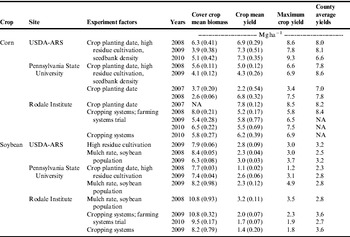
Collaborative research reported in this paper on the cover crop-based, organic rotational no-till system has been conducted by scientists at the USDA-ARS Sustainable Agricultural Systems Laboratory at Beltsville, MD, The Pennsylvania State University and the Rodale Institute. Corn and soybean have achieved comparable or greater yields than county averages (Table 1). However, there have been considerable annual variations in grain yield. Soybean yields have been more consistent than corn across the region. Corn performance appears to decline for the cover crop-based organic rotational no-till system in the northern area of the region, primarily due to planting delay caused by the later hairy vetch flowering. The greater overall crop performance and farmer adoption of soybean compared with corn is likely a result of the highly persistent and greater biomass levels of cereal rye residue that provides better weed suppression than does the hairy vetch residue; earlier soybean planting dates due to earlier rye maturity; greater tolerance to reduced crop stands from insect herbivory; and ability of soybean to provide its own nitrogen (N).
Cover crop biomass (hairy vetch/corn or cereal rye/soybean) and corn and soybean grain yield in experiments conducted by USDA-ARS, Pennsylvania State University and The Rodale Institute. Crop yields are averaged across all of the treatments and blocks of an experiment; maximum yield represents the highest treatment mean within an experiment. Standard errors are presented within parentheses.

Still, the inability to control weeds consistently limits adoption of organic rotational no-till. In addition, perennial weed management and insect seed and seedling herbivory have constricted yields of corn and soybean. In the case of soybean, performance also has been limited by challenges associated with establishing cash crops in high levels of cover crop residue and with field variations in cereal rye biomass accumulation. In our experience with corn, the lack of consistent weed control and challenges in meeting fertility demands has greatly reduced the success of the cover crop-based production system. Finally, cover crop management for optimal performance and integration into a crop rotation represents a critical challenge to the overall success of the production system. Developing a successful cover crop-based, organic rotational no-till organic corn and soybean production system will require an integrated, multi-tactic approach to pest and fertility management. Our multi-institutional, multi-disciplinary team is addressing these system constraints and challenges, as discussed below.
Cover crop management: control and biomass production
The popularization of the roller–crimper for cover crop-based, organic rotational no-till grain production has created a need to research basic agronomic practices for grain production to characterize system limitations and optimize crop performance. Cover crops play a central role to the performance of these systems; therefore strategies for maximizing cover crop performance also must be evaluated. Mechanical termination of cover crops using a roller–crimper is a key component of the rotational no-till system. Our group has focused on testing the effects of termination timing on cover crop control and biomass production. While it has been known for over a decade that mechanical control of cover crops improves with increasing plant maturityReference Ashford and Reeves4, Reference Wilkins and Bellinder8, few studies have systematically defined these relationships.
Independent experiments were conducted to test the efficacy of mechanical control of cereal rye and hairy vetch across a range of cover crop phenological stages. The first experiment evaluated how cereal rye seeding date in the fall and termination date in the spring impacted mechanical control of cereal ryeReference Mirsky, Curran, Mortensen, Ryan and Shumway5. In this study, two cultivars of rye (Aroostook and Wheeler) were seeded at six different dates between late August and mid-October. In the following spring, the rye was rolled and planted to soybean on four different dates on a 10-day interval. Results indicate cereal rye was not consistently controlled (>85%) with the roller–crimper prior to anthesis or Zadoks growth stage 60. For the most consistent control, cereal rye should be rolled at Zadoks growth stage 65 (50% anthesis). No differences in control were observed between cultivars at any given growth stage. In another study, hairy vetch was planted at a single date in the fall and rolled at four dates on a 10-day interval once flowering had commenced. Results showed that hairy vetch control improved with each delay in the termination date and that consistent control was not achieved until early pod setReference Mischler, Duiker, Curran and Wilson11. A flowering index was developed to help classify hairy vetch reproductionReference Mischler, Duiker, Curran and Wilson11. Since hairy vetch can be vegetative, flowering and setting pods at the same time, this research focused on classifying growth stages of the first five nodes below the apical meristem or terminal branches as a bud, flower or podReference Mischler, Duiker, Curran and Wilson11.
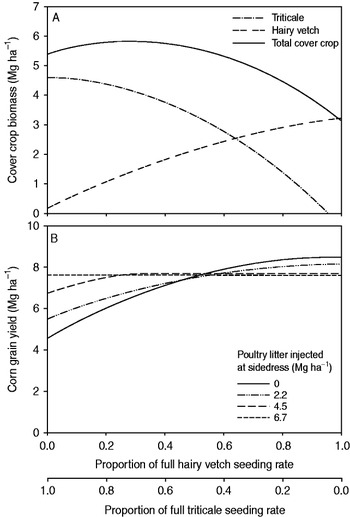
In addition to the effects of timing on cover crop control, we also have tested the effects on biomass production because abundant and uniformly distributed cover crop biomass is essential for effective weed control from cover crop mulches. Growth rate and total biomass accumulation of cereal rye and hairy vetch are affected by the timing of the fall planting, spring termination dateReference Mischler, Duiker, Curran and Wilson11, Reference Mirsky, Curran, Mortensen, Ryan and Shumway12, seeding rateReference Ryan, Curran, Grantham, Hunsberger and Mirsky13 and soil fertilityReference Ryan, Curran, Grantham, Hunsberger and Mirsky13, Reference Clark, Meisinger, Decker and Mulford14. The extent to which cereal rye tillers in the fall strongly influences its biomass accumulation potential in the spring. Delay in spring termination by 10 days can achieve comparable biomass to planting 50 days earlier in the fall, and biomass accumulation can increase 200 kg ha−1 day−1 after stem elongation. In our experience on-station and on-farm, cereal rye biomass does not typically exceed 6000 kg ha−1 in this region unless management is optimized in terms of seeding rate, seeding date and soil fertility, which can increase biomass up to 12,000 kg ha−1.Reference Mirsky, Curran, Mortensen, Ryan and Shumway12, Reference Ryan, Curran, Grantham, Hunsberger and Mirsky13 For hairy vetch, biomass accumulation after spring green-up is 50–75 kg ha−1 day−1.Reference Clark, Decker, Meisinger, Mulford and McIntosh15, Reference Clark, Decker and Meisinger16 In the mid-Atlantic region, hairy vetch biomass can be as high as 4000–6000 kg ha−1.Reference Teasdale, Devine, Mosjidis, Bellinder and Beste7, Reference Mischler, Duiker, Curran and Wilson11, Reference Clark, Decker, Meisinger, Mulford and McIntosh15 However, over-yielding of total cover crop biomass can be achieved with a biculture of hairy vetch and a cereal grain relative to monocultures of these species (Fig. 1A).
Cover crop biomass and corn yield as a function of hairy vetch and triticale seeding rate proportions at USDA-ARS in 2010. Full seeding rates for hairy vetch and triticale were 34 and 168 kg ha−1, respectively. Cover crop biomass (A) was collected at termination and reported on a dry weight basis. Cover crop biomass response to mixture seeding rate proportion was modeled using a quadratic function. Poultry litter (B) was subsurface banded when corn was 30 cm tall (side-dress) with a prototype subsurface poultry litter applicator. Corn yields were taken from weed-free plots and reported at 15.5 g kg−1 moisture content. Corn yield response to cover crop mixture proportion and poultry litter rate (Mg ha−1) was modeled using quadratic plateau models.

Cover crop breeding/variety assessments
To fully exploit the multi-functional potential of cover crops, varietal improvements must be made. A multi-state (Maryland, New York and Pennsylvania) hairy vetch breeding program was conducted to evaluate traits of early flowering and winter hardiness. From these studies, the cold hardy, early flowering cultivar ‘Purple Bounty’ and ‘Purple Prosperity’ were developed. Both cultivars are now available in sufficient quantities for commercial use. There have been three publications linking the genetic structure of the accessions contained in the USDA V. villosa germplasm collection and phenotypic traits of interest to organic rotational no-till grain producers. Two of the reports link phenotypic traits to a coarse assessment of physical genome structureReference Yeater, Bollero, Bullock and Rayburn17, Reference Yeater, Bollero, Bullock, Rayburn and Rodriguez-Zas18, while the third focuses on developing of a core genetic subset of key accessions maintained in the collection by identifying genomic markers for use in future molecular assisted breeding programsReference Maul, Mirsky, Emche and Devine19. Current work is aimed at understanding the environmental and genetic controls on flowering phenology and seedbank persistence, and looking more closely at the linkages between flowering phenology, cold hardiness and N fixation.
Soil moisture
Cover crops can serve as both an asset and a liability in grain-cropping systems due to their impact on soil moisture. When winter cover crops break dormancy in spring and begin their period of rapid growth, evapotranspiration may exceed precipitation. In dry years or on draughty soils, soil moisture may be significantly depletedReference Ewing, Wagger and Denton20. Systems that must delay termination until cover crop flowering for optimizing termination efficacy (e.g., roller–crimper), will also be subject to greater soil moisture removal and prone to initiating the cropping season at a soil moisture deficit. However, the roller–crimper technology that maximizes rye cover crop mortality and creates residue mulch can maximize soil moisture conservation compared with approaches that allow rye regrowth or bare soilReference Kornecki, Price, Raper and Arriaga21.
Once moisture is captured in the soil, evaporation is slowed by cover crop residue on the soil surface, with greater soil moisture retention being associated with higher residue levelsReference Teasdale and Mohler22. Generally, diffusive resistance of water vapor through residue has been shown to be most influenced by the thickness of the residue layerReference Flury, Mathison, Wu, Schillinger and Stockle23, such that residue layer thickness is positively correlated to diffusive resistance. Research conducted in Maryland concluded that summer soil moisture conservation by cover crop residues was more important than spring moisture depletion by growing cover cropsReference Clark, Decker, Meisinger and McIntosh24. The balance between water use and conservation is influenced by local weather, soil conditions and cover crop species selection. Growers will need to weigh these offsetting effects carefully before making a final decision on the timing of cover crop management.
Crop establishment
Maximizing cover crop biomass to ensure optimal weed suppression creates high-residue environments that challenge crop seed placement. No-till planters and drills equipped with appropriate coulters, seed firmers, depth control, weight and effective closing wheels are essential for optimal crop seed placement. In rolled cover crop systems, it is necessary to cut through the fresh plant residue to create the seed slit. The coulter serves this purpose by cutting the residue and loosening the soil prior to the double disk opener. We have relied on a bubble-type coulter that is designed for residue cutting and soil penetration. Wave-type coulters are generally less desirable for cutting heavy, living residue and for penetrating drier soils due to penetration resistance. Further, aggressive wave-type coulters result in more extensive soil disruption, undermining weed suppression goals.
Heavy cereal rye mulches have been a significant obstacle to optimal soybean stand establishment. Soil moisture conditions are critical since wet soil can impair furrow closure and allow hair-pinning of rye residue. With dry conditions it is difficult to penetrate through both the rye and soil to get adequate seed placement. Cereal rye lodging, prior to planting, further constrains seed placement as the coulter must cut through residue that is lying at multiple angles. Maximizing weight on the front coulters is essential for cutting rye residue. Compared with planters, drills have more difficulty cutting through heavy rye mulches due to greater draft. In both Pennsylvania and Maryland, it was necessary to add more than 136 kg of weight above each planter row unit in order to get sufficient soil penetration under drier conditions. Residue managers (i.e., row cleaners) such as the Yetter Shark Tooth®Footnote 1 can help improve stand establishment in heavy residue. In Pennsylvania, we observed up to a 25% increase in soybean stand with the Yetter Shark Tooth residue managers compared with the same planter without residue managers (Mirsky, unpublished results). Increased populations and faster emergence time resulted in either no difference in weed biomass or up to a 70% reduction (decrease by 700 kg ha−1). That said, cover crop residue can wrap around the wheels of residue managers and reduce their usefulness.
Establishing corn in rolled–crimped hairy vetch has been less difficult, but wet surface soil conditions can be common. Press wheels may not effectively close the seed furrow in wet conditions, resulting in reduced stands due to insect herbivory or poor germination resulting from seed decay and/or desiccation. Closing wheel selection and down pressure tension can minimize potential problems under high-residue situations. Spading or spiked closing wheels rather than solid types can help close the seed slit in wet soils. Site-specific evaluations of closing wheels, down pressure configurations and adjusting depth-gauge wheel settings, in different cover crop and soil moisture situations, can greatly improve stand establishment.
Insects
Growers frequently question the optimal timing of cash crop planting after rolling; there is interest in managing their cover crop and planting a cash crop in a single pass system. However, it is often recommended to wait 1–2 weeks to avoid stand losses due to diseases, insects and/or allelochemicalsReference Dabney, Schreiber, Rothrock and Johnson25, Reference Hammond and Cooper26. A variety of herbivorous insects attack seeds and seedlings of field crops. The principal groups are wireworms (larvae of Coleoptera: Elateridae), seedcorn maggot (Delia platura and related species, Diptera: Anthomyiidae) and, following seedling emergence, cutworms (Lepidoptera: Noctuidae) and related caterpillar species; these have all been observed to reduce crop populations in mid-Atlantic cover crop-based, organic rotational no-till grain systems. In conventional farming, many of these pests are suppressed by seed or furrow treatments with synthetic insecticides. In organic crop production, seed treatments are in an early stage of development, but are not anticipated to provide the level of protection available to conventional growers.
Cultural effects of tillage and cover crops on seed and seedling pests are complex, and may decrease or increase insect injury depending on species of herbivorous insectsReference Dabney, Delgado and Reeves27, Reference Stinner and House28. Early season damage to seedling corn under minimal tillage and high residue can result in heavy losses due to stand reductionReference Wilson and Eisley29. Seedcorn maggot adults are attracted to areas of soil disturbance and decaying organic matter such as recently incorporated plant residues and animal manure; the larvae are more damaging under cool conditions, but populations are consistently lower in untilled systems, even those with high residueReference Hammond30. Wireworm attack on newly seeded crops is closely related to crop history, but different genera prefer different hosts; the widespread Melanotus and Conoderus are typically worst in crops following sod or other grasses Reference Capinera31. Cutworms may be favored by planting into legume cover crops and winter annualsReference Wilson and Eisley29, Reference Leonard, Clay, Hutchinson and Graves32, but their migratory habits make populations hard to predict. Armyworm [Pseudaletia unipuncta (Noctuidae)] damage is enhanced in killed grass, particularly cereal rye cover crops. Damage and predation differ by termination method (e.g., herbicide treatment versus mowing)Reference Laub and Luna33, Reference Laub and Luna34, but data on roller–crimper terminated cover crops is not available. Given these species-specific phenomena, management of seed and seedling pests in organic rotational no-till grain production poses a formidable challenge.
Weed management
Surface mulches physically suppress weeds by altering light quantity and quality, temperature at the soil surface, and by acting as a barrier to reduce seedling emergenceReference Teasdale and Mohler22. Quantity of residue is more important than the type of residue and weed suppression is less affected by allelopathic than by physical properties of mulchesReference Teasdale and Mohler35. Previous research showed that cover crops or other organic mulches must be present in high amounts to provide a high level of physical suppression of annual weeds, whereas levels below 2200 kg ha−1 can stimulate weed emergenceReference Mohler and Teasdale36, Reference Ryan, Mirsky, Mortensen, Teasdale and Curran37 by reducing surface soil water evaporation. In New York and Maryland, greater than 75% inhibition of summer annual weed emergence was consistently achieved when mulch biomass exceeded 8000 kg ha−1 and mulch thickness exceeded 10 cmReference Teasdale and Mohler35.
The effect of cover crop residues on weed control is species-specificReference Mohler and Teasdale36, Reference Liebman and Davis38 and is the result of: (1) variation in temporal synchrony between weed germination and the presence of a sufficient quantity of cover crop biomass to influence that process; and (2) the energy reserves of a given weed species (i.e., large seed versus small seeded; perennial versus annual). In general, cover crop mulches are better at suppressing small-seeded summer annuals and are largely ineffective at suppressing perennial weeds. Reducing tillage typically results in a shift from annual to perennial weeds; this weed community shift was observed in Rodale Institute's long-term cropping systems experimentReference Ryan, Mortensen, Seidel, Smith and Grantham39. Clearly, perennial weeds can become problematic in organic no-till planted crops, and illustrate the need for low perennial weed populations in fields where the cover crop-based, organic rotational no-till approach is implemented.
High-residue cultivators have been developed to kill weed seedlings between crop rows with minimal disruption of residue on the soil surfaceReference Clark6. New residue management equipment integrated with traditional high-residue cultivators are now available that minimize soil disturbance to a depth of 2–5 cm. Such cultivators use press wheels with coulters to facilitate slicing through the residue along with wide, flat sweeps that pass underneath the cover crop residue to cut the weeds off beneath the soil surface. Research in Maryland and Pennsylvania demonstrated that this type of high-residue cultivator decreased weed biomass by 66 and 52% and increased yield 23 and 61% in organic no-tillage soybean and corn, respectively, compared with mulch alone.
Effective weed control in organic rotational no-till grains production requires integration of cover crops and high-residue cultivation into a weed management program that includes additional management tacticsReference Ryan, Mirsky, Mortensen, Teasdale and Curran37. Cultural weed management tactics within the cover crop-based corn and soybean systems that we have evaluated include crop seeding rateReference Ryan, Mirsky, Mortensen, Teasdale and Curran37, timing of cover crop managementReference Mirsky, Curran, Mortensen, Ryan and Shumway12, cover crop seeding rateReference Ryan, Curran, Grantham, Hunsberger and Mirsky13 and cover crop mixturesReference Mirsky, Curran, Mortensen, Ryan and Shumway12, Reference Teasdale and Abdul-Baki40. Effective weed control in these systems demonstrates the need for an integrated approach, exploiting multiple stress and mortality factors (i.e., many little hammers)Reference Liebman, Gallandt and Jackson41. A comprehensive approach to develop cover crop-based multi-tactical weed management systems first requires defining the functional relationship of a management tactic on weed response. Subsequent efforts should include developing an understanding of how all tactics interact (synergism versus antagonism) to maximize weed suppression and minimize adverse crop effects.
Soil fertility
Cover crop-based organic rotational no-till will require soil fertility-management strategies that meet the agronomic needs of the crop, while reducing weed competitiveness. For example, decomposition of cereal rye mulch immobilizes soil N near the soil surface that can suppress weed germination and growthReference Wells, Reberg-Horton, Smith and Grossman42. Hairy vetch can provide substantial levels of N to the subsequent corn crop; however, the residue provides inferior season-long weed suppression unless combined with a cerealReference Teasdale and Abdul-Baki40. Using a cereal/legume mixture may increase weed suppression compared to a legume monoculture, but such mixtures often reduce the release rate and total available N from the legumeReference Clark, Decker, Meisinger and McIntosh43. While adequate and well-synchronized N fertility is essential to optimize both yield and quality of cornReference Tsai, Dweikat, Huber and Warren44, excessive application of N fertility sources is costly, has significant environmental ramificationsReference Follett and Hatfield45 and can increase weed competition. No-till managementReference Drinkwater, Janke and Rossoni-Longnecker46 and manipulation of supplemental soil fertilizer placement (e.g., subsurface banded next to the crop row) and timing are viable options for improving crop N uptake and influencing weed–crop competition relationshipsReference Blackshaw, Molnar and Janzen47. Preliminary work in Maryland demonstrated an approach to integrating fertility management with both animal (poultry litter applicator prototype)Reference Kibet, Allen, Kleinman, Feyereisen, Church, Saporito and Way48 and green manures (Fig. 1B). Cover crop biomass was maximized at a relatively low vetch proportion of ≈30%, while corn yield could be maintained across cover crop mixture proportions by subsurface banded poultry litter at 4.5–6.7 kg ha−1. Such multi-tactical strategies for maximizing weed suppression through optimal cover crop mulch and corn N management provide new opportunities for increasing the consistency of corn performance in an organic rotational tillage environment.
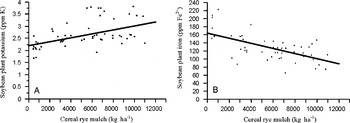
Cover crop residues on the soil surface can have both direct and indirect effects on biogeochemical processesReference Bernstein, Posner, Stoltenberg and Hedtcke49. For example, a dose-dependent effect of rye mulch biomass on soybean plant iron concentration and potassium concentration was observed in Maryland (Fig. 2). It is unclear with currently available data how other leachates from rye mulch, such as dissolved organic C, might impact the soil microbial community in regard to soil N immobilization and plant microbe interactions. For example Bending et al. Reference Bending, Turner and Jones50 showed that crop residue from a variety of plant species can differentially influence soil microbial metabolic functionality. The legacy of different crop residues has been shown to drive shifts in microbial community structureReference Maul and Drinkwater51. Mechanisms underlying these observations are still unidentified but an active area of on-going research.
Impact of cereal rye mulch rate on mineral content of soybean plants at USDA-ARS in 2008–2009: (A) plant potassium concentration and (B) plant iron concentration.

Global Warming Potential, Energy Use and Labor Requirements
Currently, there are federal and state monetary incentive programs52 to help farmers implement practices that enhance the multi-functionality of agroecosystems for the production of non-market ecosystem services (i.e., soil, water and air quality)Reference Boody, Vondracek, Andow, Krinke, Westra, Zimmerman and Welle53. To increase agricultural sustainability, research should focus on the development of systems that sequester soil C, decrease soil and nutrient loss through surface runoff and leaching, reduce external inputs and increase system resilience. While there are challenges associated with cover crop-based organic rotational no-till, there are clear indications that such production practices may meet the needs of a new multi-functional agriculture. Cover crop-based organic rotational no-till may increase C sequestration by increasing the rate and magnitude of cover crop biomass production, adding an external source of C to soil (e.g., manure or compost) and/or eliminating tillageReference Uri54, Reference Follett55. In the southeastern USA, no-till management of cropping systems that included cover crops sequestered 0.53 Mg C ha−1 yr−1, while no-till systems without cover crops sequestered only 0.28 Mg C ha−1 yr−1 (93 unpaired observations)Reference Franzluebbers56.
In contrast to no-till, organic cropping systems rely heavily on tillage, but have been reported to share some of the same benefits of no-till systems, including a lower net C flux. Despite the high frequency of tillage commonly implemented in organic systems, results from a long-term experiment in Maryland showed greater soil C sequestration rates in organic compared to a conventionally managed no-till system regardless of whether or not cover crops were used in the no-till systemReference Teasdale, Coffman and Mangum57. Thus, organic rotational no-till crop production with its reliance on high cover crop biomass production has strong potential to sequester soil C.
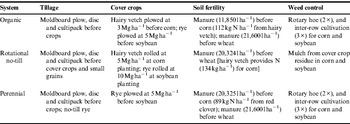
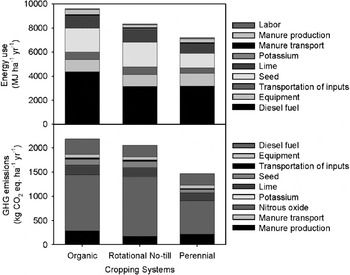
In addition to the potential to increase soil C sequestration, cover crop-based organic rotational no-till grain systems could greatly reduce energy requirements and GHG emissions through fewer tractor operations, among organic systems, and shift in fertilizer from mineral to organic when comparing organic to conventional systems that rely solely on mineral fertilizers. The Farm Energy Analysis Tool (FEAT), a static deterministic model parameterized with data from a comprehensive literature reviewReference Camargo58, was used to quantify the impact of tillage on energy use and GHG emissions on a simulated ‘average’ Pennsylvania grain production farm (154 ha in size). Using FEAT, a hypothetical corn–soybean–wheat rotation was evaluated using (1) standard organic and (2) cover crop-based organic rotational no-till management, compared to (3) a perennial organic system that included corn–soybean–wheat plus 2 years of a hay crop. The systems differed in the use of tillage, soil fertility management, weed control and seeding rates (Table 2). The boundary was restricted to the farm gate and included only farm operations and critical soil processes associated with N (fixation and denitrification). Inputs included labor, soil amendments, crop seed, diesel fuel and equipment. Outputs included grain yield, energy use and GHG emissions. In the GHG analysis, N lost from the system as N2O was included. Soil N2O emissions were estimated based on the amount of N supplied (1% N2O/N from plant residue sources and 2% N2O/N-input for N applied with manure) and converted to CO2 equivalents59.
Tillage, fertility management and weed control in three simulated cropping systems. Systems include a corn–soybean–wheat crop rotation under standard organic and organic rotational no-till management, and a 5-year corn–soybean–wheat–red clover hay rotation using standard organic management.

Reducing tillage in organic production resulted in an estimated decrease in energy use and GHG emissions (Fig. 3). Annual energy use in the cover crop-based organic rotational no-till system was lower than in the standard organic system, largely due to reduced diesel fuel and labor needs. Nitrous oxide was responsible for the relatively large GHG emissions in the standard organic and cover crop-based organic rotational no-till systems. Although the lowest energy use and GHG emissions were in the perennial system, this system did not produce grain in 2 of the 5 years. Therefore, the cover crop-based organic rotational no-till system could increase energy efficiency, reduce GHG emissions and be economically more sustainable than current tillage-based organic systems.
Energy usage and GHGs annualized over a corn–soybean–wheat crop rotation under standard organic and organic rotational no-till management, and a 5-year corn–soybean–wheat–red clover hay rotation using standard organic management.

Conclusions
Success of a cover crop-based organic rotational no-till grain production system is going to be contingent on five management factors: (1) consistent and optimal performance of selected cover crops; (2) maintenance of low perennial and annual weed populations; (3) advances in manure placement technology; (4) innovations in organic protection of crop seed and seedlings; and (5) continued advances in crop seed placement equipment. Despite the challenges, it is clear that there are very good reasons for investing resources in the development of the organic rotational no-till system. Reducing energy use and GHG emissions in a way that maintains productivity coupled with farmer interest in saving time will continue to drive innovations that are needed to increase the performance and consistency of cover crop-based organic rotational no-till.
Acknowledgements
The authors would like to thank all farm crew operations from each research station, the numerous summer students, and support technicians who contributed to the results of this paper. Special thanks to Tom Richard for reviewing the model used to conduct the energy use and GHG emissions analyses.