Introduction
Throughout our lives, in a variety of settings, we interact socially with others who may not be regarded as intimates, and such interactions have been theorised to be integral to mood and development (Fingerman Reference Fingerman, Lang and Fingerman2004). Older people engage frequently, and in some cases have interacted for many years, with local shopkeepers in their local neighbourhood shops, yet there are scant data about what these everyday community-based interactions actually entail. Much attention has been afforded older people's social relationships with family, neighbours and friends, and the association between their relationships with these traditional social contacts, and social deficit, risk of depression, disease and mortality. This has tended to present older people as reliant on family and friends for social interaction, and has stifled the probability that they can be autonomous and resilient.
Why has this situation persisted?
Early anthropologists were concerned with identifying and understanding people's social networks and they determined that the links connecting community members to each other and to members of other communities were pathways by which social norms were reinforced, cohesiveness fostered and exchange processes necessary for survival enabled. Radcliffe-Brown (1881–1955) noted in mapping the links, that they looked like a web or a net (Scott Reference Scott1991). From the early 1980s researchers commonly adopted the network mapping approach for research that aimed to draw association between a person's circle of contacts and their health, or other effects. In actuality, complex networks of interactions were rarely the focus of such research, but rather, researchers looked to identify the individuals with whom each of their participants interacted. Such research which tended to focus on family and friends was largely quantitative in nature and commonly employed closed questions, pre-determined typologies or large non-purpose-collected databases, the data of which were sometimes over-interpreted. Not uncommonly, the function of social relationships was implied from their structure. For example, access to a family member indicated the likelihood of support; church attendance indicated interaction with friends. Commonly, data that were accessed from large datasets comprising information about family, friends, relatives, church membership and other group associations were allocated to pre-determined network types or typologies; for example, the Berkman–Syme Social Network Index (SNI; Berkman and Syme Reference Berkman and Syme1979), a self-reported questionnaire which provides a composite measure of four types of social connections based on marital status, number and frequency of contacts with children, close relatives and close friends, church group membership and membership in other community organisations. Typologies of interaction according to the SNI have been categorised from large datasets, or from non-purpose-collected data, and association drawn between the network type, and other data (Kawachi et al. Reference Kawachi, Colditz, Ascherio, Rimm, Giovannucci, Stampfer and Willett1996; Litwin and Shiovitz-Ezra Reference Litwin and Shiovitz-Ezra2010; Seeman et al. Reference Seeman, Kaplan, Knudsen, Cohen and Guralnik1987). The Lubben Social Network Scale (LSN-6) is a similar method of assessing interaction with only family and friends (Lubben et al. Reference Lubben, Blozik, Gillmann and Iliffe2006). Other studies (Golden et al. Reference Golden, Conroy, Bruce, Denihan, Greene, Kirby and Lawlor2009; Litwin Reference Litwin2001; Scharf Reference Scharf1997) have classified data according to Wenger's Practitioner Assessment of Network Types schedule (PANT), a clinical tool developed to assess social support networks for people who are considered at-risk because they lack contacts that may provide them with support (Wenger Reference Wenger1991, Reference Wenger1997; Wenger and Tucker Reference Wenger and Tucker2002). Wenger's network types have been found to correlate with levels and duration of formal services, and to measures such as health, morale, social isolation and loneliness (Wenger Reference Wenger1997). Wenger's locally integrated support network typology, which Wenger considered the most common and robust for support, while associated with interaction with nearby family, friends, neighbours and community groups, accounts also for recognition of reciprocity between the older person and their network members. Yet investigating such reciprocity has often been disregarded by researchers using the PANT; commonly the typology which best suits the available data or the research aim has been selected. Other studies have simply assigned data to categories designated as family, friends, neighbours, confidants and attendance at church or other organisations (Fiori, Antonucci and Cortina Reference Fiori, Antonucci and Cortina2006; Fratiglioni et al. Reference Fratiglioni, Wang, Ericsson, Maytan and Winblad2000; Giles et al. Reference Giles, Glonek, Luszcz and Andrews2005; Lennartsson Reference Lennartsson1999; Litwin Reference Litwin2010; Olsen et al. Reference Olsen, Olsen, Gunner-Svensson and Waldstrøm1991; Oxman et al. Reference Oxman, Berkman, Kasl, Freeman and Barrett1992; Reed et al. Reference Reed, McGee, Yano and Feinleib1983). The hierarchical mapping technique (Antonucci Reference Antonucci1986; Janevic et al. Reference Janevic, Ajrouch, Merline, Akiyama and Antonucci2000) has identified participants' social contacts according to levels of closeness (closest/close/somewhat close) but the technique has commonly elicited information about family and friends (Ajrouch, Antonucci and Janevic Reference Ajrouch, Antonucci and Janevic2001). Rook (Reference Rook1987) employed interviews to identify with whom participants reciprocated companionship, and emotional and instrumental support, and accordingly the participants identified family and friends (Rook Reference Rook1987). Where information has been sought about participants' kin networks (family) and non-kin networks (friends) with whom they had: a 15-minute or longer conversation during the previous three months; engaged in other activities or material exchanges such as instrumental support (money, food or help when sick); or exchanged advice (Fiori, Consedine and Merz Reference Fiori, Consedine and Merz2011), only family and friends were identified. Whether any of the participants chatted with, and shared opinions or advice with local shopkeepers or others who were not family or friends, remained unexplored.
Overall, such methodological approaches and the categorisation of social relationships in the aforementioned studies are unlikely to, and have indeed failed to, elicit information about interactions with others such as local shopkeepers. Granted, depending on the purpose of the research, such other relationships may not have been considered relevant, however, the point being made here is that persistence with traditional research approaches have resulted in a limited understanding about older people's relationships with others who are not family or friends. Crucially, the nature and the purpose of such relationships have remained largely unknown.
The scant research activity that has employed a different approach should be acknowledged because it has recognised, or elicited information about, older people's social interaction in local shops or with local shopkeepers. Stone's (Reference Stone1954) seminal study, in setting out to explore whether urban housewives preferred to shop at local independent stores, or at large chain stores, ultimately identified a psycho-social process of attachment by which the housewives integrated into their community, particularly where they had little other opportunity for social interaction. The way in which such attachment was forged was not elucidated. Yasuda et al. (Reference Wenger and Tucker1997) investigated the association between social network characteristics and the mortaliy of older women in a community. In addition to collecting information about interaction with family and friends, these researchers collected information about organisational ties, and friendly merchants. Although the association between a lack of interaction with such merchants and mortality seems somewhat tenuous, it is noted that these other relationships were considered. Rosenbaum (Reference Rosenbaum2006) explored the interaction between staff and customers in a local restaurant, noting that emotional support was given by staff to the older customers. Gardner (Reference Gardner2011) took a qualitative approach in her study which aimed to understand how neighbourhoods contributed to the wellbeing and healthy ageing of older people, and in addition to eliciting information about relationships with neighbours, elicited information about relationships with business personnel including cab drivers, sales clerks, wait staff and relationships with strangers. Gardner concluded that local neighbourhoods provided key sites that enabled informal interaction and engagement in life. So while we know older people do interact in their local neighbourhood shops, it remains that few studies have explored what is really going on in these relationships.
Why focus on the local neighbourhood shop?
People of all ages and cultures exchange commodities in local shops or market places as part of their everyday lives, a practice that has persisted over eons. But such places are much more than mere retail structures. They provide an opportunity for people to exchange information, to observe others and to gossip. The interactions can be vital to community life commercially, and for building familiarity and trust; for deciphering who is a friend or an opponent, for forging alliances, and to alert one to opportunities and threats. Our communities or neighbourhoods can be a source of pride or identity. One only need look to local sports clubs to see this in action. Many older people have resided in their local community for decades and during that time have interacted continually with local shopkeepers, but it remains that there is scant empirical data that indicate the significance of such social interactions.
The study aim
A study was designed to explore the nature, and the purpose, of older people's social interactions in their local neighbourhood shops. Ethics approval (CF09/2271-2009001305) was granted by Monash University Human Research Ethics Committee.
Methods
Several methodological approaches were considered for the study, particularly those that align with the qualitative paradigm of enquiry as these approaches are suited to exploratory research about which little is known. Symbolic interactionism and phenomenology are effective exploratory methodologies but they have underlying philosophical or theoretical underpinnings and thus can impose a priori assumption. An ethnomethodology-based study could have provided an understanding and a description about how older shoppers and shopkeepers in their everyday setting formulated their everyday actions. The approach would require the researcher to become immersed in the culture associated with the local neighbourhood shop and this was not practical. The inductive, value-free approach, classic grounded theory (Glaser and Strauss Reference Glaser and Strauss1967), was ultimately employed. Other ‘iterations’ of grounded theory were available – the Strauss and Corbin ‘version’ (Strauss and Corbin Reference Strauss and Corbin1990), and the constructivist grounded theory approach (Charmaz Reference Charmaz, Denzin and Lincoln2000). The primary researcher considered that the analysis framework put forward by Strauss and Corbin could incline the researcher towards thematic analysis of data rather than raising data to a conceptual level. Constructivist grounded theorists recognise the existence of multiple social realities, and these are often realised through consultation with the participants, however, the primary researcher considered that such an approach was not aligned with the study aim. The primary researcher was familiar with the classic grounded theory method and was confident about its effectiveness in raising data to a conceptual level, culminating in the development of a succinct conceptual theory about the participants' main concern, and what they were doing constantly to deal with their concern.
The participants and the site
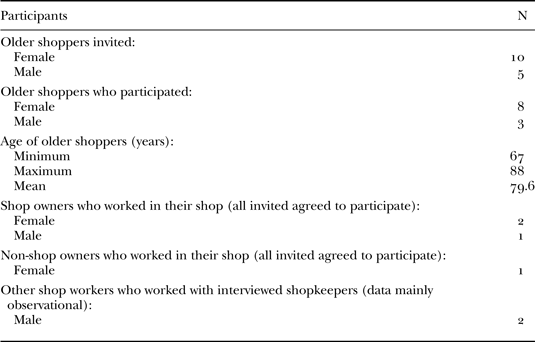
The sample ultimately comprised 11 people who were 67 years of age or older, and six shopkeepers. Recruitment took place over a period of two years from 2009 to 2011. Older shoppers were approached by the primary researcher as they shopped at a small group of local neighbourhood shops facing a suburban roadway, and were invited to participate in the study. The shops provided easy and safe access to a range of shops. Shopkeepers were recruited in their shops. No gratuities were offered. All the shopkeepers who were invited agreed to participate; 15 older shoppers were invited to participate and four declined. An overview of the demographic characteristics of the participants is presented in Table 1. The sample size was not predetermined; in accordance with the classic grounded theory approach the decision about which data were required was driven by what the analysis process revealed (theoretical sampling).
Demographic characteristics of the participants

Data collection
Data were collected via face-to-face interviews (one per person) with older shoppers, observation of the older participants in their home environment and at the local shops, interviews with shopkeepers (one per person) and observation of shopkeepers in their shops. The older shoppers all chose to be interviewed in their own homes and agreed to the interviews being recorded. The appearance of the participants, their personal environments and their experience of living in a community were all noted in writing by the primary researcher. Shopkeepers indicated a preference to be interviewed in their shops. These interviews were not tape-recorded; notes about the conversation were recorded in writing by the researcher. Where other observations were conducted in shops, notes were recorded in writing by the researcher.
Data treatment
Overview
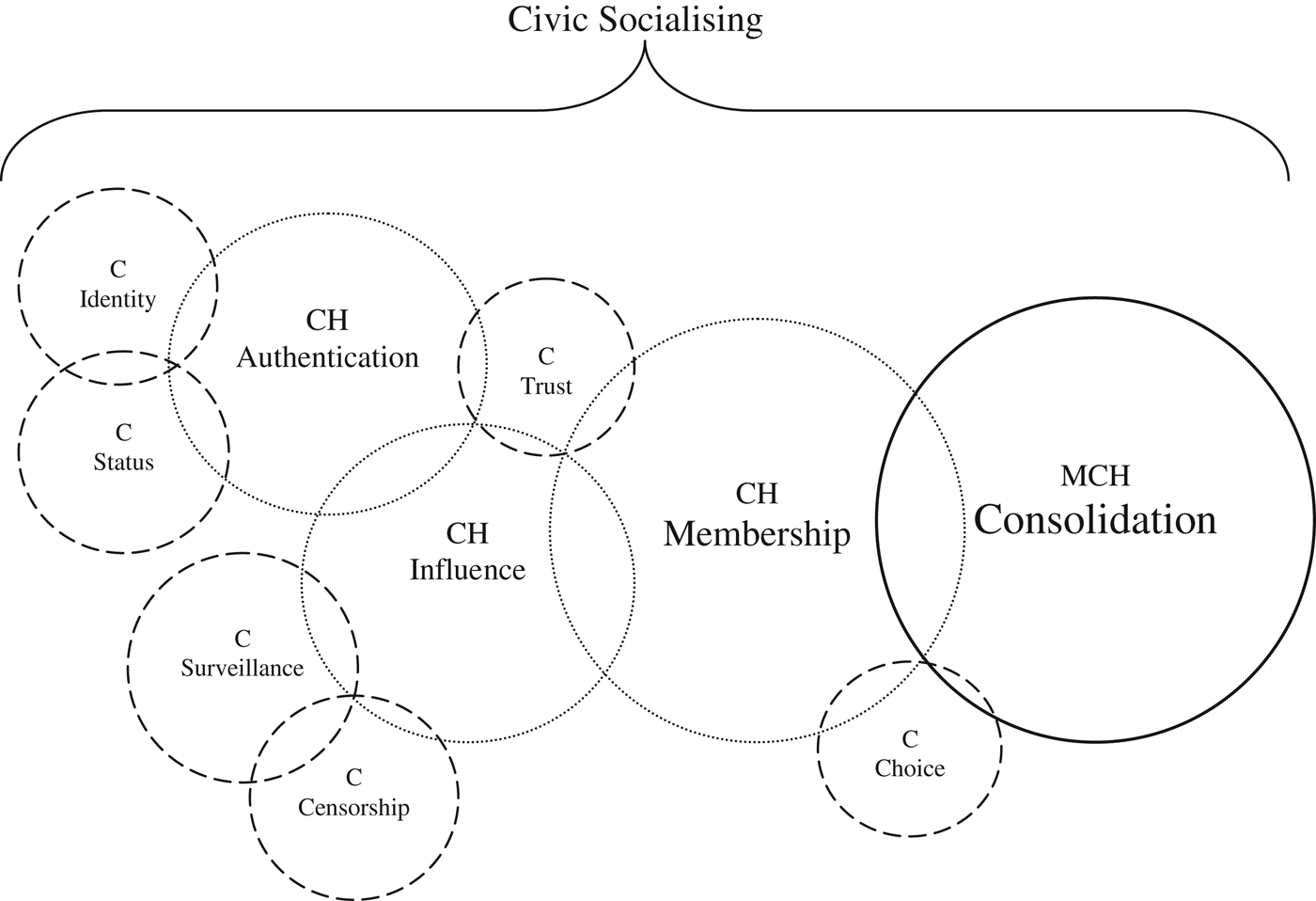
Recorded interviews were transcribed and analysed immediately following each interview. The transcribed data were examined and were frequently deconstructed. Words or phrases were labelled or coded according to the concepts they indicated and as analysis progressed coded data were integrated into conceptual hypotheses. Comments made by the shopkeepers during their interviews were recorded in writing and were similarly treated. Notes made during observation in shops served as discrete data but commonly corroborated interview data. The analysis process which is described in more detail is represented in Figure 1.
Integration of the coded conceptual indicators (C) and the development of the conceptual hypotheses (H) and the main conceptual hypothesis (MCH): Consolidation.
Analysis
During the two years of data collection and analysis, six main concepts that accounted for all the variation in the data were identified. These were coded Trust, Identity, Status, Surveillance, Censorship and Choice.
Trust
Data coded Trust indicated an understanding between the shopkeeper and the older shopper. The shopkeeper would act in a certain way: be affable, prompt, obliging, affirming where required, and would supply good quality goods consistently. Trust was a reciprocal arrangement; shopkeepers were assured that the older shoppers continued to support them.
Identity
Data coded Identity indicated older shoppers' projection and verification of themselves as individuals and as community members. Older people who attended the local shops were observed to present themselves with hair styled and wearing smart clothes and make-up. Swann has called such displays ‘identity cues’; they serve to ‘tell others whether one is liberal or conservative, wealthy or destitute, easygoing or meticulous, prudish or promiscuous’ (Reference Swann1987: 1040). Data confirmed that integral to the observance of cues such as dress were the interplays between older shoppers and shopkeepers (Goffman Reference Goffman1959). Older men were observed projecting a youthful cheeky image while exchanging banter with female staff, and the staff affirmed them. Yet in shops staffed by men such as the butcher shop, the older male shoppers projected a more macho image. First names were a common form of address and emphasised individuality. However, some older shoppers preferred to be addressed by their family name and this was adhered to by shopkeepers.
Familiarity and recognition were integral to being endorsed as a member of the local community.
They'll [shopkeepers] always say ‘G'day’ you know … ‘How are you’ sort of thing as though you're reg in the [a regular in the community]. (Female shopper, age 77)
The participants' experience in the larger shopping complexes emphasised that being recognised and attended to was important.
See in the big shopping centre they don't really know you … you could be a CHAIR they could walk past you and wouldn't know you're there. (Female shopper, age 81)
Maintaining one's appearance and being seen were integral to self-image as well as continuing to be a functioning community member.
You know they've got walkers and and they try and and keep up you know the the um what they've always done try and look reasonably all right when you're shopping. (Female shopper, age 80)
Status
Data coded Status were concerned with the participants' awareness of their middle-class status and their long-serving community membership.
You see everybody you know no one's … wealthy, wealthy, wealthy, but if you sold your house in that area at the moment you would probably get a fortune. (Female shopper, age 77)
The participants considered such status, and long standing, earned respect.
They [shopkeepers] SHOULD be polite to me. (Female shopper, age 78)
Surveillance and Censorship
Data coded Surveillance and Censorship, while indicating discrete concepts, generally co-existed; older shoppers were vigilant and took action where they considered that there were breaches of local social norms. These data conceptualised the participants' active role in community affairs. For example, a non-shopper had been using a car-parking space and local council was notified. Where a shopkeeper proposed to extend their business scope to include the sale of liquor, the older shoppers regarded that this was unfair to the licensed grocer and they took action.
The [shopkeeper] wanted a liquor licence but we already HAD a licensed grocer see so we all howled that down. (Female shopper, age 88)
Choice
Data coded Choice indicated older shoppers' decision-making that was directed towards maintaining the milieu of their local shopping precinct with a view to ensuring their ongoing independence. There were two time dimensions associated with these data: the present time and the future, when they perceived they may be less able. Although many of the participants elected to visit other shops further afield, they chose to visit their local shops enough to ensure that they continued to maintain their membership status, and so that the local neighbourhood shops remain viable.
I shop there because we've GOT to have a grocer shop. (Female shopper, age 77)
If they don't get the customer turnover they close up. (Female shopper, age 80)
Integration of the coded concepts
Authentication
While the coded data indicated discrete concepts, they were essentially related to a common conceptual hypothesis and this was developed through a process of integrating the indicators. Identity and Status integrated to form the conceptual hypothesis delineated Authentication. For the older shoppers, social interactions in their local neighbourhood shops were associated with affirming and sustaining their personal and community identity.
Influence
Surveillance and Censorship integrated to form the conceptual hypothesis delineated Influence. The older shoppers' social interactions in their local neighbourhood shops were associated with playing an active part in community affairs.
Membership
The conceptual hypotheses Authentication and Influence integrated with the data coded Trust, to form the conceptual hypothesis, Membership. Membership aligned with the dimensions of McMillan and Chavis’ (Reference McMillan and Chavis1986) concept, a sense of community: belonging; the group mattering to its members; trusting that members' needs would be met through their membership in the group; shared history, common places, time together and similar experiences; and endeavouring to make a difference to the welfare of the group (McMillan and Chavis Reference McMillan and Chavis1986).
Consolidation
The data coded Choice integrated with Membership (thus all the data were accounted for) to form a hypothesis that conceptualised the participants' approach to continually strengthening their position in their community, maintaining the milieu of their local neighbourhood shops, and thereby, increasing their opportunity to remain autonomous into the future.
Being able to access services at their local shop meant that older people in the community could choose not to burden their families with all their needs.
The thing is they [the shop] do mending like ah I don't have a machine anymore and my hands don't work [shows hands] so if it's a zip in here or ah well will you take this up. (Female shopper, age 77)
You see I can walk up there still I might get to the stage where I can't walk. (Female shopper, age 88)
We've got everything if we wanted it … say we don't drive a car anymore you could go down here and almost get anything you want. (Female shopper, age 80)
With the identification of the conceptual hypothesis Consolidation, saturation occurred; no new concepts were identified in the data, and all the data had been integrated. The authors termed this newly identified psycho-social process, Civic Socialising. The new conceptual theory Civic Socialising embodies a type of social interaction that involves the co-construction and co-preservation of the milieu of a local neighbourhood shopping precinct, and older shoppers' approach to sustaining their community membership with a view to preserving their ongoing autonomy.
Discussion
The study has highlighted that older people's social relationships within their community can help affirm their personal identity, their community membership and provide an opportunity for display of competence and exercise of control. When we consider that the positive psychology approach promotes a view that people tend to be positive, proactive, curious and social, and that they aim to achieve autonomy and mastery, it is likely that this type of engagement is crucial for human fulfilment.
The discovery of the new conceptual theory Civic Socialising has highlighted that persistence with the approaches commonly employed in research concerned with older people's social relationships has tended to stifle our understanding about their relationships with others who are not family or friends. The new conceptual theory Civic Socialising emphasises that much can be gleaned where the nature, and the purpose, of social relationships are identified, and that enquiry into social relationships must look beyond structure of a person's social set-up (whether it includes family, friends or shopkeepers) and ascertain what social arrangements furnish, and how. It may also be important to ascertain whether relationships are passive, proactive or reciprocal.
Highlighting older people's proactive approach towards maintaining their autonomy is crucial for policy and social planning and the welfare of a growing worldwide population of older people.
The significance of the study for policy and social planning pertinent to older people, and for the fulfilment or wellbeing of older people
A view persists that older people associate living in their own homes in a familiar community with control and autonomy, and world population-focused initiatives, such as the 1999 United Nations Principles for Older Persons and the Healthy Cities movement, promote such a view. The conceptual theory Civic Socialising clearly shows that there are benefits to be gained from continued participation within the community: confirmation of one's identity, and the opportunity to demonstrate competence and exercise a level of control. Societal participation is considered a human right for anyone at any age, and the concept of active ageing has been used as a change agent for empowering older people through social action and policy. However, there remains a subtle underlying connotation of ‘doing for’ older people. This neglects that many older people may assume empowerment, and crucially, that it might be the very act of doing so that is integral to their sense of satisfaction, personal fulfilment or sense of wellbeing.
It seems indecorous to be negative considering the proactive nature of the older shopper participants, but it must be emphasised that should social planning fail to ensure that older people can continue their everyday interactions in their communities, vast numbers may be excluded from mainstream society altogether. Our society and local communities would be poorer in terms of social and fiscal capital. Older people could become less able to live independently, and many could succumb to despondency and require costly care and support.
Fortunately, the new conceptual theory, namely Civic Socialising, demonstrates a positive achievable alternative. Merely having accessible local shops meant that the participants could engage socially, and maintain a visible presence as active community members. The conceptual theory Civic Socialising has demonstrated that where the environment is enabling, older people can participate in community life and help sustain their own independence.
Study limitation
The use of an explanatory statement may have affected the participants' behaviour or responses but the authors' university's ethics committee required the use of an explanatory statement.
Conclusion
The new conceptual theory, which the authors have entitled Civic Socialising, has changed the way we view older people's social relationships. It has significant implications for the way that policy makers, social planners and formal carers approach initiatives associated with older people remaining in their communities for as long as possible. The new theory Civic Socialising makes it clear that older people, where the environment is enabling, will strive proactively to preserve their autonomy and remain active members of society.
The new conceptual theory Civic Socialising reveals concepts that may have application in research concerned with gerontology, environmental geography, and sales and marketing. As a theory it can be tested: Does Civic Socialising similarly conceptualise older people's approach in other neighbourhoods? Does Civic Socialising apply to other age groups?