INTRODUCTION
On March 12, 2004, the government of the United States of America signed a Memorandum of Understanding (MOU) with the Republic of Honduras for protection of pre-Columbian materials. It represents the fourth MOU in the region; El Salvador, Guatemala, and Nicaragua currently have MOUs with the United States. All memoranda fall under the Convention on Cultural Property Implementation Act (CPIA), the U.S.-implemented legislation for the 1970 UNESCO Convention on the Means of Prohibiting and Preventing the Illicit Import, Export, and Transfer of Cultural Property.1
For information about the various memoranda and other state department activities related to the trade in antiquities, please consult the main web site page available at http://exchanges.state.gov/culprop/
See Gardiner, “Long-Term Archaeological Loans” and “International Conventions”; Luke and Kersel, “The Antiquities Market.”
This academic rift is relatively recent; the increasingly wide divide between these two communities—the collector and the archaeologist—has a long history. Collectors and archaeologists were once close colleagues, each seeking to provide data and information to better our understanding of the past. In many areas around the world, local businessmen and diplomats were among the first participants in this quest for knowledge. In the Ulua Valley of Honduras, this was certainly the case: A diverse group of foreigners set the stage for collecting and excavating the Honduran past. And Honduras responded with increasingly rigid regulations that applied to the excavation of the landscape, the storage of finds, and the export of finds. Today Honduras has one of the toughest national ownership laws in the world: Not only is it illegal to transfer cultural heritage across the national border, but it is also illegal to hold it privately in the country, regardless of whether the material is registered to the state.3
This paper, thus, explores the history of Honduran legislation, specifically how U.S. involvement in the early excavations at Copan and then in the Ulua Valley galvanized Honduran efforts to enhance legislation.4The Honduran laws for this article are the following: Decreto No. 127, April 9, 1900, Protección de las Ruinas de Copán y otras ruinas del país; 1936 The New Constitution Politica of Honduras, Titulo VIII, de la Hacienda Nacional, Capitulo I, de los Bienes Nacionales; Decreto No. 81–84 1984, Ley para la protección del patrimonio cultural de la Nación; Decreto 220–97 1997, Ley para la protección del patrimonio cultural de la Nación.
A critical goal in this preliminary examination, then, is to explore the shifting definition of a collector of the Honduran past. For the purpose of understanding the foundations of early collecting history in Honduras in the context of U.S.-led exploration in the region, a number of different groups are defined: the local Honduran collectors and looters living in Honduras; U.S. archaeologists conducting research in Honduras on behalf of a U.S. institution; U.S.-based businessmen working in Honduras; U.S. archaeologists permanently based in Honduras; and U.S.-based institutions and dealers driving the demand for Honduran materials. The focus of this first analysis is U.S. participants in this network based in Honduras; an investigation of the local Honduran perspective, particularly the rise of looting and the involvement of local collectors, is explored elsewhere.5
Luke and Henderson, “The Plunder of the Ulua Valley.”
Over the last 20 years archaeologists have come to consider how their work should be conducted ethically with regard to the host communities where their specific research area is located and to the importance of context. In 1993 Ricardo Elia concluded an essay with the landmark statement, “the collectors are the real looters”; that is, it is predominately elite collectors who drive the demand for antiquities, and thus this group is directly responsible for massive plunder of archaeological contexts.6
Elia, “A Seductive and Troubling Work”; Renfrew, “Collectors Are the Real Looters.”
Coggins, “Illicit International Traffic.”
The research concentrates on the period between 1890 and 1947, when archaeological work in the Ulua Valley began with a review of earlier nineteenth-century explorations at Copan that ultimately influenced the decision to conduct work in the Ulua region. This timeframe marks also the period when American archaeology, as well as more universal interests in Central America, began to take serious hold in the academic community, with U.S. institutions seeking to make their own mark in the museum world in light of the massive accessions by British, French, and German institutions. For this first analysis, I draw from the archives at the Peabody Museum of Archaeology and Ethnology at Harvard (PMAE) and the University of Pennsylvania Museum of Archaeology and Anthropology (UPENN), the former being the museum given exclusive rights to archaeological remains in Honduras for a brief time in the early 1890s. The archives provide a history of U.S. interests in Honduras and encapsulate the ongoing debate regarding scientific exploration, site preservation, object acquisition, and object and archival curation.8
See Susan Pearce's publications Museum Studies in Material Culture and Archaeological Curatorship for an overall perspective on the importance of understanding the responsibilities of archaeological museums, particularly the archival aspect.
See Boone, Collecting the Pre-Columbian Past for a detailed look at the history of collecting pre-Columbian antiquities, but there is not an emphasis on the Ulua Valley, per se. For discussions on what drives people to collect archaeological artifacts, particularly today, please consult Susan Pearce, Collecting; and Brodie and Luke, “The Social and Cultural Contexts of Collecting.”
The inherent approach in this paper is from the U.S. perspective. The archives do hint at the Honduran perspective, specifically a growing concern with how U.S. citizens in their country (archaeologists and businessmen) treated cultural heritage. Future research will concentrate on understanding how this concern developed and from where—government officials, wealthy businessmen, communities living near the areas pillaged, and/or communities outside of this general sphere. A final note on what will not be discussed is the looters or the looting culture. Researchers working in Mesoamerica who have addressed this issue include Chase, Chase, and Topsey, “Archaeology and the Ethics of Collecting”; Paredes, “Surviving in the Rainforest”; Pendergast, “And the Looting Goes On”; Pendergast and Graham, “Fighting a Looting Battle”; and “The Battle for the Maya Past.” For the Andes, see Alva, “Destruction of the Archaeological Heritage of Peru,” where he does address the changing face of the looter and his operation. Matsuda's “The Ethics of Archaeology” defines the subsistence digger, and part-time specialists in the Ulua Valley are described by Luke and Henderson in “The Plunder of the Ulua Valley.” Compare these to the much more organized and standardized systems of the Andes portrayed in the studies of Atwood, Stealing History; and Smith, “Looting and the Politics of Archaeological Knowledge.” These various studies make it clear that there is a massive looting problem. This study steps back from the looters to ask why people are looting and explores the history behind this phenomenon. I have written elsewhere in Luke and Kersel, “The Antiquities Market,” that we need to understand the collecting culture; and this study is the first of my attempts in answering this question for Honduras.
ARCHAEOLOGY IN HONDURAS
1839 to 1900: The Period of Discovery
John Lloyd Stephens' infamous trek to the environs of Copan set the stage for defining more than just the future of Honduran archaeology: His work provided a base-point for defining the Maya. Ruins along the so-called southeastern Maya periphery were among the first systematically studied Maya remains, including the first classification of art in Central America by Stephens. The end of the twentieth century saw a definition of the Maya core in the central Lowlands of Guatemala, and it is this core and its material correlates that have come, rightly or wrongly, to epitomize what is meant by the term Maya;11
See Euraque, “Antropólogos, arqueólogos, imperialismo”; Joyce, “The Construction of the Mesoamerican Frontier,” “Archaeology and Nation Building”; “Solid Histories for Fragile Nations”; “Critical Histories of Archaeological Practice”; Joyce and Henderson, “Who Do We Work for Now?”
Gilgan, “Looting and the Market”; Luke and Henderson, “The Plunder of the Ulua Valley.”
[D]rawing my blanket around me, [I] suggested to Mr. Catherwood “an operation.” (Hide your heads, ye speculators in up-town lots!) To buy Copan! Remove the monuments of a by-gone people from the desolate region in which they were buried, set them up in the “great commercial emporium,” and found an institution to be the nucleus of a great national museum of American antiquities! But quere, Could the “idols” be removed? They were on the banks of a river that emptied into the same ocean by which the docks of New-York are washed, but there were rapids below and, in answer to my inquiry, Don Miguel said these were impassable. Nevertheless, I should have been unworthy of having passed through the times “that tried men's souls” if I had not had an alternative; and this was to exhibit by sample: to cut one up and remove it in pieces, and make casts of the others. The casts of the Parthenon are regarded as precious memorials in the British Museum, and casts of Copan would be the same in New-York. Other ruins might be discovered even more interesting and more accessible. Very soon their existence would become known and their value appreciated, and friends of science and the arts in Europe would get possession of them. They belonged of right to us, and, though we did not know how soon we might be kicked out ourselves, I resolved that ours they should be; with visions of glory and indistinct fancies of receiving the thanks of the corporation flitting before my eyes, I drew my blanket around me, and fell asleep.13
Stephens, Incidents of Travel in Central America, 115–16.
Stephens bought Copan for $50 in 1839. The Honduran Government later overturned the purchase, passing the first legislation aimed at protection of the site in 1845.14
Fash, Scribes, Warriors and Kings, 49, footnote 51; Agurcia, “La Depredación del patrimonio,” 90.
By the 1850s E. G. Squier ventured to Honduras—first as Charge D'Affaires and later as secretary of the Honduran Inter-Ocean Railway Company. In addition to being a businessman, he was an avid explorer, mapping and excavating sites.15
See Squier, Notes on Central America; and Hartman Strom, “E. G. Squier y el ferrocarril oceánico Hondureño.”
Squier, “Ruins of Tenampua” and Honduras Expedition report of “News from the Peabody Museum.”
Hinsley, “Wanted: One Good Man” and “From Shell-Heaps to Stelae”; Joyce, “Peabody Museum, Harvard University”
Fash, Scribes, Warriors and Kings, 50–51.
From the beginning of the PMAE's work, their focus was on preservation and excavation of materials, and as early as 1891 there is evidence of the PMAE's concern over the plunder of the site: “We have frequently raised our voice against the barbarous plunder and destruction of antique remains and now hail with pleasure the beginning of work, that will reveal new interesting facts, relating to the early history of Central America, the classic antique ground of the Continent of America.”19
Honduras expedition report of “News from the Peabody Museum.”
See Aguirre, “Agencies of the Letter”; Chinchilla, “Archaeology and Nationalism in Guatemala”; Euraque, “Antropólogos, arqueólogos, imperialismo”; Graham, “Three Early Collectors in Mesoamerica”; Joyce, “Critical Histories of Archaeological Practice.”
Universal Museum constitutes an institution seeking to display a range of artifacts from many different locations of the world to exhibit the diversity of mankind, often emphasizing particularly monumental and/or exquisite examples of the past. Among the first universal museums were the British Museum in London, the Louvre in Paris, and what is now the Pergamon Museum in Berlin. The 2001 Declaration on the Importance and Value of Universal Museums, drafted by the Cleveland Museum of Art and the British Museum, validates these early collecting policies:
[O]bjects acquired in earlier times must be viewed in the light of different sensitivities and values, reflective of that earlier era. The objects and monumental works that were installed decades and even centuries ago in museums throughout Europe and America were acquired under conditions that are not comparable with current ones…. Museums serve not just the citizens of one nation but the people of every nation. Museums are agents in the development of culture, whose mission is to foster knowledge by a continuous process of reinterpretation. Each object contributes to that process. To narrow the focus of museums whose collections are diverse and multifaceted would therefore be a disservice to all visitors.
Watson, “Opening the Museum.”
From the start the PMAE program was focused on both recording artifacts in their proper contexts and excavating grand finds meant to impress the patrons of the expedition as well as collecting the artifacts for shipment back to the United States for eventual display. The fine art of diplomacy played a key role in the success of both goals. The following correspondence from then director Frederic Ward Putnam of the PMAE to Owens reminds us all of the diplomatic face required for doing archaeology, even in the remote jungle of western Honduras in 1892:
I think that all that is needed is a little judicious management of the Customs-House Officials at Livingston. I have written to Mr. Saville that Mr. Bernhard, U.S. Vice-Consul at Tegucigalpa, has been appointed as honorary agent of the Museum at the Capital of Honduras and I think through his influence you will have no difficulty in obtaining any facilities which may be desired; for the letters which we have from the Government of Guatemala show a cordiality which only needs to be brought out a little in order to produce the desired results.
I fully understand your feelings in relation to having so much work to do outside of the actual archaeological investigations but this is always the case, and it must always be taken for granted … you must also remember the grand opportunity you are now enjoying to study these ancient ruins, an opportunity for which I would willingly do ten times the drudgery you have to perform if I could thereby study the ruins for a month …
For it must be understood that not a single object, no matter how insignificant, can be removed from the ruins except by the expedition, with the exception of those objects which are determined by proper authority to belong to the Government of Honduras.23
Putnam to J. G. Owens, March 12.
Complications with the expedition were a constant threat to the work. Soon thereafter Owens died tragically, and the inexperienced G. B. Gordon, who had gone to assist in excavation, was left in charge of closing down that season's expedition. It is in the correspondences between Gordon and the PMAE that we learn a lot regarding the interactions between the Honduran Government and U.S. archaeologists. In the following correspondence from Charles Bowditch, trustee of PMAE, to Gordon in the aftermath of Owen's death, we glean an understanding of the keen involvement of the PMAE in local negotiations and the role of government officials in Honduras and Guatemala (at this time most materials—excavation equipment and excavated finds—came and went via Puerto Barrios, Guatemala). Gordon, burdened with the enormous task of shutting down the expedition, organized the transport of casts and original sculpture, as directed by Bowditch:
You will ask the Government Representative to divide all the objects which are subject to division, and if he agrees to this, you will carefully pack the share belonging to the Expedition, together with all negatives, surveying plans, and articles belonging to Mr. Owens, including all his notes, papers and accounts, and send them to Yzabal, there to be shipped to the Peabody Museum to New York or Boston. If they go to New York, order them transshipped in bond to Boston. In packing all articles special care must be taken to ensure them against injury on the way, and any paper moulds must be carried to the coast on the backs or in the hands of mozos, and not on mules …
If, however, the Government Representative refuses to accept such a house, or to permit any part of the specimens to be taken away until a large house is built, you are authorized to go to Tegucigalpa, if you decide that it is wise to do so, and lay the matter before the Government. In that case the enclosed letters to Mr. F. M. Imboden and the American Consul, Peterson, may be of use to you. Although you are thus authorized to go [to] the capital, we think that it will be better to say to the Government Representative that you can do nothing further, and that you will let the matter be a subject of discussion between the Honduras Government and that of the United States, at the same time requesting the Government to join with you in cataloguing the specimens and placing those which are liable to be carried away in place of safety …24
Bowditch to G. B. Gordon, February 25, emphasis added.
The focus of the concession arrangements was on the finds themselves, not the excavation documentation—all apparently property of the PMAE. Both parties make interpretations of the concession, particularly with regard to a facility to store the finds. The U.S. perspective is that they provided sufficient storage facilities; the Hondurans disagreed. This dispute highlights the concern of the source country, Honduras, with the long-term storage of all finds; this was apparently not the case for the excavating party, PMAE, concerned only with the storage of what were considered the best materials or “those which are liable to be carried away”.

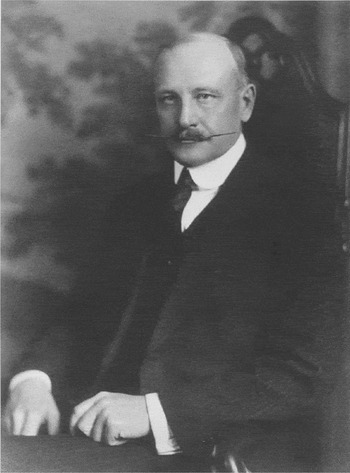
George Byron Gordon, director of the University Museum from 1910–1927. Conducted research at Copan and in the Lower Ulua Valley starting in the late 1880s prior to his first museum appointment at the University Museum in 1903. Photograph courtesy of the University of Pennsylvania Museum of Archaeology and Anthropology, #143973.
Over the course of the next 10 years, the Honduran Government became increasingly involved in the management of antiquities within its national boundaries, and the PMAE was shut out. The DOS acted as the main negotiating body, advocating for U.S. involvement (i.e., PMAE) at Copan. In fact, the journey from Boston to Honduras most often included a stop in Washington. This trip required lengthy stays in multiple ports and afforded the researchers time to visit and make negotiations with the respective officials.
A now-seasoned Gordon returned to Honduras in 1894 to begin excavations at Copan, expecting to continue under the 1891 concession granted to the PMAE, under which Owens had excavated. Yet, Gordon's trip was primarily focused on diplomacy, not archaeology, to ensure access to the site, a point under considerable debate by the Honduran Government. In one of Gordon's very lengthy letters, written December 1, 1894, to Putnam at the PMAE, he affirms the strategic role of the DOS and states that he sought legal advice regarding the concession. His letter also clearly conveys his determination to continue work at Copan until he is literally thrown out of the country:
The present administration is firmly opposed to our Copan concession; they will listen to no proposition that we make, but give me to understand that it was their intention to prevent us doing any more work there. It is of no use to use arguments or try to conciliate. They want to be ugly and they will do their worst. The only thing that you can do is to maintain your rights and not give way in the least. I am convinced that they are legally bound to acknowledge your concession and keep to it, and I shall go directly to Copan and begin operations. They can take whatever steps they like to eject me and then it will remain for the government of the United States to see that your rights are properly respected. They claimed to have discovered various loop-holes by which to get away from their obligations and leave them at liberty to cancel the contract.25
Gordon to C. Bowditch, December 1.
The Honduran Congress was opposed to work by the PMAE at Copan, but as Gordon tells us elsewhere in the same letter, the Honduran President was not; thus, access to sites and finds was a hot-button issue in the Honduran political sphere. In this same letter to Putnam, Gordon offered advice for future work and his current plan:
I am sorry that your contract was not better gotten up. In your dealings in these countries, no matter who may be in power at the time, you should be very careful to leave no possible opportunity for an advantage and be sure that no detail is omitted in a legal process, because the government changes hands very often and although those in power at the time may be disposed to act fair, the next crowd may not, and they may have a very different policy …
My plan is this: I shall write a clear statement of the circumstances and have the Consul forward it to the minister at Guatemala with his own comments; then I shall go to the ruins and begin operations. If they send me an order to stop, I will telegraph to the minister for advice. If they merely continue to molest us in the usual way, we are not obliged to submit to it. The terms of your contract are definite enough …26
Gordon to C. Bowditch, December 1.
The use of legal language became a tool to gain control of the past, rather than the earlier sentiments of diplomatic negotiation. Gordon was sufficiently frustrated with, as he saw it, the lack of reasonable diplomacy on the part of the Hondurans and decided to forge ahead with work at Copan. The frustration regarding the excavation and access to the site fueled hostility over the other major agenda of the PMAE: collecting the best finds and shipping them home. Further on in the same December 1, 1894, letter, Gordon demonstrates his frustration and inclination to go forward with exporting archaeological materials:
When it comes to a division of the objects found, if they refuse to divide with us as they did last year, we do not need to wait for them, we can take our share and let them look after theirs if they want to. In order to be in a position to deal with the government of Honduras or its agents, I shall require general power of attorney, specifying, however, any regular duties as to administration, including judicial power to represent, prosecute, defend, compromise, or arbitrate all matters concerning the business of the Peabody Museum with the government of Honduras, or its respective departments, with power of substitution and revocation. It should be perfectly general; drawn up in proper legal form by a notary, and it must be authenticated by the Honduranian consul general in New York. (I don't think they have a consul in Boston.) [T]hen it can be sent to the American consul here, who will have it authenticated by the minister of Foreign Relations and forward it to me. I shall need this very soon and ask that it be sent to me as soon as possible …27
Gordon to C. Bowditch, December 1, emphasis original.
The voice of Gordon portrays an institution (the PMAE) seeking to establish itself, which at the time included excavation, documenting the context, the storage of finds, and access to goods for export and eventual ownership by the institution. Gordon asked for permission to negotiate on behalf of the PMAE, authority previously given to him in 1891 by the museum, just after Owens's death. The close networks between the U.S. archaeological, museum, and diplomatic communities are clear from Gordon's letter, including (in the closing of the letter) assurance of transport of the letter via diplomatic pouch to ensure sealed delivery.
The reasons for Honduran apprehension are not clearly stated in the letters. Gordon attributes the apprehension to political mayhem—certainly the case in Honduras and elsewhere in Central America during the 1890s.28
For an overview of the political situation in Honduras with regard to archaeology, consult Harris and Sadler, The Archaeologist Was a Spy.
The Honduran government's opposition to U.S. work at Copan reflects the larger issue of U.S. presence in Honduras during the end of the nineteenth century, particularly the increasingly powerful fruit, mining, and railroad companies. Up until this period Copan had been the focal point of archaeology in the country—ever since Stephens and Catherwood first visited the site. Thus, it constituted the main point of interest for foreign institutions. The Hondurans allocated permits for work at Copan to U.S. researchers as well as others. Yet, foreign access to the past was clouded by the current political sentiments. In the body of Gordon's December 1, 1894, letter we get a glimpse of how the political situation in Honduras influenced archaeological work:
I think that the President himself is disposed to be fair. His manner was friendly and my conversation with him was agreeable. He impresses me as a man who would like to do what is right but does not dare. He would like to favor foreigners and stand well in their opinion, but knows that he must not run counter to the prejudices of his party. He made use of the worst element in the country to put him in power. They themselves the “liberal party” and their cry was “Honduras for Hondurainas”; they hate foreigners and persecute them as far as they dare. Bonilla's ministers are a crowd of vagabond doctors and lawyers. The particular one in whose department our business came is a certain Doctor Arias who lived not far from Copan. When Vasquez was declared President in 1892 Arias came here and became secretary of state. In the war between Vasquez and Bonilla in 1894 he opened a secret correspondence with Bonilla and offered to put the government into his hands on certain terms. Vasquez found him out but instead of shooting him took him out to the field and sent him over to Bonilla's camp. My trouble has come chiefly from this fellow; my business had to be presented through him, he refused to negotiate on the grounds I have explained. I told him at last that my mission was to arrange certain details of the contract and not to argue its validity. I was sorry for the position he took, but since he refused to listen to our propositions, I could only report the failure of my mission to the Museum and go away. I find that this same fellow was in private correspondence with Carlos Madrid when Owens was sick and afterwards and also recently [sic]. It may be that he had something to do with the authorship of that letter to Professor Putnam, and that Madrid is a sort of tool. All the new officers in that part of the country have been appointed by him and we will probably be molested considerably…. When Bogran was in power he would have given you almost anything you asked for, and if congress opposed him he would put all the members in jail. His policy was to stimulate foreign enterprise, and he felt friendly towards foreigners; his supporters were people of the same class with himself. The crowd that are in now are the reverse of this, they have made a new constitution which bears heavily on foreigners owning property in the country. All the Americans here fought against Bonilla, and his crowd in the last revolution, and those who were not killed got out of the country.29
Gordon to C. Bowditch, December 1.
The change in government had a profound impact on how archaeological work was conducted. Furthermore, the growing sentiment of “Honduras for Hondurainas” implicated the archaeological record, precisely because the Hondurans saw the past, in this case, Copan, as their cultural heritage. In contrast the PMAE viewed Copan as evidence of the ancient Maya, not necessarily related to the contemporary inhabitants or the nation state of Honduras.30
This issue of control over an archaeological site still persists today at Copan, where the Chorti-Maya have become increasingly active with site management in addition to increased site control by the central government. See Joyce, “Archaeology and Nation Building,” and Mortensen, “Structural Complexity,” for further discussion of Copan.
Because of problems with the Copan concession, Gordon turned to the Ulua Valley, following leads from various businessmen (Joyce and Henderson 2002), many who purchased materials. Gordon focused on the Ulua region precisely because “good finds” had been made by others, particularly Germans, in the area, and such “operations [were] less likely to attract the attention” than at Copan: “It will therefore not be well to make our movements conspicuous by attempting any extensive work at the latter place.”31
Bowditch to Gordon, 1896.
Although working in the Ulua Valley proved to be interesting for Gordon and the PMAE, they hoped to reaffirm their concession and return to Copan. They found themselves up against political favoritism, however, and relied increasingly on the U.S. Embassy in Tegucigalpa to help with negotiations. Affronted by the concession granted to the French for work at Copan, Richard Olney, U.S. secretary of state, stepped in on behalf of the PMAE in February 1897, writing to Putnam:
I have to acknowledge the receipt of your letter of the 1st instant, stating that the Government of Honduras has granted to Mr. A. Pinart, of France, a concession to explore the antiquities of Honduras in disregard of the rights of the Peabody Museum, as specified in that Government's concession to it of 1891.
I have forwarded a copy of your letter and of its enclosure to our Minister accredited to Guatemala and Honduras, in connection with previous correspondence on the subject of the repeal of the Museum's concession, and have instructed him to again bring the matter to the attention of the Honduranean Government, and to take such proper steps as he may deem necessary to insure the Museum in its rights.32
Olney to F. Putman, February 4.
The issue remained unresolved by May of the same year, and the DOS wrote again:
Referring to previous correspondence on the subject of the concession granted to the Peabody Museum by the Government of Honduras to explore and excavate the ruins in that country, I have to inform by direction of the Secretary of State, that a note has been addressed to the Minister of the Greater Republic of Central America, in this city, setting forth the facts in the case and requesting that the matter receive the early attention of the Honduranean Government with a view to the proper protection of the interest of that Museum.33
Rockliny to F. Putman, February 4.
These two correspondences and others similar to them clearly document the important role of the DOS in negotiating access to ruins, particularly the enforcement of the concession granted in 1891. The broad concession was ultimately revoked: The PMAE was forced to stop excavation and export of the ruins of Copan.
The Honduran government implemented new legislation in 1900, clearly prompted by foreign excavations in the country. Under the new national cultural patrimony law, all remains within the borders were property of the Republic. The PMAE remained hopeful of getting the last choice pieces out of the country, but settled for the fine and interesting molds:
Of course we are disappointed at not getting the regular concession, and we hope that something may yet turn up that will enable us to secure it. As I understand it, you are now doing the work under special permit from the President. Of course it will be a great feather in your hat if you succeed in getting out a lot of sculptures on this trip, but I hardly dare hope for it, although I suppose you will get some of the smaller objects. At all events you will have a fine lot of moulds which will be of great interest.34
Putnam to G. B. Gordon, June 9.
In this correspondence the PMAE laments the failure to secure a permit and to continue work—both excavation and exportation. Although many correspondences highlight the implicit instructions for scientific excavation, this letter also conveys the sense of disappointment in unsuccessful attempts to secure and export the loot, particularly the monumental sculptures of Copan, despite the consolation of the molds.
1900 to 1946: Banana Cowboys and Archaeologists
Work resumed at Copan under the auspices of the Carnegie Institution in the 1920s;35
Fash, Scribes, Warriors and Kings, 53–57.
Gordon to L. Valentine, April 2.
Gordon to L. Valentine, April 14.
By 1914 material from the Ulua Valley had attracted a significant amount of attention in the growing local market, fueled by a U.S. market. This attention spurred plunder, as indicated in a letter from Valentine to Gordon:
I regret to say that the rumor was spread in the Ulua region that the antiquities found in the river possess a tremendous marketable value. Consequently, my agent encountered difficulties in eliminating numerous interested parties from acquiring the latest findings. The publication in local newspapers of a translation of your report on Copan has contributed to create unwarranted competition. However, I have taken steps to replace the matter on a normal basis and am quite confident that I shall soon be in possession of everything there is to be had around San Pedro. In order to make this possible I have deemed it wise to recall the gang of men I engaged. But this is temporary and I hope that in a very short time I shall be able to offer you further findings.38
Valentine, Letter to G. B. Gordon, July 6, emphasis added.
Valentine operated as a sort of middleman, trafficking objects from Honduras to the collecting institution in the United States. He competed with others, most likely businessmen affiliated with the mining and/or fruit companies. Both groups worked with local gangs to prospect for antiquities. Thus, the rise of the U.S. market helped to jump-start the plunder of sites in the Ulua Valley.
In his next letter Valentine reiterates his points regarding local plunder and the growing demand for objects from the region. The most salient point for this research pertains to the emphasis on monetary value of objects in addition to cultural value.
Some time ago I wrote you about the difficulties I encountered in securing further pieces of interest from the Ulua valley owing to rumors current in that region that the antiquities found there represent a tremendous, marketable value.
About half a dozen beautiful calcium [marble] vases are now in the possession of various parties in San Pedro, besides numerous jade beads, clay articles, etc. One particularly pretty and well preserved calcium vase about twice the size of the largest you obtained from me is now on the way to the Smithsonian Institute for exhibition purposes. The owner has such an exaggerated idea of the value of this vase that he expects to “make his fortune” with it by selling it for—$10,000.00.
If any more antiquities are to be obtained from the Ulua valley it is necessary to discourage people there with regard to the value of these articles. If the Smithsonian Institute could write to the owner of the above-mentioned vase a discouraging letter offering a nominal amount for the vase, I would see to it that this letter became generally known in the Ulua region.
I am informing you of the above, because I would like to obtain for you whatever pieces are found in and around the Ulua and I am thinking that possibly you have some means of informing the Smithsonian Institute of the advisability of discouraging the people down there as above suggested …39
to G. B. Gordon, July 28, emphasis added.
Gordon's response to Valentine indicates a concern of access, not necessarily mitigation, and again highlights the emphasis on market value and the influence of U.S. institutions in this market:
I regret to know that rumors current in the Uloa Valley have caused such fantastic notions about the marketable value of antiquities. I am sorry also that you did not get possession of the specimens now in private possession. I shall look out for the one [marble vase] which you say is on its way to the Smithsonian Institution, and perhaps we can help to dispose of the aforesaid rumors. Such notions, however, are very persistent and are more likely to take encouragement than to give way to reason or experience. I hope that you will do your best to discourage the notions which prevail around San Pedro and that you will be successful in securing whatever is found in that region in the future.40
Gordon to L. Valentine, August 4.
UPENN competed with the private market, but also with other prominent institutions (e.g., the Smithsonian and Harvard) for materials from the Ulua Valley. The correspondences focus on access to these finds and attempts to underbid the market and disseminate information of the low market value of objects to the local middlemen and looters in Honduras. That is, U.S. institutions, working closely with their own middlemen—the businessmen—actively tried to squash a developing public interest to insure that they cornered market.
The prized marble vases were among the most desired objects. Initially brought to light by Gordon's earlier excavations in the valley,41
they have remained among the hottest items from the Ulua Valley on the market.42Luke and Henderson, “The Plunder of the Ulua Valley.”
In the period between 1914 and 1915, Royal Mining had the favor of the Honduran Government; the previous administration had been overthrown in a 1910 coup. The goal of the coup was to ensure that the railroad lines could be built and operated according to U.S. interests. The coup was backed by several key U.S. businessmen, particularly Samuel Zemurray, then president of Cuyamel Fruit (1911–1929), and the future president of United Fruit (1933–1950), who was the most influential figure in the banana industry. Zemurray had a vested interest in the railroad lines to move materials and goods across the country. What is more, his daughter, Doris Stone, became one of the most prominent archaeologists in the region. Therefore, Royal Mining had significant sway with local authorities, as clearly stated in the correspondences from Valentine. In fact, Valentine assures Gordon of good ties, regardless of whether he (Valentine) was in the country: “I have a good many friends and connections in Central America, particularly in Honduras. If I can serve you in any way, please do not hesitate to inform me. I shall be most delighted to assist you whenever an occasion may arise.”43
Valentine to G. B. Gordon, April 10.
Proper excavations resume in the Ulua Valley some 15 years later under Dorothy Popenoe, who had accompanied her botanist husband, Wilson Popenoe, to the region. Dedicated to her work in the valley, Popenoe returned to areas highlighted by Gordon, with a goal of defining the break between monochrome and polychrome ceramic styles in the Ulua Valley (an inherently archaeological question); she was also the first to consider seriously the importance of stratigraphy, using what she called the “onion-peel” method.44
For details of Dorothy Popenoe, please consult the work of Rosemary A. Joyce: “Dorothy Hughes Popenoe”; “Popenoe, Dorothy Hughes (1899–1932)”; and “Solid Histories for Fragile Nations.” The work of Levin concentrates on the role of women in archaeology, including Dorothy Popenoe: “Creating Their Own Niches.”
United Fruit played a key part in redefining this period of archaeology in the Ulua Valley. United Fruit offered a number of strategic opportunities for archaeologists, including the introduction of both Popenoe and Stone to the region. Although these two researchers were not close (they may have never met), they were both pioneers in the field, conducting excavations in the valley as well as the more remote regions of Comayagua and Olancho, respectively. Both women were intricately tied to United Fruit, but it was the U.S.-based field archaeologists who relied exclusively on United Fruit for access to the region. United Fruit also helped in a number of logistical ways: Excavations were often conducted near United Fruit farms that provided living quarters for the excavation team; and materials for excavations and finds from excavations were shipped via the Great White Fleet, a United Fruit–backed shipping company. United Fruit also had considerable clout with the Honduran Government, avoiding the tense permit and export negotiations of the 1890s.

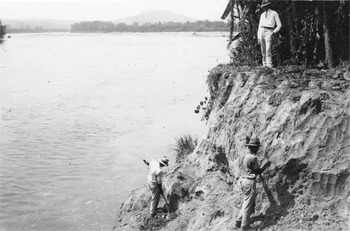
Excavation directed by D. Popenoe at Playa de los Muertos, late 1920s along the Ulua River. Photograph credit: 2006 Harvard University, Peabody Museum 2004.29.7940.
What is more, members of the United Fruit workforce, the Banana Cowboys, became key members of the early antiquities trade in the Ulua region, as captured vividly in the following correspondence of Popenoe:
The problems of the field archaeologist are tending to become less simple year by year as the Ulua Valley is being opened up for farming of bananas and the mozos and peons who live on the farms and along the river are already aware of the intrinsic value of the prehistoric relics they encounter. Women as well as men make it a pastime to wander up and down the banks, probing with their sharp pointed machetes wherever fragments protrude from the bank. Objects found are sold to passersby, to souvenir collectors, or to “Banana Cowboys” on the lookout for mementos to send to the folks at home.45
D. Popenoe to A. Tozzer, March 17.
In addition to local Honduran men and women, the cowboys did actively collect and bring home materials. Working for United Fruit as dragline (for dredging canals) operators, they often found archaeological materials. Items of known value were taken back to the United States to be sold. The deliberate nature of this activity is clearly stated in a 1932 article from a Savannah paper:
J. I. Kennedy, formerly a resident of Savannah, but more recently with the United Fruit Company at Tela, Honduras, was in Hotel Savannah yesterday with pieces of pottery and stone work which he believes are rare specimens.
Mr. Kennedy was operating a drag line in Honduras and forty feet from the river at Tela, and nine or ten feet below the earth's surface, found the piece of stone work which shows considerable age. He was interested in finding out what sort of tools could have been used to [work] the stone and to inscribe the figures on the outside of the “cup-like” vessel …
The piece of pottery was found with red coloring predominating, but the boy of general work about the camp, thinking to please Mr. Kennedy by clearing the pottery, first tried lye on it, then sandpaper, and the result was that while he scoured it successfully, he also scoured quite a bit of the coloring off of it. This disappointed both Mr. Kennedy and the boy when the latter found out what his enthusiasm had led him to do. Mr. Kennedy, a guest of Hotel Savannah while here, left last night for the North with his prized possessions and hopes to [learn] up there just what his discoveries amount to.46
News clipping from unknown “Savannah Paper” provided by Maxine Kennedy.
This newspaper clipping documents the interest in antiquities of businessmen during the 1930s, echoing the interest for specific items between 1914 and 1915, as documented in the correspondences with Valentine. The U.S. pre-Columbian market of the second decade of the twentieth century had continued to grow, now apparently with hubs in the northeast, not coincidently the home of the major collecting institutions. Local workmen took charge of cleaning antiquities and U.S. citizens carted materials back to the United States in hopes of finding buyers.

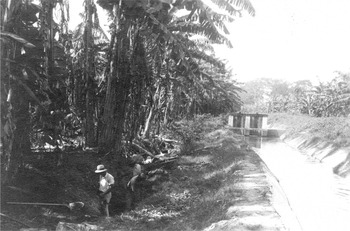
Excavation along banana plantation canal, ca. 1930. Photograph credit: 2006 Harvard University, Peabody Museum 2004.29.7939.
Certainly by the mid-1940s, there was a serious interest in antiquities from Central America in the United States, when pre-Columbian materials began to be collected seriously as “art”, particularly by the U.S. private collector Robert Woods Bliss and U.S. dealers Alfred Stendahl and John Wise.47
See Benson, “The Robert Woods Bliss Collection of Pre-Columbian Art,” and Coe, “From Huaquero to Connosisser.”
J. B. Edwards, a U.S. citizen, became one of the first U.S. dealers in Honduras, with a “curio shop in Puerto Cortes” (Popenoe 1935a), working closely with those looting the northern shores of Lake Yojoa, just south of the Ulua Valley. Even after his wife's death, Wilson Popenoe continued to monitor what was happening archaeologically in Honduras and became one of the foremost collectors of Uluan material. He followed Edwards' activities, occasionally buying pieces from him and then selling or gifting them to the PMAE. According to a letter from Popenoe, Edwards did not go unnoticed by the Honduran Government:
[Edwards] says he had quite a time getting his contract with the Honduras govt., but that General Carias has assured him he will not have any further trouble as long as he, the General, is President. He has to give half of his finds to the National Museum… He is allowed to export his own share.
The big row he recently had with the govt. came, he says (and Mr. Turnbull verifies this), because someone in Teguci read an article published by Doris Z. Stone that he was turning up gold at Yojoa. Since he had not turned in any gold to the govt., they thought they were being double-crossed and they had him arrested at Potrerillos, took him up to Teguci and held him there for ten days, until they were satisfied.
… Since much of the Edwards material will henceforth figure in museums in the U S, it would be well to have some technical information regarding the source. I believe we could strike a bargain of some sort with him, to enable us to do the necessary work at Yojoa. I think he would be open to almost any proposition which involves cash down. He is working for a living, not because he is devoted to archaeology as a science.
It certainly seems as though the Yojoa site should be tied with the Ulua valley, anyway,—at least that is the way it looks to me.48
W. Popenoe to A. Tozzer, November 23, 1935.
Plunder for the purpose of sale was clearly part of Edwards' agenda, and he was among the few people actively organizing such activities, building on the days of prospecting by local businessmen or making chance finds from development (such as the dragline discoveries of United Fruit).

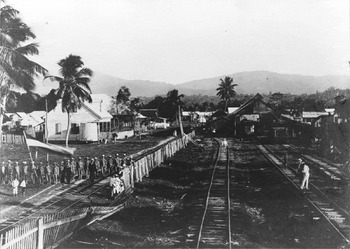
View of Puerto Cortes from the banana company rail line. Courtesy of the University of Pennsylvania Museum of Archaeology and Anthropology, #148732.
By the mid-1930s the PMAE took a more forceful stance against purchasing looted antiquities, appealing to the growing trend of archaeology as a science, clearly expressed in the sentiment of this letter written by Tozzer to Popenoe about Edwards:
As you know, we are not out for loot. There is no question but that there is plenty of stuff down in his area, but personally I am much more interested in continuing the problem on which Dorothy was working, the contact between the monochrome and polychrome cultures. This, it seems to me, could best be tackled in the valley itself.49
Tozzer to W. Popenoe, 1935.
Tozzer impressed upon Popenoe the need to pursue the monochrome-polychrome ceramic chronology: The research question initially proposed by his wife (Joyce 1994). Popenoe's response shows that he understood the importance of context, a concern that is highlighted throughout his correspondences; yet, he continued to follow local plunder, even questioning why archaeologists should not at least monitor local prospecting endeavors:
I feel as you do that what we are after is information, not loot, and we must tie up the relationship between the monochrome and polychrome wares. But the Yojoa site is turning out such a grand lot of stuff that I very much doubt Strong's and Kidder's ability to resist taking a look at it. Especially after they have seen some of the pots Edwards has exhumed. But I do not want or intend to complicate our own job in any manner, nor shall I.50
W. Popenoe to A. Tozzer, December 13, 1935.
Regardless of his conflicting ethical stance on looted materials, the PMAE continued to rely on Popenoe for a permit; the permit issues are often presented in the same correspondences as those about loot, with references to the diplomatic attempts to secure permission in Washington (Tozzer 1935).
I yesterday talked with Mr. Turnbull's office regarding affairs at Teguci. Mr. Hamer, who is acting in charge during Turnbull's absence in the States, was in Teguci day before yesterday and started the ball rolling. He assures me there will be no difficulty at all. I haven't any qualms on this score; I believe we can consider the arrangements as complete.51
W. Popenoe to A. Tozzer, December 13, 1935.
Popenoe's association with United Fruit was clearly a key factor in the ease of securing permission: “I haven't any doubt that we shall get the sort of cooperation we want from Tegucigalpa. The Company's relations with the present administration are excellent” (W. Popenoe 1935c).
In 1936 the Honduran Government took another look at legislation, in part because of Edwards' activities at Lake Yojoa. In fact, the government took interest in not only illicit trafficking, but also the importance of context.
I have just seen a batch of 15 Yojoa bowls…. They knock out not only one, but both your eyes synchronously and simultaneously. I understand Edwards has some 75 still on hand; but his digging has been stopped by the government on the grounds that he is merely exploring the site, and not getting sufficient information. A very progressive and enlightened attitude, say I.52
W. Popenoe to A. Tozzer, February 18, 1936.
The new legislation changed how archaeology in Honduras was conducted, even that conducted by friends of the Honduran Government. Permission to excavate became more challenging, and getting materials out of the country for the respective sponsoring institutions (i.e., the PMAE) was also increasingly difficult.
Now, about Yojoa pots: Duncan, Jean, and “Dreckly” are digging there right now. We went up to Tegucigalpa and wrangled a permit to do so. We stopped and saw the site, which is rapidly being looted … and Duncan felt it highly important that he get conformation from that area this year. Our understanding worth it—Minister regarding exportation of artifacts is highly informal but I think it will work: if so, it—Peabody is going to end up with some Yojoa pots…. Honduras is about to vote a new Constitution which not only prohibits exportation of every sort of archaeological material, but also gives the govt. the right to seize anything privately held in the country, for the National museum I have read the text and its log…. It may go into effect in a month or two.53
W. Popenoe to A. Tozzer, March 15, 1936.
As intimated in this correspondence, implementation of the 1936 legislation made it increasingly difficult to export antiquities:
I have made necessary arrangements to get it out, all open and above board. It is the last large batch of Yojoa pottery which may come out of Honduras for some time. So far as I know, there is no other private collection of any considerable size in the country, and for the past year or more, no digging has been done in Yojoa, for which I am glad, there is sufficient of this material in North American museums now, to answer all purposes of study; and it would be better to protect the Yojoa region against further depredations, until such time as competent archaeologists can give it further attention.54
W. Popenoe to A. Tozzer, November 23, 1938.
Popenoe continued to participate as a collector and patron. The following reply to Tozzer, four years after the exchange regarding the end of collecting loot, portrays the sentiments of a collector, not an archaeologist, realizing that the days of easy export have come to a close and that times have indeed changed:
I am not going to Honduras, and in any event would not wish to attempt any further shipments of pottery, unless you were especially interested. The people over there have been good to me in the past and I do not want to impose on their good nature. If you should know of someone who is fairly dying to have 35 good Yojoa pots, and care to write to Edwards, he could probably get these for you; but unless you really need them I think it would be better not to press matters further. I figure you now have the best collection of Yojoa pottery in the U.S., anyway.55
W. Popenoe to A. Tozzer, February 26, 1939.
Popenoe's friendship and ties to United Fruit placed the PMAE in the middle of a diplomatic quagmire. They wished to maintain ties to and benefit from Popenoe and yet also needed to enforce upon Popenoe the mandate for context and a break with antiquarian practices. In the following correspondence, it is clear that Popenoe continued to grapple with how to understand this evolving debate over how to reconcile plunder and scientific research:
I am delighted that the Honduras artifacts are making a good showing. I do not believe there can be any doubt that you now have the best, if not the most extensive, lot of Yojoa polychrome in the U.S. and I quite agree with you that you don't need any more, unless perchance I should see something very choice in Honduras, some time in future, and feel that it ought to be added to your batch… .
It has been pretty difficult arranging shipment of the last two lots I got for you, and unless something particularly choice shows up, something you really must have, I'd just as soon drop the subject of Honduras archaeology. I told Doris this, in New Orleans. I'm terribly glad she is looking to you now, for guidance; as long as she does this I would like to assist her as much as possible, in every way.56
W. Popenoe to A. Tozzer, March 30, 1939.
Popenoe's sentiment reflects his changing perspectives on the importance of context. Yet, subsequent letters tell of Popenoe's continued interest in collecting antiquities, regardless of their context, particularly from his new post in Colombia.57
Wilson Popenoe, in addition to being a botanist, was also an undercover agent for the U.S. government. See Harris and Sadler, The Archaeologist Was a Spy. Therefore, his ease of movement around Central and South America and his close ties with prominent political members were not entirely because of his good graces as a botanist but as a highly trained agent. He clearly used his ties to embellish his love of antiquity, particularly the building of the PMAE's collections.
The PMAE remained interested in ensuring diverse collections, particularly having one of everything. This sentiment is most clearly viewed in a series of correspondences between the Smithsonian and PMAE over the final division of material from the Ulua expedition. Ties were severed not over the excavated finds, supposedly the focus for both institutions, but over one vase—a large clay effigy of the famed marble vases—that Wilson gifted to the expedition, the so-called Wilson Vase.
The correspondences between Gordon and Valentine and the Popenoes and Tozzer demonstrate that looting was recognized as a lucrative activity in the valley by the second decade of the twentieth century and certainly well-known by the 1930s; a strong local market had developed, driven by the growing U.S. market; stratigraphy was recognized, even promoted by Dorothy Popenoe58
Joyce, “Dorothy Hughes Popenoe.”
The face of the collector changed considerably during this period. U.S. institutions and archaeologists working for them turned toward emphasizing context in the Ulua Valley, particularly in light of the work by Dorothy Popenoe and the Strong expedition. Yet, even with the growing acknowledgment of the importance of context, archaeologists and their respective institutions still hoped to keep at least part of what they found. The large collections now housed at many U.S. institutions were taken from the Ulua Valley during the last stage of when the Hondurans allowed the export of materials. After the Hondurans closed their borders to antiquities in 1936, most formal U.S.-sponsored archaeological work stopped in the Ulua Valley and did not resume seriously until the late 1970s.
1950–1984: Diplomats and Archaeologists
Although artifacts from Mexico and Guatemala lured collectors during the 1940s and earlier, during the 1950s and 1960s the artifacts from the Ulua Valley attracted interest from collectors beyond the Banana Cowboys and the handful of archaeologists working for museums. Robert Woods Bliss purchased two “Ulua marble vases” from Stendahl galleries in Los Angeles in the 1950s. By the 1960s Alfred Stendahl was the primary dealer of material from the Ulua Valley, particularly the Ulua marble vases. Spencer Throckmorton served as his East Coast counterpart in New York. By the 1970s museums that did not own material from the Ulua Valley, specifically a marble vase, began buying from Stendahl and Throckmorton.59
Luke and Henderson, “The Plunder of the Ulua Valley.”
As the early correspondences document, the Honduran government was always responsive to archaeological work in the country. In fact, the implementation of national legislation appears to have been driven by foreign interest in the past or, perhaps more realistically, foreign interest in acquiring antiquities, as reflected in the implementation of the 1900 and 1936 laws, both corresponding to peaks in archaeological investigations and the export of finds as well as increased looting. A number of new laws went into place between 1946 and 1975. Notably, in 1952 under Decree 245 the National Institute of Anthropology and History was formed.60
By 1966 Honduras had issued an emergency decree hoping to deter further destruction of cultural sites. The 1950s and 1960s saw a rise in looting, particularly around the sites of Travesia and Tenampua where “it was a popular ‘sport’ for affluent people and the diplomatic core in Tegucigalpa to go on ‘digging expeditions.’”61See Agurcia, “La depredación del patrimonio cultural en Honduras,” 89; Agurcia, “Late Classic Settlement in the Comayagua Valley,” 264.
By the late 1970s Honduras knew it had a substantial pillage problem. Pillage had taken a serious toll on the landscape. Archaeological sites were disappearing at an alarming rate, most of them completely undocumented. In 1979 Proyecto Arqueológico Sula (PAS) began: the first major U.S.-Honduran cooperative project in the Ulua Valley. PAS aimed to document sites in the Ulua Valley and conduct salvage operations at damaged sites and/or sites slated for future construction.63
See Agurcia, “La depredación del patrimonio cultural en Honduras,” 91; Henderson, Agurcia, and Murray, “El proyecto arqeuologico sula”; Joyce, Cerro Palenque, 30.
Luke and Henderson, “The Plunder of the Ulua Valley.”
1984–2005: Legislative Efforts for Honduran Archaeology
Honduras ratified the 1970 UNESCO Convention in 1979, followed by its toughening of the national patrimony legislation under Decree 81–84. During the same period, the United States also worked toward implementing the 1970 UNESCO Convention, implementing it in 1983 under the Cultural Property Implementation Act (CPIA). Today agreements are implemented country by country, the initial request for an MOU coming through diplomatic channels to the United States from the other state party (usually transferred via the respective ambassador). Under an MOU certain categories of artifacts are prohibited from entering the United States without proper documentation from the respective ministry of culture or an equivalent entity. These MOUs serve as one tool in protecting archaeological sites from future pillage and provide a formal channel for further cooperation at the international, national, and regional levels, as stipulated in the respective agreement.66
Each agreement and respective information regarding implementation can be accessed from the Cultural Property Advisory Committee web site: Available at http://exchanges.state.gov/culprop/sindex.html.
Luke and Kersel, “The Antiquities Market.”
In 2001 Honduras submitted a formal request to the United States, and an MOU was implemented three years later in March 2004, the fourth in the region following El Salvador, Guatemala, and Nicaragua. The Honduran case was clear. Looting was endemic and it had become increasingly embedded in the social fabric of local communities. The primary market was the United States. In the Ulua area the sites of Travesía, Calabazas, and Gualjoquito as well as hundreds of other sites had all been badly looted, if not completely demolished. In the neighboring regions of El Cajon, Comayagua, and Naco, plunder was a major problem. Over the years international buyers had made frequent trips to San Pedro Sula, even out to specific sites known for particular artifacts. Furthermore, the history of the diplomatic core in trafficking antiquities was also clear.68
A number of archaeologists who have worked in these areas confirm the endemic nature of plunder, including John S. Henderson, Kennith Hirth, Rosemary A. Joyce, Jeanne Lopiparo, Allan Maca, Edward Schortman, Robert Sharer, and Patricia Urban.
In the late 1990s the Margarita tomb complex at Copan was pillaged; evidence suggests a highly organized plan. In 1997 National Geographic published a number of glossy images of the complex. In February 1998 the tomb was brutally looted.69
Stuart wrote the piece for National Geographic: “The Royal Crypts of Copán,” but Agurcia is among the only to have published (albeit briefly) the horrific looting: “Copan Honduras.”
Also in 1998, the Chorti Maya took over the site of Copan, demanding a stake in the planning and management of Honduran cultural patrimony. See Joyce, “Archaeology and Nation Building,” and Mortensen, “Structural Complexity and Social Conflict.”
It is legal to buy and sell antiquities in Costa Rica, Nicaragua, El Salvador, Guatemala, and Mexico as long as the antiquities and the transactions are registered with the respective government; it is illegal in these countries to export antiquities without government permission, which is rarely, if ever, granted for the permanent export of privately held materials.
DISCUSSION
Through more than 150 years of archaeological work in Honduras, we can track the continued interests of U.S. archaeologists and museums. We can track the fluctuating interest of the U.S. Government, particularly DOS and the U.S. Embassy in Tegucigalpa. The archival materials from PMAE document the U.S. State Department's role in the early days of archaeological work in the country. These same archives show the increasingly powerful role of U.S.-based businesses, particularly the Royal Mining Company and United Fruit, in negotiating permits for fieldwork and exports. Although the State Department and the mining and fruit companies acted as negotiating authorities for PMAE and UPENN, recent work has been carried out with the diplomatic skills of the U.S. archaeologists. Overall, this practice is good. Direct ties allow for a transparent permit process and development of long-term relationships. The recent MOU with Honduras presents a potential shift in DOS involvement and opens a new opportunity for dialog.
A result of the increased interest by U.S. institutions in materials from Honduras, specifically in the Ulua Valley, the local Honduran and U.S. antiquities markets thrived. Valentine's correspondences reveal a long history of U.S. institutions and archaeologists creating a market for Honduran antiquities. And there was a diverse group interested in procuring collections: U.S. institutions patronizing archaeological work, U.S. archaeologists conducting excavations, and U.S. businessmen based in Honduras (the elite as well as the dragline operators or miners as well as the local middlemen and collectors such as J. B. Edwards). That is, these various participants all identified with collecting as an integral part of what constituted archaeological practice in a foreign country. It was the development of archaeology as a science (and thus the importance of context) that began to identify archaeologists distinctly from others interested in the past. And in the case of Honduras, it was the 1936 law that forbid the continued shipment of antiquities from its national boundaries and required a more stringent permit process that turned archaeologists working in the Ulua Valley away from their earlier agendas of collecting; now they were faced with the reality of having to leave excavated materials behind.
In closing it is clear from the early correspondences that keeping abreast of looting and collecting activities provided information about how materials moved and who was moving them and why. The discipline of archaeology has moved away from close connections with the collecting community, arguing that such connections serve to validate collecting. Yet, collectors have not stopped collecting, and looting has increased across the world.72
Neil Brodie and Colin Renfrew provide the most up-to-date summary of the situation: “Looting and the World's Archaeological Heritage.”
ACKNOWLEDGMENTS
A number of people made this research possible, and I wish to thank them briefly here. Patricia Kervick, archivist at the Peabody Museum of Archaeology and Ethnology, and Alex Pezzati, archivist at the University of Pennsylvania Museum Archives, have made this study possible through their patience in working with me at the respective archives. Maxine Kennedy provided a key newspaper clipping from a Savannah paper, which I have been unable to relocate. I would also like to thank Patty Gerstenblith, Rosemary A. Joyce, Morag Kersel, and Christopher H. Roosevelt for their valuable comments on earlier versions of this research; comments from two anonymous reviewers also greatly enhanced the clarity of this paper. Finally, I wish to thank my students from the fall 2004 research writing seminars in the Boston University Writing Program for their enthusiasm in discussing the antiquities trade in Central America. This research grew in many ways from our conversations.