Introduction
In recent years, the statutory minimum wage (SMW) has returned to the centre stage of social policy in advanced economies. Its revival has been driven by a combination of converging institutional and political imperatives: it serves as a state response to wage stagnation and rising in-work poverty, a substitute for weakened collective bargaining, and a tool for political parties competing for votes (Bruckmeier and Bruttel, Reference Bruckmeier and Bruttel2020; Kozák and Picot, Reference Kozák and Picot2025). As a policy instrument, the SMW represents a key form of market intervention, particularly within liberal welfare regimes aiming to establish a wage floor and mitigate working poverty through predistribution (Wilson, Reference Wilson2017; Marchal, Reference Marchal2020; Cova, Reference Cova2023).
However, the pursuit of these social goals is inseparable from the polarised economic debate surrounding the SMW’s implementation. While advocates champion the minimum wage for its potential to reduce poverty and earnings disparity (Engbom and Moser, Reference Engbom and Moser2022; Bossler and Schank, Reference Bossler and Schank2023), proposals consistently face opposition rooted in orthodox economic predictions of increased unemployment and underemployment (Bossler and Gerner, Reference Bossler and Gerner2020; Neumark and Shirley, Reference Neumark and Shirley2022). As the policy’s effects are highly context-dependent (MaCurdy, Reference MaCurdy2015), the critical task for social policy scholarship is not merely to adjudicate outcomes but to analyse how specific institutional and political settings shape the policy’s ultimate impact.
Hong Kong represents a crucial case for these global debates. First, on the economic front, its status as a textbook liberal market economy serves as a stress test for orthodox claims about negative employment effects. Its hyper-flexible labour market and residual welfare state lack the institutional buffers – such as strong employment protection or robust unemployment benefits – that might otherwise cushion the policy’s impact (Price and Ho, Reference Price and Ho2011). Consequently, if orthodox predictions of adverse employment adjustments – whether through reduced hours, increased underemployment, or outright job losses – hold true, they should be acute in this unmediated context. Second, on the political front, Hong Kong has decoupled the minimum wage from the electoral competition common in Western democracies. Instead, the policy emerged as a tool of authoritarian legitimation: it was a strategic response by an elite-dominated system to manage profound inequality and secure social stability (Holliday, Reference Holliday2000; Kwon, Reference Kwon2005). This distinctive context allows for an analysis of the policy’s economic impacts that is largely separated from democratic electoral politics, offering a valuable perspective on non-electoral drivers of social policy.
Within this setting, policy discourse is sharply polarised. While labour unions and civil society advocate for robust increases to combat working poverty (Tsang, Reference Tsang2023; The Standard, 2024), employer associations consistently warn of adverse consequences. Their primary concern is not the direct cost of raising wages for the lowest-paid, but a broader inflationary ‘ripple effect’. They argue that to maintain internal pay hierarchies and staff morale, firms – particularly small and medium-sized enterprises – would be compelled to raise wages for more senior staff, thus escalating the entire wage bill and threatening employment (Tan and Ko, Reference Tan and Ko2010; Au-yeung, Reference Au-Yeung2024;). This narrative of an inflationary ripple effect contrasts with the well-documented ‘anchor effect’ in the economic literature, where wage increases are instead tightly compressed near the new floor (Lee, Reference Lee1999; Cengiz et al., Reference Cengiz, Dube, Lindner and Zipperer2019). Adjudicating between these competing claims is central to understanding the SMW’s true impact. Yet a comprehensive, systematic evaluation of the policy across its multiple adjustment cycles remains a critical gap in the literature. Local studies, while valuable, are often fragmented, typically focusing on a single adjustment period or sector (e.g., Wong and Ye, Reference Wong and Ye2012; Su et al., Reference Su, Heo and Leung2014; Lau and Wong, Reference Lau and Wong2018; Liu et al., Reference Liu, Zhang and Wu2024), and a holistic understanding of the policy’s performance over its formative decade is lacking.
This article addresses this gap. Using representative data from the General Household Survey (GHS, 2011–2019), we use a Difference-in-Differences (DID) method to analyse the consequences of Hong Kong’s first five SMW adjustments. We ask the following questions: (1) Did SMW adjustments impact underemployment and working hours for low-wage workers? (2) Did the SMW raise wages for the most affected workers, and did it generate inflationary wage spillovers for workers higher up the wage distribution?
This analysis makes two primary contributions to social policy scholarship. First, regarding the political economy of welfare, this study re-evaluates the policy’s outcomes against its rhetoric. We argue that the SMW’s cautious trajectory – which has seen its real-world ‘bite’ decline over the decade – can be better understood through a logic of ‘authoritarian legitimation’. From this perspective, the policy functions as a strategic tool to manage social discontent while accommodating business interests, with the substantive goal of tackling in-work poverty appearing to be a secondary consideration. This finding offers a critical extension to theories of productivist welfare capitalism by revealing the inherent limits of this model for genuinely tackling in-work poverty within an elite-dominated system.
Second, for social policy practice, our findings suggest the potential existence of an untapped policy space for more meaningful wage adjustments in Hong Kong. By showing that a decade of modest increases did not trigger the feared adverse employment effects, our analysis encourages a shift in the policy debate from whether the minimum wage should be raised to how much it can be raised to effectively achieve its social objectives without significant economic disruption.
The political economy of the minimum wage setting: a Hong Kong case study
Across advanced economies, the statutory minimum wage has re-emerged as a central instrument in the fight against in-work poverty. In many European welfare states, its revival is a direct response to the erosion of collective bargaining, designed to fill the regulatory void left by the decline of trade unions (Pedersen and Picot, Reference Pedersen and Picot2023; Kozák and Picot, Reference Kozák and Picot2025).
Hong Kong’s trajectory, however, departs from this model. Here, the SMW was introduced not within a context of declining tripartite negotiation, but into an ‘institutional vacuum’ where legally protected collective bargaining rights are absent. This section explores the competing narratives that shape Hong Kong’s minimum wage discourse, arguing that the city’s unique political economy not only explains the intensity of this conflict but also frames it around specific, testable claims that form the hypotheses of our empirical analysis.
The dominant narrative in Hong Kong’s policy debates centres on economic risk, a perspective that finds fertile ground in the city’s entrenched productivist welfare capitalism (Holliday, Reference Holliday2000). This model structurally prioritises market-led growth and competitiveness over social protection, with economic advantage predicated on cost minimisation, high intensity, and labour flexibility (Lee and Cheng, Reference Lee and Cheng2011). This structural reliance on a low-cost growth model means that any government-led wage floor is perceived not merely as a cost but as a direct challenge to the foundations of the city’s competitiveness.
This economic model is fiercely guarded by a political structure of ‘liberal authoritarianism’, where a powerful business veto is formally protected within the state apparatus (Fong, Reference Fong2017). The swift 1997 repeal of the short-lived Collective Bargaining Ordinance serves as a pivotal example of this veto in action, as it cemented the institutional vacuum in formal wage negotiation (Hong Kong Labour Rights Monitor, 2023). This political reality, combined with the government’s preference for ‘welfare adhocism’ – favouring one-off handouts over permanent institutional commitments (Lee and Law, Reference Lee and Law2014) – has placed immense political weight on the few available state-led instruments. The SMW is therefore not one tool among many; it is the primary formal mechanism through which wage floors are contested. This explains why business opposition is so fierce: it represents resistance not just to a wage level but to the principle of institutionalised government intervention in a labour market hitherto largely free from such regulation.
The introduction of the SMW in 2011 appeared to mark a rupture from welfare adhocism, as it established a permanent institutional floor in place of one-off handouts. However, a closer look at its origins and design reveals a deeper continuity with Hong Kong’s pro-business policy orientation. The policy was catalysed not by a shift in ideology but by mounting public pressure – sparked by media exposés of exploitation – and was ultimately triggered by the 2008 financial crisis, which made the ‘trickle-down’ narrative politically untenable (Wong, Reference Wong2014). This reluctant intervention is therefore better understood not as a fundamental change, but as a strategic act of authoritarian legitimation. Consequently, the tripartite Minimum Wage Commission (MWC) was itself a political compromise, designed to contain social pressures within a statutory deliberative process where, as Wong (Reference Wong2014) argues, fragmented labour unions faced a politically dominant business sector.
This model of minimum wage governance stands in contrast to the diverse arrangements found in other liberal welfare states. Australia, for instance, is unique in entrusting its wage floor to an independent statutory authority, the Fair Work Commission, a quasi-judicial body with deep historical roots in arbitrating labour relations (Wilson, Reference Wilson2017). The United Kingdom uses a hybrid model where the Low Pay Commission (LPC) – a tripartite social partnership – provides independent, evidence-based recommendations to the government. Although technically advisory, the LPC’s recommendations carry immense political weight and provide crucial political cover for a democratically elected government to pursue what is often a popular, vote-winning policy (Dolton et al., Reference Dolton, Bondibene and Wadsworth2012). New Zealand, following its radical deregulation in the 1990s, opted for a third model of direct parliamentary determination, where the ruling government legislates the wage level as a matter of direct policy (Wilson, Reference Wilson2017). This comparative lens underscores the uniqueness of Hong Kong’s Minimum Wage Commission. It is not a quasi-judicial body like Australia’s, nor a direct instrument of a ruling party like New Zealand’s, nor, crucially, is it a technocratic social partnership like the UK’s LPC, designed to provide independent expertise. Instead, the Hong Kong MWC functions as a formalised arena for political negotiation, designed to contain the conflict between a powerful business elite and a fragmented labour sector.
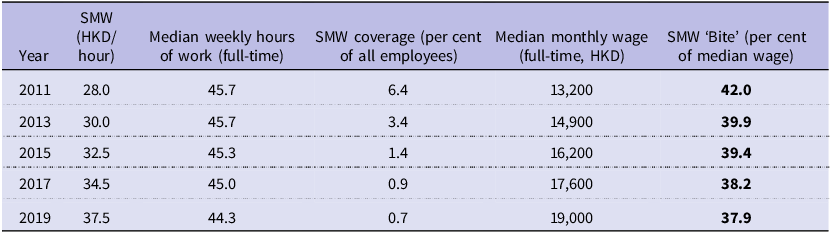
The practical outcome of this institutional arrangement is visible in how the MWC has executed its statutory function. Officially, the MWC’s biennialFootnote 1 review is guided by an evidence-based approach, centred on the core statutory principle of maintaining an appropriate balance between the twin objectives of ‘forestalling excessively low wages’ and ‘minimising the loss of low-paid jobs’. In practice, however, this formal process settled into a pattern of intense political negotiation rather than technocratic calculation (Wong, Reference Wong2014). As detailed in Table 1, the outcome of these negotiations was a history of strictly incremental adjustments. While the nominal wage rose from HKD28 in 2011 to HKD37.5 in 2019, its real-world impact was systematically eroded. Using internationally standard measures based on full-time employees, Table 1 shows that the policy’s ‘bite’ – its level relative to the median wage – began at a modest 42.0 per cent in 2011 and quickly fell below the 40 per cent mark, declining steadily thereafter. Concurrently, the proportion of the labour force earning at the prevailing minimum wage level plummeted from an initial 6.4 per cent to just 0.7 per cent by 2019 (Minimum Wage Commission, 2020). This pattern of slow, incremental increases became a central fact in the ensuing political debate, interpreted by business groups as proof of policy success and by labour advocates as a sign of its fundamental failure.
The trajectory of Hong Kong’s SMW: diminishing coverage and bite, 2011–2019

Notes: SMW ‘Bite’ is the monthly equivalent of the SMW, calculated as (SMW Rate × Median Weekly Hours × 52/12), expressed as a percentage of the median monthly wage for full-time employees. SMW Coverage refers to the proportion of all employees earning at or below the prevailing SMW rate. Data are authors’ calculations based on reports from the Minimum Wage Commission (2020) and the Census and Statistics Department (2012).
These incremental adjustments fuel a polarised discourse structured directly by the MWC’s dual mandate. On one side, employer associations and business leaders consistently frame the debate in terms of economic survival, warning that any increase would trigger a ‘cost tsunami’ for labour-intensive small and medium-sized enterprises. Their core anxiety is not mass layoffs, but an inflationary ripple effect that would increase the entire wage bill (Au-yeung, Reference Au-Yeung2024). In doing so, they directly invoke one half of the MWC’s official remit: the need to ‘minimise the loss of low-paid jobs’. This acute local anxiety, however, contrasts with a broad international academic consensus that modest minimum wage increases typically have minimal to zero aggregate disemployment effects (Gopalan et al., Reference Gopalan, Hamilton, Kalda and Sovich2021; Manning, Reference Manning2021; Mansoor and O’Neill, Reference Mansoor and O’Neill2021). On the other side, labour unions and advocacy NGOs frame the SMW as a matter of fundamental dignity and social justice. They counter the economic risk narrative by highlighting in-work poverty, arguing that robust increases are necessary to achieve wage compression and ensure that economic growth is more equitably shared. Their arguments champion the other half of the MWC’s mandate: the need to ‘forestall excessively low wages’ (Tsang, Reference Tsang2023; The Standard, 2024).
Thus, the Hong Kong debate is defined by a marked divide between the business sector’s narrative of economic risk and the labour sector’s call for predistributive justice. Yet while the political debate centres on these economic effects, academic research in Hong Kong has largely focused elsewhere. For instance, studies have explored the SMW’s social implications, such as its positive effect on preventing suicides (Rath et al., Reference Rath, Lau and Schooling2022) or its initial boost to family income, which was quickly eroded by inflation (Lau and Wong, Reference Lau and Wong2018). A comprehensive empirical study systematically testing the core economic claims – underemployment, working hours, and wage spillovers – that dominate local policy-making discourse has been lacking. This article addresses this research gap, providing a rigorous empirical adjudication of the central claims that animate Hong Kong’s vital minimum wage debate.
Hypotheses
Drawing on the political and institutional landscape detailed above, this article empirically adjudicates the core claims that define the SMW debate. By systematically testing the competing narratives of economic harm versus social justice, this study aims to move the discourse beyond political rhetoric toward evidence-based evaluation. We examine impacts on two distinct affected groups – those that are the most disadvantaged and less disadvantaged relative to an unaffected control group – to capture both direct and spillover dynamics.
Hypotheses on employment effects: underemployment and working hours
The first set of hypotheses addresses the most prominent claim made by business elites: that the SMW adversely affects low-paid workers by reducing their employment opportunities. Orthodox economic theory posits that a mandated price floor on labour will lead firms to reduce demand for it, potentially increasing unemployment (Neumark and Shirley, Reference Neumark and Shirley2022). In highly flexible labour markets, however, firms often make adjustments along the intensive margin (reducing hours) or compositional margin (shifting toward involuntary part-time work) rather than through outright dismissals. Consequently, while major international studies find minimal effects on aggregate unemployment (Cengiz et al., Reference Cengiz, Dube, Lindner and Zipperer2019), fears of increased underemployment and reduced working hours are acute in Hong Kong (Au-yeung, Reference Au-Yeung2024). Local academic research suggesting that the SMW may have induced such shifts for vulnerable groups (Wong and Ye, Reference Wong and Ye2012; Lau and Wong, Reference Lau and Wong2018) lends credence to these concerns. We therefore test these claims directly for both the most and less disadvantaged groups.
Hypothesis 1a: SMW increases raise the rate of underemployment for the most disadvantaged group of workers compared with the control group.
Hypothesis 1b: SMW increases raise the rate of underemployment for the less disadvantaged group of workers compared with the control group.
Hypothesis 2a: SMW increases reduce the weekly working hours of the most disadvantaged group of workers compared with the control group.
Hypothesis 2b: SMW increases reduce the weekly working hours of the less disadvantaged group of workers compared with the control group.
Hypotheses on wage effects: direct gains and spillover dynamics
The second set of hypotheses concerns the dual-edged nature of wage effects. The primary objective of the SMW is to raise the earnings of the lowest-paid workers. The countervailing concern for employers is the potential for these wage gains to spill over to workers higher up the pay scale – the ripple effect. International evidence confirms that the SMW can indeed generate such spillovers, which are often seen as a powerful tool for reducing overall wage inequality (Autor et al., Reference Autor, Manning and Smith2016; Gopalan et al., Reference Gopalan, Hamilton, Kalda and Sovich2021). In Hong Kong, this ripple effect is framed almost exclusively as an inflationary threat to business viability. Our research design allows us to simultaneously test for both the intended wage gains at the bottom and the feared wage spillovers just above it. To ensure the validity of our findings against potential sample composition effects, these hypotheses are tested on the full sample and further validated through a targeted robustness check on a restricted occupational sample.
Hypothesis 3a: SMW increases raise the hourly wage of the most disadvantaged group of workers compared with the control group.
Hypothesis 3b: SMW increases raise the hourly wage of the less disadvantaged group of workers compared with the control group, providing evidence of a wage spillover effect.
Method
This study uses data from the GHS, a repeated cross-sectional survey collected quarterly by the Hong Kong Census and Statistics Department. The GHS provides comprehensive information on the labour force and the demographic and socioeconomic characteristics of the population (Census and Statistics Department, 2024). Given the cross-sectional nature of the GHS, we adopt a pseudo-panel approach by constructing fixed industry-occupation cells, which is a standard method for estimating policy effects in the absence of longitudinal data, allowing us to track group-level outcomes across survey waves. Our analysis uses GHS data from 2011 to 2019, excluding unemployed respondents and foreign domestic helpers.Footnote 2
Our analysis is conducted in two stages.
Stage 1: Full Sample Analysis for Direct and Spillover Effects. Our main analysis examines the entire labour force to test for direct and spillover effects. The first step is to define our analytical groups. We pool GHS data from the two-year period preceding each SMW adjustment and calculate the proportion of workers within each industry-occupation cell earning below the new threshold. The cells are then categorised as follows: (1) control group (0 per cent of workers below the threshold), (2) less disadvantaged group (less than 10 per cent of workers below the threshold), and (3) most disadvantaged group (10 per cent or more of workers below the threshold).Footnote 3 This three-group design is crucial for identifying the direct wage effect on the most affected workers from the indirect spillover effect on those just above the new wage floor. This method is applied to define the control and treatment categories for all five policy adjustments, as detailed in Appendix Figure A1.
The second step is the construction of our pre-post analytical sample. Because each SMW increase took effect on May 1, we pool GHS data from the quarter immediately preceding the change (Q1, January–March) and the quarter immediately following its full implementation (Q3, July–September). This pre-post design, with fixed group definitions determined ex ante,Footnote 4 creates the necessary structure for our DID estimation.
Stage 2: Robustness Check on a Restricted Sample. To confirm the validity of our main findings, we conduct two key robustness checks. First, to ensure that our results are not biased by the inclusion of high-status occupations, we re-estimate the models on a restricted sample that excludes managers, administrators, professionals, and associate professionals. This design isolates wage dynamics among workers who are more likely to be influenced by the SMW. For this analysis, we compare a single treatment group (defined as industry-occupation cells where 10 per cent or more of workers earned below the new SMW threshold) to a combined control group (cells where the proportion was less than 10 per cent).Footnote 5 This allows us to test whether the primary effects on employment and wages for the most disadvantaged group hold true within the non-managerial workforce.
Second, to directly address the critical claim that adverse employment effects are most likely to appear in the sectors most heavily impacted, we conduct a supplementary within-industry analysis of underemployment. This analysis, which focuses on the three most low-wage-intensive industries – food services, real estate, and retail trade – serves as a targeted robustness check of our main employment findings. It is detailed in Appendix Table A1.
For all stages, we use the DID method. Our primary estimating equation is as follows:
 $$y = \alpha + {\beta _1}treatmentgroup + {\beta _2}quarter + {\beta _3}\left( {treatmentgroup*quarter} \right) + {\beta _{4\;}}controls + \varepsilon $$
where
 $y$
represents the outcome variable in the model: the probability of underemployment, working hours, and log hourly wage;
 $treatmentgroup$
varies depending on the classifications of the key independent variable; and
 ${\beta _2}$
refers to the time of adjusting the minimum wage. The main interest of this analysis is the coefficient
 ${\beta _3}$
, which captures the differential impact of the SMW adjustment on the respective treatment group.
Our analysis uses three dependent variables to test the core claims of the policy debate. Underemployment is a binary variable (yes = one, no = zero) based on the official GHS definition.Footnote 6 Working hours is a continuous variable measuring the total hours worked per week. Log hourly wage is the natural logarithm of an individual’s hourly wage, used to test for both direct wage gains and potential spillovers.
The analysis also includes a standard set of control variables to account for demographic characteristics associated with labour market outcomes. These are age (three categories: fifteen to thirty-four, thirty-five to fifty-four, and fifty-five or above), gender (binary; female = one, male = zero), marital status (binary; currently married = one, otherwise = zero), and education level (three categories: junior high and below, senior high, and tertiary education).
Results
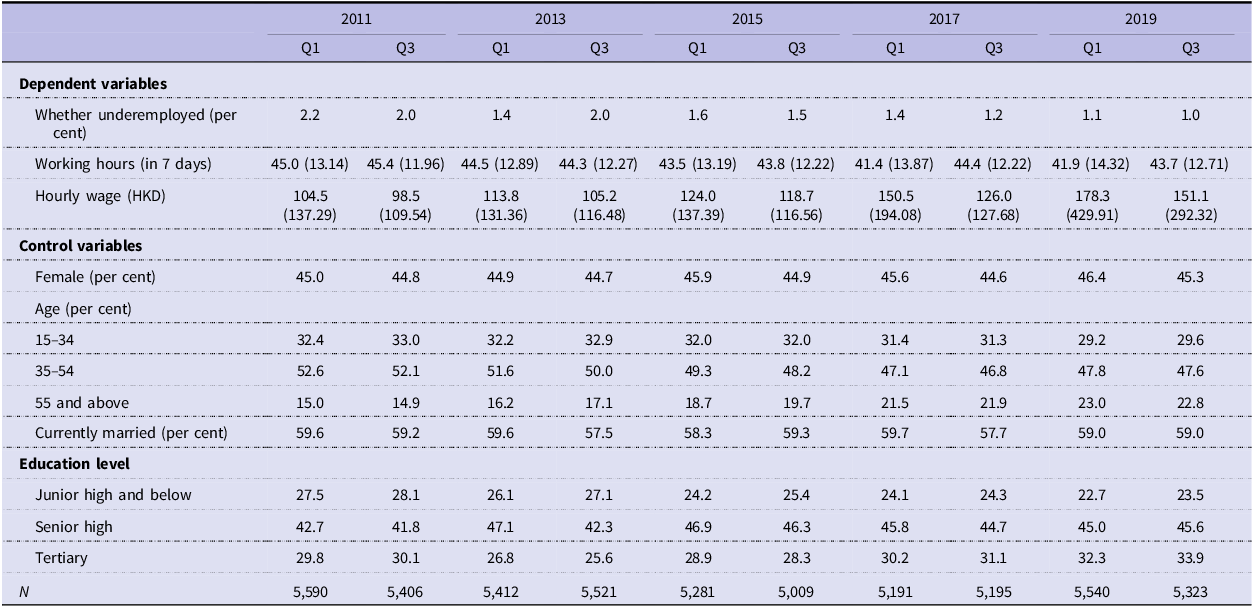
Before presenting our DID analysis, we first describe the raw pre–post changes for each of the five SMW adjustment periods. Table 2 presents the descriptive statistics for all of the key variables in the quarter immediately preceding each adjustment (Q1) and the quarter immediately following it (Q3).Footnote 7
Descriptive statistics for selected variables from GHS 2011–2019, full sample

Notes: Standard deviations are in parentheses.
These simple pre–post comparisons reveal inconsistent and sometimes counterintuitive patterns. For instance, while the underemployment rate generally decreased or stayed stable between Q1 and Q3, it increased notably in 2013. Similarly, average working hours did not show a consistent pattern of decline between the pre- and post-adjustment quarters. The hourly wage data also show fluctuations that do not align neatly with the policy changes, likely influenced by broader economic trends and seasonal variations within each year. The demographic data show a stable workforce, with the largest group of employees aged thirty-five to fifty-four and a steady increase in the proportion with tertiary education over the period.
These raw comparisons highlight the difficulty of isolating the SMW’s true impact from other concurrent factors. A more rigorous method is therefore required to disentangle the policy impact from underlying trends. We now turn to the results of our DID analysis.
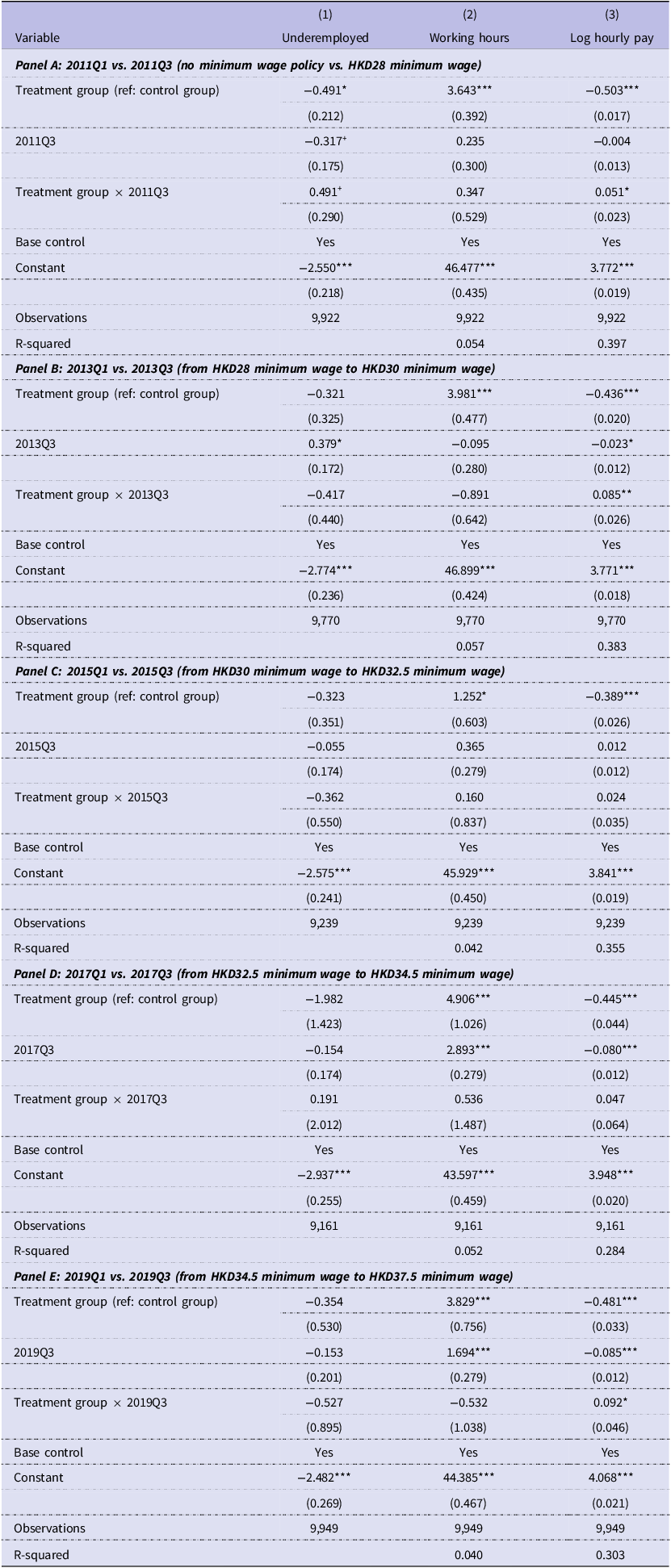
Table 3 presents the DID estimation results for the full labour force, revealing a clear distinction between the policy’s employment and wage impacts and thereby allowing direct adjudication of the central claims in the local policy debate.
DID estimation of the adjustment of minimum wage and labour market outcomes, GHS 2011–2019, full sample

Notes: Control group = no minimum wage earner; treatment group one = less than 10 per cent earn the minimum wage (less disadvantaged group); treatment group two = 10 per cent or more earn the minimum wage (the most disadvantaged group). Base control variables are sex, age group, marital status, and education level. Standard errors are in parentheses. *** p < 0.001, ** p < 0.01, * p < 0.05, + p < 0.1.
Regarding employment outcomes, the results refute the narrative of economic harm. As shown in Panels A through E of Table 3, across all five adjustment periods, we find no statistically significant increase in underemployment or reduction in working hours for either the most disadvantaged or the less disadvantaged group. The consistent and insignificant coefficients provide no support to the hypotheses of adverse employment impacts (H1a, H1b, H2a, and H2b).
The policy’s wage impacts show a more complex pattern. The initial 2011 enactment (at HKD28) and the 2013 adjustment (from HKD28 to HKD30) both produced significant increases in the log hourly wage exclusively for the most disadvantaged group (Panels A and B). This supports H3a, demonstrating a targeted wage lift for the intended beneficiaries. However, this positive wage impact vanished during the 2015 and 2017 adjustments, with no significant wage gains for any affected group (Panels C and D), indicating a period of policy ineffectiveness. The wage-lifting impact for the most disadvantaged re-emerged following the 2019 adjustment (Panel E), which is somewhat surprising because the policy’s economic ‘bite’ – its value relative to the median wage – was very low that year (even lower than in 2015 and 2017). We suspect this may be related to that year’s social protests. As Chen (Reference Chen2020: 59) notes, the unrest ‘disrupted social stability, transportation and commerce’, causing severe damage to low-wage retail and tourism sectors. Such an exogenous shock may have made the minimum wage adjustment protective to the most disadvantaged group.
Regarding the ‘ripple effect’ debate, we find no evidence of significant wage spillovers across all five periods. The log hourly wage for the less disadvantaged group did not increase significantly relative to the control group, lending no support to H3b.
One might suspect that our findings could be influenced by the inclusion of high-status occupations, so we re-estimate the models using a restricted sample of the non-managerial workforce. We focus exclusively on the non-managerial workforce – where the impacts of the minimum wage should be most apparent – and compare a single treatment group of highly affected workers to an appropriate control group. The results of this analysis, presented in Table 4, confirm the robustness of our full-sample findings.
DID estimation of the adjustment of minimum wage and labour market outcomes, GHS 2011–2019, restricted sample

Notes: Control group = no minimum wage earners or less than 10 per cent earn the minimum wage (less disadvantaged group); treatment group = 10 per cent or more earn the minimum wage (the most disadvantaged group). Base control variables are sex, age group, marital status, and education level. Standard errors are in parentheses. *** p < 0.001, ** p < 0.01, * p < 0.05, + p < 0.1.
First, they reinforce the absence of adverse employment impacts. Across all five adjustment periods, we find no statistically significant increase in underemployment or reduction in working hours for the treatment group. This confirms that there is no employment harm for workers directly affected.
Second, the specific pattern of wage effects was replicated: the treatment group experienced significant wage gains following the adjustments in 2011, 2013, and 2019, but not in 2015 or 2017.
Finally, a supplementary analysis of underemployment in the three low-wage-intensive industries (i.e., food services, real estate, and retail trade) directly addresses concerns about concentrated employment harm. As shown in Appendix Table A1, the results are unequivocal: even within these most vulnerable sectors, we find no statistically significant increase in the probability of underemployment for low-wage workers following any of the five SMW adjustments. This suggests that within the industries most exposed to the policy, the feared negative employment consequences did not materialise.
In summary, our analyses of both the full and restricted samples yield three consistent findings. First, across all five minimum wage adjustments, we find no statistically significant evidence of increased underemployment or reduced working hours. Second, the policy produced significant wage gains for the most disadvantaged group, but only intermittently (in three of the five periods). Third, our empirical results do not provide any evidence of the feared wage spillovers.
Discussion and conclusion
There has been debate over whether raising the minimum wage would increase underemployment, reduce working hours, and have a ripple effect on wages in Hong Kong. Since the implementation of the SMW in 2011, the policy’s real-world ‘bite’ relative to the median wage has dropped from a modest 42.0 per cent to just 37.9 per cent in 2019 (as shown in Table 1). This occurred amid a steady rise in the median monthly wage over the years. Concerns about the possible negative effects of increasing SMW may be one reason why its growth lagged behind the overall labour market in the city.
Against this context, this study adjudicates the contested effects of Hong Kong’s SMW across its formative decade. Our study aims to provide a more nuanced perspective on the polarised narratives that dominate the local policy discourse, offering an evidence-based assessment of the core areas of contention: adverse employment impacts, wage gains, and inflationary spillovers.
Using the Hong Kong General Household Survey data (2011–2019), we assess five SMW adjustment cycles and find no evidence that raising the minimum wage led to increased underemployment or fewer working hours. This finding reinforces the growing international consensus that modest minimum wage increases do not carry the employment costs that orthodox economic models predict (Bossler and Gerner, Reference Bossler and Gerner2020; Neumark and Shirley, Reference Neumark and Shirley2022). This finding challenges the narrative that Hong Kong’s hyper-flexible labour market is vulnerable to policy interventions. Our results align with prior local research suggesting that employment patterns were not significantly altered (e.g., Lau and Wong, Reference Lau and Wong2018).
Furthermore, our analysis does not lend support to the ripple effect hypothesis. The widely feared inflationary spillovers do not appear to have materialised, as the policy’s wage impact was largely contained within its target group. This finding contradicts the primary narrative used by employers to resist more meaningful increases.
Our research makes two primary contributions to social policy scholarship. First, regarding the political economy of welfare, our study illustrates how rigorous empirical analysis can help reframe a seemingly economic debate as a political one. By showing that the proclaimed economic risks did not materialise to the extent feared, our findings challenge the official justification for the SMW’s cautious trajectory. This points toward a political logic distinct from those dominant in the literature, which explain the revival of minimum wages through democratic electoral competition (Cova, Reference Cova2023) or as a substitute for declining collective bargaining (Kozák and Picot, Reference Kozák and Picot2025). Instead, Hong Kong’s experience points to a logic of authoritarian legitimation. Consistent with theories of East Asian productivist welfare capitalism (Holliday, Reference Holliday2000, Reference Holliday2005), our analysis shows that the SMW’s implementation was shaped by a logic geared toward managing social discontent and accommodating business interests, with substantive labour empowerment appearing to be a secondary consideration.
Second, regarding social policy practice, our findings suggest the potential existence of an untapped policy space for non-disruptive wage uprating in Hong Kong. By showing that a decade of adjustments did not appear to trigger underemployment effects, our study implies a potential for more assertive policy adjustments, although the precise scope of such a space remains an open question for future research. This encourages a shift in the central policy question from whether the minimum wage should be raised to how much it must be raised to effectively achieve its social objectives.
This reinterpretation has important implications for policy design. It requires seeing the SMW not as an isolated tool, but as a foundational component of a broader institutional ensemble supporting low-income households (Marchal, Reference Marchal2020; Mansoor and O’Neill, Reference Mansoor and O’Neill2021). Complementary policies, such as Hong Kong’s Working Family Allowance, risk becoming indirect subsidies to low-paying employers if they are not built on an adequate and regularly increased wage floor (Au-Yeung, Reference Au-Yeung2023). Without a robust SMW, such in-work benefits can inadvertently institutionalise a low-pay equilibrium rather than providing a genuine pathway out of poverty. A key task, therefore, appears to be the creation of a coherent strategy: first, by recalibrating the SMW to have a meaningful and consistent ‘bite’ within the potential policy space whose existence our analysis has suggested, and second, by strengthening its integration with the wider social security system to create a robust safety net for Hong Kong’s working poor.
In conclusion, Hong Kong’s experience with the SMW appears to have been shaped less by a difficult economic trade-off and more by a political choice of incrementalism that may have blunted the policy’s potential. The key risk highlighted by this decade of policy is perhaps not economic disruption, but that of policy irrelevance. This underscores the need for a critical re-evaluation of the SMW’s calibration, moving the debate beyond disproven fears toward an evidence-based strategy for achieving its core social objectives.
Supplementary material
The supplementary material for this article can be found at https://doi.org/10.1017/S1474746425101127.
Acknowledgements
The authors acknowledge the funding support received from Oxfam Hong Kong, Youth Employment and Poverty Project, Lingnan University; Guangzhou Municipal Science and Technology Bureau (Guangzhou Basic and Applied Basic Research Scheme, No. 2024A04J6375 and No. 2025A03J3490), and the State Administration of Foreign Experts Affairs, Ministry of Science and Technology, China (High-end Foreign Experts Project, No. G2023030045L). The authors would also like to thank the three anonymous reviewers for their comments and suggestions on this article and Dr. Duoduo Xu for providing access to the HKGHS data.
Competing interests
The authors report that there are no competing interests to declare.