INTRODUCTION
The jawfish family Opistognathidae (Perciformes: Teleostei) comprises 81 species world-wide, recognized under three genera, Lonchopisthus Gill, Opistognathus Cuvier, and Stalix Jordan and Snyder (Nelson, Reference Nelson2006; Eschmeyer, Reference Eschmeyer2012). The genus Opistognathus is represented by 65 recognized species and, probably, many undescribed species in the world (Smith-Vaniz, Reference Smith-Vaniz2011; Eschmeyer, Reference Eschmeyer2012; Froese & Pauly, Reference Froese and Pauly2012). Of the known species 14 are from Atlantic Ocean, 11 from the eastern Pacific and the remainder from the Indo-Pacific region. Ten species occur in the western Indian Ocean (Smith-Vaniz, Reference Smith-Vaniz2010) but only 5, viz., O. albicaudatus Smith-Vaniz, O. annulatus (Eibl-Eibesfeldt and Klausewitz), O. cyanospilotus Smith-Vaniz, O. nigromarginatus Rüppell, and O. rosenbergii Bleeker, are known from Indian waters (Smith-Vaniz, Reference Smith-Vaniz2009, Reference Smith-Vaniz2011). Another species, O. variabilis Smith-Vaniz, occurs in the eastern Indian Ocean but is yet to be reported from the Indian coast. All of these five species are known from the Andaman and Nicobar Islands. However, only two species, viz., O. nigromarginatus and O. rosenbergii have previously been recorded from the east coast of India.
Jawfishes constitute an interesting group of fishes well known for their typical ecological and behavioural adaptations. They are reported to have limited dispersal capabilities and a high level of regional endemism (Smith-Vaniz, Reference Smith-Vaniz2004). They are obligatory burrow-dwelling fishes. They construct and maintain the burrow with their wide mouth and enter the burrow tail first. Males usually incubate their eggs orally. This peculiar habit and behaviour makes them difficult to find and capture (Smith-Vaniz, Reference Smith-Vaniz2011).
During a study of the ichthyofaunal diversity of the coastal waters near and around Kalpakkam, the authors came across an interesting specimen belonging to the genus Opistognathus. The specimen (64 mm standard length (SL)) was later identified as Opistognathus macrolepis (Peters, Reference Peters1866) and is reported herein as the first record from the Indian Ocean.
MATERIALS AND METHODS
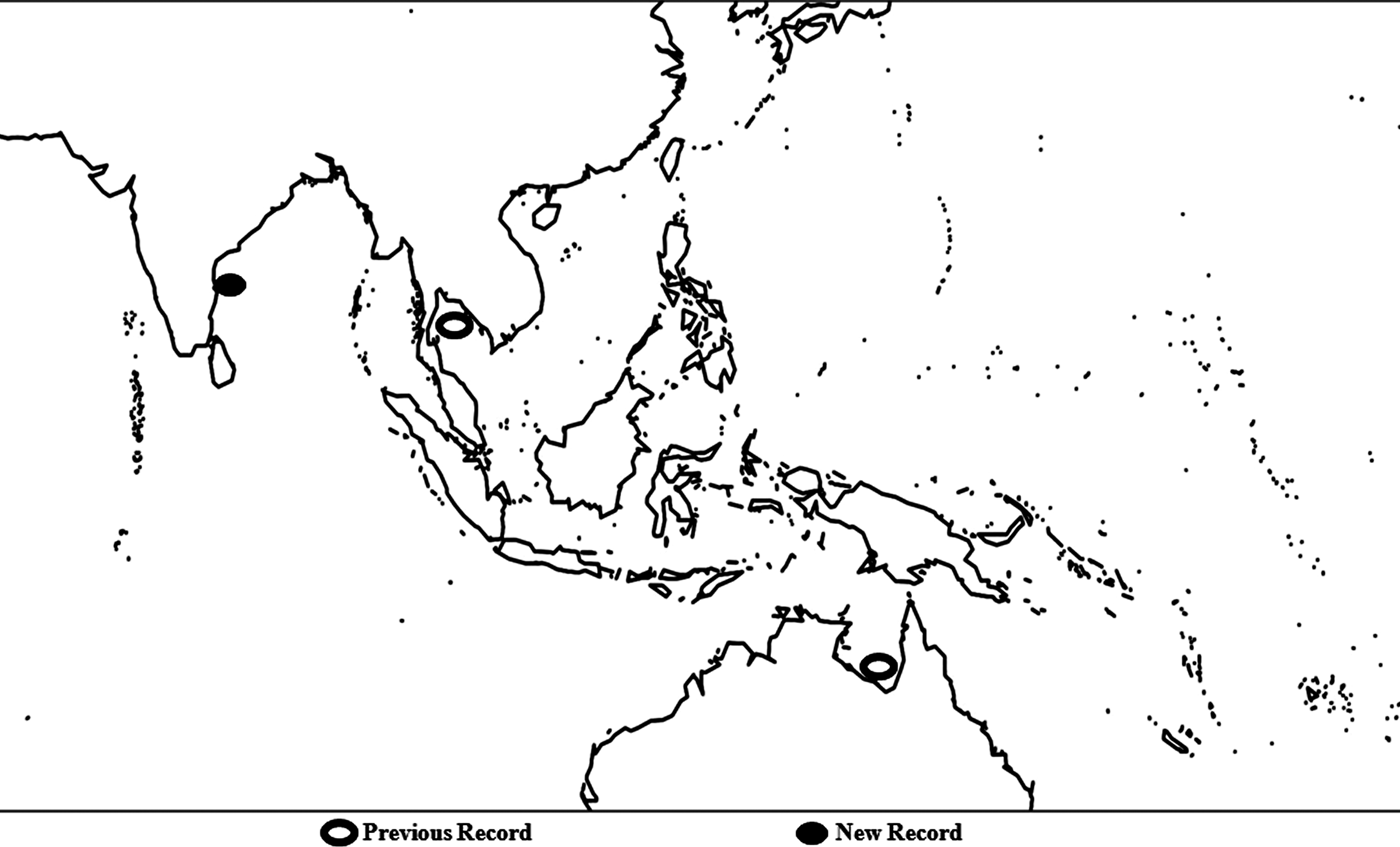
The specimen was caught in the seawater screening system of the pump house of the cooling water system of Madras Atomic Power Station (MAPS) located at Kalpakkam (12°33′N 80°11′E), on the east coast of India (Figure 1) during July 2008. MAPS usually utilizes seawater as the condenser cooling fluid. The water is drawn at a rate of 35 m3 s−1, through a sub-sea bed tunnel, located 53 m below the sea bed. The sub-surface seawater enters at the intake point, located 420 m away from the shore, passes through the tunnel (468 m long and 3.8 m diameter) and reaches the forebay. At this forebay, the pump house, seawater is pumped through travelling water screens (with mesh 1 × 1 cm) to remove macro-organisms and particles, before entering the condensers and other auxiliary cooling systems. Sieved materials are carried vertically upward by the travelling screens. The specimen is deposited with the Zoological Survey of India, Kolkata with catalogue number ZSI F-10576/2. All measurements and counts are from Smith-Vaniz (Reference Smith-Vaniz1997).
Distributional map of Opistognathus macrolepis.

RESULTS
Opistognathus macrolepis Peters, Reference Peters1866
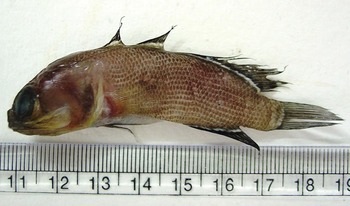
(bigscale jawfish) (Figure 2)
Opistognathus macrolepis Peters, Reference Peters1866, Monatsbericht der Koniglich Preussischen Akademie der Wissenschaften zu Berlin: 520 (Bangkok, Tailand).
Opistognathus macrolepis, from Kalpakkam, Tamil Nadu, India.

Body small, moderately elongate and tapering posteriorly. Head bulbous, large. Eyes large; interorbital space narrow. Mouth large; maxilla long, extending well behind orbit. Posterior end of maxilla broad and truncate, its depth 20% of head length; not produced as a thin flexible lamina. Jaws subequal, lower slightly included. Both jaws with an outer row of enlarged conical teeth, relatively straight with blunt tips and slanting forward anteriorly; 1 or 2 irregular rows of much smaller inner teeth present anteriorly, those adjacent to premaxillary symphysis slightly enlarged and curved posteriorly; no teeth on vomer. Gill rakers on first arch slender, 10 on upper arch and 20 on lower arch. Upper margin of opercle straight and slightly rounded posterodorsally; posterior margin of preopercle distinct, with a free margin. Dorsal fin spines slender and rigid, without flexible tips. Dorsal fin spines XI and rays 12; anal fin spines II and rays 10; pectoral fin rays 21. Pelvic fin with I spine and 5 segmented rays; outer 2 rays unbranched and stout, positioned anterior to pectoral fin base. Caudal fin rounded, segmented rays 16, middle 12 branched. Lateral line (LL) incomplete, running close to dorsal fin; lateral-line tubes extend posteriorly to about 30th longitudinal scale rows; terminating below 11th dorsal-fin spine. Body scaly from behind head; nape naked anterior to dorsal-fin origin, with two to three rows of scales above LL anteriorly. Scales cycloid; longitudinal series with about 50 oblique scale rows; 20 scale rows on lateral transverse series below lateral line to anal fin origin. Scales around caudal peduncle 20.
Measurements of the specimen as percentage of SL: predorsal length 35.2; preanal length 60.2; dorsal-fin base 63.3; anal-fin base 25.6; pelvic-fin length 22.8; caudal-fin length 28.1; depth at anal-fin origin 24.2; head length 37.5; eye diameter 10.9; upper jaw length 23.4; caudal peduncle depth 11.4. As percentage of head length: postorbital head length 62.1; upper jaw length 62.5; postorbital jaw length 25.0; eye diameter 29.2; interorbital width 7.5.
COLOUR
Body mostly brownish in colour with yellowish tinge on body and pinkish tinge on head. Middle of each scale darker, forming almost continuous lines along scale rows. Soft dorsal and anal fins mostly dark, with a narrow pale basal stripe. No ocellus on spinous dorsal fin; no dark blotch on opercle; no dark bar on chin. Caudal and pelvic fins blackish.
DISTRIBUTION
Indo-west Pacific, from east coast of India to Gulf of Thailand and Gulf of Carpentaria, Australia.
DISCUSSION
Among the eastern Indian Ocean species of Opistognathus, viz., O. albicaudatus, O. nigromarginatus and O. variabilis, can be distinguished in having an elongate supramaxilla and maxilla produced as a thin flexible lamina that extends to or beyond posterior margin of opercle. Other three species, viz, O. annulatus, O. cyanospilotus and O. rosenbergii, have truncated or bluntly rounded upper jaw ends, with the maxilla either rigid or with only a slight flexible lamina posteriorly. Opistognathus macrolepis is more similar to O. rosenbergii, one of the jawfishes well distributed along the east coast of India. It has closer affinity, but differs in having smaller scales, more dorsal fin elements, more anal fin rays, more gill rakers and different colour pattern (Figure 3).
Opistognathus rosenbergii, collected from Kalpakkam, Tamil Nadu, India.

Opistognathus macrolepis was previously known only from the Gulf of Thailand and the Gulf of Carpentaria in Australia (Monkolprasit, Reference Monkolprasit, Sontirat, Vimollohakarn and Songsirikul1997; Smith-Vaniz, Reference Smith-Vaniz2004; Hoese et al., Reference Hoese, Bray, Paxton, Allen, Beasley and Wells2006). The present report documents the first record of O. macrolepis from the Indian Ocean along the east coast of India, a range-extension westward to India. Given the accidental collection of the specimen, this distributional record can only be explained as due to the virtually under-explored bottom fauna in the Bay of Bengal. Further, the habitat and behaviour of this species makes it difficult to observe and capture.
It is important to note that the occurrence of two eels, Brachysomophis cirrhocheilos Bleeker (Biswas et al., Reference Biswas, Mishra, Satapathy and Selvanayagam2010), and Heteroconger tomberua Castle & Randall (Biswas et al., Reference Biswas, Mishra, Satpathy, Das, Selvanayagam and Nayak2012), and a toadfish Torquigener brevipinnis (Biswas et al., Reference Biswas, Mishra, Satpathy and Selvanayagam2011), have been reported from the same collection site. If attempts are made to study the discards of deep-sea trawlers and to explore the near shore deep waters of India with the help of advanced methods and diving, much more information on its biodiversity is likely.
ACKNOWLEDGEMENTS
The first, third and fourth authors are grateful to the Director, IGCAR and the Station Director, MAPS for encouragement and permission. The second author is thankful to Sri K.C. Gopi, Scientist-E, Fish Division and Dr K. Venkataraman, Director, Zoological Survey of India, Kolkata for permission and encouragement. The authors thank Dr W.F. Smith-Vaniz for his kind co-operation in identification and material support.