

INTRODUCTION
Many studies previously performed on environmental impacts of land cover change in the Amazon have focused on simulating the substitution of native forests by pastures, a practice which predominated from the 1970s to the 1990s. Many of these studies have indicated important changes in the regional climate of the Amazon in response to alterations caused by biosphere-atmosphere interactions, such as increase in air temperature and surface albedo and decrease in evapotranspiration (Costa and Foley, Reference Costa and Foley2000; Dickinson and Henderson-Sellers, Reference Dickinson and Henderson-Sellers1988; Nobre et al., Reference Nobre, Sellers and Shukla1991; Randow et al., Reference Randow, Manzi, Kruijt, Oliveira, Zanchi, Silva, Hodnett, Gash, Elbers and Waterloo2004).
In the case where forest is substituted by pastures in the Amazon, the seasonal impacts encountered are the order of +44% and +28% for sensible heat flux and −21% and −42% in latent heat flux during the rainy and dry seasons, respectively (Randow et al., Reference Randow, Manzi, Kruijt, Oliveira, Zanchi, Silva, Hodnett, Gash, Elbers and Waterloo2004).
In recent years, however, the expansion of the agricultural frontier in the Amazon, with soyabean monoculture as the principal activity, has caused concern due to possible environmental impacts (Simon and Garagorry, Reference Simon and Garagorry2005). The transition from forest coverage to soyabean crops and the reuse of pasture areas for soyabean crops causes drastic environmental changes compared to the historic use of the Amazon territory, changes which are associated with architectural changes in the soyabeans during their growth season (Souza et al., Reference Souza, Rocha, Ribero, Loureiro and Bispo2008).
Despite the diverse social-environmental problems generated, expansion of this crop to low latitude regions arose as a strategy to meet the food demands of a growing population, and more recently, the increasing demand for biofuels. Low economic profitability of pastures in the region has contributed to the pressure for land use change for agricultural purposes.
There are very few studies on the impacts caused by change of land use from forest to agricultural use in the Amazon, especially in the case of soyabeans (Souza et al., Reference Souza, Rocha, Ribero, Loureiro and Bispo2008). Utilizing global models, Costa et al. (Reference Costa, Yanagy, Ponte De Souza, Ribeiro and Rocha2007) and Sampaio et al. (Reference Sampaio, Nobre, Costa, Satyamurt, Soares-Filho and Cardoso2007) simulated possible impacts of the expansion of soyabean on the Amazon climate and they verified a possible reduction in precipitation of the region. However, these results were not conclusive since few variables for parameterization were used in the model (albedo and leaf area index) and impacts generated during the period between growing seasons were not considered.
Furthermore, there is a need to use in such models, more realistic scenarios and characteristics of the physical processes observed in soyabean ecosystems as well as those observed during the off-season. According to Cohen et al. (Reference Cohen, Beltrão, Gandu and Silva2007), the principal problem of general circulation and mesoscale models is that they do not consider this dynamic over time, which compromises the accuracy of the simulated results.
According to Fearnside (Reference Fearnside2006), there are three basic groups of environmental services provided by forest maintenance that justify the preservation of its area: biodiversity, water cycling and carbon storage. A large amount of rain is generated from local recycling of water vapour through evapotranspiration and associated convection in the Amazon forest, which generates 50–60% of rainfall; the rest is the result of water vapour advection from the Atlantic Ocean by the northeast trade winds (Salati, Reference Salati1978). When tropical deforestation occurs it is expected that there will be a reduction in the ability of the surface to maintain an elevated rate of evapotranspiration (Costa and Foley, Reference Costa and Foley2000). Sampaio et al. (Reference Sampaio, Nobre, Costa, Satyamurt, Soares-Filho and Cardoso2007) found a strong reduction in the evapotranspiration of the surface after replacing forest with soyabean, with impacts ranging from −5.6 to −31.2% according to the deforested fraction adopted.
Tropical forests play an important role in the carbon cycle, functioning as atmospheric carbon sinks. In the case of the Caxiuanã Forest situated in the eastern portion of the Amazon, it has been shown that the net ecosystem exchange (NEE) was −10.9 × 10³ tC ha−1yr−1, with roughly 20–30% of carbon being fixed in the soil (Malhi et al., Reference Malhi, Aragão, Metcalfe, Paiva, Quesada, Almeida, Anderson, Brando, Chambers, Costa, Hutyra, Oliveira, Patiño, Pyle, Robertson and Teixeira2009). Even with no-till techniques, soyabean crops present low efficiency in sequestering atmospheric carbon (Bernacchi et al., Reference Bernacchi, Hollinger and Meyers2005). Despite increasing NEE, relative to average productivity in the region, the quantity of carbon removed from the field in the form of grain (Cg) will account for a majority of the carbon sink in this ecosystem, generating an average biome production (NEE + Cg) of + 0.938 tC ha−1yr−1, i.e. a net carbon emitter (Bernacchi et al., Reference Bernacchi, Hollinger and Meyers2005).
During the past decade, deforestation in the Brazilian Amazonia released around 200 millions of tC yr−1 (Houghton, Reference Houghton, Moutinho and Schwartzman2005). From the total deforested land in the legal Amazon over 1961–2003, 6% remains as cropland and 62% as pasture (Ramankutty et al., Reference Ramankutty, Gibbs, Achard, Defries, Foley and Houghton2007). According to these authors the estimation of total carbon emissions from this deforested area is between 0.22 and 0.37 GtC yr−1 depending whether it is taken in to account that almost 32% of the deforested land is covered by regrowing vegetation. Considering the historical rate of deforestation in the Amazon, together with the acceleration of the paving of its highways, more than 50% of the original forest cover in the Brazilian Amazon would be lost by around 2030, representing an annual deforestation rate of 40 000 km2 (Soares Filho et al., Reference Soares-Filho, Nepstad, Curran, Cerqueira, Garcia, Ramos, Lefebvre, Schlesinger, Voll and Mcgrath2005). According to Soares Filho et al. (Reference Soares-Filho, Nepstad, Curran, Cerqueira, Garcia, Ramos, Voll, McDonald, Lefebvre and Schlesinger2006), 40% deforestation of the Amazon basin would release 32 billion tC into the atmosphere.
It is extremely important therefore to evaluate the possible impacts on the local energy balance of a change in Amazonian land use because this information will allow for a better understanding of how the local hydrological cycle and the local/regional climate will be affected by the expansion of soyabean cultivation. Thus, the objective of this study was to quantify the alterations in the components of the energy balance in an area of agricultural frontier expansion in the Amazon.
MATERIAL AND METHODS
The soyabean ecosystem
The experiment on the soyabean ecosystem (Glycine max) was conducted in 2006 and 2007 in the city of Paragominas, in the northeastern region of the state of Para, Brazil, where 200 ha were planted with soyabeans (lat. 02°59′08″S, long. 47°19′57″ W; 122 m asl). This site was selected as an area of large expansion of soyabean cultivation in the region. The total area of soyabean cultivation has increased from 1200 ha in 1998 to 14 200 ha in 2009.
A micrometeorological tower (3.0 m) was installed at the centre of the experimental area (Table 1). Sensors were connected to a CR10X datalogger (Campbell Scientific, Inc.) and an AM416 multiplexer (Campbell Scientific, Inc.). Measurements were taken every 10 sec during the experimental period, providing total and averages every 10 min. In the experimental area the existing fetch was greater than the ratio of 1:100 demanded for a good representation of the collected data. Soyabean development was evaluated daily according to the Fehr & Caviness scale (Souza et al., Reference Souza, Rocha, Ribero, Loureiro and Bispo2008). In the subdivision of soyabean phenology analysis, S means sowing date, and V and R means vegetative and reproductive stages, respectively.
List of instruments, heights and measurements of the automatic meteorological station used in the soyabean and forest experimental areas.

†Canopy height (≈35 m)
Forest ecosystem
Data covering the forest ecosystem were obtained at the Caxiuanã National Forest located in the central region of the state of Para in an area belonging to the Marajo Archipelago region (00°50′31″S; 46°38′56″W; 30 m asl). Average canopy height was 36 m. The same variables measured in the soyabean ecosystem were measured at a height of 54 m (Table 1). Data were collected between February and November in 2006 and 2007, with the non-growing season, corresponding to period between July and November in both years.
Energy balance
Components of the energy balance were obtained according to equation 1 below:

where Rn is the total radiation, components H, LE and G are the sensible, latent and soil heat fluxes, respectively.
Energy stored in the canopy was not considered in the energy balance because it represented relative importance only during the transition phases of the day (Moore and Fisch, Reference Moore and Fisch1986), being a maximum of 8% of the total radiation at the beginning of the day for soyabeans (Meyers and Hollinger, Reference Meyers and Hollinger2004). Advection energy could be considered negligible because the area of study (200 ha) was large enough for there to be no lateral advection of energy from other ecosystems; therefore a homogenous area was presented to the sensors (Gavilan and Berengena, Reference Gavilan and Berengena2007). The storage component of photosynthesis uses on average roughly 3% of total radiation and therefore was also disregarded (Pereira, Reference Pereira1998).
Components H and LE were obtained by means of the Bowen ratio technique (β), measured using the relationships of vertical transport of heat and water vapour, assuming that the turbulent transport coefficients (KH and KLE) are equal (Arya, Reference Arya1998).
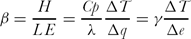

where λ is the latent heat of vapourization (J kg−1), Cp the specific heat of dry air (1013 J kg−1 °C−1), q the specific humidity, γ the psychometric coefficient, ΔT and Δe are the difference in air temperature and the vapour pressure between two levels, respectively.
To avoid problems associated with the effect of adjacent areas in the measurements, the instruments were installed with sufficient fetch of homogeneous land cover in the predominant wind direction (900–1000 m) following the required ratio of 1:100 height:fetch. The level of the sensors was altered frequently with crop growth in order to maintain the same profile interval (0.5–1–2 m) to guarantee that they remained within the equilibrium sublayer of the internal boundary layer (Rosenberg et al., Reference Rosenberg, Blad and Verma1983).
The methodology proposed by Perez et al. (Reference Perez, Castellvi, Ibañez and Rosell1999) was adopted to eliminate unreliable data from this method, i.e. an analytical method to determine consistency between components observed in the flow-gradient relationship and discarding data where β values were near −1. Student's t-test was used at a probability level of 5% to indicate significant differences between the averages of the two ecosystems.
RESULTS
Interannual variability exchange
Figure 1 shows the seasonal distribution of the energy balance components during two years at both experimental sites. Energy partition between the components (LE, H and G) in the forest ecosystem (Figure 1A) is clearly completely different from that observed in the soyabean area (Figure 1B). In the forest the highest energy consumption occurs as latent heat (64%). Around 34% of the available energy is used as sensible heat and very little directed to the ground. This default behavior does not seem to change seasonally either on an interannual scale even with the occurrence of an El Niño during the second year.
Seasonal distribution of energy balance components for the two years in the forest (A) and soyabean field (B).

In the soyabean ecosystem the seasonal effect was more pronounced than the interannual variability (Figure 1B). During the growing season, there was a much greater consumption of energy as latent heat, which was observed in both years of the experiment (87% in 2006 and 72% in 2007). It is possible to identify clearly the effect of ground cover in the distribution of energy to the ground as well as to air heating, as shown by seasonal variability throughout the year. Although there was not enough data during the off-season in 2006, it is likely that a pattern similar to that found in 2007 would have occurred even with the influence of the El Niño phenomenon.
These results suggest that greater variability in the partitioning of the available energy occurs on the seasonal scale, especially in soyabean ecosystems, and despite there being only two years of data available, it is possible to assume that, if really there is an interannual variability, this effect is small and should be studied in more detail with a database longer than two years. As in 2006 there was a major gap in the data, only the 2007 results will be discussed.
General meteorological conditions
The net radiation available in the forest was greater than that encountered in the soyabean fields for the majority of the days analysed, especially during the production off-season where this occurred 86% of the time (Figure 2A). During the soyabean growing season the occurrence of lower values of net radiation in comparison to the forest was less (75%). The cumulative difference of net radiation between ecosystems over the growing season (four months) reached 247 MJ m−2, which represents a mean reduction of −14.9% of the value normally found in forest ecosystems. On the other hand, during the off-season, the mean daily difference found between ecosystems was −2.33 MJ m−2, a slightly larger difference than that observed during the soyabean growing season (−2.03 MJ m−2).
Comparison between the daily averages of net radiation (A), air temperature (B), absolute humidity (C) and daily vapour pressure deficit (D) in the forest and soyabean field during the soyabean growing season and the period between growing seasons (off-season)

The two environments presented very distinct meteorological conditions, especially during the off-season, when the atmosphere above the soyabean field was always hotter and, for several days, drier (Figures 2B, 2C and 2D). The occurrence of days with higher humidity over soyabean during off-season is associated with the return of the rainy season in the region which occurs near the end of the year. On the other hand, during the growing season, despite a smaller variation in temperature and absolute humidity between the two environments, air above the soyabean ecosystem was still relatively hotter (Figure 2B) and with greater atmospheric demand (Figure 2D) for water vapour, besides higher absolute humidity.
The total rainfall in the forest during the growing period was nearly three times greater than that observed in the soyabean field, maintaining the atmosphere constantly cooler (Figure 3). However, the quantity of rain observed in the soyabeans (410 mm) did not significantly affect the conductance of the canopy for diffusion of vapour, maintaining the crop at adequate water availability levels (Costa, Reference Costa2008). During the period between growing seasons (off-season) the difference in rain totals was more drastic with few rainfall events in the agricultural ecosystem. This was an important controller of climatic conditions in this area and period of year.
Evolution of rainfall and albedo throughout the year in the soyabean field (A) and in the forest (B).

Energy balance components
Pronounced differences were noted in the energy balance during the soyabean production season, particularly in the off-season (Figure 4B). During the soyabean growing season a large portion of energy was consumed by latent heat with little directed to H. Daily peaks of 14 MJ m−2 in latent heat flux (LE) and maximal H of only 7 MJ m−2 were observed.
Average components of the energy balance in the forest (A) and soyabean field (B). Vertical bars represent standard errors.

As expected there was an abrupt change in the energy balance after soyabean harvest. During the off-season energy consumed by the latent heat rarely surpassed 2 MJ m−2, with the largest portion of energy consumed as sensible heat (maximum of 12 MJ m−2).
In the forest ecosystem, seasonality was much less accentuated, presenting daily LE peaks of roughly 12 MJm−2 during the period corresponding to the soyabean growing season and peaks of 11 MJm−2 in the off-season (Figure 4A). The absence of seasonal intensity is directly associated with the plant cover during the entire year, in contrast to the seasonal variation in the soyabean ecosystem.
Energy balance impacts
On average, during the soyabean growing season LE was increased by up to 11% and H was reduced by more than 40% in some of the soyabean growth phases (Figure 5). This was associated with the increased conductance of the soyabean canopy relative to that observed in the forest.
Mean daily impact on the components H and LE due to substituting soyabean fields for forests in the Amazon.

During the off-season, there was a reduction in the latent heat flux of nearly 80% compared to that normally observed in the forest. As a consequence, an increase in the energy consumed in the form of sensible heat was observed (+85%) (Table 2).
Mean daily impact on the components of the energy balance throughout the soyabean growth period in the Amazon.

% = (soyabean − forest)/forest. Values in parentheses represent estimated s.e. *: significant at 5% by the t−test; n.s.: non-significant.
Table 2 presents a general overview of the impact observed on the components of the energy balance by substitution of tropical forest by soyabeans. The reduction in latent heat flux during the growing season was not statistically significant (t-test, p < 0.05) because in some growth phases the energy consumption in the form of LE was greater than that observed in the forest.
DISCUSSION
General meteorological conditions
The reduced amount of net radiation found in the agricultural ecosystem compared to the native ecosystem was directly associated with the increase in the reflected component throughout the soyabean growing season (Souza et al., Reference Souza, Ribeiro, Rocha, Loureiro, Capela and Souza2007) as well as the greater loss by the surface of long wavelengths associated with the increase in LAI (Fontana et al., Reference Fontana, Berlato and Bergamashi1991). The difference in latitude between the locations was not sufficient to cause impacts on the measured variables compared to the observed differences in incident solar radiation (between 4 and 21%) caused by changes in cloudiness.
The main regulators of the difference in energy balance between the locations were directly associated with the rainfall regime and albedo of the surface (Figure 3). When considering the period corresponding to the entire soyabean growing season, there was an absolute mean increase of 0.096 in surface albedo (forest to soyabean), which represents a relative increase of 93% of the forest value, as a result of change in land use, which greatly contributed to the reduction in net radiation (Souza et al., Reference Souza, Rocha, Ribero, Loureiro and Bispo2008). Despite the forest showing a slight increase in albedo during the corresponding soyabean off-season period (Carswell et al., Reference Carswell, Costa, Palheta, Malhi, Meir, Costa, Ruivo, Leal, Costa, Clement and Grace2002), albedo in the soyabean field remained near 0.20 throughout nearly this entire period, contributing to a greater impact during this part of the year.
Energy balance components
The change in energy partitioning and the consequent reduction in the fraction of latent heat is one of the principle consequences of agricultural activities in the terrestrial ecosystems due to the reduction in the growth period of the crops relative to the natural land cover (Chen et al., Reference Chen, Chen, Lin, Zhang, Miao, Wei, Huang and Han2009).
Because the soyabean planting season in the Amazon coincides with the period of greatest water availability in this region, the increase in LAI and greater surface conductance (Souza et al., Reference Souza, Ribeiro, Rocha, Loureiro, Capela and Souza2007) increase greater energy utilization in evapotranspiration of soyabeans (LE) in comparison with the original forest coverage, since energy consumption by LE increases logarithmically with the increase in stomatal conductance in this crop (Baldocchi et al., Reference Baldocchi, Verma and Rosenberg1985).
Values of the surface conductance found in this experiment are greater than those obtained by Baldocchi et al. (Reference Baldocchi, Verma and Rosenberg1985) for soyabeans under water stress and for Amazon forest ecosystems (Souza Filho et al., Reference Souza Filho, Ribeiro, Costa and Cohen2005). In such conditions the surface conductance observed ranged from 0.028 to 0.008 m s−1, for soyabean with water stress and from 0.06 to 0.01 m s−1, for Amazon forest, throughout the day. This difference is directly associated with the availability of water during this period of the year as well as the elevated LAI observed in soyabeans.
This facility, and therefore, preference in using the available energy as latent heat is the responsible for the reduction in the consumption of the energy as sensible heat during the soyabean growing season. The greater difference found in energy partitioning during the off-season over soyabean fields is associated with the reduction in evaporative surface of the soil, which directs the available energy to be consumed as sensible heat and soil heating. In the forest this effect is not so pronounced during off-season because the forest trees can maintain a large uptake of soil water as a function of their deep roots (Randow et al., Reference Randow, Manzi, Kruijt, Oliveira, Zanchi, Silva, Hodnett, Gash, Elbers and Waterloo2004).
Energy balance impacts
The effect of land use change in the Amazon towards agricultural purposes can be observed in the continuous change in albedo, in the canopy architecture and consequently in the loss of long wavelengths to the sky throughout the crop growing season due to the irradiative cooling of the surface, resulting in a greater impact on exchange processes between the surface and the atmosphere during a specific period of the year (Souza et al., Reference Souza, Rocha, Ribero, Loureiro and Bispo2008).
The greatest potential problem of the impacts of land use change in the Amazon was during the off-season, when there is a considerable increase in the sensible heat flux (85%) and an abrupt reduction in latent heat (78%). The principle factors responsible for these characteristics are the sudden loss of vegetative coverage and an intense reduction in rain during this period of the year. Adequate soil management soon after harvest, such as crop rotation or planting of grasses such as millet can considerably reduce this impact (Chen et al., Reference Chen, Chen, Lin, Zhang, Miao, Wei, Huang and Han2009; Suyker and Verma, Reference Suyker and Verma2008)
The results of Sampaio et al. (Reference Sampaio, Nobre, Costa, Satyamurt, Soares-Filho and Cardoso2007) point to an average annual increase of only 5% in sensible heat flux and an average annual decrease of 5.6% in evapotranspiration when considering 20% substitution of forest by soyabeans. For cases of total substitution of the forest by soyabeans, the annual impact generates an increase of 54% in H and a reduction of 31.2% in evapotranspiration (Sampaio et al., Reference Sampaio, Nobre, Costa, Satyamurt, Soares-Filho and Cardoso2007).
It is observed here that the data measured in the field do not coincide with the results generated by the model used in Sampaio et al. (Reference Sampaio, Nobre, Costa, Satyamurt, Soares-Filho and Cardoso2007), perhaps due to the fact that the dynamic architecture of the canopy was not considered by the model throughout the soyabean growing season and principally by not including the effects of the interactions during the off-season. These contrasts can result in different conclusions about precipitation reduction in the Amazon based on the expansion of soyabeans.
It is therefore emphasized that when transforming large forest areas for agriculture, the feedback which occurs in the energy balance at the surface must be considered an important interaction between the surface, boundary layer and cloud fields (Betts et al., Reference Betts, Desjardins and Worth2007). In the case of small-scale local deforestation, however, these effects may contribute to an increase in the amount of cloud over the deforested region due to the effect of local circulation generated by intensification of the horizontal temperature gradients (Avissar et al., Reference Avissar, Silva Dias, Silva Dias and Nobre2002; Correia et al., Reference Correia, Alvalá. and Manzi2006; Silva Dias et al., Reference Silva Dias, Cohen and Gandu2005).
CONCLUSIONS
The observed mean annual impacts of clearing forest for soyabean were −55% in LE and +47% in H, as the result of a significant impact of the off-season on the average (p < 0.05). Contrary to expectations, soyabeans consume more energy in the form of latent heat than the forest ecosystems during some of the growing season phases, due to factors such as elevated LAI and elevated conductance to water vapour by the canopy. Simulations of the impacts on the energy balance due to expansion of soyabeans obtained by Costa et al. (Reference Costa, Yanagy, Ponte De Souza, Ribeiro and Rocha2007) and Sampaio et al. (Reference Sampaio, Nobre, Costa, Satyamurt, Soares-Filho and Cardoso2007) are not compatible with those observed in this study. Such contradictions may affect the interpretations on the hydrological cycle impacts of soyabeans cultivation in the Amazon.
Acknowledgements
We thank the CNPq for financial support of this study via the project CTHIDRO (process no. 552738/2005-0). We are grateful to project CARBO-PARÁ for providing data referring to the forest ecosystem. The first author would also like to thank CAPES for the doctoral scholarship.



