



LEARNING OBJECTIVES
After reading this article you will be able to:
-
• demonstrate familiarity with the main sections involved in discharge from Part III (Patients concerned in criminal proceedings or under sentence) and Part V (Mental Health Review Tribunals) of the Mental Health Act 1983
-
• recognise differences between conditional and absolute discharge
-
• demonstrate awareness of the criteria considered by Mental Health Tribunals in cases regarding absolute discharge and be able to use these in relevant medical reports.
The main aim of this article is to review pertinent case law regarding absolute discharge of restricted patients detained under the Mental Health Act 1983 (MHA) for England and Wales and develop learning about this unique area of mental health law. However, key issues concerning discharge cannot be reviewed without putting them into context of both Part III and Part V of the MHA. Part III deals with ‘Patients concerned in criminal proceedings or under sentence’ – this sets out the powers that courts and the criminal justice system have to assess, detain, treat or restrict people with mental disorders who are involved in criminal cases. Part V encompasses ‘Mental Health Review Tribunals’ (MHTs) – court judgments refer to these as ‘First-tier Tribunals’ but for consistency MHT will be used throughout this article.
Although mostly associated with forensic services, it is not uncommon for patients under forensic sections to be managed within other specialties, such as general adult, older adult and intellectual disability psychiatry. Hence a working understanding of absolute discharge will be relevant for some non-forensic clinicians. It will also be of use for medical and specialist members of the MHT service involved in such cases. The MHA sections relevant to absolute discharge are outlined in Box 1.
Summary of relevant Mental Health Act 1983 sections relating to absolute discharge
Section 37 Powers of courts to order hospital admission or guardianship
Section 41 Power of higher courts to restrict discharge from hospital
Section 42 Powers of Secretary of State in respect of patients subject to restriction orders
Section 73 Power to discharge restricted patients
Section 75 Applications and references concerning conditionally discharged restricted patients
Section 37 – hospital and guardianship orders
Section 37 sets out the power of the courts (magistrates’ or Crown Court) to order hospital admission or guardianship for offenders who the court is satisfied are suffering from mental disorder and where hospital admission and treatment is deemed more appropriate than a custodial sentence. This can be with or without a restriction order (s.41; see below). Those subject to s.37 alone are subsequently treated by the MHT in the same way as those under s.3. The court can, where it sees fit, make a hospital order without convicting the offender of the act/omission charged. The salient elements of s.37 are in Box 2.
Mental Health Act 1983, section 37 – hospital and guardianship orders
S.37(1) – ‘Where a person is convicted before the Crown Court of an offence punishable with imprisonment other than an offence the sentence for which is fixed by law, or is convicted by a magistrates’ court of an offence punishable on summary conviction with imprisonment, and the conditions mentioned in subsection (2) below are satisfied, the court may by order authorise his admission to and detention in such hospital as may be specified in the order […]’.
S.37(2) – ‘The conditions referred to in subsection (1) above are that –
-
(a) the court is satisfied, on the written or oral evidence of two registered medical practitioners, that the offender is suffering from mental disorder or mental impairment and that either –
-
(i) the mental disorder from which the offender is suffering is of a nature or degree which makes it appropriate for him to be detained in a hospital for medical treatment and appropriate medical treatment is available for him; or
-
(ii) in the case of an offender who has attained the age of 16 years, the mental disorder is of a nature or degree which warrants his reception into guardianship under this Act; and
-
-
(b) the court is of the opinion, having regard to all the circumstances including the nature of the offence and the character and antecedents of the offender, and to the other available methods of dealing with him, that the most suitable method of disposing of the case is by means of an order under this section’.
S37(6) – ‘An order placing an offender under the guardianship of a local social services authority or of any other person (in this Act referred to as “a guardianship order”) shall not be made under this section unless the court is satisfied that that authority or person is willing to receive the offender into guardianship’.
Section 37 guardianship orders are exceedingly rare, with fewer than 5–10 being made annually in England. In 2024, 120 people in England were subject to a guardianship order of any type; 35 of these were under s.37 (NHS England Digital 2024).
Section 41 – restriction orders
As noted above, a s.37 hospital order can be made with or without restrictions. When restrictions are made, they result in an ongoing legal requirement for monitoring of the patient, plus additional restriction criteria as set out in the order (s.37/41). S.41(1) concerns the Crown Court’s power to restrict discharge from hospital where it deems it necessary for the protection of the public from serious harm ‘having regard to the nature of the offence, the antecedents of the offender and the risk of his committing further offences if set at large’. These restrictions are not time-limited, thus making all s.37/41 orders indefinite in duration until formally discharged. Practical implications for clinicians include:
-
• s.41(2) – a restriction order is only made if at least one of the registered medical practitioners who has given evidence to the court under s.37(2)(a) has also given oral evidence before the court;
-
• s.41(6) – when a person is subject to a restriction order, the responsible clinician must provide regular reports on that person at least annually (or when otherwise directed by the Secretary of State for Justice – SSJ). Every report ‘shall contain such particulars as the Secretary of State may require’.
Conditional and absolute discharges
Discharge from s.37/41 is either through the MHT (s.73) or the SSJ (s.42). A restriction order removes the option available in civil sections for the nearest request relative to discharge (Mental Health Law Online 2026). Those detained under s.37/41 retain rights for their case to be heard by an MHT after the first 6 months of detention. Given that the SSJ’s consent is needed (administratively through the HM Prison and Probation Service Mental Health Casework Section) for s.17 leave, s.19 hospital/guardianship transfers or s.23 discharge, this means that hospital manager hearings are effectively rendered powerless for restricted patients and there is ‘rarely any point in applying’ for an MHT (Mental Health Law Online 2026). However, the MHT does have the power to discharge patients and can do so either conditionally or absolutely.
Section 73 – power to discharge restricted patients
Section 73(1) states that the MHT shall direct the absolute discharge of the patient if:
-
• the MHT is not satisfied that the patient meets the criteria for ongoing detention set out in civil sections of the MHA (e.g. s.3), and
-
• the MHT is satisfied that it is not appropriate for the patient to remain liable to be recalled to hospital for further treatment,
i.e. this is a ‘two-stage’ test. If the former applies but the MHT is not convinced of the latter, the MHT can conditionally discharge the patient if:
-
• it is not satisfied that conditions amounting to a deprivation of the patient’s liberty would be necessary for the protection of another person from serious harm, if the patient were discharged from hospital (s.73(2)(c)(i)); or
-
• it is satisfied that conditions amounting to a deprivation of the patient’s liberty would be necessary for the protection of another person from serious harm if the patient were discharged from hospital and is also satisfied that for the patient to be discharged subject to those conditions would be no less beneficial to their mental health than for them to remain in hospital (s.73(2)(c)(ii) and s.73(5A)).
A conditional discharge with deprivation of liberty conditions is also known as a ‘supervised discharge’. Conditional discharges may be deferred.
A major s.73 development occurred in February 2026. The Mental Health Act 2025 amendments (of the MHA 1983) essentially reversed the Supreme Court decision in Secretary of State for Justice v MM [2018] whereby neither the MHT nor the SSJ could impose conditions amounting to deprivation of liberty as part of a conditional discharge. Following these amendments, such conditions can now be imposed by the MHT, as above, or by the SSJ – ‘where the Secretary of State is satisfied that those conditions are necessary for the protection of the public from serious harm’ (s.73(5B)). These amendments apply to those already under restriction orders as well as new orders. Hot on the heels of these amendments came the ‘AGNI’ Supreme Court case (Reference by the Attorney General for Northern Ireland [2026]). This changed the legal definition of a deprivation of liberty, overturning the previous ‘acid test’ definition from the Cheshire West Supreme Court judgment (P v Cheshire West and Chester Council and another [2014]). The new AGNI multifactorial deprivation of liberty test will now need to be incorporated into conditional discharge considerations where a deprivation of liberty arises.
Once a patient has been absolutely discharged under s.73(1) they cease to be liable to be detained by the relevant hospital order and the restriction order will consequently cease to have effect (s.73(3)).
The key elements of a conditional discharge are contained within s.73. This outlines that when a patient is conditionally discharged:
-
• the patient may be recalled by the SSJ (s.73(4)(a));
-
• the patient shall comply with such conditions (if any) as may be imposed at the time of discharge by the MHT or at any subsequent time by the SSJ (s.73(4)(b));
-
• the SSJ may from time to time vary any condition(s) imposed (whether by the MHT or by the SSJ) (s.73(5)).
Section 42 – powers of Secretary of State in respect of patients subject to restriction orders
The SSJ can, ‘if he thinks fit’, warrant discharge either absolutely or subject to conditions at any time while a restriction order is in force (s.42(2)). This is subject to the SSJ being satisfied that ‘a restriction order is no longer required for the protection of the public from serious harm’ (s.42(1)). There are no set MHA criteria for the SSJ to consider as part of such discharge decisions. An SSJ discharge would follow a recommendation from the patient’s responsible clinician. Such discharges are rare (Mental Health Law Online 2026).
Section 75 – applications and references concerning conditionally discharged restricted patients
Section 75 concerns the rights of restricted patients who have been conditionally discharged. It includes an exact time frame for when these individuals or their representatives can apply to the MHT to request an absolute discharge, variation of conditions or termination of their restriction order (leaving s.37 in place).
Criteria for absolute discharge
Neither s.73 nor s.42 contain any statutory legal criteria to guide the MHT in its decision-making on an absolute discharge application. However, although not intended as an exhaustive list, a High Court judge identified criteria for MHTs to contemplate when considering an absolute discharge (R (SC) v Mental Health Review Tribunal [2005]). Although future case law relating to absolute discharge may change and evolve, these criteria have thus far stood the test of time for over two decades (Box 3).
Features for consideration of absolute discharge
-
• The nature, gravity and circumstances of the patient’s offence
-
• The nature and gravity of the patient’s mental disorder, past, present and future
-
• The risk and likelihood of the patient reoffending
-
• The degree of harm to which the public may be exposed if he reoffends
-
• The risk and likelihood of a recurrence or exacerbation of any mental disorder
-
• The risk and likelihood of his needing to be recalled in the future for further treatment in the hospital
-
• The nature of any conditions previously imposed under sections 42(2), 73(4)(b) or 73(5), the reasons why they were imposed and the extent to which it is desirable to continue, vary or add to them
(R (on the application of SC) and Secretary of State for Health [2005])
In contrast to MHTs, where the onus is on the detaining authority to provide evidence for continued detention of a patient, the converse applies for absolute discharge hearings. Here the burden of proof falls on the patient to satisfy the MHT that it is not appropriate for them to remain liable to be recalled to hospital for further treatment.
Knowledge of these criteria is therefore important for clinicians who may support an absolute discharge for a patient. When a responsible clinician composes such a report, these criteria should be included and individually addressed, as they continue to be the cornerstone for an MHT when reaching their decision (as well as any other key issues not in these criteria that the responsible clinician feels are important for consideration of absolute discharge).
Absolute discharge – case law review
Cameron v Secretary of State for Justice [2025]
Although non-adherent to antipsychotic treatment for several months, Mr Cameron, who had an established paranoid schizophrenia diagnosis, was arrested for attempted murder of a neighbour, ‘being seriously unwell’ at the time of the offence. Following pleading guilty, he was made subject to s.37/41 in 2016. After a period of successful treatment and recovery, he was conditionally discharged in 2021. In 2023, he applied to the MHT for absolute discharge under s.75(2). However, before this could be heard, his mental state deteriorated, leading to his recall to hospital under s.42(3) in 2024.
In accordance with s.75(1), the SSJ duly referred the case (the SSJ is required to refer to the MHT within 1 month any restricted patient on conditional discharge recalled to hospital). Although there was an intention to consider both the recall referral and the outstanding discharge application together, the MHT struck out the absolute discharge application on jurisdictional grounds, a decision upheld on appeal. The Court of Appeal clarified that, on recall, any pending application for discharge under s.75(2) is effectively ‘subsumed’ within the mandatory s.75(1) referral – the MHT’s powers remain the same irrespective of the route of referral. The MHT must consider the patient’s current clinical state and all relevant up-to-date evidence, including events leading to recall.
Re G (absolute discharge) [2023]
This case concerned a conditionally discharged restricted patient who, unusually, remained detained in prison under a life sentence with many years remaining before Parole Board eligibility. A condition of discharge required her to remain in custody. Information regarding the psychiatric history and index offence for the original s.37/41 was redacted from the judgment available online. The judgment provided important considerations on the function and continued necessity of s.41 restriction orders.
The MHT applied the established absolute discharge criteria from R (SC) v Mental Health Review Tribunal [2005] (Box 3). Central to the case was whether the MHA framework remained necessary alongside the criminal justice regime governing life sentence prisoners. The applicant argued that Parole Board licence conditions could adequately replicate the safeguards of the MHA. In contrast, the responsible authority emphasised that the MHA framework provided specialist risk management and facilitated timely hospital treatment, which the prison-based system could not guarantee without a delay. The MHT highlighted a key practical limitation: as the patient was not living in the community, recall powers under s.41 were not operable, having no relevance in her mental health management and risk, and so ‘serve[d] no useful purpose’, i.e. rendering the core feature of the restriction order functionally redundant. The MHT reiterated that its duty was to assess the current utility of s.41, rather than speculate about future eventualities in relation to the patient’s prison term. The MHT concluded that the restriction order was no longer necessary and should cease. The decision illustrated that where restriction orders confer no present or practical benefit, their continuation may be difficult to justify, even in high-risk forensic contexts.
DA v Central and North West London NHS Foundation Trust [2021]
This case addressed whether it was irrational for the MHT to remove all conditions of a conditional discharge while maintaining the ability to recall and whether its reasoning was adequate. DA had a diagnosis of paranoid schizophrenia that was in remission. He had a history of substance misuse and serious violence, including a 2011 offence of wounding with intent to cause grievous bodily harm (GBH), culminating in a s.37/41. After a sustained period of stability, he was conditionally discharged in 2016 with standard supervisory conditions. By 2020, both his responsible clinician and future community consultant supported an absolute discharge, albeit noting ‘one could never predict with complete certainty’ that recall ‘is not an imminent likelihood’. The MHT refused absolute discharge, describing the case as ‘very finely balanced’. It concluded that it remained ‘appropriate for the patient to remain liable to be recalled to hospital’, citing the severity of the index offence and the potentially grave risk if relapse occurred. Notably, it removed all conditions while retaining only the ‘safety net’ of recall. On appeal, the Upper Tribunal (which hears appeals from MHT decisions) rejected the argument that this was inherently irrational. The judge clarified that ‘there is nothing in the legal framework […] which makes […] a conditional discharge, when no conditions are attached, intrinsically irrational’, and highlighted that s.73(4)(b) expressly allows for conditions ‘if any’. The essence of conditional discharge lay in ‘liability to recall’, not in the conditions themselves. Retaining recall as a safeguard was therefore ‘entirely rational’. This case highlighted the permissibility of condition-free conditional discharge, but with the necessity of clear, clinically grounded reasoning, particularly when departing from unanimous professional opinion.
An interesting issue explored in this case concerned the psychological burden on DA from the ‘possibility of recall hanging over him’ (which had been identified as a live issue in evidence given). The judge acknowledged that ‘There will be cases where there is a psychological burden, but it has to be borne’, but the reasons in this case had not addressed such an impact on DA. This in part led to the case being successfully appealed owing to overall inadequate reasoning and the judgment was set aside and reheard before a new MHT.
SLL v Priory Healthcare Limited & Secretary of State for Justice [2019]
This case involved SLL, who was made subject to s.37/41 in 2015 following an offence of arson. In 2018, he applied to the MHT for discharge. At the time of the hearing, he was on remand in prison facing a separate charge of violent disorder allegedly committed while he had been a restricted patient in hospital. SLL presented a complex and contested diagnostic picture. There was some agreement, though not unanimous, that he met criteria for dissocial personality disorder. Greater diagnostic uncertainty surrounded whether he suffered from a psychotic disorder. Historically, in 2009 he had been assessed as psychotic while in custody and was treated with antipsychotic medication. His index offence of arson in 2015 appeared to have occurred during a psychotic episode. However, the broader longitudinal evidence during his hospital admission did not clearly support an enduring diagnosis of schizophrenia or any other severe mental illness. The clinical picture was further complicated by illicit substance use, which may have contributed to psychotic symptoms.
At the time of the MHT, management focused on risk assessment, psychiatric monitoring and pharmacological treatment where indicated, particularly the use of antipsychotic medication to treat suspected psychotic symptoms. There was also consideration of the limits of hospital treatment effectiveness, particularly in relation to personality disorder, where structured psychological and behavioural approaches are typically more relevant, but were not clearly detailed in the MHT’s findings. The MHT concluded that the statutory criteria for continued detention under s.72 were not met but nevertheless ordered a conditional discharge with continued liability to recall, without imposing conditions. On appeal, the Upper Tribunal held that the MHT had failed properly to apply the ‘two-stage test’ under s.73 and had provided inadequate reasons, particularly by not explaining clearly the nature of SLL’s mental disorder, the purpose and availability of treatment and why recall remained appropriate. Because further facts were needed, the judgment was set aside and reheard before a new MHT.
DL v SLAM & Secretary of State for Justice [2010]
This case involved an appeal by DL against a 2009 MHT decision refusing him an absolute discharge, which maintained his conditional discharge. His diagnosis was paranoid schizophrenia. The index offence of manslaughter occurred in 2000 while floridly psychotic, resulting in the death of his grandmother. He was detained under s.37/41 following a guilty plea on the grounds of diminished responsibility. Treatment with clozapine led to significant improvement such that he became symptom-free. He was conditionally discharged in 2005 and, apart from a brief readmission due to interpersonal issues at a supported hostel, he remained mentally stable with no subsequent relapses or recalls.
DL appealed on the basis that the MHT erred in law by relying on irrelevant considerations, making incorrect assumptions and failing to provide adequate reasoning. The Upper Tribunal accepted that the MHT’s reasoning had indeed been inadequate. A key issue was the MHT’s reliance on the ‘relative’ recency between the index offence and conditional discharge, without clarifying the significance of these time frames. This lack of context rendered the reasoning unclear. Critically, the MHT failed to explain why it rejected strong expert evidence from a consultant forensic psychiatrist and a forensic social worker, both of whom supported absolute discharge. Although not bound to accept expert opinions, the MHT was required to provide clear justification for rejecting them, which it had not. The appeal was allowed and the case sent for rehearing before a new MHT.
R (SH) v Mental Health Review Tribunal [2007]
This case addressed whether MHTs could vary conditions attached to the conditional discharge of restricted patients and how such conditions interact with the patient’s right to consent to treatment. SH, who had a history of schizophrenia, killed his wife in 2000 and was consequently made subject to s.37/41. He was conditionally discharged in 2003, having responded to antipsychotic depot medication. In 2005, he applied for absolute discharge under s.75(2). This was refused but the MHT amended the conditional discharge conditions. The revisions included replacing a named prescribing doctor with ‘the RMO [responsible medical officer]’ and adding a requirement that SH ‘shall comply’ with treatment recommendations, including medication and psychotherapy. SH challenged these conditions, arguing that the mandatory wording unlawfully interfered with his common law ‘absolute right to choose’ or refuse treatment, i.e. as a capacitous and consenting patient.
The court held that MHTs have the authority to amend conditions at subsequent hearings. It interpreted the obligation to ‘comply’ as inherently subject to the patient’s ongoing right to consent, rather than as authorising compulsory treatment in the community (which it has no powers to do anyway). As SH had expressed willingness to continue medication, the challenge failed on the facts. The conditions did not breach Article 8 of the European Convention on Human Rights (ECHR) (the right to respect for private and family life); any interference was proportionate and supported by procedural safeguards. This case confirmed that treatment-related conditions are permissible if they respect patient autonomy and do not override valid consent.
R (SC) v Mental Health Review Tribunal [2005]
This judgment reviewed the statutory powers of the MHT under s.73 and s.75 in relation to the discharge of restricted patients and addressed both the scope of relevant considerations and compatibility with Article 8 of the ECHR. In 1988, SC was convicted of GBH with intent and made subject to s.37/41. He was conditionally discharged in 2001. In 2003, he applied for absolute discharge but this was refused, although one condition (residence in a hostel) was removed. SC challenged the decision: first, that it had erred by relying on evidence of ‘psychopathic personality’ despite his previous classification as mental illness; and second, that s.75(3) was incompatible with Article 8 owing to the absence of defined criteria guiding MHT decision-making. It is this case that gave rise to the now long-held criteria to be considered in absolute discharge applications (Box 3).
The court rejected both arguments. It found that the MHT was not confined to a fixed ‘lexicon’ of factors unless specified by statute; in the absence of such, it was entitled to consider a broad range of clinically relevant matters, including personality features. The presence or absence of a formally classified mental disorder did not automatically determine entitlement to absolute discharge – the judgment noted that s.73
‘has no application at all in deciding the issue, and it by no means follows from the fact that a man no longer has a mental disorder at all that he should be absolutely discharged. That would only follow in the rare case where it can clearly be seen that the recovery is permanent come what may. In other cases, all the circumstances need to be weighed up’.
Importantly, s.75(3) was found compatible with Article 8 – the statutory framework was sufficiently clear, foreseeable and protective against arbitrariness. The claim for judicial review was dismissed and conditional discharge continued.
Discussion
The above case law elucidates key learning points when considering absolute discharge. Additional learning points from these cases are described in Box 4.
Further learning points from absolute discharge case law
-
• The Mental Health Tribunal’s (MHT’s) legal obligation is to consider the current purpose of the Mental Health Act s.41 restriction order, not in the future (Re G (absolute discharge) [2023])
-
• The wording of s.73(1)(b) effectively places the burden on the patient to satisfy the MHT that it is not appropriate for him to remain liable to recall when applying for an absolute discharge (SLL v Priory Healthcare [2019])
-
• It is not the ‘mere passing of time’ that is significant in terms of progress/change since the index offence that the MHT considers, but what happens during the time that has passed (DL v SLAM [2010])
-
• Section 75 should always be read together with section 73. Any MHT considering discharge of a conditionally discharged restricted patient would need to consider the key question – whether it is satisfied that it is not appropriate for the patient to remain liable to be recalled to hospital for further treatment (s.73(1)(b)). If it is not, it is difficult to see how it could be appropriate to make a discharge order under s.75(3)(b) (DL v SLAM [2010])
-
• A patient may remain in the hospital, or later be admitted, informally during a conditional discharge (DB v Humber Teaching NHS Foundation Trust and SSJ [2026])
-
• Patients who do not have a mental disorder may be detained for a reasonable period in order to plan their discharge into the community. If such arrangements are not identified within a reasonable time, the patient must be discharged either absolutely or conditionally, being subject only to the possibility of recall (AN v St Andrew’s Healthcare [2026])
Proportions of absolute versus conditional discharges
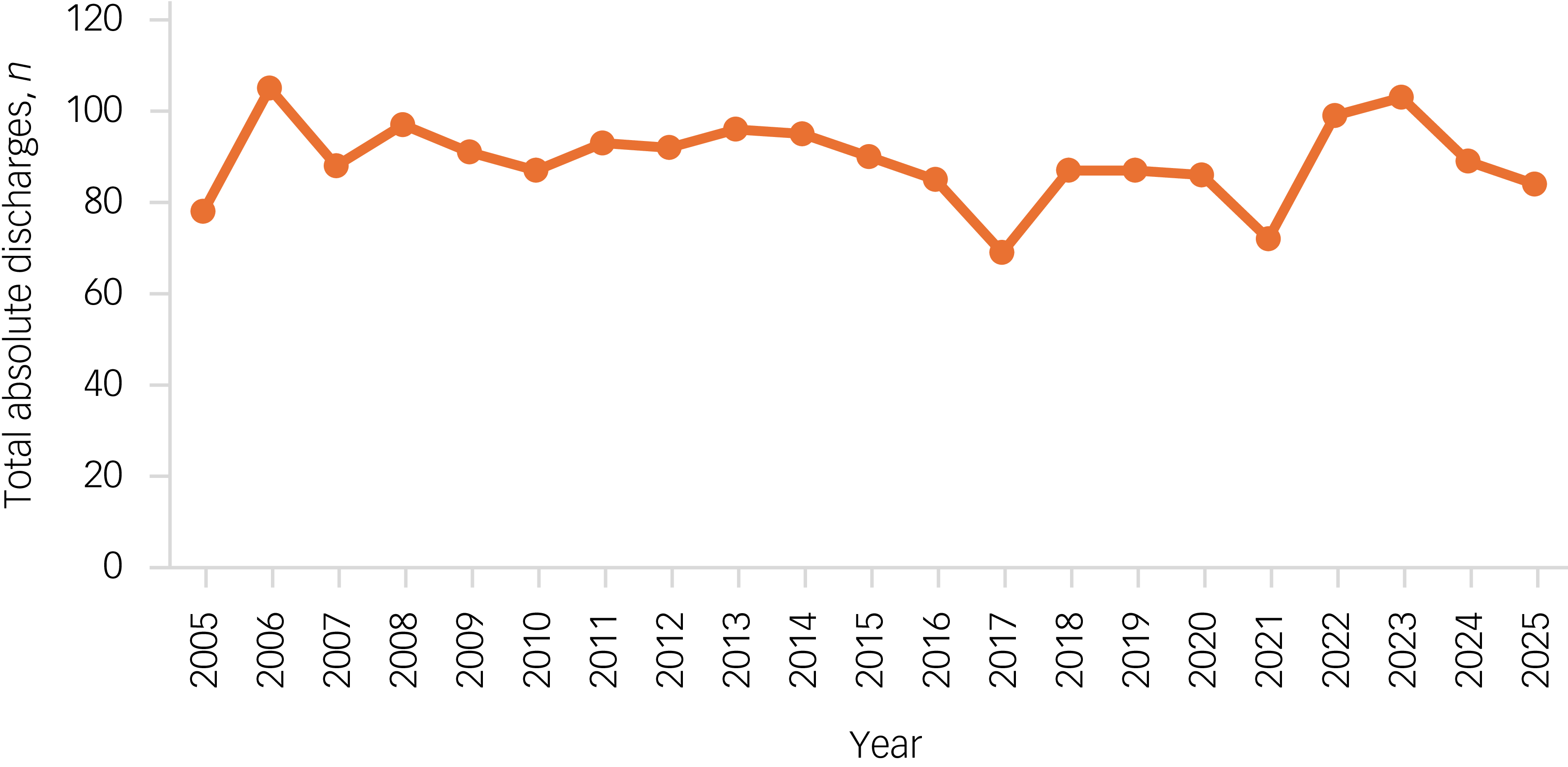
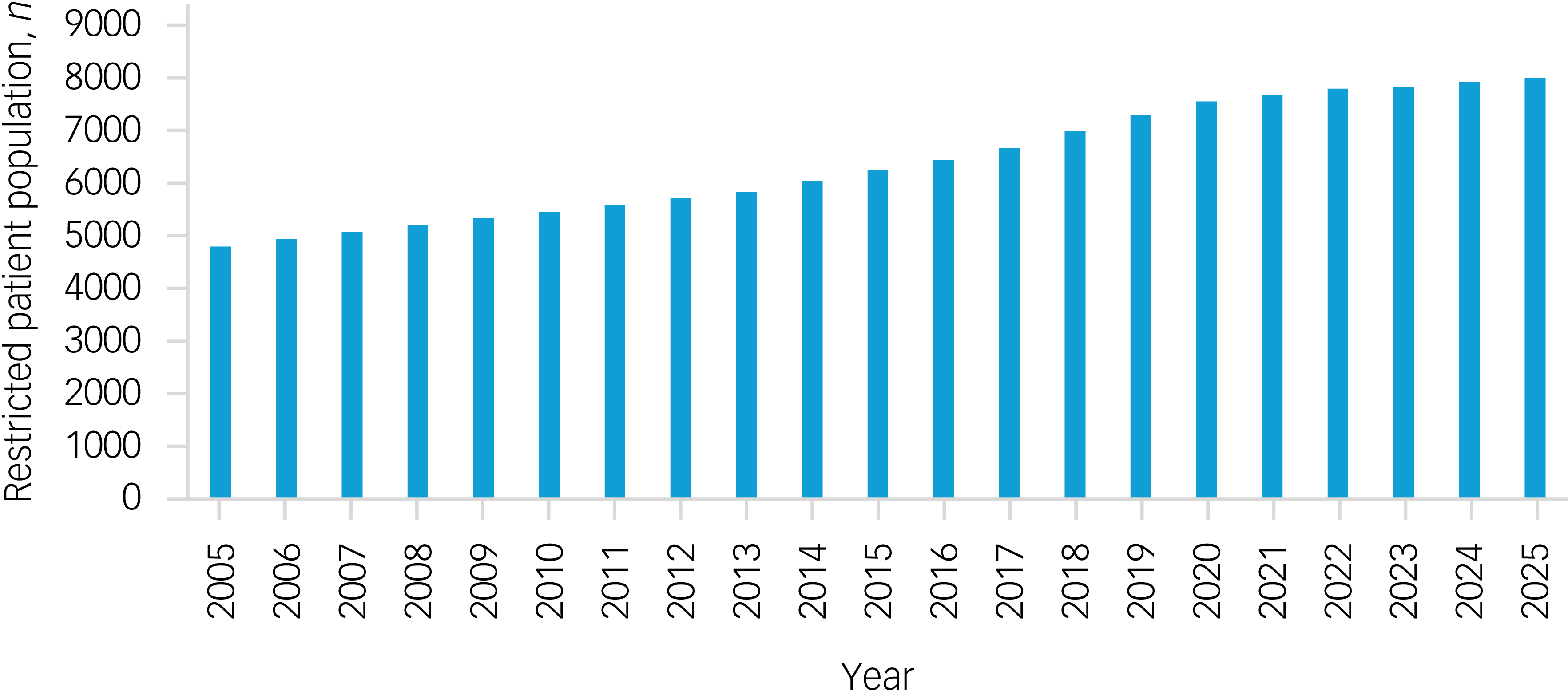
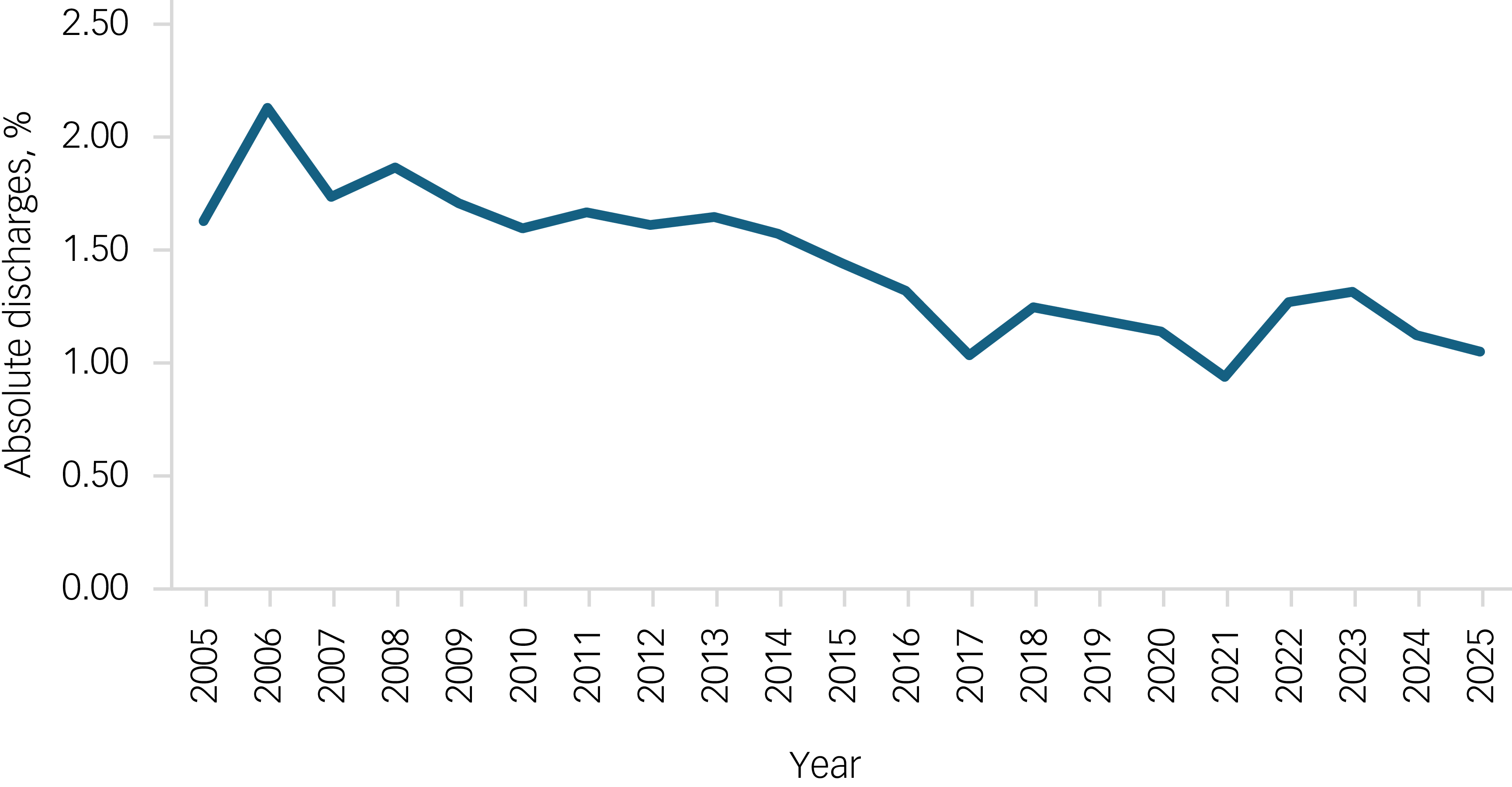
The total number of absolute discharges in England and Wales consistently remains low, with only 1873 over a 21-year period, which equates to an average of 94 per year (Ministry of Justice 2026). Although the annual numbers of absolute discharges have remained relatively static over the past 21 years, at approximately 70–100 per year (Fig. 1), the restricted patient population has steadily climbed, with numbers reaching 7998 by 2025, an increase of approximately 67% over two decades (Fig. 2). This has inevitably resulted in a gradual decrease in the proportion of absolute discharges comparatively (Fig. 3). Around 80–90% of all absolute discharges occur after conditional discharge, with direct absolute discharge from hospital remaining rare.
Total absolute discharges for restricted patients detained under the Mental Health Act 1983 in England and Wales, 2005–2025 (data collated from Ministry of Justice 2026).

Total restricted patient population detained under the Mental Health Act 1983 in England and Wales, 2005–2025 (data collated from Ministry of Justice 2026).

Absolute discharges as a proportion of the restricted patient population detained under the Mental Health Act 1983 in England and Wales, 2005–2025 (data collated from Ministry of Justice 2026).

Recall rates
Previous cohort studies have demonstrated that 69–75% of forensic patients discharged from medium secure units are subsequently readmitted to hospital (Maden Reference Maden, Rutter and McClintock1999; Davies Reference Davies, Clarke and Hollin2007). A study specifically looking at rates of recall for 101 conditionally discharged patients reported that 44.5% were recalled during the follow-up period (mean follow-up time: 811 days; Jewell 2018). Although the recall rates are notable, the majority of those conditionally discharged were not recalled to hospital for a significant period of time (average time to first recall: 500 days), prompting the question of whether this is because they were under the conditions/restrictions of a conditional discharge or whether they were unlikely to require recall and thus could have been granted an absolute discharge. In a wide-ranging systematic review of conditionally discharged patients, Kilbane et al (Reference Kilbane, Zamorano and Romero2025) found that such patients were less likely to engage in violence or offend when compared with absolute discharge patients.
The ‘leash’ of conditional discharge
Although it would appear practically that conditional components of discharge do not ordinarily stop a person living their life normally in the community, it is disingenuous to think that having an ongoing, potentially lifelong, legal ‘leash’ will have no impact on the person whatsoever. As noted above, the utility of a conditional discharge in this respect may induce a protracted psychological burden of being liable to recall which should be considered by an MHT in its weighing up of an absolute discharge application (DA v Central and North West London NHS Foundation Trust [2021]).
Human rights
There will naturally be an interplay between mental health law and human rights when MHTs consider whether to grant absolute or conditional discharge. The case of RP involved a patient who was conditionally discharged in 2011 but was refused an absolute discharge in 2015 based on assessment of the risk of recall (RP v Dudley and Walsall Mental Health Partnership NHS Trust and the Secretary of State for Justice [2016]). The case focused on Article 8 of the Human Rights Act 1998 because conditions attached to conditional discharge inevitably interfere with personal autonomy and daily living.
The court accepted that Article 8 was engaged but emphasised that any interference must be justified under Article 8(2), which requires a two-stage proportionality assessment:
-
• first, the interference must be ‘in accordance with the law’, which in practice means the statutory conditions under the MHA must be properly satisfied;
-
• second, the interference must be ‘necessary in a democratic society’ for legitimate aims such as public safety, protection of health or safeguarding the rights and freedoms of others – criteria that mirror the statutory test for conditional discharge.
The judgment recognised that, on a case-by-case basis, conditions attached to conditional discharge might amount to an unjustified interference with private or family life. The Upper Tribunal observed that although many conditions could theoretically be applied ‘oppressively’, in routine practice they are usually implemented ‘reasonably and according to the circumstances at the time’ and ‘Intervention may be light-handed or heavy-handed as required’ – the intensity of supervision should be proportionately calibrated to the patient’s needs and public protection and tribunals will likely focus on whether conditions are reasonable in principle.
Article 5 (the right to liberty) was central to the decision in Johnson v The United Kingdom [1997]. A restricted patient, who clinicians agreed was no longer suffering from mental illness and no longer required hospital treatment, remained detained for over 3 years because a supervised placement required for a conditional discharge could not be secured. He had been admitted to a high secure hospital in 1984. A breach of Article 5(1) was found, in that detention must be justified by clinical necessity rather than by administrative or resource shortfalls. When the MHT later granted an absolute discharge in 1993 (at a sixth hearing), the applicant received financial compensation for the Article 5 breach and an egregious unlawful detention between 1989 and 1993.
MCQs
Select the single best option for each question stem
-
1 Approximately what percentage of the restricted patient population in England and Wales are granted an absolute discharge each year?
-
a 1–2%
-
b 5–10%
-
c 10–20%
-
d 20–50%
-
e >50%.
-
-
2 Which section of the Mental Health Act 1983 concerns the Mental Health Tribunal power to discharge restricted patients?
-
a Section 37
-
b Section 41
-
c Section 42
-
d Section 73
-
e Section 75.
-
-
3 Which of the following was not a feature for consideration of absolute discharge suggested by the judge in R (SC) v Mental Health Review Tribubnal [2005]?
-
a The nature, gravity and circumstances of the patient’s offence
-
b The risk and likelihood of the patient reoffending
-
c The degree of harm to which the public may be exposed if he reoffends
-
d The age and gender of the patient
-
e The risk and likelihood of a recurrence or exacerbation of any mental disorder.
-
-
4 Which of the following statements regarding Mental Health Tribunal considerations in absolute discharge is not true?
-
a The ‘mere passing of time’ is not significant in terms of progress that the MHT considers
-
b What has happened in the time that has passed since the index offence is not significant
-
c The burden is effectively placed on the appellant to satisfy the MHT that it is inappropriate to remain liable to recall
-
d The MHT need to consider whether it is satisfied that it is not appropriate for the patient to remain liable to recall
-
e The fact that someone no longer has a mental disorder automatically determines an absolute discharge.
-
-
5 Which of the following is not a key element of conditional discharge detailed in section 73?
-
a The patient may be recalled by the SSJ
-
b The MHT or SSJ must impose specific conditions to the discharge
-
c The patient shall comply with conditions imposed at the time of discharge by the MHT
-
d The patient shall comply with such conditions that may be imposed at any subsequent time by the SSJ
-
e The SSJ or MHT may vary any condition imposed.
-
MCQ answers
-
1 a
-
2 d
-
3 d
-
4 e
-
5 b
Data availability
Data availability is not applicable to this article as no new data were created or analysed in this study.
Acknowledgement
Artificial intelligence use: no artificial intelligence tools have been used in the research or writing process for this manuscript.
Author contributions
M.C. conceived the idea for the article and it was further developed in collaboration with A.M. The case law was researched by M.C.; A.M. undertook a literature review, analysed data, developed the figures and devised the MCQs. The text of the article was initially drafted by M.C. and cyclically modified and developed by both authors.
Funding
This work received no specific grant from any funding agency, commercial or not-for-profit sectors.
Declaration of interest
None.



eLetters
No eLetters have been published for this article.