INTRODUCTION
Polychaetes are one of the best represented groups of the macrofauna in terms of biomass or diversity in benthic environments (Salazar-Vallejo, Reference Salazar-Vallejo1981). They are numerous, diverse and almost entirely marine (Blake & Ruff, Reference Blake, Ruff and Carlton2007). They can constitute about 40% of the number of individuals and number of species (Reish, Reference Reish, Buikema and Cairns1980). They can be found on hard substrates, soft-bottoms, and polluted or unpolluted bottoms (Salazar-Vallejo & Londoño-Mesa, Reference Salazar-Vallejo and Londoño-Mesa2004; Blake & Ruff, Reference Blake, Ruff and Carlton2007). Therefore, polychaete taxonomy has important ecological implications in many marine or estuarine ecosystems.
Several studies have been performed regarding polychaetes inhabiting the continental platform of Southern California (i.e. Fauchald, Reference Fauchald1968, Reference Fauchald1970; Hartman, Reference Hartman1968, Reference Hartman1969; Kudenov, Reference Kudenov1975a, Reference Kudenovb, Reference Kudenov and Brusca1980; Williams, Reference Williams1987, among others). Polychaetes from the Gulf of California continental shelf have been studied by Sarti-Martínez (Reference Sarti-Martínez1984), Lezcano-Bustamante (Reference Lezcano-Bustamante1989), Hernández-Alcántara (Reference Hernández-Alcántara1992), and Hernández-Alcántara & Solís-Weiss (Reference Hernández-Alcántara and Solís-Weiss1999). Hernández & Juárez (Reference Hernández and Juárez1988) included a list of polychaetes associated with hard and soft bottoms in Topolobampo Bay and Méndez-Ubach (Reference Méndez-Ubach1997) studied the polychaetes inhabiting soft bottoms subjected to organic enrichment in the same area.
Only a few polychaete studies have been carried out in shallow bottoms inside Mazatlán Bay. Rioja revised material collected between 1941 and 1962, but no data of depth have been reported in the majority of cases (see Salazar-Vallejo, Reference Salazar-Vallejo1989). Chan-León (Reference Chan-León1983) analysed the families of polychaetes associated with rocky bottoms in the intertidal zone of the bay. Solís-Weiss (Reference Solís-Weiss1983) and Arias-González (Reference Arias-González1984) revised material collected at depths between 3.5 and 33 m. The most recent study concerning the polychaete fauna inhabiting shallow soft bottoms corresponds to Méndez & Green-Ruiz (Reference Méndez and Green-Ruiz1998) who studied the superficial sediments and their relation to polychaetes families.
Polychaetes inhabiting soft-bottoms of the coastal lagoon Estero de Urías have been poorly studied to date. Álvarez-León (Reference Álvarez-León2007) identified 12 species and 3 genera (collection date: 1977) and Méndez (Reference Méndez2002) reported 64 species and 2 genera (collection date: 1997) in the area. Several anthropogenic activities are ongoing in the coastal lagoon Estero de Urías. They include a harbour, a fishing fleet, domestic and industrial sewage, a fish processing factory, a slaughterhouse, a thermoelectric plant, and several shrimp farms. Mangrove trees exist in the upper part of the lagoon. The characterization of the lagoon, based on the annelid distribution with respect to different environmental conditions, was performed during 1997 by Méndez (Reference Méndez2002) and 11 years later by Ferrando (Reference Ferrando2010). This paper presents a checklist of the soft-bottom polychaetes collected during 2008 (the latter study), together with the relevant information referring to the environmental conditions where they were found.
MATERIALS AND METHODS
The coastal lagoon Estero de Urías is located in the State of Sinaloa along the south-east coast of the Gulf of California between 23°09′–23°12′N and 106°18′–106°25′W, near the city of Mazatlán. It is a shallow and brackish lagoon with a permanent interchange with the sea and it is almost parallel to the coastline. Depth ranges from 1 to 3 m, except for the navigation channel where it can reach 12 m. It has a surface area of 18 km2 and a length of 17 km (Montaño-Ley, Reference Montaño-Ley1985). The climate is tropical/subtropical, with two contrasting seasons: rainy (July–October) and drought (November–June). The average annual atmospheric temperature is 25°C and the average annual rainfall is 800 mm. The average salinity (‰) during the drought season is 39.4 and it was 31.7 during the rainy season (Ochoa Izaguirre et al., Reference Ochoa-Izaguirre, Carballo and Páez-Osuna2002).
Sampling was performed in February and August 2008 at six stations located along the lagoon (Figure 1). Samples of sediment were collected using a van Veen grab (mouth dimension: 26.5 × 12.5 cm) (three replicates) and sieved through a 0.5-mm mesh. The retained material was fixed with 4% formaldehyde solution and preserved with 70% ethanol. Annelids were sorted and identified according to Hartman (Reference Hartman1968, Reference Hartman1969), Fauchald (Reference Fauchald1977), Hernández-Alcántara (Reference Hernández-Alcántara1992), Blake & Ruff (Reference Blake, Ruff and Carlton2007) and Tovar-Hernández (Reference Tovar-Hernández2007).
Study area showing the collection stations.

The validity of taxonomic status and distribution species were reviewed according to Salazar-Vallejo & Londoño-Mesa (Reference Salazar-Vallejo and Londoño-Mesa2004) from the Tropical Eastern Pacific, ITIS (Integrated Taxonomic Information System, available online at http://www.itis.gov) and WORMS (World Register of Marine Species, available online at http://www.marinespecies.org) databases. To do that, the valid names and their synonymies were taken into account.
Additional sediment samples were collected for sediment analyses. Almost 200 g of sediments were sieved trough a 2-mm mesh (to separate gravel from sand) and a 0.0625-mm mesh (to separate sand from mud), and grain size was expressed as percentages of each fraction according to Folk (Reference Folk1965). Organic matter percentages in sediments were obtained following the ignition loss method (Dean, Reference Dean1974). Sediment temperature was measured with a digital CE model KM43F thermometer. Salinity and oxygen were measured only during August with a Sper Scientific model 300011 refractometer (1.0 precision) and a Ysi model 85 sounder (0.005 mg/l precision), respectively.
RESULTS AND DISCUSSION
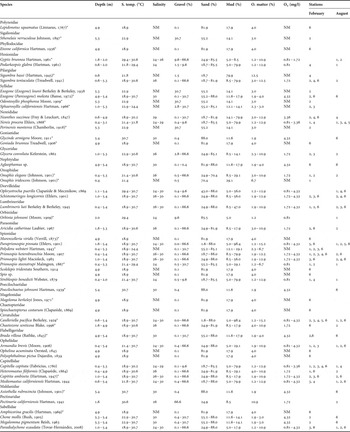
A total of 53 species belonging to 26 families were identified in the area (Table 1). Aglaophamus sp. and Spio sp., which had a lesser number of specimens at Station 6, could not be identified to the species level due to their poor condition. The capitelid Capitella capitata constitutes a complex of sibling species that cannot be separated morphologically due to the fact that a different fixation technique is required to make this possible.
List of species found at stations and environmental parameters.

S. temp., sediment temperature; O. matter, organic matter; O2, dissolved oxygen; *, species reported for the first time in the Urías coastal lagoon; NM, not measured.
The 51 taxa identified to species level had been previously found in soft-bottoms, except for Perinereis monterea which was known to occur on rocky substrates, and Polydora websteri which bores into shells and other limestone materials (Blake & Ruff, Reference Blake, Ruff and Carlton2007). Their appearance in our samples is due to the presence of pieces of rocks and shells in sediments.
Results were compared with the two polychaete checklists previously published for the same lagoon and faunal differences were observed. Monthly, during 1977, Álvarez-León (Reference Álvarez-León2007) collected polychaetes associated with soft-bottoms, gravel, wood and metallic surfaces, and rock and vegetal substrates. He used a shrimp net with a 2-cm mesh size in the body and a 1-cm mesh in the glass. Paraprionospio pinnata and Neathes succinea are the only species found by this author and in this study. They were always collected in substrates containing, totally or partially, muddy sediments. No more species were found in common probably due to the different substrates sampled and sampling gears used over the two studies. Although Méndez (Reference Méndez2002) collected the samples in 1997 (one replicate per sample) in soft-bottoms and used the same gear and sieving mesh size, some differences were observed. Only 24 species were found in common. This is probably due in part to the collection effort being higher in this study, since three replicates were taken in each sample instead of one. Moreover recent literature was used to identify our specimens (Salazar-Vallejo & Londoño-Mesa, Reference Salazar-Vallejo and Londoño-Mesa2004; Blake & Ruff, Reference Blake, Ruff and Carlton2007; Tovar-Hernández, Reference Tovar-Hernández2007). Most taxonomic problems have been solved. Literature used by Méndez (Reference Méndez2002) was older (Hartman, Reference Hartman1968, Reference Hartman1969; Fauchald, Reference Fauchald1977; Kudenov, Reference Kudenov and Brusca1980; Hernández-Alcántara, Reference Hernández-Alcántara1992). Nevertheless, the possibility of temporal variations on faunal composition cannot be discarded because some anthropogenic activities have been modified over 11 years. This could produce the polychaete faunal substitution shown by Ferrando (Reference Ferrando2010).
Comparisons with these previous studies allowed the establishment of the first new reports of 26 species for the Urías coastal lagoon (Table 1). These species were previously found in the Tropical Eastern Pacific (Salazar-Vallejo & Londoño-Mesa, Reference Salazar-Vallejo and Londoño-Mesa2004), except for Amphicorina gracilis, Marenzelleria viridis and Exogone (Parexogone) molesta, which were previously reported on the Pacific coast of the United States (Blake & Ruff, Reference Blake, Ruff and Carlton2007) and are reported for the first time on the Pacific coast of Mexico.
Marenzelleria viridis was originally described as Scolecolepides viridis Verrill, Reference Verrill1873 (invalid species). It is native to the north-eastern United States (Blake & Ruff, Reference Blake, Ruff and Carlton2007). This species was also reported in the Gulf of Mexico (Foster, Reference Foster1971) and was later introduced to northern Europe and San Francisco Bay (Cohen & Carlton, Reference Cohen and Carlton1995). Marenzelleria viridis (Verrill, Reference Verrill1873) is a recent invader of European brackish waters (North Sea and Baltic Sea) (Schiedek, Reference Schiedek1997). This species produces up to 21 million planktonic larvae per cubic metre of water during its reproductive season and the planktotrophic larval stage lasts about eight weeks (George, Reference George1966; Bochert & Bick, Reference Bochert and Bick1995). Moreover, Zettler et al. (Reference Zettler, Daunys, Kotta, Bick, Lepäkoski, Gollasch and Olenin2000) indicate that the environment tolerance, high genetic variability, short generation time, early sexual maturity, high reproductive capacity, and variable diet are attributes of M. viridis. Also, the results of their study showed that this species presents a high tolerance to many abiotic factors such as depth, salinity, temperature, eutrophication, and sediment quality. Therefore, this species is likely transported as larvae and/or adults in ballast water. This theory is supported by a collection of specimens from a plankton tow in a North American estuary (Maciolek, Reference Maciolek and Hutchings1984).
The type locality of Exogone (Parexogone) molesta was Orcas Island in the State of Washington (Banse, Reference Banse1972) and its distribution ranges from central California to Oregon (Blake & Ruff, Reference Blake, Ruff and Carlton2007). Kudenov & Harris (Reference Kudenov, Harris, Blake, Hilbig and Scott1995) also reported it from Southern California. Amphicorina gracilis was originally described from Moss Beach (San Mateo County) as is Oriopsis gracilis and is distributed on the Pacific coast, especially in central California. It is found in tidal pools with sand, forming tube clusters among sponge and ascidians clumps (Hartman, Reference Hartman1969).
This study enhances our knowledge in understanding the diversity of polychaetes inhabiting soft-bottoms in the Estero de Urías lagoon and also constitutes a database with respect to the distribution of the polychaetes under different ecological conditions in the lagoon.
ACKNOWLEDGEMENTS
We are grateful to the Mexican Government for the scholarship to the first author, and to Sergio Rendón and Tulio Villalobos for their assistance during field work. María Ana Tovar helped during sampling and identification. Pablo Hernández confirmed the revision of species distribution. Jim Marlatt and Jacqueline Partridge revised the written English.