


Introduction
Disasters are characterized by being unexpected, dynamic, time critical, and having a significant level of uncertainty.Reference Hugelius, Becker and Adolfsson 1 , Reference Steigenberger 2 Disaster response is a complex field that requires a broad palette of competences among disaster responders, yet there is no agreed definition of the specific competences needed for the response. Competence is sometimes described as an individual’s ability to perform a specific task.Reference Sriharan, Banaszak-Holl and Fleig-Palmer 3 In this paper, competence is defined as “the ability to integrate and apply contextually appropriate knowledge, skills, and psychosocial factors (e.g., beliefs, attitudes, values, and motivations) to consistently perform successfully within a specified domain.”Reference Vitello, Greatorex and Shaw 4 The relationship between skills, knowledge, and competence has been discussed since Aristoteles’ Nicomachean Ethics, in which episteme represents scientific knowledge, techne represents skill-based knowledge—including both technical skills and non-technical skills, and phronesis represents practical, pragmatic knowledge.
Previous studies have suggested that disaster response competence consists of both technical skills, where clinical skills as well as knowledge of the system and disaster-specific skills are included; non-technical skills such as communication, leadership, teamwork, and situational awareness; personal traits such as openness, conscientiousness, emotional stability, and agreeableness are important; and mental preparedness consisting of emotional preparedness, coping skills, and personal practical preparedness.Reference Westman 5 See Figure 1.Reference Westman 5
Disaster responders include individuals with different backgrounds and professions. In some settings, the disaster responders will be a predetermined group who have completed previous missions together and with common training. However, more often the disaster responders have no previous shared training and do not know each other, i.e., they are not an established team.Reference Kaim, Bodas and Camacho 6 For disaster responders, both technical and non-technical skills have been shown to be of value.Reference Westman, Kurland and Hugelius 7 Technical skills are the specific skills required to perform a task. Therefore, they are reasonably easily measured and can be gradedReference Stark, Seff and Asghar 8 and are also easier to train. Although non-technical skills also affect performance and are entangled with technical skills, they are related to personal qualities and actions rather than to a specific task.Reference Rosendal, Sloth and Rölfing 9 There are several definitions of non-technical skills, which are commonly divided into seven categories including situation awareness, decision-making, communication, teamwork, leadership, managing stress, and coping with fatigue.Reference Flin, Yule and Paterson-Brown 10 , Reference Flin, O’Connor and Crichton 11 By their nature, non-technical skills are more complex than technical skills and, consequently, harder to assess, but this can be done through the use of behavioral marker systems.Reference Flin, O’Connor and Crichton 11 No set standard or common ground currently exists for the core competences for disaster responders,Reference Kaim, Bodas and Camacho 6 , Reference Ripoll Gallardo, Djalali and Foletti 12 , Reference Bahattab, Trentin and Hubloue 13 nor is it fully known how such skills and competences are developed and how training programs should be designed to correspond to the demands a disaster response entails.Reference Legemaate, Burkle and Bierens 14 -Reference Gordon, Baker and Catchpole 16 However, several recent studies have shown that, for disaster responders, communication, teamwork, and leadership along with mental preparedness and stress management are especially valuable skills.Reference Westman, Kurland and Hugelius 7 , Reference Bahattab, Trentin and Hubloue 13 , Reference Black, Brown and Utunen 17
On the basis of this knowledge gap, the aim of this study was to explore how disaster responders acquire competence.
Materials and Methods
Design
An inductive qualitative study was conducted.
Recruitment of Participants
A convenience study sample was used, recruiting participants by open advertising through social media and snowballing. The invitation to participate was advertised via social media, including a link to a study-specific website containing further information and the ability to submit interest in participating in the study. In addition, snowball recruiting was used by asking study participants to spread the same link to other potential candidates.
The inclusion criteria were that the participants should have experience of being deployed to a disaster area on at least two separate missions and have acted in a team leadership position, defined as experienced disaster responders. The inability to communicate their experiences in English or Swedish or not meeting the inclusion criteria regarding experience led to exclusion.
Data Collection Procedures
In all, 14 disaster responders matching the inclusion criteria showed an interest in participating and were included in the study. Individual interviews were held via video link by the first author (AW). A study-specific semi-structured interview guide (see Supplementary File 1) was developed by the research team, based on previous research and professional experience, and tested in a pilot interview. No major changes were made after the pilot interview, which was therefore included in the analysis. Some of the questions asked during the interview were not analyzed in this study but will be reported elsewhere. Demographic data such as age, previous experience, and profession were anonymized and documented.
The interviews were held between September 2024 and February 2025, recorded, and transcribed verbatim.
Analysis
The data were analyzed using an inductive approach to reflexive thematic analysis.Reference Braun and Clarke 18 , Reference Braun and Clarke 19 Only data relevant to the aim of this study was analyzed, in six steps:
Step 1: Step Familiarizing with the data. The first author performed all the interviews and made necessary corrections to the transcripts, thereby acquiring knowledge of the data. All interviews were read through by all authors to gain a sense of the complete data.
Step 2: Step Generating the initial codes. Data extracts relevant to the aim of the study were obtained and thereafter coded according to their content and meaning, staying true to the content of the extracts. This step was performed by the first author (AW) and reviewed and discussed independently by the last author (KH).
Step 3–4: Steps Searching for themes and reviewing themes. Themes were developed from the codes, rendering an initially high number of different themes, which via mind maps and a spreadsheet of notes were reorganized into new themes through an iterative process. This step of the analysis was latent and interpretative, searching for patterns of shared meanings in the data. The final themes were crosschecked by reviewing the data extracts as well as the full data set, carried out by the first and last authors (AW and KH). These final themes were thereafter validated by the second author (LK).
Step 5: Step Defining and naming themes. The themes were further refined by processing the data from Step 4 and renaming them to present in the following step. All authors participated in this step.
Step 6: Step Producing the report. Finally, the results were described in writing as part of the current manuscript. All authors participated in writing or editing the manuscript.
Results
Demographics
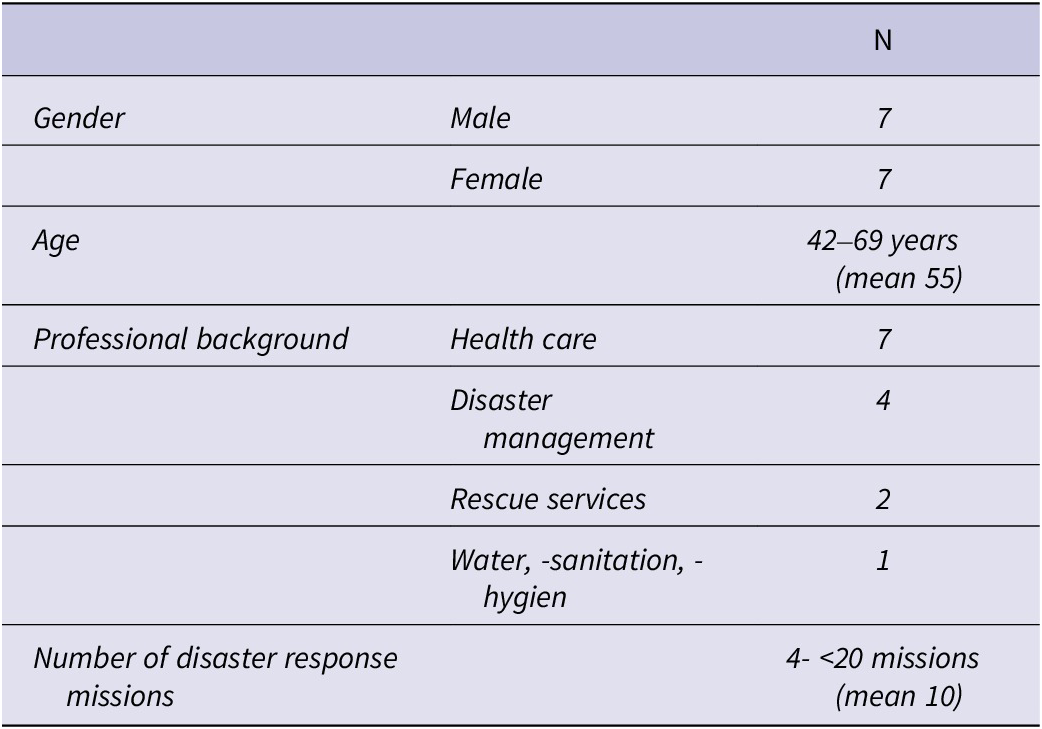
Seven men and seven women of seven different nationalities (Netherlands, Belgium, Sweden, Canada, UK, Pakistan, and Germany) participated in the study. The demographics of the study participants are shown in Table 1.
The four main areas that comprise disaster response competence: technical and non-technical skills in combination with personal traits and mental preparedness.

Figure 1. Long description
A central circle is divided into four quadrants by a horizontal and vertical axis, with two curved arrows at the center point indicating a cyclical relationship.
* Top-left quadrant: Labeled Technical skills. An external box contains bullet points for Professional skills, Knowledge of the system, and Specific disaster response skills.
* Top-right quadrant: Labeled Non-technical skills. An external box contains bullet points for Decision making skills, Leadership, and Communication.
* Bottom-right quadrant: Labeled Mental preparedness. An external box contains bullet points for Emotional preparedness, Coping skills, and Personal-practical preparedness.
* Bottom-left quadrant: Labeled Personal traits. An external box contains bullet points for Openness, Conscientiousness, Emotional stability, Agreeableness, and Extraversion.
Overview of study participants demographics

Table 1. Long description
The table consists of three columns and seven data rows.
* Gender: Male has a count of 7. Female has a count of 7.
* Age: The range is 42 to 69 years with a mean of 55.
* Professional background: Health care accounts for 7 participants. Disaster management accounts for 4 participants. Rescue services accounts for 2 participants.
* Number of disaster response missions: The range is 4 to 20 missions with a mean of 10.
The participants all had extensive previous experience in disaster response, both as team members and as team leaders. Their experience varied from 4 missions to over 20 missions with a mean of 10 and included participating in responses to floods, earthquakes, fires, and volcano eruptions, as well as droughts and armed conflicts.
Acquisition of Disaster Response Competence
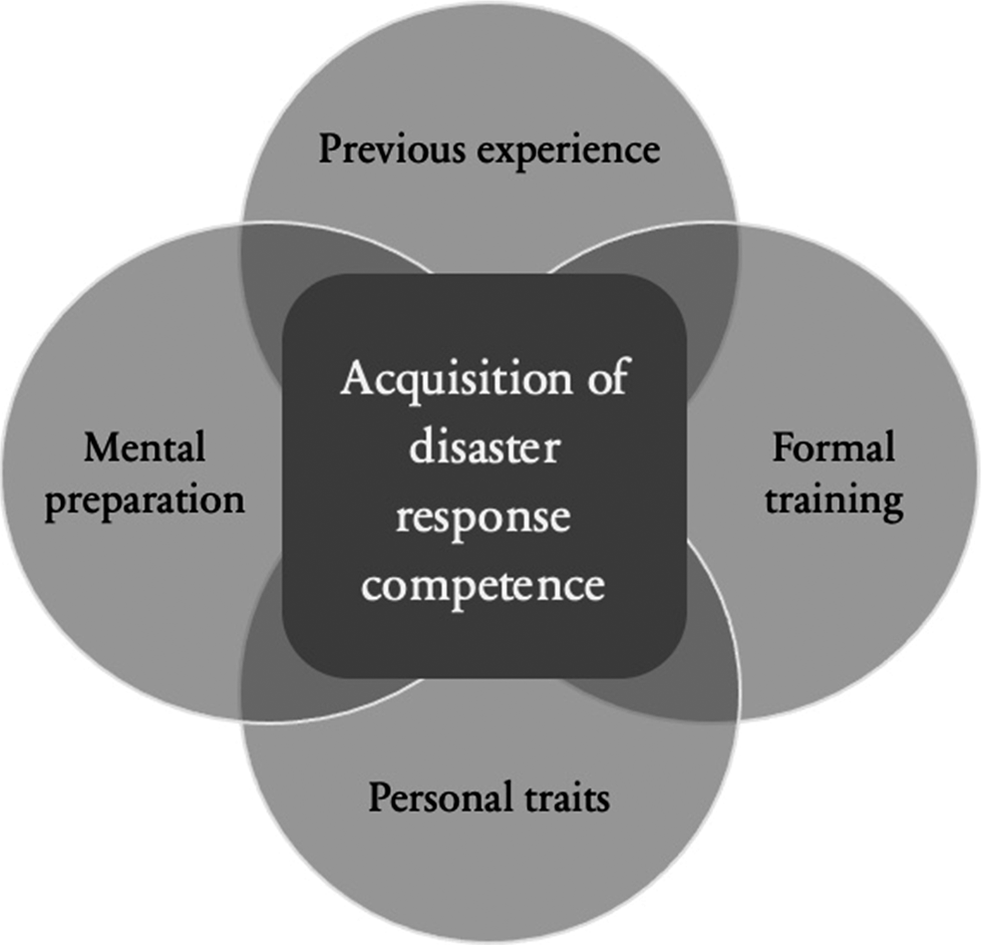
Although the participants’ backgrounds and disaster contexts covered by their experiences showed a broad variation, the results were consistent and resulted in four themes describing different ways of acquiring the competences that the participants considered as required for a disaster responder. The different ways of acquiring the required competences and skills were closely linked and dependent on one another and would not function in isolation. See Figure 2.
The four themes needed by disaster responders to acquire disaster response competence.

Acquiring Disaster Response Competences from Previous Experiences
Both previous experiences from other disaster missions and a broad professional background were valuable for the disaster responders. Previous disaster mission experience was valuable for acquiring specific competences such as particular routines or procedures not used within everyday working life. Examples of such skills could be how to use disaster-specific equipment, assessment procedures, or other technical or medical procedures not used in everyday health care services. It was emphasized that such specific skills could be hard to acquire without having previous disaster mission experience.
There needs to be a mixture of different backgrounds or work environments, and it might be more difficult for them [disaster response organizations] to have these type of people that they don’t have in their normal work environment at home (…) If you take a team from a hospital to go on an international mission, they will also need some people from logistics, for WASH (…). And they will not have these people, from their regular staff … (Participant J)
Previous experiences also served to provide role models for how to be a disaster responder.
You have worked with managers, and you know who are good or bad. And you, you look at how they do and adopt your own way. Adopt your methodology based on experience. (Participant K)
The development of the competences needed to perform as a disaster responder did not originate solely from previous disaster response experiences or training but also from everyday life experiences. Participating in sports, being a scout, or volunteering in an NGO were described as formative and valued when confronted by a real disaster. Such experiences contributed to developing personal skills on how to bring people together, make people feel safe, and rely on others—important skills for a disaster responder.
Yeah. It’s something like scouting, when I was a leader in scouting, in youth working. So, there is where I think I had that, I learned those skills on how to work together, bringing people together and to one plus one is three and not one plus one is two. (Participant A)
To have a broad professional background was also regarded as supportive. For example, for medical professionals responding to a disaster, it was more useful to hold broad clinical experience, such as coming from primary health care in a remote environment, compared to having significant but very specialized experience within highly technological care contexts, such as an intensive care unit.
Acquiring Disaster Response Competences Through Formal Training
Both technical and non-technical skills were expressed as necessary for a disaster responder. Several of the interviewees expressed that it was important to master the technical skills needed first but also to be able to excel in the non-technical skills. That meant that technical skills must be developed and trained on before the actual disaster response mission. The distinction between technical skills and non-technical skills was, in many cases, well defined. Participants described that their experience was that technical skills were expressed and trained on specifically, while the non-technical skills were more rarely discussed in disaster response training. Training on non-technical skills exists but often as part of a training session with a separate goal.
Non-technical skills? Absolutely. Absolutely. But not necessarily on deployment or in the field. It’s something that needs to be done ahead of time, right? (Participant H)
Several participants described that the opportunity to train with the actual team they were to be deployed with was positive:
I think practice makes perfect. Um, there’s really not any other way that I can think of other than actually doing it. Um, yeah. You can’t, you can’t really do teamwork without a team, so. (Participant H)
To be effective and relate to the demands encountered in real disasters, formal training needed to be well thought through and realistic and span several days in order to add value to the development of non-technical skills for the disaster responders. For shorter missions, technical skills were valued higher than non-technical skills, but the longer the mission, the more the non-technical skills were considered of high value by the study participants. Non-technical skills were considered to have a significant effect on how tasks were performed.
Acquiring Disaster Response Competences Through Mental Preparations
With time and experience, many disaster responders form their own individual preparations prior to deployment. These preparations consist of, for example, visualizing worst-case scenarios, discussing the upcoming mission with a colleague, or simply thinking through what parts may be controlled and preparing for them (i.e., practical preparation and equipment) and what things cannot be controlled beforehand. While it is impossible to prepare for every scenario, it is important to be prepared by keeping one’s technical skills at a good level and to use formal training to develop these skills while accepting that one may never be prepared for every possible event:
Um, can you prepare for something like that? I don’t think so. No. Um. Which means that you should try to prepare for all the rest. Because you only have so much bandwidth. (Participant B)
Both informal and formal sharing of previous experiences from disaster response missions, including practicalities such as pictures and personal stories on what life in the field (e.g., living conditions) could look like, added much value to individual mental preparations, especially helping new disaster responders to get an idea of what a mission could be like:
When we go abroad, we sleep in tents. And in the afternoon [of the training], there was a technical session, a practical session, how to put up a tent. In the evening there were some sessions on communication, radio communication, and talking to each other. Uh, there was someone coming to give a presentation on how it was on that mission, how we worked, how we lived over there, so that new colleagues have an idea when we go abroad and we will sleep in a tent, we will have a shower. But it’s not a normal shower. It’s a field shower. We have toilets, but it’s not a normal toilet as we have here. So, they know a little bit. (Participant A)
Having the opportunity to share such experiences was an important part of being mentally prepared.
Using Personal Traits to Acquire Disaster Response Competences
The importance of predetermined factors, such as personal traits, when becoming a disaster responder was emphasized. The study participants stressed that any person could be trained to a certain degree, especially regarding technical skills, but to reach the levels required to be a disaster responder, specific personal traits were needed as well. As long as missions were predictable, trained behavior could be highly functional and sufficient. However, in situations where problems occurred and the stress became remarkably higher, the individual’s nature became more important, either enhancing or hindering effective disaster response.
Since disaster responders require both skills used in their everyday lives and specific skills, it was emphasized that it was not necessary to hold, for example, a managerial position in everyday working life in order to succeed as a manager in a disaster response context, or vice versa. The ability to be flexible and the willingness to learn and adapt were considered important characteristics.
I’ll give you an example. We went to a facility that was submerged under water and mud, and everyone was cleaning. So, you say, as a doctor, my job is to see the patient. But at that time there are no patients, so you are cleaning the facility, whitewashing, cleaning. So, when the patients come, it is ready for them as early as possible. So, teamwork is very important. And as a team member you have to take initiatives, like you cannot stand and wait for someone to come and clean for you. (Participant L)
And so having that rounded clinical skill set, as well as the mental health skill set, allows you to have the more rounded, softer skills. Yeah. And that’s who are the ideal kind of responders that we want rather than, you know, somebody who is in an ICU, that everything is nice and neat and, you know, like that. But somebody that is a lot more flexible and ready to roll with the punches. Um, so that’s who we look for. (Participant H)
Gender issues were exclusively addressed by female study participants. While this was not necessarily considered a problem, it was nonetheless a circumstance that needed to be taken into consideration during disaster response missions. Being a woman on a disaster response mission was described by both sexes as something that had changed over time, with more acceptance in later years. Some study participants linked the change to an overall change in society regarding the role of women in professional life.
(…) that pat on the back, the old boys’ culture, beers in the sauna, and decision-making based on completely different premises. But that isn’t really camaraderie if you happen to be the only woman, or the only person who doesn’t drink beer, for example. I don’t know exactly what other examples there might be, but in my case, gender was definitely a limiting factor. (Participant D)
The competence needed to become a team member or a team leader as part of a disaster response team, and not only an individual responding to a disaster, requires personal traits such as curiosity and interest in the other team members, a willingness to listen and learn, and to be open minded. Such skills are important for all disaster responders, but especially for those acting as team leaders. An example that was given of a way to acquire awareness of each other’s competences, skills, and personalities was to arrange a team meeting early in the mission where everyone in the team gets acquainted and their skills (both non-technical and technical) are explored. The ability to transform how to perform tasks one is trained to deliver in a well-equipped everyday environment in a low-resource setting was also addressed as important. To manage this, skills such as flexibility and adaptability are needed.
Uh, being open, being very social, discussing and listening to others is also a very important skill. I think it’s not a (…) you have to listen to other opinions. And you can for sure learn from other opinions. So an open mind and social listening are very important skills to be a team player (…). (Participant A)
We had several ICU beds in the ICU. So, we had a lot of capacity to do a lot for one patient or two patients. And in a disaster, it’s a turnaround. It’s you have not so much capacity, not so much material, but you know, you have the knowledge, and you have your ICU skills to try to do a little bit for a lot of people. (Participant A)
The ability to inspire, to recognize team members’ efforts, and to ensure everyone was utilized to their full potential, regardless of their differing backgrounds and prior experiences, were regarded as crucial skills for disaster responders:
You’ve got to have the ability to empower other people within the team to do things. Yeah. Otherwise, they’re not feeling, uh, worthy. So, give them. Give them the amount of work out how much you think, how much pressure you can put on them by empowering themself. (Participant C)
This was especially true for team leaders or experienced disaster responders, when acting as mentors for less experienced responders. The knowledge transformation from experiences to experienced disaster responders included coping skills and professional and personal growth.
Discussion
The aim of this study was to explore how competences were acquired among experienced disaster responders. Competence may be acquired through a broad professional background, everyday life experiences, previous disaster mission experiences, and formal training, in combination with personal reflections and mental preparations. Although there was a wide variety of backgrounds, professions, and experiences among the study participants, they showed a surprisingly unanimous agreement on the skill set needed for disaster responders and how such skills could be acquired and how to build up competence.
The findings indicate that both prior disaster missions and diverse professional or personal experiences strengthen responder competence.Reference Goniewicz, Burkle and Khorram-Manesh 20 Mission exposure provides technical skills not easily learned elsewhere, while broad clinical backgrounds support adaptability. Everyday experiences, such as volunteering or team activities, also contribute valuable interpersonal and leadership abilities. Together, these factors highlight the importance of combining mission experience with varied practice to enhance disaster preparedness.
Although efforts have been made to develop formal training and curricula for disaster responders, there remains no consensus on how such training should be designed.Reference Almukhlifi, Crowfoot and Wilson 21 Considering the number of formal courses for disaster responders being conducted worldwide, relevant questions, such as what training should be used, the goal of the training, and who the training is for, must be asked.Reference Hugelius, Edelbring and Blomberg 22 This study cannot provide the full answers to these questions, but the results indicate that more focus should be put on how to develop non-technical skills in formal training settings. While non-technical skills have been found to be more difficult to assess than technical skills, the use of observers who evaluate and provide feedback to trainees can be beneficial.Reference Flin, O’Connor and Crichton 11 , Reference Graham, Hocking and Giles 23 In particular, the participants in this study emphasized teamworking skills as essential for disaster responders. Team training, specifically training with the team you are supposed to deploy with, has been suggested to be of importance in previous studies.Reference Kaim, Bodas and Camacho 6 However, given that disaster response missions often have a very short timescale for preparation and that most disaster response mission teams are based on an ad hoc team constellation, an alternative might be to include teamworking training in all formal training, ensuring that all potential responders have fundamental skills in and shared awareness of these aspects.Reference Kaim, Bodas and Camacho 6 , 24 , Reference Amat Camacho, Hughes and Burkle 25
Another perceived problem with formal training for the respondents in the present study was that it did not reflect the reality of a disaster, making it less valuable for the disaster responder. Previous studies on training in emergency management have shown that psychological fidelity is more valuable for learning outcomes than physical fidelity.Reference Drews, Musters and Siebeneck 26 , Reference Kozlowski and DeShon 27 This is in line with, for example, the perception presented by the study participants that longer training, lasting for several days and nights, is more supportive than shorter training and that the training should include psychologically challenging situations and processes, such as creating situational awareness or decision-making under severe stress, to better prepare disaster responders. However, it is important that the level of fidelity in the training is adapted to the level of experience of the training participants. In this study, only experienced disaster responders participated. Less experienced disaster managers have been suggested to require a lower level of fidelity to acquire the needed skills or knowledge.Reference Tannenbaum 28 , Reference Ketelaars and Saurin 29
Despite the given interest in formal training and how it should be optimized, the findings of this study also indicate that formal training alone does not fully prepare disaster responders for the reality of a disaster. It was emphasized that predetermined personal traits could only be trained to a certain degree and were, therefore, also dependent on previous personal and professional experiences and personalities. The idea that the human personality is at least partially genetically determined is well describedReference Sanchez-Roige, Gray and MacKillop 30; however, implementing this knowledge in training needs further study. Linkage between personal traits and occupational choices can be found in the literature, and the effect on decision choices and function in especially stressful situations should be considered.Reference Raoust, Kajonius and Hansson 31
Mental preparation, both by personal reflection and by sharing and reflecting on previous experiences together with colleagues, was also an important strategy to acquire disaster responder competence. This type of preparation touches on the concept of disaster readiness, meaning moving beyond technical or knowledge preparation or training to also include personal mental preparedness.Reference Hugelius and Harada 32 , Reference Zahos, Crilly and Ranse 33 Mental preparations also included aspects of preparing for not being fully prepared, since some aspects of disasters were considered impossible to prepare for. One possible suggestion arising from these findings could be that preparations such as listening to others’ experiences and personal reflections should be included in formal training in order to encourage the use of such strategies to acquire the competences and skills needed as a disaster responder.
Limitations
The participants of this study were recruited partly by combined convenient- and snowball recruitment, which can introduce selection bias. However, in the present study, the range of the participants’ backgrounds and experiences ensured that the opinions expressed were broad. Also, the study participants had rich experience in disaster response. This strengthened the information power in the study.
In addition, information power was considered to be strengthened by following the concept of high data quality (rich and detailed responses by all participants) and sample adequacy (study participants with highly relevant experiences) as well as the use of a strong theoretical framework.Reference Braun and Clarke 18 , Reference Malterud, Siersma and Guassora 34
The reflexive thematic analysis is a methodology used to reach beyond the manifest content of the data. The analysis was conducted collaboratively by a team of authors with diverse backgrounds in disaster response and theoretical expertise. Notably, two team members also had practical experience in the field. This combination enabled a deeper and more nuanced understanding of the phenomena studied. Coupled with a structured and theoretically informed approach, the analysis was considered valid and trustworthy.Reference Braun and Clarke 19 , Reference Braun and Clarke 35
Conclusion
Disaster responder competence is acquired from a combination of previous experience, formal training, mental preparedness, and personal traits. Formal training alone cannot fully prepare disaster responders for the reality of a disaster but needs to be combined with personal experiences from both disasters and other contexts as well as personal traits and mental preparations.
Based on these results, when developing training programs for disaster responders, it might be beneficial to take into consideration that disaster-specific technical skills should form the foundation, but the training should also focus to a high extent on awareness of non-technical skills (particularly teamworking skills) and leadership and mentoring skills, as well as gender awareness in disaster response teams. In addition, personal mental preparation should be encouraged, both as a part of formal training and separated from such, to develop well-prepared disaster responders. This knowledge could be included in future studies on how to develop optimal training programs.
Supplementary material
The supplementary material for this article can be found at http://doi.org/10.1017/dmp.2026.10433.
Data availability statement
No additional data available.
Author contribution
AW is the guarantor
Conceptualization: AW, KH, LK
Investigation: AW
Methodology: AW, KH, LK
Formal analysis: AW, KH
Validation: LK
Writing—Original draft preparation: AW, LK, KH
Competing interests
None
Ethics
Prior to the interviews, the study participants had access to full study information, both in writing and verbally, and gave their consent to participate. With respect to the study participants’ confidentiality, no specification of, for example, exactly which disaster responses the participants had been part of is provided. The study was approved by the Swedish Ethical Review Authority (Ref nr 2024-0523-02).



 Open access

