Introduction
Social networks are consequential for many dimensions of health. Numerous studies document how the structure and supportive functionality of people's close networks protects against disease and death, and mitigate the health consequences of challenging circumstances (Berkman et al., Reference Berkman, Glass, Brissette and Seeman2000). A central argument emerging from this body of research is that personal networks impose social pressures and facilitate the flow of resources useful for detecting and treating illness (Berkman et al., Reference Berkman, Glass, Brissette and Seeman2000; Keating et al., Reference Keating, O'Malley, Murabito, Smith and Christakis2011; Marquez et al., Reference Marquez, Elder, Arredondo, Madanat, Ji and Ayala2014). The current study adopts this perspective and considers the role of networks in HIV testing among middle- and older-age adults, a critical health-seeking behaviour in sub-Saharan Africa.
This region is at the epicentre of the global HIV/AIDS epidemic, including the largest number of adults aged over 50 living with HIV in the world. Nearly 70 per cent of all AIDS-related deaths among this age group occur in sub-Saharan Africa (Autenrieth et al., Reference Autenrieth, Beck, Stelzle, Mallouris, Mahy and Ghys2018). Recent estimates from South Africa suggest that 9 per cent of adults aged 50+ and over are HIV+ (Negin and Cumming, Reference Negin and Cumming2010; Wallrauch et al., Reference Wallrauch, Bärnighausen and Newell2010), though the prevalence is expected to increase from greater access and use of antiretroviral therapy (ART) among younger people who will survive to later life and from newly acquired infections during older age (Mills et al., Reference Mills, Rammohan and Awofeso2011; Negin et al., Reference Negin, Martiniuk, Cumming, Naidoo, Phaswana-Mafuya, Madurai, Williams and Kowal2012a). Indeed, many older South Africans remain at risk of HIV infection (Freeman and Anglewicz, Reference Freeman and Anglewicz2012; Houle et al., Reference Houle, Mojola, Angotti, Schatz, Gómez-Olivé, Clark, Williams, Kabudula, Tollman and Menken2018).
Despite efforts by the Joint United Nations Programme on HIV/AIDS advocating for 90 per cent diagnosis of people living with HIV (UNAIDS, 2014), HIV testing uptake is especially poor among older South African adults. Recent estimates suggest that only 54 per cent of adults aged 50+ were ever tested for HIV, compared to 78 per cent of those aged 25–49 (Shisana et al., Reference Shisana, Rehle, Simbayi, Zuma, Jooste, Zungu, Labadarios and Onoya2014). Older adults who undergo testing are often prompted by a provider when they are symptomatic – typically at a late stage of illness which decreases the effectiveness of ART (Snow et al., Reference Snow, Madalane and Poulsen2010; Negin et al., Reference Negin, Nemser, Cumming, Lelerai, Ben Amor and Pronyk2012b, Reference Negin, Gregson, Eaton, Schur, Takaruza, Mason and Nyamukapa2016). HIV testing and counselling is the crucial but underutilised entry point to treatment access, care and support (Day et al., Reference Day, Miyamura, Grant, Leeuw, Munsamy, Baggaley and Churchyard2003; Subramanian et al., Reference Subramanian, Gupte, Mathai, Boopathi and Dorairaj2008; Peltzer et al., Reference Peltzer, Matseke, Mzolo and Majaja2009; Conserve et al., Reference Conserve, Issango, Kilale, Njau, Nhigula, Memiah, Mbita, Choko, Hamilton and King2019).
The role of networks may be especially critical in sub-Saharan Africa, where underdeveloped health care and formal support systems (Apt, Reference Apt2002; Waweru et al., Reference Waweru, Kabiru, Mbithi and Some2003) elevate the compensatory role of close social ties. At the same time, social ties who are lacking health knowledge may hinder older adults from active health-seeking behaviour by providing misinformation or superstitious interpretations of health indicators – especially for HIV and other diseases that do not manifest overt symptoms. Up to this point, however, little research has investigated which social network characteristics encourage or inhibit testing take-up.
We address this gap using the survey data from 5,059 South African adults aged 40 and older. Drawing from existing research on social networks and health, we examine the role of network structure and potential resourcefulness – size, the proportion of non-kin members, literacy of network members – as well as network functionality, including the provision of emotional and informational support.
Social relationships and health seeking among older adults
Extensive literature attests to the importance of networks on health behaviour (Berkman et al., Reference Berkman, Glass, Brissette and Seeman2000; Freeman, Reference Freeman2004; Smith and Christakis, Reference Smith and Christakis2008; Valente, Reference Valente2010), revealing that family and close friends influence, provide information, share support, and create and sustain health-related norms (Umberson and Montez, Reference Umberson and Montez2010). This pattern extends to the realm of health seeking, where prior studies indicate that social support and social contact with close network members is associated with receiving recommended disease screenings (Honda and Kagawa-Singer, Reference Honda and Kagawa-Singer2006; McFall and Davila, Reference McFall and Davila2008; Dong and Liu, Reference Dong and Liu2017).
Networks are especially important for health seeking in later life because older adults are at heightened risk of multiple co-morbid conditions. Yet despite higher needs, older adults experience multiple barriers to preventive care, including cognitive impairment, reduced physical function (Waweru et al., Reference Waweru, Kabiru, Mbithi and Some2003) and a need for transportation assistance (Pang et al., Reference Pang, Jordan-Marsh, Silverstein and Cody2003; Fitzpatrick et al., Reference Fitzpatrick, Powe, Cooper, Ives and Robbins2004). Networks can push against these tendencies by providing information and advice about specific tests, encouraging those who have avoided screening and supporting those who are worried about negative results, helping to find doctors and scheduling appointments, and urging compliance with accepted health norms (Keating et al., Reference Keating, O'Malley, Murabito, Smith and Christakis2011).
The current study: social networks and HIV testing
Though social network approaches have been instrumental in estimating the magnitude of the HIV/AIDs epidemic in sub-Saharan Africa (Perkins et al., Reference Perkins, Subramanian and Christakis2015), surprisingly few studies have examined the role of networks in shaping testing behaviour among residents of the region. Accordingly, we draw extensively from research conducted in other areas of the world when proposing our hypotheses. From existing theory and research, we take structural and compositional aspects of networks – size, kinship and literacy – to indicate access to breadth and quality of information. That is, what latent resources reside in the personal network? Likewise from existing literature, we consider how networks function in their provision of support. This is to ask, what do networks provide in terms of information and emotional aid? (House et al., Reference House, Robbins and Metzner1982; Holt-Lunstad et al., Reference Holt-Lunstad, Smith and Layton2010).
Social network size
All else being equal, larger personal networks are a greater repository of resources and information that promote health prevention services (Johnson et al., Reference Johnson, Redding, DiClemente, Mustanski, Dodge, Sheeran, Warren, Zimmerman, Fisher, Conner, Carey, Fisher, Stall and Fishbein2010). Empirical patterns supporting this view have been borne out in several studies. In one, British older adults with the largest networks were at lowest risk of missing cholesterol screenings, influenza immunisations and cancer screenings (Molloy et al., Reference Molloy, Perkins-Porras, Strike and Steptoe2008); in another, Californians with the greatest network size had the highest use of preventive health services (Berkman and Syme, Reference Berkman and Syme1979). Related to HIV, previous studies report a positive association between network size and HIV testing among Chinese men who have sex with men (MSM) (ZJ Huang et al., Reference Huang, He, Nehl, Zheng, Smith, Zhang, McNabb and Wong2012; D Huang et al., Reference Huang, Hu, Wu, Jia, Lu, Xiao, Raymond, McFarland, Ruan, Ma and Sun2014; Cao et al., Reference Cao, Saffer, Yang, Chen, Peng, Pan, Durvasula, Liu, Fu, Ong, Tang and Tucker2019), as well as among Nigerian MSM (Ramadhani et al., Reference Ramadhani, Ndembi, Nowak, Ononaku, Gwamna, Orazulike, Adebajo, Crowell, Liu, Baral, Ake and Charurat2018). In light of this evidence, we hypothesise a positive relationship between network size and HIV testing among South African older adults:
• Hypothesis 1: Greater network size is associated with higher likelihood of HIV testing.
Non-kin network composition
Qualitative studies of both older and younger populations in sub-Saharan Africa describe how friends and workmates influence whether people take or intend to take an HIV test (Siu et al., Reference Siu, Seeley and Wight2013; Schatz and Knight, Reference Schatz and Knight2018). Friends often recognise symptoms, discuss the risk of HIV and apprise people about the benefits of treatment programmes (Siu et al., Reference Siu, Seeley and Wight2013; Schatz and Knight, Reference Schatz and Knight2018). Though each of these communicative actions could be undertaken by kin members, the more expansive and less socially circumscribed nature of non-kin network connections enlarges the breadth of available resources. That is, the representation of friends, neighbours and others diversifies a network and provides access to novel and varied information (Granovetter, Reference Granovetter1983). Furthermore, discussing sexual risk and HIV with a spouse or other family member is widely believed to be inappropriate and against common norms in sub-Saharan Africa (Skovdal et al., Reference Skovdal, Campbell, Nyamukapa and Gregson2011; Conroy, Reference Conroy2014; Siu et al., Reference Siu, Wight and Seeley2014). On the other hand, a study of Ugandan men illustrates that people hesitant to undergo HIV testing can be encouraged by friends to learn their serostatus (Siu et al., Reference Siu, Seeley and Wight2013). In light of these various findings, we hypothesise a positive association between the proportion of non-kin members in the network and HIV testing among South African older adults:
• Hypothesis 2: A higher proportion of non-kin network members is associated with higher likelihood of HIV testing.
Network literacy
While network size and non-kin composition can signal the quantity and diversity of support and information available through personal networks, it is also important to examine the resource richness of people's connections when assessing the network backdrop of HIV testing. A social capital perspective maintains that networks comprised of highly educated and socio-economically advantaged members affect health seeking by disseminating accurate and up-to-date health information, connecting individuals to other sources of effective aid, and enforcing mainstream norms of health maintenance and information-seeking (Song and Chang, Reference Song and Chang2012). In the context of sub-Saharan Africa, educated people are more likely to be tested for HIV and to know their HIV status (Hutchinson and Mahlalela, Reference Hutchinson and Mahlalela2006; Peltzer et al., Reference Peltzer, Matseke, Mzolo and Majaja2009; Cremin et al., Reference Cremin, Cauchemez, Garnett and Gregson2012). This suggests that older adults will benefit from literate network members who comprehend national HIV prevention schemes and that have knowledge on the disease and about testing centres.
Previous literature on sub-Saharan Africa also attests to how misinformation circulating through social networks can have detrimental effects on health seeking, suggesting a dark side to low education and literacy. The rise of the AIDS epidemic in the region was met with a mixed reaction of confusion, fear and denial (Tenkorang et al., Reference Tenkorang, Gyimah, Maticka-Tyndale and Adjei2011). To explain the unfamiliar illness, many people resorted to witchcraft or the ‘traditional’ paradigm, sometimes attributing an HIV diagnosis to curses or black magic (Kalichman and Simbayi, Reference Kalichman and Simbayi2004; Wreford, Reference Wreford2009). Presumably, this type of confusion would be less commonly circulated within well-informed personal networks.
In advanced industrial societies such as the United States of America or Taiwan, the resourcefulness of network members for health and health seeking is usually assessed by their formal educational credentials or occupational prestige (Song and Lin, Reference Song and Lin2009; Song and Chang, Reference Song and Chang2012); in contexts such as rural South Africa, literacy is a more basic indicator of a network member's resource potential (Breier et al., Reference Breier, Matsepela, Sait, Prinsloo and Breier1996). We propose that being embedded in highly literate networks will boost the likelihood of HIV testing.
• Hypothesis 3: A high proportion of literate network members is associated with higher likelihood of HIV testing.
Emotional and information support
Structural and compositional features of a network speak to its potential to promote health seeking, whereas support from network members indicates how the network functions. Social support is among the most commonly studied network predictors of HIV testing around the world, and multiple studies indicate that supportive relations promote testing (Mashburn et al., Reference Mashburn, Peterson, Bakeman, Miller and Clark2004; Lypen et al., Reference Lypen, Lockwood, Shalabi, Harper and Ngugi2015; Boydell et al., Reference Boydell, Buston and McDaid2017; Nall et al., Reference Nall, Chenneville, Rodriguez and O'Brien2019). Feeling supported appears to reduce HIV-related stigma (Takada et al., Reference Takada, Weiser, Kumbakumba, Muzoora, Martin, Hunt, Haberer, Kawuma, Bangsberg and Tsai2014), a major barrier to HIV testing (Fortenberry et al., Reference Fortenberry, McFarlane, Bleakley, Bull, Fishbein, Grimley, Malotte and Stoner2002; Pitpitan et al., Reference Pitpitan, Kalichman, Eaton, Cain, Sikkema, Skinner, Watt and Pieterse2012). Still, many existing studies on social support and HIV testing are conducted among younger and high-risk populations (e.g. MSM); we are unaware of any studies in sub-Saharan Africa targeting older-age individuals. In addition, many previous studies use composite social support indexes that primarily reflect emotional aspects of support (e.g. empathy, love) but downplay its informational dimension. In the current study, we distinguish between emotional support and informational support (House et al., Reference House, Umberson and Landis1988) to understand better how each may matter in our empirical context:
• Hypothesis 4: High emotional support is associated with higher likelihood of HIV testing.
• Hypothesis 5: High information support is associated with higher likelihood of HIV testing.
Finally, we expect to see a synergy between network form and function, particularly with respect to informational support and network literacy. That is, people whose close connections are inclined to share information may be more likely to get tested if those ties are educated. Embeddedness in an advice-sharing but less resourceful network could indicate exposure to lower-quality information and perhaps reduce the likelihood of HIV testing. Our final hypothesis thus integrates two overlapping, but distinct, features of people's networks: their potential for delivering beneficial resources and the activation of resources available:
• Hypothesis 6: There is a positive interaction between network literacy and information support provision on likelihood of HIV testing.
Data and methods
This analysis uses data from the population-based Health and Aging in Africa: A Longitudinal Study of an INDEPTH Community in South Africa (HAALSI). The study sampled adults aged 40 or older from the existing framework of the Agincourt Health and Socio-Demographic Surveillance System (Agincourt HDSS) in rural north-east South Africa. The study site is a former apartheid-era ‘homeland’, where Black South Africans were forcibly relocated and endured hardships such as poor education, limited employment opportunities and inadequate health services (Coovadia et al., Reference Coovadia, Jewkes, Barron, Sanders and McIntyre2009). These hardships are still present and are now compounded by a severe HIV epidemic (Kabudula et al., Reference Kabudula, Houle, Collinson, Kahn, Gómez-Olivé, Clark and Tollman2017). Two health centres and six clinics are established within the sub-district, and three district hospitals are located within 25–60 kilometres (Kahn et al., Reference Kahn, Collinson, Gomez-Olive, Mokoena, Twine, Mee, Afolabi, Clark, Kabudula, Khosa, Khoza, Shabangu, Silaule, Tibane, Wagner, Garenne, Clark and Tollman2012).
An in-home survey was conducted between November 2014 and November 2015 using computer-assisted interviewing. HAALSI investigators collected data related to health, physical and cognitive function, ageing and wellbeing. A total of 5,059 participants completed the survey. Our analytic sample excludes the 266 respondents who did not mention any social network members as well as those missing on other key variables. The final number of respondents included in the analysis is 4,660.
Dependent variable: HIV testing
The dependent variable is HIV testing. Respondents were asked if they had ever been tested for HIV (yes = 1, no = 0).
Independent variables: social network characteristics
Network information was gathered by first asking respondents: ‘Please tell me the names of six adults with whom you have been in communication either in person or by phone or by internet in the past six months, starting with the person who is most important to you for any reason.’ Respondents could identify fewer than six names (i.e. network alters), and spouses were then automatically included if not initially listed. We used this information to compute a variable for network size. Once network members were identified, respondents were asked follow-up questions, such as their relationship with each alter, the literacy of each alter and the types of support provided by each alter. The proportion of non-kin in the network was calculated by dividing number of non-kin network members (including acquaintances, friends, co-workers, club/organisation members and others) over the number of total network members whom the respondents reported. Network literacy was computed as the proportion of the network reported as able to read and write (yes versus no). Emotional support was operationalised as the average frequency with which each network alter provided comfort when the respondent was ‘feeling sad or anxious or upset’ in the past half year. Response options included 1 = not at all, 2 = a few times in the past six months, 3 = once a month, 4 = a few times per month, 5 = once per week, 6 = a few times per week, 7 = every day or almost every day. Informational support was measured for each network member on the same frequency scale, and we again calculated an average score across alters to assess how often they provided ‘advice about important health issues, employment issues or any other important matters’ within the past six months.
Covariates
Based on existing literature, selected demographic and behavioural factors were also included in the analysis. Marital status was measured by differentiating those currently married from those who are not (married = 1, others = 0). The number of sexual partners in the previous 24 months included scores of 0, 1, and 2 or more. Educational attainment is deemed a poor proxy for literacy among 31 sub-Saharan African countries (Smith-Greenaway, Reference Smith-Greenaway2015), and so we directly measure respondents’ ability to read or write (able to both read and write = 1, cannot read nor write = 0). Those who could only read or only write (1.9 and 5.6%, respectively) were coded as illiterate. We also control for employment status (employed, not working, home-maker), religion (none, Christianity, others), household wealth quintile and immigration status (from other country = 1). Functional limitations will impede older adults from visiting clinics, and so we generated a dichotomous variable to identify respondents who reported any difficulty on one or more activities of daily living (difficulty in bathing, getting in/out of bed, dressing, eating, using toilet, walking across room). Those who have other health issues are most likely to visit clinics and to get tested for multiple illnesses, which could include HIV. Therefore, we included binary variables for whether the respondents were ever diagnosed with the following conditions (0 = no, 1 = yes): high cholesterol, stroke, heart failure, angina, myocardial infarction, diabetes, tuberculosis and kidney disease. Interview month was also controlled since past research found that the number of network ties fell over time as the data collection progressed (Harling et al., Reference Harling, Perkins, Gómez-Olivé, Morris, Wagner, Montana, Kabudula, Bärnighausen, Kahn and Berkman2018). Finally, analyses adjust for sex and for age group (40–49, 50–59, 60–69, 70+).
Analytic strategy
We conducted multiple logistic regression analyses to examine the association between social network characteristics and HIV testing for the 4,660 respondents who have at least one social network alter and no missing variables for independent and control variables. Preliminary analyses restored missing data values with multiple imputation through the chained equations technique (White et al., Reference White, Royston and Wood2011), but results were identical to those using listwise deletion. All analyses were performed in Stata version 15.1.
Results
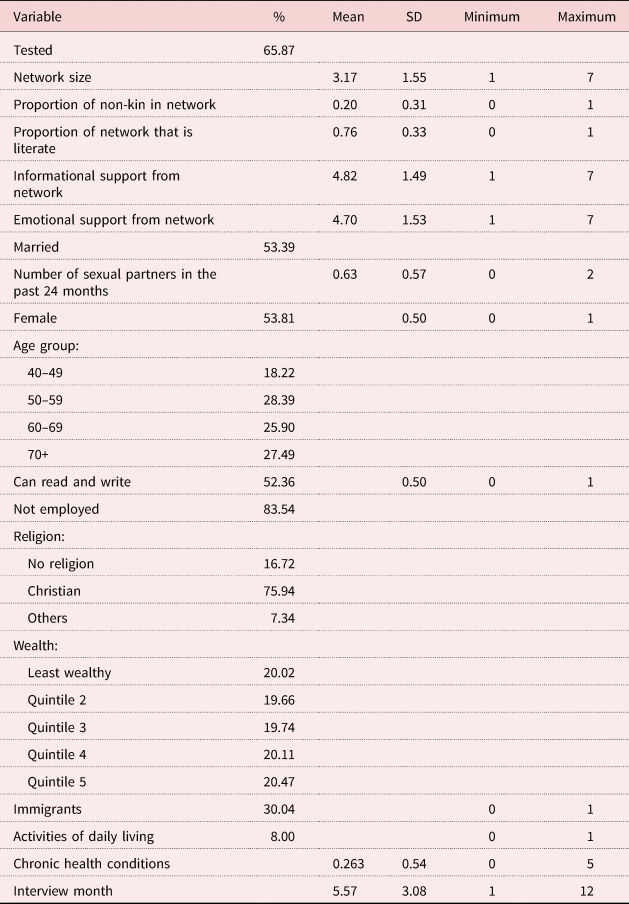
Table 1 displays descriptive statistics. About two-thirds of respondents answered that they have ever been tested for HIV. Respondents averaged just over three network members, with non-kin representing approximately one out of five of the alters. On average, just over three-quarters of people's network members could read and write. Respondents answered that they received informational and emotional support, on average, nearly ‘once a week’ (4.82 and 4.7, respectively) from network members. As for additional demographic, socio-economic and health characteristics of the sample, just over half of respondents were married and the average number of sexual partners in the past 24 months was 0.63. The sample was split almost evenly according to literacy status, and 84 per cent of the respondents were not currently working. Only about 8 per cent of the sample indicated that they have one or more difficulties in activities of daily living and the average number of chronic health conditions was 0.26.
Descriptive statistics

Notes: N = 4,660. SD: standard deviation.
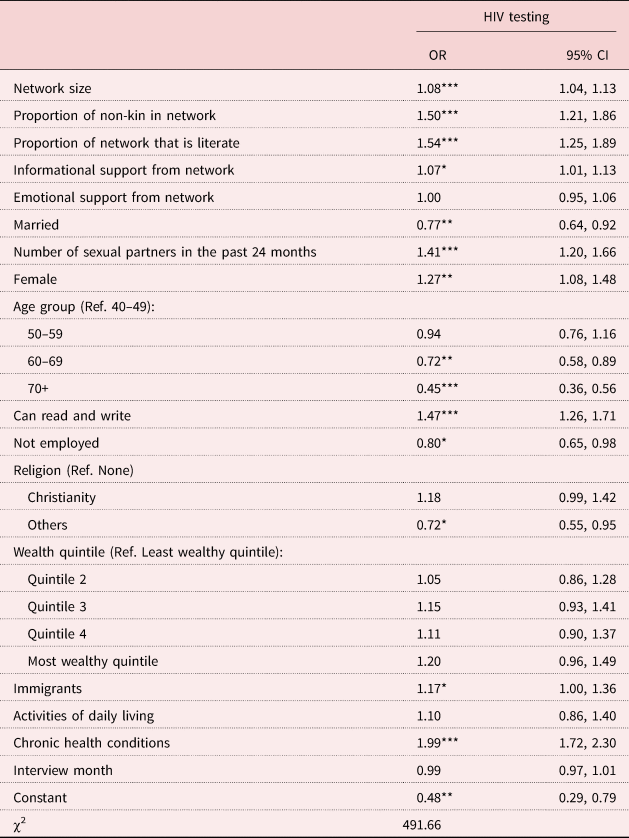
Moving to our hypothesis tests, Table 2 shows the estimated odds ratio (OR) of HIV testing associated with multiple network characteristics. Hypothesis 1 is supported, as each additional social network alter is linked to a 1.08 increase in the odds of HIV testing (p < 0.001). To put this relationship in the context of predicted probabilities, going from smallest network size (one alter) to a network of seven is associated with a 10 percentage point increase in testing likelihood (0.63–0.73).
Multivariate logistic regression analysis

Notes: N = 4,660. OR: odds ratio. CI: confidence interval. Ref.: reference group.
Significance levels: * p < 0.05, ** p < 0.01, *** p < 0.001.
The proportion of network non-kin was also positively associated with HIV testing. Compared with those who only reported kin in their social network, those who only reported non-kin ties showed a 50 per cent increase in the odds of HIV testing (OR = 1.50; p < 0.001). Moving from a network of 25 per cent non-kin to a network of 75 per cent non-kin predicts an increase in the predicted probability of testing from 0.66 to 0.71. This finding supports Hypothesis 2.
To assess Hypothesis 3, we turn to network literacy. Compared to those without any literate network members, the odds of being HIV tested increase by a factor of 154 per cent for people with completely literate networks (OR = 1.54; p < 0.001). Again, looking to how predicted probability scores change when going from a network 25 per cent literate to one 75 per cent literate, we would predict an increase from 0.62 to 0.66 in the likelihood of testing. This supports Hypothesis 3.
Moving to social support, a one-unit increase in average informational support from one's network is associated with a 1.07 increase in the odds of HIV testing (p < 0.05). Emotional support from social network ties was not a statistically significant predictor of HIV testing (OR = 1.00; p > 0.05). Therefore, Hypothesis 5 finds support, while Hypothesis 4 is unsupported.
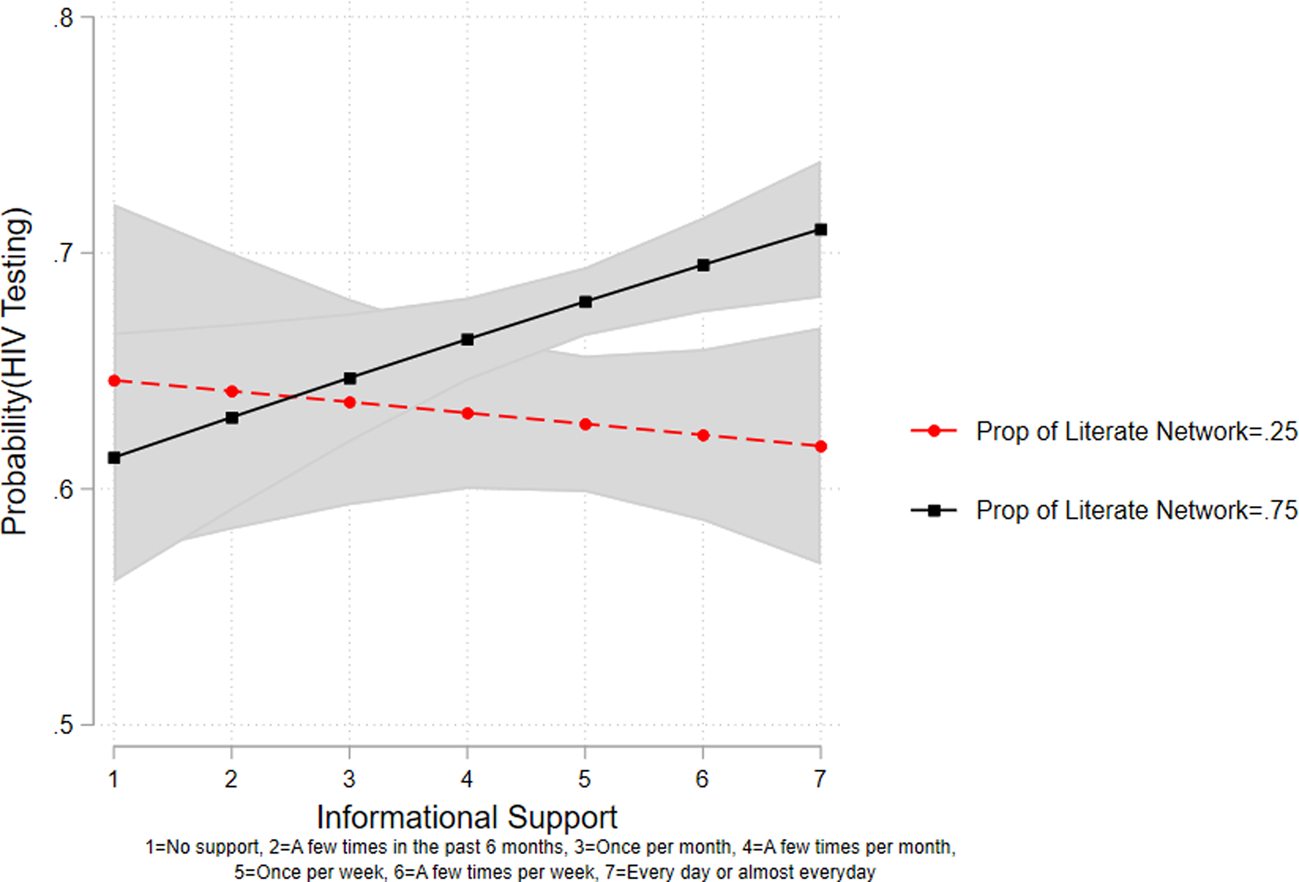
Finally, Hypothesis 6 anticipated a synergy between network literacy and informational support. We therefore re-estimated the multivariable regression model in Table 2 to also include the relevant cross-product term (proportion of literate network ties × informational support). Results, depicted as predicted probabilities in Figure 1, show support for the hypothesis. Specifically, increased informational support from network members is associated with a higher likelihood of testing only if the network has a high literacy level (shown in Figure 1 as 0.75 of the network being literate). High information input appears inconsequential for people with less-literate networks, as indicated by the flat to slightly declining predicted probability value for respondents with networks of only 25 per cent literacy. Confidence intervals, calculated with the delta method, indicate a statistically significant interaction effect.
Predicted probability of HIV testing by proportion (Prop) of literate network ties and informational support.
Notes: Predicted probabilities were generated from the logistic regression model in Table 2, but also adding the multiplicative interaction term between network literacy and informational support. The shaded areas represent the confidence intervals.

Though not the focus of this analysis, a number of covariates were also associated with HIV testing. Married respondents were 0.77 times less likely to answer that they were tested for HIV. The result is in accordance with previous studies on marital relationship and HIV-testing behaviour. On the other hand, each additional sexual partner in the previous 24 months increased the odds of being HIV tested by a factor of 1.41. Women were more likely to be tested for HIV than men, and odds of testing declined across age categories. Similar to the findings for network literacy, an individual's own ability to read and write increased the odds of HIV testing (OR = 1.47), while not working decreased the odds of testing. Compared to those who do not have any religious affiliation, those who identified with non-Christian religions were less likely to be tested for HIV. Immigration status was associated with higher odds of HIV testing. Finally, each additional health issue increased the odds of HIV testing by a factor of 1.99.
Discussion
Prior research reveals that characteristics of people's close social networks have important implications for health seeking. Building on this foundation, the current study investigated HIV testing among older adults in rural South Africa. Our analysis targeted potential interpersonal routes to preventive care because underdeveloped health-care and formal support systems elevate the compensatory role of informal mechanisms in sub-Saharan Africa (Apt, Reference Apt2002; Waweru et al., Reference Waweru, Kabiru, Mbithi and Some2003). Indeed, older adults have limited access to health information and are not the main target of HIV prevention interventions and targeted programming in the region (Negin and Cumming, Reference Negin and Cumming2010). Furthermore, misconceptions prevail among older adults about their own HIV risk (Savasta, Reference Savasta2004; Skevington, Reference Skevington2012). These conditions motivated our hypotheses about informal networks being channels to convey the importance of HIV testing and to inform test recipients about the nearest clinic. On the flip side, social ties who are lacking health knowledge could hinder older adults from active health-seeking behaviour by providing misinformation or superstitious interpretations of health indicators – especially for HIV and other diseases that do not manifest overt symptoms. With this combination of network resources and risks in view, we investigated how multiple social network characteristics are associated with higher or lower testing take-up.
Findings show both commonalities and contrasts with patterns identified for other at-risk groups in other parts of the world. The link between large networks and ever being tested for HIV, for instance, matches earlier studies conducted with young Chinese and Nigerian MSM samples (ZJ Huang et al., Reference Huang, He, Nehl, Zheng, Smith, Zhang, McNabb and Wong2012; D Huang et al., Reference Huang, Hu, Wu, Jia, Lu, Xiao, Raymond, McFarland, Ruan, Ma and Sun2014; Cao et al., Reference Cao, Saffer, Yang, Chen, Peng, Pan, Durvasula, Liu, Fu, Ong, Tang and Tucker2019). The typical interpretation for why network size matters is that, all else equal, larger personal networks are better conduits for information flow.
For network provision of emotional support, on the other hand, our results differ from studies conducted in other settings. Specifically, we uncovered no association between frequency of emotional support received from older South Africans by close network members and likelihood of HIV testing. Prior studies conducted in various global locations among young people have reported a positive association between emotional support and testing (e.g. Mashburn et al., Reference Mashburn, Peterson, Bakeman, Miller and Clark2004; Lypen et al., Reference Lypen, Lockwood, Shalabi, Harper and Ngugi2015; Nall et al., Reference Nall, Chenneville, Rodriguez and O'Brien2019), so the null finding was unexpected. It is possible that emotional support is less effective in reducing HIV stigma among South African older adults than it is for younger adults (Takada et al., Reference Takada, Weiser, Kumbakumba, Muzoora, Martin, Hunt, Haberer, Kawuma, Bangsberg and Tsai2014), but we did not have access to measures of stigma in our data to show whether or not that connection manifested, or to explore what consequence it might have for testing.
The present study also examined features of personal networks that have not been widely studied as predictors of HIV testing, but that appear to have critical implications for resource availability and flow in this population. One such factor is the non-kin composition of personal networks. Our results indicate that older South Africans with networks featuring neighbours, friends and other voluntary ties predicted they were far more likely to be tested for HIV than those who lack such connections. Kin-dominated networks tend to be insular sources of information as they limit exposure to non-overlapping social groups. Discussion of sexual and HIV risk with a spouse or other family members is also considered taboo in rural South Africa (Skovdal et al., Reference Skovdal, Campbell, Nyamukapa and Gregson2011; Conroy, Reference Conroy2014; Siu et al., Reference Siu, Wight and Seeley2014), suggesting that personally tailored information about HIV testing is unlikely to be received if one's network consists only of kin. That said, older South Africans’ networks tend to be quite kin-centred, so the health-seeking benefits of role-diverse close social ties do not appear to be widely actualised in this context.
A second aspect of networks representing resource availability and considered in this study is the literacy of social network members. For rural South African older adults, who are unlikely to be the target of HIV prevention schemes and may interpret HIV/AIDS symptoms as correlates of normal ageing (Emlet et al., Reference Emlet, Gerkin and Orel2009), literate network members can be a crucial source of information. Indeed, the ability to read and write is a form of social capital that could impact HIV-related health-seeking behaviour by facilitating health-promoting behaviours, sharing local HIV-relevant information (i.e. availability of testing centres), and conveying necessary information and knowledge on the insidious virus (i.e. possible symptoms, necessity of tests). The fact that higher network literacy was linked to higher likelihood of testing could also indicate that older individuals embedded in such networks have less exposure to misinformation about HIV/AIDS risk and prevention – a challenge endemic to the AIDS crisis in rural African regions (Kalichman and Simbayi, Reference Kalichman and Simbayi2004; Wreford, Reference Wreford2009; Kuteesa et al., Reference Kuteesa, Wright, Seeley, Mugisha, Kinyanda, Kakembo, Mwesigwa and Scholten2014), but also one cropping up the world over in the face of emerging health crises (Roozenbeek et al., Reference Roozenbeek, Schneider, Dryhurst, Kerr, Freeman, Recchia, van der Bles and van der Linden2020).
Looking beyond the information available through network members, the current study also considered its provision. Few prior studies empirically distinguish informational forms of support from emotional aid, though previous qualitative research among refugees in Uganda suggests that information about HIV testing can be facilitated by network members directly – e.g. advice on getting tested, sharing facts about infection – or indirectly, in the form of knowing of friends and family getting tested (Rouhani et al., Reference Rouhani, O'Laughlin, Faustin, Tsai, Kasozi and Ware2017). Our findings do not specify the informational content flowing through older adults’ networks, but the patterns we observe are broadly consistent with these earlier qualitative results. Importantly, our analysis also indicated that network literacy magnified the association between informational support and likelihood of testing. That is, older adults who had a high proportion of literate network ties were more likely to be tested for HIV only when they received high levels of informational support from them. Returning to the influential call several decades ago by House et al. (Reference House, Umberson and Landis1988), this study distinguishes between structural network properties (resource richness) and the flow of support received from those close contacts, indicating how support can have varied consequences for health-seeking behaviour depending on the network's composition.
There are several limitations of the present analysis. Social networks and their influence on health-seeking behaviour are dynamic and interactive processes and may not be fully captured using cross-sectional ego-centric data. Collection and analysis of longitudinal global network data directly measuring each network member's HIV-related behaviour and demographic data are needed to understand more fully the various ways in which networks shape testing. A second important limitation is that HIV testing is self-reported and is therefore susceptible to recall and social desirability bias. Generalisability is a key limitation. HAALSI data represent a rural older population in South Africa and it is not clear whether the role of social network characteristics would be identical in other older adult populations. Future studies are needed to examine the role of personal networks for HIV testing in urban areas of sub-Saharan Africa and in more developed countries.
Conclusion
This study is the first to consider how different dimensions of social networks (i.e. size, composition, resources) predict HIV testing among older adults in rural South Africa. Our findings build on previous studies showing the importance of social networks for health-seeking behaviour, particularly in their role in facilitating informational resources for diseases with vague symptom profiles (Emlet et al., Reference Emlet, Gerkin and Orel2009; ZJ Huang et al., Reference Huang, He, Nehl, Zheng, Smith, Zhang, McNabb and Wong2012; Veinot et al., Reference Veinot, Caldwell, Loveluck, Arnold and Bauermeister2016). Embeddedness in particular types of networks entail particular configurations of resources and risks that transcend individual-level characteristics. Results from this study have important implications for both public health organisations and policy makers. Social networks should continue to be targeted in HIV prevention and intervention efforts, especially among older adults who do not regularly seek out HIV testing due to inaccurate assumptions about age-based risks (Schatz and Knight, Reference Schatz and Knight2018). Expansion of network intervention research among older adults is needed, since this population is often excluded in the HIV prevention discourse (Negin and Cumming, Reference Negin and Cumming2010).
With the growing number of HIV+ older people around the world, it is becoming increasingly important to understand the ways in which social relationships promote health-seeking behaviour. Our findings document the association between social network characteristics on HIV testing. Hopefully this study will stimulate further research on HIV prevention and health information services.
Data
The Health and Aging in Africa: A Longitudinal Study of an INDEPTH Community in South Africa (HAALSI) project was supported by the National Institute on Aging at the National Institutes of Health (P01 AG041710). This effort is nested within the MRC/Wits Rural Public Health & Health Transitions Research Unit (Agincourt), funded by the Wellcome Trust (058893/Z/99/A; 069683/Z/02/Z; 085477/Z/08/Z; 085477/B/08/Z), the University of the Witwatersrand and the South African Medical Research Council.
Financial support
The HAALSI study is funded by the National Institute on Aging from the National Institutes of Health (P01 AG041710), and is nested within the MRC/Wits Rural Public Health and Health Transitions Research Unit (Agincourt), supported by Wellcome Trust (Grants 058893/Z/99/A, 069683/Z/02/Z, 085477/Z/08/Z, and 085477/B/08/Z), the University of the Witwatersrand, and the South African Medical Research Council. Additional funding was provided by the Canadian Social Sciences and Humanities Research Council (Insight Grant) and the funding source had no involvement in study design; in the collection, analysis and interpretation of data; in the writing of the article; and in the decision to submit the work for publication.
Conflict of interest
The authors declare no conflicts of interest.
Ethical standards
Ethical approval was not required as secondary data was used.