Introduction
Patients with cervical tuberculous lymphadenitis are usually treated based on the pathological diagnosis, even though a definitive diagnosis may be able to be obtained by bacterial culture of Mycobacterium tuberculosis.Reference Dawson, Blacklock, Hayward and Walsh1 International standards for the diagnosis of extra-pulmonary tuberculosis require appropriate specimens from the suspected sites of involvement to be obtained for microscopy and, where facilities and resources are available, for culture and histopathological examination.Reference Hopewell, Pai, Maher, Mukund and Raviglione2
However, excisional biopsy in elderly patients involves greater risks due to the likelihood of poorer physical and mental health. Furthermore, most cases of cervical tuberculous lymphadenitis in the elderly are caused by reactivation, without any other clinical findings related to tuberculosis apart from neck swelling.
Fine needle aspiration cytology (FNAC) is a practical diagnostic method and has been reported to decrease the need for excisional biopsy, although its sensitivity and specificity vary and its usefulness has not been fully established.Reference Lee, Tami, Lalwani and Schecter3–Reference Lau, Wei, Hsu and Engzell5 Detection of M tuberculosis DNA by the polymerase chain reaction technique can be performed to diagnose cervical tuberculous lymphadenitis, using FNAC material.Reference Beak, Kim, Ko and Chu6 However, such testing can be undertaken only when cervical tuberculous lymphadenitis is suspected on initial examination.
The purpose of the present study was to present the clinical characteristics of cervical tuberculous lymphadenitis, and also to determine which investigations are effective to diagnose the disease when caused by reactivation in the elderly. Because elderly patients may not present any other clinical findings related to tuberculosis apart from neck swelling, malignant lymphoma must be considered in the differential diagnosis. Therefore, all patients with a neck lump who underwent excisional biopsy were included in the present study, and we compared the clinical characteristics of patients with cervical tuberculous lymphadenitis versus malignant lymphoma.
Patients and methods
We included in the study 33 patients who underwent excisional biopsy of cervical lymph nodes at the otorhinolaryngology department of the Tokyo Metropolitan Geriatric Hospital between 2002 and 2008. Because the purpose of this institution is to care for elderly people, patients' ages ranged from 63 to 93 years (mean: 78.3), with 32 patients aged over 65. Patients comprised 18 women and 15 men.
The provisional diagnosis of cervical tuberculous lymphadenitis was based on the initial physical examination and the results of ultrasonic tomography and FNAC, while the definitive diagnosis was based on excisional biopsy results in each case.
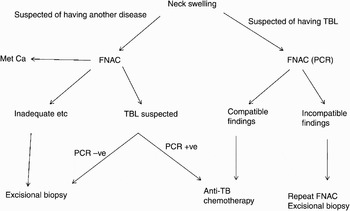
We carried out the following investigation protocol for each patient (Figure 1). All patients underwent FNAC. Polymerase chain reaction for M tuberculosis was performed for patients suspected of having tuberculosis. If patients suspected of having tuberculosis on initial examination had FNAC and/or polymerase chain reaction findings compatible with tuberculosis, then antituberculosis chemotherapy was commenced. If not, FNAC was repeated or excisional biopsy was performed. Patients not suspected of tuberculosis on initial examination underwent excisional biopsy if the FNAC results were non-diagnostic. If FNAC led to a positive result for tuberculosis, polymerase chain reaction was carried out, and antituberculosis treatment was commenced if this test was positive. If polymerase chain reaction showed a negative result, excisional biopsy was performed.
Protocol for investigation, diagnosis and treatment of neck swelling in elderly patients. TBL = tuberculous lymphadenitis; Met Ca = metastatic carcinoma; FNAC = fine needle aspiration cytology; PCR = polymerase chain reaction; TB = tuberculosis

We also compared the results of computed tomography (CT), white blood cell (WBC) and C-reactive protein (CRP) analysis in cervical tuberculous lymphadenitis cases versus malignant lymphoma cases. The excisional biopsy specimen was cultured for M tuberculosis in four cases.
Results
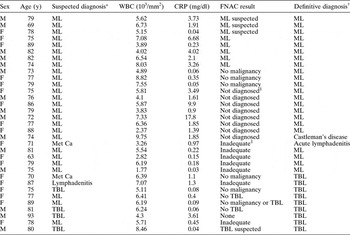
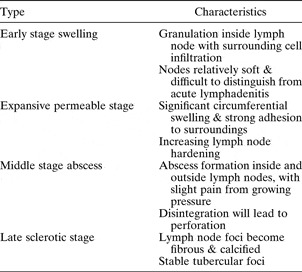
Of the 33 patients, the final diagnosis was cervical tuberculous lymphadenitis in nine, malignant lymphoma in 22 and other diseases in two (Table I). All nine cases with cervical tuberculous lymphadenitis were classified as the early stage swelling type, without any associated characteristic tuberculous findings (Table II).Reference Matsushita7
Results for WBC, CRP, FNAC and excisional biopsy: all patients

*On initial examination; †from excisional biopsy. ‡Unknown. WBC = white blood cell; CRP = C-reactive protein; FNAC = fine needle aspiration cytology; y = years; ML malignant lymphoma; Met Ca = metastatic carcinoma; inadequate = inadequate specimen for diagnosis; TBL = tuberculous lymphadenitis; Not diagnosed = definitive diagnosis could not be obtained
Japanese classification of tuberculous lymphadenitis

Initial investigation indicated suspected malignant lymphoma in 26 patients. Excisional biopsy for these 26 patients gave a final diagnosis of malignant lymphoma in 22, cervical tuberculous lymphadenitis in three and Castleman's disease in one. Cervical tuberculous lymphadenitis was suspected in four cases on initial investigation, and was confirmed by excisional biopsy. The other two patients with cervical tuberculous lymphadenitis were diagnosed on initial investigation as metastatic carcinoma and lymphadenitis, variously.
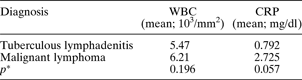
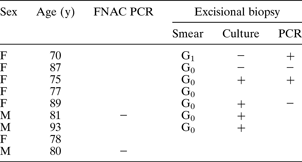
There was no significant difference in WBC or CRP level, comparing patients with cervical tuberculous lymphadenitis versus those with malignant lymphoma (Table III). Furthermore, there was no significant difference in CT findings between these two patient groups. Table IV shows the results for smear, culture and polymerase chain reaction investigations, using the excisional biopsy specimen, in patients with cervical tuberculous lymphadenitis. One of seven cases presented with a positive smear result, while four of six cases demonstrated a positive culture. Two of four cases were positive on polymerase chain reaction using the excisional biopsy specimen.
WBC and CRP: tuberculous lymphadenitis v s malignant lymphoma patients
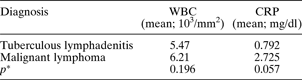
*Welch's t-test. WBC = white blood cell count; CRP = C-reactive protein
Cervical tuberculous lympadenitis patients' results for FNAC, smear, culture and PCR
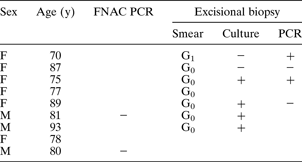
FNAC = fine needle aspiration cytology; y = year; PCR = polymerase chain reaction; F = female; M = male; −= negative; += positive; G = Gaffky
Discussion
Infection with Mycobacterium tuberculosis usually occurs initially in childhood. In most individuals, the disease remains in a subclinical state, and becomes clinically active in only about 10 per cent.Reference Kochi8 Some bacilli remain in the tissues in a latent state for the rest of the individual's life. In countries with low or moderate tuberculosis endemicity, most cases of tuberculosis result from the reactivation of latent infection.Reference Rejagopalan and Yoshikawa9–Reference Hernandez-Pando, Jeyanathan, Mengistu, Aguilar, Orozco and Harboe11 All cases in the current study involved cervical tuberculous lymphadenitis of the early stage swelling type, possibly caused by the reactivation of latent infection.
Fine needle aspiration cytology is regarded as a reliable investigation with which to diagnose cervical tuberculous lymphadenitis, although its reported sensitivity varies (from 46 to 90 per cent).Reference Lee, Tami, Lalwani and Schecter3, Reference Lau, Wei, Hsu and Engzell5, Reference Wright, van der Burg and Geiger12, Reference Yassin, Olobo, Kidane, Negesse, Shimeles and Tadesse13 Previous reports have assessed the efficacy of FNAC in diagnosing tuberculous lymphadenitis in patients of all ages in endemic areas. In the present study, only one case was suspected of having cervical tuberculous lymphadenitis based on FNAC.
The combined use of FNAC and tuberculin skin testing in patients suspected of tuberculous lymphadenitis is reportedly effective.Reference Lau, Wei, Kwan and Yew14
Polymerase chain reaction testing for M tuberculosis DNA, using the FNAC specimen, can be a useful and less invasive test for diagnosing cervical tuberculous lymphadenitis, and it can reduce the need for an excisional biopsy.Reference Beak, Kim, Ko and Chu6, Reference Purohit, Mustafa and Sviland15 However, in patients with cervical lymphadenitis but no other tubercular findings, such polymerase chain reaction plus tuberculin skin testing may be infrequently performed, because tuberculous lymphadenitis would not usually be included in the differential diagnosis. Thus, achieving a diagnosis of extrapulmonary tuberculosis is largely dependent on the physician's suspicions in respect of the disease.Reference Yoon, Song and Park16
A definitive diagnosis of cervical tuberculous lymphadenitis can be made through bacterial culture. When FNAC obtains purulent material, this should be cultured for mycobacteria.Reference Lau, Wei, Hsu and Engzell5 However, cases of the early stage swelling type, as in the present study, show abscess formation only infrequently. A small amount of specimen collected by FNA may lead to a high rate of false negatives on polymerase chain reaction. Furthermore, it has been reported that cultures of infected material are frequently false negative, as is the acid-fast bacilli smear.Reference Alleva, Guida, Romo and Kimmelman17
Although the serum CRP concentration is used to indicate tuberculosis activity, our study showed no significant difference in this parameter, comparing tuberculous lymphadenitis and malignant lymphoma cases.Reference Djoba Siawaya, Bapela, Ronacher, Veenstra, Kidd and Gie18
Our cases with cervical tuberculous lymphadenitis of the early stage swelling type lacked significant CT findings, compared with malignant lymphoma cases.
In the present study, a final diagnosis of cervical tuberculous lymphadenitis could be made based on histological findings, using excisional biopsy specimens. Lymph node biopsy specimens could be employed for acid-fast bacilli smear, culture and polymerase chain reaction. Positive results for these investigations were considered to represent additional support for a definitive diagnosis. In our study, only one case showed a positive smear using the excised specimen, while a positive culture was frequently obtained using the excised specimen.
In endemic areas with low rates of tuberculosis, most cases of cervical tuberculous lymphadenitis in the elderly are caused by reactivation. It is wise to remember that this disease mechanism differs from that of initial mycobacterial infection in younger people in areas of high tuberculosis endemicity.Reference Beak, Kim, Ko and Chu6, Reference Wright, van der Burg and Geiger12, Reference Yassin, Olobo, Kidane, Negesse, Shimeles and Tadesse13 The clinical characteristics of cervical tuberculous lymphadenitis in the elderly are similar to those of malignant lymphoma, and a definitive diagnosis can only be made from histological examination of an excisional biopsy specimen. Other examinations, including FNAC, blood tests, CT and polymerase chain reaction for M tuberculosis, can supply supportive data.
• Cervical tuberculous lymphadenitis in elderly people is often caused by reactivation
• The clinical presentation differs from that of primary mycobacterial infection in endemic areas, making diagnosis (by fine needle aspiration cytology or polymerase chain reaction) difficult
• In elderly patients with lymph node swelling, the possibility of tuberculous lymphadenitis should not be discounted without performing an excisional biopsy, unless there is a clear alternative diagnosis
Cervical tuberculous lymphadenitis should always be considered in patients with slowly progressing cervical lymph node swelling, especially in the elderly. When it is not initially suspected, tuberculous lymphadenitis may lie undetected.
Conclusion
Cervical tuberculous lymphadenitis in elderly people is often caused by reactivation. It presents a different clinical picture to that of initial mycobacterial infection in an endemic area, and this makes diagnosis by FNAC or polymerase chain reaction difficult. When assessing lymph node swelling in elderly patients, the possibility of tuberculous lymphadenitis should not be discounted without performing an excisional biopsy, unless there is a clear alternative diagnosis.