1. Factors contributing to attrition
The occurrence and extent of L1 attrition, the non-pathological decrease in language proficiency in the individual (Köpke and Schmid, Reference Köpke and Schmid2004), is influenced by several determinants. Among the most important ones are: age at the onset of L2 acquisition, age at the onset of L1 attrition, time elapsed since the onset of L1 attrition, the speaker's level of education, the speaker's attitude towards her languages, and the amount, frequency and settings of use of the attriting language (Köpke and Schmid, Reference Köpke and Schmid2004).
Additional factors have to be taken into account when judging the language production of older bilinguals. Attrition refers to increasing problems with the accessibility and the retrieval of formerly available linguistic knowledge. These problems can be due to a state of ‘untrained-ness’ (Schmid, Reference Schmid2004) because of lack of exposure and practice. Retrieval problems, however, especially with respect to the lexicon, are also typical of cognitive aging (Salthouse Reference Salthouse1996; Zacks, Hasher and Li, Reference Zacks, Hasher, Li, Craik and Salthouse2000). Further, the activation thresholds of L1 and L2 items play a role (Green, Reference Green1986, Reference Green1998; Köpke, Reference Köpke2002; Costa, Colome, Gomez and Sebastian-Gallés, Reference Costa, Colome, Gomez and Sebastian-Gallés2003; Paradis, Reference Paradis2007). The activation threshold is higher for rarely used items than for more common ones (Fabbro, Reference Fabbro2002), and, although the threshold is lowered each time an item is activated, it subsequently starts rising again until its next activation (Köpke, Reference Köpke2002, Reference Köpke2007; Paradis, Reference Paradis2004, Reference Paradis2007). Thus, the “threshold is subject to permanent fluctuation, depending on frequency and recency of activation” (Köpke, Reference Köpke2002, p. 121). In the case of long-term contact between two languages in one individual, resulting in L1 attrition, the dominance of the L2 (in the speaker and in the environment) lowers the activation level of L2 items. Therefore it takes more resources to inhibit the L2 before the L1 (where items have higher activation thresholds) can be accessed, and these resources also appear to be more limited in older speakers (May, Zacks, Hasher and Multhaup, Reference May, Zacks, Hasher and Multhaup1999; Zacks et al., Reference Zacks, Hasher, Li, Craik and Salthouse2000). Finally, language change and convergence, as the results of long-term bilingualism and exposure to the L2, can additionally blur the image of the speaker's L1 proficiency.
2. The study
2.1 The informant
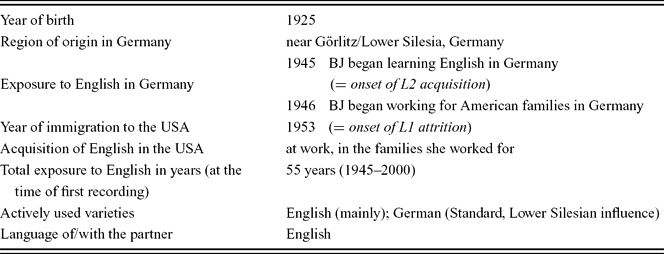
In our case study we investigated data from a female German immigrant to the USA, BJ, who was born and brought up in Lower Silesia, which is at today's border of Germany and Poland. In 1953, at the age of 28, she immigrated to the USA where she had been living for almost 50 years at the time of the first recording. BJ is married to an American who has a limited command of German. They speak English with each other almost exclusively. BJ's first visit to Germany took place in 1961, her last one to date in the early eighties. She has no intention of returning to Germany to live there, a factor that may influence the extent of attrition (Fuller and Lehnert, Reference Fuller and Lehnert2000). Table 1 provides BJ's biographical dates and background.
BJ's biographical background.
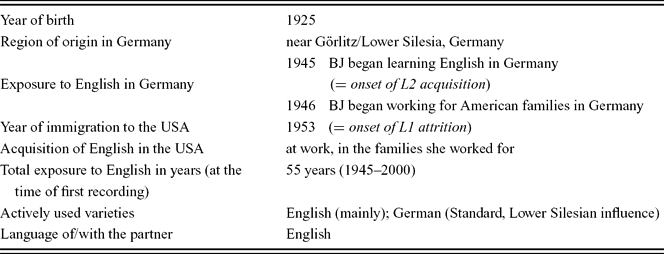
After her immigration and prior to the recordings, BJ spoke English almost exclusively. As she only has loose ties to one relative living in Germany, opportunities to receive German input as well as to speak German are rare, and her exposure to German in daily life is highly limited to non-existent. Against this backdrop, the conversations initiated and recorded for the purpose of the present study constituted a considerable increase in BJ's exposure to German in terms of both perception and production.
2.2 The data
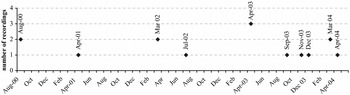
The data were collected by two fully bilingual German–English interlocutors (EL, RT) and consist of recordings of free, informal conversations, e.g. at the dinner table, in the company of friends, or over coffee and cake.Footnote 2 There were a total of 15 conversations between the years 2000 and 2004 at intervals of between less than one month and 11 months. Out of the total approx. 23 hours of recordings, we analyzed 12.5 hours (eight recordings), limiting the investigation to those conversations where only the informant and either one or both investigators, but no other persons, were present. This was done to ensure the comparability of the data over time. Thus, the main independent variable is the increase in exposure to German but not situational or interlocutor-related factors (see Table 2 and Figure 1).
Overview of the analyzed recordings.

Distribution of all recordings with BJ.

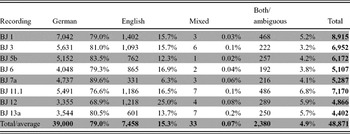
The topics of these conversations include the informant's childhood in Germany, experiences during World War Two, work experience in Germany and the USA, reasons for the speaker's emigration, her life in the USA, and her art work (a very important part of her current life). All of BJ's utterances (totalling about 49,000 words) were analyzed. For an estimate of the surface level amount of German and English in her utterances, see Table 3, which shows the distribution of German, English, mixed and ambiguous words across the analyzed recordings.
German, English, mixed, ambiguous words (numbers and percentages).

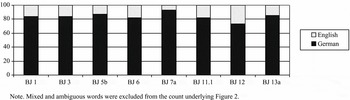
While German is the language that is dominantly used during all recordings, there is a certain amount of code-switching into English. The ratio of German to English words is represented in Figure 2. As this figure illustrates, the ratio of German to English in BJ's speech remains fairly constant over time,Footnote 3 with no consistent proportional increase in her use of German.
German and English words across all recordings (in percentages).

3. Data analysis
3.1 Methodology
Eight recordings were selected, following the criteria laid out above (section 2.2) and were analyzed with respect to lexical-semantic, syntactic and morphological deviations from Standard German (while taking into account Lower Silesian characteristics). In addition, we investigated the occurrence of different language mixing phenomena (code-switching, loan translations, blends, etc.). In this paper, we concentrate on BJ's German and the deviations we found, because our focus here is on assessing the extent of attrition in the different areas of BJ's first language, and its decrease in the course of the recordings. We expected such a decrease to result from renewed contact with German native speakers and a consequent rise in German input, as well as from more practice through BJ's increased use of her native language.
As discussed in other studies (e.g. Schmid, Reference Schmid, Köpke, Keijzer and Weilemar2004), finding a point of reference against which to measure what to consider as deviant is not trivial. Andersen (Reference Andersen, Lambert and Freed1982) and Jaspaert, Kroon and Van Hout (Reference Jaspaert, Kroon, Van Hout, Weltens, de Bot and van Els1986), for instance, recommend that the point of reference for an attrited speaker's L1 be “the level of language proficiency a language user is supposed to have had at some earlier moment in time” (Jaspaert et al., Reference Jaspaert, Kroon, Van Hout, Weltens, de Bot and van Els1986, p. 43). In our case, we did not have data from the same speaker from a time before her emigration. Also, due to the political and demographic changes after World War Two, BJ's native variety of German, Lower Silesian (an East Middle German variety), is not spoken anymore in her region of origin; thus it was not possible to establish a control group. Therefore we used Standard German as a point of reference, supplemented by a recording of a monolingual dialect speaker from the same region of origin. This recording, with the identification number OS 534, was made available by the Institut für Deutsche Sprache (IDS) Mannheim. The speaker is female, born in 1885; the recording took place in 1963.
In the absence of a more precise point of reference, we decided on this option, although we are aware of the fact that today's Standard German may deviate from the Standard German of the time before BJ emigrated and that, as pointed out, BJ most likely did not speak Standard German but Lower Silesian, or a blend of the two. One main phonological feature of this variety is the particular realization of [r] as the retroflex approximant /ʵ/, which is very close to the American pronunciation. The assumption that this is indeed the variety which BJ uses received strong support from the comparison of BJ's German speech with the recording mentioned above. This comparison was important to avoid a misinterpretation of BJ's pronunciation pattern as indicating a strong English influence on her German down to the phonological level.
3.2 Results
The issues we investigated in relation to BJ's data were:
1) which phenomena appear to a constant extent across all the recordings, thus over time and in spite of renewed contact with German;
2) which phenomena show changes in the extent to which they appear across the recordings.
We hypothesized that an unchanged amount of occurrence should imply a permanent loss, while decreasing frequencies indicate that these areas were only temporarily affected by attrition, and that this effect can be, and in the case of BJ has been, partly reversed by renewed contact with German.
What remains constant?
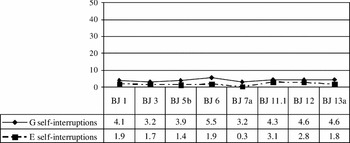
The number of self-interruptions is, on average, fairly constant in both languages; there is no indication of a consistent increase or decrease over the time of the recordings. Self-interruptions are more frequent in BJ's German (3.2%–5.5%) than in her English (0.3%–3.1%), implying a difference in her ability to phrase and structure her utterances in the two languages (see Figure 3).
Overview of BJ's self-interruptions in German (G) and English (E) across the analyzed recordings (per 100 words of the respective language).

Most of the self-interruptions occur around syntactic structuring difficulties, often involving a re-ordering of the same or similar words (example (1) below), and less in the context of purely lexical retrieval problems (word searches). Syntactic structuring, then, seems to be an area that is vulnerable to attrition and does not easily recover with increased input (although there seems to be a qualitative change, as is discussed below).
What changes?
For all structural deviations, we found corresponding correct, or standard-like, occurrences of the same category (e.g. correct case marking, correct word order, etc.). That is, these deviations reflect a slowly emerging optionality (Sorace, Reference Sorace2000) in various structural features of BJ's German, while there is no evidence for a complete loss of correct forms.
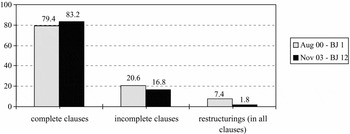
While BJ produces complex sentence structures with correct word order and morphological inflections (e.g. case on determiners, adjectives or nouns in complex DPs) in all recordings, earlier recordings contain more incomplete clauses than later ones. For two of the analyzed recordings we quantified this development by comparing the numbers of complete clauses, incomplete clauses and instances of restructured clauses (clauses that include one or more self-interruptions followed by a restructuring), as illustrated in Figure 4. An instance of an incomplete clause is provided by the section wenn's shark attack “if it shark attack” in example (1). The larger context of this utterance is a conversation about reports of shark attacks on swimmers. BJ tries to explain that in her husband's opinion in most reported cases the attacking animals had not been sharks but blue fish.Footnote 4
Complete clauses, incomplete clauses and restructurings (in percentages of the total number of clauses for each recording).

(1)

Usually, BJ's incomplete clauses do not disrupt the discourse because they can easily be understood from the context. Therefore, there is no immediate need for her to complete or correct them. Nevertheless, their number decreases over the time of the recordings, a development we attribute to the increased input and practice in producing German that BJ experiences through the conversations with RT and EL, offering evidence for the reversibility of (at least certain) attrition phenomena.
Based on our estimate of BJ's original L1, we found deviations in the following areas:
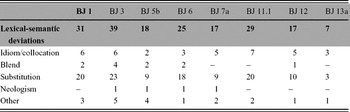
(i) Lexicon/semantics: lexical deviatons with respect to words, expressions, idioms (Table 4).
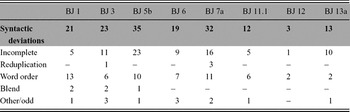
(ii) Syntax: word order, such as finite verb placement; incomplete structures, reduplications (Table 5).
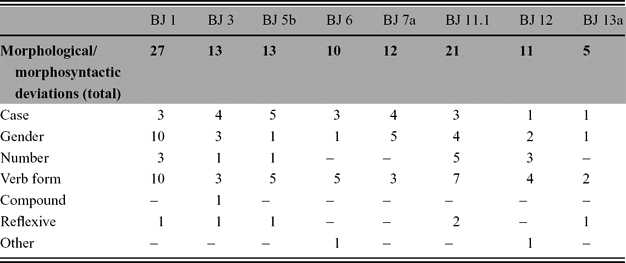
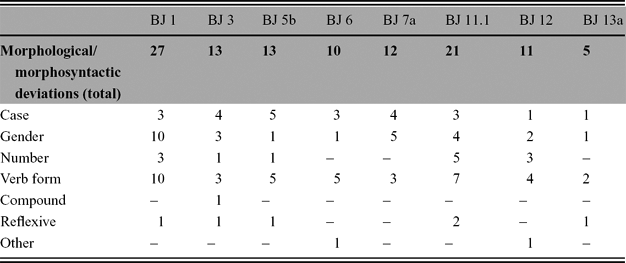
(iii) Morphology: case-, gender-, plural-marking, and verb morphology (Table 6).
Lexical-semantic deviations.

Syntactic deviations.

Morphological and morphosyntactic deviations.
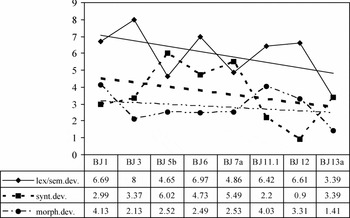
Four years after the recordings started, BJ's German appears noticeably more fluent than at the beginning. A number of quantified changes support this judgement:
• While the number of lexical-semantic, syntactic and morphological deviations from the standard is low compared to the total number of utterances and number of words investigated, there was nevertheless a decrease between the first and the last analyzed recording (see overview in Figure 5). This implies that BJ has recovered some of her temporarily lost language skills.
• The amount of BJ's self-interruptions does not show a uniform direction of change over the time of the recordings; she breaks off more frequently in German than in English linguistic contexts, but the overall rate does not increase or decrease consistently in either language (see Table 4 and Figure 3).
• The ratio between German (on average around 80% of all words) and English remained constant over the time of the recordings. That is, German is the (silently) agreed-upon language of conversation but slips and switches into English occur and are not a hindrance to communication because all participants are bilingual (see section 2.2, Table 3 and Figure 2).Footnote 6
Overview of attrition phenomena in BJ's German across the analyzed recordings (per 1000 German words).

Certain tendencies can be noted, even though the numbers are quite low in all areas, and in fact too low to draw definite conclusions.Footnote 7
• Compared to the other areas of deviation, lexical-semantic deviations and retrieval problems are the highest in number in the beginning and decrease the most, and most consistently, over the time of the recordings.
• The amount of syntactic deviations (including deviant verb placement in main and subordinate clauses as well as ‘weaker’ deviations such as unusual extrapositions or the misplacement of modal particles) is unstable and fluctuates more than in the other areas, with a slight tendency for decrease.
• Morphological deviations (e.g. gender- and case-marking, verb morphology) are distributed fairly evenly, with a barely decreasing tendency.
3.3 Discussion
Discussion of deviations
The following examples and their discussion illustrate the types of deviation exhibited in BJ's data.
Lexicon/semantics: lexical deviations with respect to words, expressions, idioms (Table 4)
Examples (2)–(4) illustrate BJ's intent to use idiomatic German while, at the same time, they reflect her insecurity with respect to certain fixed expressions, resulting in interference from English (example (2)), replacement with a semantically related word (example (3)) and a rephrasing, partly under the influence of English (example (4)).Footnote 8
(2)

(3)
(4)
Example 4 is interesting because it becomes clear from the conversational context that BJ intends a metaphorical meaning, referring to the thread of a story one of the interlocutors is telling. Her phrasing and choice of verb (brechen “break”, which here, probably due to English interference, substitutes for the proper lexical item reißen “rip”) would rather be used (and understood) in a literal sense by a non-attriting native speaker of German. So what we find here is a blending of the literal and the metaphorical level, with additional lexical interference from English.
Syntax: word order, such as finite verb placement; incomplete structures and reduplications (Table 5)
With respect to verb placement we found violations of German verb-second and verb-end placement regarding main clauses (example 5) and subordinate clauses (example 6).
(5)
Example 5 is an instance of missing verb-second placement in a German main clause. The inflected element (the copula is(t) “is”) follows the subject and appears in third position in the clause, rather than following the first constituent für mich “for me”, as would be grammatical in German. This placement parallels the required pattern for English (verb following subject).
In the context of the following example BJ proposes that harsh criticism should be avoided when commenting on a person's behavior, but making suggestions would be acceptable for her.
(6)
In the subordinate clause in example (6), the position of the finite verb denkt “thinks” parallels verb placement in German main clauses in that the verb appears in second position, following the first constituent in the clause, man “you” (not counting the complementizer wenn “when, if”), and it also coincides with English word order. This instance, like example (5), reflects an emerging optionality on BJ's part with regard to German verb placement. While there are many instances where her verb placement is non-deviant, we find a few cases like this, where interference from English, at least with respect to surface word order, seems to play a role.Footnote 9 Such deviations can be interpreted as a beginning tendency towards reducing the verb placement asymmetry in German between main and subordinate clauses, an asymmetry that is not found in English, where word order is the same in main and subordinate clauses.
Morphology: case-, gender-, plural-marking, and verb morphology
Morphological deviations are not frequent in BJ's data (see Table 6 and Figure 5). Across all recordings there is a total of 111 items showing morphological or morphosyntactic deviation, distributed as in Table 6.
Case and gender deviations of the type found here have also been reported in other attrition studies (Köpke, Reference Köpke2001, Reference Köpke2002; Schmid, Reference Schmid2002; Gross, Reference Gross2004; Hutz, Reference Hutz2004; Münch, Reference Münch2006; among others). BJ occasionally substitutes accusative for dative case marking (example (7)), a pattern also found in German first language acquisition and in contact-induced language change (Clahsen, Reference Clahsen1984; Jordens, De Bot and Trapman, Reference Jordens, De Bot and Trapman1989; Keel, Reference Keel, Berend and Mattheier1994; Stolberg, Reference Stolberg2007).
(7)
Gender deviations, as in examples (8) and (9), are infrequent. In example (8), Schüssel “bowl” is marked neuter instead of feminine. Auf dem einen Stelle “at this one point” (example (9)) is ambiguous and could be either masculine or neuter, again instead of feminine (non-attrited German: auf der einen Stelle). A tentative hypothesis is that there is a tendency to replace the non-neuter gender of inanimate entities with neuter (following the English pattern), but the number of deviating gender markings is too small in BJ's data to allow a safe conclusion.
(8)
(9)
Example (10) below provides an instance of deviant verbal morphology. Instead of vorgeschlägt, the proper form of the participle should be vorgeschlagen. Here, BJ provides a regularized form rather than the correct strong one in that she somewhat adjusts the verb form to that of weak participles (the fully regularized form would be vorgeschlagt, without the umlaut). This can be either the result of a simplification tendency (where irregular verb forms are replaced by more regular ones), or of a default strategy for cases where BJ cannot access or is not sure of the correct morphological form.
(10)
Self-interruptions and explicit word searches
In addition to assessing deviations, we quantified BJ's self-interruptions (Figure 3 above), i.e. break-offs followed by a fresh start, a self-correction or restructuring, and explicit word searches where BJ herself indicates that she is missing a word. The following examples illustrate the type of utterance we considered in this category.
Self-interruptionsFootnote 11
In the following two examples, BJ interrupts herself repeatedly to restart her clause. In example (1), repeated here as example (11), she seems undecided and is possibly searching for the proper word or structure to express her concept. Eventually, the subordinate clause is left imcomplete (wenn's shark attack “when it shark attack”). The following main clause, if it is considered a sentential unit with the subordinate clause, exhibits the same type of verb placement irregularity as example (5) above: The finite verb sagt “says” follows the subject instead of preceding it and appearing in verb-second position, after the subordinate clause as the first constituent. In this specific case, deviant verb placement may either be the result of planning difficulties in the preceding clause, and as such a consequence of attrition in another area (the lexicon); or it could be an indicator of attrition in the syntactic component in the strict sense.
(11)
In example (12), BJ expands her structure with every fresh start until she arrives at a structure she considers complete. This utterance gives the impression of a speaker who likes to reshape her utterances until they fully comply with her own standards, unlike example (11), where structural and lexical insecurities force the speaker to restructure her clause. Note that example (12) is taken from one of the later recordings, thus at a point in time when a certain training effect can be assumed to have set in due to BJ's renewed contact with German.
(12)
Explicit word searches
Explicit word searches are often accompanied by self-interruptions. In the case of a word search, however, the fresh start usually does not contain a restructuring of a previously produced phrase. The explicit request for a lexical item was our criterion to consider these utterances as belonging to a category different from self-interruptions with the goal of building a proper or more complete structure.
Examples (13)–(16) demonstrate how BJ draws on the resources of her interlocutors to bridge her own lexical gaps. Note that she usually first tries to frame her request in German; only if that strategy fails, does she resort to English for retrieving the proper lexical item.
(13)
(14)
(15)
(16)
Besides explicitly asking for a missing lexical item, BJ has a number of covert strategies to solve lexical retrieval problems: If she fails to access a lexical item in German on-line, she either switches to and continues in English, or she hesitates until she can retrieve the item herself or until it is provided by one of the other interlocutors. These strategies can co-occur with self-interruptions, as examples (17) and (18) demonstrate.
Syntactic restructurings can be used to mask lexical retrieval problems (example (17)), and, in this sense, the two areas cannot be strictly separated from each other.
(17)
This restructuring could reflect the delayed inhibition of wir waren s[ehr glücklich] “we were very happy”. This is not the meaning BJ intends to convey, however, as her self-correction demonstrates. In English, we were very happy and we were very lucky exhibit the same syntactic structure. In German, there is a difference in structure matching the difference in meaning: wir waren sehr glücklich corresponds to we were very happy (with a parallel structure in German and English), while we were very lucky is expressed by wir haben sehr viel Glück gehabt (roughly: “we had much luck”). We propose that in example (17) BJ started out with wir waren s[ehr glücklich], triggered by the English pattern which she is not able to inhibit immediately. She breaks off and corrects herself after successfully having retrieved the proper German expression.
In example (18), there does not seem to be any competition with English, either regarding the structure or a lexical item. The only candidate for a possible retrieval problem seems to be durcheinander “in a jumble; messy”. Note that there is no close English equivalent for the use of durcheinander in combination with gehen “go” as in the German construction durcheinander gehen “be messy/confused/in a jumble”. Thus, there is no corresponding English item that BJ could use as a bootstrap to access the German item.
(18)
General discussion
Some of the deviations that our data exhibit fall in with general tendencies also found in long-term contexts of contact-induced language change. Syntactically, in main clauses, the finite verb can follow the subject irrespective of other fronted elements (i.e. instead of strictly appearing in verb-second position); in subordinate clauses, the verb can occur in main clause position (verb-second) rather than in clause-final positition. Morphologically, accusative begins to replace dative case; inanimate entities with feminine gender are occasionally changed to neuter (or masculine), along the lines of the English default pattern of gender assignment; irregular verbal morphology is changed in the direction of more regular forms.
The most essential changes across the recordings, however, are reflected in the accessibility of lexical items. A training effect seems to have set in, beginning with the onset of the recordings and helping BJ to recover language skills that had temporarily become inaccessible. Only those topics she commonly talks about in English are still marked by hesitations and word searches, especially if they require specific terms. This happens for instance when she describes the techniques she employs in her art work. In some of these cases, the problems are probably not only due to retrieval difficulties but also to occasional lexical gaps in BJ's German.Footnote 13 In the first recordings, in contrast, we find more word searches and hesitations, also to do with fairly common German lexical items (e.g. “disadvantage” – Nachteil). In later recordings, BJ's German lexicon appears to be more easily accessible for her, reflected by fewer hesitations with respect to everyday items, fewer explicit word searches, and code-switching for discourse-structuring reasons rather than for avoiding lexical retrieval problems in German.
We found accordingly that the patterns underlying BJ's switches to English change: In the beginning, she often appears to switch into English out of need, i.e. because she is missing the right word or expression in German to fit the concept she has in mind, or because she “gets stuck” in a German syntactic structure she does not know how to finish. She then interrupts herself and switches into English to keep up the conversation, as illustrated by examples (19)–(21):
(19)
(20)
(21)
In later recordings, BJ's code-switches are more often motivated by considerations of discourse structure, e.g. to mark a quotation (example (22)) or a comment (example (23)), with fewer cases left to be interpreted as avoidance or as a result of lexical retrieval problems.
(22)
(23)
Our results with respect to BJ's data have to be understood in the context of a speaker who, in spite of rarely using her L1 for a long time, is able to converse on a high level of language proficiency. The fact that about 80% of each recording is in German points towards her excellent ability to keep up a fluent conversation in this language, conveying a wide range of concepts, ideas and thoughts. Further, as we mentioned above, her utterances contain instances of highly elaborate sentence and discourse structures even in the earliest recording.
4. Conclusion
The findings presented above suggest that in BJ's case the lexicon was most affected by attrition and has recovered the most, while the development in the structural areas investigated is less predictable (especially in syntax). On the morphological level, a reversal of attrition is least detectable.
Developments such as fewer explicit word searches, fewer lexicon-driven switches to English and fewer hesitations indicate a revitalized accessibility of BJ's German lexicon. We therefore argue that it is first and foremost this accessibility of BJ's linguistic knowledge that had been impaired by attrition, not the knowledge itself. This matter is closely linked to the question of permanent or temporary loss: We propose that, if loss can be reverted and thus turns out to be temporary, it must be the accessibility (a performance factor) that has been affected by attrition, not the speaker's language competence.
It is worth noting that BJ does not mix her languages much, which can be due to her biographical background. BJ immigrated on her own and is married to an American with whom she speaks English only, and she had no social contacts in the USA with whom she used German before the beginning of the recordings. Therefore, there were hardly any opportunities for her to mix. These conditions might explain why there are so many structures still intact in BJ's German. There is little convergence with English, and it is not systematic or habitualized. Thus, even though BJ exhibits retrieval problems and signs of attrition resulting from lack of exposure, her German language proficiency at large seems to be affected surprisingly little by language loss, leaving the impression that much of her German was preserved on the level it was at when she emigrated, including complex sentence structures and elaborate case marking. Louden (Reference Louden, Greenhill, Littlefield and Tano1999, p. 428) alludes to the idea that a language “may be ‘frozen in time’ and then quickly ‘thawed out’” when he refers to Kaspar Hauser's language production which seemed to be at the level of a four-year-old's language development at his first public appearance at age 16. In terms of L1 attrition (and its reversal), Kasper Hauser's case is unique because L1 attrition is usually accompanied by an increase in L2 proficiency and often difficult to separate from other factors. In the (unfortunate) case of Kaspar Hauser, there was no diffusion of attrition with bilingualism and L2 interference because he apparently was not exposed to any language at all.
The case of BJ supports the idea of a language being preserved at a specific level of competence that can be reached again quickly as soon as this language is used again, even when an active L2 exists. The degree to which the languages are ‘kept separate’ by the speaker seems to play a role, however.
In bilinguals who often are in contexts that permit code-switching and who use English and German in frequent alternation, language change and convergence are more likely to result. As a consequence, it can be difficult to determine the speakers’ L1 proficiency.
We found this to be the case for a group of informants who immigrated to the USA with their families (parents and sister or husband) and who have been living in a ‘mixing-friendly’ linguistic environment (family and friends) for over fifty years (Lattey and Tracy, Reference Lattey, Tracy and Ureland2001, Reference Lattey, Tracy, Hinnenkamp and Meng2005; Münch and Stolberg, Reference Münch, Stolberg, Preisler, Fabricius, Haberland, Kjaejbeck and Risager2005). These informants code-switch freely when in a bilingual setting and thus use German much more often than BJ does. Consequently, they rarely experience accessing or retrieval problems in German (in free conversation). It appears, however, that they do not use complex syntactic structures to the same degree as BJ, nor is their morphological marking as rich. While we did not analyze these differences in detail, we propose that not speaking German in the USA helped preserve BJ's L1 fairly unchanged, while speakers who habitually use German and English in the same settings are more prone to convergence across their language systems. That is, in the latter case, attrition takes a different route, reflecting processes of contact-induced change and convergence, and results in different ‘symptoms’ from the attrition type we find in BJ. This matter offers a promising area for future research.
We conclude by letting have BJ the last word:
[BJ:] und wenn ich ihm geschrieben hab’, dann hat er sich den Brief genommen und dann hat er geguckt, was da alles falsch war, das er mir erklären müsste, und das ist nicht, und das ist nicht- und- [RT laughing] da hab ich einmal geschrieben oder sagte ich was; sag’, ich weiss das nicht, wie auf deutsch h/ [louder, with a deep voice:] ja, die Muttersprache vergisst man nicht, ja sowas gibt's ja gar nicht! [RT: hm] [RT, BJ laughing] [BJ, normal voice:] Ich bin ein Mensch, ich vergesse.
[and when I wrote to him, then he took the letter and then he looked what was wrong in it that he had to explain to me, and that is not, and that is not, and- [RT laughing] one time I wrote to him or said something, said: I don't know what that is in German/ [louder, with a deep voice:] well, but the mother-tongue you don't forget, that's not possible! [RT: hm] [RT, BJ laughing] [BJ, normal voice:] I am human, I forget.]