Introduction
The natural vegetation of the central part of NE Brazil consists mainly of the rather open Caatinga forest, which is inspersed with more closed forest enclaves at higher altitudes, such as islands of the coastal Atlantic rainforest (Thomas Reference Thomas2008). The lichen diversity of this biome is still largely unexplored (Cáceres Reference Cáceres2007).
The epiphytic lichen flora in this whole area is dominated by crustose lichens, with Graphis and Polymeridium as the most speciose genera. The Arthoniales are, together with Ostropales and Trypetheliales, among the main groups in terms of species number and abundance.
The order Arthoniales includes several families, with c. 60 genera and 1200 species in total (Ertz et al. Reference Ertz, Miądlikowska, Lutzoni, Dessein, Raspe, Vigneron, Hofstetter and Diederich2009). Members of this group are an important component of the lichenized mycota in many types of forests, but mostly in tropical regions, where the diversity of corticolous and foliicolous species is high (Cáceres Reference Cáceres2007; Ertz et al. Reference Ertz, Miądlikowska, Lutzoni, Dessein, Raspe, Vigneron, Hofstetter and Diederich2009).
Species which were partly the same, and partly different, were found in the Vale do Catimbau National Park and the Chapada do Araripe, in NE Brazil. The Vale do Catimbau National Park is one of the most important reserves of the Caatinga biome in Brazil. It is a unique place, with an altitude ranging from 800 to 1100 m and with mostly dry and open vegetation, located c. 300 km west of the Atlantic coast. The Chapada do Araripe includes a National Forest reserve, and is an isolated table mountain in Ceará State, further west than Vale do Catimbau, in the middle of the Brazilian semi-arid region. The Araripe plateau, at an altitude of c. 900 m, comprises at least four different vegetation types, including rainforest patches but mostly areas of Caatinga, with Cerrado and Cerradão forests (Sampaio et al. Reference Sampaio, Andrade-Lima and Gomes1981).
Material and Methods
Identification and descriptive work was carried out in Itabaiana, Universidade Federal de Sergipe, using a Leica EZ4 stereomicroscope and a Leica DM500 compound microscope, and also in Soest using an Olympus SZX7 stereomicroscope and an Olympus BX50 compound microscope with interference contrast, connected to a Nikon Coolpix digital camera. Sections were mounted in tap water, on which all measurements were taken. The specimens from this study are preserved in ISE. The chemistry of the type specimens was investigated by thin-layer chromatography (TLC) using solvent A (Orange et al. Reference Orange, James and White2001).
The Species
Coniarthonia aurata E. L. Lima, M. Cáceres & Aptroot sp. nov.
MycoBank No.: MB 802589
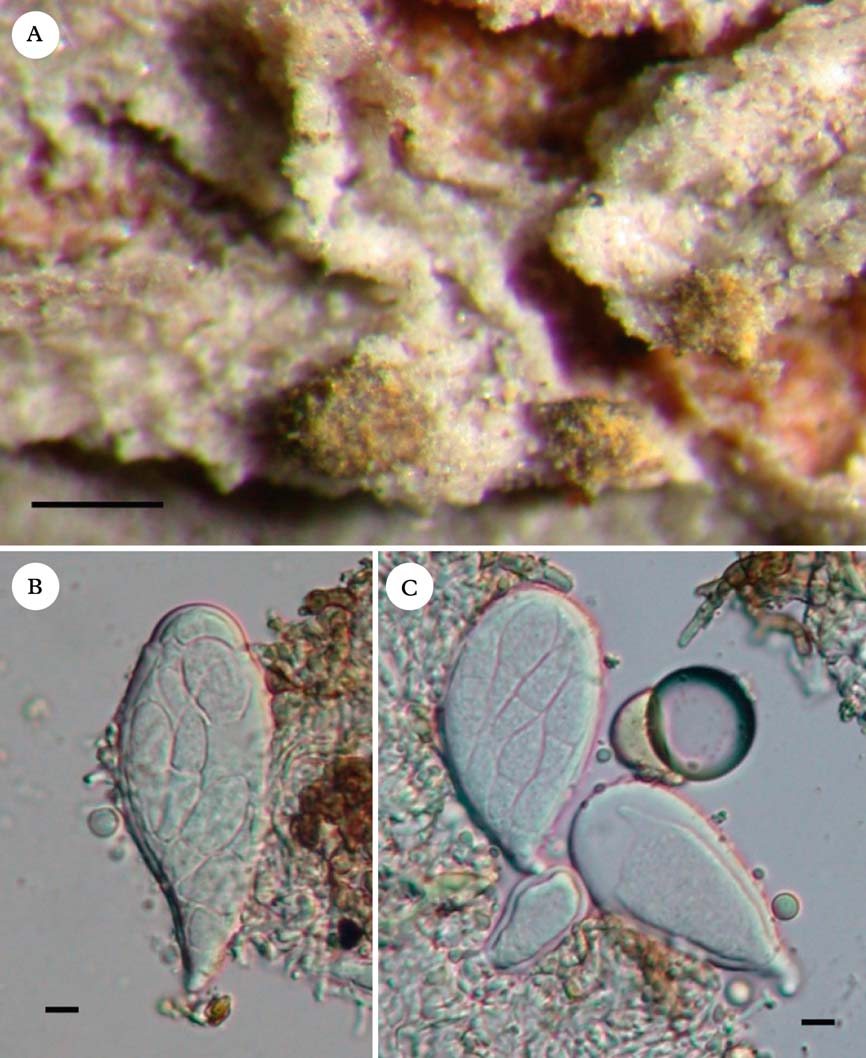
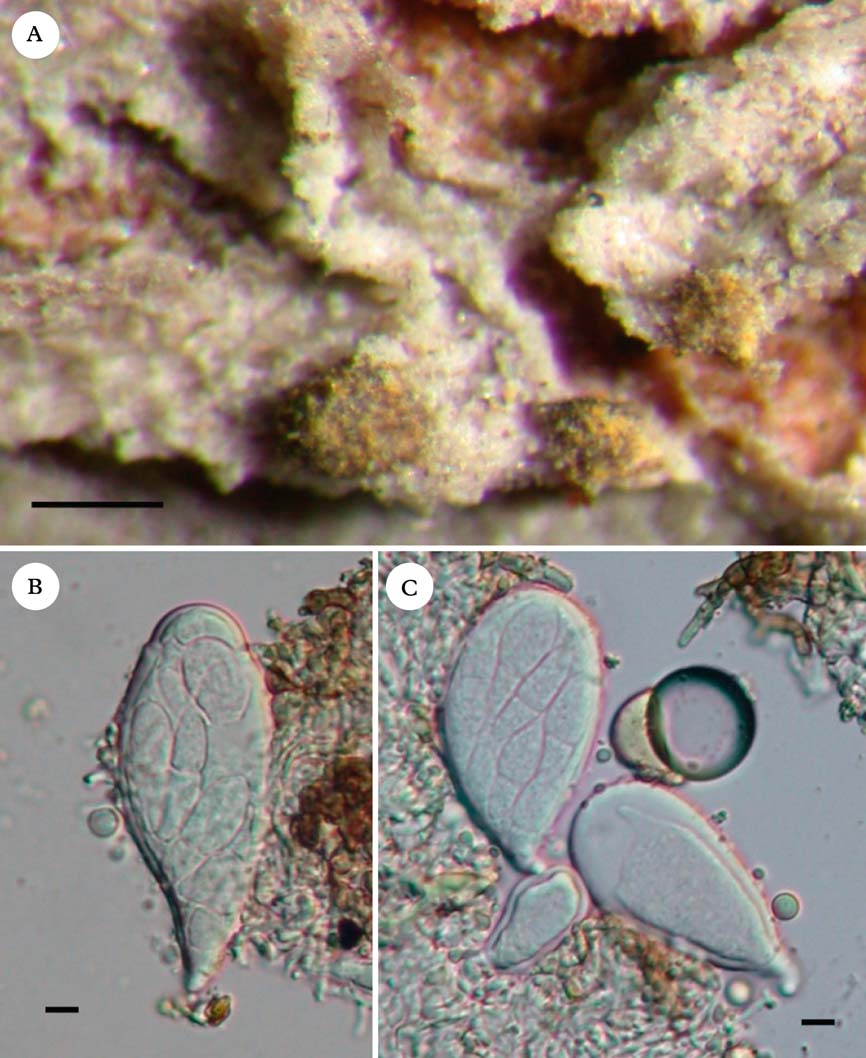
Coniarthonia with mustard yellow soralium-like structures that contain clavate asci 60–70×23–28 µm and hyaline 1-septate ascospores 20–28×7–11 µm.
Type: Brazil, Pernambuco, Buíque, Vale do Catimbau National Park, on bark of tree, c. 900 m alt., 4 February 2012, E. L. Lima 684 (ISE—holotype).
(Fig. 1)
Coniarthonia aurata (holotype). A, habitus; B & C, asci with ascospores. Scales: A=0·5 mm; B & C=5 µm. In colour online.
Thallus crustose, not corticate, dull, nearly white, very thin and closely following the bark surface, without prothallus. Algae trentepohlioid.
Ascigerous structures 0·2–0·4 mm diam., sessile, soralium-like, mustard yellow, hemispherical. Asci clavate, 60–70×23–28 µm, wall in upper half thickened. Hamathecium of anastomosing, curled hyphae, incrusted with golden crystals. Ascospores 8 per ascus, hyaline, 1-septate, clavate, 20–28×7–11 µm, upper cell much larger than the lower cell, slightly constricted around the septum, without perispore, upper cell rounded, lower cell pointed, wall very thin.
Pycnidia not observed.
Chemistry
Ascigerous structures UV−, C−, P−, K+ purple. TLC: anthraquinone.
Ecology and distribution
On smooth bark of trees in Caatinga forest. Known only from Brazil. It grows together with, for example, Acanthothecis abaphoides (Nyl.) Staiger & Kalb, Chrysothrix xanthina (Vain.) Kalb, Dirinaria leopoldii (Zahlbr.) D. D. Awasthi, Glyphis scyphulifera (Ach.) Staiger, Graphis furcata Fée, Lecanora leprosa Fée, Phaeographis ventosa Malme, and Ramboldia haematites (Fée) Kalb et al. It grows on moderately rain-exposed, not sheltered, bark.
Discussion
This species is assigned here rather schematically to the recently described small genus Coniarthonia (Grube Reference Grube2001). It agrees in the hydrophobic ascomatal structures without much differentiation, the ascus shape and the ascospores. It also agrees in the presence of pigmented crystals in the ascoma, but differs by the mustard yellow rather than red colour of the crystals. The new species is remarkable because of the soralium-like structures that contain loose asci. It resembles a sterile Tylophoron in some respects, as it has the aspect of a whitish thallus with soralium-like spots, but differs by the presence of asci and the mustard yellow rather than nearly black colour of the soralium-like structures. It closely resembles the truly sorediate Caloplaca lucifuga G. Thor in colour and K-reaction, so it may contain the same anthraquinone. So far only six species are known in the genus Coniarthonia (Grube Reference Grube2001). The new species is closest to C. erythrocarpa Grube, although this differs markedly in the red, elongated apothecia.
Cresponea endosulphurea A. A. Menezes, M. Cáceres & Aptroot sp. nov.
MycoBank No.: MB 801925
Cresponea with deep yellow medulla, reaction KOH+ orange due to the presence of a xantholepinone.
Type: Brazil, Ceará, Crato, Chapada do Araripe, on bark of tree, c. 800 m alt., May 2012, A. A. Menezes P8-A4-T-CE (ISE 15896—holotype).
(Fig. 2)
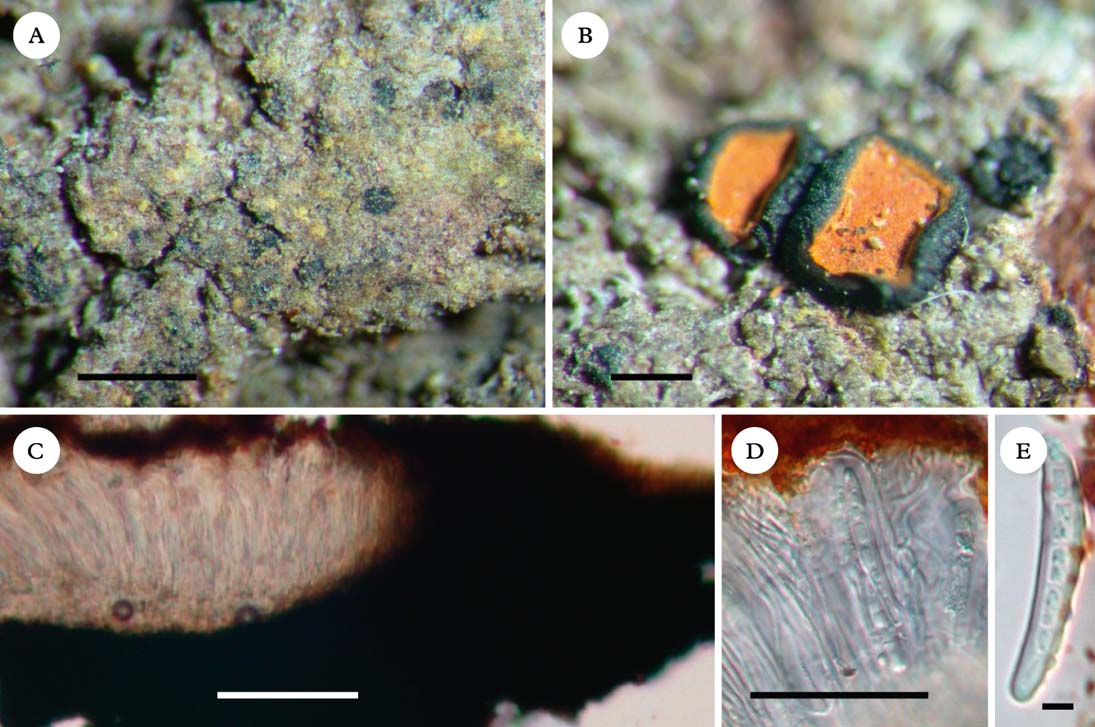
Cresponea sorediata (holotype). A, thallus; B, apothecia; C, section through ascoma; D, hamathecium; E, ascospore. Scales: A & B=0·5 mm; C & D=50 µm; E=5 µm. In colour online.
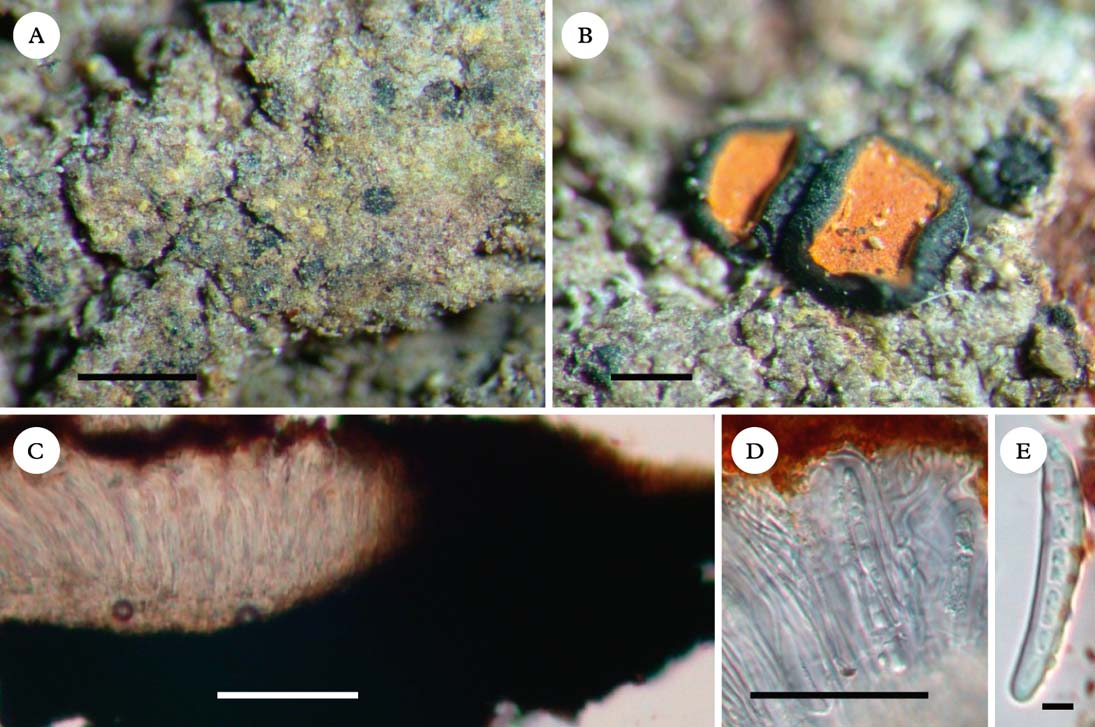
Thallus crustose, corticate, a little shiny, green, thin and closely following the bark surface, with minute (c. 0·05 mm diam.) warts that occasionally break off revealing a deep yellow medulla, without prothallus. Algae trentepohlioid, 7–13×10–15 µm.
Apothecia 0·7–1·0 mm diam., rounded; disc bright orange pruinose; margin crenulated, c. 0·2 mm thick, glossy black, epruinose, raised above the disc. Excipulum black throughout, also below the hymenium. Epihymenium orange crystals. Asci cylindrico-clavate. Hamathecium 60–80 µm high, not inspersed. Ascospores 8 per ascus, hyaline, consistently 7-septate, narrowly fusiform, 37–43×5–7 µm, without perispore, lumina rounded.
Pycnidia not observed.
Chemistry
Medulla UV−, C−, P−, K+ orange; disc pruina K+ purple. TLC: a xantholepinone in the thallus.
Ecology and distribution
On smooth bark of trees in Caatinga forest. Known only from Brazil.
Discussion
This is the first Cresponea known with a pigmented thallus medulla (Egea & Torrente Reference Egea and Torrente1993). It is close to Cresponea proximata (Nyl.) Egea & Torrente, which differs by having a thallus without a coloured medulla, and by the smaller ascospores which are 25–38 µm long (Egea & Torrente Reference Egea and Torrente1993). The medullary pigment is deep yellow and reacts orange with KOH, showing that it is a xantholepinone, a group of substances known only from a few lichen groups, viz. Malmidea and Rinodina [thiomelin, see Leuckert & Mayrhofer (Reference Leuckert and Mayrhofer1984), for description of the characteristics] and not yet from the Arthoniales. The orange pruina of the disc reacts K+ purple and is an anthraquinone.
Cryptothecia macrocephala E. L. Lima, M. Cáceres & Aptroot sp. nov.
MycoBank No.: MB 802590
Cryptothecia with macrocephalic ascospores 45–50×14–19 µm and thallus with psoromic acid.
Type: Brazil, Pernambuco, Buíque, Vale do Catimbau National Park, on bark of tree, c. 900 m alt., 3 October 2011, E. L. Lima 139 (ISE—holotype).
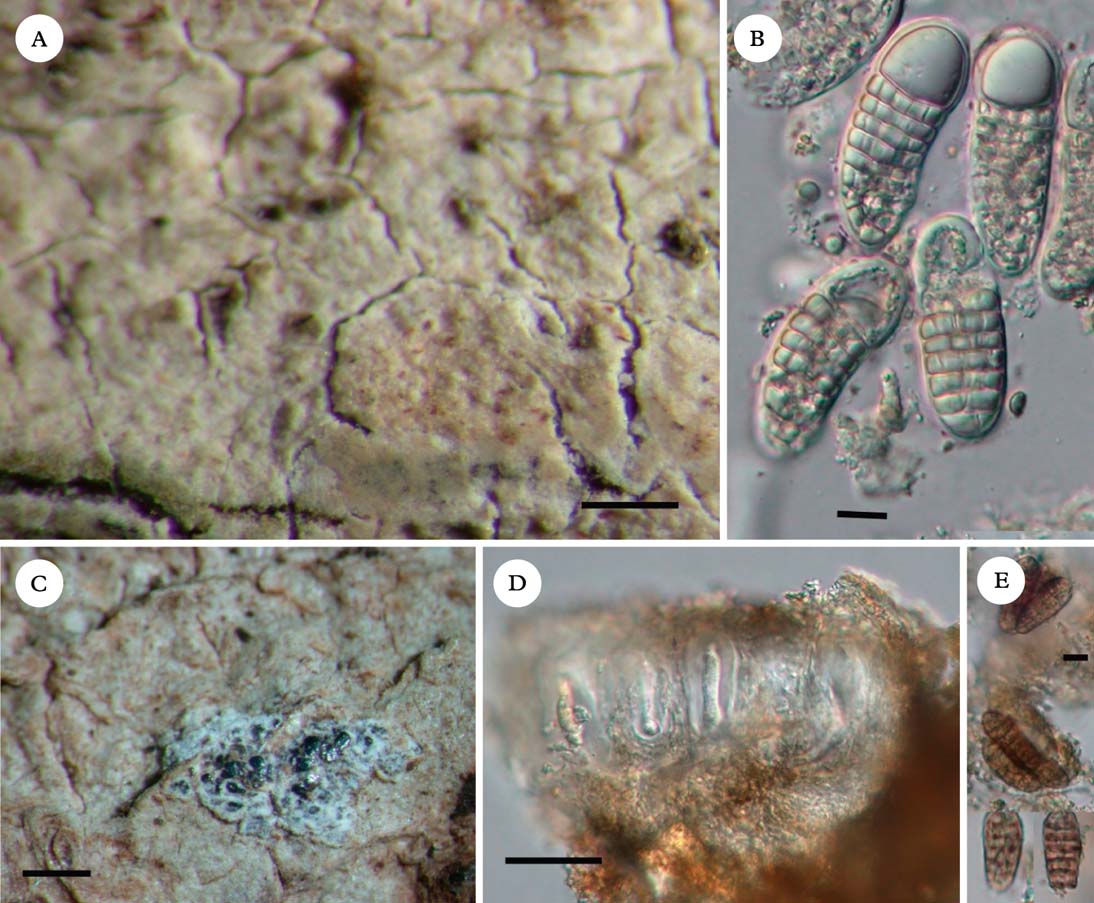
A & B, Cryptothecia macrocephala (holotype). A, habitus; B, ascospores. C–E, Synarthonia sarcographoides, holotype. C, habitus; D, section through ascoma; E, ascospores. Scales: A & C=0·5 mm; D=50 µm; B & E=5 µm. In colour online.
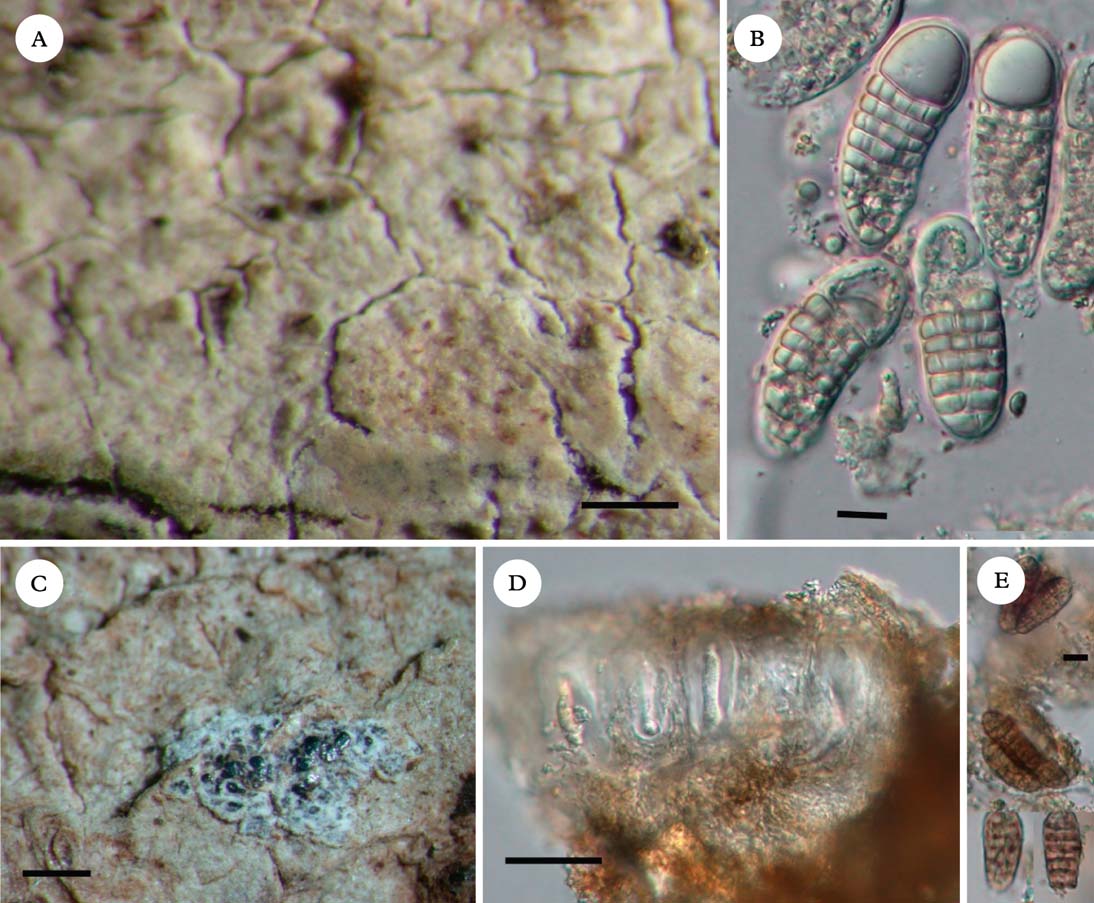
Thallus crustose, cracked, not corticate, dull, pale ochraceous white, very thin and closely following the bark surface, surrounded by a brown prothallus line. Alga trentepohlioid.
Ascigerous structures rounded and flattened, 0·3–0·6 mm wide, partly IKI+ blue (around asci), mostly IKI+ reddish (hemiamyloid). Asci clavate, c. 90–120×40–60 µm. Ascospores 8 per ascus, hyaline, 7–9×1–3-septate, ellipsoidal, 45–50×14–19 µm, with one deviating large upper end cell that occupies 1/3 to 1/4 of the ascospore (macrocephalic), without perispore, wall c. 1·5 µm thick.
Pycnidia not observed.
Chemistry
Thallus and ascigerous structures UV−, C−, P+ yellow, K−. TLC: psoromic acid.
Ecology and distribution
On smooth bark of trees in Caatinga forest. Known only from Brazil. It grows together with Polymeridium pleiomerellum (Müll. Arg.) R. C. Harris.
Discussion
This species differs from all other described Cryptothecia species (Makhija & Patwardhan Reference Makhija and Patwardhan1986, Reference Makhija and Patwardhan1987, Reference Makhija and Patwardhan1994; Thor Reference Thor1997; Sparrius & Saipunkaew Reference Sparrius and Saipunkaew2005; Lücking et al. Reference Lücking, Thor, Aptroot, Kalb and Elix2006; Wolseley & Aptroot Reference Wolseley and Aptroot2009; Lima et al. Reference Lima, Mendonça, Aptroot and Cáceres2013) by the markedly macrocephalic ascospore septation. Macrocephalic ascospores are known, however, from two species in the closely related genus Stirtonia (Aptroot Reference Aptroot2009), viz. S. alba Makhija & Patw and S. santessonii Makhija & Patw. The occurrence of this character in Cryptothecia is therefore not unexpected. Stirtonia species differ by the only transversely septate instead of muriform ascospores.
Additional specimens examined. Brazil: Pernambuco: same as the type, E. L. Lima 146 (ISE). Ceará: Crato, Chapada do Araripe, on bark of tree, c. 800 m alt., 2012, A. A. Menezes 238 (ISE).
Synarthonia sarcographoides Aptroot, A. A. Menezes, E. L. Lima & M. Cáceres sp. nov.
MycoBank No.: MB 801924
Synarthonia with black ascomata in white pseudostromata, and brown, broadly ellipsoid, muriform ascospores 20–22×11·0–12·5 µm.
Type: Brazil, Pernambuco, Buíque, Vale do Catimbau National Park, on bark of tree, c. 900 m alt., 3 February 2012, E. L. Lima 333 (ISE—holotype).
Thallus crustose, not corticate, usually dull, pale green, very thin and closely following the bark surface, surrounded by a black prothallus. Algae trentepohlioid.
Ascomata c. 0·1 mm diam., round, black, white pruinose, aggregated in groups of 5–50 in white pseudostromata which are rounded to usually elongated and branched, and up to 2 mm diam. Hymenium hyaline, not inspersed; paraphyses c. 1 µm wide, frequently anastomosing; epihymenium c. 10 µm thick, formed of clustered paraphyses tips with brown incrustation; hypothecium dark brown, black in thick section. Asci clavate, with 8 ascospores, 35–45×15–20 µm, wall in upper half thickened. Ascospores brown, broadly ellipsoid to slightly clavate, muriform, 7×1–2-septate, 20–22×11·0–12·5 µm, wall and septa thin, ends rounded.
Pycnidia not observed.
Chemistry
Thallus and ascomata UV−, C−, P−, K−. TLC: three unidentified xanthones (pale yellow-brown, UV+ yellowish at Rf 7, pale yellow, UV+ bluish at Rf 6 and pale yellow, UV+ greenish at Rf 5).
Ecology and distribution
On smooth bark of trees in Caatinga forest. Known only from Brazil.
Discussion
This new species is here tentatively assigned to the small genus Synarthonia, which is characterized by clavate asci, transversely septate ascospores and tiny ascomata aggregated in pseudostromata (Sparrius Reference Sparrius2009). The organization of several ascomata in a pseudostroma makes it difficult to ascertain whether or not the pale marginal areas of the ascomata should be seen as ascomal tissue (apothecium margins). They are interpreted here as sterile tissue. There are only two species known in the genus, which both differ from the new species by their transversely septate instead of muriform ascospores. The new species superficially resembles a Sclerophyton, but differs by the broad, symmetrical ascospores. The species is very frequent on at least one of the sites, but the ascomata are rarely fertile. All ascospores observed are brown.
Additional specimens seen. Brazil: Ceará: Crato, Chapada do Araripe, on bark of tree, c. 800 m alt., 2012, A. A. Menezes 086, 238, 524 (all ISE); v 2012, A. A. Menezes (ISE 15950, 15951, 15952, 15953, 15954); xi 2011, A. A. Menezes (ISE 8279 ISE).
The CNPq (Conselho Nacional de Desenvolvimento Científico e Tecnológico) is thanked for a research grant to MESC (Processo 501633/2009-0) and for financial support for the collecting trips (CNPq-Protax Processoo 562.330/2010-0, INCT-Herbário Virtual Processo 573.883/2008-4, and CNPq-PPBio/Semiárido Processo 558317/2009-0). The Coordenação de Aperfeiçoamento de Pessoal de Nível Superior (CAPES) is thanked for a Master's scholarship to AAM and ABXL. The Fundação de Amparo à Ciência e Tecnologia do Estado de Pernambuco (FACEPE) is thanked for a Master's scholarship to ELL. AA is grateful to the Hugo de Vries-fonds for travel support. Leo Spier is thanked for performing thin-layer chromatography.