Zuckerman, Kuhlman, Joireman, Teta, and Kraft (Reference Zuckerman, Kuhlman, Joireman, Teta and Kraft1993) have proposed an alternative five-factor model (AFFM) that includes only dimensions with a substantial biological-evolutionary basis. This model is an extension of the Zuckerman’s Sensation Seeking personality theory (Aluja & García, Reference Aluja and García2005; Rosenblitt, Soler, Johnson, & Quadagno, Reference Rosenblitt, Soler, Johnson and Quadagno2001). The basic traits in the AFFM measured by the Zuckerman-Kuhlman Personality Questionnaire (ZKPQ) are: Neuroticism-Anxiety (N-Anx), Activity (Act), Sociability (Sy), Impulsive Sensation Seeking (ImpSS) and Aggression-Hostility (Agg-Host). The ZKPQ is available for adults and also for children populations (Aluja, Ballesté, & Torrubia, Reference Aluja, Ballesté and Torrubia1999; Aluja, García, & García, Reference Aluja, García and García2004). A full description and psychometric properties of the questionnaire can be found in works of Zuckerman (Reference Zuckerman, de Raad and Perugini2002, Reference Zuckerman, Boyle, Matthews and Saklofske2008) and Joireman and Kuhlman (Reference Joireman, Kuhlman and Stelmack2004).
The ZKPQ (and its shortened version ZKPQ-50-CC) has turned out to have a robust factor structure and acceptable psychometric properties in various countries (Aluja et al,, 2006), which can be explained by a strong psychobiological basis. The original version of the ZKPQ has been adapted in different countries and languages: China (Wu et al., Reference Wu, Wang, Du, Li, Jiang and Wang2000), Germany (Ostendorf & Angleitner, Reference Ostendorf and Angleitner1994), Italy (De Pascalis & Russo, Reference De Pascalis and Russo2003), Japan (Shiomi et al., Reference Shiomi, Kuhlman, Zuckerman, Joreiman, Sato and Yata1996), and Spain (Catalan [Gomà-i-Freixanet, Valero, Puntí, & Zuckerman, Reference Gomà-i-Freixanet, Valero, Puntí and Zuckerman2004; Gomà-i-Freixanet, Wismeijer, & Valero, Reference Gomá-i-Freixanet, Wismeijer and Valero2005], and Spanish versions [Aluja et al., Reference Aluja, García and García2002, Reference Aluja, García and García2004; Herrero, Viña, González, Ibáñez, & Peñate, Reference Herrero, Viña, González, Ibáñez and Peñate2001; Romero, Luengo, Gómez-Fraguela, & Sobral, Reference Romero, Luengo, Gómez-Fraguela and Sobral2002]). The cross-cultural shortened form (ZKPQ-50-CC) was also developed in English, French, German, and Spanish languages by Aluja et al. (Reference Aluja, Rossier, García, Angleitner, Kuhlman and Zuckerman2006).
The ZKA-PQ was developed starting with a pool of 537 items, but the final version contained only 200 items, 10 items per facet. Items representing behaviors, intentions and attitudes were written for each proposed facet by relying on the current literature, and adopting the classic rational-empirical approach. The item content was related to the respective theoretical constructs. There were 20 items designed for each facet and 100 for each factor, which included several items from the original ZKPQ. Additionally, permissions were obtained to include: a) 29 items from the Buss and Perry (Reference Buss and Perry1992) Questionnaire of Aggressiveness (AG) in the Aggressiveness-hostility dimension; and b) 37 items from the UPPS Impulsive Behavior Scale (Lynam, Smith, Whiteside, & Cyders, Reference Lynam, Smith, Whiteside and Cyders2006). According to Zuckerman (Reference Zuckerman2005), the different types of impulsivity may be related to different basic personality factors, thus it was considered to be important to include more impulsivity scales. The AG and UPPS items were translated several times from English to Spanish and vice-versa during the back-translation process. A series of factor analyses have yielded 10 items per each of the 20 facets. The final structure was tested in two different Spanish samples (calibration and validation) and in an American sample (Aluja et al., Reference Aluja, Kuhlman and Zuckerman2010). The ZKA-PQ has a Likert-type 4-point response scale, which can also improve psychometric properties (see Muñiz, García-Cueto, & Lozano, Reference Muñiz, García-Cueto and Lozano2005) and increase effect sizes (Johnson, Krueger, Bouchard, & McGue, Reference Johnson, Krueger, Bouchard and McGue2002). There have also been changes in the names of the original ZKPQ factors: AG: Aggression, AC: Activity, EX: Extraversion, NE: Neuroticism, SS: Sensation Seeking (Aluja et al., Reference Aluja, Kuhlman and Zuckerman2010).
ZKA-PQ was developed within Spanish and American samples and was also validated in four French speaking countries (Aluja et al., Reference Aluja, Kuhlman and Zuckerman2010; Rossier, Hansenne, Baudin, & Morizot, Reference Rossier, Hansenne, Baudin and Morizot2012). Exploratory factor analyses and Cronbach alpha reliability analyses have shown that the structural replicability is very high, both for the dimensions and facet scales. However, confirmatory factor analyses – probably due to some covariance between facets and other factors – yielded unsatisfactory fit indices. In American and Spanish samples, the hostility (AG4) and the positive emotion (EX1) facets loaded also on the neuroticism factor and the exhibitionism (EX3) and work energy (AC4) facets had high secondary loadings on the SS factor (Aluja et al., Reference Aluja, Kuhlman and Zuckerman2010). In French speaking samples, restlessness (AC3) loaded also on aggression and positive emotions (EX1) on neuroticism.
The respondents differed in language and culture. The Catalan language is of a Latin origin and is used by seven million people in Spain. It is also spoken in Valencian country, the Balearic Islands (Spain), Andorra, in five regions of France, and in Alghero (city of Sardinia).
Hungarian is an Uralic language, part of the Ugric group of languages. It is the official language in Hungary but it is also spoken by Hungarian communities in the seven neighboring countries. Altogether, there are 14–15 million Hungarian-speaking individuals.
In such cross-cultural setting, the overarching goal of this study was to assess the reliability and cross-cultural validity of Catalan and Hungarian versions of the ZKA-PQ. As our main goal was to test structural invariance of the new facet-version questionnaire (ZKA-PQ) of the psychobiological alternative five factor personality model, we used online versions to provide a cost-effective and fast access to validate psychometric properties.
Moreover, a secondary benefit was the possibility to test whether significant differences arise between the mean personality profiles in the two different cultural settings.
Method
Participants
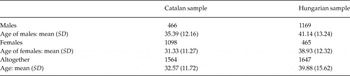
The Catalan version of the ZKA-PQ was completed by 1,564 subjects, and the Hungarian version was completed by 1,647 subjects. Means and standard deviations for age can be found in Table 1. In both samples, males were significantly older.
Descriptives of samples

T-tests indicated significant gender differences in age with medium effect size in Catalan sample (t = 6.35; p < .001, d = 0.35), and with small effect size in Hungarian sample (t = 2.25, p < .08, d = 0.17). The mean age also differed significantly between the two countries (t = 15.67; p < .001), with a medium effect size (d = 0.56).
Measures
The original ZKA-PQ was developed and validated simultaneously in English and Spanish (Castilian) by Aluja et al. (Reference Aluja, Kuhlman and Zuckerman2010). This instrument contains five factors with four facets per factor: Each facet is composed of ten items, making it a 200-item instrument with a 4-point Likert-type response format. Alpha reliabilities were acceptable for both facets and factors in both versions of the instrument (Aluja et al., Reference Aluja, Kuhlman and Zuckerman2010). The ZKA-PQ was translated from Spanish to Catalan language by Anton Aluja, co-author of the original ZKA-PQ (Aluja et al., Reference Aluja, Kuhlman and Zuckerman2010) and a bilingual Catalan-Spanish speaker. The ZKA-PQ Hungarian version was translated from English to Hungarian by the first author of this study. It was also translated back to English by a bilingual professional translator and revised by Marvin Zuckerman. After several corrections, the Hungarian ZKA-PQ version was considered appropriate and equivalent in both languages.
Procedure
Both Catalan and Hungarian respondents of the ZKA-PQ completed an on-line anonymous questionnaire. Catalan participants were recruited through several Catalan universities’ mailing lists. Therefore, responses were mainly obtained from people at the university community: students (70%), and teaching and administrative staff (30%). To stimulate participation, an automatically generated interpretative report was provided to all respondents after they had filled out the questionnaire. Hungarian data collection was completed in 19 different companies from 6 different Hungarian cities. These companies all had their own Human Resources Department that helped organize data collection. In return, executives were offered a report on the companies’ mean personality profiles.
Data analysis
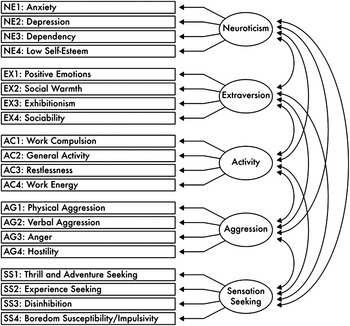
Descriptive statistics mean differences, alpha internal consistencies for both languages were analyzed. Effect sizes were indicated by Cohen’s d values. ANOVA was performed in order to assess differences in facet score means between the two countries. The factor structure in both samples was analyzed through a Principal Axis Factoring (PAF) with Varimax rotation. Additionally, these factor structures were compared and the Tucker’s (Reference Tucker1951) congruence coefficients were estimated for all of the ZKA-PQ facets. A series of consecutive Confirmatory Factor Analyses (CFA) were carried out, comparing the models with increasing complexity in both cultural settings. First, simple structure was tested (see Figure 1), and then the secondary loadings (salient and modest loadings) were also incorporated.
Factor analytic model of Zuckerman-Kuhlman-Aluja Personality Questionnaire.

Results
Descriptive, alpha internal consistencies and mean comparisons between countries
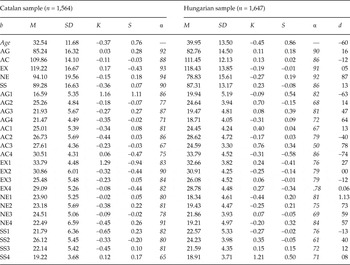
The mean, standard deviation, kurtosis, and skewness values, as well as the Cohen’s d values and Cronbach alphas for each of the ZKA-PQ 20 facets and five factors are shown in Table 2.
Descriptives, alpha internal consistencies, and country differences
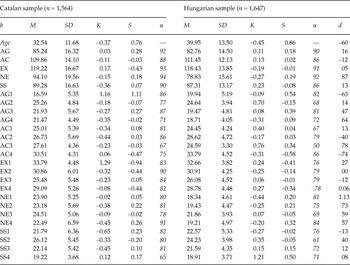
M: Mean; SD: Standard deviation: K: Kurtosis; S: Skewness; AG: Aggressiveness; AC: Activity; EX: Extraversion; NE: Neuroticism; SS: Impulsive-Sensation Seeking; AG1: Physical Aggression; AG2: Verbal Aggression; AG3: Anger; AG4: Hostility; AC1: Work Compulsion; AC2: General Activity; AC3: Restlessness; AC4: Work Energy; EX1: Positive Emotions; EX2: Social Warmth; EX3: Exhibitionism; EX4: Sociability; NE1: Anxiety; NE2: Depression; NE3: Dependency; NE4: Low Self-Esteem; SS1: Thrill and Adventure Seeking); SS2: Experience Seeking; SS3: Disinhibition; SS4: Boredom Susceptibility/Impulsivity).
Reliabilities of most of the facets were adequate in both samples. Several facets had alpha coefficients below .70. AC3 and SS4 had .67 and .65 values in the Catalan sample, while AC1, AC3, NE3 and SS2 had .67, .50, .69 and .61 in the Hungarian sample, respectively. The mean age was significantly higher in the Hungarian sample (d = –.60), but no significant differences were found between factors of the ZKA-PQ, except for NE. The NE means score was lower in the Hungarian sample (d = .87). Country differences in facet mean scores have yielded large effect size (d values exceeding .80) only in the case of NE1 (d = 1.13). Further, medium effect size differences with d values higher than .50 were found in the case of 7 facets (AG1, AG4, AC3, AC4, NE2, NE3, NE4).
To study the potential country differences between the Catalan and Hungarian samples, five ANOVAS (one for each ZKPQ dimension) were conducted with country as the independent and age and sex as the covariate variables. Mean difference in EX was non-significant [F(1, 3189) = .58, p < .447, η2 = .001], and partial eta squared values indicated negligible effect size for AG (η2 = .005), AC (η2 = .007) and SS (η2 = .006) factors. The age and sex covariates explained between only 1 % and 3.6 % of the variance in these factors. On the other hand, there was a significant country difference in the NE factor. Altogether, country, sex and age explained 18.6 % of Neuroticism variance (adjusted R squared = .186). Country differences had only medium effect size [F(1, 3188) = 292, p < .001, η2 = .084 Footnote 2 ], and there was a significant but negligible effect of age [F(1, 3188) = 29.96, p < .001, η2 = .009] and sex [F(1, 3188) = 74.66, p < .001, η2 = 023] arose. Interaction effects for ‘country x age x sex’ resulted in a negligible effect size for all 5 factors (η2 = 01, 01, 02, 00 and 00 for NE, AC, SS, AG and EX, respectively).
Structure and congruence coefficients by country
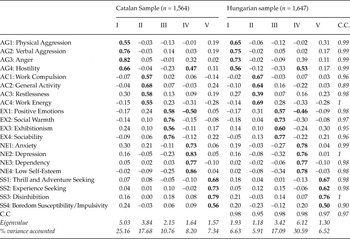
Table 2 shows Principal Axis analyses with a varimax rotation of the 20 ZKA-PQ facets. In the Catalan sample, the Kaiser-Meyer-Olkin measures of sample adequacy were above .83. There were two secondary loadings above .40 in the Neuroticism dimension: Hostility (AG4; .47) and Positive Emotions (EX1; –.50). The Catalan version indicated a stable five-factor structure in accordance with the eigenvalue > 1, scree test, and Velicer’s MAP methods. The Velicer’s minimum average partial (MAP) test compares the relative amount of systematic and unsystematic variance remaining in a correlation matrix after the extraction of an increasing number of components (O’Connor, Reference O’Connor2000). The smallest average squared correlation indicates the appropriate number of components. The smallest average squared partial correlation was 025, which supported the extraction of 5 factors. The Tucker’s (1951) congruence coefficients after procrustes Varimax rotation were analyzed and the global coefficients were equal or above 97, indicating that the factorial solutions were very similar (see Table 3).
Factorial structure of the ZKA-PQ and factorial congruency coefficients

Note: Values above 0.40 are shown in boldface. CC: Congruence coefficients.
The factorial structures of the Catalan and Hungarian ZKA-PQ were equivalent, only General Activity (AC2: .89) obtained a congruency coefficient below .90.
The same factorial procedure was conducted with the Hungarian ZKA-PQ version. The Kaiser-Meyer-Olkin measures of sample adequacy were above .88. Factors were ordered to coincide with the Catalan factor order. Similarly to the ZKA-PQ Catalan structure, two secondary loadings were above .40 in the Neuroticism dimension: Hostility (AG4 = .53) and Positive Emotions (EX1 = –.46). The smallest average squared partial correlation was .023, supporting the extraction of 5 factors.
Confirmatory factorial analyses
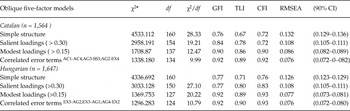
The Confirmatory Factor Analyses (CFA) of the 20 ZKA-PQ facets were based on five latent variables, utilizing the Maximum Likelihood estimation method. Different models of growing complexity were designed: first the simple structure was tested, and then the model was modified to include the relations reflected by the secondary loadings as well (McCrae, Zonderman, Costa, Bond, & Paunonen, Reference McCrae, Zonderman, Costa, Bond and Paunonen1996). Thus, three different models were constructed in each culture: 1) Simple structure: All facets were linked to their own single latent factor only; 2) Salient loadings: All loadings larger than ± .30 were built into the model; and 3) Modest loadings: All loadings larger than ± .15 were built into the model. The parameters were freely estimated in all CFA analyses and the regression coefficients of the error terms over the observed endogenous variables (the facets) were fixed to 1. The model-fit criteria were: The Tucker-Lewis index (TLI) (Bentler & Bonett, Reference Bentler and Bonett1980; Tucker & Lewis, Reference Tucker and Lewis1973), the comparative fit index (CFI) (Bentler, Reference Bentler1980), and the root mean square error of approximation (RMSEA, Bollen & Long, 1993; Steiger, Reference Steiger1990). Table 4 shows the results for the four oblique models that were analyzed simultaneously in the two samples with increasing complexity.
Goodness of fit indices for ZKA-PQ models

Note: *The associated p values were always lower than 0.001; d.f. Degree of freedom; GFI: Goodness of fit index; TLI: Tucker-Lewis index; CFI: Comparative Fit Index; RMSEA: root mean square error of approximation and its 90% confidence interval.
These analyses were equivalent to those reported by Aluja et al. (Reference Aluja, Rossier, García, Angleitner, Kuhlman and Zuckerman2006), McCrae et al. (Reference McCrae, Zonderman, Costa, Bond and Paunonen1996) on the NEO-PI-R data, and Aluja et al. (Reference Aluja, Kuhlman and Zuckerman2010) on ZKA-PQ data of the original study carried out on Spanish and English samples. All the fit indexes were unsatisfactory. Only the modest loading models that included covariance – based on the three largest modification indices (MI’s) – between errors of facets exhibited minimum satisfactory indexes. Nevertheless, when models were built separately for each of the five factors, the fit indices for each ZKA-PQ factor were satisfactory (AGFI and TLI > .90), although unsatisfactory TLI of AC was present in the Catalan sample.
Discussion
The results of this study indicated that the ZKA-PQ, using different methods of factor extraction, has a stable structure comprising five factors in both Catalan and Hungarian cultures. Reliabilities were acceptable and also similar in both cultures. Procrustes rotations require a linguistic and cultural context as reference a structure. Tucker’s congruence coefficient has been used for studying the replicability, with analyses carried out independently for each of the factors (Rolland, Reference Rolland, McCrae and Allik2002). The factorial congruence analyses between the Catalan and Hungarian samples demonstrate a strong factorial equivalence, indicating negligible cultural differences in the structure of the ZKA-PQ in both cross-cultural and linguistic contexts.
The simple structure of the ZKA-PQ was analyzed by Confirmatory Factor Analysis in both samples. Similar results were found in both cultures. The results showed discordance between the outcomes from the EFA and CFA. The robust structure obtained with EFA had poor fit indices in the subsequent CFA. It was necessary to include salient and modest loadings to improve upon the model. It is well known that secondary loadings and correlated items or facets affect the goodness-of-fit indices (Aluja et al., Reference Aluja, Kuhlman and Zuckerman2010). Only the model that incorporated the modest loadings and the three pairs of correlated facets obtained the minimum satisfactory fit values. All this supports the need of further testing the interactions of facets and factors. A holistic view considers factors as not totally independent dimensions, but as interacting parts of a complex psycho-social-biological system. Further person-oriented analyses can unfold holistic patterns that could help us understand interactions between the different facets and between the different factors along incorporating genetical-environmental interactions.
The main cultural differences that were observed relate to the Neuroticism factor. Lower Neuroticism scores were present in the Hungarian sample. Surprisingly, these scores were slightly affected by age and gender. Assuming that Catalan and Spanish people are culturally more similar than Hungarians and Catalan people, our results are contradictors to previous cross-cultural findings Hungarians scored higher than Spanish participants on the NEO-PI-R (McCrae, Reference McCrae, McCrae and Allik2002) and on the Eysenck Personality Questionnaire (EPQ) Neuroticism factor (Van Hemert, Van de Vijver, Poortinga, & Georgas, 2002) or Sensitivity to Punishment (Caseras et al., Reference Caseras, Fullana, Riba, Barbanoj, Aluja and Torrubia2006). It is important to emphasize that we cannot conclude that the differences between our samples were due cultural differences, as sampling differed in the two countries by more aspects. Thus further studied are needed to test systematically cultural differences in personality profiles.
Moreover, McCrae and Allik (Reference McCrae and Allik2002) have stated that one should be cautious in interpreting mean personality profiles as ‘national types’. There is no strong evidence that mean profiles are in congruence with national stereotypes (McCrae, Reference McCrae2001). Indeed, a study with national character ratings from 49 cultures showed that these did not converge with personality test mean scores (Terracciano et al., Reference Terracciano, Abdel-Khalek, Adám, Adamovová, Ahn, Ahn and McCrae2005). Thus, studying ’national characters’ should include more detailed profile analyses, such as the above mentioned holistic-interactionist person-oriented analyses (such as latent class analyses, configuration analyses).
The gender differences were congruent with results of the original validation study (Aluja et al., Reference Aluja, Kuhlman and Zuckerman2010). Males scored higher than females in Sensation Seeking Factor, also in line with the results of Rossier et al. (Reference Rossier, Hansenne, Baudin and Morizot2012), as well as the results of numerous studies using different measures of sensation seeking traits (Roberti, Reference Roberti2004). Hungarian males scored higher than females in Aggressiveness factor, but this difference was not found in the Catalan sample. Females scored higher than males in Neuroticism and Activity factors in both samples, and Catalan women were more Extraverted than males.
Further, there are some limitations to this study that need to be mentioned. Although we used two large samples in both countries, there were significant differences in age and social status of the participants. While the Catalan sample consisted of university students and staff members, the Hungarians were individuals employed at different companies from various cities.
The contexts, in which the participation has taken place, were also different in the two samples. The Catalans responded to a collective e-mail that asked to participate for academic purposes, whereas the Hungarians were asked to fill out several questionnaires in order to help make certain changes to the company based on their needs. Therefore, some differences in self-presentation might have arisen. It is possible that all the cultural differences in means can be attributed to the specific situation in which the Hungarians responded to the ZKA-PQ, as they might have been motivated for a more positive self-presentation. This would be in accordance with findings suggesting that employees usually tend to exhibit reduced scores on anxiety-related scales (Daly, Richmond, & Leth, Reference Daly, Richmond and Leth1979), even when the whole procedure is anonymous. Based on this, we suggest that (1) difference in Neuroticism between the two cultures should be further studied by collecting more representative samples; (2) future studies carried out with the ZKA-PQ in work-related contexts should include social desirability scales.
In summary, the main findings of this study indicate the cross-cultural validity of the Catalan and Hungarian versions of the ZKA-PQ. The ZKA-PQ had good psychometric properties with regard to equivalent factorial structures and similar internal consistencies. Significant differences between countries were found only in Neuroticism dimension, and these differences were only slightly affected by age and gender. These findings, as well as some study limitations, should be replicated and addressed in futures research on the ZKA-PQ.