



Introduction
The Gac plant (Momordica cochinchinensis Spreng.) is an underutilised species of the Cucurbitaceae family (Joseph and Bharathi, Reference Joseph and Bharathi2008). The aril of Gac fruit is highly nutritious and contains lycopene, β-carotene, fatty acids, vitamin E, flavonoids and polyphenol compounds (Kha et al., Reference Kha, Nguyen, Roach, Parks and Stathopoulos2013). Gac is commonly used as a colourant source to make ‘xoi gac’, a traditional red sticky rice dish in Vietnam, is used as a vegetable in Indian, Vietnam and Thai cuisine (Joseph and Bharathi, Reference Joseph and Bharathi2008; Kubola and Siriamornpun, Reference Kubola and Siriamornpun2011; Tran et al., Reference Tran, Parks, Roach, Golding and Nguyen2016) and the seeds are used in traditional medicine (Xiao et al., Reference Xiao, Rajput, Liu and Hu2007).
Traditionally, Gac is propagated by seed or by striking semi-hardwood and hardwood cuttings of the female plants of this dioecious species. These methods have some limitations. One issue for seedling production is that the plant gender can only be identified when flowers develop (Parks et al., Reference Parks, Murray, Gale, Al-Khawaldeh and Spohr2013), as recent techniques of gender identification of seed using DNA technology are still in its infancy (Sarkar et al., Reference Sarkar, Banerjee and Gantait2017). Another issue is that the use of semi-hardwood and hardwood cuttings requires a large biomass of mother rootstock which may not be locally available. The use of softwood cuttings and the grafting of female scions onto seedling rootstock could provide alternative methods for multiplication of fruit-bearing plants.
To germinate seed, traditionally in Vietnam fresh Gac seed is steamed at approximately 60–70 °C. This is thought to overcome physical dormancy as the Gac seed is coarse and is covered by a thick, hard seed coat. Seed coat removal has been shown to overcome dormancy in Gac sourced from the Andaman Islands (Pandey et al., Reference Pandey, Devi, Kak, Khan and Gupta2013). However, Gac seed sourced from a South Vietnamese accession did not have a dormancy phase (Parks et al., Reference Parks, Murray, Gale, Al-Khawaldeh and Spohr2013). A number of other factors known to influence the germination of seeds including temperature, storage period and conditions (seed age) and seed weight have not been evaluated for Gac, limiting the development of appropriate propagation guidelines for this species.
In non-dormant conditions, the optimum temperature guideline for any species is based on obtaining a maximum germination rate. Temperatures that are excessively high or low can inhibit the germination of vegetables (Wagenvoort and Bierhuizen, Reference Wagenvoort and Bierhuizen1977). In a previous study, the optimum temperature for seed germination of several Cucurbitaceae species was determined including cucumber (22 °C), muskmelon (24–26 °C), squash (22 °C) and watermelon (21–22 °C) (Nau, Reference Nau1991) and these were used to guide the experimental temperature range for the current study. The conditions of seed storage are important to germinability and cucurbits can vary in their sensitivity to storage. For example, stored at 35 °C, cucumber and watermelon seeds with a moisture content of 8% had lost their ability to germinate by 6 months compared with melon having a germination rate of 80% at 6 months (Demir and Mavi, Reference Demir and Mavi2008). The rate of germination can also relate directly to seed weight, with heavier seeds germinating first, for example, as occurs in tamarind (Olufunke and Gbadamosi, Reference Olufunke and Gbadamosi2009). The Gac seed has a large weight and any relationship between seed weight and germination rate may be useful in seed selection for propagation.
In a preliminary study of Gac propagation by cuttings, with IBA (powder and gel), the benefit of auxin treatment was inconclusive (Parks et al., Reference Parks, Murray, Gale, Al-Khawaldeh and Spohr2013) but there is a good potential for this treatment since in a closely related species, Momordica dioica Roxb., the rooting of cuttings increased when they were treated with IBA hormone powder (Mohammad et al., Reference Mohammad, Hiroshi, Tomoko and Kunimitsu1991). The survival and rooting rate of cuttings of a range of species depends on several factors including the selection of cutting materials, environmental conditions during propagation and the use of rooting hormones (Hartmann et al., Reference Hartmann, Kester, Davies and Robert2002). Commercially, auxins are commonly applied to stimulate the rooting of cuttings using liquid, powder or gel formulations, containing indole-3-butyric acid (IBA), 1-naphthaleneacetic acid (NAA), or a combination of the two (Blythe et al., Reference Blythe, Sibley, Ruter and Tilt2004).
Grafting is a potential technique to salvage unwanted male Gac plants by using them as mature rootstock material. Grafting of the Gac plant has been demonstrated previously using the insertion grafting technique (Joseph and Bharathi, Reference Joseph and Bharathi2008) but other grafting techniques have not been demonstrated. The maturity of the rootstock at the time of grafting also needs consideration since cucurbit grafts tend to have rootstock material of a young seedling age (10–20 days) (Amin and Mona, Reference Amin and Mona2014; Traka-Mavrona et al., Reference Traka-Mavrona, Koutsika-Sotiriou and Pritsa2000).
This study aimed to improve the propagation of Gac using several approaches. The effect of temperature and seed storage time on the germination of Gac seed, the effect of auxin (indole butyric acid-IBA) concentration on the rooting and survival rate of Gac cuttings and the effects of three rootstock ages (4, 8 and 12 weeks) and two grafting methods (splice and wedge) on the survival rate of graft combinations were investigated. These results were used to develop practical guidelines for Gac propagation.
Materials and Methods
Seed germination experiment
Mature Gac fruits were harvested in May for three consecutive years (2012, 2013 and 2014) from greenhouse crops grown at the NSW Department of Central Coast Primary Industries Centre, Ourimbah, NSW, Australia (151° 22’E, 33° 21’S). The Gac type grown was of southern Vietnamese origin (Wimalasiri et al., Reference Wimalasiri, Piva, Urban and Huynh2015). The air temperature and the relative humidity of the greenhouses were maintained within bands of 18–25 °C and 60–80%, respectively. The seeds were removed from fruit and washed with distilled water. They were dried at room temperature (21± 1 °C, 60% relative humidity) on plastic trays for 1 week until they reached approximately 10% moisture content. The moisture content of a sample of seed was determined using the method described by Kauth and Biber (Reference Kauth and Biber2015). These seeds were placed in open paper bags and stored at room temperature (21 ± 1 °C, 60% relative humidity). Each individual seed was labelled and weighed before conducting the experiment. The moisture content of a sample of seed was determined using constant-temperature oven-dry method (International Seed Testing Association, 1993).
The Gac seeds produced in three seasons (2014, 2013 and 2012) were extracted from fruit aril and stored for 6, 18 and 30 months, respectively, and sown into coir trays (35 cm × 30 cm × 6 cm in size) at a depth of 5 cm. Trays were placed into five incubators at constant temperatures of 20, 25, 30, 35 and 40 °C. All treatments were kept on a 12-h light/12-h dark photoperiod (approximately 50 µmol photons m-2s-1) provided by cool white fluorescent lights for 20 days using a completely randomised block design with five replicates and each replicate contained 15 seeds. The trays containing the seeds were sprayed with 100 ml distilled water, daily per tray, to ensure adequate moisture for germination. Each seed was observed daily by gently brushing the surface coir to one side. A seed was considered to have germinated when the radicle had emerged from the seed coat.
Germination speed index (GSI) estimates the mean number of seeds germinated per day and was calculated using the formula (1) as described by (Ribeiro and Costa, Reference Ribeiro and Costa2015):
 $${\rm{GSI}} = {\rm{ G1}}/{\rm{N1 }} + {\rm{ G2}}/{\rm{N2 }} + \cdots + {\rm{ G2}}0/{\rm{N2}}0$$
(1)
where G1, G2,…, G20 – is the number of seeds germinated every other day and N1, N2,…, N20 – is the number of days after seed incubation began.
Seed germination rate was expressed as the proportion germinated of the total number of seeds.
Cutting type and rooting hormone experiment
Cuttings were collected from 3-year-old greenhouse-grown, female plants. Two types of cuttings were collected: semi-hardwood (0.6–0.8 cm diameter) and softwood (0.3–0.5 cm diameter), 7–10 cm long with one node for both. These cuttings were dipped into commercial IBA gel (Clonex Rooting Hormone Gel, Yates, Padstow, NSW 2211, Australia) for 1 s with one of four IBA concentrations (1.5, 3.0, 5 and 8.0 g/L) and a water control (0 g/L). The cuttings in all treatments were placed in moistened rock wool cubes of 3.8 cm on trays in a randomised complete block design with eight replications (2 × 5 factorial treatment structure). Each experimental unit contained 10 cuttings. The trays with the cuttings treated with IBA were placed on a bench (2 m × 1 m × 1 m). Air temperature at the cutting height ranged between 16 and 25 °C and relative humidity was maintained above 90% with overhead sprinklers. A propagation bench was covered with 80% shade in a polyethylene house. The propagation house temperature and relative humidity were maintained at 18–30 °C and 60–100%, respectively. The number of surviving cuttings, that is those with roots, was counted after 6 weeks.
Grafting type and rootstock age experiment
The seed for rootstocks was germinated in trays before being transferred to plastic pots (150 mm diameter, 200 mm high). The pots were filled with potting mix (coir, vermiculite, perlite in 1:1:1 v/v/v). These pots were placed in the greenhouse and irrigated with overhead sprinklers. The seeds were sown at 4-week intervals and grafted at the same time (4, 8 and 12 weeks old). New softwood scions were collected from 3-year-old female plants (6–8 cm long and 0.5–0.7 cm diameter with one bud). The mother stocks had been pruned after fruiting and the new scions were selected from softwood shoots. The stem diameter of scions was matched with the rootstocks at grafting.
The experiment combined three seedling rootstock ages (4, 8 and 12 weeks after germination) and two grafting methods: splice and wedge (Lee et al., Reference Lee, Kubotab, Tsao, Bied, Echevarriae, Morraf and Odag2010). Seedling rootstocks were cut 10–15 cm above ground level at grafting. Grafts were wrapped with plastic budding tape (25 mm wide). A randomised complete block design was used with 6 treatment combinations (2 × 3 factorial treatment structure); each treatment included 6 replicates of 10 rootstocks. Grafted plants were placed in a growth room with temperature maintained at 22 (±1 °C), humidity 90% and a 12-h photoperiod (approximately 100 µmol m−2 s-1). The number of surviving grafts was counted weekly and the experiment was monitored for 6 weeks.
Statistical analysis
To test the effects of seed storage age and sowing temperature, and their interaction, on the proportion of seeds germinated after 20 days, a generalised linear model was fitted with binomial error distribution and logit link function. A survival regression analysis (Therneau, Reference Therneau2015), conducted within R programming (R Core Team, 2018), was also conducted on a factor which combined 2 age × 5 temperatures. Modelling of the rate of seed germination over time using a Cox proportional hazard regression with a Weibull distribution allowed the number of days to 50% germination for the seed ages at different storage temperatures to be estimated, together with standard errors.
The effect of seed weight on germination was tested using Pearson’s correlation.
The effect of seed storage age and sowing temperature on the GSI was analysed using an ANOVA and means were separated using LSD (p < 0.05).
The effect of cutting type (semi-hardwood and softwood), IBA rate (0.0, 1.5, 3.0, 5.0 and 8.0 g/L) and their interaction on the survival of cuttings was analysed using an ANOVA of the actual percentages and of the arcsin-transformed percentages. The effect of grafting type (splice and wedge), rootstock age (4, 8 and 12 weeks) and their interaction on the survival of cuttings used the same approach. For both of these experiments, diagnostic plots for data residuals were normally distributed for the untransformed data and similar statistical results were obtained for the transformed and raw data; therefore, the results for untransformed data are presented. Means were separated using LSD (p < 0.05). These analyses were conducted using GenStat for Windows, 18th Edition (VSN International, 2015).
Graphs were made by using GraphPad Prism 7.
Results
Effect of seed storage age and sowing temperature on the germination of Gac seeds
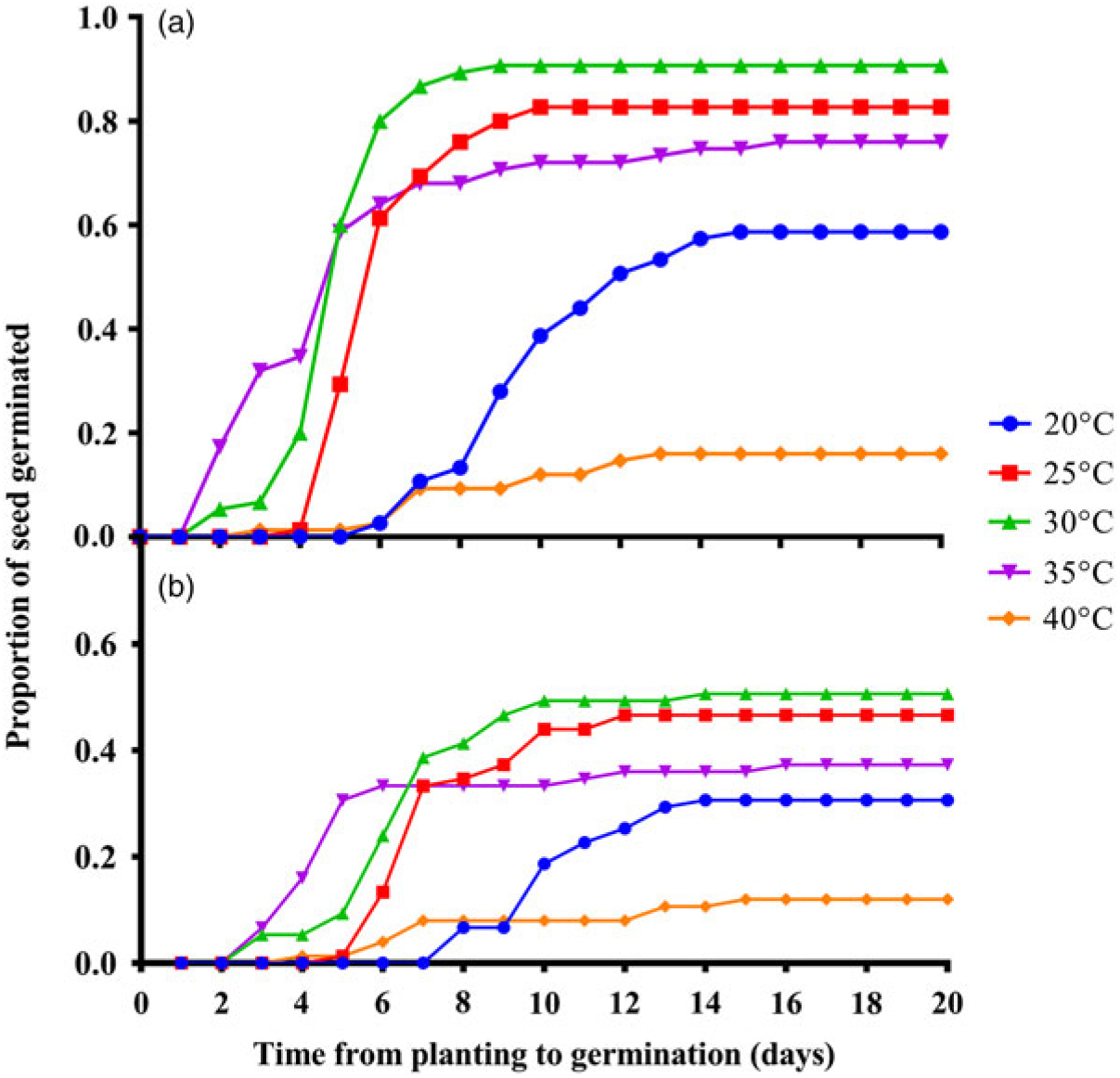
In this study, no germination was observed for the seed stored the longest (30 months) at any temperature. The effect of temperature on the germinated proportion for 6-and 18-month-stored Gac seed is presented in Figure 1(a and b). The proportion of seeds germinated after 20 days differed and depended on the age of the seed and the sowing temperature (residual deviance = 29.73: d.f. = 4,36; p = 0.052). The most successful germination (0.91) was observed in 6month-old seeds sown at 30 °C followed by the same aged seeds sown at 25 and 35 °C (0.80 and 0.76, respectively). Seed stored for 18 months and sown at 40 °C had the least successful germination (0.12).
The mean proportion of total seeds germinated for stored seed (a – 6 months, b – 18 months) sown at five temperatures (n = 15). The proportion germinated at 20 days differed depending on the storage age of the seed and the sowing temperature (p = 0.052).
The effects of the combined age and sowing temperature treatments on germination using the survival regression analysis were significant (X 2 = 278.9, d.f. = 9, p < 0.001). The estimated number of days to 50% germination shows a trend of fewer days at mid-range temperatures (25–35 °C) and more days at extreme temperatures (20 and 40 °C) (Figure 2a). The longest-stored seed generally took more days to achieve 50% germination than the younger seed set.
(a) Number of days to 50% germination for each seed storage age and sowing temperature treatment (±SE), (n = 15). (b) The mean germination speed index (GSI) of seed stored for 6 and 18 months at five sowing temperatures (±SE), (n = 15).

The mean GSI for 6-month-old seed was significantly greater than for longer-stored seed (p < 0.01), and for sowing temperatures between 25 and 30 °C (p < 0.01) (Figure 2b). There was also a significant interaction (p < 0.01) suggesting that the effect of seed age on GSI depended on the sowing temperature (LSD = 0.925).
The average weight of Gac seed at three storage ages is presented in Table 1. The mean seed weight before storage did not differ among the three seasons (2012, 2013 and 2014). However, the weight of the older seed, stored unsealed at ambient temperature, declined following prolonged storage. The seed stored for 6 months lost 7% weight, seed at 18 months had lost 14% and seed at 30 months had lost 32% weight.
The mean weight (±SD) of Gac seed stored for three lengths of time (30, 18 and 6 months) under laboratory conditions (21 ± 1 °C, 60% relative humidity), (n = 374)

A correlation Pearson analysis (p < 0.01) indicated that the seed weight had no relationship with the proportion of seed germinated at any seed storage age (30, 18 and 6 months). In addition, the seed weight did not appear to have an effect on the time to radicle emergence (data not shown).
Effect of cutting types and plant hormone (IBA) on the survival rate and rooting of Gac cuttings
The effect of cutting type on the survival of cuttings, ‘surviving’ defined as those with roots, depended on the IBA rate as suggested by a significant interaction between these treatments (Table 2). Semi-hardwood cuttings had generally higher survival rates than softwood but at 3.0 and 5.0 g/L IBA softwood cuttings had comparable survival rates to the semi-hardwood ones.
The effect of IBA concentration (g/L) applied as a dip on the survival of Gac cuttings of two ages

Data within a column followed by the same letter are not significantly different (LSD = 14.123). Values are means (n = 10); NS: not significant.
Effects of rootstock age and grafting on the survival of the Gac grafts
The effect of grafting type on the survival of cuttings depended on the age of rootstocks as suggested by a significant interaction between these treatments (Table 3). In general, younger rootstock (4 and 8 weeks) for both types of grafts had higher survival rates than 12-week-old rootstock. This older rootstock appeared to be associated with reduced shoot growth (data not shown).
The effect of grafting method and rootstock age on the survival of the grafting combination

Data within a column followed by the same letter are not significantly different (LSD = 9.68). Values are means (n = 6) (each with 10 grafted plants); NS: not significant.
Discussion
This study has demonstrated that a more-efficient, larger-scale propagation system for Gac is possible using seed germination, cuttings and grafting techniques. Few resources will be required to achieve these greater efficiencies and could be implemented in regional areas to take advantage of local genetic diversity in Gac, more likely to be suited to the local growing conditions (Sthapit et al., Reference Sthapit, Rana, Eyzaguirre and Jarvis2008).
The proportions of seed germinated were greatest for the 25–35 °C treatments identifying this temperature range as suitable for germination. This is in general agreement with the optimum seed germination temperature of other species belonging to the Cucurbitaceae family such as Momordica dioica Roxb. (30 °C) (Mohammad et al., Reference Mohammad, Hiroshi, Tomoko and Kunimitsu1991) and pumpkin (29–32 °C) (Motsa et al., Reference Motsa, Slabbert, Van Averbeke and Morey2015). Reduction of germination at higher temperatures (35 and 40 °C) implies that the traditional practice of cooking gac seed has no practical value for germinability.
The germination proportion of the Gac seed declined by more than 45% from 6 to 18 months of storage and those stored for over 2.5 years (30 months) appeared to have completely lost viability associated with the highest weight loss (Table 2). This highlights that appropriate seed storage conditions need to be developed for Gac. Whether gac seed is desiccant-tolerant or desiccant-sensitive has not been determined and this will dictate the conditions required. Most Cucurbits are desiccant-tolerant and require drying to a moisture content of about 5% for long-term storage (Nerson, Reference Nerson2007). In this study, Gac seeds were dried to only 10% moisture content and it is possible that this increased during storage.
In a previous study on the storage potential of the seeds of some cucurbits, watermelon was shown to be the most sensitive to storage, compared with melon and cucumber (Demir and Mavi, Reference Demir and Mavi2008). The authors hypothesised that this related to the higher oil content in watermelon seeds (20–45%). Gac seed is also high in oil, containing 60% fatty acids, mostly as stearic acid (Ishida et al., Reference Ishida, Turner, Chapman and Mckeon2004). However, in a comparative study of 195 species, the seed oil content and its longevity were not related (Probert et al., Reference Probert, Daws and Hay2009). Nonetheless, the composition of the oil may be important to lipid peroxidation potential which possibly affects seed aging (Probert et al., Reference Probert, Daws and Hay2009). For example, the peroxidation of oil in red cedar seeds (Thuja plicata Donn ex D.Don) is associated with seed deterioration during storage (McDonald, Reference McDonald1999) and in soybean relates to the decline of antioxidant enzyme activity (Sharma et al., Reference Sharma, Kaur, Bansal and Gill2013), and increased activity of lipoxygenase enzymes in almonds (Zacheo et al., Reference Zacheo, Cappello, Perrone and Gnoni1998).
Using softwood cuttings dipped in hormone has been shown in this study to be a suitable alternative to semi-hardwood and hardwood cuttings, which do not require plant hormone but require a large biomass. Although rooting hormone is not needed to strike roots in cuttings as highlighted by Parks et al. (Reference Parks, Murray, Gale, Al-Khawaldeh and Spohr2013), it was shown in this study to improve the survival of softwood cuttings with a concentration of 3–5 g/L IBA being appropriate. Based on research with watermelon, the use of rooting hormones also has the potential to advance yield. Watermelon cuttings dipped in IBA improved vegetative growth of shoots, and produced an earlier yield compared with the seedling control (El-Eslamboly, Reference El-Eslamboly2014). In the current study, two cuttings were grown on to maturity and flowering and fruiting occurred for one of these plants suggesting further investigations on the hormone effects of timing of flowering and yield are warranted for Gac.
The survival of Gac grafts in this study was shown to depend on rootstock age, with younger rootstock increasing survival. The highest survival rate and the shoot length of grafting combinations were obtained at rootstock ages of 4 and 8 weeks. In general, cucurbit grafts use rootstock material of a much younger seedling stage (10–20 days) (Amin and Mona, Reference Amin and Mona2014; Traka-Mavrona et al., Reference Traka-Mavrona, Koutsika-Sotiriou and Pritsa2000). However, in this study, Gac rootstock needed more than 20 days from emergence to reach an appropriate stem diameter for grafting; therefore, older rootstocks were used. Further, it appears from this study and a previous one (Joseph and Bharathi, Reference Joseph and Bharathi2008) that the grafting techniques of insert, splice and wedge can be successfully used in future work with Gac.
Conclusion
This study successfully used and refined three approaches for the propagation of Gac including seed germination, striking of cuttings and grafting. The germination of fresh Gac seed was most suitable at 25–35 °C, with 20 and 40 °C significantly reducing it. However, under ambient conditions, storage requirements need to be developed to maximise the germinability of Gac seed. The utilisation of external plant hormone significantly improved the survival rate of the softwood cuttings from 53 to 77% but not of semi-hardwood cuttings. The two grafting methods (splice and wedge) with younger rootstock (4 and 8 weeks old) were successful techniques. These simple methods could be widely used to propagate Gac with the purpose of increasing the number of female plants to achieve greater control of productivity. It is recommended that future work investigate the impact that these techniques have on production potential.
Author ORCIDs
Sophie Emma Parks, 0000-0001-9718-5969
Acknowledgements
The authors would like to acknowledge the Vietnamese Government and the University of Newcastle, Australia for financial support through a PhD scholarship for Xuan Thi Tran. We also thank Ms Lorraine J. Spohr and Anne Harris at Central Coast Primary Industries Centre, NSW Department Primary Industries for their statistical assistance with this study.






