Implications
Presently, global beef cattle production is not only a concern in terms of food security. It is also accounted in climate change inventories mostly owing to bovine enteric methane production, which is a key index of the energy preserved for muscle (beef) production or released as an atmospheric greenhouse gas. To obtain a sustainable and cost-effective beef cattle production system in the tropics, this study found applications of cattle breeds and dietary fat sources for improving the animal energy efficiency and developing the methane emissions mitigation strategies. However, their implications for ruminant livestock industry still need to be explored.
Introduction
The methane conversion factor (Ym) obtained in Thailand’s inventory of the enteric methane emissions of beef cattle fed low-quality crop residues and by-products in the tropics reached 8.4% of the gross energy (GE) intake (Kaewpila and Sommart, Reference Kaewpila and Sommart2016). This was much higher than the Intergovernmental Panel on Climate Change (IPCC) value of 6.5% (Intergovernmental Panel on Climate Change (IPCC), 2006). Methane mitigation strategies in beef cattle are partly based on cattle genetic potential, available feeds, feeding systems and rumen methanogenesis inhibitors (Llonch et al., Reference Llonch, Haskell, Dewhurst and Turner2017). Beef cattle are primarily selected for its higher daily gain and higher energy retention (ER) in body tissues than in low genetic merit beef cattle (Agricultural Research Council (ARC), 1980). Ferrell and Jenkins (Reference Ferrell and Jenkins1998) evidenced that genotype can influence the energetic efficiency and energy requirements of beef cattle.
Increasing energy feeding levels increases daily gains and increasing energetic efficiency reduces energy outputs in urine, methane, and heat production (Chaokaur et al., Reference Chaokaur, Nishida, Phaowphaisal and Sommart2015). Fats provide 2.25-fold more energy than carbohydrates and proteins. Therefore, fats are commonly used to increase feed energy density, particularly soyabean seed (SBS) derivatives (Hess et al., Reference Hess, Moss and Rule2008). Although kapok seed (KPS) (Ceiba pentandra) and oil palm fruit (OPF) (Elaeis guineensis) are a raw-feed material in the tropics, they have not received much attention regarding nutrient utilisation efficiency and capacity to replace SBS. Diets with high potential fat sources can reduce Archaea populations and methanogenesis in the rumen (Hristov et al., Reference Hristov, Oh, Firkins, Dijkstra, Kebreab, Waghorn, Makkar, Adesogan, Yang, Lee, Gerber, Henderson and Tricarico2013) and are thus expected to have less methane energy loss and high metabolisable energy (ME) intake (ARC, 1980). However, the addition of more than 7.4% oilseeds or fats to dry matter (DM), which is the recommended threshold, can reduce feed intake (Hess et al., Reference Hess, Moss and Rule2008). In addition, medium- and long-chain fatty acids can have a negative effect on gram-positive rumen bacteria, including the cellulolytic bacteria Ruminococcus sp., which could lead to the suppression of fibre digestibility (Yang et al., Reference Yang, Bu, Wang, Hu, Li, Wei, Zhou and Loor2009; Chuntrakort et al., Reference Chuntrakort, Otsuka, Hayashi, Takenaka, Udchachon and Sommart2014). In addition, fatty acids can adhere to feed particles, thus building a physical barrier that prevents the action of microorganisms (Fiorentini et al., Reference Fiorentini, Carvalho, Messana, Castagnino, Berndt, Canesin, Frighetto and Berchielli2014).
In addition to Zebu cattle, the native crossbreds Charolais and Japanese Black (Bos taurus×Bos indicus) are the predominant breeds of beef cattle in northeast Thailand. Breeding programmes for these two crossbreds started about 25 years ago and focused mainly on improving genetic resources, marbling scores and on improving the resistance of the animals to hot and humid environments and diseases. Breeding programmes of Charolais have aimed to improve birth rate using dams with large body size, such as Brahman, because the large skull of Charolais foetus leads to dystocia and maternal mortality, because they have inherited the large body size of B. taurus. However, research on the genetic merit of B. taurus×B. indicus crossbreds in humid tropical conditions is still scarce (Marcondes et al., Reference Marcondes, Tedeschi, Valadares Filho and Gionbelli2013). Presently, there is little quantitative information available on the maintenance energy requirement for native crossbreds. As diets used for beef cattle in tropical developing countries generally have poor quality and thus lower energy density than those supplemented with oilseeds, the default Ym values for beef cattle fed with low-quality crop residues and by-products may not be fully applicable to those fed with dietary oilseeds. In addition, differences in the genotypes of crossbred beef cattle and in the properties of the oilseed used as the dietary fat source may have major effects on nutrient utilisation efficiency, and they might reduce the environmental impact of cattle methane emissions in tropical developing countries.
The present study aimed to evaluate the effect of different oilseeds included in fermented total mixed rations on feed intake, digestibility, rumen microbial populations, energy partition and methane emissions in the yearlings of different Thai native crossbred beef cattle genotypes. In addition, it aimed to determine the ME requirement for maintenance and Ym values using energy partition data.
Material and methods
Experimental procedure
This study was conducted at the Beef Cattle Research Station, Khon Kaen University, Khon Kaen, Thailand, from February to May 2014 (i.e. during summer). Three Charolais crossbred bulls (genotype=0.50Charolais×0.25Thai native ×0.25Brahman; 14 months; BW±standard deviation (SD)=241.3±9.6 kg) and three Japanese Black crossbred bulls (genotype=0.53Japanese Black ×0.25Thai native ×0.16Red-Sindhi ×0.06Thai-Friesian; 10 months; BW±SD=85.0±6.6 kg) were analysed based on a replicated 3×3 Latin square design. In this design, each animal breed was analysed in a separate square comprising three periods of 21 days for the energy balance trials and three dietary oilseed treatments. The animals were housed in individual pens (4×2 m) and water and feed were provided ad libitum (1.1 times the intake of the previous day) twice daily (at 0800 and 1630 h). Animals were prepared during a pre-experimental period of 30 days and weighed on the 1st day of every trial and again on the 22nd day of the last trial (at 0730 h) to determine their metabolic BW0.75.
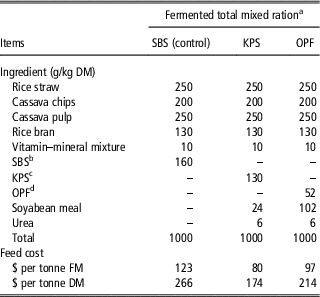
To examine the effect of the dietary oilseed treatment, we prepared three fermented total mixed rations (Table 1) including 840 g/kg DM and one of the following fat sources: 160 g/kg whole SBS (control), 130 g/kg whole KPS with 24 g/kg soyabean meal and 6 g/kg urea (KPS), or 52 g/kg cracked whole OPF with 102 g/kg soyabean meal and 6 g/kg urea (OPF). The particle sizes (diameters) of whole OPFs ranged ~between 20 and 60 mm, which were much bigger than that of the whole SBS (~5 mm) and whole KPS (~5 mm). Whole OPFs also contain a shell, which is much harder (woody) than that of the two other oilseeds and surround the seed kernel. The OPFs were cracked to adjust the particle size (to ~2–30 mm in length), distribute it uniformly in the total mixed ration, and ensure the digestibility of seed kernel. The control diet was formulated to meet the ME and CP requirements for maintenance, as recommended by the Working Committee of Thai Feeding Standard for Ruminant (WTSR) (2010) for yearling beef cattle production in Thailand. Total fats in our experimental diets were optimised at 65 g/kg ether extract (EE), which consisted of a1:1 mixture of basal ingredients:oilseed-based diet.
Ingredients and the cost of each experimental diet used in the present study

SBS=soyabean seed; KPS=kapok seed; OPF=oil palm fruit; DM=dry matter; FM=fresh matter.
a Dietary oilseed treatments were prepared with either whole SBS, whole KPS or cracked OPF.
b Cost: $714/tonne FM, or $816/tonne DM.
c Cost: $143/tonne FM, or $162/tonne DM.
d Cost: $151/tonne FM, or $260/tonne DM.
Ingredients were purchased from commercial cooperative suppliers of animal feed in Khon Kaen. Rice straw, fresh cassava roots and OPFs were cut into pieces that were 3 cm length, and 380 kg of each fresh ingredient was mixed in a horizontal feed mixer and ensiled in a polyethylene bag silo (150×220 cm, 0.14 mm thick) for 14 days before the first experimental period. All fermented total mixed rations possessed proper particle size and were soft and juicy for feeding the cattle. The silos were opened for ~10 min before each feeding time, and then re-vacuumed and re-sealed. Feed refusals were removed daily at 0730 h. On the 14th day of every trial, at 1600 h, the animals were moved to metabolic cages for determining faeces and urine outputs, oxygen consumption and carbon dioxide and methane emissions. Faeces and urine outputs were measured for 6 days (days 15 to 20) using the total collection technique (Schneider and Flatt, Reference Schneider and Flatt1975).
Oxygen consumption, and carbon dioxide and methane emissions were determined during days 18 to 20 of each period using an individual head box respiration chamber system according to the method reported by Suzuki et al. (Reference Suzuki, Phaowphaisal, Pholsen, Narmsilee, Indramanee, Nitipot, Chaokaur, Sommart, Khotprom, Panichpol and Nishida2008). In brief, the system consisted of a head cage system and flow meter (thermal flow cell, FHW-N-S; Nippon Flow Cell MFG Co., Ltd, Tokyo, Japan), which recorded the flow rate and total volume of air flowing out of the respiration chamber. The flow meter was defaulted to record the volume of gas at standard temperature and pressure. The collected samples of outflow and incoming air were analysed for methane concentration using an IR gas analyser (IR200 Infrared Gas Analyser; Yokogawa Electric Co., Tokyo, Japan). The gas analysers were calibrated once daily (from 0731 to 0800 h) against certified gases (Takachino Chemical Industrial Co., Ltd, Tokyo, Japan) of known concentrations.
Aliquots of oilseeds, feed (fermented total mixed rations) offered, refusals, faeces and urine were collected and stored at −20°C. Fermentation quality analyses of the total mixed rations were determined from cold water extracts (Cao et al., Reference Cao, Cai, Takahashi, Yoshida, Tohno, Uegaki, Nonaka and Terada2011), and ration pH was measured with a glass electrode. Ammonia nitrogen (N) concentration was determined using a spectrometer (UV/VIS Spectrometer; PG Instruments, London, UK) following the procedure described by Fawcett and Scott (Reference Fawcett and Scott1960). Short-chain fatty acids (SCFAs) and lactic acid concentrations were measured using gas chromatography (GC2014; Shimadzu Co., Kyoto, Japan, equipped with an SGE BP21-05 column; SGE Analytical Science Pty Ltd, Victoria, Australia), following the procedure reported by Porter and Murray (Reference Porter and Murray2001). Samples were dried in a forced-air oven at 60°C for 72 h, and grinded into 1 mm pieces. The GE content was determined using a bomb calorimeter (IKA C2000Basic; IKA-Werke, Staufen, Germany). The DM, ash, CP and EE content were determined following the methods recommended by the Association of Official Analytical Chemists (1995). Neutral detergent fibre and ADF contents were determined following Van Soest et al. (Reference Van Soest, Robertson and Lewis1991). Acid detergent lignin were assayed according to Galyean (Reference Galyean1997). The DM and nutrient intakes were calculated as the difference between feed offered and refusals. However, the intakes of days 1 to 7 were considered as adaptation time and excluded from the intake measurements. Therefore, the intakes of days 8 to 21 (14 days) were measured and averaged. Feed digestibility was calculated as the difference between intakes and faeces.
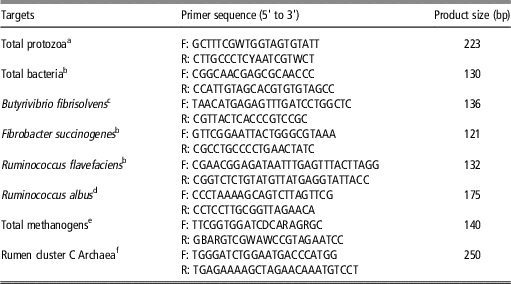
Rumen fluids were collected using a stomach tube, 3 h after the morning feeding on day 21, and pH was immediately measured. The rumen fluids were separated into two portions: one portion (90 ml) was mixed with 6 N HCl (10 ml) for measuring ammonia N concentration, following the procedures of Fawcett and Scott (Reference Fawcett and Scott1960), and SCFA concentration was measured using gas chromatography (GC2014 equipped with an SGE BP21-05 column), according to the procedure reported by Chuntrakort et al. (Reference Chuntrakort, Otsuka, Hayashi, Takenaka, Udchachon and Sommart2014). The other portion (1 ml) was used to determine rumen microbial populations. Total genomic DNA was extracted using the Fast DNA Kit (MP Biomedicals, Cleveland, OH, USA) following the manufacturer’s protocol, and its concentration (ng/µl) was then measured spectrophotometrically at 260 nm. Real-time PCR was performed in a CFX96 Touch™ instrument (Bio-Rad Laboratory, Hercules, CA, USA) using the species-specific primer pairs presented in Table 2. Standard copy numbers were obtained from preconditioned PCR products, which were amplified from the reactions described below. These PCR products were purified using a kit (Nucleo Spin® Gel and PCR Clean-up; Macherey-Nagel, Düren, Germany), and serially diluted from copy numbers of 103 to 108/µl. Real-time PCRs were performed in 20-μl final reactions containing diluted DNA template (2-µl), master mix (10-µl, KAPA SYBR® FAST Universal qPCR Kit; Kapa Biosystems, Woburn, MA, USA), primers (0.5 µl or 1 µl for total protozoa) and milli-Q water (7 µl or 6 µl for total protozoa). Amplification took place at 94°C for 3 min followed by 40 cycles at 90°C for 10 s and 60°C for 30 s (54°C for 45 s and 56°C for 45 s in reactions of total protozoa and rumen cluster C Archaea, respectively). Fluorescence readings were taken after each elongation step, and a final melting step was conducted by slow heating at 0.5°C/s increments from 65 to 90°C.
Real-time PCR primers for detecting microbial populations in rumen fluid

bp=base pairs; F=forward primer; R=reverse primer.
a Sylvester et al. (Reference Sylvester, Karnati, Yu, Morrison and Firkins2004).
b Denman and McSweeney (2006).
c Yang et al. (2009).
d Koike and Kobayashi (2001).
e Denman et al. (2007).
f Jin et al. (2014).
The energy balance was partitioned taking GE intake, faeces, urine, enteric methane, heat energy and ER values into account (ARC, 1980). A database was developed for the Charolais (n=9) and Japanese Black (n=8) crossbreds, and analysed by regressing ME intake (kJ/kg BW0.75) against ER (kJ/kg BW0.75) according to ARC (1980) guidelines for evaluating the ME requirements for maintenance (X-intercept). The Ym (%) was then calculated as the methane energy loss in relation to GE intake.
Statistical analyses
All data were subjected to an ANOVA based on the GLM procedure in SAS 6.12 (SAS Institute Inc., Cary, NC, USA), using the model:
 $$Y_{{ijkl}} \,{\equals}\,\mu \,{\plus}\,S_{l} \,{\plus}\,A_{{i(l)}} \,{\plus}\,\rho _{j} \,{\plus}\,\tau _{k} \,{\plus}\,{\epsilon}_{{ijkl}} $$
where Y ijkl is the mean response of animal i, l is the genotype, j the period, k the dietary treatment, μ the overall mean, S l the effect of genotype l (l=1 to 2), A i(l) the effect of cattle i (i=1 to 3) within genotype l, ρ (j) the effect of period j (j=1 to 3), τ (k) the effect of dietary treatment k (k=1 to 3) and ε ijkl the residual error.
The ANOVA showed that the interaction between genotype and dietary treatment was not significant for all variables. Therefore, our results, reported as the mean of the main effects of genotype and dietary oilseed treatments and the standard error of the mean, were compared using Duncan’s test. The significance threshold was P<0.05 unless otherwise noted.
Results
Fermentation quality, chemical composition, feed intake and digestibility
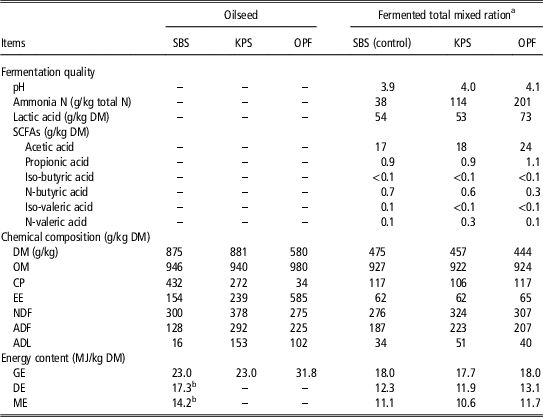
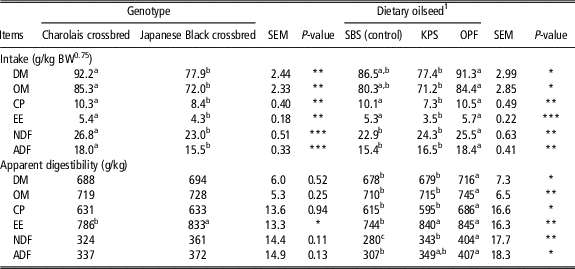
The three fermented total mixed rations were of optimum quality (pH 3.9 to 4.1), and their chemical composition is reported in Table 3. As compared with Charolais crossbred cattle, Japanese Black crossbred cattle had lower (P<0.01) DM intake (g/kg BW0.75) and higher (P<0.05) EE digestibility (g/kg) (Table 4). Among dietary oilseed treatments, OPF resulted in higher DM intake than KPS (P<0.05), whereas SBS presented an intermediate value. However, SBS and OPF diets allowed higher EE intake than the KPS diet did (P<0.01). As compared with SBS and KPS, the OPF diet contributed to higher DM (P<0.05), OM (P<0.01), CP (P<0.05) and NDF (P<0.01) digestibility.
Fermentation quality and chemical composition of the experimental diets

SBS=soyabean seed; KPS=kapok seed; OPF=oil palm fruit; N=nitrogen; DM=dry matter; SCFAs=short-chain fatty acids; OM=organic matter; EE=ether extract; GE=gross energy; DE=digestible energy; ME=metabolisable energy.
a Dietary oilseed treatments were prepared with either whole SBS, whole KPS or cracked OPF.
b Values taken from National Research Council (2000).
Effect of genotype (n=9) and dietary oilseed (n=6) on feed intake and apparent digestibility in yearling Thai native crossbred beef cattle

SBS=soyabean seed; KPS=kapok seed; OPF=oil palm fruit; DM=dry matter; OM=organic matter; EE=ether extract.
a,b,cValues with different superscripts within a row differ significantly at P<0.05.
1 Bulls were fed fermented total mixed rations prepared with either whole SBS, whole KPS or cracked OPF.
*P<0.05, **P<0.01, ***P<0.001.
Rumen fermentation characteristics and microbial populations
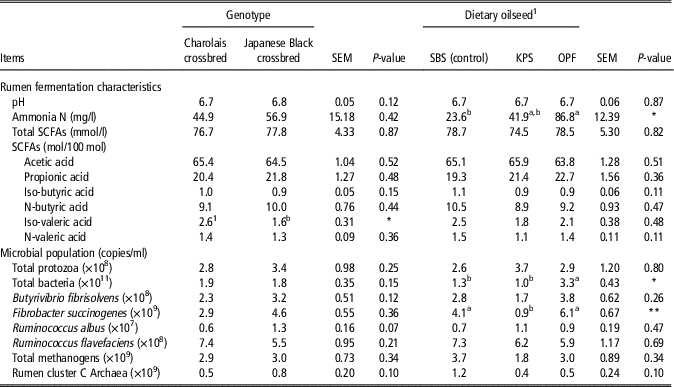
Genotype and dietary oilseed treatments had no significant effect (P>0.05) on pH, total SCFAs concentration and SCFAs profile (Table 5). The OPF diet resulted in 3.6-fold higher ammonia N concentration than the SBS diet, with KPS diet being the intermediate (P<0.05). There were no significant differences between genotypes or among the three dietary oilseed treatments (P>0.05) in total protozoa, Butyrivibrio fibrisolvens, Ruminococcus albus, Ruminococcus flavefaciens, total methanogens and rumen cluster C Archaea populations. However, the OPF diet resulted in larger populations of total bacteria (P<0.05) and Fibrobacter succinogenes (P<0.01).
Effect of genotype (n=9) and dietary oilseed (n=6) on rumen fermentation in yearling Thai native crossbred beef cattle

SBS=soyabean seed; KPS=kapok seed; OPF=oil palm fruit; N=nitrogen; SCFAs=short-chain fatty acids.
a,bValues with different superscripts within a row differ significantly at P<0.05.
1 Bulls were fed fermented total mixed rations prepared with either whole SBS, whole KPS or cracked OPF.
*P<0.05, **P<0.01.
Energy partition and enteric methane emissions
The Japanese Black crossbred showed lower (P<0.05) GE, DE and ME intakes, and lower energy loss in faeces, urine, methane and heat energy than those in the Charolais crossbred, although these differences were not significant in ER and DE/GE, ME/GE, ME/DE and ER/ME efficiencies (Table 6). In addition, the ME requirement for maintenance in the Charolais crossbred (ER=0.574×ME intake −247.1; n=9; P<0.001, R 2 =0.82, rSD=43.17) and Japanese Black crossbred (ER=0.688×ME intake −265.5; n=8; P<0.001, R 2 =0.80, rSD=47.4) cattle were 430 and 385 kJ/kg BW0.75, respectively. The OPF diet resulted in greater ME intake and ER than the KPS diet, with the SBS diet providing intermediate values (P<0.05). As compared with SBS and KPS diets, the OPF diet contributed to higher (P<0.05) DE/GE and ME/GE efficiencies, although the differences were not significant for ME/DE and ER/ME efficiencies. Methane emissions (g/kg BW0.75) were lower in Japanese Black crossbred than in Charolais crossbred (P<0.001), and in KPS diets than in SBS and OPF diets (P<0.001). However, genotype and dietary oilseed treatments had no significant effects (P>0.05) on Ym.
Effect of genotype (n=9) and dietary oilseed (n=6) on energy utilisation and methane emissions in yearling Thai native crossbred beef cattle
SBS=soyabean seed; KPS=kapok seed; OPF=oil palm fruit; GE=gross energy; DE=digestible energy; ME=metabolisable energy; ER=energy retention; DM=dry matter; Ym=methane conversion factor.
a,bValues with different superscripts within a row differ significantly at P<0.05.
1 Bulls were fed fermented total mixed rations prepared with either whole SBS, whole KPS or cracked OPF.
*P<0.05, **P<0.01, ***P<0.001.
Discussion
In the present study, we evaluated the effect of different oilseeds included in fermented total mixed rations on feed intake, digestibility, rumen microbial populations, energy partition and methane emissions in different beef cattle genotypes. However, the difference in body size of the two genotypes was large with only three cattle per genotype. Therefore, conclusions about genotype differences should not be over-interpreted when considering strategies for improving the energy utilisation efficiency and reducing the enteric methane emissions of beef cattle production system.
Effects on feed intake and digestibility
Dry matter intake ranged from 77 to 92 g/kg BW0.75 across genotype and dietary oilseed treatments in yearling Thai native crossbred beef cattle. Charolais crossbred cattle showed a significantly higher DM intake (15%) than Japanese Black crossbred did (Table 4). Our results agree with that of Ferrell and Jenkins (Reference Ferrell and Jenkins1998) who reported that, when DM intake was evaluated on a weight-constant basis, beef cattle genotype influenced feed intake. They also noted that feed intake was directly proportional to maintenance costs of each genotype, with those having higher growth rate, production potential, or larger size at maturation showing higher feed intake. The similar digestibility of major dietary nutrients irrespective of genotype is consistent with the previous observation, which indicated a comparable effect of young Thai native or Brahman genotypes on feed utilisation (Chuntrakort et al., Reference Chuntrakort, Otsuka, Hayashi, Takenaka, Udchachon and Sommart2014).
In addition, our results indicate that the OPF diet could replace the SBS diet, with greater fibre intake and digestibility resulting in greater feed utilisation. However, this finding was inconsistent with that of Fiorentini et al. (Reference Fiorentini, Carvalho, Messana, Castagnino, Berndt, Canesin, Frighetto and Berchielli2014), who reported that the addition of palm oil led to lower DM and NDF intakes than the addition of whole SBSs did. This inconsistency might be partly explained by the lower palm oil availability in our study and difference in roughage/concentrate ratio of the basal diets used in both studies. Hess et al. (Reference Hess, Moss and Rule2008) suggested that an increased fat concentration and/or availability in the rumen, especially with increased roughage/concentrate ratio, were associated with decreased fibre digestibility and rumen in-flow and out-flow rates. In addition, it should be noted that the EE intake in the cattle fed with KPS diet was low owing to low intake of the diet. Our data, however, showed that the optimal inclusion rate for KPS should be below 13% of diets (on DM basis) to maintain feed intake. This observation is consistent with the type of fats present in KPS and their poor palatability. The major anti-nutritional characteristics of KPS oil, such as cyclopropene fatty acids (C18:1), have also been reported in a previous study (Anwar et al., Reference Anwar, Rashid, Shahid and Nadeem2014).
Effects on rumen fermentation and microbial populations
Previous studies showed no difference in pH, ammonia N concentration, total SCFAs concentration, SCFAs profile and protozoa populations between Brahman and Thai native cattle (Chuntrakort et al., Reference Chuntrakort, Otsuka, Hayashi, Takenaka, Udchachon and Sommart2014), and in total bacteria and Archaea populations between Aberdeen Angus crossbred and Limousin crossbred cattle (Rooke et al., Reference Rooke, Wallace, Duthie, McKain, De Souza, Hyslop, Ross, Waterhouse and Roehe2014). Production of acetate and butyrate in the rumen is known to balance hydrogen level within the rumen. In the present study, no differences in total SCFA concentration and SCFA profiles associated with the genotype effect were found (Table 5), suggesting that Charolais and Japanese Black crossbreds have similar hydrogen-utilisation performance. Our results indicated that dietary oilseeds influenced ammonia N concentration in the rumen. Yang et al. (Reference Yang, Bu, Wang, Hu, Li, Wei, Zhou and Loor2009) reported that dietary oils affected ammonia N concentration by increasing proteolytic bacteria. In the present study, the presence of soyabean meal and urea in the OPF diet (Table 1) likely accelerated protein degradation resulting in high ruminal ammonia N concentration. Moreover, OM digestibility was high in the OPF diet (Table 4), but total SCFA concentration was similar (Tables 5) among diets, suggesting that the OPF diet was digested in the rumen, where fermentable OM utilisation efficiency is the highest.
Although protozoa prey upon bacteria, large bacterial populations within the rumen are known to enhance microbial yields and feed degradability. Moreover, ruminal fibrolytic bacteria are important for utilisation of fibrous feeds, resulting in increased feed utilisation performance. Our results indicate that Charolais and Japanese Black crossbreds have similar total protozoa and total bacteria populations in the rumen, in agreement with measurements reported for other cattle genotypes (Chuntrakort et al., Reference Chuntrakort, Otsuka, Hayashi, Takenaka, Udchachon and Sommart2014; Rooke et al., Reference Rooke, Wallace, Duthie, McKain, De Souza, Hyslop, Ross, Waterhouse and Roehe2014). Our results on the effects of dietary oilseeds revealed that the abundance of total bacteria and F. succinogenes was high on cattle fed with the OPF diet. This observation might be related to direct and indirect effects of fat sources, and the fats of the OPF diet might exert a low inhibition and/or coating action upon microorganisms. Another factor that contributes to differences in rumen microbial number owing to diet may have been the prevailing ammonia N concentrations in the rumen. Diets using soyabean meal and urea to replenish CP were more readily degraded to ammonia thus potentially affecting the microbial population abundance. Satter and Slyter (Reference Satter and Slyter1974) reported that an ammonia N concentration of 50 mg/l is sufficient to support maximum growth rates of rumen bacteria. In addition, the low ammonia N concentration in the control diet (23.6 mg/l) should be below the growth requirements of total bacteria and cellulolytic bacteria. Therefore, the low ammonia N concentration in the control diet might inhibit growth rates of rumen bacteria, thereby resulting in a significant difference in a total number of rumen bacteria in the present study (P<0.05). It is known that large populations of methanogens could enhance methanogenesis by utilising hydrogen and carbon dioxide (Hristov et al., Reference Hristov, Oh, Firkins, Dijkstra, Kebreab, Waghorn, Makkar, Adesogan, Yang, Lee, Gerber, Henderson and Tricarico2013). However, our results indicated that the total methanogens and rumen cluster C Archaea populations did not differ between the genotypes or diets examined.
Effects on energy partition and methane emissions
Our results indicate that ER was similar between the two genotypes (Table 6); however, the Japanese Black crossbred had lower energy intake and energy loss than the Charolais crossbred. This observation suggests that the Japanese Black crossbred has better energy utilisation efficiency than Charolais crossbred. Energy partition is important to develop the feeding standards used to predict nutrient requirements (ARC, 1980). Ferrell and Jenkins (Reference Ferrell and Jenkins1998) demonstrated that the ME requirements for maintenance can differ among beef cattle genotypes. Our findings support this premise, because, in the same dietary oilseed treatment, genotype effects on energy utilisation were markedly related with the ME requirement for maintenance in the Japanese Black crossbred. Although there is no explanation for such differences in ME requirement for maintenance so far (National Research Council (NRC), 2000), environmental conditions, feed level×temperature interactions, coprophagy and compensatory gain of limited-fed cattle might be potentially affected (Ferrell and Jenkins, Reference Ferrell and Jenkins1998). A recent study proposed that differences in protein and fat metabolism might influence ME requirements (Marcondes et al., Reference Marcondes, Tedeschi, Valadares Filho and Gionbelli2013). Compared with B. taurus in developed countries, fewer studies have been conducted on B. indicus or other genotypes adapted to tropical developing countries (Marcondes et al., Reference Marcondes, Tedeschi, Valadares Filho and Gionbelli2013; Chaokaur et al., Reference Chaokaur, Nishida, Phaowphaisal and Sommart2015). In fact, the present study is the first to determine the ME requirements for maintenance of yearling B. indicus×B. taurus in Thailand. According to NRC (2000), the ME requirement for B. indicus is 10% lower than that for B. taurus (British breeds), and the values for B. indicus×B. taurus are within the ranges obtained for B. taurus and B. indicus. However, the values obtained in the present study are 18% to 27% lower than that recommended by ARC (1980) for British breeds (527 kJ/kg BW0.75), and 13% to 22% lower than the value reported by Kearl (1982) for crossbred cattle (B. indicus crossbred) in developing countries (493 kJ/kg BW0.75). They are also 11% to 20% lower than the values recommended by WTSR (2010) for purebred Brahman in Thailand (484 kJ/kg BW0.75) and lower than the values recommended by Marcondes et al. (Reference Marcondes, Tedeschi, Valadares Filho and Gionbelli2013) for purebred and crossbred Nellore cattle (491 to 694 kJ/kg empty BW0.75) and by Chaokaur et al. (Reference Chaokaur, Nishida, Phaowphaisal and Sommart2015) for purebred Brahman in Thailand (435 kJ/kg BW0.75).
Chaokaur et al. (Reference Chaokaur, Nishida, Phaowphaisal and Sommart2015) suggested that increasing intake for ‘a dilution of maintenance’ is an important factor for improving beef production in the tropics. In this study, a consistently high ME intake and ME/GE efficiency could possibly explain the better performance of the OPF diet. This implies that feeding OPF as the dietary fat source might potentially improve beef cattle, similar to that achieved with SBSs (Hess et al., Reference Hess, Moss and Rule2008). In addition, the OPF diet was associated with the highest NDF digestibility, which likely accounted for the low energy loss in faeces combined with greater ME/GE efficiency observed in bulls fed this diet.
Our results also clearly indicated that the Japanese Black crossbred has 18.5% lower enteric methane emissions than the Charolais crossbred. However, the reported effects of genotype on methane emissions are not consistent. Chuntrakort et al. (Reference Chuntrakort, Otsuka, Hayashi, Takenaka, Udchachon and Sommart2014) reported that Brahman and Thai native cattle have similar methane emissions. However, Aberdeen Angus crossbred and Limousin crossbred cattle have different methane emissions (Rooke et al., Reference Rooke, Wallace, Duthie, McKain, De Souza, Hyslop, Ross, Waterhouse and Roehe2014). Our results indicate that dietary oilseeds influence methane emissions, which was consistent with previous reports (Chuntrakort et al., Reference Chuntrakort, Otsuka, Hayashi, Takenaka, Udchachon and Sommart2014; Fiorentini et al., Reference Fiorentini, Carvalho, Messana, Castagnino, Berndt, Canesin, Frighetto and Berchielli2014). Regarding Ym, the proportion of GE intake released as enteric methane energy (%GE intake) is a critical factor for estimating the potential extent of global warming and methane emissions in national inventories (IPCC, 2006). However, studies on the base line Ym typical of B. taurus×B. indicus crossbreds within feeding systems in tropical developing countries are very few. In fact, this is the first study determining the Ym of yearling Thai native crossbred beef cattle fed dietary oilseeds in Thailand. However, regarding the method used (Suzuki et al., Reference Suzuki, Phaowphaisal, Pholsen, Narmsilee, Indramanee, Nitipot, Chaokaur, Sommart, Khotprom, Panichpol and Nishida2008), a recent report (Hill et al., Reference Hill, McSweeney, Wright, Bishop-Hurley and Kalantar-Zadeh2016) suggested that the head box systems might underestimate methane measurements because it does not measure hindgut methane emissions. To account for methane emissions from the hindgut, which are <5% the total methane emission (Boadi and Wittenberg, Reference Boadi and Wittenberg2002), the Ym values of 5.8% to 6.0% GE intake obtained in the present study could be corrected to 6.1% to 6.3% to avoid underestimation. The adjusted Ym ranging from 6.1% to 6.3% GE intake is consistent with the Ym of B. indicus fed dietary oilseeds ranging (5.2% to 8.3% GE intake) (Chuntrakort et al., Reference Chuntrakort, Otsuka, Hayashi, Takenaka, Udchachon and Sommart2014). However, it is lower than the 6.5% default value recommended by the IPCC (2006) and the 8.4% default value for beef cattle fed low-quality crop residues and by-products in tropical developing countries (Kaewpila and Sommart, Reference Kaewpila and Sommart2016). The present study revealed that the increased energy density and intake owing to the addition of fat to the typically poor-quality feed, which is available in tropical production systems, might be the main factor affecting Ym.
In conclusion, our results imply that enteric methane emissions might be lower in Japanese Black than in Charolais crossbred because of their lower energy intake and ME required for maintenance. Our results indicated that dietary OPF could replace SBSs as the fat source in feed completely because it stimulated feed intake, the growth of rumen total bacteria, NDF digestibility and ER. Moreover, the present study indicated that Ym values of Thai native crossbred beef cattle yearlings fed with a typical tropical feed supplemented with oilseeds were below the default value of 6.5% GE intake recommended by IPCC. The beneficial effects of producing Japanese Black crossbred cattle and using dietary OPF as the fat source in feed should be further confirmed based on long-term feeding trials.
Acknowledgements
The authors thank the Food and Functional Food Research Cluster of Khon Kaen University (under the Higher Education Research Promotion and National Research University Project, Office of the Higher Education Commission), who provided the scholarship fund for the PhD student Mr Chatchai Kaewpila (grant no.: Ph.d.54126). The authors also thank the National Research Council of Thailand for funding (NRCT2556-64), and Khon Kaen University and the Japan International Research Centre for Agricultural Sciences for the infrastructure and laboratory facilities.
Declaration of interest
There are no conflicts of interest to declare.
Ethics statement
All animal-related procedures were reviewed and approved by the Animal Ethics Committee of Khon Kaen University, according to the Ethics of Animal Experimentation of the National Research Council of Thailand (Record No. AEKKU81/2556, Reference No. 0514.1.12.2/92).
Software and data repository resources
None.