Studies on influence of feeding management on milk composition have mostly been conducted with experimental flocks in which main factors such as animal condition and physiology, lactation stage, indoor feeding type, or grazing management are under control (Atti et al. Reference Atti, Rouissi and Othmane2006; Ostrovský et al. Reference Ostrovský, Pavlíková, Blaško, Górová, Kubinec, Margetín and Soják2009). Studies made with commercial flocks are very scarce in the scientific literature. On-farm investigations provide data from the real context of commercial flocks with uncontrolled factors in contrast to experimental farms. Thus, effects of lactation, season and feeding management are inseparably associated, and it is not possible to have a commercial control flock to dissociate those effects as done in experimental trials (Collomb et al. Reference Collomb, Bisig, Bütikofer, Sieber, Bregy and Etter2008; Abilleira et al. Reference Abilleira, Collomb, Schlichtherle-Cerny, Virto, de Renobales and Barron2009; Revello-Chion et al. Reference Revello-Chion, Tabacco, Giaccone, Peiretti, Battelli and Borreani2010). Nevertheless, despite this handicap, on-farm studies are necessary to know real situations in-depth and to determine the extent to which experimental results translate to a commercial flock.
Milk fat composition is strongly influenced by animal feeding and different lipid compounds have been reported to characterise milk and cheese from grazing ruminants (Morand-Fehr et al. Reference Morand-Fehr, Fedele, Decandia and Le Frileux2007; Povolo et al. Reference Povolo, Pelizzola, Lombardi, Tava and Contarini2012). Some of these compounds such as tocopherols come directly from the pasture whereas others, such as FAs and retinol, are products of animal and/or ruminant metabolism. Most papers on sheep grazing reported that fresh pasture intake lowered the saturated FA content of milk fat, whereas that of some unsaturated FAs such as C18:1t11 (VA), C18:2c9t11 (RA), C18:2t11c15 and C18:3c9c12c15 (ALA) increased (Atti et al. Reference Atti, Rouissi and Othmane2006; Abilleira et al. Reference Abilleira, Collomb, Schlichtherle-Cerny, Virto, de Renobales and Barron2009; Revello-Chion et al. Reference Revello-Chion, Tabacco, Giaccone, Peiretti, Battelli and Borreani2010). The accumulation of above-mentioned unsaturated FAs in milk fat increases the nutritional quality of milk and cheese from grazing animals because they are claimed to have potential antiatherogenic, antiobesity and anticarcinogenic properties for human health (Pintus et al. Reference Pintus, Murru, Carta, Cordeddu, Batetta, Accossu, Pistis, Uda, Ghiani, Mele, Secchiari, Almerighi, Pintus and Banni2013). Studies on fat-soluble antioxidants (tocopherols and retinoids) present in sheep milk are scarce in the scientific literature, reporting higher content of vitamin E and A in milk fat from grazing animals than in that from indoor feeding based on concentrate and forage (Hulshof et al. Reference Hulshof, van Roekel-Jansen, van de Bovenkamp and West2006; Delgado-Pertíñez et al. Reference Delgado-Pertíñez, Gutiérrez-Peña, Mena, Fernández-Cabanás and Laberye2013).
This work focuses on the Latxa sheep breed management system used in the east region of the Cantabrian area (Northern Spain). Seasonal feeding changes during lactation range from indoor feeding in winter (early lactation), part-time grazing in spring (mid lactation) and extensive mountain grazing in summer (late lactation). In particular, the study analyses changes in FA and fat-soluble antioxidant composition of milk and cheese from commercial flocks with those seasonal feeding regimes.
Materials and methods
Commercial flocks and feeding management
Six commercial flocks of Latxa dairy breed were selected. All flocks were ascribed to the Protected Denomination of Origin (PDO) Idiazabal cheese (Basque Country Region in Northern Spain) and had 200–500 lactating ewes during the study period. Suckling lambs were weaned at 30 d, and milking period extended from February (early lactation) to late June (late lactation). All the shepherds followed the same feeding strategy that consisted of concentrate and conserved forages (alfalfa and grass hay) from February to mid- March, and part-time grazing with supplementation of concentrate and forage from late March to late April. From May on, flocks were moved to mountain farms located in the Aralar Natural Park (42°59′48″N and 2°06′51″W) which is an 11 000 ha protected zone. In this mountain park, grasslands are traditionally divided without physical artificial boundaries into different grazing areas, some of which were used independently by each commercial flock. Around 20 PDO Idiazabal flocks are moved every year to these mountain pastures and shepherds make cheese in mountain farms. The six commercial flocks participating in this study were selected looking for representativeness of different grazing areas of the Aralar Natural Park.
Each farmhouse purchased different concentrate formulations and conserved forages from local suppliers, and some of the shepherds prepared the forages themselves. For indoor feeding, ewes were given 400 to 1500 and 500 to 4000 g/d/ewe of concentrate and forage in fresh matter, respectively, varying from 0·2 to 3·0 the concentrate/forage ratio used by each shepherd. For part-time grazing shepherds allowed ewes to graze up to 8 h/d depending on weather conditions. Pastures were either cultivated private grasslands where ryegrass (Lolium perenne) and white clover (Trifolium repens) were predominant, or non-cultivated community-owned grasslands. The pasture composition of such community-owned grasslands consisted of herbaceous species such as Trifolium repens, Festuca rubra and Agrostis capillaris, with other non-graminoid plants and some shrubs (Mandaluniz et al. Reference Mandaluniz, Aldezabal and Oregui2009). For mountain grazing, the commercial flocks were allowed to graze all day and animals were kept outdoors overnight. The vegetation type and abundance of botanical species of the mountain grazing areas of Aralar Natural Park was previously reported (Mendizabal, Reference Mendizabal2009). Jasiono-Danthonietum grassland (code 6230, subtype a) was the most abundant vegetation unit in the mountain grazing areas, showing high plant biodiversity with over 30 different botanical families of which Poaceae, Fabaceae, Juncaceae and Asteraceae were the major ones. Farmhouses and valley pastures were located at an altitude of 200 to 400 m whereas mountain farms and grazing areas were located at around 1000 m. Weather conditions were rather similar for all locations of the farms participating in this study. The study was carried out in 2011, and average monthly temperatures from February to April were 9·0, 10·7 and 15·2 °C and accumulated rainfall records were 145·4, 117·8 and 91·1 l/m2, respectively. During grazing period in Aralar mountain grasslands, average monthly temperatures from May to June were 11·3 and 12·0 °C and accumulated rainfall records were 67·9 and 76·8 l/m2, respectively (Euskalmet, 2011).
Milk and cheese sampling
Ewes were milked twice a day. During the indoor and the part-time valley grazing period automatic milking machines, automatic vats, and controlled ripening chambers were used. During the mountain grazing period, only two flocks were milked using automatic machines, and manual vats and ripening chambers without temperature and relative humidity control were used. All cheeses were manufactured according to the PDO Idiazabal guidelines (Ministerio de Agricultura, Pesca y Alimentación, 1993) with the milk from their own flocks in only one vat (200–600 l).
Raw bulk milk samples from each commercial flock were taken in mid-February (indoor feeding), mid-April (part-time valley grazing), early June (early mountain grazing) and late June (late mountain grazing). For each sampling, milk samples (1·5 l) were taken from vats on two different days of consecutive weeks (8 milk samples from each flock). Dry matter (DM) mean percentage (by weight) was 18·93 ± 0·72, and total fat and protein mean percentages in DM were 41·07 ± 5·95 and 48·50 ± 3·46, respectively. Commercial cheeses (~1·5 kg) were manufactured with the same bulk milk as was sampled, and one cheese was randomly collected per vat after 150 d of ripening (8 cheeses from each flock). All milk samples and cheeses were transported to the laboratory in portable coolers on ice. Once in the laboratory, aliquots of whole milk of each sample were stored in 50-ml screw-capped plastic pots at −80 °C and cheeses were cut in sections (~200 g), vacuum-packed and frozen at −35 °C, until analysis. DM mean percentage of cheeses was 67·32 ± 3·83, total fat and protein mean percentages in DM were 51·42 ± 7·18 and 49·44 ± 1·87, respectively. DM of milk and cheese was determined as described (IDF, 1962, 2004).
FA analysis
Fat was extracted from milk and from finely grated cheese as described previously (Secchiari et al. Reference Secchiari, Antongiovanni, Mele, Serra, Buccioni, Ferruzzi, Paoletti and Petacchi2003). Fat extracts were dissolved in chloroform (⩾99·8% purity, Sigma-Aldrich, Milan, Italy) and FA methyl esters (FAMEs) were prepared with an acid-base-catalyzed transesterification (Christie, Reference Christie1982; Kramer et al. Reference Kramer, Fellner, Dugan, Sauer, Mossoba and Yurawecz1997). Prior to transesterificacion, n-tricosanoic acid (C23; ⩾99% purity; Sigma-Aldrich, St. Louis, USA) was added to the fat extract as internal standard. FAMEs were separated as described by Buccioni et al. (Reference Buccioni, Rapaccini, Antongiovanni, Minieri, Conte and Mele2010) on a CP-Select CB (Varian, Middelburg, The Netherlands) capillary column (100 m × 0·25 mm; 0·20 µm film thickness) installed in a CP-3800 gas chromatograph (Varian) equipped with a flame ionisation detector. FAMEs were identified by comparing their retention times with those of the standard mixture 37 Component FAME Mix (Supelco, Bellefonte, USA). Individual FAME analytical standards (⩾90% purity) of C18:1t9, C18:1t10, VA, C18:1t12, C18:1t13 (Supelco), RA, C18:2t11c15 and C18:2t10c12 (Matreya, Pleasant Gap, USA), and previously published isomeric profiles in ruminant fats (Kramer et al. Reference Kramer, Cruz-Hernandez, Deng, Zhou, Jahreis and Dugan2004) were used to identify trans C18:1 and conjugated C18:2 isomers. Quantification was done using the internal calibration method for each of the FAs found in the samples. Response factors relative to internal standard were calculated for FAME standards solutions in the range of 0·005–0·2 mg/ml.
Geometrical and positional isomers of conjugated linoleic acid (CLA) were also separated by HPLC as previously described (Buccioni et al. Reference Buccioni, Rapaccini, Antongiovanni, Minieri, Conte and Mele2010) on a ChromSpher (Agilent, Santa Clara, USA) silver ion stainless steel column (25 cm × 4·6 mm; 5 µm particle size) using a 410 autosampler and a 210 solvent delivery pump module (Varian) coupled to an ultraviolet light detector (model 325, Varian). Major CLA isomers were identified by comparing their retention times with those of CLAs mix standard (RA and C18:2t10c12; Sigma-Aldrich) and to identify other CLA isomers their retention times were compared with published CLA isomeric profiles (Kramer et al. Reference Kramer, Cruz-Hernandez, Deng, Zhou, Jahreis and Dugan2004). The amount of CLA isomers was estimated based on their area percentage of total CLA HPLC peaks and the amount of RA calculated by GC. The concentrations of FAs in milk and cheese samples were expressed as mmol/100 g of DM. The atherogenicity index (AI) was calculated as the content ratio of saturated FAs/unsaturated FAs using the following formula (adapted from Ulbricht & Southgate, Reference Ulbricht and Southgate1991):
 $${\rm AI =} \displaystyle{{(C12 + 4 \times {\rm C}14 + {\rm C}16)} \over {{\rm UFA} - [({\rm tMUFA} - {\rm VA}) + ({\rm CLA} - {\rm RA})]}}$$
where UFA was the total content of unsaturated FAs, tMUFA was the total content of trans monounsaturated FAs (C18:1), and CLA, the total content of conjugated linoleic acid isomers.
Tocopherol and retinoid analysis
Tocopherols and retinoids were simultaneously extracted from 1 ml milk without saponification as previously described (Moltó-Puigmartí et al. Reference Moltó-Puigmartí, Castellote and López-Sabater2009), and from 500 mg grated cheese using solid-liquid extraction and saponified as described (Panfili et al. Reference Panfili, Manzi and Pizzoferrato1994). Tocopherols were analysed on a Zorbax RX-SIL column (25 cm × 4·6 mm, 5 µm particle size) (Agilent) in a 2695 Alliance HPLC separation module (Waters, Milford, USA) coupled to a fluorescence detector (model 474, Waters) as previously described (Valdivielso et al. Reference Valdivielso, Bustamante, Ruiz de Gordoa, Nájera, de Renobales and Barron2015). For retinoid analysis, a separate injection of the extract was done using a gradient elution of n-hexane/2-propanol (HPLC grade, Teknokroma, Barcelona, Spain) from 99·8/0·2 to 95/5 (v/v) for 25 min. Fluorescence detection wavelengths for retinoids were set at 325 nm for excitation and 475 nm for emission. Tocopherols and retinoids were identified by comparing their retention times with those of high purity standards (⩾90%; Sigma-Aldrich), or tentatively identified by comparison with literature data (Lampi, Reference Lampi2011). Some peaks were identified as compounds with retinoid chemical structure according to their response to excitation and emission fluorescence wavelengths. Quantification was done by external calibration method using calibration curves for standards solutions of α-, β-, γ- and δ-tocopherol analysed in concentrations from 0·025 to 10 µg/ml, and solutions of retinol and retinyl palmitate, in concentrations from 0·01 to 10 µg/ml. The concentrations of tentatively identified α- and β-tocotrienol, and those of peaks identified as compounds with tocol or retinoid chemical structure were estimated using the calibration curve of the standard with the nearest retention time. The concentrations of tocopherols and retinoids in milk and cheese samples were expressed as μmol/100 g of DM.
Data treatment and statistical analysis
Three significant figures were used to express (mean and standard deviation) the composition of FAs and fat-soluble antioxidants in milk and cheese samples. Molar concentration units instead of weight units were used because all chemical, biochemical and physiological reactions occur under molar ratios. SPSS IBM Statistics software version 21·0 (New York, USA) was used for statistical analysis. Analysis of variance (ANOVA) was used to determine the presence or absence of significant differences (P ⩽ 0·05) in the chemical composition of milks and cheeses from the commercial flocks managed with different seasonal feeding regimes during lactation. Mixed linear model including ‘season’ (fixed effect) nested within ‘flock’ (random effect) was used. F-test of the ‘season’ against the interaction ‘season × flock’ was used when the interaction term was significant (P ⩽ 0·05). Four groups of samples were compared on the ‘season’ factor: indoor feeding, part-time valley grazing, early mountain grazing, and late mountain grazing. Pairwise comparisons using the estimated marginal means for the different groups were carried out by Fisher's Least Significant Difference (LSD) test (P ⩽ 0·05). A stepwise discriminant analysis was applied to all analytical variables (FAs, tocopherols and retinoids) to classify cheese samples from the different feeding regimes.
Results and discussion
FAs in milk and cheese
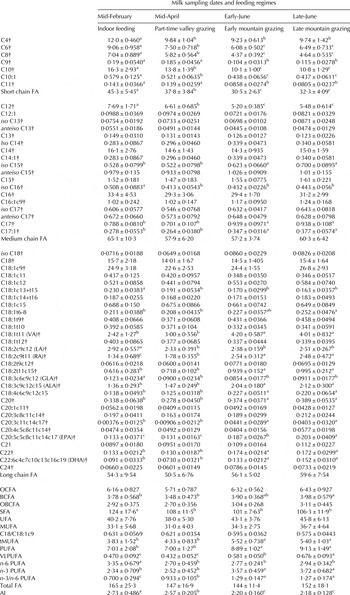
Table 1 shows the FA composition of milk samples from commercial flocks during the lactation period with different feeding regimes. C16, C18:1c9, C14 and C18 were the major FAs (with individual percentages higher than 9·5% of total FAs), and showed unchanged content (P > 0·05) among milks with different feeding regime. The content of most individual short-chain FAs (C4–C11) was lower (P ⩽ 0·05) in mountain milks than in milks from indoor feeding or under part-time valley grazing. Among straight even-numbered saturated FAs, the content of C12 was lower (P ⩽ 0·05) in mountain milks than in indoor feeding and part-time valley grazing milks, whereas the opposite occurred for the content of C20 and C22 (Table 1). Among straight odd-numbered saturated FAs, the content of C17 was higher (P ⩽ 0·05) in mountain milks than in indoor feeding and part-time valley grazing milks. Likewise, a considerable increase was observed in the content of iso C15, the only odd branched-chain saturated FA significantly affected by seasonal feeding changes. As a result of the above-mentioned changes, the total content of saturated FA was lower (P ⩽ 0·05) in milks from grazing sheep than in milks from indoor feeding. The content of total unsaturated and monounsaturated FAs did not change significantly in the milks from sheep with different feeding regimes, mainly due to the constant content of C18:1c9 in the milk samples (Table 1). The concentration of total trans monounsaturated and polyunsaturated FAs was higher (P ⩽ 0·05) in mountain milks compared to indoor feeding milk. VA was the major trans monounsaturated FA in all milk samples and its content was considerably higher in mountain milks than in indoor feeding or part-time valley grazing milks. Major polyunsaturated FAs in all milk samples showing percentages over 0.5% of the total FAs were C18:2c9c12c15 (LA), ALA, RA and C18:2t11c15. As observed for VA, the content of RA and C18:2t11c15 were higher (P ⩽ 0·05) in mountain milks than in indoor feeding or part-time valley grazing milks. On the contrary, the content of LA was slightly lower (P ⩽ 0·05) in milks from grazing animals than in indoor feeding milk. The content of some individual polyunsaturated FAs with more than three double bonds significantly increased in mountain milks, particularly C20:5c5c8c11c14c17 (EPA) and C22:6c4c7c10c13c16c19 (DHA) (Table 1). Due to the above-mentioned changes, the n-3/n-6 FA ratio increased significantly when sheep grazed on mountain pastures, whereas the opposite occurred for the atherogenicity index value (Table 1).
Seasonal changes in the fatty acid (FA) composition (mmol/100 g of DM) of milks from six commercial sheep flocks following the same seasonal feeding pattern during the lactation period

nd, not detected; OCFA, odd-chain FA; BCFA, branched-chain FA; OBCFA, odd branched-chain FA; SFA, saturated FA; UFA, unsaturated FA; MUFA, monounsaturated FA; tMUFA, trans monounsaturated FA excluding C18:1t15 and C18:1t16; PUFA, polyunsaturated FA; VLPUFA, very long-chain (C ⩾ 20) polyunsaturated FA; AI, atherogenicity index
a–cMeans followed by a different superscript letter in the same row are significantly different (P ⩽ 0·05)
† Positively identified by comparison with retention times of standards
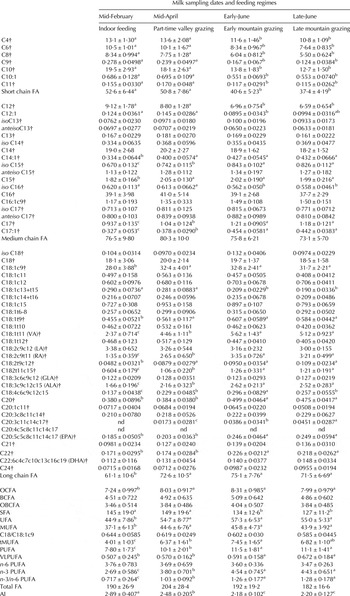
Table 2 shows the FA composition of 150 d ripened cheeses made with milks from the commercial sheep flocks with different feeding regimes. The FA profile (in relative percentages) of the cheeses was essentially the same in each seasonal feeding as those of the corresponding milk samples. However, in terms of amount (mmol/100 g of DM) the content of most individual FAs was higher in cheese than in milk samples. The higher FA concentration in the cheese matrix was probably due to losses of mainly milk proteins, lactose, fat and minerals into whey when curd stirring and draining during cheesemaking process (Abd El-Gawad & Ahmed, Reference Abd El-Gawad and Ahmed2011). The above-mentioned trends in milk of most individual FAs were also observed in cheeses obtained with different feeding regimes (Tables 1 and 2).
Seasonal changes in the fatty acid (FA) composition (mmol/100 g of DM) of 150 d ripened cheeses made with milks from six commercial sheep flocks following the same seasonal feeding pattern during the lactation period

nd, not detected; OCFA, odd-chain FA; BCFA, branched-chain FA; OBCFA, odd branched-chain FA; SFA, saturated FA; UFA, unsaturated FA; MUFA, monounsaturated FA; tMUFA, trans monounsaturated FA excluding C18:1t15 and C18:1t16; PUFA, polyunsaturated FA; VLPUFA, very long-chain (C ⩾ 20) polyunsaturated FA; AI, atherogenicity index
a–cMeans followed by a different superscript letter in the same row are significantly different (P ⩽ 0·05)
† Positively identified by comparison with retention times of standards
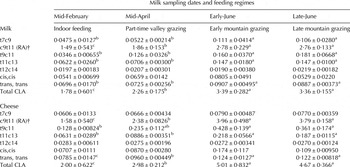
Table 3 shows average concentrations of individual CLA isomers separately analysed by HPLC in milk and cheese samples. CLA isomers were only analysed in milk and cheese from two of the six commercial flocks. Total CLA content in both milk and cheese increased progressively (P ≤ 0·05) from indoor feeding to grazing regime, and particularly when sheep were under extensive mountain grazing. RA was the predominant CLA isomer in all milk and cheese samples (around 80% of the total CLA content) followed by C18:2t9c11 and C18:2t11c13 showing individual percentages higher than 3% in both milk and cheeses. As reported for RA by GC analysis, the content of these three major CLA isomers was significantly higher in mountain milks and cheeses than in indoor feeding or part-time valley grazing milks and cheeses.
Seasonal changes in the conjugated linoleic acid (CLA) composition (mmol/100 g of DM) of milks and 150 d ripened cheeses from two commercial sheep flocks following the same seasonal feeding pattern during the lactation period

a–cMeans followed by a different superscript letter in the same row are significantly different (P ⩽ 0·05)
† Positively identified by comparison with retention times of standards
Tocopherols and retinoids in milk and cheese
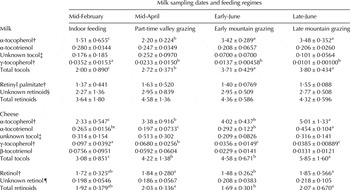
Table 4 shows the tocopherol and retinoid composition of milks and 150 d ripened cheeses from commercial flocks with different feeding regimes. The most abundant compound in all milk and cheese samples was α-tocopherol representing over 75% of the total tocols. The content of α-tocotrienol ranged between 5 and 14% of the total tocol content in milk and cheese samples, whereas those other minor compounds such as γ-tocopherol and β-tocotrienol were lower than 3%. The content of α-tocopherol increased (P ⩽ 0·05) in milk and cheese when sheep grazed on mountain pastures as compared to its content in milks or cheeses from indoor feeding sheep. The content of α-tocotrienol was significantly higher in late mountain grazing cheese than in the other cheese samples, with no significant differences found among milk samples. As mentioned above for FAs, the changes observed in the tocol composition of milks from sheep with different seasonal feeding regimes were also essentially the same as those found for cheeses, although the total content of tocols was higher (P ⩽ 0·05) in cheese than in milk samples. Retinyl palmitate was found in milk whereas retinol was found in cheese due to saponification of cheese samples. Despite other authors’ observed increase of retinol in goat and cow milk when comparing grazing systems with indoor feeding (Fedele et al. Reference Fedele, Rubino, Claps, Manzi, Marconi and Pizzoferrato2004), no significant increase (P > 0·05) was found in the content of retinol or total retinoids of milk and cheese from grazing sheep (Table 4).
Seasonal changes in the tocopherol and retinoid composition (μmol/100 g of DM) of milks and 150 d ripened cheeses from six commercial sheep flocks following the same seasonal feeding pattern during the lactation period

a–cMeans followed by a different superscript letter in the same row are significantly different (P ⩽ 0·05)
† Positively identified by comparison with retention times of standards
‡ μmol calculated using the molecular weight of α-tocopherol
§ μmol calculated using the molecular weight of retinyl palmitate
¶ μmol calculated using the molecular weight of retinol
Discriminant analysis
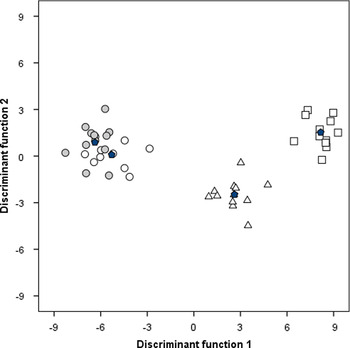
Discriminant analysis was applied to all analytical variables to classify cheese samples into the seasonal feeding groups. Figure 1 shows the cheese sample distribution in the graph displaying the two first canonical discriminant functions. As observed, cheese samples from indoor feeding and part-time valley grazing were correctly classified into their seasonal feeding group, but cheese samples from early and late mountain grazing were mixed forming a single homogeneous mountain grazing group. The highest difference in the centroid value along function 1 axis was found between indoor feeding and mountain grazing groups (around 14 units). The difference in the centroid value between part-time valley grazing and indoor feeding, or mountain grazing was very similar (around 6 units each). Therefore, this multivariate approach was able to discriminate beyond doubt mountain cheeses from those of indoor feeding and part-time valley grazing.
Graph for the two first discriminating functions corresponding to the stepwise discriminant analysis on FA and fat-soluble antioxidant composition of cheese samples from different seasonal feeding regimes during lactation. □, indoor feeding; ∆, part-time valley grazing; ○, early mountain grazing;  , late mountain grazing;
 , group centroid.

In conclusion, important changes were reported in the composition of FAs and fat-soluble antioxidant composition of milk and cheese from commercial flocks following the same management pattern with different seasonal feeding regimes during lactation. Mountain grazing in late lactation still improved the nutritional quality of milk and cheese by increasing the amounts of some healthy desirable FAs and α-tocopherol and significantly decreasing that of total saturated FAs and C12, and the atherogenicity index of milk and cheese. Finally, the differences in FA and fat-soluble antioxidants found in milk and cheese during the lactation period were capable to discriminate among seasonal feeding regimes, in particular between mountain grazing, and indoor feeding and part-time valley grazing.
Financial support was provided by the University of the Basque Country (UNESCO 09/07) and the Department of Education, Language Policy and Culture (IT766-13) of the Basque Government. The authors thank the sheepherders and the forest guard of the Enirio-Aralar Commonwealth, and the Training and Research Unit on Food Quality and Safety (UPV/EHU). Izaskun Valdivielso thanks Antonio Bonelli for excellent technical assistance.