


Introduction
This article uses theoretical frameworks from the social sciences to elucidate interpretations based on archaeological and textual evidence. Top-down and diachronic global approaches to the human past can be rightfully criticized for promoting reductionist, anachronistic, and teleological narratives and concepts (see, e.g., Wengrow & Graeber, Reference Wengrow and Graeber2021; Geroulanos, Reference Geroulanos2024). Similar critiques have targeted explanatory models aimed at understanding synchronous large-scale spatial patterns, such as world system theory (WST hereafter). While we recognize these pitfalls, we also believe that archaeology’s deep time and comparative potentials make it particularly suited for social modelling (Glørstad & Melheim, Reference Glørstad, Melheim, Melheim, Glørstad and Glørstad2016; cf. Peregrine, Reference Peregrine1996, Reference Peregrine2004; Spriggs, Reference Spriggs2008; Meyer, Reference Meyer2024). Models have explanatory value as analytical rationalizations of processes and relationships that, of course, were much more complex, undirected, and messy in reality. In the same spirit, we contend that archaeology, rather than refraining from them, should take ownership of transhistorical frameworks. Inherent in this lies a critique of current tendencies, e.g. within postcolonial studies, to leave the relationship between the ‘global’ and the ‘glocal’, or structure and individual unit, untheorized (Roudometof, Reference Roudometof2016). One way to tackle this gap, but beyond the scope of this article, would be through middle range theory. Our approach takes a different angle, based in international relations studies (IR hereafter) and its claim that systems emerge from multiple institutions.
Although usually dealing with the present or the near past, IR is also concerned with system genealogies. In historical IR scholarship, the ‘Amarna system’, named after Tell el-Amarna, the capital of Egypt for fifteen years in c. 1347–1332 bc, is reckoned as the world’s first interstate system, and a conventional bookend (e.g. Wight, Reference Wight1977; Cohen & Westbrook, Reference Cohen and Westbrook2000; Liverani, Reference Liverani2001). We posit, however, that this short interlude in the fourteenth century bc is not representative. This is based on the fact that interstate diplomacy in the Middle East predated Amarna by more than a millennium (Larsen, Reference Larsen2015; Winters, Reference Winters2019) but also that a threshold was reached in c. 1700 bc, when a broader range of polities, among these that of the Hittites in Anatolia, known as The Hittite Empire or Hatti, became involved in interstate diplomacy. This ended with the co-called Bronze Age collapse a little after 1200 bc, when less institutionalized contacts continued amongst smaller polities (see, e.g., Cline, Reference Cline2021, Reference Cline2024). In IR vocabulary, what we hereafter will refer to as the Hatti-Amarna system can be conceived of as a multi-civilizational system that grew out of the intra-civilizational Mesopotamian system from a matrix of practices characteristic of that system. By civilization we mean ‘a kind of moral milieu’ encompassing more than one culture, with each culture ‘being only a particular form of the whole’ (Durkheim & Mauss, Reference Durkheim and Mauss1971: 811).
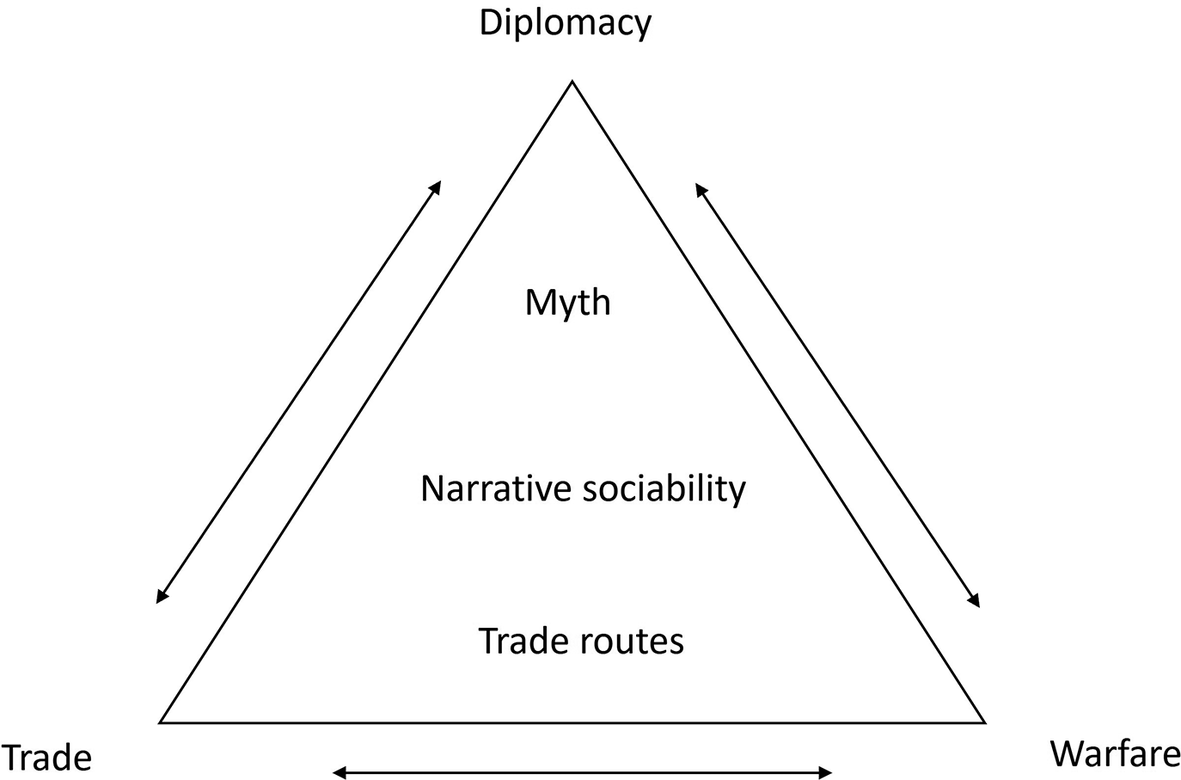
In this attempt to model connectivity between far-between polities within the frames of the Hatti-Amarna system, we try to rectify some of the shortcomings of previous models. Key debates about the strengths and weaknesses of WST have been hosted by the European Journal of Archaeology (importantly Sherratt, Reference Sherratt1993; Harding, Reference Harding2013) and will not be repeated here. Suffice to say that applications of WST in archaeology have tended to maintain a material, Wallersteinian focus on trade and luxury goods, especially metals and precious stones (Frank et al., Reference Frank, Algaze, Barceló, Chase-Dunn, Edens and Friedman1993; Papadimitriou & Kriga, Reference Papadimitriou, Kriga, Alberti and Sabatini2012; but see Kohl, Reference Kohl1987; Kardulias & Hall, Reference Kardulias and Hall2008; Wilkinson et al., Reference Wilkinson, Sherratt and Bennet2011). Notwithstanding that scientific, methodological, and theoretical advances have enabled archaeologists to study mobility, networks, and connectivity in new ways, Bronze Age ‘globalization’ has continued to be approached as first and foremost a measure of trade (Vandkilde, Reference Vandkilde2016; Kristiansen, Reference Kristiansen, Fernández-Götz, Nimura, Stockhammer and Cartwright2023). We believe that more of the inherent social variation of this system can be explained when more parameters and institutions are included. Our focus will be on how trade intersected with other institutions such as warfare and diplomacy, taking as our point of departure that both enmity and amity were systems generating (Figure 1). Here, we lean on Maurice Godelier’s insight that endemic warfare and latent violent conflict tend to tie in with mechanisms of exchange and reciprocity (Godelier, Reference Godelier1986, Reference Godelier and Scott1999: 142–44, 159). Abandoning WST in favour of more bottom-up network approaches, Anthony Harding (Reference Harding2013) sought parameters for distinguishing between commodity flows and relations that are more strictly systemic. Agreeing that this is crucial, we shall therefore start by defining what we mean by systems.
Simple presentation of the ideal relationship between institutions such as trade, warfare, and diplomacy in a multi-dimensional system.

Multi-Institutional Systems and Constitutive Outsiders
Systems may be nominally defined as groups of interacting units that form a whole (Gilpin, Reference Gilpin1981; Buzan & Little, Reference Buzan and Little2000: 36–47). By social system we mean a totality of various interrelated and interdependent parts (in our case, polities) that work together to maintain stability and equilibrium. International systems are geographically extensive networks of social relations, which ‘exhibit an awareness of their social environment as a coherent and integrated field of strategic interaction’ (Phillips & Sharman, Reference Phillips and Sharman2015: 49). Against methodological individualists, who ultimately reduce interaction to individual agency, system theorists hold that a system is more than the sum of its parts. Thus, complex systems cannot be reduced to their constitutive units; instead, system and units should be understood as co-constitutive (Cederman, Reference Cederman1997; Collins, Reference Collins1999: 6; Neumann & Glørstad, Reference Neumann and Glørstad2022).
Systems of political units rest on social orders, with social orders being ‘configurations of practices that organize social life’ (Adler, Reference Adler2019: 6; cf. Ish-Shalom et al., Reference Ish-Shalom, Kornprobst and Pouliot2020). Social orders are most productively thought of as the outgrowth of social control. Importantly, this involves the manner in which humans interact in an ordered and ordering fashion, for example in relation to a postulated sacred realm. The ensuing practices are constitutive of social order within polities, as well as of world order between polities (Le Boutillier, Reference Le Boutillier2003; Nexon, Reference Nexon, Albert, Cederman and Wendt2010). This plays out in various institutions; that is, a regular set of practices focused on a specific kind of activity.
Barry Buzan and Richard Little (Reference Buzan and Little2000: 97) argued that, for much of history, international systems have been one-dimensional, with only intermittent contacts between non-neighbouring groups. This is an oversimplification that ignores, for example, relations with mobile polities who raided and traded (Neumann & Wigen, Reference Neumann and Wigen2018). For instance, there were chains leading from Egypt to cities as well as to nomadic polities in the region (Watrous, Reference Watrous, Cline and Harris-Cline1998; Meeks, Reference Meeks, O’Connor and Quirke2003; Harvey, Reference Harvey, O’Connor and Quirke2003). In an idealized sense (Szuchman, Reference Szuchman and Szuchman2009), the relationship to such mobile polities is best conceptualized in terms of a constitutive outside, to which the social order that glued the core together did not apply. Another helpful insight comes from WST, where a lack of symmetry between polities is considered to be systems generating (e.g. Sherratt, Reference Sherratt1993; Wengrow, Reference Wengrow, Wilkinson, Sherratt and Bennet2011). When introducing an IR framework to archaeology, we do not just posit that Bronze Age interaction was systemic (Neumann & Glørstad, Reference Neumann and Glørstad2023), we establish an analytical position enabling us to substantiate the nature of relations.
From its beginning around 1700 bc, the Nordic Bronze Age is a splendid example of a polity (or several polities) being constituted through interaction with distant polities. This goes back to the diffusionist paradigm of ex oriente lux, but the nature of such relations have been further theorized since (e.g. Larsson, Reference Larsson1997; Kristiansen, Reference Kristiansen1998, Reference Kristiansen, Kristiansen, Lindkvist and Myrdal2018; Kaul, Reference Kaul2004; Vandkilde, Reference Vandkilde2016; Vandkilde et al., Reference Vandkilde, Stephansen, Suchowska-Ducke, Ahlqvist, Andersen and Felding2024). Arguably, the Nordic polities had their economic and political base in a ranked system of exchange, where the elite’s claim to the mobilization of labour created a surplus that allowed them to partake in political alliances, trade, and gift exchange (Kristiansen, Reference Kristiansen, Kienlin and Zimmermann2012). Surplus was converted into maritime ventures that allowed chiefs to capitalize on long-distance trade (Ling et al., Reference Ling, Earle and Kristiansen2018, Reference Ling, Hjärthner-Holdar, Grandin, Stos-Gale, Kristiansen and Melheim2019; Melheim et al., Reference Melheim, Grandin, Persson, Billström, Stos-Gale and Ling2018a, Reference Melheim, Ling, Stos-Gale, Hjärthner-Holdar, Grandin, Armada, Murillo-Barroso and Charlton2018b), using maritime know-how and flexible organization as comparative advantages in interaction with other polities (Earle et al., Reference Earle, Ling, Uhnér, Stos-Gale and Melheim2015; Austvoll et al., Reference Austvoll, Fauvelle and Ling2025). The Nordic realm was among the few regions in Europe that experienced growth and dynamic sociopolitical developments in the aftermath of the Thera eruption in the Aegean in the second half of the seventeenth century bc (Risch & Meller, Reference Risch and Meller2015: 253). At the same time, new polities arose in the eastern Mediterranean: the Hittite Empire, the Egyptian New Kingdom, and the Mycenaean city-states.
Diplomacy, Warfare, and Narrative Sociabilities
The Hittite state in recognizable form was in place around 1700 bc (Bryce, Reference Bryce1998: 70–71). Throughout its half millennium-long existence, the Hittite Empire pursued military campaigns that increased the density of interaction with Mitanni in Anatolia, Babylonia, and Assyria. Diplomacy was a leading element, and included practices related to the acknowledgement of foreign diplomats, treaty making, forms of greetings, dress codes, and so on. A number of these—the drawing up of legal treaties according to a set formula, the diplomatic form of addressing fellow heads of polities as ‘brother’, the contingent trade and gift economy—are immediately recognizable from Mesopotamian city-states (Pettinato, Reference Pettinato and Faith Richardson1991; Heimpel, Reference Heimpel2003; Podany, Reference Podany2010; Cunliffe, Reference Cunliffe2015: 89–95; Winters, Reference Winters2019). For example, the word for entering into a binding relationship described in a treaty, ishiul, is the same in Hittite as in Akkadian. Amongst vassal polities, a distinction was made between those that were culturally similar, and those that were not. An example of the latter is the tribal confederation of Hayasa from the Armenian or Anatolian highlands. The treaty with its leader sets out how he should conduct himself socially and sexually, giving as the reason for these instructions that ‘your land is barbaric’ (Beckman, Reference Beckman1999: 31); with ‘barbaric’ being a translation of Hittite dam-pu-u-pí, which seems to mean uninformed and is also used for lay people (as opposed to priests; Friedrich, Reference Friedrich1930). Other polities could be acknowledged as client states; subservient to the Hittite Empire but not formally or openly vassals (Beckman, Reference Beckman1999: 19). When Egypt became a prominent player within this system, with Egypt’s victory over Kadesh and other Syrian city-states at Megiddo around 1479 bc (Cline, Reference Cline2021: 27–29), it took up already established diplomatic practices regarding oath taking and reciprocity towards vassals.
Among the most important sources for political interaction from this era are the Amarna letters: 382 clay tablets with cuneiform script written in the lingua franca of the period, Akkadian (Moran, Reference Moran1992). However, the institution of diplomacy rested not only on a highly stylized correspondence and on gift giving, but also on what has been called an ‘international artistic koine’ (Feldman, Reference Feldman2006: 26–30). Marian Feldman (Reference Feldman2006: 146) stresses that luxury gifts and letters on stone tablets may be read as parallel items. As did textual diplomacy, the international style used Mesopotamian precedents as inspiration (Feldman, Reference Feldman2006: 165). Great kings as well as lesser status-seeking polities produced and exchanged luxury goods with hybridized and readily recognized motifs that referred to royal behaviour (Feldman, Reference Feldman2006: 87). From a political perspective, the key fact here is the attitude on display amongst rulers and their often highly travelled craftsmen: even when artefacts displayed their own specific craft traditions, the expression was tailor-made for the multi-civilizational receivers and viewers intended. The visual hybridity of the koine objects downplayed difference, contributing to an idealized, rhetorical mode of parity, reciprocity, and friendship (Feldman, Reference Feldman2006: 8, 161–64). In political science parlance, the koine would be part of the institution of diplomacy, one of the constitutive institutions of the system.
Diplomacy and warfare, and to a lesser degree trade, are institutions contingent on direct interaction between the parties, based on patterned social norms and behaviour. Where diplomacy is concerned, we may conceptualize these patterns as layered (Neumann, Reference Neumann2012). One layer would be myth, understood as an inevitable social phenomenon that makes more specific representations of social reality possible (Geertz, Reference Geertz1980). From the Mesopotamian city-states to recent European history, the key myth has been that kings, and eventually entire nations, were to be classified as kin (Podany, Reference Podany2010; Haugevik & Neumann, Reference Haugevik and Neumann2018). Calling one another ‘brother’ preconfigured the knowledge needed to establish and perpetuate regular contacts. This implies what Marshall Sahlins (Reference Sahlins1981) calls ‘narrative sociability’, where each type of situation has a set of categories and relationships pertinent to it. Typically, these narratives have an affinity to myth, but are more specific than myths. For example, there will be a narrative about how a representative of another political entity should be heralded, received, and treated by the head of a polity; for example, as a diplomatic envoy. This affinity to myth means that the same type of situation will induce different narrative sociabilities within different cultures. The narrative sociability attached to a diplomatic envoy would be founded on religious myth, but the chances that it was seen as anything other than a human being (say, a goddess) would be small (but not unknown). Crucially, Sahlins argues that a society’s identification between narrative sociability and myth is not necessarily self-reflective (Sahlins, Reference Sahlins1981, Reference Sahlins1995; cf. Obeyesekere, Reference Obeyesekere1992). This implies that the cultural setting of diplomatic encounters is always situated, and not just marked by a lack of cultural information about the other party, but also by a lack of reflectiveness about one’s own party’s preconditions for action.
The naming of foreigners who rebelled against the Egyptian pharaoh as chaotic forces is one example of how narrative sociability works. For the pharaoh and his administration, Egypt was the realm of the gods. The pharaoh was their earthly incarnation on top of a hierarchy consisting of Egyptians, then foreigners, and finally the world of nature. However, if foreigners rebelled against this divine order, they were reclassified as ‘equivalent to the wild beasts and birds of the natural world, and the demons and monsters that manifest aggressive chaotic forces [Isfet] on the cosmic level’ (O’Connor & Quirke, Reference O’Connor, Quirke, O’Connor and Quirke2003: 11). Another example of the way narrative sociability and othering go hand in hand are the written testimonies of how the chaos forces nicknamed the Sea Peoples were categorized. An inscription from Karnak reveals that the captives, after an attack in 1207 bc, were divided into those who were circumcised and those who were not, and the manner they were punished accordingly: ‘[Ek]wesh who had no foreskins, slain, whose hands were carried off, for they had no foreskins’ (Cline, Reference Cline2021: 7). The uncircumcised instead had their genitals cut off. A relief in the temple of Ramesses III at Medinet Habu illustrates how this practice materialized, showing a heap of severed right hands being counted. At Avaris, a pit containing sixteen right hands, dated to c. 1600 bc, may indicate a similar practice.
In the period in question, new technologies of war evolved and spread rapidly across the Middle East and Europe along with new martial practices (Cunliffe, Reference Cunliffe2015; Drews, Reference Drews2017; Horn & Kristiansen, Reference Horn and Kristiansen2018). Innovations like swords and two-wheeled horse-driven chariots were transmitted to the far north via the Carpathian Basin and the Terramare (Johannsen, Reference Johannsen2010; Vandkilde, Reference Vandkilde2014; Kristiansen & Sukowska-Ducke, Reference Kristiansen and Suchowska-Ducke2015; Kveiborg, Reference Kveiborg2019). Warfare does not involve an indiscriminate use of violence, but the breaking of the other party’s will, a social concern that is dependent on patterned norms and behaviour. It may be less institutionalized than diplomacy, but it also rests on myths (this land was promised to us by gods etc.), practices (spying, sabotage, ambush, negotiations, etc.), as well as narrative sociabilities. Diplomacy and warfare are mutually constitutive, in the sense that diplomacy takes some of its energy from perceived needs to avoid warfare, and warfare comes with expectations of how diplomacy will and will not work after its abeyance. Moreover, diplomacy includes threats to go to war and takes place in parallel with warfare when such threats are validated. Conflict can be integrative, in the sense that it both increases the density of a system and is spatially widening (Buzan & Little, Reference Buzan and Little2000).
Discussion: The Ranges of the Hatti-Amarna System
We move on to discuss to what degree the Hatti-Amarna system also included more distant polities, outside the East Mediterranean brotherhood of states known from textual materials. Among these is a ‘kingdom of Ahhiyawa’ mentioned in Hittite sources, commonly held to refer to the Mycenaeans (Feldman, Reference Feldman2006: 9, 138–39; Kelder, Reference Kelder2018). By the mid-thirteenth century, we find the locution ‘brother’ and, in one documented case, even ‘Great King’ (Bryce, Reference Bryce2003: 206). While Egypt in particular has been highlighted as a fertilizer for Mycenaean growth, nourishing its power structures with royal gifts and silver (Kelder, Reference Kelder, Strootman, van den Eijde and Wijk2020), Mycenae is, on the other hand, often seen as a link between the Egyptian world and other parts of Europe (Sherratt & Sherratt, Reference Sherratt, Sherratt and Gale1991, Reference Sherratt, Sherratt, Cline and Harris-Cline1998; Sherratt, Reference Sherratt1993). For example, impulses from Mycenae mediated through the Carpathian Basin have been framed as crucial for the development of the Nordic Bronze Age’s material culture from c. 1600 bc (Vandkilde, Reference Vandkilde2014). Sunken ship cargos such as Uluburun and Gelidonya showcase the extent of exchanges between polities in the eastern Mediterranean in the fourteenth century bc (Pulak, Reference Pulak1998; Kristiansen & Larsson, Reference Kristiansen and Larsson2005: 102; Bachhuber, Reference Bachhuber2006; Kelder, Reference Kelder2013; Warburton, Reference Warburton2023). Elusive objects such as beads of Baltic amber and warrior swords of European types (aboard the Uluburun) have been seen as indicative of networks out of the region. Finds of Baltic amber in the south have often been highlighted as indications of connectivity between northern Europe and the Mediterranean (Beck et al., Reference Beck, Harding and Hughes-Brock1974; Peres & Risch, Reference Peres and Risch2022; Bunnefeld et al., Reference Bunnefeld, Becker, Martin, Pausewein, Simon and Meller2023; Vandkilde et al., Reference Vandkilde, Stephansen, Suchowska-Ducke, Ahlqvist, Andersen and Felding2024) and other, trade-related phenomena in the north such as weight systems (Ialongo et al., Reference Ialongo, Hermann and Rahmstorf2021; Vandkilde, Reference Vandkilde2021) and (depictions of) oxhide ingots (Sabatini, Reference Sabatini2016; Ling & Stos-Gale, Reference Ling and Stos-Gale2015) may lend support to this viewpoint. Some have argued that connections were indirect, first via Wessex and later via middlemen in the Adriatic (Beck et al., Reference Beck, Harding and Hughes-Brock1974) or the Carpathian Basin (Vandkilde et al., Reference Vandkilde, Stephansen, Suchowska-Ducke, Ahlqvist, Andersen and Felding2024), while others have voiced more direct relations with Mycenae (Kristiansen, Reference Kristiansen, Kristiansen, Lindkvist and Myrdal2018).
From around 1600 bc, an extensive exchange of metals connected the far north with groups in the Italian Alps (Melheim et al., Reference Melheim, Grandin, Persson, Billström, Stos-Gale and Ling2018a; Ling et al., Reference Ling, Hjärthner-Holdar, Grandin, Stos-Gale, Kristiansen and Melheim2019; Nørgaard et al., Reference Nørgaard, Pernicka and Vandkilde2023), a factor that may have attracted the attention of northern traders to wider Mediterranean markets. Similarly, networks spreading copper and tin connected the North Sea region with the Mediterranean via the Atlantic façade (Earle et al., Reference Earle, Ling, Uhnér, Stos-Gale and Melheim2015; Melheim et al., Reference Melheim, Ling, Stos-Gale, Hjärthner-Holdar, Grandin, Armada, Murillo-Barroso and Charlton2018b; Williams et al., Reference Williams, Montesanto, Badreshany, Berger, Jones and Aragón2025). If so, not just one but several trade-based (and so institutionally speaking one-dimensional) lines may have tied these northernmost polities to the Hatti-Amarna system.
Unlike Egypt and its close allies, the Nordic polities were illiterate. It is more demanding, therefore, to define the character of these relations. In a pioneering work, Flemming Kaul (Reference Kaul, Nessel, Neumann and Bartelheim2018) introduced the Greek institution of xenia, or guest friendship, as a model for understanding how cross-continental connections could be upheld by traders. While such exchanges are probably systemic factors, we contend here that they must be understood against other social practices and institutions. Diplomacy, while widely treated in its Mediterranean context, is seldom discussed in a Nordic context, where peer interaction with other sovereigns is often more vaguely referred to as ‘political alliances’ (e.g. Horn & Kristiansen, Reference Horn and Kristiansen2018; but see Kristiansen, Reference Kristiansen, Kiriatzi and Knappett2016). Such peer-polity interaction involving gift exchange has, on the other hand, been highlighted as fundamental for the way internal and external power relations were forged, curated, and manipulated in the north. Terje Oestigaard and Joakim Goldhahn (Reference Oestigaard and Goldhahn2006) contend that, while gift exchange was crucial in the structuring of interregional relations, funerals were, qua political rituals, occasions where future hierarchies and alliances were negotiated through a transfer of the deceased’s status and relations, thus arguing for the possible presence of guests from afar at high-status funerals. Hittite, Egyptian, and Mycenaean influences in Nordic Bronze Age rituals and ceremonies have been noted (Larsson, Reference Larsson1997 with references; Kristiansen & Larsson, Reference Kristiansen and Larsson2005: 189–99; Kaul, Reference Kaul2004; Wiggering, Reference Wiggering, Austvoll, Eriksen, Fredriksen, Melheim, Prøsch-Danielsen and Skogstrand2020). For example, drinking equipment of Mycenaean style is held to have entered Scandinavia via workshops in the Carpathian or Alpine areas (Jensen, Reference Jensen2002: 252–57).
Feldman’s koine artefacts, intended to tone down cultural difference and signalling sameness, are excellent examples of how diplomatic ties were orchestrated through material culture. To our knowledge, there is no evidence that artefacts of the koine repertoire reached the far north, nor does amber seem to have featured prominently in their making. In fact, few areas apart from Egypt show a complete overlap between diplomatic letters and koine objects, and key polities, such as the Hittite Empire, seem to lack the luxury elements of the koine (Feldman, Reference Feldman2006: 144). In addition, distinctions between gifts and tribute were often blurry, and sometimes manipulated (Feldman, Reference Feldman2006: 20, 179). This ties in with other contradictions between texts and material culture (see, e.g., Zangani, Reference Zangani2023). For example, despite written evidence linking Alashyia to the brotherhood of states, it lacks state-indicating items such as seals (Meyer, Reference Meyer2024). That political forms were not necessarily clear-cut nor stable is another factor.
What the far north does display are multiple examples of hybridization, such as the one-edged swords of copper and flint, argued to copy Hittite scimitars (Engedal, Reference Engedal2002; but see Maran, Reference Maran, Kaiser, Meyer, Scharl and Suhrbier2022). Peter van Dommelen and Mike Rowlands (Reference van Dommelen, Rowlands, Maran and Stockhammer2012) point out that hybridity always unfolds in a local context. Therefore, the ways foreign elements are being negotiated in localized forms will reflect the community’s ontology of contact (along a spectrum from exclusion to inclusion). The uniquely preserved oak log coffin burials of the Nordic Bronze Age show how foreign material culture traits were localized in the ritual sphere.
Chairs and other types of furniture figured among the koine artworks (Feldman, Reference Feldman2006: 122–23). Being similar to folding stools found in Mesopotamia, Egypt, Anatolia, Crete, and Mycenae, where they served as indicators of rank (Werner, Reference Werner1987), the twenty locally produced folding stools (and fittings) (Figure 2) found in the Nordic sphere (Jensen, Reference Jensen2002: 266–69; Fabian, Reference Fabian2009) are especially interesting, as they seem to represent an inclusive ontology. They were deposited in otherwise prominent male burials, with other objects indicating high status and access to international networks—such as goldwork and wooden bowls with tin nails—and appear as personal emblems, indicative of a particular military, political, or religious status (Fabian, Reference Fabian2009; Felding & Stott, Reference Felding and Stott2023). The fact that folding stools were deposited with tools not only suggests that their making conferred high status (Fabian, Reference Fabian2009: 117) but may also indicate that their makers or commissioners must have ‘seen original chairs from the far away cultures in the Near East and Greece’ (Felding & Stott, Reference Felding and Stott2023: 148).
Wooden folding stool from a male burial dated to 1389 bc, Guldhøj, Ribe, Denmark.
CC-BY-SA, Roberto Fortuna and Kira Ursem, Nationalmuseet, https://samlinger.natmus.dk/do/asset/3513.

As rare, emblematic objects, the folding stools are paralleled by diadems, mostly of bronze and associated with female burials, and with (gold) precedents in northern Germany, eastern-central Europe, and Mycenae (Felding & Stott, Reference Felding and Stott2023: 147–48). Another foreign element in female burials are blue glass beads of Egyptian and Mesopotamian origin (Figure 3). They occur alone or together with orange amber beads of Baltic origin as burial finds in both regions, and in the areas between (Varberg et al., Reference Varberg, Gratuze, Kaul, Hansen, Rotea and Wittenberger2016; Kaul, Reference Kaul, Nessel, Neumann and Bartelheim2018; Reiter et al., Reference Reiter, Frei, Nørgaard and Kaul2019; Vandkilde et al., Reference Vandkilde, Stephansen, Suchowska-Ducke, Ahlqvist, Andersen and Felding2024). Glass ingots of mixed provenance might have been amalgamated at workshops in Mycenae or Tiryns, before they reached the Nordic (Varberg et al., Reference Varberg, Gratuze, Kaul, Hansen, Rotea and Wittenberger2016: 192). Another object with cosmological connotation considered to be adopted and adapted from Mycenae is the one-edged razor (Kaul, Reference Kaul2013).
Bead of Mesopotamian glass with amber inlay, c. 1500–1300 bc, from Søvigårde, Ribe, Denmark. CC-BY-SA, Arnold Mikkelsen, Nationalmuseet, https://samlinger.natmus.dk/do/asset/13472.

A further parallel can be drawn between the wheeled wagon on which the horse pulling the Danish Trundholm sun chariot stands and the wheeled wagon serving as a base for a boat model found in the tomb of Ahhotep I (Wachsman, Reference Wachsmann, Miniaci and Lacovara2022). According to Egyptian cosmology, the boats were there to transport the soul of the dead. In a similar Nordic myth, which Trundholm probably portrays, a horse assisted the sun ship on its travel across the sky (Kaul, Reference Kaul2004: 271). In line with Kaul, David Warburton acknowledged the close parallels between New Kingdom mythology and the cosmological system that can be drawn from Scandinavian imagery, but pointed out that ‘Obviously, it was easier for outsiders to adopt and adapt the iconography without the concepts or the underlying understanding of the political importance of the [Egyptian] Solar Theology’ (Warburton, Reference Warburton, Kousoulis and Lazardis2015: 1280). Considering the dynamics of such contact situations (cf. van Dommelen & Rowlands, Reference van Dommelen, Rowlands, Maran and Stockhammer2012), this can be qualified further: if returned travellers brought back and copied elements from another religious context, this probably made sense, first and foremost, in their local context.
As already mentioned, amber was established early on as the Nordic Bronze Age polities’ comparative advantage (Earle et al., Reference Earle, Ling, Uhnér, Stos-Gale and Melheim2015, with references). Despite recent studies questioning the organizational scale of amber exploitation in Scandinavia (Earle et al., Reference Earle, Bech and Villa2023; Austvoll et al., Reference Austvoll, Fauvelle and Ling2025), there is ample evidence of Baltic amber in the south. From around 1800/1700 bc, it occurs in royal contexts with other highly valued materials in far-between polities such as Mycenaean Greece, the El Argar culture in the Iberian Peninsula, Kanesh in Anatolia, and Ur in Mesopotamia (Bunnefeld et al., Reference Bunnefeld, Becker, Martin, Pausewein, Simon and Meller2023). From c. 1550 bc the amber trade increased, and especially the Mycenaeans appear to have valued Baltic amber highly (Czebreszuk, Reference Czebreszuk, Bergerbrant and Sabatini2013; Ling et al., Reference Ling, Earle and Kristiansen2018: 502). While the provenance of the amber from Tutankhamun I’s tomb remains unconfirmed, the lion-headed amber vessel from Qatna (Syria) has been identified as Baltic amber reworked into a local shape (Mukherjee et al., Reference Mukherjee, Roßberger, James, Pfälzner, Higgitt and White2008). This invites a discussion about how amber was localized in the Middle East.
An early example of imported Baltic amber comes from a foundation deposit for a ziggurat in Assur, Mesopotamia, erected in c. 1800–1750 bc by Samsi-Adad I, who also took up the Akkadian title of king ‘of the four corners [of the world]’. Not only does this show how Assyrian kings saw themselves (Cunliffe, Reference Cunliffe2015: 115), it may also explain the deposition of beads of various geographic origin (Bunnefeld et al., Reference Bunnefeld, Becker, Martin, Pausewein, Simon and Meller2023). When used by Neo-Assyrian kings in the first millennium bc, this concept seems to signify a ruler who could tame and control other polities, a capacity that was materialized through inscriptions, reliefs, and tableaux that brought the cultural and biological diversity of ‘the known world’ into the realm of the palace (DeGrado, Reference DeGrado2019). If the amber deposited below the ziggurat by Samsi-Adad I served similar functions, its presence may indicate that his known world went beyond the Middle East. The amber is considered to reflect directional exchange with only a few middlemen (Bunnefeld et al., Reference Bunnefeld, Becker, Martin, Pausewein, Simon and Meller2023: 238). As a result of trade with powerful agents such as Wessex and Mycenae, the exact origin of the raw amber may of course never have been acknowledged. It is, however, striking that an ancient Baltic word for amber—elmešum—was used in Akkadian texts (Warburton, Reference Warburton2023: 66).
The foreign name might reveal notions about this substance’s area of origin and a more or less specific ‘land of amber’, which may have contributed to the narrative sociabilities surrounding its traders. There is little reason to assume, however, that Middle Eastern polities had any interest in the Nordic world as such. It seems more likely, in terms of direct contact, that northerners may from time to time have entered the Hatti-Amarna space and brought back knowledge about this realm. That some Nordic traders or mercenaries were multilocal is a possibility that needs to be researched further, but may find resonance in certain, ambiguous burial finds (Vandkilde et al., Reference Vandkilde, Stephansen, Suchowska-Ducke, Ahlqvist, Andersen and Felding2024) (Figure 4). If the connection had been mainly indirect (through down-the-line trade), the appropriation of ritual practices and cosmological schemes in the north (which probably relied on eyewitness observation and not storytelling) is hard to explain.
A selection of ornaments from a male burial dated c. 1500–1300 bc, from Lundsbakke in Kirke-Værløse near København, Denmark: a bronze belt-hook, two bronze pendants shaped as double-axes and an amber bead.
CC-BY-SA, Roberto Fortuna and Kira Ursem, Nationalmuseet, https://samlinger.natmus.dk/do/asset/4674.

If Nordic travellers, traders, and raiders entered the core of the system from the outside, did they at some point in time become directly involved, subservient to the large powers, having to pay tribute, for example, in the form of raw amber? Did these relations at some point evolve into a more formal relationship? We have to keep in mind that, in the eyes of, for instance, the Egyptians, the Nordic polities could have been viewed as potentially chaotic forces similar to the beasts of nature. Against this, one could argue that if there were diplomatic bonds between, for example, Amarna and polities outside the core, these peoples would have been mentioned in the widely preserved diplomatic letters. Theoretically, understandings of diplomacy as a first and foremost Mediterranean institution may have hampered the identification of outsiders in these sources. However, the current evidence is perhaps more likely to indicate that Nordic chiefdoms were directly connected to Mycenae (as indicated by amber exchange) and the Terramare (as indicated by copper trade). Any further direct connections to, for instance, Egypt would have been through individual traders or mercenaries tapping into the political economy of the Mediterranean.
Conclusion
Symbols of authority have long been acknowledged as indicators of interaction between the far north and the Middle East. Bridging archaeological system theory with IR perspectives has allowed us to posit that diplomacy, driven by warfare and political strategy, may have been a yet wider context than trade for the movement of objects and ideologies across cultural boundaries. We have drawn on basic concepts from political science about systems, particularly about institutions and systems logics, to argue that the Hatti-Amarna system had its beginnings around 1700 bc, when the Hittite state came into closer contact with first Mesopotamian city-states and then Egypt. Drawing on Mesopotamian practices and institutions, what emerged was a multi-institutional state system. Given the longevity of the system (give or take half a millennium), it does not seem right to name it after the short fourteenth-century interlude that we know from the Amarna letters. Our identification of a bookend for the beginning of the system around 1700 bc has thus led us to rename it the Hatti-Amarna system. Regarding spatial markers, we have hypothesized that this system included areas geographically very far from the core, not through direct contact, but one-dimensionally, through people based in Mycenae and Terramare. While diplomacy has been crucial for explanations of the Amarna system, and at the fore of studies of Middle Eastern polities, it has remained understudied in the north. Our take is that diplomacy adds to the old enigma of north–south connections, adding a dimension to previous interpretations focused on long-distance exchange. Given that the Nordic polities capitalized on seafaring, trading, and raiding, it is not unlikely that some of these groups entered the Mediterranean realm. They may have been narrated as chaotic forces, from an unspecific ‘land of amber’, and still had a role as a constitutive ‘other’. A number of issues remain to be tackled; importantly, whether the relationship between the far north and the contact points discussed here can be framed as a form of diplomacy, and, further, whether this involved practices known from the Mediterranean realm, such as, for instance, a shared artistic koine.
Acknowledgements
We are grateful for comments on previous drafts of this manuscript from Christoph Bachhuber, Flemming Kaul, Kristian Kristiansen, Roberto Risch, and from three anonymous reviewers. We thank Dag Truslew Haug for help with the Hittite language and Kristian Kristiansen for pointing out the similarity between the Trundholm and Amenhotep wagons. This article is the result of a collaboration between a political scientist and a prehistorian, both interested in system thinking and connectivity between different polities. Both have contributed in equal measures to the conceptualization of the article and to the writing of the text.


 Open access

