Increasingly, the health consequences of interventions are assessed in terms of the impact on health-related quality of life. The main economic benefit of health interventions are commonly expressed as a utility, which entails the preferences individuals or society have for any particular set of health outcomes being referred to as utility (Reference Drummond, Sculpher, Torrance, O'Brien and Stoddart7). Multi-attribute utility instruments have been developed to score utilities and to measure quality-adjusted life-years (QALYs). The Health Utilities Index has been exclusively developed to assess the health of children (Reference Feeny, Furlong, Barr, Torrance, Rosenbaum and Weitzman9;Reference Feeny, Leiper and Barr10). Other instruments have been used to access the health-related quality of life in children (Reference Apajasalo, Rautonen, Holmberg and Sinkkonen1;Reference Apajasalo, Sintonen, Holmberg and Sinkkonen2;Reference Sintonen, Pekurinen, Walker and Rosser23). However, there are still questions with regard to health assessment tools for children. This is partly due to the limited evidence surrounding the psychometric properties of multi-attribute measures in childhood (Reference Ravens-Sieberer, Erhart and Wille21;Reference Rosenbaum, Saigal and Spilker22). The quality of life in children is unique and complex, which causes difficulties in its determination (Reference Matza, Swensen, Flood, Secnik and Leidy18;Reference Theunissen, Vogels and Koopman26). The inability of little children to give information about their own state of health is the reason that proxies are approached. This incorporates the risk of under- or overestimating the importance children attribute to certain issues or the unawareness of influencing environmental factors such as relationships with peers (Reference Matza, Swensen, Flood, Secnik and Leidy18). Furthermore, the developmental, behavioral, and socialization processes of individual children make health-related quality of life in children even more complex.
The EQ-5D is extensively used for adults and this questionnaire has been proven to be reliable and valid (Reference Brooks4). Reasons for using the EQ-5D are that it is a short multi-attribute utility measurement, which is explicitly preferred as the source of quality of life weights for the calculation of QALYs in the new guidelines of the National Institute for Health and Clinical Excellence (NICE) (19). Only a few studies have used the EQ-5D to measure the quality of life in children with chronic conditions. In the United Kingdom, the EuroQol group has modified the standard version of the EQ-5D and tested this in a survey of more than 3,000 children and young people aged 7 to 17 (Reference Hennessy and Kind14). To date, the validity of a Dutch EQ-5D in children has only been investigated in children treated for imperforate anus (Reference Stolk, Busschbach and Vogels25). That study supported the validity of the proxy form of the EQ-5D with regard to these children. To our knowledge, no study has explored the use of the Dutch child version of the EQ-5D in children with asthma, diabetes, a rheumatic disorder, or a speech/language and/or hearing disorder: all chronic conditions. A chronic condition is an illness or impairment that has persistent or recurring health consequences, which may affect the emotional, physical, and social well-being. It must be determined how far the management and the chronic condition compromise the child's quality of life (Reference Eiser and Morse8). Chronic diseases are the primary cause of mortality in the Western world. In 2005, there were 35 million people with a chronic disease (30). In 2003, of the Dutch population 10 percent to 20 percent is estimated to suffer from a chronic condition (Reference Baan, Hutten and Rijken3). Another survey reported in 2004 that 250,000–450,000 of the Dutch chronic patients are children (20). To which extent a condition affects people's lives is different for each person and condition. In addition, the way these children cope and adjust may be dependent on the developmental stage and symptom severity.
The objective of this explorative study was to examine the use of the Dutch EQ-5D child and proxy form as a generic measure in children with chronic conditions. The chronic conditions included asthma, diabetes, rheumatic disorders, and speech/language and/or hearing disorders. For this purpose the practicality, convergent validity, discriminant power, and test–retest reliability were investigated. The study protocol was approved by the Medical Ethical Committee of the MUMC in the Netherlands.
PATIENTS AND METHODS
Study Population
A convenience sample of the population was selected by means of hospital outpatient and school records. We included children aged 7–18 years with one of the following four conditions: asthma, rheumatic disorders, diabetes, or speech/language and/or hearing disorders. After given informed consent, children with asthma (asthma severity stage I–III), a rheumatic disorder, or diabetes were recruited from the outpatient clinic of the MUMC (Maastricht; the Netherlands) and the Hospital Gooi-Noord (Blaricum; the Netherlands). Children with a combined disorder of speech/language and/or hearing were pupils of the Mgr. Hanssenschool (Hoensbroek; the Netherlands), a special primary school for children with these disorders in combination with another chronic physical or mental condition.
Instruments
The EQ-5D consists of a descriptive system and a visual analogue scale (VAS), on which patients rate their own health between 0 and 100 (Reference Brooks4). The five questions in the EQ-5D classify people into 1 of 243 health states. The commonly used scoring function for the EQ-5D is based on a British study (EQ-5D UK) with preferences derived from the time trade-off method, in a representative sample of the adult UK population (Reference Dolan5). The possible range of utility scores (global score) is from −0.59 (lowest) to 1.00 (highest). In this study, we used the Dutch EQ-5D child version as translated and used in the article of Stolk et al. (Reference Stolk, Busschbach and Vogels25), which entails a child and a proxy form (see Supplementary Table 1 for the English version, which is available online at www.journals.cambridge.org/thc). These forms are based on the five items of the (adult) EQ-5D and the VAS. The questions are adjusted to children and consequently there are some slight alterations in the phrasing. The items “pain/discomfort” and “anxiety/depression” are not formulated in the same way in the child version as in the adult version of the EQ-5D. As illustrated in the appendix, the word “and” is replaced by the word “or.” However, we choose to use the same version as used by Stolk et al. (Reference Stolk, Busschbach and Vogels25). The interpretation of the scores and the calculation of the utility scores are the same as the standard EQ-5D (adult version).
The TNO-AZL Questionnaires for Children's Health-Related Quality of Life (TACQOL) was developed to measure generic quality of life in children aged between 5 and 15 with chronic diseases, and contains seven scales, each consisting of eight items (Reference Theunissen, Vogels and Koopman26;Reference Verrips, Vogels and Koopman27;Reference Vogels, Verrips and Verloove-Vanhorick29). This questionnaire was especially developed for children and is commonly used in the Netherlands. The TACQOL has shown a good validity and reliability (Reference Flapper, Koopman, Napel and Van Der Schans11;Reference Vogels, Verrips and Verloove-Vanhorick29) and has a parent/proxy form for children aged 6–15 years and a child form for children aged 8–15 years. Except for the phrasing of the items, their design and scale structure are identical, and the two forms can be used as supplementary measures. The seven scales measure: limitations in physical functioning, motor functioning, autonomy, cognition, social, and the occurrence of both positive and negative emotions. The TACQOL scales were calculated by the use of a SPSS programme as described in the TACQOL manual (Reference Vogels, Verrips and Koopman28).
Procedure
The separation of the age groups was based on existing data of the asthma children. Children beyond 12 years completed both the EQ-5D child form and the TACQOL with or without help of their parents by paper and pencil self-administration. For children younger than 12 years of age the parents or caregivers completed the proxy form with or without help from the children by paper and pencil self-administration. An information letter was addressed to both the children and the parents. After obtaining informed consent of the parents, the first questionnaires, the EQ-5D child version and the TACQOL, were sent by post. After 2 weeks they received a second EQ-5D child version. Additional data were gathered such as the child's age, gender, the date of completion, and the administration method (with or without help of the child or the parent). In an open question, we also asked for comments from the child and the parents on these questionnaires. Furthermore, a question regarding perceived changes in the health situation was added during the study.
Statistical Analyses
The practicality of the EQ-5D child version was indicated by describing the qualitative comments during the procedure, and by counting the number of missing baseline scores on the EQ-5D, VAS, and TACQOL scales. With regard to the TACQOL this suggested that if more than two of the eight scale item scores were missing, the overall scale score was defined as missing. As the EQ-5D is a simple and short questionnaire, it was expected that the practicality would be good.
The convergent validity suggests the actual general agreement among independently ratings, where measures should be theoretically related. This was measured by calculating Spearman rank correlations (rho) between the EQ-5D (EQ-5D items, VAS, and EQ-5D utility) item response and the ordinal TACQOL scales. The reason for this approach is that, although the EQ-5D descriptive part is a classifier for health status, the items are measured on an ordinal scale. The utility and the VAS were analyzed first, because these variables can be regarded as continuous variables. For that reason these analyses are more valid, compared with the five individual items of the EQ-5D. The interpretation of the strength of the Spearman's rho was as follows: 0.8–1, very strong; 0.6–0.8, strong; 0.4–0.6, moderate; 0.2–0.4, low and 0–0.2, very low.
Based on the context of both questionnaires the rank correlations were expected to be negative and moderate to high (0.40 ≤ rho ≤ 0.80) between the corresponding concepts in the EQ-5D and TACQOL (Reference Brooks4;Reference Verrips, Vogels and Koopman27;Reference Vogels, Verrips and Verloove-Vanhorick29).
Discriminate validity suggests the lack of a relationship among measures which theoretically should not be related. Ceiling effects may reduce the discriminant power of the EQ-5D among less severe conditions. However, we expect the mean EQ-5D scores to be lower in more severe conditions than in less severe conditions. Because information on disease severity was lacking only the univariate statistics of the scale scores between the conditions were explored.
The test–retest reliability on two repeated measurements was measured, using intraclass correlation coefficients (ICCs), to investigate the reproducibility of the EQ-5D. A mixed two-factor model was used with a fixed time interval of 2 weeks. Due to the large variability in the course of asthma and rheumatic disorders, the lowest ICCs were expected in this group. In addition, ICCs were calculated for the subset of children who stated that they had experienced no health changes between the two questionnaires, and for the subset of children who did experience health changes.
Statistical analysis was performed using SPSS, version 12.0 and all analyses were performed separately for children younger or older than 12 years of age, and the whole group. A p value of .05 was considered to be statistically significant.
RESULTS
Study Population
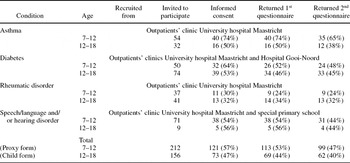
Of the 368 children who were invited to participate, 194 (53 percent) children were willing to participate in the study. In the end, 182 of these children or their parents completed the first questionnaire, and 161 children or their parents completed both questionnaires. On average, the second questionnaire was returned after 15 days. Table 1 shows these figures in more detail. More children aged 7–12 years than children aged 12–18 years were included for each condition. This was especially the case with regard to children with a speech/language and/or hearing disorder, due to the fact that these children were mainly recruited from a special primary school. In at least half of the children, the cause of the speech/language disorder was a hearing impairment. The mean age among the 99 participants aged 7–12 years, who completed both questionnaires was 10 (7–12; SD 1.5, MD 11.0; IQR 4.5), and 59 percent were boys. Among the 62 children aged 12–18 years, who completed both questionnaires, the mean age was 15 (12–18; SD 1.8), and 48 percent were boys. The scores were on average high. The average VAS score was 83.04 (maximum score 1.00). Overall, the means were the highest among the children with diabetes, and the lowest among the children with a rheumatic disorder.
Study Population by Condition and Age Group

Practicality
In total, 21 parents and their children aged 7–12 years, and 8 children aged 12–18 years included comments on the questionnaires. These comments varied from statements on the children's recent health state, to comments on the items in the questionnaire.
There was only one comment specifically about the EQ-5D. This was a comment by a parent with regard to the EQ-5D descriptive system who said that the item “Pain/discomfort” was not specific enough. The answer “My child has pain and does not feel good/sick” is difficult to answer if a child is in pain, but does not feel sick. In the total baseline group of 182 children, only two of the five item scores were missing in the EQ-5D. Both missing scores concerned the item “Pain/discomfort,” which were supposed to be answered by parents with children aged 7–12 years (1 asthma; 1 rheumatic disorder). The VAS was not completed by 16 participants (9 percent). Of these, the highest number of missing scores percentage-wise occurred among the children with a speech/language and/or hearing disorder (7 of 36).
With regard to the TACQOL, two of the parents of children with a speech/language and/or hearing disorder, made comments on the question about “Going to school on their own” (scale: Autonomy), because most children were being picked up by (school)bus. Some parents experienced this as being very autonomous, while others decided this was not autonomous, as all other children go by foot or bike. Furthermore, the TACQOL questions refer to the children's health status as experienced in the last few weeks. At least five questions concerning children's school activities turned out to be difficult to answer during the middle of their summer holidays. Three older children had the opinion that the question about “Being asked by other children to play with them” was too childish. In total, six TACQOL scale scores were missing. Again the highest number of missing scores occurred among the children with a speech/language and/or hearing disorder.
Convergent Validity
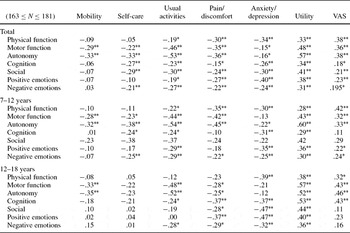
The baseline Spearman rank correlation coefficients of the EQ-5D utility (global score) EQ-VAS and the EQ-5D and the TACQOL scales are presented in Table 2.
Spearman Correlations between Scores on EQ-5D Items (Columns) and TACQOL Scales (Rows)a

aSpearman's rho value: 0–0.2 = very low, 0.2–0.4 = low, 0,4–0.6 = moderate, 0.6–0.8 = high, 0.8–1 = very high. * p < 0.05; ** p < 0.01. EQ-5D range: 1–3 (no problems–extreme problems); VAS 0–100 (low–high quality of life). TACQOL range in the scales concerning limitations in physical functioning, motor functioning, autonomy, cognition, social: 0–32 (low–high quality of life). TACQOL range in the scales concerning the occurrence of positive and negative emotions: 0–16 (low–high quality of life).
VAS, visual analogue scale; TACQOL, TNO-AZL Questionnaires for Children's Health-Related Quality of Life (TACQOL).
On average low to moderate correlations were found between both questionnaires. In the total group, all correlations of the utilities and the VAS scores were statistically significant. The highest correlation (.57) was found between the EQ-5D utility and the “Autonomy” scale of the TACQOL. Furthermore, the EQ-5D utility correlated highly with the item “Mobility” (.48). With regard to the VAS scores, the highest correlations were found among children aged 12–18 years on the “Motor function”, “Autonomy”, and “Cognition” scales.
Discriminant Power
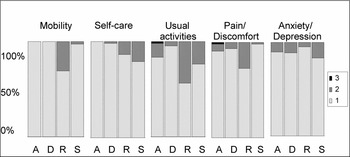
The stacked bars in Figure 1 illustrate the discriminant power of the EQ-5D items. The EQ-5D discriminated most in children with a rheumatic disorder, and in this group more problems were reported on the items “Mobility,” “Usual activities,” and “Pain/discomfort,” than in the other groups.
Stacked bars discriminant power between conditions in the EQ-5D items. A, asthma; D, diabetes; R, rheumatic disorder; S, speech/language and/or hearing disorder. 1, no problems; 2, some problems; 3, severe problems.

With regard to the TACQOL, the scales “Positive and negative emotions” in particular did not discriminate between the conditions. The scale “Motor functioning” differed in the children with a rheumatic disorder, and the scale “Cognition” scored the least in the children with a speech/language and/or hearing disorder.
Test–retest Reliability
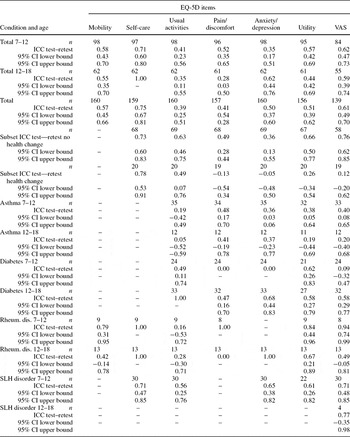
Table 3 provides intraclass correlation coefficients in the repeated scores of the EQ-5D items and the TACQOL scales.
EuroQol Test–Retest Intraclass Correlation Coefficients

VAS, visual analogue scale; CI, confidence interval; ICC, intraclass correlation coefficients; Rheum. dis., rheumatic disorder; SLH disorder, speech/language and/or hearing disorder; –, analyses could not be performed due to low variance; Subset ICC test–retest no health change, ICC test–retest for the subset of children, who did not experience health changes between the two questionnaires; Subset ICC test–retest health change, ICC test–retest for the subset of children, who did experience health changes between the two questionnaires.
The ICCs varied from −0.25 to 1.00. With regard to utility, the lowest ICC was found among the children with asthma, and the highest ICC among the children with a rheumatic disorder. By means of a Bland Altman Plot the differences were plotted against the averages of the repeated measurements. The plot demonstrated that, in patients with moderate VAS and Utility scores, the within-case variability is higher, and consequently the test–retest reliability was lower.
The ICCs for the subset of children who experienced no health change between the two questionnaires differed from the total population. The largest differences in the ICCs showed an upward trend, and occurred in the item “Usual activities,” in the utility score and in the VAS. In the subset of children who stated to have experienced a change in health status between the two questionnaires, correlations were lower in the items “Pain/discomfort,” “Anxiety/depression,” the utility score, and the VAS, compared with the correlations in the total group. Furthermore, in this group the correlation was higher in the item “Usual activities” and the same in the item “Self-care” compared with the correlations in the total group.
DISCUSSION
The aim of the study was to explore the use of the EQ-5D in children with chronic conditions. This was investigated among children with asthma, diabetes, a rheumatic disorder, and a speech/language and/or hearing disorder using the version as used by Stolk et al. (Reference Stolk, Busschbach and Vogels25). The practicality, convergent validity, and discriminant power were compared with a generic questionnaire for children (TACQOL). Furthermore, the 2-week test–retest reliability of the EQ-5D child version was assessed.
As expected, the practicality of the EQ-5D is good. Only one comment was given and missing scores were minimal. Moderate correlations were found between the utility scores and the TACQOL scales, and the discriminant power was low overall. In the subset of children who experienced no health change between the test and the retest the reliability was moderate to high.
The practicality seemed the least among children with a speech/language and/or hearing disorder. Possibly this is caused by additional problems, such as a poor ability to read. In this study for practical reasons the TACQOL was completed by children aged 7–18 years, while actually the TACQOL was developed for children up to 15 years of age. This resulted in comments on the suitability of the questionnaire for adolescents, and possibly an adult version was more appropriate for these “children.” Furthermore, school holidays led to confusion with regard to some school-related questions.
The low to moderate Spearman rank correlations suggest that the EQ-5D and TACQOL seem to be measuring different concepts. However, the EQ-5D items were not developed to be analyzed as continuous variables. The total score (utility), which can be used as a continuous item, actually correlated higher than the separate EQ-5D items. Nevertheless, the TACQOL seems to have an additional value, especially with regard to cognitive functioning. This emphasizes the need for the use of an additional specific instrument alongside the EQ-5D. Cognitive functioning, peer and social relationships, family involvement, and emotions are typical child-related items, which are generally underexposed in generic questionnaires. Furthermore, the low convergent validity may be caused by the differences between the TACQOL and the EQ-5D. The TACQOL is a population-specific questionnaire, whereas the EQ-5D is a generic questionnaire. Furthermore, the aim of the EQ-5D is to measure the degree that quality of life is present, and the aim of the TACQOL is to measure the degree that quality of life is absent.
Not surprisingly, the discriminant power of the items in the EQ-5D is low and was the best in children with a rheumatic disorder. In contrast to our expectations, patients with asthma stated that they had no more problems with their usual activities, nor did they experience more pain/discomfort, than children with diabetes or a speech/language and/or hearing disorder. In contrast to the TACQOL scales, the EQ-5D (in particular the item “Usual activities”) was not able to distinguish children with a speech/language and/or hearing disorder from children with other conditions. A shortcoming in this study was the lack of information on disease severity. Stratification by type of administration could also lead to new information. With regard to the items “Mobility” and “Self-care” ceiling effects were observed, as the main answer was “Having no problems” and variance was low. This was especially the case in children with asthma and diabetes. For that reason, some analyses could not be performed. One possible explanation for these ceiling effects might be that these children have adapted to their condition. Furthermore, the higher quality of life in the study populations may have decreased the discriminant power. One should bear in mind that the low discriminant power was to be expected, as the EQ-5D is less sensitive in chronic diseases and the use of an additional specific instrument is suggested.
In the subset of children who experienced no health change between the questionnaires, the test–retest reliability is moderate to high. However, the extremely high ceiling effects in the EQ-5D items may have reinforced these results. The low ICCs in children who did experience a health change demonstrates that the generic quality of life in this population varied substantially over time, even with a 15-day interval. Consequently, large sample sizes and frequent monitoring are needed in children with a variable disease status. Although the study population represented children with some variation in the severity of their chronic condition, it is important that the findings are replicated in more strictly defined research populations.
Several studies have performed test–retest analyses to explore the reliability of the EQ-5D in adults with different conditions. For instance, a moderate ICC (overall score 0.46) was found after a 5-week test–retest in adults with rheumatoid arthritis (Reference Marra, Rashidi and Guh17). A higher ICC of 0.64 was found in another study, after a 2-week test–retest among adults with a rheumatic disease (Reference Luo, Chew and Fong16). Consequently, a shorter test–retest period appears to increase the correlation rapidly. In adults with an inflammatory bowel disease, an ICC of 0.89 was found in patients with an unchanged health status, after a 2-week test–retest (Reference Konig, Ulshofer and Gregor15). The ICC in patients with a chronic obstructive pulmonary disease was 0.73 after 2 weeks (Reference Stavem24). Overall, the correlations in the studies among adults with a 2-week test–retest seemed higher than the correlations among children, as found in our study.
Generic quality of life is influenced by several factors, which may not all be directly associated with the condition. It would be interesting to examine whether other factors, for instance, quarrels between the parents, play a different role in the perception of quality of life in children compared with adults. Furthermore, as all items should be equal to obtain reliability (Reference Hays, Anderson and Revicki13), we suggest requesting the same method for conducting future test–retest analyses.
One limitation of this study was that the responsiveness of the instrument was not investigated. Another limitation was that, although the EQ-5D child version is formulated differently than the adult version, for the calculation of the utility scores the tariff developed for the EQ-5D adult version was used.
There is a growing demand for child health assessment tools (Reference Ravens-Sieberer, Erhart and Wille21;Reference Rosenbaum, Saigal and Spilker22). Generic preference-based instruments for children are very important for certain economic evaluations on which decisions might be based for pediatric health interventions. There is currently still extensive variation in the methods used by researchers (Reference Griebsch, Coast and Brown12). Economic evaluation in health care often involves cost-utility analysis, a method based on the cost-effectiveness criterion of monetary units per QALY. The EQ-5D is a well-known instrument for generating these QALY scores. Utility scores derived from the EQ-5D are weighted irrespective of who those QALYs are for and how they are distributed across society (Reference Dolan, Shaw, Tsuchiya and Williams6). The social aspect is independent of age, whereas in real life some people wish to give more priority to, for instance, children compared with adults. Another reason which complicates QALY measurement is that different attributes may be relevant in children, for example family relationships (Reference Griebsch, Coast and Brown12). It appears that multi-attribute utility instruments are not simply suitable for children as a matter of course. For these reasons, caution should be taken when using EQ-5D derived QALY scores in child populations. Research has to be done to assess, if age is taken into account, to which extent preferences change. Depending on the outcomes, this could eventually lead to the development of valuable generic preference-based utility functions for children. Furthermore, this instrument should take into account that children adapt to their situation and the view of their condition (Reference Stolk, Busschbach and Vogels25).
In conclusion, the EQ-5D can be easily conducted among children and parents of children with chronic conditions. The EQ-5D may be less suitable for children who experience cognitive problems (as among children with a speech/language and/or hearing disorder in this study) and if the course of a condition is variable in severity. The EQ-5D seems the most suitable for children with a chronic physical condition. Although the ICCs are lower than those observed among adults, the EQ-5D child version appears to be reliable for children.
SUPPLEMENTARY MATERIAL
Supplementary Table 1 (www.journals.cambridge.org/thc)
CONTACT INFORMATION
Daniëlle C. M. Willems, PhD (danielle.willems@epid.unimaas.nl), Researcher, Department of Clinical Epidemiology and Medical Technology Assessment, Manuela A. Joore, PhD (m.joore@mumc.nl), Senior Researcher, Department of Clinical Epidemiology and Medical Technology Assessment, Fred H. M. Nieman, MSc (f.nieman@mumc.nl), Senior Researcher, Department of Clinical Epidemiology and Medical Technology Assessment, Johan L. Severens, PhD (h.severens@beoz.unimaas.nl), Professor, Department of Health Organisation, Policy and Economics; Department of Clinical Epidemiology and Medical Technology Assessment, Emiel F. M. Wouters, MD, PhD (e.wouters@mumc.nl), Professor, Department of Respiratory Medicine, Johannes J. E. Hendriks, MD, PhD (h.hendriks@mumc.nl), Pediatric-pulmonologist, Department of Paediatrics, Maastricht University Medical Centre, P.O. Box 5800, 6202 AZ Maastricht, The Netherlands