INTRODUCTION
The concept of spirituality is found in all cultures and societies (National Consensus Project, 2013; National Cancer Institute, 2012; Hinshaw, Reference Hinshaw2004). It is not limited to participation in organized religion or other overt behaviors but also encompasses a belief in God, family, naturalism, rationalism, humanism, and even the arts (Puchalski, Reference Puchalski2004; Chochinov & Cann, Reference Chochinov and Cann2005; Balboni et al., Reference Balboni, Vanderwerker and Block2007; Pargament et al., Reference Pargament, Koenig and Tarakeshwar2004). Spirituality contributes to health for many people and is an important component in the care of patients with life-threatening illnesses, such as cancer and congestive heart failure (National Consensus Project, 2013; Peteet & Balboni, Reference Peteet and Balboni2013; Puchalski et al., Reference Puchalski, Ferrel and Virani2009; Reference Puchalski, Dorff and Hendi2004). Spiritual and religious beliefs can also affect the way patients cope with illness-related stress and disease burden (National Cancer Institute, 2012; Balboni et al., Reference Balboni, Vanderwerker and Block2007; Pargament et al., Reference Pargament, Koenig and Tarakeshwar2004; Peteet & Balboni, Reference Peteet and Balboni2013). Because spirituality and religiosity are important components of many people's lives, they can be critical factors in end-of-life (EoL) care discussions among patients, caregivers, and physicians.
There is a high prevalence of spiritual need, struggle, and pain among patients facing a life-threatening disease and their caregivers, particularly for ethnic minorities. Spiritual needs are even common among patients who do not consider themselves religious or spiritual (Balboni et al., Reference Balboni, Vanderwerker and Block2007; Delgado-Guay et al., Reference Delgado-Guay, Hui and Parsons2011; Astrow et al., Reference Astrow, Wexler and Texeira2007; Balboni et al., Reference Balboni, Paulk and Balboni2010; Hui et al., Reference Hui, de la Cruz and Thorney2011). When coping with a life-threatening illness such as cancer, spiritual well-being may serve as a buffer against depression, hopelessness, and the desire for death in patients with advanced disease (Grant et al., Reference Grant, Murray and Kendall2004; Breitbart et al., Reference Breitbart, Rosenfeld and Pessin2000). Conversely, it is also possible that greater spirituality and/or religiosity is associated with more negative religious coping (e.g., belief in illness as a consequence of God's punishment), which can lead to distress and decreased quality of life and suffering (Hills et al., Reference Hills, Paice and Cameron2005; Sherman et al., Reference Sherman, Simonton and Latif2005). Religion and spirituality can influence the medical decisions taken by patients and their caregivers with respect to cancer. Patients' cultural and spiritual beliefs may yield different views about who should make decisions for the individual at the end of life and what constitutes optimal care. Though there is evidence that spiritual beliefs can influence EoL care decisions (Balboni et al., Reference Balboni, Vanderwerker and Block2007), the importance of this influence and the nature of the interaction between spiritual beliefs and EoL care preferences remain poorly understood. In the present study, we analyzed the relationship between the intensity of religiosity among advanced-cancer patients and their resuscitation status preferences for themselves and for others.
METHOD
Prior to initiation, this study was approved by our institutional review board. We conducted a secondary analysis of a randomized controlled clinical trial conducted by our group. In the previous study, we assessed the impact of a physician's communication style on patient preferences regarding code status by exposing patients to two video scenarios (Rhondali et al., Reference Rhondali, Perez-Cruz and Hui2013). Both involved the same professional actors, who performed from a script including ideal physician communication methods, such as breaking bad news in an empathic manner, eliciting patient preferences toward decision making, and addressing patient concerns and information needs. No religious or spiritual statements were included. All patients admitted to the study had normal cognitive status and were able to complete a series of questionnaires, including the Edmonton Symptom Assessment Scale (ESAS) (Carvajal et al., Reference Carvajal, Centeno and Watson2011; Chang et al., Reference Chang, Hwang and Feuerman2000; Bruera et al., Reference Bruera, MacMillan and Hanson1989 and the Santa Clara Strength of Religious Faith Questionnaire–Short Form (SCSRFQ–SF) (Plante et al., Reference Plante, Vallaeys and Sherman2002; Reference Plante2010). Following the first and second videos, all patients were asked what their EoL status preference (do not resuscitate [DNR] or no DNR) would have been if they had been the patient in the video. Patients were also asked if they had any previous code status discussions with their doctors and if they had made a decision regarding cardiopulmonary resuscitation.
The SCSRFQ–SF is a 5-item validated scale based on the 10-item SCSRFQ (Plante & Boccaccini, Reference Plante and Boccaccini1997). The SCSRFQ assesses strength of religious faith using questions answered on a 4-point Likert-type scale (1 = strongly disagree and 4 = strongly agree). A total score is derived by summing all items. The results of the SCSRFQ–SF correlate highly with those of the SCSRFQ (r = 0.95), which has valid psychometric properties. A cutoff of ≥13 of a possible of 20 total points is used to identify highly religious patients.
As from SCSRFQ–SF scores, data on age, ethnicity, gender, type of cancer, decision-making style, and DNR status were recorded for each patient in the parent study.
Statistical Analysis
We analyzed the frequencies, means, medians, and measures of variability for all demographic variables, as appropriate. Tests of correlation were also utilized. Comparison of groups was performed using t tests, Wilcoxon rank–sum tests, and Fisher's exact tests, and multivariable logistic regression was performed to determine independent predictors of binary outcomes. Values of p < 0.05 were considered statistically significant.
RESULTS
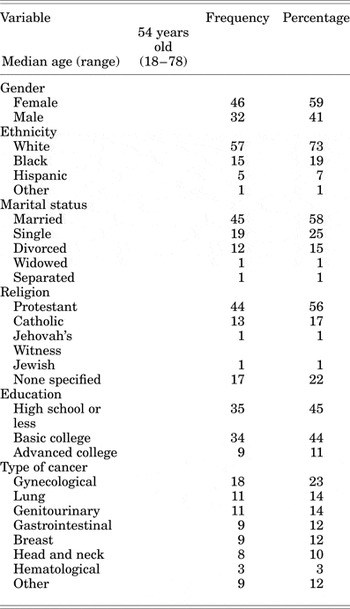
A total of 78 patients completed the parent study. Table 1 summarizes the demographic characteristics of study participants. There was no significant difference between intensity of religiosity for Caucasian and African-American patients (median 17.0, interquartile range [IQR] 14.0–20.0 vs. 14.0–20.0; p = NS). There were not enough Hispanic patients to obtain statistically significant comparisons. All African-American patients refused DNR independent of their level of religiosity.
Clinical characteristics of advanced-cancer patients (n = 78)

Intensity of religiosity did not vary significantly among the different decision-making styles, which was one of the primary metrics of concern in the parent study. For active decision makers, the median SCSRFQ–SF score was 16.5 (IQR = 13.5–19.5); for passive decision makers, it was 14 (IQR = 13–20); and for shared decision makers, it was 19 (IQR = 15–20), with p = 0.13.
A total of 53 of the 60 patients (88%) who chose DNR for the video patient and 16 of the 18 (89%) who did not were highly religious (p = 0.64). Some 43 of the 48 patients (90%) who refused DNR for themselves and 26 of the 30 (87%) who chose DNR were highly religious (p = 0.08). The Spearman correlation coefficient between patients choosing DNR for themselves and intensity of religiosity was r = –0.16 (p = 0.16).
The 30 patients (38%) who chose DNR for the video patient but refused DNR for themselves and the 42 patients (54%) who chose DNR for both were highly religious (p = NS).
DISCUSSION
In this population of highly religious American advanced-cancer patients, a patient's intensity of religiosity was not associated with DNR preference. Level of religiosity was not correlated with age, ethnicity, religious affiliation, or style of decision making. Spirituality and religion most likely influences a patient's decision-making process, but they constitute only one important component of the whole process. This is especially true if we also consider patient and caregiver culture, ethnicity, community support, and trust or mistrust in the medical system. Other possible factors include the nature of the patient–physician relationship and the nature of their interactions. All patients stated that the doctors from the video communicated with their patient in a very compassionate way (see Rhondali et al., Reference Rhondali, Perez-Cruz and Hui2013). This may have affected patients' perceptions of the conversation more so than the patients' levels of religiosity had. Future studies may help clarify the role of religiosity in responses to video scenarios by including religious/spiritual components in the experimental videos.
Interestingly, other studies have reported that religiousness, religious coping, and lack of support for spiritual and religious needs are associated with increased preference for cardiopulmonary resuscitation, mechanical ventilation, hospitalization (Bullock, Reference Bullock2006), and significant end-of-life measures (Balboni et al., Reference Balboni, Vanderwerker and Block2007). However, despite the high level of religiosity among the participants in our study, we found no significant difference in religiosity between the patients who chose DNR or those that did not.
There is evidence suggesting that religious factors affect medical decisions at the end of life. In a survey of 1006 members of the general public, 68.3% of individuals stated that their religious beliefs would guide their medical decisions if critically injured, and 57.4% believed that God could heal a patient even if physicians had pronounced further medical efforts to be futile (Bullock, Reference Bullock2006). Religious beliefs tend to influence medical decisions in the direction of “not giving up” and pursuing continued administration of invasive treatment, even in terminally ill patients in situations deemed medically hopeless (Truog, Reference Truog2010).
In our study, all African-American patients refused DNR independent of their level of religiosity. This could indicate that specific cultural or racial factors are more important influences in end-of-life decisions than religiosity. It has been reported that lower rates of advance-care planning among minority patients may arise partly from spiritual appraisals of illness and healing (e.g., the belief that only God knows when it's one's time to die) (Johnson et al., Reference Johnson, Elbert-Avila and Tulsky2005, Jacobs et al., Reference Jacobs, Burns and Bennett Jacobs2008).
A recent survey comparing EoL planning and spirituality with primarily female African-American medical inpatients determined that those who were highly religious and/or spiritual were more likely to have a designated decision maker to help with EoL decisions (Karches et al., Reference Karches, Chung and Arora2012). Similar to the findings of our research, that study noted that religious characteristics were not significantly associated with having an advanced directive or DNR order. Moreover, African-American patients are less likely than other demographic groups to have a code status documented in their medical record (Temel et al., Reference Temel, Greer and Admane2010), though it is unclear what causes this.
It has also been reported that African Americans as a group generally believe in the sanctity of life, which would suggest that, in general, they would not be inclined to discontinue life-sustaining treatment once it was begun if they believed that such a decision would result in death (Barrett & Heller, Reference Barrett and Heller2002; Bolling, Reference Bolling, Perry and Ryan1995). However, generalizations regarding care preferences should be avoided whenever possible, and communications between physicians and patients are critical when faced with various EoL scenarios.
Another important aspect to consider is that in cultures that tend toward collectivism (e.g., African Americans and Latinos) people value their community and believe in honoring close associates, especially family. Any major event, such as a decision about medical care at the end of life, would be arrived at through family consensus, where many individuals would give their opinions, and the group would reach a joint decision. Further studies are needed to understand the role of culture, religious beliefs, and decision-making style.
When providing care to patients with advanced and terminal illness, healthcare providers can build patient trust by offering to involve family members in decision making, and anticipate and arrange for, when possible, many family members to be included in discussions regarding the end of life. Our study did not include the input of family members in DNR decisions regardless of a patient's decision-making style, so that further study is warranted on how decision-making styles and familial influence can affect DNR choices.
Other previous studies have shown an association between religiosity and DNR preferences. Our data indicate that this is not always the case, and that such other factors as perception of the physician's compassion and patient decision-making style may play a role. Further studies are warranted to evaluate various aspects of the decision-making process—for example, level of religiosity, spirituality, spiritual pain, spiritual needs, family support, and decision-making style.
Because the influence of spirituality and religiosity on end-of-life care preferences seems to vary widely among patient populations, it is important that physicians discuss these issues with patients using an individualized approach. Spiritual needs should be met within the context of an individualized reciprocal process. The words that patients utilize to communicate perceptions about their end-of-life needs and preferences reveal how important it is to assess the dynamics of patient spirituality and religiosity within the context of clinician communication.
Our study had a number of limitations. Since it was a secondary analysis, causal relationships among intensity of religiosity and spirituality, religiosity, spiritual needs, and code status preferences cannot be established. The majority of patients were Caucasian and well educated, so that these factors may not be generalized to other population groups.
We conclude that in our population religiosity was not associated with a higher refusal of DNR status both for the video-simulated patients and the patients themselves. More research is necessary to determine the multiple dimensions that contribute to patients' choices about undergoing resuscitation near the end of life.
DISCLOSURES AND ACKNOWLEDGMENTS
We thank the Department of Scientific Publications at The University of Texas MD Anderson Cancer Center for editorial assistance. Dr. E.B. is supported in part by National Institutes of Health grants RO1NR010162-01A1, RO1CA122292-01, and RO1CA124481-01. The authors state that they have no conflicts of interest to declare.