Richard Hobbs writes: This note concerns the two largest vessels in the Mildenhall treasure, one of the most spectacular survivals of the late Roman Empire and, to date, the largest set of Roman silver tableware discovered in the British Isles. The hoard’s 27 piecesFootnote 52 of silver plate have received a great deal of discussion since it came to public attention in 1946, not least because of its fine classical decoration, largely Bacchic in tone,Footnote 53 and the complicated circumstances surrounding its discovery.Footnote 54 The treasure continues to delight and intrigue millions of visitors to the British Museum every year, where it has been on almost uninterrupted display except for occasional visits to other British and international museums.Footnote 55
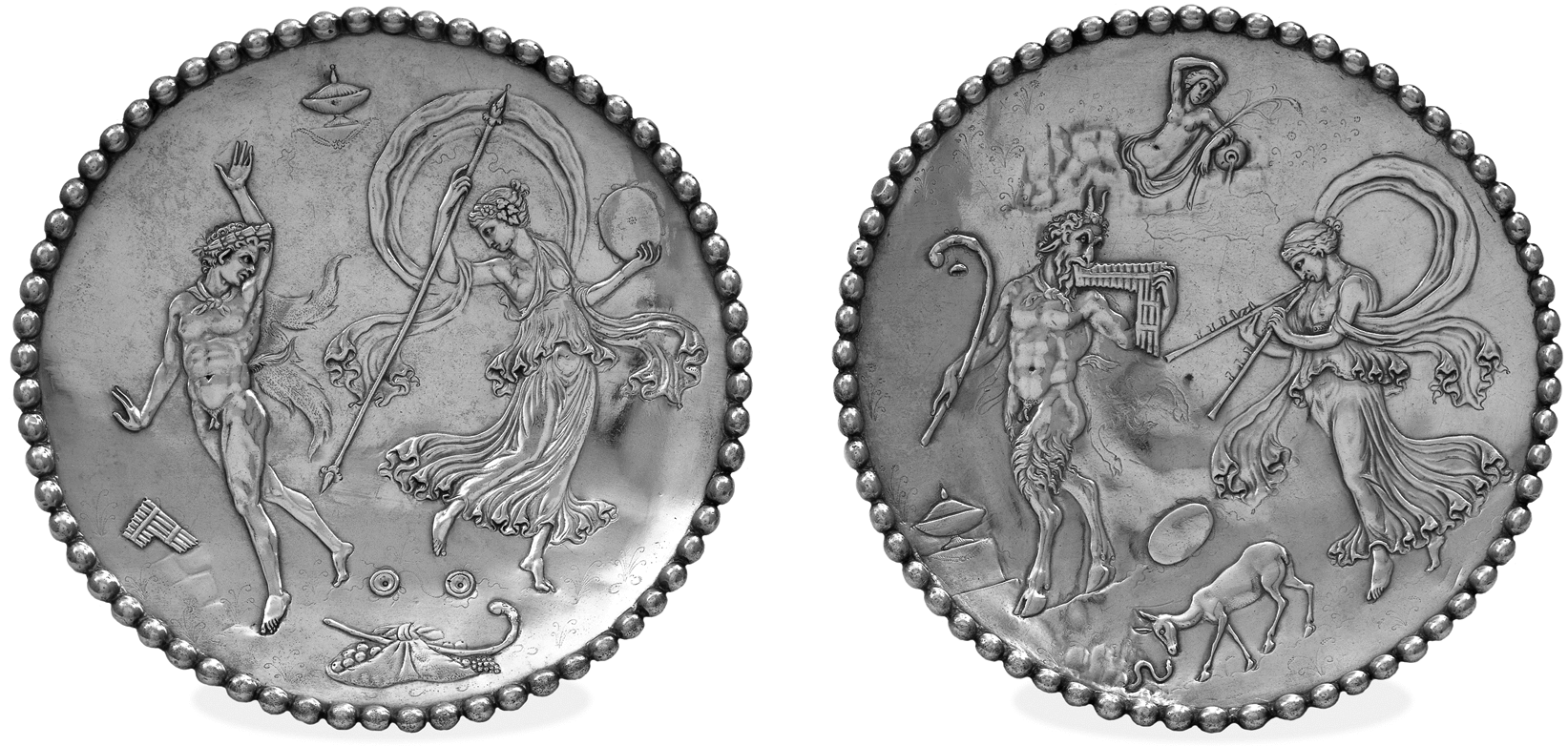
The two largest vessels, which are under discussion here, are ‘the Great Dish’ and the ‘Niello Dish’. Since assuming responsibility for curating the Mildenhall treasure in 2002, it has been a puzzle as to why two further components of the hoard, a matching pair of vessels, are described as ‘platters’ (or ‘the Bacchic Platters’, BM reg. nos BM 1946,1007.2–3) (fig. 5), whilst the two largest vessels are described as ‘dishes’. In fact, a range of terms has been used to describe the vessels in the Mildenhall treasure, only some of which are satisfactory. As indicated, the term ‘dish’ has been used to describe the ‘Great Dish’ and the ‘Niello Dish’, whilst the term ‘bowl’ is used — acceptably — to describe the rest of the large serving vessels, such as the fluted bowl with handles (BM 1946,1007.15–17), six flanged bowls, and a covered bowl (BM 1946,1007.5–12). Two further items are unsatisfactorily described as a ‘pair of goblets’ for they are almost certainly not goblets at all but small pedestalled plates with cupped bases (BM 1946,1007.13–14). The rest of the material in the hoard presents little terminological difficulty, comprising as it does spoons and ladles (BM 1946,1007.18–34).
‘The Bacchic Platters’ from the Mildenhall treasure. (© Trustees of the British Museum)

The terminology used to describe the tableware items in the Mildenhall treasure was first adopted by Brailsford in his swift publication of the hoard,Footnote 56 and repeated in the updated publication 30 years later.Footnote 57 The puzzlement derives from the fact that the word ‘platter’ — as opposed to ‘plate’, ‘dish’, or ‘bowl’ — conjures up (for the author at least, and probably others) an image of a wide, circular vessel, designed to serve a number of portions of food for sharing with more than one individual. It also gives an impression of a vessel that is completely flat, although this is a lesser consideration. Yet the ‘Bacchic platters’ are neither large nor flat; in fact, they are amongst the smallest vessels in the Mildenhall treasure, being 18.8 cm and 18.5 cm in diameter respectively, and are also slightly dished. The term ‘platter’ seems more appropriately applied to the largest vessels: ‘the Great Dish’ and ‘the Niello Dish’, which are 60.5 cm and 55.6 cm in diameter respectively. It could be argued that these vessels ought to be termed the ‘Great platter’ and the ‘Niello platter’ for the reasons set out below.
DEFINING SILVER PLATTERS
The author’s perceived view of a ‘platter’ is corroborated by the Oxford English Dictionary, which defines the term thus:
Platter: a large, flat dish or plate, esp. for food. Later also: the quantity contained on a platter; a plateful; (chiefly N. Amer., usu. with modifier denoting the type of food being served) a main dish with accompaniments, served on a platter.
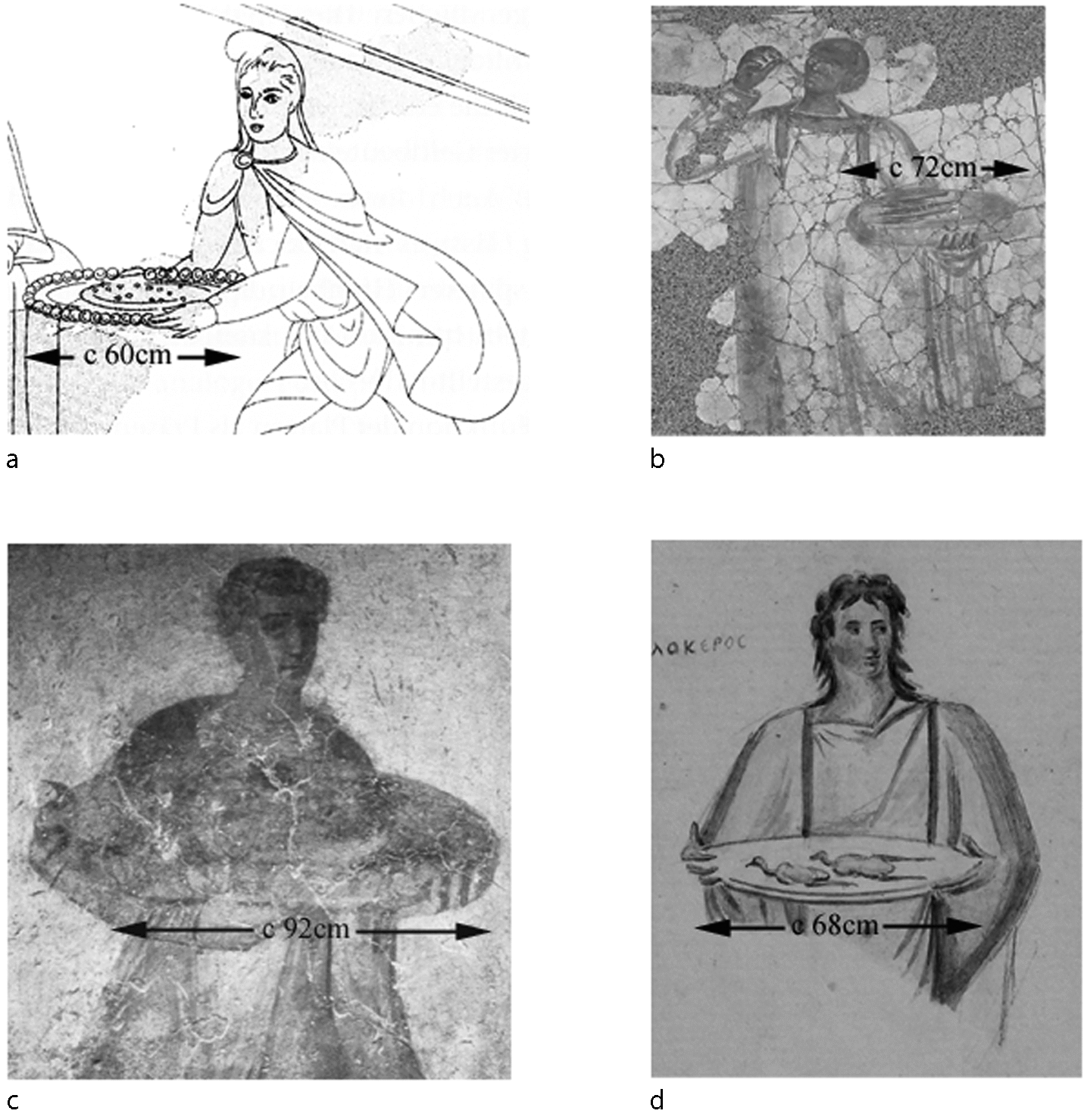
Notably, the OED’s only concession to size is the observation that a platter is ‘large’, although it does not attempt to qualify this. In this paper ‘platter’ is defined as a vessel with a diameter equal to or greater than 30 cm. This is of necessity an arbitrary judgement, but is not entirely conjured out of thin air. Modern dinner plates are usually about 25 to 28 cm in diameter, whilst buffet platters, used, for example, at wedding receptions, are usually around 40 cm in width.Footnote 58 Depictions of platters in late antique art show vessels at least 30 cm in diameter, and most are considerably larger. Four depictions of platters — chosen because it is possible to estimate their size in comparison with the figures holding them — show vessels between 60 cm and 92 cm in diameter (fig. 6).Footnote 59 This discussion is restricted to circular vessels, not only because the two platters in the Mildenhall treasure are circular, but because this is the commonest shape of vessels in the surviving depictions of platters in late antique art.Footnote 60
Four depictions of large silver platters, each with an indication of their approximate size based on the height of the figure carrying them. (a) Trani, southern Italy (reconstruction of F. Hilscher-Ehlert in the article by D. Korol in Jahrbuch für Antike und Christentum 39 (1996), fig. 3; see also Guggisberg and Kaufmann-Heinimann 2003, fig. 240); (b) Brigetio, Hungary (Courtesy of the Museum György Klapka, Komáron, Hungary; photo by László Borhy); (c) Rome, Caelian Hill (Napoli, Museo Nazionale 84285, upon authorisation of the Ministry for Cultural Heritage and Environment; see also Dunbabin 2003, pl. X); (d) Tomb painting from Sidon (© William John Bankes archive/The National Trust and Dorset History Centre; see also Dunbabin 2003, fig. 90).

Just to confuse matters, others have not defined ‘platters’ in the same way. In fact, there is no standard universal terminology for domestic silver tableware. In other languages, the term ‘platter’ is often used, but not necessarily consistently. The German word ‘Platte’ is used in the publication of the Kaiseraugst treasure, sometimes with qualification, e.g. ‘Grosse Platte’.Footnote 61 The term translates well as ‘platter’, and is used in preference to ‘Teller’ (‘plate’). French publications use the term ‘plateau’, again a good equivalent to ‘platter’ in English;Footnote 62 yet ‘plat’ (‘plate’) is also used for vessels which could also be defined as platters, for instance in the case of a flat vessel 40 cm in diameter from Rethel.Footnote 63
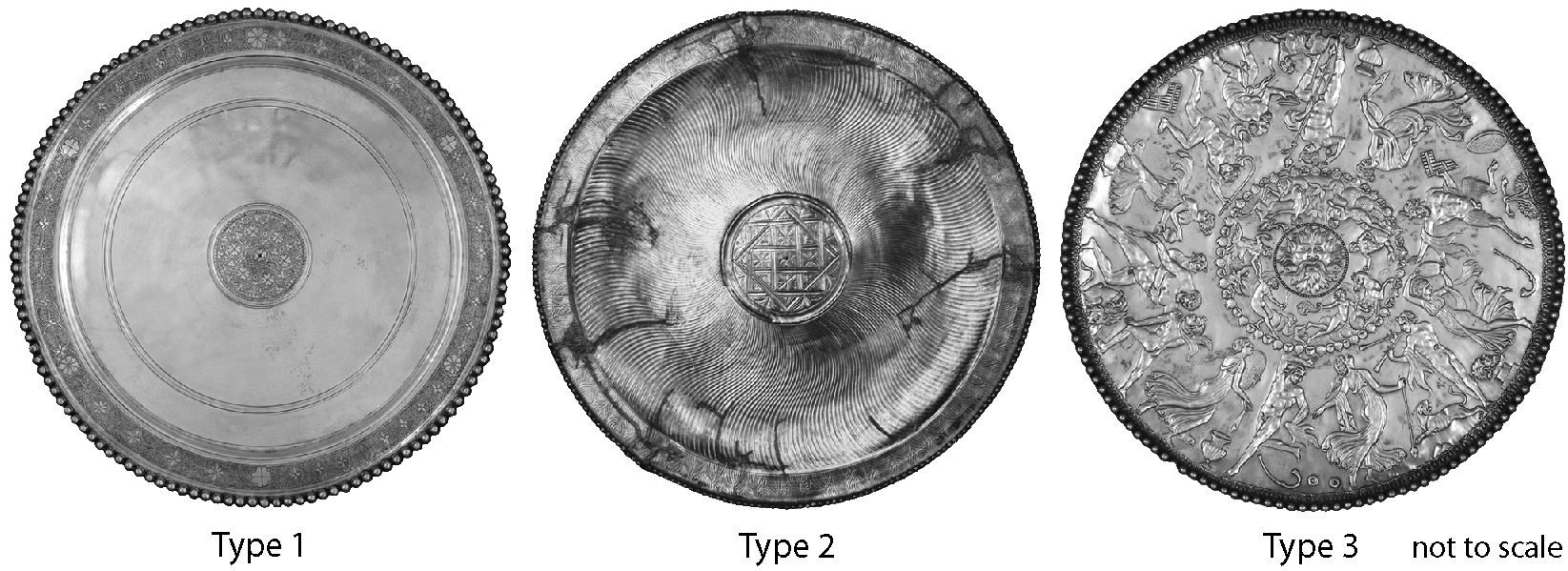
Circular platters over 30 cm in diameter are here divided into three sub-types, which display increasing degrees of decoration (fig. 7):Footnote 64
Three sub-types of silver platter.
(1 and 3: © Trustees of the British Museum; 2: © Augusta Raurica, Augst)

Type 1. A vessel which is largely undecorated. The vessel has a plain, serrated, or beaded rim, with either a plain or decorative zone immediately inside it; an undecorated zone in the centre, which constitutes the majority of the upper, visible surface; a plain centre or decorative central medallion of varied diameter. There is usually a low foot-ring on the reverse. In profile, these vessels can either be completely flat or slightly concave (‘dished’).
Type 2. A vessel which is decorated with a geometric design across its whole upper surface. This type is in effect a slightly more elaborate version of Type 1, with the plain zone between the rim and the central medallion infilled with additional geometric decoration.
Type 3. A vessel which is largely adorned with figurative decoration. The vessel has a similar variety of rims to Type 1, but figural scenes cover the whole of the vessel surface on the upper side. The decoration might be arranged in a series of circular registers or in a series of horizontal bands forming a narrative which runs from ‘top’ to ‘bottom’ of the platter. The underneath of these vessels is similar to Type 1. Like Type 1 vessels, they can be either completely flat or concave in profile.
In the Mildenhall treaure, the ‘Niello Dish’ (BM 1946,1007.4) can be categorised as a Type 1 platter, because it has simple geometric decoration inside its beaded rim, and a large undecorated inner zone around a geometric patterned central medallion (see fig. 7). Its profile is flat. The ‘Great Dish’ is a Type 3 platter, since it is fully decorated over its entire upper surface and has a beaded rim. In contrast to the ‘Niello Dish’, its profile is shallowly concave or ‘dished’ (BM 1946,1007.1).Footnote 65 There are no Type 2 vessels in the Mildenhall treasure, and the example used here is the Euticius platter from Kaiseraugst, which has a flat, decorated rim, a geometric central medallion, and a series of reversed ‘S’ curves radiating out from the centre and extending to the inside edge of the rim. This vessel is gently concave in profile.Footnote 66
Type 3 vessels, sometimes termed ‘picture plates’, have predictably received more attention than the largely plain Type 1 platters. Toynbee and Painter’s survey still provides the standard reference and catalogues 80 vessels, 22 of which are circular platters over 30 cm in diameter.Footnote 67 Interpretative works by SchneiderFootnote 68 and Leader-NewbyFootnote 69 explore what the narrative scenes on platters and other decorated vessels tell us about late Roman society. These studies view Type 3 vessels as ‘display’ pieces and treat the decoration as their most important characteristic, and conclude that the original owners thought of them principally as works of art or symbols of sophistication. For example, it has been suggested that narrative mythological scenes were one means by which the paideia, the traditional education of the élite, could be passed on to a new generation and the Helleno-Classical traditions so important to the Roman élite respected, maintained and promulgated.Footnote 70
For the ‘Great Dish’ — with its scenes of Oceanus and his attendants in the inner medallion and adjacent frieze, and a land-based Bacchic revel with Bacchus and Hercules in the wider outer decorative band — ideas of ostentatious display, élite education and maintenance of traditional Classical values are largely unproblematic. Yet the ‘Niello Dish’ and other Type 1 vessels seem to be very different in character. There is nothing particularly educational, traditional, or even ostentatious about the ‘Niello Dish’, relative to its highly decorated counterpart, and in fact the only thing germane to both vessels is the large quantity of precious metal that went into producing them (the ‘Niello Dish’ weighs 5,023 g whilst the ‘Great Dish’ weighs 8,256 g). The principal characteristic of the ‘Niello Dish’ and similar vessels is the plainness of their upper surface; any decoration is at most neutral and seemingly unlikely to provoke discussion or debate. It also seems significant that, unlike the ‘Great Dish’, the surface of the ‘Niello Dish’ is entirely flat. The obvious conclusion to draw from this is that the ‘Niello Dish’ was intended for a different purpose, and logically that purpose was a practical one, namely for use as a serving vessel: what is missing from the type’s large expanses of blank space are piles of food for the delectation of diners. But how common are these plain vessels? Also, how can we be certain that they were not produced as pieces of art, but for dining?
THE MILDENHALL ‘PLATTERS’ IN CONTEXT
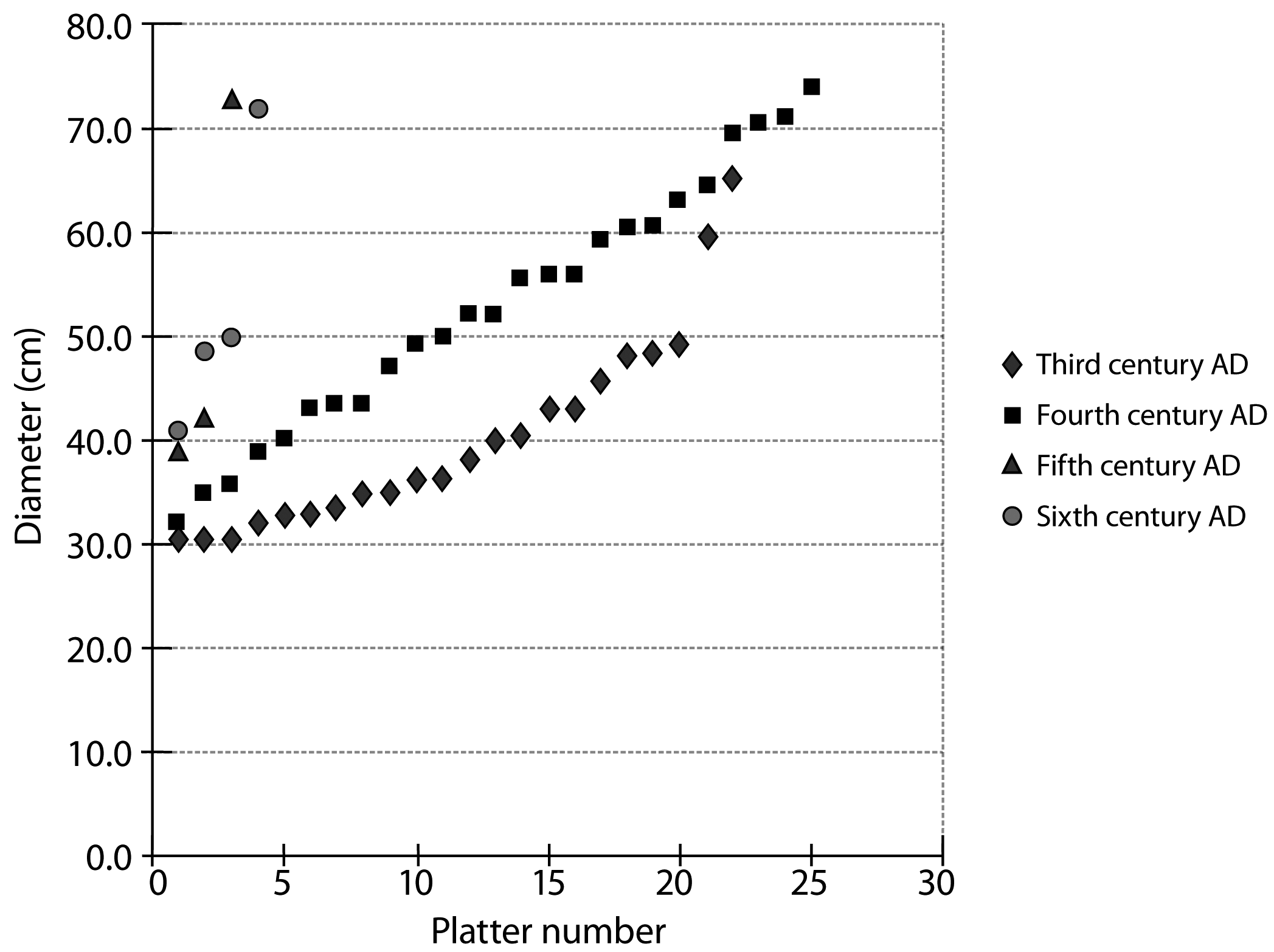
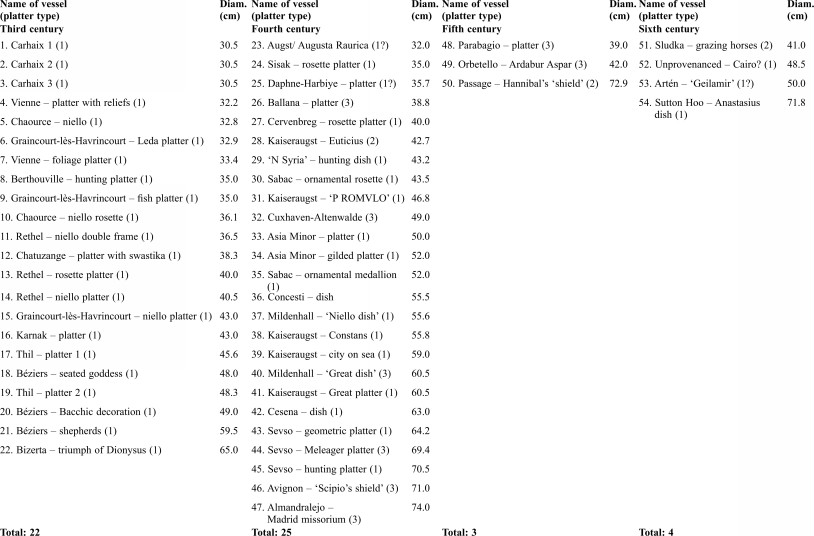
To date, the ‘Great Dish’ and the ‘Niello Dish’ are the only circular platters known from late Roman Britain.Footnote 71 They can be added to a list of 52 similar vessels, data of which has been taken from the author’s own survey of 2,045 precious metal deposits dating from the third to early seventh centuries a.d.Footnote 72 These vessels can be arranged by date and diameter (Table 2; fig. 8). Although it is impossible to be completely objective, most of the vessels in this group can be classified as domestic, secular objects dating from the third to sixth centuries a.d. Christian patens have been excluded, because it is highly unlikely that the Mildenhall platters served as liturgical vessels.Footnote 73
Size of silver platters in Late Antiquity (for the source of data, see Table 2)

SILVER PLATTERS ARRANGED BY DATE AND SIZE.
(Details of the finds and their publication sources can be found in Hobbs 2006, Appendix, 152-74.)

A number of interesting features can be observed. Firstly, there is clearly correlation between size of platter and date. As a general rule, platters tend to increase in diameter over time (fig. 8). Only two vessels from a total of 22 dated to the third century are over 50 cm in diameter, both from the Béziers hoard, and most are between 30 and 50 cm. Even the smallest fourth-century vessels start at a higher level than most of those of the third, and most platters of this date are between 40 and 65 cm in diameter, with only four smaller and three larger. The trend seems to continue in the fifth and sixth centuries, although the sample is small (there are only seven platters from this period). Nevertheless these platters are all larger than 39 cm and include two vessels larger than 70 cm in diameter.
Secondly, the analysis of vessel type in relation to diameter. The majority of vessels in the known corpus are Type 1 platters (i.e. largely undecorated): 42 out of 53, or 79 per cent, whilst only three are Type 2 vessels.Footnote 74 Thirty of the Type 1 vessels lie between 30 and 50 cm in diameter. All but two of the larger Type 1 vessels date to the fourth century or later. Type 3 vessels, decorated across the whole of their upper surface, were produced in a range of different diameters. They could be relatively small, such as those from Balana and Parabagio (both around 39 cm), or at the upper end of the scale, the Mildenhall ‘Great Dish’ itself (60.5 cm), ‘Scipio’s shield’ from Avignon (71 cm), and the Madrid missorium (74 cm).
One unexpected outcome of this analysis was the discovery that all vessels dating to the third century are plain (Type 1). Type 2 platters, the slightly more decorative version of Type 1, and Type 3 ‘picture platters’ do not appear to be produced until the fourth century. Why this is the case is unclear.Footnote 75 It is also unclear why platters appear to increase in size over time. We know that the production of precious metal objects, particularly silver coin and silver plate, was heavily controlled in the late Roman period and linked to a complex system of gift giving for the maintenance of élite relationships amongst the imperial hierarchy,Footnote 76 so perhaps increasing vessel size is reflective in some way of élite one-upmanship — a ‘raising of the stakes’ as time went on. Or maybe it is more a reflection of changes in dining practice: in the Late Empire, there was a move away from the three-sided couch (triclinium) of the Early Empire to the curved couch, or stibadium, and it is possible that this opening out of the dining space led to a demand for larger vessels to accommodate such a change.Footnote 77
ILLUSTRATIONS OF SILVER PLATTERS IN LATE ANTIQUITY
In addition to the platters themselves, there are a large number of banqueting scenes in a variety of artistic media in Late Antiquity which show platters in use. These include pictorial representations on silver vessels themselves,Footnote 78 mosaics, wall paintings and stone reliefs. Many show circular platters being used to serve food,Footnote 79 usually placed before a set of diners reclining on the curved couch (stibadium), which, as has been noted above, was preferred in the Late Empire to the three-sided couch (triclinium). This is not the place to discuss this iconography in depth, because there are a considerable number of depictions and a full survey is beyond the scope of this paper, but there are enough illustrations readily available to make some basic observations. Images can be found in two main sources, Dunbabin’s excellent survey of banqueting scenes in the ancient worldFootnote 80 and Guggisberg and Kaufmann-Heinimann’s discussion of the second part of the Kaiseraugst treasure.Footnote 81
Firstly, it is often quite clear that the artist intended the viewer to recognize the vessel portrayed as a silver platter, because they are depicted with beaded rims, the most distinctive feature of silver vessels from the fourth century onwards (beaded rims are present on virtually all of the vessels in the Mildenhall treasure). Examples include the banquet of Vibia among the Blessed, Rome,Footnote 82 which shows two vessels with beaded rims set before the diners: the beads are picked out by a series of black dots. Beaded rim vessels are also seen being transported by servants on a mosaic from Santa Maria Maggiore.Footnote 83 One of the clearest examples of a silver vessel with a beaded rim comes from Trani in Southern Italy.Footnote 84
Secondly, there are many examples of silver platters which show food being served. The most celebrated and clearest depiction is a remarkable series of silver vessels on a mosaic pavement from the ‘House of the Buffet Supper’ at Antioch, dated to the early third century a.d.Footnote 85 One silver platter depicts boiled eggs in egg-cups and accompanying round-bowled spoons, artichokes and pig’s trotters, and an additional bowl in the centre which contains a red dipping sauce.Footnote 86 A possible silver platter on which is sat a spit-roast chicken is shown set before a hunting party in the ‘Room of the Small Hunt’ at Piazza Armerina, but since the background to the chicken is rendered in dark tesserae, the vessel might conceivably be bronze, although it does appear to have a ‘silver’ rim.Footnote 87
Sometimes it is not food being carried on platters but precious metal gifts, either coins or bullion. For example, there are crudely drawn coins on a platter in the Notitia Dignitatum,Footnote 88 four sacks of 1,000 denariiFootnote 89 on the Magerius mosaic, Smirat,Footnote 90 and pieces of gold and coins, as interpreted by Guggisberg and Kaufmann-Heinimann, on both the Trani painting and the mosaic at Santa Maria Maggiore.Footnote 91
These examples make the point that silver platters in late Roman art are depicted ‘in use’. There are no examples, known to the author, of silver vessels being shown on display as passive works of art. Even though it is not possible to judge what types of silver platter are being shown in these images with any certainty, it is suggested here that it is likely that they depict the much more common Type 1 vessels, of which the ‘Niello Dish’ from the Mildenhall treasure is the only complete example from Roman Britain. The innate plainness of these vessels can be explained, as argued above, by their practical function as buffet platters for the sharing of large quantities of food, and possibly, in some cases, for the presentation of donatives. Whereas, the heavily decorated Type 3 vessels, such as the Mildenhall ‘Great Dish’, were probably produced for different reasons, which are more likely — as others have argued — to reflect the complex social relations, myths and mores of the Late Empire and particularly the late Roman élite. Whatever the case, it would seem inappropriate to cover the figures of gods with piles of food,Footnote 92 and even more unacceptable in the few cases of platters which were specifically produced to commemorate imperial decennaliae (e.g. the ‘Theodosius Dish’Footnote 93). But in the case of essentially plain platters, such as the ‘Niello Dish’, it is suggested here that the exact opposite is true: these were vessels produced in large numbers for a very practical, if certainly high status, function, namely the sharing of food and other gifts.
ACKNOWLEDGEMENTS
I would like to thank Ralph Jackson, Catherine Johns, Simon Esmonde Cleary and Richard Reece for their helpful comments and observations on earlier drafts of this paper. Also those who helpfully provided images, particularly Dr László Borhy (Museum György Klapka, Komáron, Hungary), the Soprintendenza Archeologica Napoli e Pompei, Sarah Compton (National Trust), Stephen Forshaw (Dorset Records Office), Anne Marie Kauffmann-Heinimann and Susanne Schenker (Augusta Rauricum), and Professor Dr Dieter Korol (Institut für Klassiche Archäologie und Frühchristliche Archäologie, Münster).