


India harbours many narrow endemic amphibian species, the conservation of which is impeded by the Wallacean shortfall (a knowledge gap in species distribution; Hortal et al., Reference Hortal, de Bello, Diniz-Filho, Lewinsohn, Lobo and Ladle2015). This is the case in particular for saxicolous species in habitats with significant forest cover and topographic relief. The genus Bufoides (Pillai & Yazdani, Reference Pillai and Yazdani1973), family Bufonidae, is one such range-restricted genus, endemic to north-east India (Frost, Reference Frost2025) with just three nominal members (Bufoides meghalayanus, East Khasi Hills, Meghalaya state; Bufoides kempi, Garo Hills, Meghalaya; Bufoides bhupathyi, Mizoram state (Naveen et al., Reference Naveen, Tapley, Chandramouli, Jervis, Babu, Meetei and Karunakaran2023; Fig. 1). Of these, B. meghalayanus (the type species; Supplementary Plate 1) is categorized as Critically Endangered on the IUCN Red List, and was known from just three locations, in the East Khasi Hills: the type locality in Mawblang, Cherrapunji (now Sohra), and in Thangkharang and Mawsmai, 1–2 km from the type locality (IUCN SSC, 2022). This species had not been recorded for 30 years until it was rediscovered by Das et al. (Reference Das, Rangad, Lyngdoh, Deuti and Hooroo2009) near the type locality. Deuti et al. (Reference Deuti, Ray and Dey2012) documented a total known population of < 100 mature individuals and an extent of occurrence (EOO) of c. 18 km2. It was presumed to be localized to a restricted area of this karst limestone landscape, an area impacted by rock-blasting and stone quarrying (Deuti et al., Reference Deuti, Ray and Dey2012). However, knowledge of the range of narrowly endemic species can be subject to geographical sampling bias (Narayanan et al., Reference Narayanan, Bhat, Paran, Das and Aravind2022). In this context, we present here new occurrence records of B. meghalayanus, significantly expanding its known range, and describe the genetic and morphometric variations between populations.
North-east India, showing the distribution of the genus Bufoides (Pillai & Yazdani, Reference Pillai and Yazdani1973), the type locality of its three nominal members (B. meghalayanus, Mawblang, East Khasi Hills, Meghalaya; B. kempi, Tura, Garo Hills, Meghalaya; B. bhupathyi, Dampa Tiger Reserve, Mizoram), and 10 of the 11 numbered locations (including the type locality, no. 1) in which we searched for B. meghalayanus (Table 1). Note that location 7 (Umden, Ri Bhoi) lies outside the area covered by this map and is therefore not shown.

Fig. 1 Long description
The map of northeast India illustrates the distribution of the genus Bufoides, highlighting the type localities of its three nominal members: Bufoides meghalayanus in Mawblang, East Khasi Hills, Meghalaya; Bufoides kempi in Tura, Garo Hills, Meghalaya; and Bufoides bhupathyi in Dampa Tiger Reserve, Mizoram. The map also marks ten numbered locations where Bufoides meghalayanus was searched for, in addition to its type locality. The map uses symbols to indicate the presence or absence of Bufoides meghalayanus at these locations. The geographic region is detailed with rivers, topographic relief, and forest cover, providing context for the habitats of these narrow endemic amphibian species.
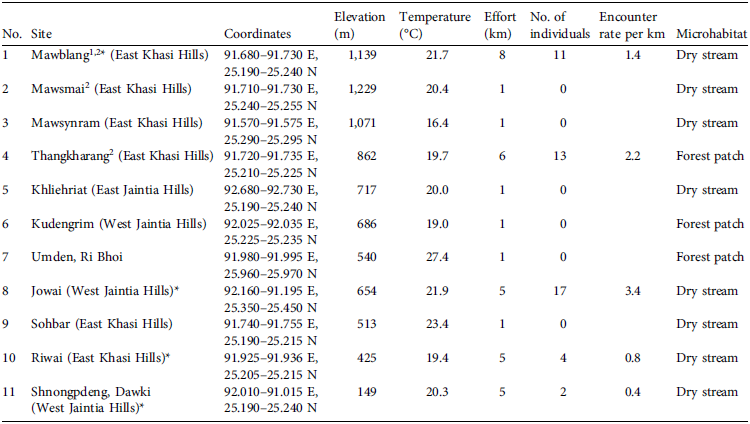
Building on the findings of a previous survey (Deuti et al., Reference Deuti, Ray and Dey2012), and incorporating knowledge from the local community and from batrachologists working in the region, we identified potential habitats for the species with the help of satellite imagery (Google Earth, 2024). We surveyed a total of 11 sites across an elevation gradient (100–1,300 m) in Meghalaya during April–June 2024, searching horizontal slits and rock crevices and between sandstone boulders along a linear search path, from 9.00 to 20.00, over a total of 24 days (Table 1). These sites included the original type locality, the two additional known localities, and eight additional sites potentially suitable for the species. The locations of all sites were recorded with a GPS along with elevation data and ambient temperature.
The 11 sites in the state of Meghalaya, north-east India, where we surveyed for Bufoides meghalayanus, with the beginning and end coordinates of the linear search, elevation, air temperature (recorded on the day), effort (km searched), number of individuals sighted, encounter rate per km, and microhabitat.

Table 1 Long description
The table presents data from 11 sites in Meghalaya, India, where surveys for Bufoides meghalayanus were conducted. It includes columns for site number, coordinates, elevation in meters, temperature in degrees Celsius, effort in kilometers, number of individuals sighted, encounter rate per kilometer, and microhabitat. Notable sites include Mawblang in East Khasi Hills with an elevation of 1139 meters and an encounter rate of 1.4 per kilometer, and Jowai in West Jaintia Hills with an elevation of 654 meters and an encounter rate of 3.4 per kilometer. The microhabitats range from dry streams to forest patches.
1 Type locality.
2 Previously known locations.
* Populations from which we collected one representative specimen (Supplementary Table 1).
We implemented best-practice biosecurity protocols during our surveys, using disposable gloves for handling individual amphibians (disposed of after each capture), disinfecting footwear and equipment with Virkon S solution between sites, and avoiding any contact between toads collected from different locations. Animal handling and processing, including morphometric measurements, were conducted on clean, disinfected surfaces.
We took standard morphometric measurements (Supplementary Table 1) of 14 individuals (10 of which were released at the capture sites following measurement), and collected four specimens from which we used liver samples for genomic DNA extraction. The latter were subjected to PCR amplification of a partial fragment of the 16S rRNA gene (Naveen et al., Reference Naveen, Chandramouli, Kadam, Babu, Karunakaran, Kumara and Parthasarathy2022). A principal component analysis (PCA) was performed on the 16 morphometric traits (standardized following the allometric equations described by Thorpe, Reference Thorpe1975) of the 14 measured individuals and of six individuals of B. kempi (one from our fieldwork and five from Naveen et al., Reference Naveen, Chandramouli, Kadam, Babu, Karunakaran, Kumara and Parthasarathy2022) and four individuals of B. bhupathyi (one from our fieldwork and three from Naveen et al., Reference Naveen, Chandramouli, Kadam, Babu, Karunakaran, Kumara and Parthasarathy2022), to remove size-dependent effects and to summarize the extent of multivariate morphometric variation within the genus. The genetic sequences from newly recorded populations were aligned with 36 other sequences of comparable length belonging to 16 genera of Asian toads available in GenBank (Supplementary Table 2), using MEGA 7.0 (Kumar et al., Reference Kumar, Stecher and Tamura2016). The resulting alignment was subjected to maximum likelihood phylogenetic reconstruction, with 10,000 bootstrap replicates, to evaluate clade stability, under the GTR+GAMMA+I model of sequence evolution, using Limnonectes khasianus and Amolops siju to root the tree (Fig. 2).
Phylogenetic relationships of the newly recorded and previously known populations of B. meghalayanus, based 16S rRNA.

Fig. 2 Long description
A scatter plot displays the principal component analysis of morphometric traits of various Bufoides species. The plot includes data points representing different species: B. bhupathyi, B. kempi, and various populations of B. meghalayanus (Jowai, Shnongpdeng, Riwai, and Type locality). The x-axis represents Axis 1 with 35 percentage variation, and the y-axis represents Axis 2 with 20 percentage variation. Different shapes and colors indicate different species and populations: B. bhupathyi is represented by green squares, B. kempi by yellow triangles, B. meghalayanus (Jowai) by blue crosses, B. meghalayanus (Shnongpdeng) by blue squares, B. meghalayanus (Riwai) by pink circles, and B. meghalayanus (Type locality) by pink stars. The plot shows clusters of data points for each species and population, with overlapping regions indicating similarities in morphometric traits. The ellipses around the clusters represent the confidence intervals for each group. The plot helps visualize the multivariate morphometric variation within the genus Bufoides.
We recorded three previously undocumented populations of B. meghalayanus, at Riwai, Shnongpdeng and Jowai (Table 1). At five sites we observed a total of 47 individuals, with an encounter rate of 0.4–3.4 individuals per km. The three newly recorded populations extend the easternmost distribution limit of B. meghalayanus by c. 50 km, into the Jaintia Hills, and lower the known elevational limit of the species to 149 m. All of the new records were from narrow horizontal rock crevices within karst limestone habitats. Our findings, along with earlier reports, indicate that B. meghalayanus inhabits limestone rocks by stream banks with an exposed canopy, including subtropical forest patches with closed canopy and large moss-covered limestone boulders.
The morphometric measurements of the individuals of the three new populations align with both the original description of the species (Yazdani & Chanda, Reference Yazdani and Chanda1971) and the expanded description (Naveen et al., Reference Naveen, Chandramouli, Kadam, Babu, Karunakaran, Kumara and Parthasarathy2022), although the snout-vent length of specimens collected from Riwai and Shnongpdeng is comparatively smaller than that of specimens from the type locality, Mawblang (Supplementary Table 1). The PCA indicated a significant overlap in the morphometric space among the three species of Bufoides, with only B. kempi forming a clear cluster (Fig. 3).
Plot of the first two axes of the PCA of 16 morphometric traits of the 14 measured individuals of B. meghalayanus (Supplementary Table 1) and of six individuals of B. kempi and four individuals of B. bhupathyi (from our fieldwork and Naveen et al., Reference Naveen, Chandramouli, Kadam, Babu, Karunakaran, Kumara and Parthasarathy2022, Reference Naveen, Tapley, Chandramouli, Jervis, Babu, Meetei and Karunakaran2023). See text for details.

Fig. 3 Long description
A plot displaying the first two axes of the principal component analysis (PCA) of 16 morphometric traits measured in 14 individuals of Bufoides meghalayanus, six individuals of Bufoides kempi, and four individuals of Bufoides bhupathyi. The plot illustrates the distribution and variation of these traits among the different species.
The phylogenetic analysis based on the 16S rRNA partial fragments (400–550 bp in length) of the three newly recorded populations showed significant genetic divergence, despite them clustering into the clade containing the other Bufoides species, being nested with the type specimen of B. meghalayanus (Fig. 2). The genetic distances (p-distance) between the three newly recorded populations varied by 0.8–1.5% from the genetic sequences in GenBank (accession number KT991342; Supplementary Table 2), with the low-elevation population from Shnongpdeng being genetically the farthest (p-distance 1.5). This pattern was further supported by a clear phylogeographical structuring within the B. meghalayanus clade in the phylogenetic tree, with distinct clustering corresponding to highland (Mawblang Plateau) and lowland (Shnongpdeng Village) populations. The genetic distinctiveness between these two populations, although relatively low, suggests an early-stage divergence consistent with an ongoing speciation process, indicating the importance of both populations as distinct components of the evolutionary diversity of B. meghalayanus and thus warrants recognition as separate conservation units requiring site-specific conservation actions targeting habitat restoration and long-term population monitoring. Comparing the 16S rRNA fragments with its congeners, B. meghalayanus differs by 2.9–3.4% from B. bhupathyi and by 4.7–5.6% from B. kempi). Together with the observed morphometric distinctness in the multivariate morphometric space (Fig. 3), this suggests a degree of ecological differentiation that may be associated with microhabitat-specific adaptation and emphasizes the need for species-specific fine-scale habitat management and incorporation of phylogeographical data in conservation prioritization across the range of Bufoides.
The three new locality records for B. meghalayanus increase the EOO from c. 18 km2 to > 300 km², and suggest a potentially broader distribution across suitable habitats in the karst landscape of Meghalaya. Our surveys indicate a population size of > 250 mature individuals and > 50 mature individuals in each population. These data indicate the species no longer meets the conditions for Critically Endangered (IUCN SSC Amphibian Specialist Group, 2022) under criteria B1ab(iii) (EOO < 100 km²) or C2a(ii) (< 250 mature individuals). We therefore propose a recategorization as Endangered based on criteria B1ab(iii) (i.e. EOO < 5,000 km² (B1), no more than five locations (a) and continuing decline observed, inferred or projected (b) in area, extent and/or quality of habitat (iii)) and C2a(i) (i.e. population < 2,500 mature individuals (C) and continuing decline observed, projected or inferred in number of mature individuals (2) and no subpopulation estimated to contain > 250 mature individuals (i)).
The specialized microhabitat of B. meghalayanus (narrow horizontal rock crevices in large limestone boulders; Pillai & Yazdani, Reference Pillai and Yazdani1973), combined with the fragmented nature of karst habitat landscapes, suggests that the known populations of the species are likely disjunct and localized, making them particularly vulnerable to anthropogenic habitat alterations and climate change. The three newly discovered sites are a tourism location, and therefore potential tourism-related effects on the species’ habitat needs to be evaluated. The human population of Sohra has risen from c. 120 per km2 in 1961 to > 300 individuals per km2 in 2011 (Census of India, 1965; 2011), increasing the anthropogenic pressures on these karst limestone habitats (which are mostly under private ownership). This landscape is also undergoing deforestation (associated with charcoal production for iron smelting and shifting cultivation) and tourism-related land-use changes and infrastructure development, and limestone mining with extensive stone-blasting and quarrying activities (Prokop, Reference Prokop2020).
To mitigate the detrimental effects of illegal stone mining and quarrying within the range of B. meghalayanus, it is essential to enforce regulations on mining permits and deforestation, and to limit the intensity and spatial extent of extraction, whilst also promoting sustainable land-use practices to regulate expansion of tourism infrastructure, particularly in the forested areas that serve as key breeding sites. Based on our findings, we recommend integration of the genus Bufoides into regional conservation strategies by the Meghalaya State Biodiversity Board, including measures to educate local communities and foster community-based conservation, and long-term monitoring of the known B. meghalayanus populations.
Author contributions
Conception, design, funding acquisition: SS, AN; data analysis and collection: EAC, SS, BB, AD; writing: SS, EAC; revision, supervision: AD.
Supplementary material
The supplementary material for this article is available at doi.org/10.1017/S0030605325101993
Acknowledgements
We thank Meghalaya Forest Department, and the Office of The Additional Principal Chief Conservation of Forests, Wildlife and Chief Wildlife Warden, Meghalaya, Shillong, for permitting us to collect Bufoides samples (Memo. no. FOR.77/2019/94-A); and Prakriti Research Fellowship for financial support.
Conflicts of interest
None.
Ethical standards
Fieldwork respected local beliefs, economic and cultural interests, and rights. This research abided by the Oryx guidelines on ethical standards, and the ethical guidelines of the Institutional Animal Ethics Committee of the Wildlife Institute of India (approved under certificate number WII/IAEC/2021-2022).
Data availability
All data are provided within this article and its supplementary materials. Molecular sequences are available from the corresponding author upon reasonable request.



 Open access

