Introduction
Aedes aegypti (Linneaus, 1762) population control is the primary means to decrease human arbovirus infections (WHO, 2016). Control of this species is best achieved by using a variety of tactics, with source reduction being among the most important (Rocha, Reference Rocha2014). Vector control programs also utilize insecticides, mainly synthetic chemicals, for larval and adult control (Rocha, Reference Rocha2014; Govindarajan et al., Reference Govindarajan, Rajeswary, Senthilmurugan, Vijayan, Alharbi, Kadaikunnan, Khaled and Benelli2018). However, there is increased interest recently in alternative methods for population control, such as: (i) lethal oviposition traps (da Silva et al., Reference da Silva, Soares-da-Silva, Ferreira, Rodrigues, Tadei and Zequi2018); (ii) spatial repellents (WHO, 2012); (iii) synthetic hormones (Nakazawa et al., Reference Nakazawa, Araújo, Melo-Santos, Oliveira and Silva-Filha2020; Santos et al., Reference Santos, Limongi and Pereira2020); and (iv) biological control, which may provide high levels of control while reducing environmental and ecological impacts (Becker et al., Reference Becker, Petric, Zgomba, Boase, Madon, Dahl and Kaiser2010). Some of the options for biological control of Ae. aegypti are: (i) modified sterile males (Multerer et al., Reference Multerer, Smith and Chitnis2019); (ii) parasitism by Heterorhalditis spp. and Steinernema spp. (Becker et al., Reference Becker, Petric, Zgomba, Boase, Madon, Dahl and Kaiser2010); (iii) Coelomomyces spp. and Lagenidium spp. fungi (Becker et al., Reference Becker, Petric, Zgomba, Boase, Madon, Dahl and Kaiser2010); (iv) botanical compounds (Govindarajan et al., Reference Govindarajan, Rajeswary, Senthilmurugan, Vijayan, Alharbi, Kadaikunnan, Khaled and Benelli2018; Almadiy, Reference Almadiy2020); (v) bacteria-derived products (e.g. Bacillus thuringiensis israelensis and Wolbachia) (Dutra et al., Reference Dutra, Rocha, Dias, Mansur, Caragata and Moreira2016; Soares-da-Silva et al., Reference Soares-da-Silva, Queirós, de Aguiar, Viana, Neta, da Silva, Pinheiro, Polanczyk, Carvalho-Zilse and Tadei2017; Nakazawa et al., Reference Nakazawa, Araújo, Melo-Santos, Oliveira and Silva-Filha2020); and (vi) natural invertebrate predators (Becker et al., Reference Becker, Petric, Zgomba, Boase, Madon, Dahl and Kaiser2010; WHO, 2012).
Strategies for the biological control of mosquito vectors should aim to reduce mosquito-borne disease incidence while preserving biodiversity and preventing toxic effects on ecosystems (Becker et al., Reference Becker, Petric, Zgomba, Boase, Madon, Dahl and Kaiser2010). Studies have demonstrated successful control of Ae. aegypti using a variety of natural predators, including fish (Pamplona et al., Reference Pamplona, Lima, Cunha and Santana2004; Cavalcanti et al., Reference Cavalcanti, Pontes, Regazzi, de Paula Júnior, Frutuoso, Sousa, Dantas Filho and Lima2007; Becker et al., Reference Becker, Petric, Zgomba, Boase, Madon, Dahl and Kaiser2010), amphibians (Blum et al., Reference Blum, Basedow and Becker1997), shrimp (Coelho et al., Reference Coelho, de Carvalho Apolinário Coêlho, Bresciani and Buzetti2017), copepods (Marten and Reid, Reference Marten and Reid2007), odonates (Fincke et al., Reference Fincke, Yanoviak and Hanschu1997; Akram and Ali-Khan, Reference Akram and Ali-Khan2016), and other aquatic invertebrate species (Becker et al., Reference Becker, Petric, Zgomba, Boase, Madon, Dahl and Kaiser2010; Bellamy and Alto, Reference Bellamy and Alto2018). Predators can exert these effects either directly via prey reduction from consumption (e.g. consumptive effects) (Creel et al., Reference Creel, Becker, Dröge, M'soka, Matandiko, Rosenblatt, Mweetwa, Mwape, Vinks, Goodheart, Merkle, Mukula, Smit, Sanguinetti, Dart, Christianson and Schuette2019), or indirectly through changes in prey behavior, morphology, or physiology after the threat of predation is perceived (non-consumptive or trait-mediated effects) (Preisser et al., Reference Preisser, Bolnick and Grabowski2009). Predator detection by mosquitoes can occur through visualization, detection of predator excretions (Creel et al., Reference Creel, Christianson, Liley and Winnie2007), or detection of the act of predation through chemical cues from injured conspecifics (Relyea, Reference Relyea2000; Creel et al., Reference Creel, Christianson, Liley and Winnie2007; Andrade et al., Reference Andrade, Albeny-Simões, Breaux, Juliano and Lima2017). The resulting behavioral changes may be physiologically costly, and often include reduced feeding and subsequent decrease in larval growth and development (Bellamy and Alto, Reference Bellamy and Alto2018). This in turn can negatively affect life history traits in resulting adults such as body size and longevity (Andrade et al., Reference Andrade, Albeny-Simões, Breaux, Juliano and Lima2017).
Several studies have demonstrated consumptive and non-consumptive effects of predators on prey populations (Rosa and DeSouza, Reference Rosa and DeSouza2011; Creel et al., Reference Creel, Becker, Dröge, M'soka, Matandiko, Rosenblatt, Mweetwa, Mwape, Vinks, Goodheart, Merkle, Mukula, Smit, Sanguinetti, Dart, Christianson and Schuette2019) and how the resulting impacts on larval development can carry over into adulthood (Ohlberger et al., Reference Ohlberger, Langangen, Edeline, Claessen, Winfield, Stenseth and Vøllestad2011; Mcintire and Juliano, Reference Mcintire and Juliano2018). The presence of a predator may increase the fitness of surviving individuals due to reductions in population density that increase resource availability (Abrams and Matsuda, Reference Abrams and Matsuda2005; Abrams, Reference Abrams2009). Many studies have utilized simple trophic configurations, such as single predator–prey interactions (Bellamy and Alto, Reference Bellamy and Alto2018), to test hypotheses of predator effects in highly controlled and simplified environmental scenarios (Ohlberger et al., Reference Ohlberger, Langangen, Edeline, Claessen, Winfield, Stenseth and Vøllestad2011; Schröder et al., Reference Schröder, van Leeuwen and Cameron2014). On the other hand, there are fewer studies assessing the impact of predators on prey populations throughout their life history, especially for organisms with complex life cycles (Schröder et al., Reference Schröder, van Leeuwen and Cameron2014). Therefore, our objective was to evaluate how consumptive and non-consumptive effects of predation at different prey densities produce variation in important life history traits across life stages. Based on previous literature, we assume that (i) predators capture and consume individuals from the prey population; (ii) predation cues (from injured co-specifics) increase food levels for surviving larvae; and (iii) high population density compromises development via intraspecific competition. Experiments were carried out to test the predictions that (i) the presence of a predator will result in increased adult mosquito size and longevity due to the reduction of intraspecific larval competition; and (ii) the chemical signals from the act of predation ( = cues) also increase adult size and longevity by increasing organic matter content in the larval environment.
Materials and methods
Invertebrate collection
Dragonfly larvae were collected (27°6′11″S, 52°46′43.5″W) in Chapecó National Forest (FLONA), in Santa Catarina, Brazil, from April to December 2019 (Collection License ICMBio/SISBIO: 61060-2). Initial developmental instars were chosen because individuals in advanced stages are larger, have a high energy demands, and could consume all prey (Fincke et al., Reference Fincke, Yanoviak and Hanschu1997). Only larvae from the family Aeshenidae were used. Dragonfly larvae were acclimated in plastic 80 ml cups containing 50 ml of water (De Carvalho et al., Reference De Carvalho, Cozzer, Rezende, Dal Magro and Simões2020). The larvae were sustained with two third-instar Ae. aegypti larvae daily during the acclimation period to avoid accelerated growth (De Carvalho et al., Reference De Carvalho, Cozzer, Rezende, Dal Magro and Simões2020).
The Ae. aegypti larvae used in the experiment came from the mosquito colony at the Ecological Entomology Laboratory (LABENT-Eco) of the Community University of the Chapecó Region (UNOCHAPECÓ). The eggs were hatched by immersing strips of oviposition papers in 35 ml test tube containing 30 ml of water. The larval density after hatching varied from 150 to 200 larvae per test tube.
Experimental microcosms and treatments
The experiments were carried in the mosquito breeding at LABENT-Eco of UNOCHAPECÓ, under controlled climate conditions (27 ± 2°C, 70–80% RH), and photoperiod (12:12 h). Experimental microcosms consisted of Becker glasses with 2 liters of water supplied with 0.05 g of larval food (Spirulina Alcon® fish food). The food was weighed using analytical balance (Bel Engineering SKU M – 0.0001 g) then mixed into distilled water for 3 min using a magnetic stirrer. All experimental microcosms received 200 first instar Ae. aegypti (0.1 larva ml−1). This amount of larval food was based on preliminary development tests (table MS1) and the larval density was chosen following the work of Bellamy and Alto (Reference Bellamy and Alto2018).
We carried out five replicates for each treatment (Control; Removal; Cues VD; Cues FD; Predator VD; Predator FD) (Table 1 / fig. MS1). Predator VD and Predator FD treatments received a single dragonfly larva (1st instar). For standardization, the mean number of larvae consumed or killed daily in Predator VD treatment replicates was used for all treatment groups except Predator FD as a measure of estimated daily mortality (table 2). All treatments for which the original larval density was maintained (FD = fixed density) were conducted containing three additional replicates, ensuring the same conditions ( = stressors) since the beginning of development to the larvae used in reposition. The number of larvae removed was equal to the estimated daily mortality. The selection of larvae for removal was completely random. The Cues VD and Cues FD treatments were treated similarly to the removal treatment, except that the removed larvae were macerated and returned to the microcosm. The methods used are described by Costanzo et al. (Reference Costanzo, Muturi and Alto2011). The Control treatment was not manipulated.
Scheme of the effects that act on the A. aegypti larvae in each treatment used in the experiment.

The symbols + and − denote the presence or absence of a significant effect on the interaction mechanism on the larvae of A. aegypti, in each treatment.
Mean number of larvae consumed or killed daily in Predator VD treatment replicates that was used in all different treatments (except Predator FD) as a measure of estimated daily mortality

All days after day 10 the consumption was inferior to one single larva, so to standardize the experiment, one single fourth instar larva was used by day in all treatments.
Experimental procedures
The experimental microcosms were examined daily. To determine daily prey mortality, we counted the number of living prey and subtracted this value from the previous day's result. Dead dragonfly larvae were removed and replaced by others of similar developmental stage. Water was added daily to the microcosms to compensate for evaporation and maintain the original volume. The entire system was renewed every 3 days (water + larval food). This 3-day period was chosen based on Bellamy and Alto (Reference Bellamy and Alto2018) and preliminary developmental tests to mimic typical conditions in container systems occupied by Ae. aegypti, in which larval food availability is typically limited (Merritt et al., Reference Merritt, Dadd and Walker1992; Barrera et al., Reference Barrera, Amador and Clark2006).
Aedes aegypti pupae from each treatment/replicate were transferred to plastic flasks (180 ml with 100 ml of water) in an emergence chamber, and adults were released in 10 × 12 cm circular cages. The adults were provided ad libitum water access from moistened cotton balls. Each cage containing the adult mosquitoes was examined daily, and the dead mosquitoes were counted and recorded. Each dead adult mosquito was sexed and the left wing (ventral view by Zeiss Stemi 305 binocular stereoscopic microscope) was measured for allometry (Hidalgo et al., Reference Hidalgo, Dujardin, Mouline, Dabiré, Renault and Simard2015). For each individual in all experimental microcosms, larval development time (hatching to pupation in days), adult size, and adult survival (emergence into adulthood until death in days) were measured for all mosquitoes in all treatments.
Statistical analysis
Differences in larval development time, adult size, and adult survival (dependent variables) were evaluated between treatments, sex (males and females), and their interactions with two-way factorial generalized linear models (GLM). Gaussian error distribution was used for all three GLMs (link = identity, test = F; Crawley, Reference Crawley2007). Post hoc orthogonal contrasts and model simplification were also used to assess differences in response variables (R vegan package). In contrast analyses, the response variable was ranked from the lowest to the highest and tested pairwise. Subsequently, a step-by-step simplification of the model was carried out by sequentially adding treatment values that did not affect the model and testing with the next variable in the sequence (for more details, see chapter 9 in Crawley, Reference Crawley2007). Tukey post hoc tests (R vegan package, lsmeans function) were also used to compare interactions between the factors evaluated. All GLMs were adjusted to correct cases of underdispersion or overdispersion (Crawley, Reference Crawley2007).
Effect size was performed by analogy with the response ratio commonly used in meta-analysis (Koricheva et al., Reference Koricheva, Gurevitch and Mengersen2013). Larval development time, adult size, and adult survival (for females and males) were estimated as ratios between each treatment (Removal, Cues VD, Cues FD, Predator VD, and Predator FD) and the Control of their respective sample battery. Afterwards, for consistent estimation of the magnitude of change from the null value, the values of larval development time, adult size, and adult survival (for females and males) were log-transformed for consistent estimation of the magnitude of change from the null value. A ratio was calculated for each replicate compared to the average control of their respective sample battery. Posteriorly, non-parametric bootstrapped 95% confidence intervals (1000 bootstrap replicates) were used (Davison and Hinkley, Reference Davison and Hinkley1997) to test whether the magnitude and direction for each treatment was different from the control by BCa method (in the boot function and package of the software R; R version 3.6.2; Canty and Ripley, Reference Canty and Ripley2016). All analyses were performed using the statistical program R, version 3.3.0 (CoreTeam, 2008).
Results
Larval development
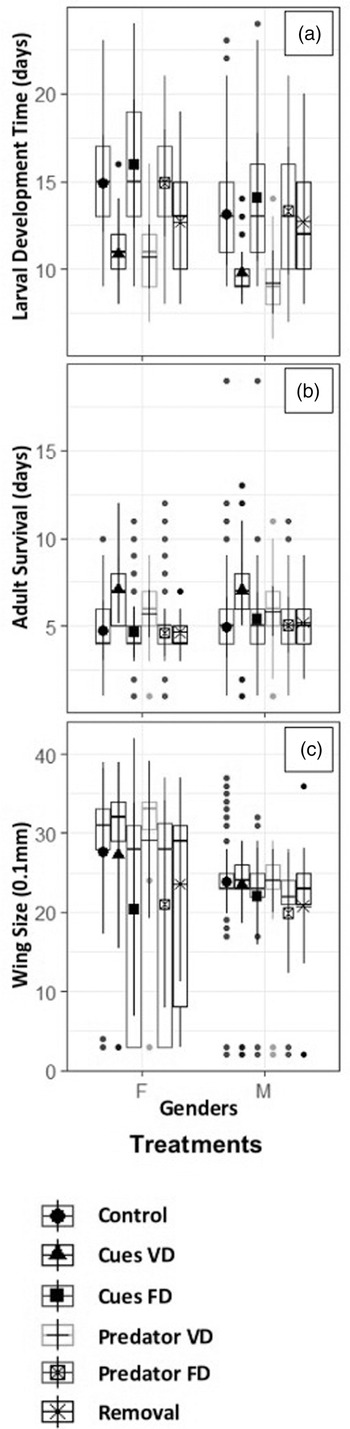
We found significant effects of treatments (GLM; F (5, 3662) = 221.69, P < 0.001), sex (GLM; F (1, 3661) = 223.84, P < 0.001), and the interaction between these factors (GLM; F (5, 3656) = 4.23, P < 0.001) on the larval development time (table 3a). Pairwise tests showed that all treatment groups were significantly different from each other, except in (i) Removal and Predator FD for males; and (ii) Removal between males and females (table MS2). Larval development time was shorter in the Predator VD (9.89 ± 1.85) and Cues VD (10.21 ± 1.43) treatments, and longer in Cues FD (14.86 ± 3.78) and Predator FD (14.06 ± 3.47) treatments. The larval development time was shorter for males (12.73 ± 3.53) and longer for females (14.23 ± 3.51). Larval development time between sexes within treatments was lower for both males and females in the Predator VD treatments (9.23 ± 1.80 and 10.70 ± 1.83, respectively) and Cues VD (9.77 ± 1.23; 10.83 ± 1.48) and higher in the Cues FD treatments (14.06 ± 3.66; 15.96 ± 3.66) and Predator FD (13.29 ± 3.64; 14.92 ± 3.05; fig. 1a).
Responses in larval development time (a), adult survival (b), and wing size (c) of different genders (males and females) to different treatments (Control, Removal, Cues VD, Cues FD, Predator VD, and Predator FD). The boxes represent the quartiles; the black symbols in the horizontal represent the average; the horizontal-colored line represents the median; the vertical line represents the upper and lower limits; and the circles, the extreme values (outliers).

Generalized linear models (GLM) between treatments (Control, Removal, Cues VD, Cues FD, Predator VD, and Predator FD), genders (males and females), and the interaction between these factors for larval development time (a), adult survival (b), and wing size (c)

In addition, orthogonal contrast analyses for treatments and genders; degrees of freedom (DF), residual deviation (Deviation), and values of F and P (Pr > F).
Adult survival and body size
Treatments (GLM; F (5, 3662) = 122.31, P < 0.001), sexes (GLM; F (5, 3662) = 58.27, P < 0.001), and the interaction between these factors (GLM; F (5, 3662) = 4.88, P < 0.001) showed a significant effect on adult survival (table 3b). All treatment groups were significantly different from each other in pairwise tests, except in (i) Removal and Predator FD for males; and (ii) Removal between males and females (table MS3). Adult survival was higher in the Cues VD (7.05 ± 1.75), followed by the Predator VD (5.77 ± 1.40), while the lowest observed value was in the Predator FD treatment (4.83 ± 1.50). Adult survival was higher for males (5.37 ± 1.79) and lower for females (4.97 ± 1.65). Adult survival was greater for both males and females in the Cues VD treatment (7.04 ± 1.62; 7.05 ± 1.93, respectively), followed by the Predator VD treatment (5.84 ± 1.42; 5.68 ± 1.37), while the lowest value observed was that of the Predator FD treatment (5.03 ± 1.59; 4.62 ± 1.36; fig. 1b).
Also, we found significant effects of treatments (GLM; F (5, 3660) = 45.35, P < 0.001), sexes (GLM; F (1, 3659) = 31.60, P < 0.001), and the interaction between these factors (GLM; F (5, 3654) = 12.09, P < 0.001) on adult size (table 3c). Pairwise tests demonstrated that all treatment groups were significantly different from each other, except in (i) Removal and Predator FD for males; and (ii) Removal between males and females (table MS4). Adults in the Predator VD treatment were largest (2.80 ± 0.46), followed by the Cues VD treatment (2.76 ± 0.45), while the lowest values occurred in the Predator FD (2.62 ± 0.43) and Cues FD treatments (2.63 ± 0.40). Females were larger (3.09 ± 0.25) and males smaller (2.36 ± 0.25). Adult size was highest for both males and females in the Predator VD treatments (2.45 ± 0.21; 3.24 ± 0.26, respectively), followed by the Cues VD treatment (2.43 ± 0.22; 3.21 ± 0.25), while the lowest values were observed in the Predator FD (2.25 ± 0.20; 3.02 ± 0.21) and Cues FD (2.34 ± 0.20; 3.03 ± 0.22; fig. 1c) treatments.
Direction and effect size
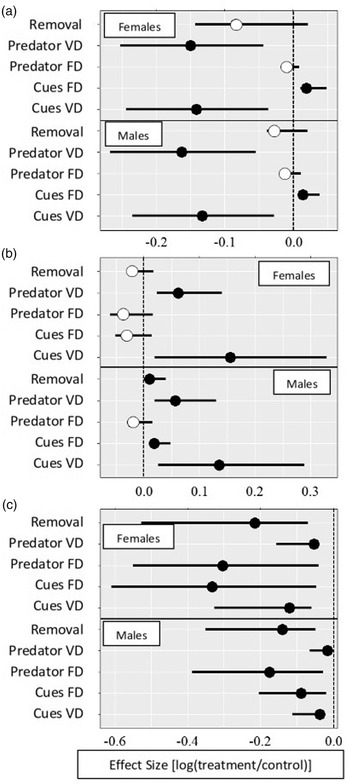
We observed a negative effect of approximately 15% in relation to control in Predator VD and Cues VD treatments in both sexes on larval development time. Removal and Predator FD treatments had a small and non-significant negative effect. Only the Cues FD treatment had a small positive and significant effect on the larval development time (fig. 2a). The analysis of adult survival indicated a positive and significant effect of nearly 15% in the Cues VD treatment, and about 7% in the Predator VD treatment compared to the control for females and males. Males still had a small positive and significant effect in the Removal and Cues FD treatments, contrary to what was observed in females. Both sexes showed small negative and non-significant values in the Predator FD treatment (fig. 2b). Finally, when assessing the adult size, all treatments had a negative and significant effect. Females were the most negatively affected, mainly in the Predator FD and Cues FD treatments. These treatments were about 30% less compared to the Control. In males, the treatments that most differed from the control were Predator FD and Removal, with approximately 18% less compared to the Control (fig. 2c).
Size and direction of the effect of larval development time (a), adult survival (b), and wing size (c) expressed by the logarithmic relationships between the different treatments (Removal, Cues VD, Cues FD, Predator VD, and Predator FD) and their respective Controls in different genders (males and females). Circles are the means, and the dark black lines are the upper and lower limits of the non-parametric bootstrapped analysis with 95% confidence intervals. Closed circles represent intervals that reject the null hypothesis (i.e. they do not touch the 0 line of the effect size and are therefore significant), and open circles represent intervals that do not reject the null hypothesis (i.e. they touch the 0 line of the effect size and are therefore not significant).

Discussion
Larval development vs. adult size and survival
Both the presence of predator and predation cues decreased larval development time, mainly in males, while lethal (consumptive) effects decreased larval density, and consequently, the intraspecific competition for space and resources (Abrams, Reference Abrams2009). Predation cues may also increase organic matter content and nutrient availability through organic fluids released during the act of predation, which may increase nutrient content for microorganisms (Merritt et al., Reference Merritt, Dadd and Walker1992; Albeny-Simões et al., Reference Albeny-Simões, Murrell, Elliot, Andrade, Lima, Juliano and Vilela2014). This, in turn, may enhance microorganism abundance, increasing mosquito larval food availability and accelerating larval development (Merritt et al., Reference Merritt, Dadd and Walker1992). Male larvae develop faster and emerge before female larvae (Kleckner et al., Reference Kleckner, Hawley, Bradshaw, Christina, Holzapfel and Fisher2016). Sex-specific differences in development rate and time (protandry) has been observed in insects systems where females are monogamous (Kleckner et al., Reference Kleckner, Hawley, Bradshaw, Christina, Holzapfel and Fisher2016). This process may also alter the size and survival of individuals who manage the escape to the aquatic system (Bellamy and Alto, Reference Bellamy and Alto2018). In this way, biological control by predation may not be as efficient for Ae. aegypti larvae in environments with low input of organic matter (Merritt et al., Reference Merritt, Dadd and Walker1992; Albeny-Simões et al., Reference Albeny-Simões, Murrell, Elliot, Andrade, Lima, Juliano and Vilela2014).
Predator presence and predation cues increased adult size, especially in females. Nutrition assimilated in the early stages of larval development is allocated for structural growth (Padmanabha et al., Reference Padmanabha, Correa, Legros, Nijhout, Lord and Lounibos2012). Resource allocation in larval early stages drives metamorphosis in insects generally (Plaistow et al., Reference Plaistow, Lapsley, Beckerman and Benton2004) and influences the size of adult mosquitoes (Chandrasegaran et al., Reference Chandrasegaran, Rao Kandregula, Quader and Juliano2018). Female mosquitos are almost always larger than the males due to greater energy needs to invest in reproduction (Wormington and Juliano, Reference Wormington and Juliano2014). This increased adult size may increase body energy reserve and vectorial capacity through increased egg production and reproductive success (LEA et al., Reference Lea, Briegel and Lea1978). Counterintuitively, larger body size can also mean a reduction in population vectorial capacity, as observed in other studies (Alto et al., Reference Alto, Lounibos, Higgs and Juliano2005; Bevins, Reference Bevins2008).
Predator presence and predation cues increased adult survival, especially in males. Adult insects expend energy constantly and may accumulate reserves in periods or high resource availability (Arrese and Soulages, Reference Arrese and Soulages2010). Therefore, the life span of adults is directly related to the amount of food that is consumed and stored (Lea et al., Reference Lea, Briegel and Lea1978; Arrese and Soulages, Reference Arrese and Soulages2010). Nutrient availability is positively correlated with body size (Reiskind and Lounibos, Reference Reiskind and Lounibos2009). Since males are smaller than females due to differential investment of energy for reproduction, male mosquitoes have lower energy expenditure (Briegel et al., Reference Briegel, Knusel and Timmermann2001). Thus, they can survive longer with lower resource input and energy stores (Dittmer and Gabrieli, Reference Dittmer and Gabrieli2020). The increased longevity may allow male mosquitoes additional opportunities for copulation (Alto et al., Reference Alto, Lounibos, Higgs and Juliano2005; Bevins, Reference Bevins2008).
Direction and effects size
The negative effect on larval development time and adult size in tandem with a positive effect on adult survival in the Predator VD and Cues VD treatments for both sexes demonstrates the combined effects of density reduction by predation and increase in organic matter content due to predator cues (Preisser et al., Reference Preisser, Bolnick and Benard2005, Reference Preisser, Bolnick and Grabowski2009). These dynamic responses of early maturation to habitat escape due to the increased probability of predation result in improved performance of the remaining individuals (Bellamy and Alto, Reference Bellamy and Alto2018; Ower and Juliano, Reference Ower and Juliano2019). High levels of mortality in early larval stages increase individual fitness of the survivors (e.g. size or adult life time; Bellamy and Alto, Reference Bellamy and Alto2018) due to changes in population density and available resources (Mcintire and Juliano, Reference Mcintire and Juliano2018).
The positive effect on larval development time and negative effect on adult size resulted in higher survival in males in the Cues FD treatment. This can be explained by the high larval densities. Low nutrition levels with high intraspecific competition may delay larval development (Bellamy and Alto, Reference Bellamy and Alto2018; Chandrasegaran et al., Reference Chandrasegaran, Rao Kandregula, Quader and Juliano2018). The quality and quantity of the nutrients used by prey, associated with the plastic responses of predator presence may result in marked development impairment, with a high number of smaller adults (Bellamy and Alto, Reference Bellamy and Alto2018; Ower and Juliano, Reference Ower and Juliano2019). In addition, adult longevity in mosquitoes is positively correlated with quantity and quality of nutritional reserves and body size (Reiskind and Lounibos, Reference Reiskind and Lounibos2009; Arrese and Soulages, Reference Arrese and Soulages2010).
The Removal treatment resulted in a reduced adult size and increased longevity in males. This effect can also be explained by density reduction that increases the availability of resources (Bellamy and Alto, Reference Bellamy and Alto2018). Although the expected was not to have small individuals for this treatment, smaller individuals (specially males) but with more energetic reserves can live more with the same amount of energy, as discussed above. Predator FD treatment effect was negative only for the adult size. Predator tracks associated with low nutrition levels and high intraspecific competition compromise the adult size of the individuals (Bellamy and Alto, Reference Bellamy and Alto2018; Chandrasegaran et al., Reference Chandrasegaran, Rao Kandregula, Quader and Juliano2018). As discussed by Altwegg (Reference Altwegg2003) altering behavior by dynamically responding to the presence of enemies in a resource-limited environment tends to be less physiologically challenging than surviving in low-nutrient, high-density environments.
Conclusion
This study mimics the natural environment to test general principles of the role of predators in regulating prey populations. We found that multiple factors, such as nutrient input, density-dependent effects, and predation rates affect larval development time, body size, and survival of resulting adults. The Predator VD and Cues VD treatments showed the shortest larval development time with the largest adults and the longest life span, probably due to the increase in the amount of organic matter associated with larval density reduction. Furthermore, males were less impacted by density effects for the three response variables, probably due to Ae. aegypti being a protandric species. Therefore, under the conditions in which this work was carried out, the results suggest that biological control by predation can be favorable to the vector under some density and nutrient conditions and may not be effective in reducing the resulting adult mosquito population. However, the authors note that few dragonfly species can survive and thrive in urban environments due to their sensitivity to environmental impacts (Bybee et al., Reference Bybee, Córdoba-Aguilar, Duryea, Futahashi, Hansson, Lorenzo-Carballa, Schilder, Stoks, Suvorov, Svensson, Swaegers, Takahashi, Watts and Wellenreuther2016). Although they are more common in natural areas, they can survive in well-preserved urban areas (Bybee et al., Reference Bybee, Córdoba-Aguilar, Duryea, Futahashi, Hansson, Lorenzo-Carballa, Schilder, Stoks, Suvorov, Svensson, Swaegers, Takahashi, Watts and Wellenreuther2016). Similarly, the acknowledgment that the applied methodology does not allow us to demonstrate whether there is selective predation (Walsh and Reznick, Reference Walsh and Reznick2009). For this, morphometric analyses, which are more precise than the allometric measurements in this study, would be necessary to detect phenotypic differences (Slice, Reference Slice2007).
Supplementary material
The supplementary material for this article can be found at https://doi.org/10.1017/S000748532200027X
Acknowledgements
UNIEDU/FUMDES provided financial support for this project through a master research fellowship to GDC. CNPq provided financial support for this project through an undergraduate research fellowship to TSL and GHM.